
Key Takeaways
- No single therapy outperforms the others — effective recovery combines detox when needed, behavioral therapy, peer support, mental health care, and family involvement matched to your situation 1.
- Large trials like Project MATCH and the VA study show CBT, 12-step facilitation, and motivational approaches produce similar outcomes, so engagement and fit matter more than picking a winning method 5, 6.
- Treating depression, anxiety, or trauma alongside substance use through integrated care produces better results than handling either condition in isolation or sequentially 11, 12.
- Match care intensity — outpatient, intensive outpatient, or residential — to four honest variables: severity of use, co-occurring conditions, stability of home environment, and readiness to change 10.
The honest answer about what works
If you’re reading this, something has probably already broken open. Maybe a bad weekend, a hard conversation, a doctor’s visit that didn’t go the way you hoped. You want to know what actually helps — not a sales pitch, not a slogan, just the truth about what to do next.
Here it is, as plainly as we can say it: there is no single treatment that beats all the others. What works is a small stack of well-matched pieces — a medically supervised detox when your body needs one, talk therapy that teaches you real skills, a recovery community that keeps showing up, care for whatever depression or anxiety is riding along, and family involvement when that’s possible. National guidance from the National Institute on Drug Abuse says the same thing: effective care usually combines behavioral therapies with medical management and treats co-occurring conditions at the same time, not one after the other 1.
That’s the frame for everything that follows. You don’t have to pick the “right” therapy off a menu. You have to figure out which combination fits your body, your history, and the life you’re trying to build. The rest of this article walks you through the pieces, what the research actually shows, and how to tell which path fits where you are right now.
What the research actually says about ‘best’ treatment
You’ve probably seen programs online that promise their method is the one that works. That’s not what the research shows. When you line up the biggest studies side by side, the picture is quieter and more useful: several approaches help, and none of them clearly wins.
Project MATCH — a landmark trial that compared 12-step facilitation, cognitive behavioral therapy, and motivational enhancement therapy — found that all three produced positive outcomes, with only a slight edge for 12-step facilitation over the three years that followed 6. In a much larger Department of Veterans Affairs study of 3,018 patients followed for one year, 12-step, CBT, and combined 12-step/CBT programs all produced similar improvements in substance use and daily functioning, with 12-step showing a small advantage on abstinence rates 5. Same story from two different angles: the therapies work, and they work at roughly the same level.
A 2023 meta-review that pulled together dozens of systematic reviews landed in the same place. The gains from psychological therapies are real but usually small to moderate, and the gaps between one modality and another are modest 3. That’s not bad news. It means you don’t have to find the magic method. It means the method matters less than whether you actually engage with it, stay in it long enough, and match it to what your life needs.
The four active ingredients shared by therapies that work
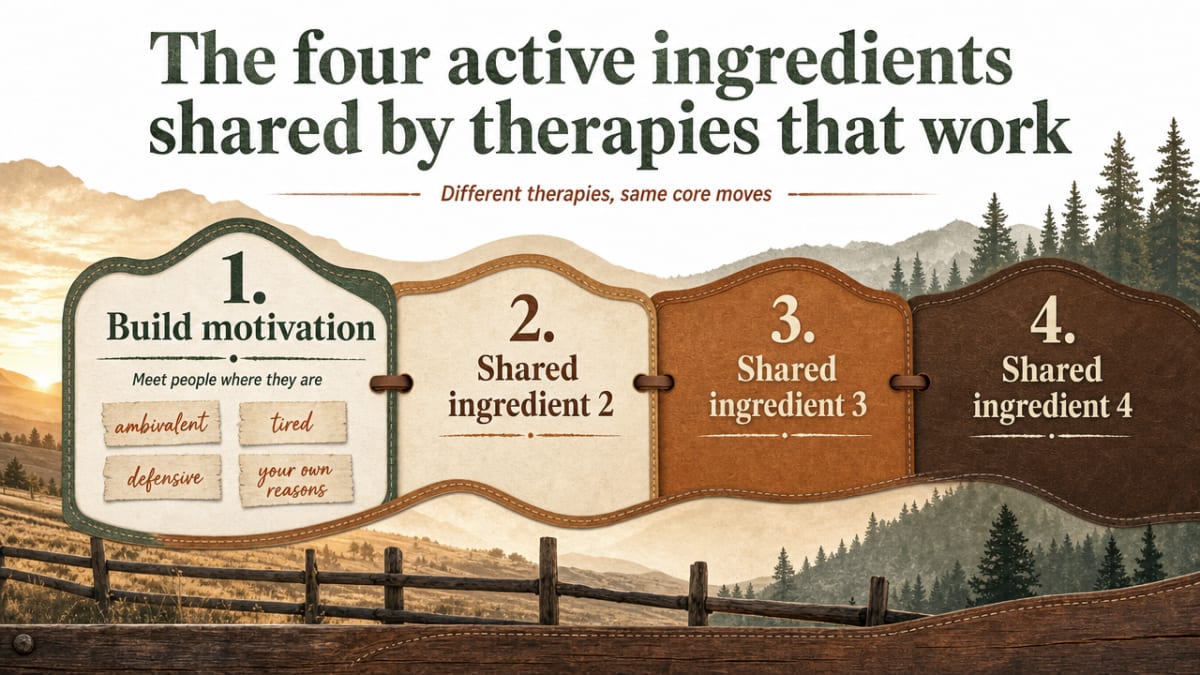
Here’s something that helps make sense of the research: when you look under the hood of the therapies that actually help people, they’re not doing wildly different things. They share the same core moves. Researchers who studied motivational interviewing, 12-step facilitation, cognitive behavioral therapy, and contingency management side by side found four common threads running through all of them 4. That’s why a 12-step program and a CBT program can produce similar results — they’re pulling on the same levers, just with different hands.
The first ingredient is building motivation. Almost no one walks into treatment feeling one hundred percent ready to change. Good therapy meets you where you actually are — ambivalent, tired, maybe a little defensive — and helps you find your own reasons to keep going. Not someone else’s reasons. Yours.
The second is learning coping skills. This is the practical stuff. What do you do at 9 p.m. on a Saturday when the craving hits? How do you handle a family dinner where someone’s drinking? Coping skills are the small, teachable moves that get you through the moments where willpower alone won’t hold.
The third is changing your social network. The people around you shape what feels normal. Therapies that work help you spend more time with people who support your recovery and less time in the settings that pulled you under. This is one of the reasons residential care can help — it interrupts the old network long enough to build a new one.
The fourth is reinforcing abstinence. Every sober day needs to count for something, whether that’s a chip at a meeting, a check-in with a counselor, or the quiet feeling of waking up clear-headed. Recovery is built from repetition, and repetition needs reward.
Notice what’s not on this list: a specific slogan, a specific book, a specific method. When you’re comparing programs, look for whether they’re doing these four things well — not whether they’ve branded them cleverly.
The pieces of care, one at a time
Medically supervised detox: when the first week is the dangerous week
If you’ve been drinking heavily every day, or using benzodiazepines, or running on opioids for a long stretch, quitting cold on your own can put you in real medical danger. Alcohol withdrawal in particular can cause seizures. This is not a willpower problem. It’s a body chemistry problem, and it deserves medical eyes on it.
Medically supervised detox means nurses checking your vitals, medications to soften the worst of the withdrawal, and a bed where you can sleep and eat while your body resets. It usually takes anywhere from a few days to about a week, depending on what you were using and how long. National guidance treats detox as the doorway to treatment, not treatment itself — getting the substance out of your system is step one, and the actual recovery work starts once your head is clear enough to do it 1.
Making it through detox is a real thing. It’s the first stretch of sober days you’ve had in a while, and it counts.
CBT and relapse prevention: spotting triggers before they spot you
Cognitive behavioral therapy — CBT — is the talk therapy most often described as the workhorse of addiction care. In plain terms, it’s a structured conversation with a counselor about the thoughts, feelings, and situations that lead you to use, and what you can do differently when you spot them coming 2.
A good CBT session sounds less like a lecture and more like reverse-engineering a bad night. What time did the craving start? Who were you with? What were you telling yourself right before you picked up? Once you can see the pattern, you can plan around it. That’s relapse prevention: a real, written plan for the Friday afternoons, the fights with your partner, the drives past the old bar.
The 2023 meta-review of psychological therapies found CBT produces small to moderate benefits over no treatment, in line with other evidence-based approaches 3. It won’t make cravings vanish. It will give you something to do when they show up.
Motivational interviewing: starting where you actually are
Almost nobody arrives at treatment with a clean, confident yes. You want to stop, and you also don’t. You know it’s hurting you, and you can list five reasons it’s the only thing that helps. That mix is normal. It’s also where motivational interviewing starts.
Motivational interviewing is a conversation style counselors use to help you talk through your own reasons for changing, instead of arguing you into it 2. Nobody wags a finger. The counselor asks questions that let you hear yourself out loud — what you want, what you’re afraid of, what you’ve already tried.
It sounds soft. It isn’t. Enhancing your own motivation is one of the core active ingredients that shows up across the therapies that actually work 4. When your reasons are yours, they hold up better on the hard days.
12-step facilitation: a room full of people who get it
12-step facilitation is the structured version of getting you connected to AA, NA, or a similar fellowship, and helping you actually work the steps with a sponsor. It’s not the same as being handed a meeting list. A counselor walks with you into it.
The evidence for 12-step is stronger than a lot of people assume. In a Department of Veterans Affairs study of 3,018 patients followed for one year, 12-step, CBT, and combined programs produced similar improvements in substance use and daily functioning, with 12-step showing a small edge on abstinence rates 5. That’s a real finding from a large sample, and it’s why most reputable residential programs still build 12-step work into their week.
What you get from a good meeting is hard to price. A room of people who know exactly what a 3 a.m. craving feels like. A sponsor who picks up the phone. A place to go on the nights when the house is too quiet.
Contingency management: small rewards, real engagement
Contingency management is a straightforward idea that sounds odd until you see it work: you get a small tangible reward — a voucher, a prize draw, a modest gift card — for each clean drug test or each session attended. It’s built on the fact that early recovery is often unrewarding, and the brain needs something to count each sober day against.
In a trial of people with cocaine dependence, contingency management produced significantly better in-treatment results than CBT alone, while CBT held its own on longer-term outcomes 7. Interestingly, a systematic review found that piling additional formal psychotherapy on top of contingency management didn’t clearly improve its effects 8. Contingency management does what it does best: it gets people to show up and stay engaged when engagement is the whole battle.
Family therapy: bringing the people you live with into the work
Addiction doesn’t happen inside one person. It happens inside a house, a marriage, a group of siblings, a set of routines. So when treatment involves the people you live with, the results tend to be better — not as a nice extra, as an actual clinical intervention with evidence behind it.
Reviews of family-based approaches find that involving family members can improve engagement in treatment, reduce substance use, and lift overall functioning 13. That happens through some specific mechanisms: family members learn what enabling looks like versus what support looks like, old resentments get a room to be spoken in, and everyone gets on the same page about what home is going to be like when you come back.
Programs that run a dedicated family week — a few days of joint sessions, education, and honest conversation — are trying to do exactly this. If your family is willing to come, take them up on it. It gives your recovery a place to land.
Equine and experiential therapy: honest about what it is and isn’t
Working with horses in recovery sounds like a marketing gimmick until you’ve actually stood next to a thousand-pound animal that will not move for you until you calm your breathing. Experiential therapies — equine work, hiking, art, music, ropes courses — put you in a real situation where the emotions come up in your body and you have to handle them without a drink or a pill.
Here’s the honest part. A 2022 systematic mapping review of equine-assisted services for substance use disorders concluded that the evidence is inconclusive, largely because there aren’t enough rigorous trials with big enough samples 9. Anyone selling equine therapy as a proven cure is overstating it.
What experiential work does well is keep you engaged. It gives you a reason to get out of bed when the group room feels like too much. It builds moments you remember. Treat it as a supportive piece of a larger plan, not the plan itself, and it earns its place.
When depression, anxiety, or trauma are part of the picture
For a lot of people, the drinking or the using didn’t come out of nowhere. It sat on top of something else — a depression that never quite lifted, an anxiety that made a drink feel like the only off switch, a trauma you’ve never really told anyone about. If that’s your situation, you’re not unusual. And it changes what good treatment looks like for you.
The old approach was to treat the substance use first and deal with the mental health stuff later. That approach doesn’t hold up. A meta-analysis of treatments for co-occurring depression and substance dependence found that integrated care — treating the depression and the substance use at the same time, with therapy and, when appropriate, antidepressant medication — produces better outcomes than treating either condition alone 11. For people carrying more serious mental illness alongside a substance use disorder, reviews of integrated dual-diagnosis programs show better engagement and modest improvements in substance use outcomes compared with care that keeps the two problems in separate lanes 12.
What this means for you is practical. When you’re looking at a program, ask whether they can actually treat what you’re bringing in the door — not just the drinking or the pills, but the sleepless nights, the panic, the memory that won’t stay put. A program with a psychiatrist on staff, counselors trained in trauma, and medications available when they help is doing the job the research points to.
How to match a path to your situation
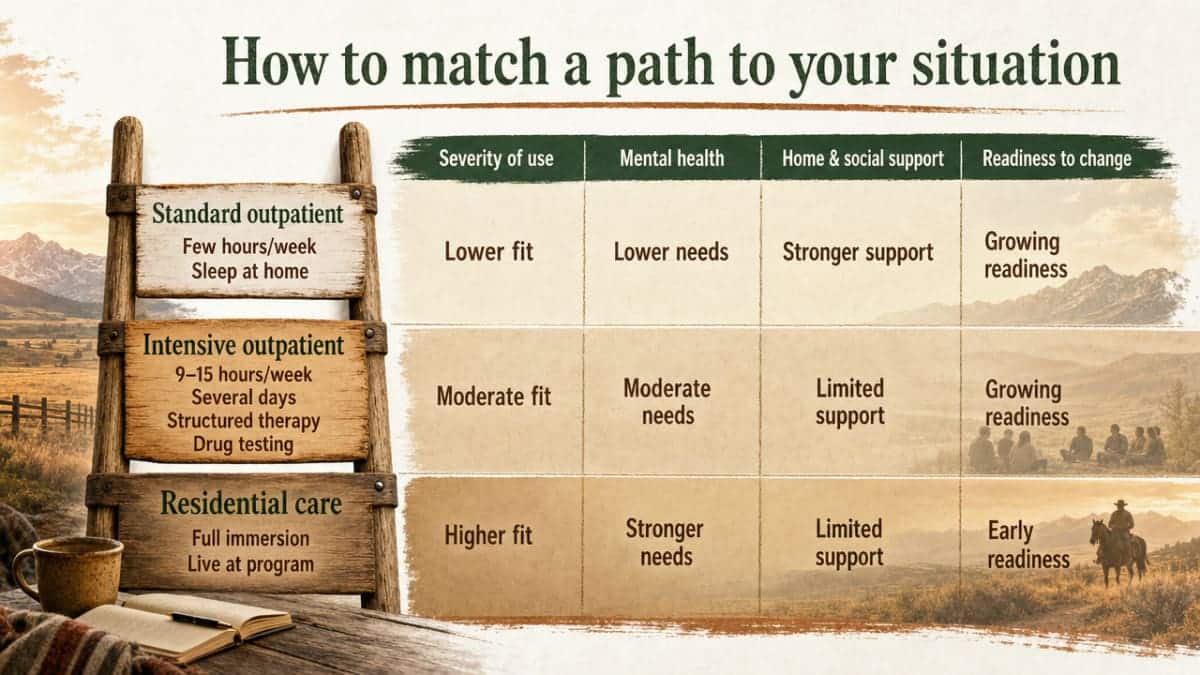
Since no single therapy clearly beats the others, the real question isn’t which method wins — it’s which level of care fits the life you actually live. Researchers who study treatment matching point to four patient-side variables that should drive that call:
- how severe your substance use has become,
- whether you’re carrying a co-occurring mental health condition,
- what your home and social support look like, and
- how ready you are to change 10.
Those four things, honestly answered, tell you more than any brochure will.
Think of care intensity as a ladder with three main rungs. Standard outpatient means a few hours a week — a counselor, maybe a group, and you sleep at home. Intensive outpatient is more like nine to fifteen hours a week, several days on, with structured therapy and drug testing. Residential care is full immersion: you live at the program for 30, 60, or 90 days, and the whole day is built around getting well.
Here’s how the four variables sort you. If your use is severe, if you’ve been drinking heavily every day or running opioids for months, higher intensity is safer. If you’re carrying depression, anxiety, or a trauma history alongside the substance use, you need a setting that can treat both at once, which usually means intensive outpatient or residential. If home is stable — a partner who’s sober, a job that supports recovery, a bedroom that isn’t across the hall from your using buddies — outpatient can work. If home is where the using happens, residential buys you distance you can’t create any other way. And readiness matters: if you’re still on the fence, a more structured setting can hold you long enough for motivation to catch up 10.
None of this is a moral judgment. It’s a matching problem. The goal is to pick the rung of the ladder that gives you the best chance of actually finishing what you start.
When residential care is the right call
Residential treatment isn’t the right answer for everyone, and it isn’t a failure to start somewhere lighter. But there are situations where living at a program for 30, 60, or 90 days gives you something no other level of care can — distance, structure, and a full day built around getting well.
You should think seriously about residential care if any of these are true for you:
- Your withdrawal will be medically risky and you need eyes on you around the clock.
- You’ve tried outpatient before and it didn’t hold.
- The people and places at home are tightly wound around your using — the roommate who drinks with you, the drawer where the pills are, the drive home that passes the liquor store.
- You’re carrying depression, anxiety, or trauma alongside the substance use, and you need a setting that can treat both at once 10.
- Or your motivation is fragile enough that you know, honestly, you won’t show up to a 6 p.m. group after a hard workday.
What residential care gives you is a reset. A month or three where the only job is your recovery, with counselors who’ve usually walked this road themselves. That’s not a small thing. For a lot of people, it’s what finally makes the difference.
What to ask before you commit to a program
Before you sign anything or pack a bag, you’re allowed to interview the program. A good one will welcome the questions. Here’s what actually matters.
Which evidence-based therapies do you use, and how often? You want to hear specific answers — CBT groups, individual counseling, motivational work, 12-step facilitation — not just “personalized care.” National guidance points to combining behavioral therapies with medical management and treating co-occurring conditions at the same time 1.
Who’s on staff, and can you treat both the substance use and the mental health side? If depression, anxiety, or trauma are part of your story, ask whether a psychiatrist is available and whether counselors are trained in integrated dual-diagnosis care.
How do you involve family? Is there a dedicated family week, or is it optional and vague?
What happens after I leave? Ask for specifics — weekly check-ins, alumni groups, follow-up calls at 30, 60, and 90 days. The month after discharge is when a lot of people slip, and a real aftercare plan is not a nice extra.
Frequently Asked Questions
Is medically supervised detox actually necessary, or can I quit on my own?
It depends on what you’ve been using and how much. Heavy daily drinking or long‑term benzodiazepine use can cause seizures during withdrawal, and quitting cold on your own can be genuinely dangerous. Opioid withdrawal is rarely deadly but is miserable enough that most people relapse to stop it. A medically supervised detox keeps you safe and sets up the actual treatment work that follows 1.
How long does treatment need to last to actually work?
Longer stays generally give recovery more room to take hold, which is why residential programs commonly run 30, 60, or 90 days. What matters more than the exact number is that the length fits your severity, home situation, and any co‑occurring conditions 10. Recovery doesn’t end at discharge either — the months of aftercare that follow are part of the treatment, not a bonus.
What’s the difference between inpatient, intensive outpatient, and standard outpatient care?
Standard outpatient is a few hours a week — a counselor, maybe a group — while you live at home and work. Intensive outpatient runs nine to fifteen hours a week across several days, with structured therapy and drug testing. Inpatient (residential) means you live at the program for 30 to 90 days and the whole day is built around recovery. Higher severity usually calls for higher intensity 10.
Does my family have to be involved in treatment?
They don’t have to be, but the research is clear that involving them helps. Family‑based interventions can improve engagement, reduce substance use, and lift overall functioning 13. If your family is willing to come to a family week or joint sessions, it’s worth saying yes. If they aren’t, treatment still works — you’ll just do more of the relationship work in individual counseling.
What happens after I leave a residential program?
The month after discharge is when a lot of people slip, so good programs build a real aftercare plan before you go. That usually looks like weekly Zoom groups, an alumni community you can call into, ongoing individual counseling, local meetings on your calendar, and follow‑up check‑ins at 30, 60, 90, 180, and 365 days. Recovery is easier when you don’t have to build the scaffolding alone.
What if I’ve been to treatment before and relapsed?
You’re not back at zero. Relapse is common in recovery from addiction, the same way it is in other chronic conditions, and each round of treatment usually teaches you something specific about what your triggers actually are. A previous relapse is useful information — it often points toward needing more intensity, better care for co‑occurring depression or anxiety, or a setting further from home 10. Coming back is not failure.
References
- Addiction Treatment. https://nida.nih.gov/nidamed-medical-health-professionals/treatment/addiction-treatment
- Evidence Based Psychosocial Interventions in Substance Use. https://pmc.ncbi.nlm.nih.gov/articles/PMC4031575/
- Meta-review on the efficacy of psychological therapies for the treatment of substance use disorders. https://pubmed.ncbi.nlm.nih.gov/37356250/
- Theory-Based Active Ingredients of Effective Treatments for Substance Use Disorders. https://pmc.ncbi.nlm.nih.gov/articles/PMC1896183/
- Behavioral treatment for substance abuse: a comparison of treatment outcomes and costs. https://pubmed.ncbi.nlm.nih.gov/9086686/
- Chapter 8. Intensive Outpatient Treatment Approaches. https://www.ncbi.nlm.nih.gov/books/NBK64102/
- A comparison of contingency management and cognitive-behavioral therapy for cocaine dependence. https://pubmed.ncbi.nlm.nih.gov/12215081/
- Improving substance misuse outcomes in contingency management treatment with adjunctive formal psychotherapy: a systematic review and meta-analysis. https://bmjopen.bmj.com/content/10/10/e034735
- Equine-assisted services for individuals with substance use disorders: A systematic mapping review. https://pmc.ncbi.nlm.nih.gov/articles/PMC9749232/
- Matching Treatment to Patient Needs in Substance Use Disorders. https://pmc.ncbi.nlm.nih.gov/articles/PMC1896175/
- Treatment of co-occurring depression and substance dependence: Using meta-analysis to guide clinical recommendations. https://pmc.ncbi.nlm.nih.gov/articles/PMC2928226/
- Psychosocial Interventions for Substance Use Disorders in People with Serious Mental Illness. https://pmc.ncbi.nlm.nih.gov/articles/PMC4934468/
- Family-based approaches to substance use disorder treatment. https://pmc.ncbi.nlm.nih.gov/articles/PMC3860461/