Key Takeaways
- North Dakota has 106 licensed SUD programs, but only 37 offer residential care, and roughly 77.62% of adults who needed treatment last year didn’t receive it 3, 4.
- Payment paths shape access: the SUD Voucher covers uninsured residents at 40 participating providers, Medicaid 1915(i) funds wraparound supports, and commercial insurance opens most out-of-state residential doors 4, 12.
- Crossing into Great Falls, Montana becomes practical when in-state beds are waitlisted, detox isn’t handled on-site, or the available level of care sits below what heavy daily drinking requires.
- The next step is a single phone call asking three things: bed availability, whether medically monitored detox happens on-site, and what your coverage or the SUD Voucher will open 4.
When cutting back stops working: where North Dakotans actually stand
You’ve probably tried already. Skipping a night. Switching to beer. Setting rules for yourself that only worked until the weekend, or until the week got hard. If you’re still reading articles like this one at 11 p.m., something inside you already knows the moderation experiment isn’t landing where you hoped. That’s not a character problem. That’s information.
Here’s what the numbers say about the ground you’re standing on. In North Dakota, roughly 20.8% of adults met the criteria for a substance use disorder in the past year, and about 77.62% of adults who needed treatment didn’t get it 3. Read that second number twice. Three out of four people who needed help stayed stuck. Some couldn’t find a bed. Some couldn’t afford the copay. Some picked up the phone, got a voicemail, and never called back. If that sounds familiar, you are in enormous, quiet company.
None of that means the door is closed. It means the door has been harder to find than it should be, and you might have to look in more than one direction, sometimes across a state line.
This guide walks you through what actually exists inside North Dakota, where the honest gaps show up, and how a structured residential program like Rocky Mountain Treatment Center in Great Falls, Montana fits when the in-state options are full, waitlisted, or not intensive enough for where you are right now. No brochure language. No pretending the system is tidier than it is. Just a clearer map, so the next call you make lands somewhere real.

What’s actually available inside North Dakota
The licensed system in plain terms
Here’s the shape of it. As of October 1, 2024, North Dakota had 106 licensed substance use disorder treatment programs. Of those, 37 are licensed for residential treatment, 4 are opioid treatment programs, and the rest — roughly 65 — deliver outpatient care, intensive outpatient, partial hospitalization, day treatment, or DUI seminars 4. That’s the whole map, in one paragraph.
Every one of those programs runs under the Behavioral Health Division of the North Dakota Department of Health and Human Services, which licenses them under state law to make sure staffing, policies, and clinical standards meet federal and state requirements 1, 10. The state uses the American Society of Addiction Medicine (ASAM) levels of care as its shared language. In plain terms, that means programs are sorted by how much structure they provide: from outpatient (a few hours a week) up through intensive outpatient, partial hospitalization or day treatment, intensive inpatient, and low- or high-intensity residential care 2.
Why does the breakdown matter to you? Because it explains why finding a residential bed in North Dakota can feel like the harder path. Only about a third of licensed programs offer any kind of residential care, and those beds are spread across a very large, mostly rural state. Outpatient options are more plentiful, which is great if you’re at a stage where you can keep working and sleeping at home while getting treatment. If you already know outpatient isn’t enough — you’ve tried it, or you’re drinking around the clock, or withdrawal scares you — that thinner residential layer is the reason your search feels tight.
Rocky Mountain Treatment Center’s 26-bed residential program in Great Falls sits inside the same ASAM framework North Dakota uses, so the level of care you’d get there maps cleanly onto what a licensed ND program would call high-intensity residential.

Opioid treatment programs and MOUD in Fargo, Grand Forks, Minot, and Bismarck
If your struggle is only with alcohol, you can skip most of this section — but read the last paragraph, because it matters for how North Dakota thinks about medication in recovery.
North Dakota has four licensed opioid treatment programs, one each in Fargo, Grand Forks, Minot, and Bismarck. As of September 12, 2024, those four OTPs together served 1,125 active participants receiving medications for opioid use disorder — methadone, buprenorphine, and naltrexone — alongside counseling 6. That’s a lot of people leaning on medication to stay stable, and it tells you something honest: in this state, MOUD isn’t a fringe option. It’s a mainstream part of how opioid addiction gets treated.
For alcohol, medications like naltrexone or acamprosate can also play a role, though those aren’t dispensed through OTPs. They’re prescribed through primary care, addiction medicine providers, or residential programs that include a medical component.
Here’s the part that matters if you’re weighing residential care: medically monitored detox comes first for many people with heavy alcohol use, because alcohol withdrawal can be dangerous on its own. Rocky Mountain Treatment Center handles that piece on-site — the first few days of getting through withdrawal safely, with medical staff watching — before the counseling work begins. If a North Dakota program can’t detox you before residential, you’ll need to line that up separately, and that’s one of the friction points worth asking about on your first call.
How people pay: SUD Voucher, Medicaid 1915(i), and private insurance
Money is where a lot of good intentions stall. Let’s walk through the three main paths North Dakotans actually use.
The SUD Voucher program is the state’s answer for people who are uninsured or underinsured. Since it launched in July 2016, roughly 8,650 individuals have been approved for services through the voucher, and as of December 2024 there were 40 participating providers across the state 4. The voucher can cover outpatient counseling, residential treatment, and OTP services at participating programs. It’s not automatic — you apply, you get approved, and then you use it at a provider that takes it. If cost is your biggest barrier to picking up the phone, the voucher is the first door to knock on.
Medicaid’s 1915(i) program is different. It doesn’t pay for the rehab bed itself. It pays for the wraparound supports that keep you stable in the community — care coordination, peer support, help finding housing, transportation, supported employment, family caregiver training, respite 12. Important limit: 1915(i) services are only available in home and community-based settings, which means you can’t use them while you’re in an institution or in jail 12. It’s a valuable layer, but it’s the layer around treatment, not treatment itself.
Private insurance is the third path, and it’s how most people access residential care at a program like Rocky Mountain Treatment Center. Rocky Mountain works with most major insurance providers and can verify your benefits before you commit. Direct heads-up: Rocky Mountain does not currently accept Medicaid or Medicare. If Medicaid is your only coverage, an in-state program that takes it — or the SUD Voucher path — is where to start. If you have commercial insurance through an employer or the marketplace, a call to admissions to check coverage takes about twenty minutes and costs you nothing.
Where the honest gaps show up
The system on paper looks reasonable. The system when you’re the one calling looks different. Here’s where people actually get stuck.
The residential bottleneck. With only 37 residential programs serving a state the size of North Dakota, beds fill up. If you’re calling from a rural county, the closest residential program might be a three-hour drive from your kitchen table 4. Waitlists are real. So is the reality that a bed opening up next Tuesday doesn’t help if you’ve decided today is the day.
The intensity mismatch. Some people call an outpatient program because it’s what’s nearby, and they get accepted into a level of care that’s a step below what their drinking actually calls for. If you’ve been drinking heavily every day, or you’ve tried outpatient before and slid back within weeks, a few counseling hours a week may not hold you.
The detox handoff. Not every residential program in the state does its own medically monitored detox. That means lining up two things instead of one, sometimes at two different addresses, sometimes with a gap in between where old habits fill the space.
The insurance wall. Commercial coverage, Medicaid, the SUD Voucher, and self-pay each open different doors 4, 12. If your coverage doesn’t match the program you want, the answer isn’t giving up — it’s asking the next program which door it opens.
None of these gaps means care isn’t out there. They mean the search sometimes has to widen.
Crossing the Montana line: the Great Falls option
Why a 26-bed residential program looks different from an institutional setting
Picture two waiting rooms. In one, a hallway stretches down toward a hundred beds, and the counselor you meet Monday might not be the counselor you see Thursday. In the other, there are twenty-six beds, one shared kitchen, and the person running your morning group probably knows your dog’s name by the end of week one. Both can help. They feel very different from the inside.
Rocky Mountain Treatment Center in Great Falls, Montana runs the smaller version on purpose. Twenty-six beds means the clinical team isn’t managing a crowd — they’re managing a group small enough to notice when you skip breakfast or go quiet in group. Over 80% of the staff are in recovery themselves. That’s not a marketing line; it changes what the room sounds like. When somebody in group says, “I don’t know how to tell my kids,” the counselor across from them has usually been there.
For a North Dakotan used to small-town scale — where you know the person at the grain elevator and the person at the clinic — the smaller residential environment often lands more comfortably than a 100-plus-bed complex in a bigger city. It’s family-oriented rather than institutional. Doors to counselors’ offices stay open. That’s the practical difference behind the size.
The 30/60/90-day structure and what each stretch is for
People ask, “How long do I need?” The honest answer: longer than you think, and shorter than you fear. Rocky Mountain’s model is built around three lengths of stay, and each one is doing a different job.
- 30 days
- is the reset. The first several days are medically monitored detox — getting through alcohol withdrawal safely with medical staff watching, so your body isn’t fighting you while your head is trying to catch up. After that, you’re into daily individual and group counseling, 12-step meetings, and the beginnings of a plan. Thirty days breaks the cycle. It doesn’t finish the work.
- 60 days
- gives your brain time to settle. Sleep starts to look like sleep again. The cravings that felt like a wall at day 20 start behaving more like weather — they show up, they pass. You have time to work through the harder counseling: the reasons under the drinking, the co-occurring anxiety or depression if that’s part of the picture, the family patterns you’d rather not look at yet.
- 90 days
- is where a lot of long-term recovery gets built. You practice the tools long enough that they become habits instead of assignments. If you’ve relapsed after shorter stays before, 90 days is worth a serious look.
Getting there: complimentary Montana pickup, family week, aftercare
The logistics stop a lot of people. That’s fair — you’re already exhausted, and now you’re supposed to plan a trip across a state line? Rocky Mountain offers complimentary Montana pickup, which for many North Dakota residents means the drive or airport transfer is handled once you’ve committed. One less thing to figure out at the worst possible moment.
The family piece runs alongside the treatment. There’s a three-day Family Week where spouses, adult kids, or parents come out, sit in on education sessions, and do some of the harder conversations with a counselor in the room. If your family is worn down, angry, or just quietly grieving, this is the structured space that keeps recovery from being a solo project.
Aftercare isn’t an afterthought either. There’s a weekly Zoom group so you can keep meeting the people who went through it with you, plus follow-ups at 30, 60, 90, 180, and 365 days after discharge. You go home to North Dakota with a schedule of check-ins already on the calendar — not a certificate and a handshake.
The clinical backbone: 12-step facilitation, and what the evidence actually says
The 12 steps get talked about like tradition, faith, or folklore. That framing shortchanges them. There’s actually a solid body of research behind structured 12-step work — enough that the Cochrane Review, which is about as skeptical a research body as you’ll find, took another hard look at it in 2020.
Here’s what they found. Across 27 studies and 10,565 participants, manualized Alcoholics Anonymous and 12-step facilitation (the clinician-guided version, not just showing up at meetings) improved rates of continuous abstinence at 12 months compared with other clinical approaches like cognitive behavioral therapy. That effect held at 24 months and again at 36 months. The reviewers also concluded that 12-step facilitation probably produces substantial health-care cost savings for people with alcohol use disorder 14. A separate peer-reviewed analysis found that 12-step facilitation improves abstinence partly by getting people to actually engage with mutual-help groups over time — the meetings, the sponsors, the phone calls at the awkward hours 15.
What that means for you, plainly: the 12-step framework isn’t a soft option. When it’s done as structured facilitation inside a residential program — with counselors teaching the steps, not just handing out a book — it holds up against the other leading approaches for keeping people sober past the one-year mark.
This is the backbone at Rocky Mountain Treatment Center. The 30/60/90-day residential program uses 12-step principles as the shared spine of individual counseling, group work, and the community you build with the people going through it beside you. Over 80% of the counseling staff are in recovery themselves, so when they walk you through Step 4 or Step 9, they’re not reading from a manual. They’ve done it. That doesn’t replace medical care for withdrawal, and it doesn’t rule out medication for alcohol cravings when a doctor says it’s the right call. It gives the counseling piece a structure that has been tested and, more often than not, holds.
Equine therapy: promising, not a cure
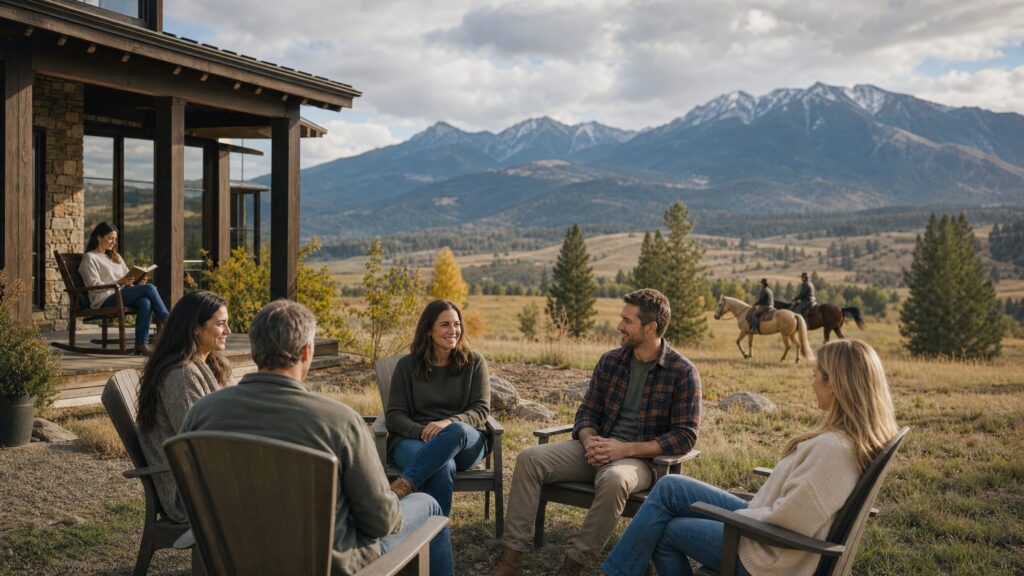
You may have seen the photos: someone with their hand on a horse’s neck, both of them looking calm in a way that’s hard to fake. It’s a real experience, and it’s part of what Rocky Mountain Treatment Center offers alongside the counseling and 12-step work. It’s also fair to ask what the research actually says before you build expectations around it.
Here’s the honest picture. A 2022 narrative review of equine-assisted services for substance use disorders concluded that the evidence base is still limited by small sample sizes and few controlled studies, and that overall effectiveness as an adjunct to SUD treatment is inconclusive 7. A 2024 preliminary study comparing equine-interaction psychotherapy with cognitive behavioral therapy found no significant difference in cortisol, a stress marker, between the two — meaning equine work looked comparable to CBT for short-term stress regulation, not superior to it 8. A pilot replication study inside a VA residential SUD program found the intervention safe, feasible, and associated with short-term benefits across two separate studies 9. An earlier pilot reported improvements in self-reported well-being and treatment engagement 16.
Choosing between in-state and out-of-state care without turning it into a verdict
Somewhere in this process, a question tends to show up like a verdict: Am I the kind of person who has to leave the state to get better? Let that go. It’s not a moral question. It’s a logistics question with a clinical layer on top.
Staying in North Dakota makes sense when the pieces line up. If a licensed program near you has a bed available at the level of care you actually need, takes your coverage or the SUD Voucher, and can either detox you on-site or hand you off cleanly to someone who can, that’s a strong path 4, 10. Being closer to your kids, your job, and the people who love you is worth real weight. Don’t discount it.
Crossing the Montana line makes sense when those pieces don’t line up. If the residential bed you need is weeks out, if the program that takes your insurance is only outpatient, if you’ve tried the closer option once already and it didn’t hold — those are practical signals, not personal failures. Rocky Mountain Treatment Center’s 26-bed program in Great Falls handles medically monitored detox on-site and the residential work in one place, which removes one of the friction points that trips people up in-state.
Two other things to weigh honestly. Distance can be a feature. Some people need physical space between themselves and the bar, the coworker, the neighborhood where every corner is a memory. Distance can also be a burden if your recovery depends on family being close through Family Week and the first months after. Rocky Mountain’s three-day Family Week and complimentary Montana pickup are built with that tension in mind, but you’re the one who knows which pull is stronger for you right now.
Whichever direction you choose, it counts as choosing. That’s the part worth holding onto.
What the first phone call actually sounds like
The hardest part is dialing. Once someone picks up, the call is usually shorter and gentler than you expect.
Here’s roughly how it goes. You’ll be asked what’s going on — not for a life story, just enough to understand what you’re drinking, for how long, and whether you’ve tried treatment before. You’ll be asked about your health, any medications, and whether withdrawal has ever hit you hard. If you have insurance, someone will take that information and check your benefits, usually within the same day. If you don’t, they’ll walk you through what your options are.
You do not need to have your answers together. “I don’t know” is a fine answer. “I’ve been drinking every day and I’m scared” is a fine answer. The person on the other end has heard both a thousand times.
If Rocky Mountain Treatment Center is where you’re calling, admissions can talk you through same-day options, insurance verification, and complimentary Montana pickup from North Dakota. If you’re calling a program inside North Dakota, ask three things:
- is there a bed,
- do they do medically monitored detox on-site, and
- what does your coverage or the SUD Voucher open 4.
That’s the whole call. You already know how to do the hard part — you just read this far.

Frequently Asked Questions
Does North Dakota have residential alcohol rehab, or do most people go out of state?
Yes, North Dakota has residential care. As of October 2024, 37 of the state’s 106 licensed SUD programs offered residential treatment 4. That’s real capacity, but it’s spread thin across a large, mostly rural state, so beds fill up and waitlists happen. Some people stay in-state and wait. Others cross a state line to get a bed sooner or at a level of care that fits.
How do I pay for rehab if I live in North Dakota and don’t have great insurance?
Start with the SUD Voucher. Since July 2016, roughly 8,650 North Dakotans have been approved for services through it, and 40 providers participated as of December 2024 4. It can cover outpatient, residential, or OTP care at participating programs. If you have Medicaid, the 1915(i) benefit adds wraparound supports like peer support and transportation in community settings 12. Commercial insurance is the main path into out-of-state residential programs.
Does Rocky Mountain Treatment Center in Great Falls accept Medicaid or Medicare?
No. Rocky Mountain Treatment Center does not currently accept Medicaid or Medicare. It works with most major commercial insurance plans and can verify your benefits before you commit. If Medicaid is your only coverage, an in-state North Dakota program that accepts it, or the SUD Voucher pathway with a participating provider 4, is where to start. It’s better to hear that clearly now than after a long phone call.
How far is Great Falls, Montana from Fargo, Bismarck, or Minot, and how would I get there?
Great Falls sits west of North Dakota along I-94 and US-2. From Bismarck it’s roughly a 7-hour drive; from Minot, closer to 6 hours; from Fargo, about 10. Rocky Mountain Treatment Center offers complimentary Montana pickup, which for many North Dakota residents means the transfer is coordinated once you’ve committed. You don’t have to plan the trip alone. Admissions can walk you through the logistics on the first call.
Is 30 days enough, or do I need 60 or 90 days of residential treatment?
Thirty days breaks the cycle and gets you through detox and early counseling. Sixty gives your brain time to settle and the deeper work to land. Ninety is where a lot of long-term recovery gets built, especially if shorter stays haven’t held before. There’s no single right answer. If you’ve relapsed after 30 days more than once, a longer stay is worth honest consideration. Admissions can help you decide.
Does equine therapy actually work for alcohol addiction?
The honest answer: it helps some people engage, but it isn’t proven to be the reason people get sober. A 2022 review found the evidence base is still limited and overall effectiveness inconclusive 7. A 2024 study found no significant difference in cortisol between equine psychotherapy and CBT 8. A VA pilot found it safe, feasible, and linked to short-term benefits 9. Think of it as a meaningful adjunct, not the treatment itself.
References
- Addiction | Health and Human Services North Dakota. https://www.hhs.nd.gov/behavioral-health/addiction
- Licensed Addiction Treatment Programs in North Dakota (Provider Book, updated). https://www.hhs.nd.gov/sites/www/files/documents/BH/Licensing%20Provider%20Book.pdf
- North Dakota Behavioral Health Data Book, 2024 (legislative testimony excerpt). https://ndlegis.gov/assembly/69-2025/testimony/HAPPHUM-1012-20250116-29764-F-SAGNESS_PAMELA.pdf
- North Dakota Substance Use Disorder Voucher and Treatment Capacity Testimony, 2025. https://ndlegis.gov/assembly/69-2025/testimony/HAPPHUM-1012-20250116-29768-F-SAGNESS_PAMELA.pdf
- Licensed Addiction Treatment Programs in North Dakota (Provider Book, November 2022). https://www.hhs.nd.gov/sites/www/files/documents/2022.11%20Provider%20Book.pdf
- North Dakota Opioid Treatment Programs and MOUD Utilization (Committee Presentation). https://ndlegis.gov/sites/default/files/pdf/committees/68-2023/25.5120.02000presentation0130c.pdf
- Equine-assisted services for individuals with substance use disorders. https://pmc.ncbi.nlm.nih.gov/articles/PMC9749232/
- Cortisol concentrations in substance use disorder patients undergoing short-term psychotherapy incorporating equine interaction compared to cognitive behavioral therapy: A preliminary study. https://pubmed.ncbi.nlm.nih.gov/39384121/
- A Pilot Replication Study of Implementing an Equine-Assisted Services Program Within a VA Residential Substance Use Disorder Treatment Program. https://pubmed.ncbi.nlm.nih.gov/37522743/
- Licensing | Health and Human Services North Dakota. https://www.hhs.nd.gov/behavioral-health/licensing
- North Dakota Century Code Chapter 50‑31: Substance Abuse Treatment Programs. https://ndlegis.gov/cencode/t50c31.pdf
- North Dakota Medicaid 1915(i) State Plan Amendment – Billing and Policy Manual (Updated October 2025). https://www.hhs.nd.gov/sites/www/files/documents/medicaid-policies/1915i-medicaid-state-plan-amendment.pdf
- NSDUH Behavioral Health Barometer: North Dakota, Volume 8. https://www.samhsa.gov/data/report/nsduh-behavioral-health-barometer-north-dakota-volume-8
- Alcoholics Anonymous and Other 12‑Step Programs for Alcohol Use Disorder (Cochrane Review, 2020). https://pmc.ncbi.nlm.nih.gov/articles/PMC7065341/
- Effectiveness of 12-Step Facilitation in Treating Substance Use Disorders. https://www.ncbi.nlm.nih.gov/pmc/articles/PMC4311235/
- Equine-Assisted Therapy for Substance Use Disorders: A Pilot Study. https://pubmed.ncbi.nlm.nih.gov/26033895/