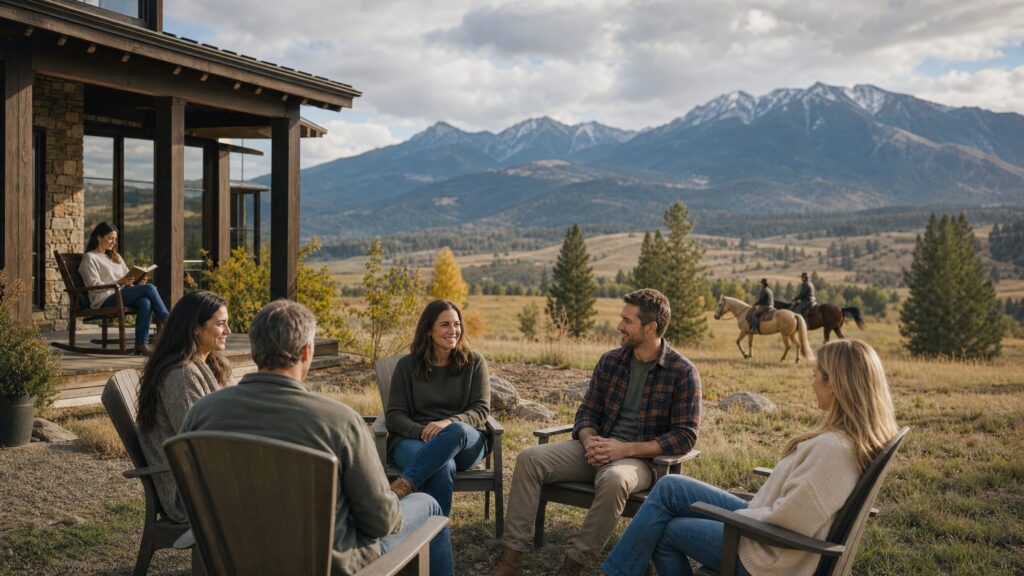
Key Takeaways
- Whole-person recovery rests on the biopsychosocial-spiritual model, addressing body, mind, relationships, and meaning at the same time rather than treating each in isolation 2.
- Integrated care for co-occurring conditions works best when one team handles both substance use and mental health in the same setting, instead of splitting them between disconnected providers 6.
- Experiential pieces like equine work, mindfulness, and yoga earn a place as adjuncts that support emotion regulation and craving management, but they don’t replace counseling, medical care, or community 1, 12, 21.
- When evaluating a program, press for specifics on detox, integrated dual diagnosis, 12-step and family involvement, voluntary spirituality, and a continuing care cadence stretching to 365 days out 11, 15.
The quiet problem with ‘mind, body, and spirit’
You’ve probably seen the phrase on a dozen treatment center websites. “We heal the mind, body, and spirit.” It sounds warm. It also tells you almost nothing about what will happen to you on a Tuesday morning at 9 a.m. when you’re sober, exhausted, and wondering if any of this will actually work.
Here’s the honest problem. “Holistic” has been stretched so thin that it can mean anything from a serious, coordinated care plan to a scented candle in the group room. If you’re the one considering 30 days away from your job, your kids, and your own kitchen, that ambiguity matters. You deserve to know what a holistic program is actually going to do with your body while it detoxes, with your mind while it settles, with your relationships while they mend, and with the harder question of why you kept drinking in the first place.
So let’s put a real definition under the word. The rest of this piece walks through what “whole-person” recovery looks like in practice at a place like Rocky Mountain Treatment Center in Great Falls, Montana — and what the research actually supports, without the incense.
A working definition: the biopsychosocial-spiritual model
The framework most clinicians use for whole-person addiction care has a mouthful of a name: the biopsychosocial-spiritual model, or BPSS. It sounds academic. What it actually says is simple. Drinking hurts four parts of you at once — your body, your mind, your relationships, and your sense of why any of this matters — so treatment has to work on all four at the same time, not one after the other 2.
Under BPSS, the biological pillar covers detox, sleep, and nutrition. The psychological pillar covers counseling and any anxiety, depression, or trauma sitting underneath the drinking. The social pillar covers family, peers, and the recovery community you lean on. The spiritual pillar covers meaning and purpose, which can include faith practices but does not have to 18. Keep those four in mind. You’ll use them to judge every program you consider — including Rocky Mountain’s in Great Falls.

The biological pillar: detox, sleep, and a body that stops sounding an alarm
Start with your body, because your body has been carrying this the longest. If you’ve been drinking heavily for months or years, alcohol has rewired how your nervous system settles, how you sleep, and how your gut absorbs the nutrients that keep your mood steady. Stopping cold on your own isn’t just uncomfortable — for a heavy drinker, it can be dangerous. That’s why the biological pillar comes first in any serious holistic plan 2.
In practice, this looks like medically supervised detox. At Rocky Mountain in Great Falls, that means nurses and clinicians checking your vitals, managing withdrawal symptoms, and helping you sleep through the worst of it in a small, 26-bed setting rather than a hospital hallway. Detox isn’t the treatment. It’s the doorway that makes treatment possible.
Once your body isn’t sounding an alarm anymore, the rest of the biological pillar gets quieter and more ordinary — three real meals, a bed you actually rest in, walks in Montana air, and time for your appetite and sleep to remember what normal feels like. A case series applying the biopsychosocial-spiritual framework showed measurable improvements when nutrition, sleep, and health stabilization were treated as clinical work, not amenities 18. That’s the point. Your body has to come along with you, or the counseling won’t stick.
The psychological pillar: counseling and treating what’s underneath the drinking
Here’s what nobody warns you about the first sober week: once the shaking stops, your mind gets loud. The reasons you drank — the ones you outran with a bottle at 6 p.m. — walk right back into the room. That’s not a setback. That’s the psychological pillar starting to do its job.
Real counseling in a holistic program isn’t a folding chair and a workbook. It’s two things happening at once. In one-on-one sessions, you work with a counselor on the specific story of your drinking — when it started, what it was solving for, and the beliefs about yourself you’ve been carrying since long before the first drink. In group counseling, you hear other people say things out loud that you thought only you thought. Both formats matter. Neither works alone.
The other half of this pillar is treating what’s underneath. For a lot of people who drink heavily, alcohol has been quietly managing depression, anxiety, PTSD, or grief for years. If you get sober and no one addresses those things, the drinking usually comes back — because the original problem never left. This is why integrated care matters. Research on co-occurring conditions is consistent: when the same team treats your substance use and your mental health at the same time, in the same setting, outcomes improve compared with sending you to two separate providers who never talk to each other 6, 19. SAMHSA calls this integrated treatment, and defines it as“the same clinicians or teams of clinicians, working in one setting” providing both kinds of care in a coordinated way 6.
At Rocky Mountain, that shows up as dual diagnosis treatment built into the residential stay — not as an add-on you have to chase down after discharge. Your counselor knows about the panic attacks. Your group knows about the depression. The plan accounts for both.
The social pillar: 12-step community, peers, and staff who’ve been there
Addiction is lonely work. Most people who drink heavily have spent years hiding it, minimizing it, or apologizing for it. By the time you reach a treatment center, you’re not just physically depleted — you’re socially exhausted from carrying a secret. The social pillar of holistic care exists because you can’t rebuild a life by yourself. You need other people who know what this actually feels like from the inside.
In practice, this pillar shows up in three overlapping layers. The first is peer community — the other clients on the unit who are walking through the same first sober week you are. In a 26-bed setting like Rocky Mountain’s in Great Falls, that group stays small enough that you learn people’s names, their kids’ names, and the shape of their story. You’re not one file in a hospital of hundreds.
The second layer is 12-step work built into the treatment day, not tacked on at night. When 12-step principles get woven into structured counseling instead of treated as a separate track, engagement changes. A pilot randomized trial of integrated 12-step facilitation (iTSF) compared with motivational enhancement plus cognitive-behavioral therapy found that clients in iTSF had significantly fewer substance-related consequences during and after treatment, and attended more 12-step meetings, even though abstinence rates were similar across both groups 8. Read that carefully. The abstinence numbers were close. What shifted was how much damage the drinking caused and how connected people stayed to a recovery community afterward. That’s the social pillar doing its quiet job — keeping you tied to people who will notice when you disappear.
The third layer is staff. At Rocky Mountain, more than 80% of the team is in recovery themselves. That isn’t a marketing line — it’s a clinical asset. When the counselor across from you has sat where you’re sitting, the pretending stops faster. You don’t have to translate your shame into language they’ll understand. That kind of lived-experience workforce, combined with 12-step meetings and continuing care, is exactly the combination continuing-care research associates with reduced use and improved mental health outcomes over time 15. The people around you aren’t accessories to the plan. They are the plan.
The spiritual pillar: meaning, not mandatory religion
Here’s the fear a lot of people carry into a holistic program and don’t say out loud: “Am I going to be handed a Bible and told to pray my way sober?” Fair question. The spiritual pillar of the BPSS model is the one most likely to be misunderstood, and it deserves a straight answer.
Spirituality in this context isn’t a specific religion. It’s the work of rebuilding a sense of meaning after years of drinking has eroded it — figuring out what you want your life to be about, what you owe the people who love you, and what you actually believe about your own worth. A review of the research on spirituality and substance use found that higher levels of spiritual engagement are generally linked with lower substance use and better recovery outcomes, but the same review is clear that spiritual interventions must be voluntary and client-centered to be ethical 11. Nobody gets to prescribe your beliefs.
Experiential and mind-body therapies: what the evidence actually says
Here’s where holistic care gets its reputation, for better and for worse. Working with horses, sitting in a mindfulness circle, unrolling a yoga mat, picking up a guitar in music therapy — these are the pieces that make a program feel different from a hospital. They also draw the sharpest skepticism, and fairly so. The research on experiential and mind-body work is real but uneven. So let’s walk through what actually holds up, and where a healthy grain of salt belongs — starting with the barn.
Equine therapy: a horse, a halter, and honest feedback
A 1,200-pound animal does not care about the story you tell yourself. That’s the working principle behind equine therapy. When you walk into an arena with a horse, your body language, your breathing, and the tension in your hands are read instantly and reflected back — no small talk, no performance. For someone who has spent years hiding a drinking problem, that kind of unfiltered feedback is a different kind of therapy hour.
At Rocky Mountain, equine sessions sit alongside counseling and 12-step work, not in place of them. You might start on the ground — leading a horse by the halter, learning where to stand, noticing what happens when you rush versus when you slow down. What that does clinically is where the research gets interesting.
A 2023 randomized controlled trial in Egypt enrolled 100 patients with substance use disorders and compared equine-assisted therapy plus usual care against usual care alone. The equine group showed significant improvements in emotion regulation, self-efficacy, and self-esteem — the exact psychological muscles you need to stay sober when things get hard 1. That’s a real finding, and it’s why programs like Rocky Mountain’s include the barn as clinical work, not a field trip.
Now the honest part. A Norwegian RCT of complementary horse-assisted therapy found completion rates were numerically higher in the equine group (44% vs. 32%) but not statistically significant 9. A 2022 scoping review reached the same cautious conclusion: promising signals on retention and mental health, but the overall evidence base is inconclusive because samples are small and study designs vary 21. Translation: equine work appears to help the emotional scaffolding of recovery. It hasn’t been proven to make people abstinent on its own. Anyone selling it as more than that is selling you something.
Mindfulness, yoga, and music: adjuncts that earn their place
The other mind-body pieces of a holistic day — mindfulness practice, gentle yoga, music therapy, breathing work — sit in the same honest category as equine work. Helpful. Worth doing. Not the whole plan.
Mindfulness has the strongest evidence of the group. A meta-analysis of mindfulness-based relapse prevention programs found that structured mindfulness practice shows promising effects on substance use and relapse risk when compared with some standard treatments 12. NCCIH puts it plainly: mindfulness-based interventions may help people reduce their use of alcohol, cigarettes, and opioids 17. What that looks like in a residential day is short, guided sessions where you learn to notice a craving without immediately obeying it — a skill you take home.
Yoga has thinner but real support. A systematic review reported preliminary evidence that yoga may reduce craving and improve mood in people with substance use problems, while flagging that the studies are limited and mixed 13. Music therapy, when added to standard care, has been linked to reduced cravings and higher motivation to stay in treatment 17.
The pattern is the same across all three. Each earns a place in the day. None replaces counseling, medical care, or community. NCCIH’s own guidance is that these approaches belong inside a comprehensive plan, not on their own 16. That’s exactly how Rocky Mountain uses them — a real hour in a real week, not a substitute for the harder work happening in the counseling room next door.
Family involvement: bringing the people your drinking hurt into the room
Nobody drinks in a vacuum. By the time you’re considering treatment, the people closest to you have their own version of the last few years — the missed dinners, the promises that didn’t hold, the phone calls at odd hours. A holistic program takes that seriously, because sending you home sober to a family that hasn’t been part of the healing sets everyone up to repeat old patterns.
A systematic review of family-based interventions across adolescents and adults found that many of these programs produce significant reductions in substance use and measurable improvements in how families actually function together 14. That’s not a soft outcome. When your spouse understands what a craving feels like, when your adult kids know what to say instead of what they used to say, the odds of your sobriety holding go up.
At Rocky Mountain, this shows up as a three-day Family Week — real chairs in a real room, hard conversations with a counselor guiding them. Your family doesn’t have to be perfect to come. They just have to be willing.
Continuing care: why day 31 matters as much as day 1
Here’s the part of recovery no one tells you about at the tour. The last day of residential treatment is not the finish line. It’s the trailhead. You’ve spent 30, 60, or 90 days in a small building in Great Falls with people who understood you, a schedule that held you, and a locked front door that took the daily decision off your plate. Then you get in a car and go home, where the wine is at the grocery store and the guy at work still opens beers at four.
That gap between residential and real life is where holistic care either holds together or falls apart. A review of continuing care programs makes the point directly: services that combine 12-step participation with outpatient support, professional treatment, and long-term continuing care are linked to reductions in substance use and improvements in mental health — the multi-component, user-oriented approach is the one that keeps working after discharge 15. NIDA frames the same idea by treating addiction as a chronic condition that needs ongoing support, not a one-time procedure 5.
At Rocky Mountain, that translates into a specific cadence. Weekly Zoom groups you can join from your kitchen table. Follow-up check-ins at 30, 60, 90, 180, and 365 days after you leave. An alumni community that keeps your phone from being the loneliest object in the room at 9 p.m. on a Sunday. Day 31 isn’t when treatment ends. It’s when the next chapter of it starts — quieter, longer, and just as much a part of the plan.

Using ‘holistic’ as a decision framework when you tour a program
You now have something more useful than a marketing phrase. You have four pillars. When you tour a program — Rocky Mountain in Great Falls or anywhere else — walk in with them in your pocket and ask plain questions.
On the biological pillar, ask who runs detox, what the medical coverage looks like overnight, and how sleep and nutrition are handled after the first hard week. On the psychological pillar, ask whether one counselor will treat both your drinking and any depression, anxiety, or trauma sitting underneath it, or whether you’ll be handed off between two teams that don’t talk 6. On the social pillar, ask how 12-step work is built into the day, what family involvement actually looks like, and how many staff are in recovery themselves. On the spiritual pillar, ask what’s required versus what’s optional — and listen for a straight answer.
Then ask about day 31. What does continuing care look like at 30, 60, 90, 180, and 365 days out 15? A holistic program should have an answer ready. If it doesn’t, that tells you something too.
Frequently Asked Questions
Will I be forced into religion at a holistic program?
No. A good holistic program treats spirituality as your territory to define, not a doctrine to accept. Research on spirituality and substance use makes this a clinical requirement — interventions must be voluntary and client-centered 11. At Rocky Mountain in Great Falls, Bible study and Wellbricity are available if you want them and skipped if you don’t. The counseling, detox, and 12-step work stand on their own.
Is equine therapy actually proven to work?
Partly. A randomized trial found equine-assisted therapy improved emotion regulation, self-efficacy, and self-esteem in people with substance use disorders 1. A scoping review, though, calls the broader evidence inconclusive because samples are small and study designs vary 21. Read it as a helpful adjunct that supports the emotional muscles you need for sobriety — not a stand-alone cure. At Rocky Mountain, it sits alongside counseling and 12-step work, not in place of them.
How is a holistic program different from a regular rehab?
A traditional program often focuses on one thing at a time — detox, then counseling, then whatever comes next. A holistic program treats your body, mind, relationships, and sense of meaning as one connected problem, and works on all of them inside the same plan 2. In practice, that means medical care, counseling, 12-step community, family involvement, and mind-body work show up in the same week — not scattered across separate providers who never talk 6.
Does insurance cover this kind of care?
Often, yes. Rocky Mountain Treatment Center works with most major insurance providers, and their admissions team can verify your specific benefits before you commit to anything. One straight caveat: they do not currently accept Medicaid or Medicare. If those are your only coverage options, ask about alternatives in Montana before you plan a trip to Great Falls. A quick benefits check up front saves you a hard conversation later.
What happens after the 30, 60, or 90 days end?
Discharge day is a transition, not a finish. Rocky Mountain’s continuing care includes weekly Zoom groups you can join from home, plus scheduled follow-ups at 30, 60, 90, 180, and 365 days after you leave. That cadence exists because the research on continuing care shows recovery holds better when 12-step participation, professional support, and long-term check-ins keep working together well after residential ends 15.
References
- Equine-assisted therapy effectiveness in improving emotion regulation, self-efficacy, and self-esteem among patients with substance use disorders: a randomized controlled trial. https://pmc.ncbi.nlm.nih.gov/articles/PMC10576391/
- Substance abuse treatment in Nigeria: applying a biopsychosocial-spiritual model. https://pmc.ncbi.nlm.nih.gov/articles/PMC12581198/
- Substance Use Disorder Treatment for People with Co-Occurring Disorders. https://library.samhsa.gov/sites/default/files/pep20-06-04-006.pdf
- Review of integrated mental health and substance abuse treatment for patients with dual disorders. https://www.ncbi.nlm.nih.gov/books/NBK67188/
- Addiction Treatment. https://nida.nih.gov/nidamed-medical-health-professionals/treatment/addiction-treatment
- Integrated Treatment for Co-Occurring Disorders: The Evidence. https://library.samhsa.gov/sites/default/files/ebp-kit-the-evidence-10242019.pdf
- An evaluation of the effect of equine-facilitated psychotherapy on trauma symptoms and substance use: results from complementary horse-assisted therapy randomized trial. https://pmc.ncbi.nlm.nih.gov/articles/PMC10306210/
- A Pilot Randomized Clinical Trial Testing Integrated Twelve-Step Facilitation for Adolescent Substance Use Disorder. https://pmc.ncbi.nlm.nih.gov/articles/PMC5673563/
- Complementary horse-assisted therapy for substance use disorders: A randomized controlled trial. https://pmc.ncbi.nlm.nih.gov/articles/PMC7001193/
- Managing Life with Co-Occurring Disorders. https://www.samhsa.gov/mental-health/serious-mental-illness/co-occurring-disorders
- Spirituality and religiousness and substance use disorders: A review of the literature. https://pubmed.ncbi.nlm.nih.gov/31414581/
- Mindfulness-based relapse prevention for substance use disorders: A systematic review and meta-analysis. https://pubmed.ncbi.nlm.nih.gov/29054309/
- Yoga as a complementary treatment for substance use disorders: A systematic review. https://pubmed.ncbi.nlm.nih.gov/26979536/
- Family-based interventions for adolescent and adult substance use disorders: A systematic review. https://pubmed.ncbi.nlm.nih.gov/32191115/
- A holistic perspective on continuing care for substance use and addiction. https://pmc.ncbi.nlm.nih.gov/articles/PMC9549220/
- Psychological and Physical Approaches for Substance Use Disorders. https://www.nccih.nih.gov/health/providers/digest/mind-and-body-approaches-for-substance-use-disorders
- 6 Things To Know About Psychological and Physical Approaches for Substance Use Disorders. https://www.nccih.nih.gov/health/tips/things-to-know-about-mind-and-body-approaches-for-substance-use-disorders
- Applying a biopsychosocial-spiritual framework at MACCARCA. https://pubmed.ncbi.nlm.nih.gov/41190114/
- Integrating Treatment for Co-Occurring Mental Health Conditions and Substance Use Disorders. https://pmc.ncbi.nlm.nih.gov/articles/PMC6799972/
- Treatment Settings (TIP 42 – Substance Use Disorders Treatment). https://www.ncbi.nlm.nih.gov/books/NBK571024/
- Equine-assisted services for individuals with substance use disorders: A scoping review. https://pmc.ncbi.nlm.nih.gov/articles/PMC9749232/