Key Takeaways
- Drug use hollows out four spiritual dimensions before it damages anything visible: severed connection, dulled conscience, lost community, and shrinking sense of purpose that healing must rebuild in order.
- Spiritual practice measurably lowers substance use risk, with regular religious community involvement linked to about 18% lower risk of harmful use, but belief alone does not replace clinical care.4
- Real recovery integrates medical detox, dual-diagnosis treatment for co-occurring mental health conditions, honest 12-step work, and community — with spirituality offered as voluntary support, never required.8,10
- When choosing a program, ask whether spiritual practices are offered or required, how dual-diagnosis care is delivered, and whether you can define a Higher Power on your own terms.
The Quiet Damage Underneath the Addiction
Before the missed calls and the empty bottles, something quieter goes missing. You might not have a word for it yet. It shows up as a flat feeling on a Sunday afternoon, or the strange loneliness of being in a room full of people who love you. It shows up when a song that used to move you doesn’t anymore. That is the part of drug use no one warns you about, because it does not bleed or bruise. It just goes hollow.
You may already sense this. People in treatment often describe how drugs affect you spiritually, empty and isolating, and they name what they lost long before they name what they used. Hope. A sense that tomorrow could matter. The feeling of being connected to something bigger than the next hour.1
This article is going to name that damage plainly, in four parts, and then walk with you through what rebuilding actually looks like when medical care, mental health treatment, and spiritual practice work together instead of fighting each other. You do not need to have your beliefs figured out to keep reading. You only need to be curious that healing might reach the parts of you that no prescription alone can touch.
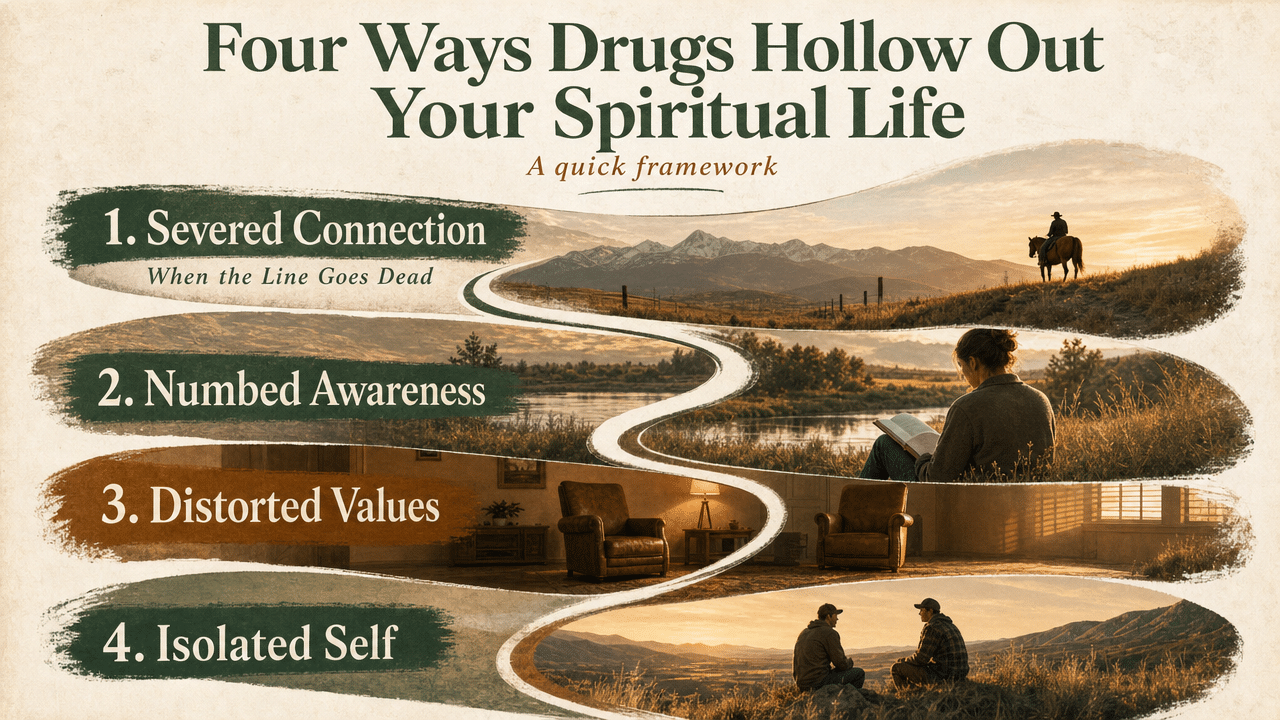
Four Ways Drugs Hollow Out Your Spiritual Life
Severed Connection: When the Line Goes Dead
The first thing to go is usually the easiest to deny. You still show up. You still say the words. But something inside you has stopped answering back.
Maybe you used to pray, or sit outside and feel like the sky was listening. Maybe you had a quiet sense that you were part of something, even if you never named it. Drugs put static on that line. At first the static is welcome, because it drowns out pain you did not know how to carry. Then the static becomes the only thing you can hear.
People coming into treatment describe this in almost identical language: they call active addiction spiritually empty, cut off, like being sealed inside their own head. You may reach for a memory of feeling loved and find only the shape of where it used to be. That is not weakness. That is what happens when a substance takes over the same nervous system that used to feel awe, gratitude, and belonging.1
The line is not gone. It is just buried under something chemical. Naming that is the first honest thing you can do.
Dulled Conscience: The Inner Compass Spins
You used to know when you had crossed a line. There was a small, clear signal inside you, and you either listened to it or you argued with it.
Drugs quiet that signal. Not all at once. The lies get a little easier. The promises you break to yourself stop stinging the way they used to. You start doing things you would not have believed a year ago, and the part of you that would have flinched is somewhere far away, watching through fog.
This is not proof that you are a bad person. It is proof that the compass has been magnetized by something stronger than your values. Shame will try to tell you the opposite. Shame will say the drug just revealed who you always were. It did not. It muted the part of you that cared, and then blamed you for not caring.
Getting that signal back is slower than you want it to be. It comes back in small moments — a wince, a memory, a moment of wanting to make something right. Those flickers are your conscience clearing its throat.
Lost Community: The Slow Retreat from People Who Love You
Isolation rarely announces itself. You just start canceling. One dinner, then two. You stop calling your sister back. You pick the seat in the corner. You tell yourself you need space, when what you actually need is not to be seen using.
Addiction is a lonely religion. It asks for privacy, then secrecy, then complete solitude. People in recovery often describe those late months of use as living inside a locked room they built themselves. The people who love you are still on the other side of the door, but you have stopped believing they would want to see what is in here with you.1
And it is not only friends and family. It is the small communities that used to hold you without you noticing — a coworker who checked in, a neighbor who waved, a group you used to sit with on Sunday mornings. Each thread frays quietly. By the time you notice, the fabric feels thin.
This retreat is one of the clearest spiritual injuries of drug use, because human beings were never built to heal alone. The good news is that the door only locks from the inside.
Shrinking Purpose: When Tomorrow Stops Mattering
There is a moment, hard to date exactly, when your future stops being a place you plan for and becomes a place you just try to reach.
Goals get smaller. Then they get vague. Then they collapse into a single question: how do I get through today. You may still have a job, kids, plans on the calendar, but the internal engine that used to make those things feel meaningful has gone quiet. Purpose, when you have it, feels like a pull forward. When drugs take over, that pull is replaced by a shorter loop — need, use, recover, repeat.
People in treatment describe this loss plainly. They talk about wanting a reason again, wanting to matter to someone, wanting tomorrow to be worth walking into. That longing is not naive. It is a signal that the part of you built for meaning is still alive, even if it has been starved.1
You do not have to know your purpose yet. You only have to notice that you miss having one. That noticing is where the fourth dimension of healing begins.
What the Research Actually Says About Faith and Recovery
If you have been told that faith is either the whole answer or a nice bonus, the research is more careful than either of those claims.
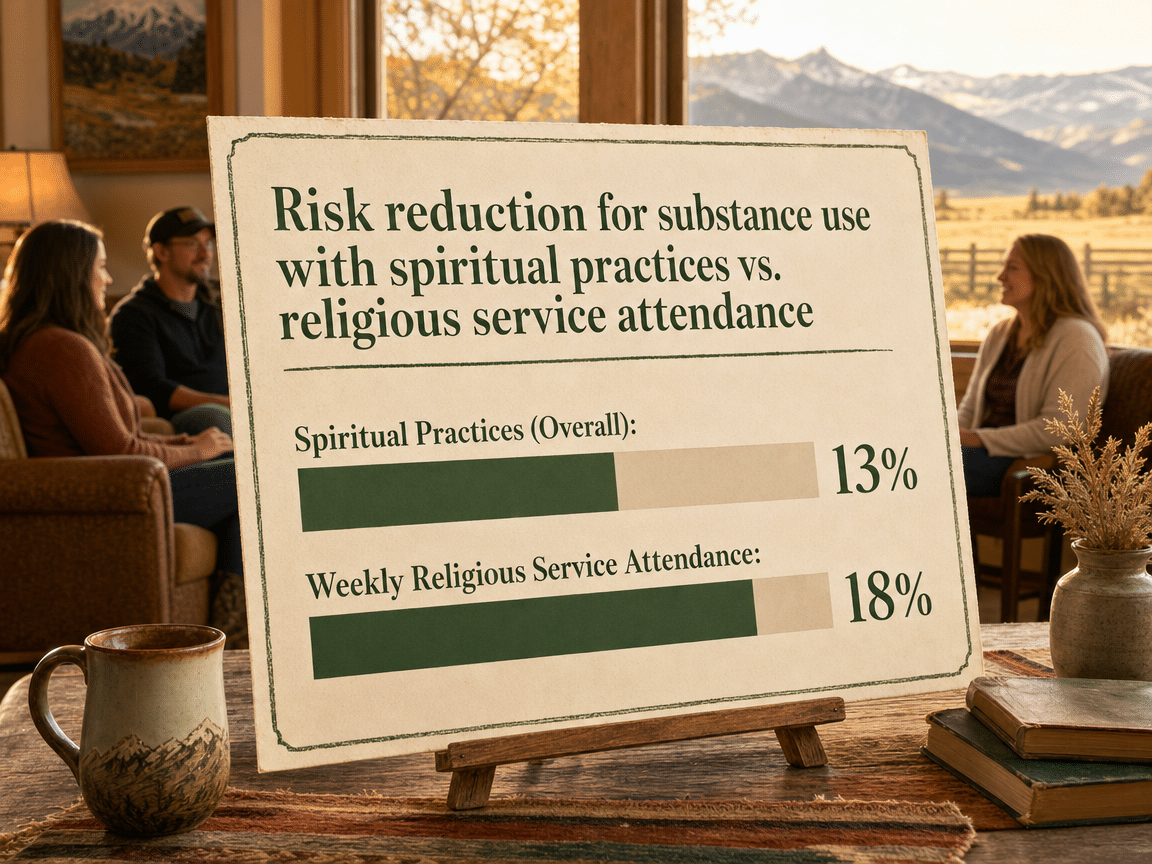
The strongest evidence so far comes from a 2026 JAMA Psychiatry meta-analysis. Researchers combined 55 long-term studies covering more than 540,000 people, following them over years to see whether spiritual practice actually protected against harmful alcohol and drug use. It did. People who engaged in spiritual practices — prayer, meditation, reflection, service attendance — had about a 13% lower risk of harmful or hazardous substance use. People who participated in a religious community more than once a week had about an 18% lower risk. Those numbers held across alcohol, tobacco, marijuana, and illicit drugs.4,5
Read that carefully, because the scope matters. This is population-level risk reduction across many years and many kinds of people. It is not a promise that lighting a candle will fix a heroin dependency next Tuesday. It is evidence that the spiritual dimension of your life is doing real, measurable work when you tend to it — and that community makes the effect stronger than solo practice.
The pattern shows up in treatment research too. In Project MATCH, people who described a spiritual awakening during recovery had better drinking outcomes and better mental health than people who attended the same meetings without that inner shift. A later study of AA members found the same thing: the awakening itself, not just the attendance, was what tracked with lasting change.2,3
What you are feeling has a body of research behind it. Your instinct that something inside you needs healing, not just your body, is not sentimental. It is documented.
Why Spirituality Alone Is Not Enough
Here is where a lot of well-meaning writing gets it wrong. You do not want to hear that prayer will fix a physical dependency, because part of you already knows it will not. And you do not want to hear that faith is irrelevant, because something in you keeps reaching for it anyway. Both of those answers are too small.
One study followed adolescents through substance use treatment and looked specifically at whether religiosity predicted better outcomes. On its own, it did not. Faith did not change abstinence rates or psychological distress in any lasting way until problem recognition — the honest, clear-eyed acknowledgment that a substance was causing harm — was part of the picture too. Belief without that inner honesty, and without real clinical engagement, ran out of road.
That finding is not a knock on faith. It is a description of how healing actually works. A withdrawing brain needs medical monitoring. A trauma history needs a trained counselor. Depression or anxiety underneath the drug use needs its own treatment, which is why federal guidance recommends integrated care for co-occurring conditions rather than treating one and hoping the other resolves on its own.7,8
Rebuilding the Four Dimensions Inside Real Treatment
Connection: Detox, Dual-Diagnosis Care, and the Return of Feeling
Connection cannot come back while your nervous system is still fighting a chemical. That is why the first stretch of real treatment usually looks medical, not spiritual. Medically monitored detox lets your body come down safely, with nurses watching the numbers you cannot feel and easing the symptoms that would otherwise send you back to use by nightfall.
Once the fog thins, something else usually surfaces. The anxiety that was always there. The depression the drug was covering. The trauma memories that got quieter with a substance and louder without one. This is where dual-diagnosis care matters. Federal guidance is clear that treating substance use and mental health together — not one after the other — produces less use, better psychiatric symptoms, and a real jump in quality of life.8
What this feels like from the inside is small at first. You sleep a full night. You taste food again. You cry at something and it is not a breakdown, just a feeling arriving on time. That is connection returning. Not a lightning-bolt reunion with the divine, just your inner life waking up enough to be reached.
Conscience: 12-Step Work and the Honest Inventory
The 12 steps get talked about a lot and understood less. At their core, they are a structured way to turn the volume back up on the part of you that knows right from wrong.
You write things down. You look at what you did, what was done to you, what you have been carrying. You tell another person, out loud, the things you swore you would take to your grave. Nothing about that is comfortable. All of it is how the inner compass gets recalibrated.
The research supports what people in the rooms have said for decades. In Project MATCH, participants who described an actual inner shift — a spiritual awakening, however they defined it — had better drinking outcomes and better mental health than people going through the same motions without that change. Later work on AA members found the same pattern. The steps are not magic. They are a workbench for honesty.3
You do not have to believe anything specific to start. You only have to be willing to tell the truth to one other person, one page at a time.2
Community: Groups, Family Week, and Being Known Again
The locked room opens from the inside, but you rarely walk out alone. Community is what pulls you the rest of the way.
In residential treatment, community starts small. A group of eight or ten people who watched you shake in detox and then watched you laugh at breakfast a week later. A counselor whose office door is actually open. Peers who catch the half-truth in your share before you do, because they were telling the same half-truth last month.
Then it widens. Family Week brings the people you retreated from into the room, with a therapist present, so that years of damage can be spoken about instead of skirted. Parents, partners, siblings, adult children — they get education, not just an update. They learn what happened to your brain, what to expect, and how to stop the patterns that kept everyone stuck.
This kind of community-based care is not a niche approach. About 73% of U.S. addiction treatment programs include a spirituality-informed element, most of it built around belonging — 12-step fellowships, group work, faith-friendly meetings. Being known again is not a bonus feature. It is the medicine.6
Purpose: Equine Work, Optional Bible Study, and Meaning You Choose
Purpose does not come from a lecture. It comes back through your hands.
Equine therapy is one of the strangest and most effective ways this happens. You stand in a paddock with a thousand-pound animal that reads your body better than most people read your words. If you are anxious, the horse knows. If you are pretending to be calm, the horse knows that too. Trust gets rebuilt without a script — you show up honestly, the horse responds, and something inside you remembers that it is possible to be met.
Alongside that, optional practices sit on the shelf, available when you reach for them. Bible study if you want it. Meditation and breathing work. Nature walks. A conversation with a chaplain or a counselor about the God you used to pray to, or the one you never quite believed in. None of it is assigned. All of it is there.
The focus-group research on people in treatment keeps landing in the same place: recovery is described as finding hope, connection, and meaning beyond drug use, after a stretch of feeling spiritually empty and isolated. Purpose is not something a program can hand you. It is something you rebuild when your days start including practices that mean something to you — a horse you helped, a page you read, a promise you kept.1
If Religion Has Already Hurt You
Some readers come to this article carrying two wounds, not one. The drug use is the newer one. The older one has a name like a church, a youth pastor, a family that used scripture as a weapon, or a community that pushed you out when you needed it most.
If that is you, please hear this clearly. Nothing in good treatment should require you to walk back through that door before you are ready. You do not owe a program your belief in exchange for your recovery. Federal guidance for behavioral health providers is explicit that spirituality can be both a source of healing and an area of real struggle, and that spiritual support in treatment has to be careful, coordinated, and never coercive.10
What that looks like in practice: a counselor who asks what you want, not what you should want. A 12-step group where your Higher Power can be honesty, or the group itself, or something you have not named yet. Bible study on a shelf, not on your schedule. Space to say the word God with anger, or not to say it at all.
Your boundary is part of the healing, not an obstacle to it.
What to Look for in a Program That Respects Your Faith
You are allowed to ask questions before you walk in the door. Most people do not know that. Here is what to listen for when you call.
Ask if spiritual practices are offered or required. The honest answer should be offered. Programs that pressure belief tend to lose people who needed help the most. Federal guidance is explicit that spiritual support in treatment must be voluntary and coordinated with clinical care, not layered on top of it. If a program cannot describe how it protects that boundary, keep looking.11
Ask about dual-diagnosis care in plain terms. You want to hear that the same team treats substance use and mental health at the same time, not that you get sober first and then talk about the depression later. Integrated care produces less use, better psychiatric symptoms, and better quality of life. This is the clinical floor everything else stands on.8
Ask what the 12-step work actually looks like. Ask whether Higher Power can be defined by the person doing the work. Ask if there is a chaplain or spiritual care person on staff, and whether Bible study is on a shelf or on your calendar. Ask what happens if you say no.
A program that respects your faith will answer these questions without flinching.
A Next Step That Is Small Enough to Take
You do not have to decide everything today. You do not have to know if you believe in God, or what you believe about yourself, or whether you can really do this. You only have to do one small thing that is honest.
Maybe that is reading this again tomorrow. Maybe it is telling one person the truth about how much you have been using. Maybe it is writing down, on paper you can throw away, what you used to feel and what you want to feel again.
When you are ready for a longer conversation, a residential program that takes both the medical and the spiritual seriously is worth a phone call. Rocky Mountain Treatment Center in Great Falls, Montana offers integrated dual-diagnosis care, 12-step work, equine therapy, and optional faith-based programming — available if you want it, never required. Calling the number is already something. That counts.
Frequently Asked Questions
Can I recover spiritually without becoming religious?
Yes. Spirituality in recovery is often described as connection, meaning, and hope — not doctrine. People in treatment define it in their own words, and programs that respect that tend to serve them better. You can rebuild your inner life through honesty, community, and practices that fit you, without signing on to a specific religion.1
What does it mean when people say drugs damaged their soul?
They usually mean something specific, even if the language sounds abstract. Connection went quiet. Conscience got muted. Relationships thinned out. Purpose shrank to the next dose. People in treatment describe active addiction as spiritually empty and isolating, and that description names a real injury — one that heals as those four dimensions come back.1
Will a faith-informed treatment program pressure me to believe something specific?
A good one will not. Federal guidance is clear that spiritual support in treatment should be voluntary, coordinated with clinical care, and never coercive. Ask directly whether practices are offered or required, whether you can define a Higher Power however you want, and what happens if you say no. Honest programs answer without flinching.10
I was hurt by a church before I started using. Can treatment still help me?
Yes, and your history matters. SAMHSA acknowledges that spirituality can be a source of healing and an area of real struggle, and recommends careful, non-coercive support for people carrying spiritual trauma. A good counselor asks what you want, protects your boundary, and does not require you to walk back through any door before you are ready.10
Is prayer or Bible study enough to overcome addiction on its own?
On their own, usually not. Research on adolescents in treatment found that religiosity alone did not change abstinence or distress without honest problem recognition and clinical engagement. Faith gives healing somewhere to land, but a withdrawing body needs medical care and a struggling mind needs trained help. Both layers matter, and neither replaces the other.7
How do 12-step meetings handle the Higher Power question if I’m unsure what I believe?
You get to define it. Members choose their own understanding — the group, honesty, nature, the God they grew up with, or something they cannot name yet. What research consistently finds is that the inner shift, not a specific creed, tracks with better outcomes. Show up unsure. The work still moves forward.2,3
References
- A focus-group study on spirituality and substance-abuse treatment. https://pmc.ncbi.nlm.nih.gov/articles/PMC2943841/
- Spiritual Awakening Predicts Improved Drinking Outcomes in Project MATCH. https://pmc.ncbi.nlm.nih.gov/articles/PMC4198522/
- Spiritual Awakening in 12-Step Recovery: Impact Among Alcoholics Anonymous Members. https://pmc.ncbi.nlm.nih.gov/articles/PMC10947114/
- Spirituality and Harmful or Hazardous Alcohol and Other Drug Use. https://pubmed.ncbi.nlm.nih.gov/41706493/
- Spiritual practices strongly associated with reduced risk for hazardous alcohol and drug use. https://hsph.harvard.edu/news/spiritual-practices-strongly-associated-with-reduced-risk-for-hazardous-alcohol-and-drug-use/
- Belief, Behavior, and Belonging: How Faith is Indispensable in Preventing and Recovering from Substance Abuse. https://pmc.ncbi.nlm.nih.gov/articles/PMC6759672/
- Religiosity as a Predictor of Adolescents’ Substance Use Disorder Treatment Outcomes. https://pmc.ncbi.nlm.nih.gov/articles/PMC4362954/
- Managing Life with Co-Occurring Disorders. https://www.samhsa.gov/mental-health/serious-mental-illness/co-occurring-disorders
- How to Talk to Community and Faith Leaders About Mental Health. https://www.samhsa.gov/mental-health/what-is-mental-health/how-to-talk/community-and-faith-leaders
- Spirituality and Trauma: Professionals Working Together. https://www.samhsa.gov/resource/dbhis/spirituality-trauma-professionals-working-together
- Faith and Community Engagement. https://www.samhsa.gov/communities/faith-based-community-engagement