Key Takeaways
- A 30-day inpatient stay in Great Falls delivers 24-hour clinical care, distance from triggers, and a structured handoff — three things shorter detoxes and weekly counseling cannot provide.1
- The four-week arc moves from medically monitored detox with 24/7 on-site RN coverage into counseling, group work, family programming, and a written continuing-care plan for day 31.11
- Before admission, verify Montana licensing under SUDF rules, confirm Medicaid or commercial insurance coverage in writing, and ask whether medically monitored detox is included on-site.3
- For rural Montanans, aftercare has to travel — Zoom groups and scheduled 30, 60, 90, 180, and 365-day check-ins matter because longer travel times reduce follow-up attendance.7
What a month away from home actually buys you
You are probably not reading this because you want to leave home for 30 days. You are reading it because something has to change, and the shorter fixes have not held. Maybe outpatient counseling worked for a while. Maybe a three-day detox got you sober enough to drive home and then everything unraveled by the second week. That pattern is not a personal failure. It is a signal that the next attempt needs more room to work.
A 30 day intensive inpatient program in Great Falls buys you three things that a weekend detox or a weekly counseling hour cannot. The first is time under 24-hour clinical care, which is the core of what SAMHSA defines as residential treatment. The second is distance from the triggers, obligations, and easy access that keep the cycle going. The third, and the one people underestimate, is a structured handoff to whatever comes on day 31.1
Think of the month as one strong attempt, not the whole recovery. Your body gets stabilized. Your head gets quiet enough to do actual counseling work. Your family gets pulled in instead of shut out. And by the last week, you have a written plan for the drive back to Havre, Cut Bank, Lewistown, or wherever home is — with people you can call when the plan gets tested.
Who a 30-day stay in Great Falls is really built for
This level of care is not for everyone with a drinking or drug problem, and pretending otherwise wastes your time. A 30-day intensive inpatient program is built for adults whose substance use has reached a point where outpatient counseling, IOP, or a short hospital detox has not been enough — usually because the physical withdrawal is medically risky, the home environment keeps pulling them back, or a co-occurring mental health issue is tangled into the drinking or using in ways an hour a week cannot untangle. Montana structures its higher-intensity substance use disorder facilities with 24/7 on-site RN coverage precisely because this population needs medical eyes on them around the clock, not just during business hours.11
If you are the one considering the stay, you might recognize yourself in a few of these:
- withdrawal symptoms that scare you or your family,
- a job or license already on the line,
- a relapse pattern that resets every few weeks, or
- a mental health diagnosis — depression, PTSD, anxiety — that has never been treated alongside the substance use.
Residential care is designed to hold all of that in one place, with structured counseling, medication support, and recovery meetings under one roof.
If you are the family member reading this for someone else — a spouse in Cut Bank, an adult child in Havre, a parent on the Rocky Mountain Front — the question is usually whether the situation has moved past what phone calls and ultimatums can fix. It probably has, or you would not be here. Montana’s state-approved providers log more than 8,000 adult and youth admissions to substance use treatment each year, and a meaningful share of those people looked a lot like your person before they went in: functioning on paper, unraveling in private.1,13
A 30-day stay is also the right fit when a shorter detox has already failed to hold. Research on inpatient detoxification shows that stays too brief to fully stabilize the person are linked to higher readmission. Four weeks gives the body time to settle and gives the counseling time to actually reach you before you drive home.10
The four-week clinical arc, week by week
Week 1: Medically monitored detox and stabilization
The first week is not about insight. It is about getting your body safe and your sleep back. If you have been drinking heavily every day, or using opioids, benzodiazepines, or stimulants at a level that makes stopping cold turkey dangerous, this is the week that keeps you out of the emergency room. Montana’s rules for higher-intensity substance use disorder facilities require a registered nurse on-site 24 hours a day, seven days a week. That is not a paperwork detail. It means someone with clinical training is watching your vitals, adjusting comfort medications, and catching problems at 3 a.m. instead of at the next shift change.11
SAMHSA describes inpatient and residential treatment as intensive care where you live at the facility and receive 24-hour support that combines medical stabilization, structured therapy, and recovery meetings under one roof. In practice, Week 1 leans hard on the medical side. You will meet with a nurse or physician early, get a full assessment, and start on whatever taper or comfort medications your withdrawal calls for. You will eat regular meals for the first time in a while. You will sleep — badly at first, then better.1
You will also start showing up to groups, even when you do not feel like it. That matters. Research on inpatient detoxification links very short stays to higher readmission rates, because the body may be cleared but the person is not yet connected to what comes next. Week 1 in a 30-day arc is designed to bridge that gap. By day seven, the acute withdrawal is usually behind you, and your head is clear enough to actually hear what a counselor is saying. That is the handoff into Week 2.10
Week 2: Individual counseling, group work, and 12-step immersion
Week 2 is where the real work starts, and where a lot of people are surprised by how tired they feel. Detox is over. The adrenaline of arriving is gone. What is left is the actual reason you drank or used in the first place — and now you have to look at it in daylight, with people around you.
Your days settle into a rhythm. One-on-one counseling sessions with an assigned counselor. Group therapy where you hear other people say things you thought only you were thinking. Psychoeducation on how substances rewired your stress response, your sleep, your relationships. And 12-step meetings, either on-site or nearby, so the language and rhythm of AA or NA becomes familiar before you have to walk into a meeting alone back home.
SAMHSA lists counseling, medication support, and peer recovery meetings as core components of residential care for a reason. Each one does something the others cannot. Counseling gives you a private place to say what you cannot say in group. Group work shows you that shame loses power when it is spoken out loud. Twelve-step meetings give you a community you can find in almost any Montana town, which matters more than it sounds when you are back in Havre on a Tuesday night.1
By the end of Week 2, most people can name a few of their real triggers instead of speaking in generalities. That is a small win, and it counts.
Week 3: Family Week and experiential therapies
Week 3 pulls in the people you left at home. Family programming — usually a structured three-day block — brings a spouse, parent, adult child, or chosen family member into the room with you and a counselor. This is not a reunion. It is a supervised conversation about what has actually been happening, what everyone has been carrying, and what a workable relationship looks like after you go home.
These conversations are uncomfortable. They are also where a lot of the 30 days pays off. Your partner in Cut Bank has been managing your absences, your moods, and probably your finances. Your teenager has been quietly editing what they say to you. Family Week gives everyone a shared vocabulary and a therapist in the room to keep the conversation from sliding back into old grooves.
Alongside family work, Week 3 usually opens up experiential therapies — recreational activities, nature time, and, for many Montana programs, equine therapy. A 2022 scoping review found that equine-assisted services in substance use treatment showed positive effects on engagement, therapeutic alliance, and psychological outcomes, though the authors were clear that samples were small and equine work should complement, not replace, counseling. A qualitative study of people in SUD treatment found that patients described horse-assisted therapy as
“more than just a break,” reporting increased self-reflection and a felt sense of responsibility through the work with horses.5,6
For rural Montanans used to being around animals and outdoor work, these experiential sessions can crack something open that a folding chair in a group room cannot. Insight lands differently when it arrives while you are grooming a horse or walking a fence line.
Week 4: Discharge engineering and the handoff home
The last week is not a wind-down. It is a build-out. By now the acute crisis is behind you, the counseling relationships are real, and the question shifts from “can I get through today sober here” to “what does day 31 actually look like at home.” A lot of people underestimate how much planning has to happen in Week 4.
You and your counselor draft a written continuing-care plan. That plan names your outpatient counselor or IOP back home, the specific 12-step meetings you will attend in your town or the nearest one, your prescriber if you are on medication for a co-occurring condition, and the exact schedule of follow-up check-ins after discharge. Research on rural clients found that treatment after discharge from detox or residential care is associated with improved outcomes, and that longer travel times measurably reduce follow-up attendance. Week 4 is when you build around that reality — Zoom-based groups, scheduled phone follow-ups, and a warm handoff to a local provider so you are not starting from cold on Monday morning.7
You will also rehearse the hard moments. The first weekend home. The first time someone offers you a drink at a branding or a wedding. The first bad day at work. Counselors walk through these with you specifically, not abstractly.
Finishing the month is a real accomplishment. Say that out loud. Then walk out with a phone number in your pocket and a plan that does not depend on willpower alone.
Equine therapy: what the research actually says
If you grew up around horses, or you have a cousin who did, you probably have questions about how a therapy session with a horse actually helps someone stop drinking. Fair question. The honest answer is that equine therapy is not a cure, and any program claiming it is should make you skeptical. It is a tool — a good one, when it is used alongside counseling and 12-step work, not in place of them.
A 2022 scoping review of equine-assisted services in substance use disorder treatment found that studies reported positive effects on psychological outcomes, engagement, and therapeutic alliance among participants. That last one matters more than it sounds. Engagement is the thing that determines whether someone stays in treatment long enough for the counseling to reach them. If working with a horse in an arena gets a rancher from Teton County to open up on Wednesday afternoon in a way that a folding chair in a group room never did, that is not soft science. That is the point.5
The same review was clear-eyed about the limits. Sample sizes have been small. The interventions vary from program to program. The authors caution that equine-assisted services should not yet be considered a stand-alone evidence-based treatment. Read that carefully — it is a caution against overclaiming, not a dismissal.
A qualitative study of patients in SUD treatment found people described horse-assisted work as5
“more than just a break,” reporting increased self-reflection and a felt sense of responsibility through their interactions with the horses.6
Horses respond to what you are actually doing, not what you are saying. For someone whose whole life has become a performance of being fine, that feedback lands.
Use equine work for what it is good at — engagement, emotional regulation, insight — and let counseling and peer support do the rest.
Recovery is rarely one-and-done
Here is something worth saying plainly, especially if you or your loved one has been through treatment before: needing another attempt does not mean the last one failed. It means recovery is usually a longer story than a single stay.
A national self-report study asking people who had resolved an alcohol or drug problem how many serious attempts it took found a median of two attempts, with about 13% reporting more than 10. That study relied on how participants themselves counted their attempts, so the exact number is less important than the shape of the finding: most people need more than one, and a meaningful share need many. If your husband already went to a 28-day program in 2019 and it held for eight months before it did not, he is not an outlier. He is the median.8
What this means for the month ahead is worth naming directly. A 30-day intensive inpatient stay in Great Falls is not the whole recovery. It is one strong, well-supported attempt inside a longer arc — the one where the medical piece gets handled, the counseling actually reaches you, and the plan for what comes next gets built with real names and real phone numbers in it.
That reframing matters for two reasons. It takes some of the pressure off the stay itself, so you are not walking in braced against a pass-fail exam. And it changes what “success” looks like on day 30. Success is not a promise you will never drink again. Success is that you leave stabilized, connected, and pointed at the next right step — with people who will pick up the phone in month two, month six, and a year in.
Paying for it: Medicaid, commercial insurance, and Montana licensing
Money is usually the second question, right after “is this really necessary.” Here is a plain read on how paying for a 30-day residential stay in Great Falls actually works.
Most people cover residential treatment through commercial insurance. If you or your spouse has an employer plan, a marketplace plan, or a plan through a union or trade association, there is a real chance a licensed Montana residential program is in-network or can be verified for out-of-network benefits. Call the number on the back of the card and ask specifically about residential substance use disorder treatment, medically monitored detox, and any prior authorization requirements. Have the admissions team at the facility make the call with you if that feels like too much to hold.
Montana Medicaid covers a range of rehabilitative services, including mental health and substance use disorder treatment recommended by a qualified professional. What Medicaid pays for at a given facility depends on the provider’s contracts and licensing category, so this is a facility-by-facility question, not a yes-or-no. Some Great Falls-area residential programs accept Medicaid; others do not. Ask directly before you assume either way.3
Licensing is where the trust signal lives. Montana regulates residential facilities for mental health and substance use conditions as health care facilities under specific state rules, and higher-intensity substance use disorder facilities must meet standards that include 24/7 on-site RN coverage, formal assessments, and written treatment planning. The state also aligns its provider expectations with ASAM criteria through the Medicaid Services Provider Manual. Translation: a properly licensed Montana program is not making up its own rules. It is operating under a framework the state audits against.2,4,11
Two practical moves for this week:
- Ask any program you are considering whether they are licensed under Montana’s SUDF rules and whether they carry Joint Commission or comparable accreditation.
- Get a benefits verification in writing before admission so you know your out-of-pocket exposure — deductible, coinsurance, and any daily copay — instead of guessing.
Day 31 and beyond: aftercare that survives the drive home
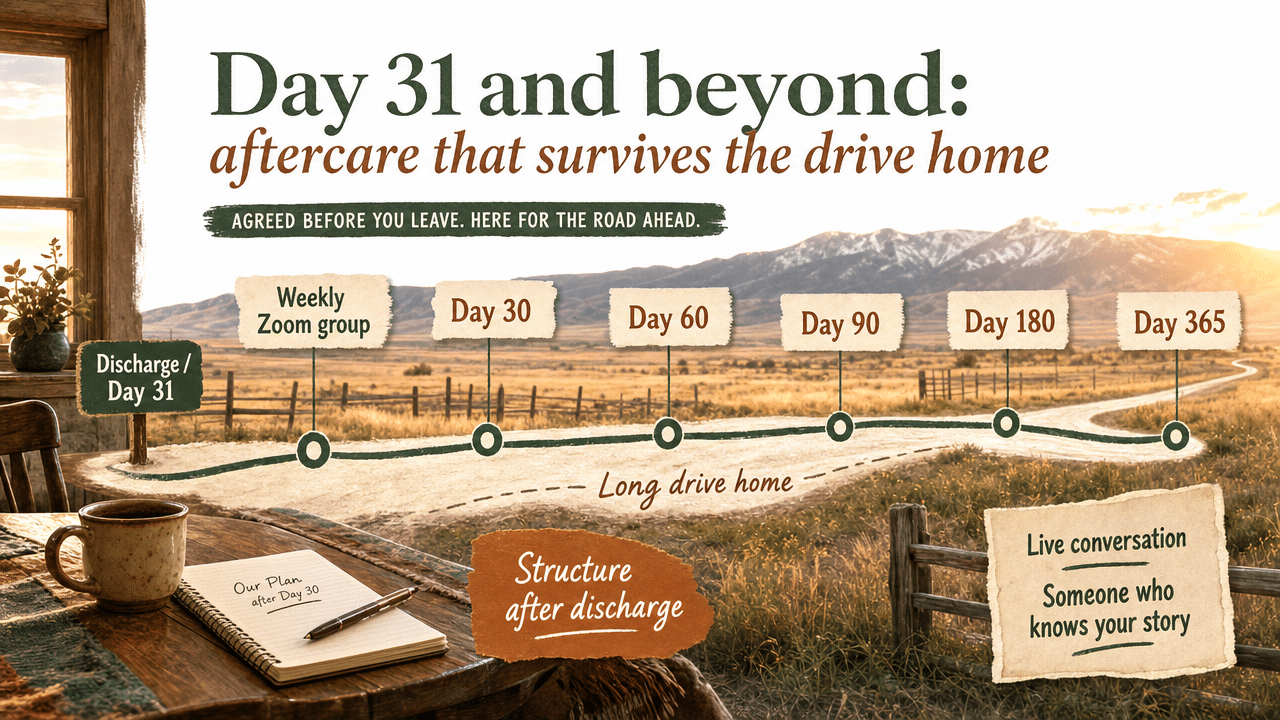
The hardest day of a 30-day stay is often day 31. Your bag is packed, the counselors you learned to trust are behind you, and the highway back to Havre or Browning is long. What keeps recovery going from here is not motivation. It is a schedule you agreed to before you left.
A well-built continuing-care plan out of a Great Falls program usually looks something like this: weekly Zoom groups you dial into from your kitchen table, plus scheduled follow-ups at 30, 60, 90, 180, and 365 days after discharge. Each touchpoint is a live conversation with someone who knows your story — not a form to fill out. That structure exists for a specific reason. Research on rural clients found that treatment after discharge from detoxification or residential care is associated with improved outcomes, and that longer travel times measurably reduce whether people show up to follow-up appointments. In other words, the further you live from your provider, the more the plan has to come to you.7
That is what the Zoom piece solves. A group you can join from Cut Bank on a Wednesday night removes the two-hour drive from the equation. It does not replace in-person recovery — you still need local 12-step meetings, a nearby counselor if one is available, and a prescriber for any medications — but it keeps the thread from your month in Great Falls unbroken while you rebuild the rest of your local support.
The check-in schedule matters just as much. Thirty days out is when the initial glow wears off and old routines start whispering. Sixty days is often when a first serious craving or family conflict tests the plan. Ninety, 180, and 365 days catch you at the milestones where people quietly disengage. Each call is a chance to adjust before something slips, not after.
Before you leave, walk out with three things written down:
- the exact time and link for your weekly group,
- the phone number of your assigned continuing-care contact, and
- the names of two local meetings — with days and addresses — in your home town or the nearest one.
That is the difference between an aftercare idea and an aftercare plan you can actually follow on a Tuesday in February.
How to make the call this week
If you have read this far, some part of you already knows what needs to happen. The gap between knowing and calling is where most people get stuck for months. Here is how to close it in the next few days.
Pick one afternoon this week and do three things in order:9
- Call your insurance to ask specifically about residential substance use disorder treatment benefits.
- Call a licensed Montana program and ask for a same-week clinical assessment over the phone.
- If you want a neutral starting point first, SAMHSA’s National Helpline is free, confidential, and open 24/7 for treatment referrals.
Rocky Mountain Treatment Center in Great Falls can walk you through admissions, insurance verification, and — for many rural Montanans — transportation from your town. You do not have to have your speech ready. You just have to make the call. Finishing this article and picking up the phone in the same afternoon is a small, real win. Count it.
Frequently Asked Questions
What actually happens during a 30-day intensive inpatient program in Great Falls?
Does Montana Medicaid or commercial insurance cover a 30-day residential stay?
Most people use commercial insurance, and many employer or marketplace plans cover residential substance use treatment. Montana Medicaid covers a range of rehabilitative services for substance use disorders when recommended by a qualified professional, but what a specific facility accepts varies by its contracts and licensing. Call the number on your insurance card, and ask any program directly whether they accept your plan before admission.3
Is medically monitored detox included, or do I need to detox somewhere else first?
What if I’ve already tried treatment before and relapsed?
How does aftercare work when I live hours away in a rural Montana town?
Is equine therapy a real clinical tool or just an extra?
References
- Treatment Types for Mental Health, Drugs and Alcohol. https://www.samhsa.gov/find-support/learn-about-treatment/types-of-treatment
- State Residential Treatment for Behavioral Health Conditions: Regulation and Policy – Montana. https://aspe.hhs.gov/sites/default/files/2021-08/StateBHCond-Montana.pdf
- Montana State Plan Amendment 24-0001 (Rehabilitative Services). https://www.medicaid.gov/medicaid/spa/downloads/MT-24-0001.pdf
- Substance Use Disorder Services and Resources. https://dphhs.mt.gov/bhdd/SubstanceAbuse/
- Equine-assisted services for individuals with substance use disorders: A scoping review. https://pmc.ncbi.nlm.nih.gov/articles/PMC9749232/
- More Than Just a Break from Treatment: How Substance Use Disorder Patients Experience Horse‑Assisted Therapy. https://pmc.ncbi.nlm.nih.gov/articles/PMC5054942/
- Rural Clients’ Continuity Into Follow-up Substance Use Disorder Treatment. https://pmc.ncbi.nlm.nih.gov/articles/PMC6856385/
- How Many Recovery Attempts Does it Take to Successfully Resolve Alcohol and Drug Problems?. https://pmc.ncbi.nlm.nih.gov/articles/PMC6602820/
- National Helpline for Mental Health, Drug, Alcohol Issues. https://www.samhsa.gov/find-help/helplines/national-helpline
- Length of Stay and Readmission after Inpatient Detoxification. https://pubmed.ncbi.nlm.nih.gov/31393286/
- Rules for Substance Use Disorder Facility. https://dphhs.mt.gov/assets/oig/Rules_for_Substance_use_Disorder_Facility.pdf
- Opioid Use/Misuse in Older Adults Fact Sheet (Montana State University Extension). https://www.montana.edu/extension/health/documents/Fact%20Sheet%20Final.pdf
- Montana Substance Use Disorders Task Force Strategic Plan. https://dphhs.mt.gov/assets/publichealth/EMSTS/opioids/MontanaSubstanceUseDisordersTaskForceStrategicPlan.pdf