
Key Takeaways
- Insist on a clear ASAM level-of-care match for your adult child, because a serious program can name the level it provides and explain how it decided.2
- Look for integrated psychiatric care under the same roof, since co-occurring depression, anxiety, or trauma usually drive the substance use and need treating together.7
- Prioritize centers built around cognitive-behavioral therapy, motivational interviewing, group work, and medications when appropriate — experiential add-ons like equine therapy should complement, not replace, that core.8
- Treat 30 days as a checkpoint rather than a finish line, because stays under 90 days show limited effectiveness and longer durations track with better outcomes.12
- Require structured family programming with real dates on the calendar, since family involvement is consistently named as a component that helps gains hold after discharge.5
- Weigh continuing care as heavily as the residential stay itself — telephone-based aftercare improves outcomes for alcohol use disorder and helps the work actually stick.4
- Decide geography and insurance deliberately, verify benefits in writing before any deposit, and call SAMHSA’s helpline if coverage options are limited.11
- Slow down at admissions and ask specific questions about ASAM level, psychiatric access, medications, aftercare timeline, and extension criteria before placing a deposit.
What to Actually Look for When Your Adult Child Needs Residential Care
If you’re reading this, you’ve probably already had the late-night phone calls, the hospital visits, the broken promises that were meant honestly and then collapsed anyway. You may have done this before. The fact that you’re researching carefully right now, instead of grabbing the first facility that picks up the phone, matters more than any glossy brochure ever will.
Here’s the hard truth no one tells parents: residential treatment centers for adults are not interchangeable. The buildings can look similar. The websites use the same words — compassionate, evidence-based, holistic. What separates a program that actually helps your adult child from one that simply houses them for 30 days comes down to five things you can ask about directly.
You want a program that matches the right level of care to your child’s situation, not a one-size stay. You want integrated mental health support, because addiction rarely travels alone. You want family involvement that’s structured into the program, not tacked on. You want therapies backed by real evidence. And you want a continuing-care plan that lasts well past discharge.2,4,7,8
The 30-, 60-, or 90-day question is real, but it’s secondary. A center that does these five things well at 60 days will serve your child better than a center that does them poorly at 90. The rest of this guide will show you how to read a program for each of these — and what to walk away from.
Matching the Level of Care to Your Child’s Situation
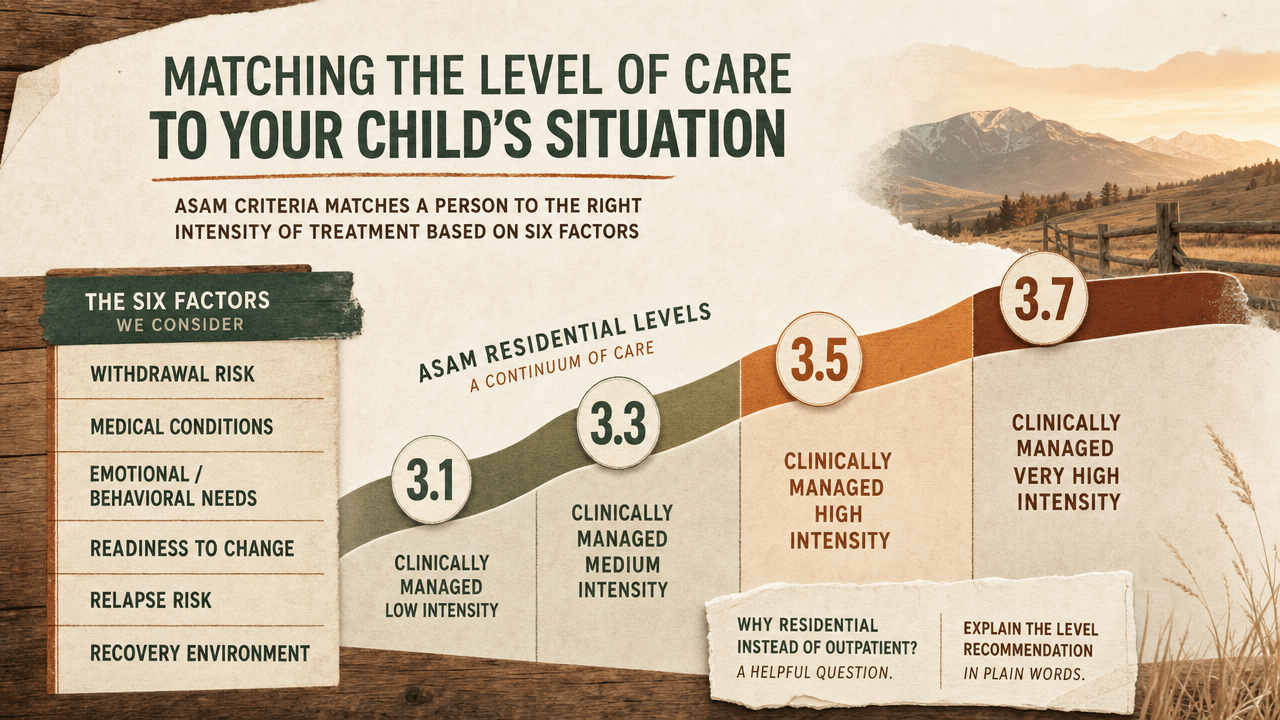
Not every adult with a substance problem needs the same kind of residential program — and one of the clearest signals you’re talking to a serious center is that they can explain, in plain words, why they’re recommending the level of care they’re recommending for your child.
The framework most reputable programs use is called the ASAM Criteria. ASAM stands for the American Society of Addiction Medicine, and its criteria are basically a structured way to match a person to the right intensity of treatment based on six factors: withdrawal risk, other medical conditions, emotional and behavioral needs, readiness to change, relapse risk, and the recovery environment they’d be going home to. When you ask a center, “How did you decide my child needs residential care instead of outpatient?” — they should be able to walk you through those factors without flinching.2
Within residential care itself, there are four levels you may hear referenced: 3.1, 3.3, 3.5, and 3.7. Here’s the plain-English version:1,2
- Level 3.1 — Clinically managed low-intensity residential. Roughly five hours of clinical services a week in a structured living environment. Good fit for someone who needs a stable, sober setting and steady support but not constant clinical contact.
- Level 3.3 — Clinically managed population-specific high-intensity residential. Designed specifically for adults with significant cognitive impairments or other complex needs that require a slower pace and more specialized staff.
- Level 3.5 — Clinically managed high-intensity residential. This is what most people picture when they hear “rehab”: a 24-hour structured program with daily individual and group therapy, often a fit for adults with serious substance problems, limited motivation, or weak social supports at home.
- Level 3.7 — Medically monitored intensive inpatient. 24-hour nursing and physician availability. Appropriate when withdrawal is medically risky or there are co-occurring medical issues that need close monitoring.
Why does this matter for you as a parent? Because if a program quotes you the same length of stay, the same daily schedule, and the same price regardless of who walks in the door, that’s a flag. Adults coming off a long, heavy alcohol use pattern with a history of seizures need something different than an adult who has been using opioids but is medically stable and motivated. A strong center can describe where on this continuum they actually operate, and what they do when someone needs more — or less — than what they offer.
Ask directly: “What ASAM level do you provide, and how do you decide my adult child meets criteria for that level?” If the answer is vague, keep calling. If the answer is specific — and includes how they’d handle a step-down to a lower level later, or a transfer up if needed — you’re in better hands.
Integrated Mental Health Care Is Not Optional
If your adult child has been drinking heavily for years, or using opioids, or cycling through stimulants — there is almost certainly something else going on underneath. Depression. Anxiety. Trauma that never got named. ADHD that was never treated. A grief that turned into a habit. You probably already know this, even if no clinician has ever said it out loud to you.
This is what professionals mean by co-occurring disorders — when a mental health condition and a substance use problem are happening at the same time, feeding each other. SAMHSA is direct about how to handle it: screening and treatment for both should happen together, in the same program, by a team that talks to each other. When that happens, people use less, their psychiatric symptoms improve, and their day-to-day functioning gets better.7
So here’s what you ask. Not “do you treat mental health?” — almost every program will say yes. Ask: “Is there a psychiatrist or psychiatric provider on staff, and how often will my adult child actually see them?” Ask whether the therapist running individual sessions and the prescriber managing medications share notes — or whether your child has to repeat their story twice. Ask what happens if depression gets worse in week two, or if a trauma history surfaces in group. A strong center has an answer that doesn’t require sending your child somewhere else.
One more thing worth knowing. The medications that treat alcohol use disorder — naltrexone, acamprosate, disulfiram — work, and they’re underused. Only about 1.6% of adults with past-year alcohol use disorder are prescribed them. If alcohol is your child’s primary problem, ask the program directly whether medication is on the table as part of treatment. “We don’t do that here” is an answer. So is “yes, and here’s how we decide.” Either is more honest than a vague brochure line about being holistic.13
The Evidence-Based Therapies a Strong Program Should Offer
When you call a center, you’ll hear a parade of therapy names. Some are well-studied. Some are pleasant but unproven. You don’t need to memorize the research — you just need to know which ones should be in the core mix, and which are extras.
At the center of any solid residential program for adults, you should see a few specific things: cognitive-behavioral therapy, which helps your child notice the thoughts and triggers that lead to use; motivational interviewing, which meets people where they are instead of arguing them into change; and structured relapse-prevention work. SAMHSA’s evidence-based practices guidance points to this same core — behavioral therapies, medications when appropriate, and recovery support services woven together. For young adults especially, motivational interviewing and cognitive-behavioral approaches have the strongest support, alongside family involvement.5,8You should also see group counseling and 12-step support meetings on the schedule. These aren’t filler hours. Group work gives your child practice being honest in front of other people who’ve been where they are — something individual therapy alone can’t replicate. A residential program that doesn’t include peer-based group time is missing something fundamental.1Medications deserve their own question. If alcohol is the primary issue, ask whether naltrexone, acamprosate, or disulfiram are options the medical team will actively consider. If opioids are involved, ask about buprenorphine or naltrexone. These tools are underused — only about 1.6% of adults with past-year alcohol use disorder receive medication for it— and a program that treats medication as a real clinical option, not an afterthought, is paying attention.13
Then there are the experiential therapies: equine work, art, music, recreation, hiking, meditation. These can genuinely help. Time with horses, for instance, has been associated with longer stays in treatment and higher program completion rates in some studies. But the systematic review of equine-assisted services for substance use disorders is careful to say the evidence is promising but limited, with small studies and varied methods. Read that honestly. Experiential therapies are a meaningful complement to clinical care — they help your child practice trust, regulate emotions, and stay engaged — but they aren’t a substitute for the core therapies above. If a program leads with horses and barely mentions cognitive-behavioral work, that ordering is backwards.10,14
How Long Should Treatment Last? The 30/60/90-Day Question
Almost every parent who calls a residential program asks the same thing first: how long? Thirty days feels manageable. Sixty feels like a lot to ask. Ninety can feel like asking your adult child to put a season of their life on hold. You’re not wrong to feel that tension. Your child probably feels it too.
Here’s what the research actually says, and it’s worth sitting with for a minute. NIDA’s research-based guide on addiction treatment is plain about it: for residential or outpatient treatment, “participation for less than 90 days is of limited effectiveness,” and longer durations are associated with better outcomes. That language matters. It doesn’t say 30 days is worthless. It says 30 days, on its own, doesn’t usually do what families hope it will.12
So why do 30-day programs exist at all? Because for many adults, 30 days is what insurance will authorize up front, and because 30 days of structured residential care is still meaningfully better than no residential care. The smarter way to read the 30/60/90 model is as a series of checkpoints, not three different products. Your child enters with an initial authorization, the clinical team reassesses around day 25 or 30, and if more time is clearly needed, the program advocates for an extension. A center that treats 30 days as the finish line is a different program than one that treats 30 days as the first chapter.
What helps your adult child during a longer stay isn’t just more days on the calendar. It’s more practice. More group sessions where they say something honest out loud. More chances to sit with a craving without acting on it. More time for the medications, if any are part of the plan, to actually settle. More space for a co-occurring depression to lift enough that they can engage in therapy at all. Thirty days can stabilize. Sixty can build skills. Ninety lets those skills get tested against real situations — passes home, a family conflict in week ten, the boredom that often shows up after the early intensity fades.
When you talk to a program, ask two specific questions. First: “How do you decide whether to recommend an extension past day 30?” A serious answer involves clinical criteria, not a sales pitch. Second: “What does the step-down from residential look like for someone who’s ready before 90 days?” Some adults genuinely don’t need the full 90, and a program that can move your child to a lower level of care while keeping them connected is showing you a continuum, not a cliff.
One last thing to hold onto. The length of stay matters less than what the program does with that time. A focused 60 days with strong therapy, integrated psychiatric care, and a real aftercare handoff will serve your adult child better than 90 days of mostly unstructured downtime. Ask what the daily schedule actually looks like. Count the clinical hours. That tells you more than the brochure.
Family Involvement: What Real Participation Looks Like
You’ve probably been told before that addiction is a family disease. That phrase can land wrong when you’re the parent who’s been losing sleep, lending money, and trying everything you can think of. But there is something true underneath it: the patterns around your adult child — what gets said, what gets avoided, who covers for whom — are part of what they’re coming home to. A residential program that takes family seriously will treat that as part of the clinical work, not a courtesy add-on.
Evidence-based reviews of treatment for adults in their 20s and 30s consistently name family involvement as one of the components that helps gains hold after intensive care. The question isn’t whether a center says it includes families. It’s how.5
Ask what family programming actually looks like on the calendar. Is there a structured multi-day family event where you’re educated about addiction, sit in on facilitated conversations, and practice the kinds of boundaries that don’t collapse the first weekend your child is home? Or is family involvement one phone call with a counselor and an open visiting hour on Sunday? Those are different products.
Ask who runs the family sessions and what they’re trained to do. You want someone who can hold a room when old resentments come up, not a staffer reading from a slide deck. Ask whether siblings, spouses, or grown grandchildren can attend — because the people in your child’s daily life often matter as much as you do.
One honest note: family involvement can be hard for your adult child too. They may not want you there at first. A strong program will work with that, not around it, and will tell you plainly when family contact is helping and when it needs to pause.
The Aftercare Question — and Why It Matters as Much as the Stay
Here’s something most centers won’t lead with: the discharge date is not the finish line. It’s the moment when the real test starts. Your adult child leaves a structured environment with predictable meals, sober peers, and a counselor down the hall — and walks back into a life that contains all the same triggers they left behind. What the program does to bridge that gap is, honestly, as important as what happens inside the residential walls.
The research on continuing care — what clinicians mean when they say aftercare — is clearer than the research on a lot of other pieces. A major review found that telephone-based continuing care consistently improves outcomes for adults with alcohol use disorder. In some studies, it was cost-effective compared to standard care and was associated with reduced criminal convictions in the four years following treatment intake. For alcohol, structured follow-up after discharge isn’t a nice-to-have. It’s part of what makes the residential stay actually stick.4
The honest caveat — and you deserve the honest version — is that the same review found mixed results for some drug-use populations. Some studies showed improvement, some showed no effect, and a few showed worse outcomes with certain follow-up formats. That doesn’t mean aftercare doesn’t matter for drug use. It means the format and intensity need to fit the person. If your adult child is in treatment primarily for opioids, stimulants, or polysubstance use, ask the center how they tailor continuing care for that specifically, rather than handing every alum the same weekly call.4
Telemedicine has made structured aftercare more accessible than it used to be. Zoom-based groups, phone check-ins, and virtual alumni meetings can keep the connection alive long after your child returns home, and the evidence base for using telemedicine in addiction treatment supports its role in expanding access — though implementation quality varies widely between programs. The format matters less than the consistency.15
When you’re evaluating a center, ask specifically: how long does continuing care last, what does it look like week to week, and who runs it? You want to hear about follow-ups at concrete intervals — 30 days out, 90 days out, six months, a year — not a vague “we stay in touch.” Ask whether the same counselor your child built trust with during residential is part of the aftercare contact, or whether they hand off to a new face the day of discharge. That handoff matters. A program that treats aftercare as a year-long commitment, not a courtesy email, is showing you what it actually believes about recovery.
Practical Considerations: Geography, Insurance, and Equine Therapy Done Honestly
Three things tend to come up late in the search, after the clinical questions are settled, and they deserve straight answers.
Geography. Distance can be a feature, not a bug. Sending your adult child a few states away — to a smaller facility in a rural setting — often removes them from the people, places, and routines that are tangled up in their use. Montana, for instance, licenses several types of residential settings, including chemical dependency facilities, with regulatory and funding structures shaped by its rural geography. That can mean smaller censuses and quieter surroundings, but also longer travel for family visits. Decide upfront whether you want proximity for family days or distance for a clean reset. Both are defensible. You just want the choice to be deliberate.3
Insurance. Verify benefits in writing before you place a deposit, not after. Ask the center’s admissions team to run a benefits check and send you the breakdown: what’s covered, what your out-of-pocket maximum is, and how many days are authorized initially. Be aware that many private residential centers do not accept Medicaid or Medicare, even when they take most commercial plans. If those are your only coverage options, SAMHSA’s National Helpline (1-800-662-HELP) can connect you to programs that do, free and confidentially, 24/7. Start there if you’re stuck.11
Equine therapy and other experiential work. If a program offers time with horses, ask what it actually involves and how it’s integrated with the clinical work. The honest read on the evidence: people who participate in equine therapy for substance use have, in some studies, stayed in treatment longer and completed programs at higher rates. The systematic review of equine-assisted services for substance use disorders is more cautious — preliminary positive effects on psychological outcomes, but small samples and varied methods leave the evidence promising rather than settled. Treat it as a meaningful piece of the experience that helps your child stay engaged, not as the reason to choose a center.10,14
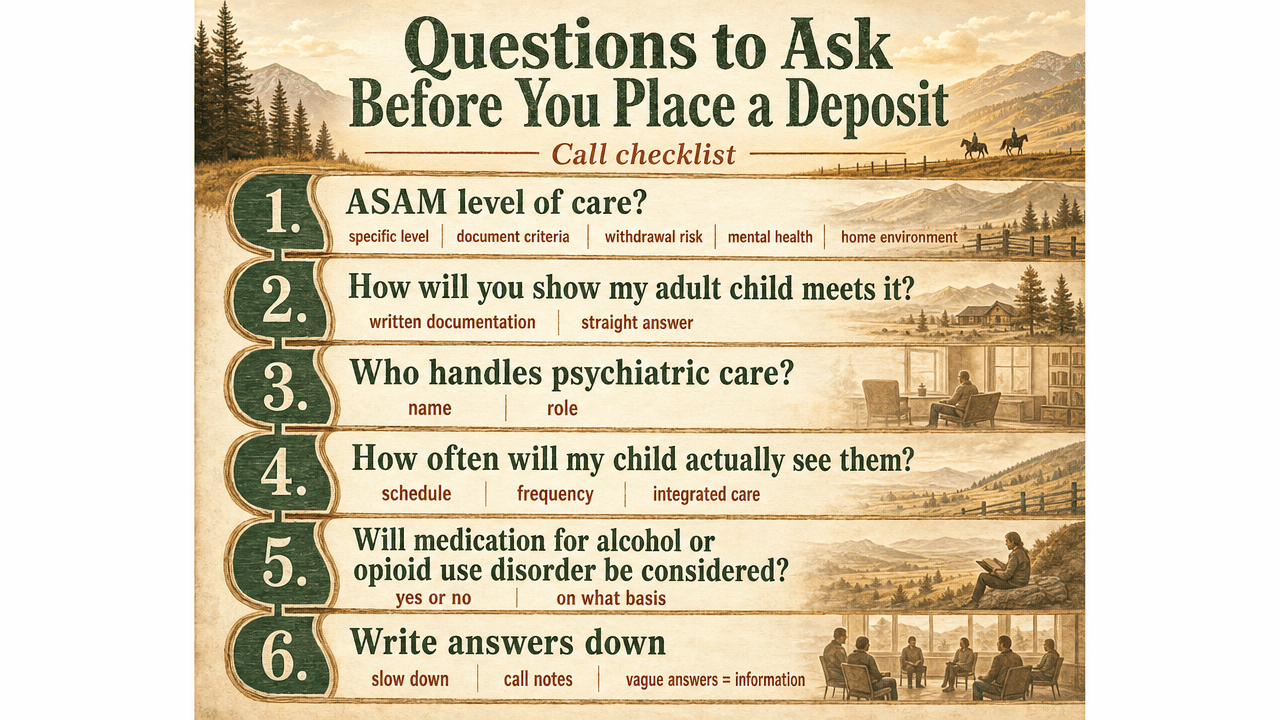
Questions to Ask Before You Place a Deposit
By the time you’re on a call with admissions, you’re often tired, the clock feels tight, and the person on the other end is warm and well-trained. That’s the moment to slow down and ask a few specific things. Write the answers down. If a center can’t give you straight ones, that’s information too.
- “What ASAM level of care do you provide, and how will you document that my adult child meets criteria for it?” You want specifics about withdrawal risk, mental health, and home environment, not a sales reassurance.2
- “Who handles psychiatric care, and how often will my child actually see them?” Integrated mental health care should have a name and a schedule attached to it.7
- “Will medication for alcohol or opioid use disorder be considered, and on what basis?” A clear yes or no is more honest than a vague reference to holistic care.13
- “What does your continuing-care plan look like at 30, 90, 180, and 365 days, and who runs it?” Sustained, structured follow-up is part of what makes a residential stay hold.4
- “What does family programming require of us, and when?” Real involvement has dates on a calendar.
- “How do you decide when to recommend an extension or a step-down?”
If the answers are specific, documented, and patient with your follow-ups, you’re talking to people who do this work seriously. Rocky Mountain Treatment Center is one of the programs built around exactly this kind of conversation — and whether you call them or someone else, you deserve that same level of straight talk before you commit.
Frequently Asked Questions
What if my adult child refuses to go to residential treatment?
How do we pay for residential treatment, and what about insurance?
Is 30 days enough, or does my child really need 90?
What happens if my adult child relapses after leaving the program?
Should we choose a center close to home or send our child farther away?
How involved will we be as parents during the residential stay?
References
- Chapter 5—Specialized Substance Abuse Treatment Programs. https://www.ncbi.nlm.nih.gov/books/NBK64815/
- Overview of Substance Use Disorder (SUD) Care: Clinical Guidelines and ASAM Criteria. https://www.medicaid.gov/state-resource-center/innovation-accelerator-program/iap-downloads/reducing-substance-use-disorders/asam-resource-guide.pdf
- Montana: State Residential Treatment for Behavioral Health Conditions. https://aspe.hhs.gov/sites/default/files/2021-08/StateBHCond-Montana.pdf
- Impact of Continuing Care on Recovery From Substance Use Disorder. https://pmc.ncbi.nlm.nih.gov/articles/PMC7813220/
- Evidence-Based Treatment for Young Adults with Substance Use Disorders. https://pmc.ncbi.nlm.nih.gov/articles/PMC7879425/
- Impact of Continuing Care on Recovery From Substance Use Disorder (Full PDF). https://pmc.ncbi.nlm.nih.gov/articles/PMC7813220/pdf/main.pdf
- Managing Life with Co-Occurring Disorders. https://www.samhsa.gov/mental-health/serious-mental-illness/co-occurring-disorders
- Residential Treatment for Substance Use Disorder (Evidence-Based Practices Resource Center). https://www.samhsa.gov/libraries/evidence-based-practices-resource-center/residential-treatment
- Impact of Continuing Care on Recovery From Substance Use Disorder (NCBI version). https://www.ncbi.nlm.nih.gov/pmc/articles/PMC7813220/
- Implementation of Equine Therapy into Treatment Programming for Adolescents with Substance Use Disorders. https://red.mnstate.edu/cgi/viewcontent.cgi?article=1924&context=thesis
- National Helpline for Mental Health, Drug, Alcohol Issues. https://www.samhsa.gov/find-help/helplines/national-helpline
- Principles of Drug Addiction Treatment: A Research-Based Guide (Third Edition). https://nida.nih.gov/sites/default/files/podat-3rdEd-508.pdf
- Recommend Evidence-Based Treatment: Know the Options. https://www.niaaa.nih.gov/health-professionals-communities/core-resource-on-alcohol/recommend-evidence-based-treatment-know-options
- Equine-assisted services for individuals with substance use disorders. https://pmc.ncbi.nlm.nih.gov/articles/PMC9749232/
- Use of Telemedicine in Addiction Treatment: Current Practices and Organizational Implementation Characteristics. https://pmc.ncbi.nlm.nih.gov/articles/PMC5866865/