
Key Takeaways
- Search results often route calls through aggregators that sell your inquiry to the highest-paying facility; bypass them by starting with SAMHSA’s helpline or FindTreatment.gov.11,12
- Free flights, waived copays, and vague payment explanations on a first call often signal patient brokering; insist on written details about who pays for what before committing.10
- A legitimate program can name its state license and outside accreditor on the phone, describe FDA-approved medications, evidence-based therapies, family involvement, and concrete aftercare.2
- If a program can’t assess you or a loved one within 48 hours, or spends the first ten minutes selling amenities instead of asking clinical questions, move to the next call.2,3
- Keep a fixed list of questions covering licensing, assessment, medications, co-occurring care, family programming, length of stay, aftercare, staff credentials, weekly therapies, and out-of-pocket costs.18,3
- Residential isn’t automatically better than outpatient; intensive outpatient produces comparable outcomes for many people when intensity and duration fit the clinical picture.15,8
- Untreated depression, PTSD, or anxiety needs integrated care under one team and plan, not a referral out after discharge, which is linked to better outcomes.17
- Trauma histories, parenting responsibilities, and gender-specific needs should be surfaced at intake, since programs that ignore them produce worse fit and worse results.16
- Thirty days is an insurance convention, not a clinical rule; ask how extensions are decided and demand specific aftercare check-ins at 30, 60, 90, and 180 days.4,18
- Equine therapy, yoga, and chef-plated meals can support engagement but aren’t proven treatments; ask how much of the week is spent in therapies with real evidence behind them.19,13
The Real Question Isn’t Which Rehab Is Best
You opened this tab, probably tired, probably scared, maybe reading around a hangover or a family member’s silence. That already took something. So let’s skip the pep talk.
Here’s the thing nobody says out loud when you start searching for drug rehab centers: the hardest part isn’t picking the best one. It’s spotting the wrong ones before they pick you. The industry has a real problem with deceptive marketing, paid referrals, and programs that look polished online but can’t answer a basic question about licensing on the phone. If you know what to walk away from, the shortlist gets a lot shorter, and a lot safer.10,11
This guide is built around one idea. Instead of chasing a mythical “best” facility, you’re going to learn the specific traps and the specific quality markers federal agencies use as the yardstick. Licensing. Real medications. Evidence-based care. Family involvement. Aftercare that doesn’t end at the parking lot.1,2
You don’t need to figure it all out today. You just need to stop trusting the loudest voice in the search results.
How the Referral Game Actually Works
Spoofed Listings, Aggregator Hotlines, and Paid Leads
Type “drug rehab centers near me” into a search bar and you’ll see what looks like a menu of options. What you’re actually seeing is a marketplace, and in some corners of it, you are the product being sold.
Here’s the mechanic, straight from a 2017 U.S. House hearing and its staff background memo. Some marketers set up websites and listings that look like the real facility you searched for, but the phone number has been swapped. When you call, you don’t reach the center whose name you Googled. You reach a call aggregator. That aggregator then sells your call, in real time, to whichever facility is willing to pay the highest per-admission commission that day. The person on the phone sounds warm and knowledgeable. They may even say the name of the place you were originally looking for. They are not that place.11
The same hearing documented the fuller picture: kickbacks, deceptive marketing, overbilling, excessive urine drug testing, and in some cases treatment that was low quality or barely existed at all. One line from the hearing is worth sitting with: anyone being paid a referral fee to recommend a specific center does not have your best interests in mind.10
So when a hotline can’t tell you which single facility you’ve reached, or which company owns the phone number, or how they’re compensated when you show up somewhere, hang up. That’s not rudeness. That’s protecting yourself from a system built to route you toward whoever pays the most, not whoever fits you best.
Free Flights, Free Rent, and Other Offers That Should Make You Pause
If someone on a first call offers to fly you across the country tomorrow, cover a few weeks of housing, or waive your copay with a wink, slow down. These offers show up in the same body of testimony that documented patient brokering, and they usually mean somebody is expecting to make that money back through your insurance once you’re admitted.10
That doesn’t mean every generous offer is a scam. Legitimate centers do help with transportation, and some run local pickup services. The difference is transparency. A real program will tell you exactly who is paying for what, what your insurance covers, and what you’ll owe. They’ll put it in writing before you get on a plane or into a van.
The tell isn’t the offer itself. It’s whether anyone will explain, plainly, how the money moves. If the person on the phone gets vague, evasive, or suddenly urgent when you ask, that’s your answer. You don’t owe a stranger a yes today because they were nice for eight minutes.
Where to Call Instead
You can skip the marketplace entirely. SAMHSA runs a free, confidential helpline at 1-800-662-HELP, staffed 24 hours a day, every day of the year, that gives referrals and information without selling your call to anyone. There’s no commission attached. No one gets paid based on where you end up.12
The other neutral starting point is FindTreatment.gov, which NIDA points patients toward directly as a way to identify residential, outpatient, and medication-based options in your area. Use it to build a shortlist of specific facility names. Then call those facilities directly, using the phone number listed on the federal directory, not the one at the top of a paid ad.6
Two calls. That’s the filter. It costs you nothing and it cuts out the middleman entirely.
Five Quality Markers a Real Program Can Prove on the Phone
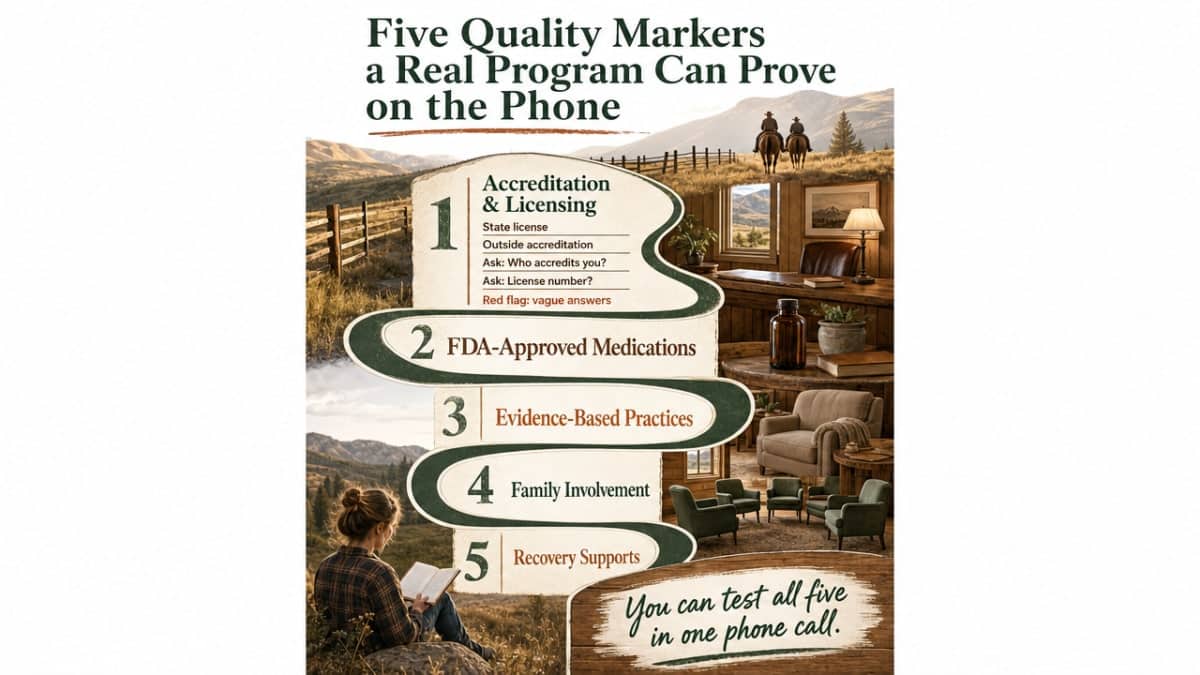
Once you’re past the marketing layer, the question gets simpler: what does a legitimate program actually look like? SAMHSA’s consumer guidance answers this with five plain markers of quality treatment — accreditation, FDA-approved medications, evidence-based practices, family involvement, and recovery supports. You can hold any center against this list in one phone call. If they get vague on any of the five, that tells you something.2
- Accreditation and licensing.
- A real program is licensed by the state and accredited by an outside body. You can ask directly: “Who accredits you, and can you tell me your state license number?” If the person answering can’t say, or has to check and never calls back, keep going. Red flag version: a slick website with no license or accreditation named anywhere on it.1
- FDA-approved medications.
- For opioid and alcohol use disorders, there are medications that reduce cravings and lower relapse risk, and quality programs offer them or coordinate them. Ask whether they’ll be available on site if you or your loved one needs them. Red flag version: a center that treats medication as weakness or insists abstinence alone is the only “real” recovery.1,2
- Evidence-based practices.
- That means therapies with actual research behind them — cognitive behavioral therapy, motivational interviewing, contingency management, family counseling. Ask what specific therapies you’ll receive each week. Red flag version: a brochure promising a “holistic cure” or a proprietary method they won’t explain.2,13
- Family involvement.
- Quality programs bring family into the process through education, counseling, or scheduled programming. Ask what that looks like. Red flag version: no family programming at all, or family is welcome to visit but never included in care.2
- Recovery supports.
- Real treatment doesn’t end at discharge. It connects you to continuing counseling, peer support, and help with housing, employment, or other needs. Ask what happens on day 31, day 90, day 180. Red flag version: discharge-and-done, with a handshake and a printout.1,2
Screenshot this list. Read it once before you dial.
The 48-Hour Rule and Other Fast Filters
Here’s a filter you can use tonight. SAMHSA’s consumer guide is blunt about it: if a program can’t see you or your family member within 48 hours, find another provider. Windows of readiness close fast. Someone willing to walk through a door on Tuesday may not be willing on Friday, and a center that puts you on a two-week waitlist is telling you something about their capacity, their staffing, or both.2
A few other filters that cost nothing to apply on a first call:1,3,18
- They can name their state license and accreditor without a pause. If the person answering has to “get back to you” on whether they’re licensed, that’s your answer.
- They ask about you before they sell to you. A real intake call includes questions about what you’re using, how much, for how long, any medical conditions, and any mental health history. If the first ten minutes are all about their pool and their chef, hang up.
- They quote costs and insurance plainly. Not “we’ll work with you” — actual numbers, or at least a clear process for getting them in writing.
You don’t need a perfect center. You need one that clears a low bar on the phone. That’s enough to move to the next call.
Questions to Ask Before You Say Yes
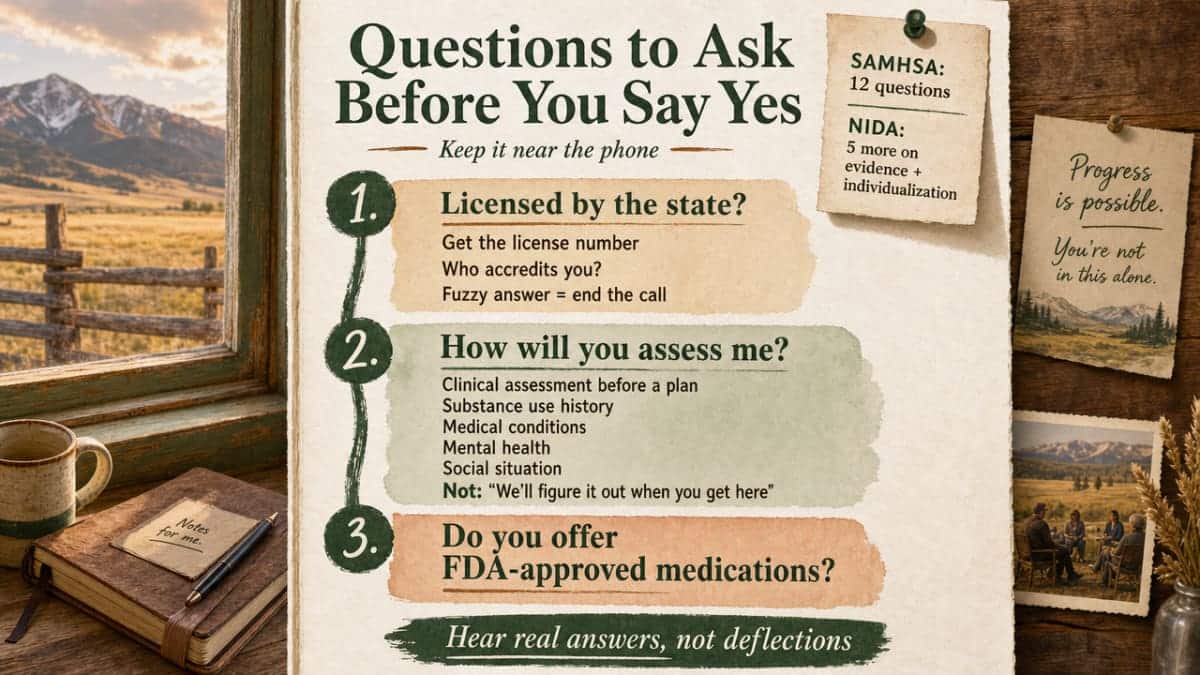
Print this list. Screenshot it. Write it on the back of an envelope. However you keep it, keep it near the phone. SAMHSA’s quick guide gives families 12 specific questions to ask before enrolling in any addiction program, and NIDA layers on five more focused on evidence and individualization. You don’t have to ask them all in one call. You do have to hear real answers, not deflections.3,18
- Are you licensed by the state, and who accredits you? Get the license number and the accrediting body’s name. If either answer is fuzzy, that’s the call.
- How will you assess me before you build a plan? A real intake includes a clinical assessment covering substance use history, medical conditions, mental health, and social situation. “We’ll figure it out when you get here” is not an assessment.
- Do you offer FDA-approved medications on site for opioid or alcohol use disorder? If yes, which ones. If no, how do you coordinate them.
- How do you handle depression, PTSD, anxiety, or bipolar diagnoses alongside addiction? You want to hear about integrated care, not a referral out the door .
- What does family involvement look like? Ask for the actual schedule — education sessions, family counseling, visiting structure.
- How long is the typical stay, and how is that decided? Real programs match duration to clinical need, not to what your insurance pre-authorizes on day one.
- What happens after I leave? You want specifics: continuing counseling, peer support groups, check-in schedule, help with housing or employment if needed.
- Who will be treating me, and what are their credentials? Ask about the counselors, the medical staff, and who runs group sessions.
- What does my insurance cover, and what will I owe out of pocket? Ask for a written estimate before you commit.
- What therapies will I actually receive each week? Names of the approaches, not just “holistic” or “individualized” as adjectives.
If the person on the phone answers most of these clearly, you’re talking to a real program. If they get impatient, redirect to their amenities, or push for a same-day commitment, you already have your answer. Trust that.
The Mistake of Assuming More Restrictive Care Is Better
Here’s a myth worth breaking early: the tighter the lockdown, the better the recovery. It sounds intuitive. It’s not what the research shows.
A systematic review of intensive outpatient programs found that, for many people with substance use disorders, outpatient care produced outcomes comparable to residential care when the intensity and duration were adequate. That doesn’t mean outpatient is right for everyone. It means the right level of care depends on your situation, not on which option sounds most serious.15
Residential makes sense when a few things are true at once. You need medically monitored detox. Your home isn’t safe or sober. You’ve tried outpatient before and it didn’t hold. You’re carrying a serious co-occurring mental health condition that needs 24-hour eyes on it. NIDA describes residential as intensive, 24-hour structured care for people with severe problems, co-occurring conditions, or unstable living situations. That’s the population it’s built for.8
Outpatient can work when you have stable housing, someone at home who supports your recovery, a job you can keep, and a level of use that doesn’t require medical supervision to stop. A good intake assessment will tell you which side of that line you’re on. If a center pushes you toward their most expensive level of care before they’ve asked what your days actually look like, that’s the sales pitch talking, not the clinician.
Ask which level of care they’re recommending, and why. Ask what they’d recommend if their program didn’t exist. A real answer to that second question tells you almost everything.
Programs That Can’t Handle What You’re Actually Carrying
Co-Occurring Depression, PTSD, and Anxiety
Most people who walk into a drug rehab center aren’t only dealing with drugs. There’s usually something underneath — depression that started years before the first pill, PTSD from something you don’t talk about, anxiety that made the first drink feel like relief. If a program treats the substance use and ignores the rest, you’re going to feel that gap fast.
SAMHSA’s clinical guidance is direct on this: integrated treatment for co-occurring mental health and substance use disorders is associated with better outcomes than treating each condition separately or in sequence. That means one team, one plan, one set of records. Not “finish rehab and then find a therapist.”17
Ask specifically. “If I come in with untreated depression, who diagnoses it, who treats it, and how does that show up in my weekly schedule?” A real program can name the psychiatrist or prescriber, describe how mental health assessments happen at intake, and tell you which therapies address trauma or mood alongside the addiction work. A weak program will tell you they “address the whole person” and change the subject. That’s the tell. Push once. If the answer stays vague, keep dialing.17
Trauma, Parenting, and Gender-Specific Needs
Some of what you’re carrying doesn’t fit neatly into a diagnosis. A history of assault. Kids at home who need someone to pick them up from school. A body that remembers things your head has spent years trying to drown.
SAMHSA’s Treatment Improvement Protocol on women’s care puts this plainly: women in treatment often bring histories of trauma, mental health conditions, and responsibility for children, and programs that ignore those realities produce worse fit and worse outcomes. The same principle applies more broadly. Ask how a program handles trauma-informed care. Ask what happens if you have young kids at home — is there family programming they can join, phone access, help coordinating with a co-parent?16
You don’t have to disclose everything on the first call. You do need a program that asks the right questions before you arrive, not after you’re already three days in and out of options.
Duration, Aftercare, and the 30-Day Illusion
Thirty days is a number that got famous. It’s not a clinical finding. It’s what a lot of insurance plans will authorize on the first pass, and over time it hardened into the shape most people picture when they picture rehab.
The research says something different. NIDA’s principles are direct: staying in treatment for an adequate period of time is critical, and cutting off care early is one of the most common reasons treatment doesn’t hold. A peer-reviewed study of drug court participants found that treatment completion was associated with significantly reduced substance use and criminal behavior — length and finishing what you started both mattered. That study looked at a specific court-referred population, so the exact numbers don’t transfer to every setting, but the direction is consistent with decades of NIDA guidance.4,14
What that means for your call list: ask what happens if you need more than 30 days. A real program will describe how they extend care based on how you’re doing, not on what the initial authorization said. 30-, 60-, and 90-day residential options are common, and the right length is a clinical decision, not a calendar one.4
Then ask what happens after. Aftercare isn’t a bonus feature — SAMHSA lists ongoing recovery supports among its five signs of quality treatment. You want to hear specifics: continuing counseling, peer groups, check-ins at 30, 60, 90, and 180 days out, help reconnecting to work or housing if you need it. If discharge day is where the plan ends, the plan was never really a plan.2,18
Equine Therapy, Yoga, and the Amenity Trap
Scroll through rehab websites long enough and you’ll see the same photos: horses in a golden pasture, a yoga mat by a window, chef-plated food. It looks like healing. Sometimes it is. Sometimes it’s the wallpaper on a program that skimps on the parts that actually do the work.
Here’s the honest read on equine therapy, since it shows up on so many brochures. A 2022 systematic review of equine-assisted services for substance use disorders found signals of possible benefit for retention and mental health, but the studies were small and mixed enough that the authors couldn’t call it proven. A separate mixed-methods study of horse-assisted therapy in youth reported that participants stayed in treatment longer and were more likely to finish. Promising as an adjunct. Not a headline cure. If a center pitches horses as the reason people get better, that’s marketing. If they pitch counseling, medications where appropriate, family work, and aftercare — and mention equine sessions as one supportive piece of that plan — that’s a program.19,20
The same test applies to yoga, art, hiking, and every other extra. Ask what percentage of your week is spent in therapies with actual evidence behind them. If the amenities are the plan, keep looking.13
Making the Call: What to Say and Where to Start
You’ve read a lot. You’re probably tired. Here’s the shortest version of everything above, and the two things to do next.
Start with a neutral number, not a search ad. Dial SAMHSA’s National Helpline at 1-800-662-HELP, or open FindTreatment.gov, and build a shortlist of specific facility names in states you’re willing to consider. Then call those facilities using the phone number listed on the federal directory. On each call, ask the same handful of things: Are you licensed and accredited, and by whom? How soon can you assess me? What medications and therapies do you offer? How do you handle mental health conditions alongside the addiction? What does family programming and aftercare actually look like?2,6,12,18
If they answer plainly, you’re in a real conversation. If they push, promise, or dodge, hang up without apologizing. One of the centers you can call directly is Rocky Mountain Treatment Center in Great Falls, Montana. Either way, the first honest phone call is the win. Make it today.
Frequently Asked Questions
How do I know if a rehab hotline is legitimate or a paid referral service?
What licenses and accreditations should a real drug rehab center have?
Is residential rehab always better than outpatient treatment?
What should I ask a rehab center before I agree to admit myself or a loved one?
Does equine therapy, yoga, or a luxury setting actually improve recovery outcomes?
How long should treatment last, and what happens after I leave?
References
- Quality Treatment for Mental Health, Drugs and Alcohol. https://www.samhsa.gov/find-support/learn-about-treatment/finding-quality-treatment
- Finding Quality Treatment for Substance Use Disorders. https://library.samhsa.gov/sites/default/files/pep18-treatment-loc.pdf
- SEEKING DRUG ABUSE TREATMENT: KNOW WHAT TO ASK. https://nida.nih.gov/sites/default/files/treatmentbrochure_web.pdf
- Principles of Drug Addiction Treatment: A Research-Based Guide (Third Edition). https://nida.nih.gov/sites/default/files/podat-3rdEd-508.pdf
- Selecting Best-Fit Programs and Practices: Guidance for Substance Misuse Prevention Practitioners. https://library.samhsa.gov/sites/default/files/selecting-best-fit-programs-pep19-02.pdf
- Treatment Materials for Patients | National Institute on Drug Abuse. https://nida.nih.gov/nidamed-medical-health-professionals/treatment/treatment-materials-patients
- Treatment Options for Substance Use Disorder. https://www.samhsa.gov/substance-use/treatment/options
- What are residential treatment programs, and who can benefit from them?. https://nida.nih.gov/publications/principles-drug-addiction-treatment-research-based-guide-third-edition/frequently-asked-questions/what-residential-treatment-programs
- How to Find Alcohol Treatment. https://alcoholtreatment.niaaa.nih.gov/how-to-find-alcohol-treatment
- Examining Concerns of Patient Brokering and Addiction Treatment. https://www.congress.gov/115/chrg/CHRG-115hhrg28931/CHRG-115hhrg28931.pdf
- Staff Background Memo: Examining Concerns of Patient Brokering and Addiction Treatment. https://docs.house.gov/meetings/IF/IF02/20171212/106716/HHRG-115-IF02-20171212-SD002.pdf
- National Helpline for Mental Health, Drug, Alcohol Issues. https://www.samhsa.gov/find-help/helplines/national-helpline
- Treatment Approaches for Drug Addiction. https://nida.nih.gov/publications/drugfacts/treatment-approaches-drug-addiction
- The impact of treatment length and completion on substance use outcomes among drug court participants. https://pubmed.ncbi.nlm.nih.gov/23731427/
- The effect of intensive outpatient programs for substance use disorder: A systematic review. https://pubmed.ncbi.nlm.nih.gov/26999388/
- Substance Abuse Treatment: Addressing the Specific Needs of Women (TIP 51). https://www.ncbi.nlm.nih.gov/books/NBK424859/
- Co-Occurring Disorders: Integrated Assessment and Treatment (from TIP series). https://www.ncbi.nlm.nih.gov/books/NBK424848/
- A Quick Guide to Finding Effective Alcohol and Drug Addiction Treatment. https://www.michigan.gov/-/media/Project/Websites/mdhhs/Folder2/Folder62/Folder1/Folder162/SAMHSA_Quick_Guide_Find_Treatment.pdf
- Equine-assisted services for individuals with substance use disorders: A systematic review. https://pmc.ncbi.nlm.nih.gov/articles/PMC9749232/
- More Than Just a Break from Treatment: How Substance Use Disorder Patients Experience a Horse-Assisted Therapy Program. https://pmc.ncbi.nlm.nih.gov/articles/PMC5054942/