
Key Takeaways
- Start by recognizing that proximity matters less than matching program intensity, evidence-based therapies, and built-in confidentiality protections to what your clinical situation actually requires.
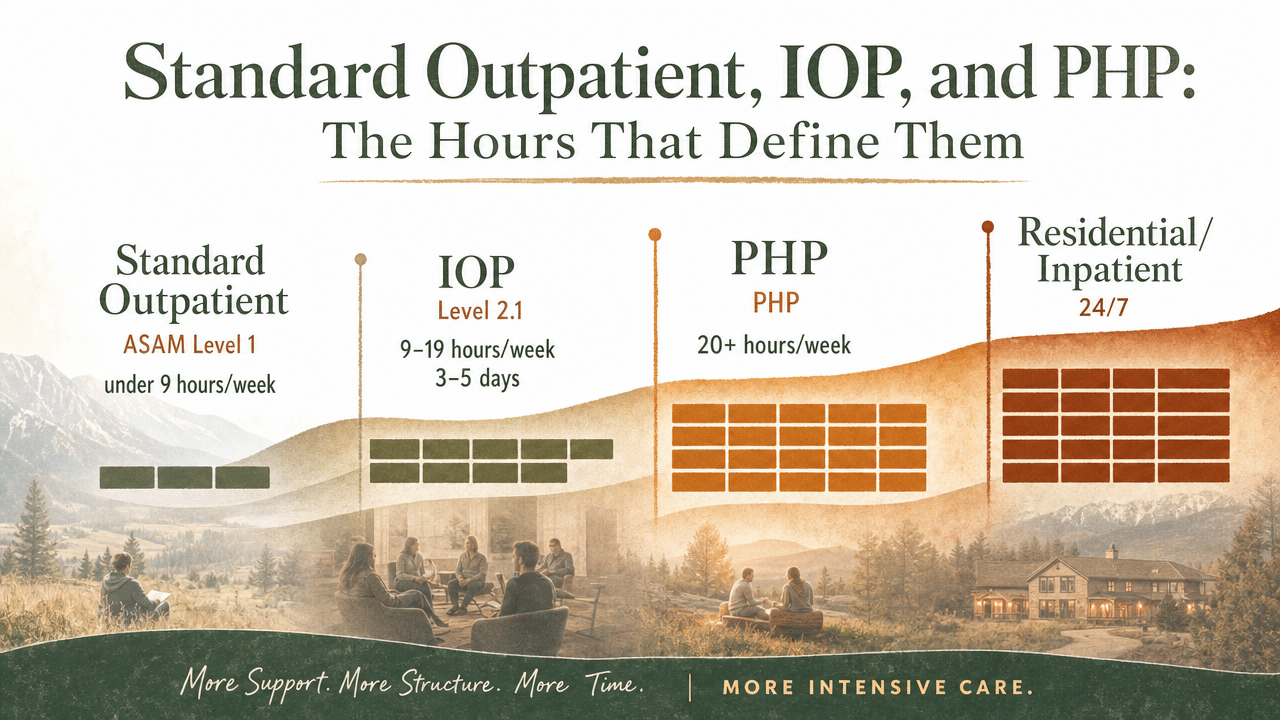
- Understand that outpatient spans standard outpatient (under 9 hrs/week), IOP (9-19 hrs/week), and PHP (20+ hrs/week), and ask any program to name its tier in hours.
- Map treatment hours against your real workload honestly, because choosing the lightest tier that fits your calendar rather than your clinical need is a common and costly mistake.
- Walk through the ASAM six-dimension assessment yourself—withdrawal risk, medical conditions, mental health, readiness, relapse risk, and recovery environment—before your first conversation with a program.
- Let the pattern of your six-dimension answers point to a level of care, recognizing that acute withdrawal risk or a hostile home environment often means outpatient is not the safe starting point.
- Trust that well-run outpatient care produces outcomes comparable to residential when patients are appropriately matched and complete treatment, with meaningful improvement typically appearing around the three-month mark.
- Insist on medications as part of care for alcohol or opioid use disorder, and treat any program that dismisses FDA-approved pharmacotherapy as out of step with the evidence.
- Evaluate confidentiality as clinical infrastructure protected by 42 CFR Part 2, and verify licensure through state agencies like Montana DPHHS plus Joint Commission or CARF accreditation.
The Real Question Behind Your Search
You typed “outpatient addiction treatment near me” for a reason, and it probably wasn’t just about zip codes. You’re trying to figure out if you can get real help without taking a month off, without a paper trail your licensing board might see, without your team wondering where you went. That’s a heavy thing to carry into a search bar, and it deserves a better answer than a list of nearby clinics.
Here’s the honest reframe: proximity is the easy part. The harder questions are whether the program’s intensity matches what your body and brain actually need right now, whether the therapies and medications on offer have evidence behind them, and whether the confidentiality protections are built into how the program operates rather than just promised on a homepage. Sometimes outpatient is the right fit from day one. Sometimes it’s the right fit only after a short residential stabilization. You deserve to know which one you’re looking at before you commit.
This guide walks you through that decision the way a thoughtful clinician would, not the way a marketing brochure would.
What Outpatient Actually Means at Each Intensity
Standard Outpatient, IOP, and PHP: The Hours That Define Them
“Outpatient” is not one thing. It’s a range, and the range is measured mostly in hours per week of structured programming. Knowing where a program sits on that range tells you more about your commitment and your clinical support than any glossy description will.
At the lightest end, standard outpatient (ASAM Level 1) generally means fewer than 9 hours per week of scheduled treatment. Think weekly individual therapy, a group session or two, and periodic check-ins with a prescriber. It’s the level most compatible with a full work schedule, but it assumes you’re already stable and not in acute risk.1
Intensive outpatient (Level 2.1) is the middle tier. For adults, it delivers 9 to 19 hours per week of structured, professionally directed programming, typically spread across three to five days. That’s real clinical contact: multiple group sessions, individual counseling, family or psychoeducation groups, and case management. You keep sleeping at home, but the week has a spine.
Partial hospitalization (PHP) sits above IOP, usually at 20 or more hours per week. Days look closer to a shortened workday of clinical programming, with evenings and weekends at home. Above that is residential and, at the top, medically monitored 24/7 care.
The chart below maps those tiers side by side so you can see the jump between them at a glance:
When a program’s website says “outpatient,” ask them which of these tiers it actually is. If they can’t answer in hours per week and days per week, that’s a data point about the program.
Time and Coverage Math: Fitting Treatment Around a Full Workload
Now do the math against your actual week. If you’re carrying a 50-hour workload plus call, meetings, or clinic hours, IOP is not a light lift. Nine to nineteen hours of clinical programming is roughly a part-time job stacked on top of your day job.
Most IOPs schedule sessions in blocks — three-hour evening groups three nights a week is a common shape, and some offer early morning tracks. That structure was built with employed adults in mind. You can protect a 7 a.m. to 6 p.m. workday and still hit the minimum. But it also means your evenings disappear for the duration, and “just this one dinner” is exactly the kind of drift that erodes engagement.
PHP is harder to hide inside a full-time job. Twenty-plus hours of daytime clinical programming usually requires a formal reduction in work — reduced schedule, FMLA, or short-term leave — even when the program runs on weekdays. That’s worth naming honestly to yourself before you commit.
Standard outpatient fits easily around work, but its intensity may not match what you need if you’re coming off active use, managing withdrawal risk, or trying to hold recovery together in a high-stress environment. Choosing the lightest tier because it fits your calendar is a common, understandable mistake. The right question is not “what will fit?” — it’s “what intensity does my situation actually call for, and how do I build my week around that?”2
The ASAM Six-Dimension Framework as Your Decision Spine
The Six Dimensions and What They Ask You to Answer
Clinicians who place patients into the right level of care don’t guess. They use the American Society of Addiction Medicine’s six-dimension assessment, which is essentially a structured way to ask, “What is actually going on with this person, and what does that mean for how much support they need right now?” You can walk through those same six dimensions yourself before you talk to anyone. The point isn’t to self-diagnose. It’s to arrive at that first conversation already knowing what you’re weighing.
Here are the six, in plain language, with the honest question each one puts in front of you:
- Acute intoxication and withdrawal potential. When you stop or cut back, what happens to your body? Tremors, sweats, seizures, blood pressure spikes, or protracted alcohol or benzodiazepine withdrawal are not outpatient problems. They’re medical ones.
- Biomedical conditions and complications. What else is your body carrying? Liver disease, cardiac issues, chronic pain, pregnancy, or medications that interact badly with recovery pharmacotherapy all change the math.
- Emotional, behavioral, or cognitive conditions. Are you dealing with depression, anxiety, trauma, an eating disorder, or suicidal thoughts alongside the substance use? Co-occurring conditions are common and treatable, but they need to be treated together, not sequenced.
- Readiness to change. Where are you honestly? Some days you’re convinced. Other days you’re bargaining with yourself. That’s not a character flaw; it’s data about how much external structure you need to hold the line.
- Relapse, continued use, or continued problem potential. Given your history, what’s the realistic risk that use resumes in the next 30 days without significant intervention?
- Recovery environment. Who and what surrounds you? A partner in recovery, a supportive employer, and a stable home tilt one way. Colleagues who drink hard at every dinner, a spouse still using, or a job where the substance is at arm’s length tilt the other.
Read those again slowly. If three or more give you a knot in your stomach, that’s the assessment talking.
How Your Answers Point to a Level of Care
The six dimensions don’t produce a score. They produce a pattern. And the pattern points somewhere.3
If your answers cluster in dimensions 4, 5, and 6 — you’re motivated, your withdrawal risk is low, your body is stable, and your home environment is reasonably safe — standard outpatient or IOP is usually where placement lands. You need therapy, accountability, and structure, but not medical supervision.
If dimension 3 lights up alongside 5 — meaning depression, trauma, or anxiety is tangled with a serious relapse risk — IOP or PHP with integrated co-occurring care becomes the more honest fit. Treating the substance use without treating what sits underneath it rarely holds.
If dimension 1 is a real concern — you’ve had withdrawal seizures before, you’re drinking daily to head off shakes, or you’re using opioids in doses that suggest a rough taper — outpatient is not the safe starting point. Medically monitored detox comes first, and residential often follows.
Dimension 6 is the one professionals underweight. If your recovery environment is genuinely hostile to sobriety — a partner who drinks, a home where the substance is stored, a job culture that runs on it — sleeping there every night while trying to build early recovery is asking a lot of yourself. That’s a case where a residential stay, even a short one, buys you the geographic distance to reset before you step down to outpatient. It’s not weakness. It’s engineering.
Medications as Part of Outpatient Care
If you have alcohol or opioid use disorder, a program without medications is a program working with one hand tied. That’s worth saying plainly, because stigma still keeps a lot of clinicians and patients from asking the question directly.
For opioid use disorder, three FDA-approved medications carry the evidence: methadone, buprenorphine, and naltrexone. All three are meant to be paired with counseling and recovery support, not used in isolation, and all three can be delivered through outpatient settings with appropriate monitoring. For alcohol use disorder, behavioral treatments and FDA-approved medications are roughly equally effective and can be combined — meaning you don’t have to choose between therapy and pharmacotherapy, and a program that offers both gives you more room to find what holds. Federal guidance describes this as a “whole-patient” approach: medication plus counseling, coordinated together.
When you’re vetting a program, ask specifically: Do you have a prescriber on staff or a direct referral relationship? Which medications do you prescribe or coordinate? How is medication management integrated with the group and individual therapy schedule? A program that treats medication as an afterthought — or worse, discourages it as “not real recovery” — is out of step with what the evidence actually shows. That answer alone can narrow your list quickly.
Confidentiality as Clinical Infrastructure
For a licensed professional, privacy isn’t a comfort. It’s a condition of care. If you can’t trust the walls, you can’t be honest inside them, and honesty is where the clinical work starts. So evaluate confidentiality the way you’d evaluate any other clinical system: look at how it’s built, not how it’s described.
Federal substance use treatment records are governed by 42 CFR Part 2, which is stricter than HIPAA. Under Part 2, a program generally cannot disclose that you’re even a patient without your written, specific consent — not to your employer, not to your insurer beyond what’s needed for payment, not to a family member, not to another treating clinician. The consent is granular: it names who receives what, and for how long. You can revoke it. That’s the floor, and any program you’re considering should be able to explain how it applies to your record in one clear paragraph. If they can’t, that tells you what you need to know.
Ask specific questions. Where are records stored, and who inside the program can see them? How are telehealth sessions conducted — is the platform hardened for behavioral health, and what’s your responsibility for a private location on your end? How are prescriptions written and pharmacies notified, especially if you have a professional monitoring program involved? If your license requires reporting to a board or a Physician Health Program, how does the treatment program coordinate that release, and does your counselor help you script what gets shared?
The programs that treat these questions as ordinary are the ones that have built the infrastructure. The ones that get vague are telling you something too.
How to Verify a Program Is Legitimate
Before you hand a program your history, verify it can actually operate. In Montana, that means state approval through the Department of Public Health and Human Services, which sets standards for prevention, treatment, and recovery services and requires supporting documentation like a health care facility license. The state’s rules also define what counts as skilled treatment — individual and group counseling, medication management, family therapy, educational groups — and set staffing and clinical standards a real program must meet. You can check a program’s status directly with DPHHS rather than trusting a website badge.
Ask three things on the phone. First, what accreditation and state approvals do you hold, and can you send me the current documentation? Joint Commission or CARF accreditation on top of state approval is the pattern you want to see. Second, who are the licensed clinicians on staff — LCSWs, LACs, LCPCs, prescribers — and what is the ratio to patients? Third, what evidence-based therapies do you use, and how is treatment planning individualized?4
If you’d rather start with a neutral referral source, SAMHSA’s National Helpline (1-800-662-HELP) is free, confidential, and available around the clock.
The Four Stages You Can Expect After Intake
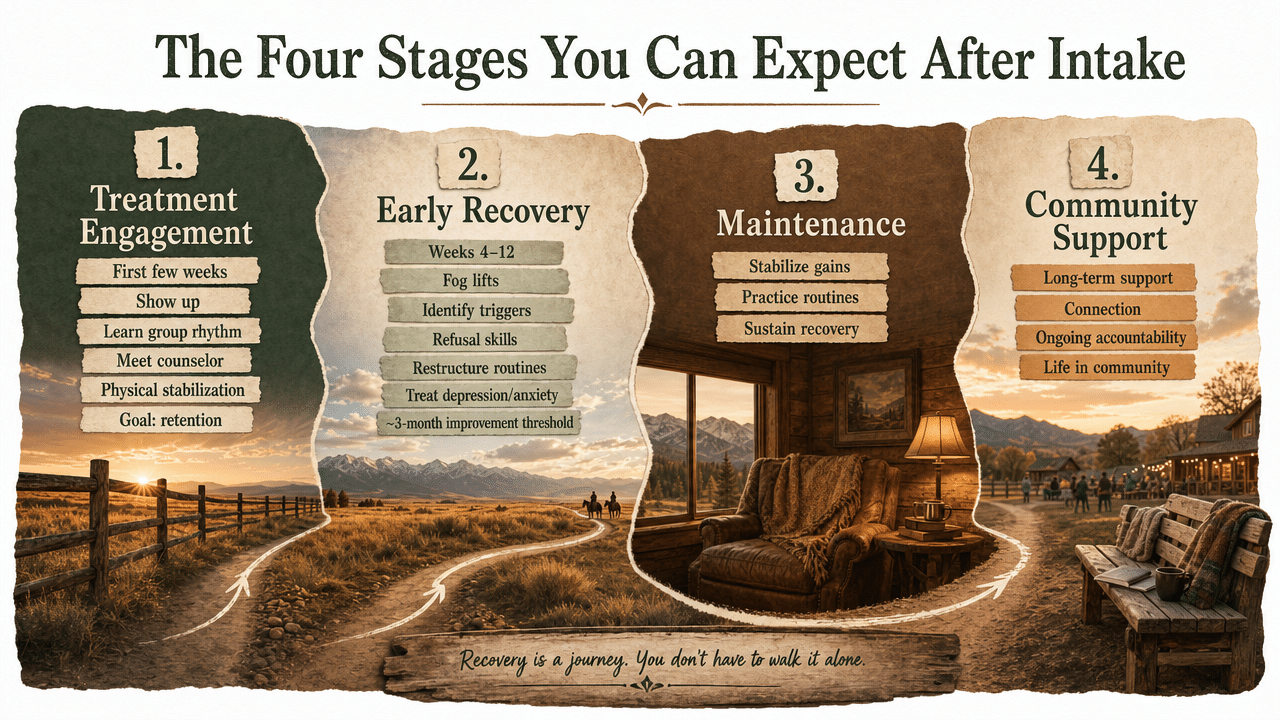
Recovery in outpatient care doesn’t happen in one long arc. It moves through four distinct stages, and knowing which one you’re in helps you (and your clinician) calibrate what needs the most attention that week.
Stage 1: Treatment engagement. The first few weeks. You’re showing up, learning the rhythm of the groups, meeting your counselor, and often still stabilizing physically. The clinical goal here is retention, not transformation. If you make it past this stage, the odds shift meaningfully in your favor.
Stage 2: Early recovery. Roughly weeks four through twelve for most patients. The fog lifts a little. The work turns to identifying triggers, building refusal skills, restructuring routines, and treating co-occurring depression or anxiety in earnest. NIDA’s guidance places the threshold of significant improvement around the three-month mark, which lines up with the tail end of this stage.
Stage 3: Maintenance. Months three through twelve, give or take. Session frequency usually steps down, from IOP to standard outpatient, from weekly to biweekly. You’re practicing recovery inside your real life — the meetings, the travel, the tense family dinner — and bringing what happened back into therapy.
Stage 4: Community support. Alumni groups, mutual-support meetings, ongoing check-ins. Care becomes lower-intensity but longer-horizon.
Knowing the stages keeps you from mistaking a hard week in stage two for evidence the program isn’t working. It usually just means you’re in stage two.
When Residential Is the Safer First Step
There’s a version of this decision where outpatient is the right call, and a version where it isn’t. It’s worth being honest about the second one, because trying to muscle through outpatient when your situation calls for more can cost you more time, not less.
Residential is the safer starting point when a few specific things are true. If you’ve had withdrawal seizures, delirium tremens, or a history of heavy benzodiazepine or alcohol dependence, medically monitored detox comes first — outpatient can’t hold that risk safely. If your home environment actively works against sobriety — a partner still using, the substance stored in the kitchen, a job culture that runs on it — sleeping there during the fragile first weeks stacks the deck against you. If a prior outpatient attempt didn’t hold, that’s information, not failure. And if co-occurring depression or suicidal ideation is acute, the round-the-clock structure of a residential setting is protective in a way an evening group cannot be.
A 30, 60, or 90-day residential stay isn’t the opposite of returning to work. For many professionals, it’s the shortest path back to sustained function — a defined leave, a stabilized foundation, and a planned step-down into IOP or standard outpatient near home. Rocky Mountain Treatment Center exists for exactly that arc. Choosing the higher level of care when the assessment points there isn’t a detour. It’s the map.
The Step-Down Pathway: Continuum, Not Product
Think of outpatient care less as a destination and more as a phase in a longer arc. A common trajectory looks like this: medically monitored detox, then a residential stay of 30, 60, or 90 days, then partial hospitalization for a few weeks as you re-enter your routine, then intensive outpatient while you rebuild your work rhythm, then standard outpatient, then alumni and community support that quietly carries you for a year or more. Each step down loosens the structure a little and hands more of the day back to you.
You may not enter at the top. Plenty of professionals start at IOP and stay there. But if you do begin higher up, ask the program on day one what the step-down plan looks like — who coordinates the handoff, how records move under your consent, how the next level’s clinician gets briefed. A program that thinks in continuum will answer that question in specifics. That’s the one worth choosing.
Frequently Asked Questions
How many hours per week does an intensive outpatient program require?
For adults, IOP (ASAM Level 2.1) delivers 9 to 19 hours per week of structured, professionally directed programming, usually across three to five days. Expect a mix of group therapy, individual counseling, family or psychoeducation groups, and case management. Many programs run evening tracks so you can protect a standard workday, though your evenings will be committed for the duration.
Is outpatient treatment as effective as residential care for professionals?
For appropriately matched patients who complete treatment, outcomes from well-run intensive outpatient programs are broadly comparable to residential care. Two conditions matter: the ASAM assessment has to actually point you toward outpatient, and you have to finish. If your withdrawal risk, co-occurring conditions, or home environment argue for a higher level of care, the equivalence findings stop applying to your situation.
Will my employer or licensing board find out I’m in treatment?
Substance use treatment records are protected by 42 CFR Part 2, which is stricter than HIPAA. A program generally cannot confirm you’re a patient without your specific written consent, and that consent names who receives what and for how long. If a licensing board or Physician Health Program requires reporting, that release runs through a signed, revocable authorization you control with your counselor.
When is residential treatment the safer choice over outpatient?
Residential is the safer starting point when withdrawal carries medical risk (seizure history, heavy alcohol or benzodiazepine dependence), when co-occurring depression or suicidal ideation is acute, when a prior outpatient attempt didn’t hold, or when your home environment actively works against sobriety. A defined 30, 60, or 90-day stay followed by a planned step-down to PHP or IOP is often the shortest path back to sustained function.
Do outpatient programs prescribe medications for alcohol or opioid use disorder?
Quality programs do. For opioid use disorder, methadone, buprenorphine, and naltrexone are FDA-approved and delivered alongside counseling in outpatient settings. For alcohol use disorder, behavioral treatments and FDA-approved medications are roughly equally effective and can be combined. Ask whether the program has a prescriber on staff or a direct referral relationship, and how medication management is integrated with group and individual sessions.
How do I verify that an outpatient program is legitimate and licensed?
In Montana, confirm state approval through the Department of Public Health and Human Services, which sets standards for treatment and recovery services and defines what counts as skilled clinical care. You can check a program’s status directly with DPHHS. Ask for current accreditation documentation (Joint Commission or CARF), licensed clinician credentials, and evidence-based practices. SAMHSA’s National Helpline at 1-800-662-HELP offers confidential referrals.