Key Takeaways
- Watch for signs that fit ag life: a bottle hidden in the shop or truck, chores slipping later, unexplained equipment damage, and pulling back from the co-op or church.3
- Montana carries heavier substance use and suicide rates than the nation, and rural distance, visibility, and toughness culture make asking for help feel harder than it should.5
- Timing beats scripting: raise it during a slow stretch, sober, private, and never right after a fight, a bank call, or the middle of branding or haying.
- Open with worry, not diagnosis, and stay steady when he deflects — several conversations are often needed before a proud ag worker accepts help.11
- Answer the ‘who runs the place’ fear with a real handoff plan: neighbors, a hired hand, adult kids, and the county extension agent covering chores and bookkeeping.
- Residential care in Great Falls beats piecing together local outpatient when providers are scarce, drives are long, and a parked truck at the clinic gets noticed.10,11
- Expect medically monitored detox the first week, then counseling, groups, and aftercare; equine therapy helps a horse person engage but is an addition, not a replacement.4,2
- During treatment, tell the kids something true and age-appropriate, keep routines steady, and use Family Week to do the harder conversations with trained support.6
When the person who runs the place is quietly falling apart
You’re probably reading this early, before the coffee’s finished, or late, after everyone else is asleep. Something’s off with him. Or her. The person who runs the outfit, the one who never sits down, is slower now. Quieter. Cracking a beer at 10 a.m. in the shop. Missing calls from the co-op. Snapping at the kids over nothing.
You’re not imagining it. And you’re not overreacting by looking this up on how to help a rancher or farmer struggling with addiction.
Ranchers and farmers carry loads most people never see, and heavy drinking or drug use hides easily inside a 16-hour day. Nobody notices a bottle in the tack room. Nobody questions why he’s still out checking heifers at midnight. The work becomes cover, then it becomes the excuse, then it becomes the thing falling apart too.
What follows isn’t a lecture. It’s a set of quiet, specific steps — what to watch for, when to speak, what to say, who runs the place while they’re gone, and how Rocky Mountain Treatment Center in Great Falls fits into a life built around livestock and land.
What you’re actually seeing (and what it means)
Warning signs that fit a 16-hour ag day
Most addiction checklists were written for people with 9-to-5 lives. They don’t fit here. On a ranch, the drinking hides inside the work, and the work never really stops.
Watch for these instead:
- A bottle or a flask that lives in the shop, the tack room, or under the bench seat of the truck — not the kitchen.
- Morning chores that used to happen at 5 a.m. now happening at 7, or getting handed off to a kid or a hired man without explanation.
- Equipment damage nobody can quite account for. A dented gate. A swather that went into a fence. A four-wheeler rolled and laughed off.
- Skipping the co-op meeting, the brand inspector’s coffee, the church potluck — places he used to show up without thinking.
- Short temper during calving, haying, or shipping. Not just tired-short. Mean-short. Aimed at the dog, the kids, or you.
- Sleep that’s gone strange — up at midnight for no reason, or dead asleep at 3 p.m. in the recliner with boots still on.
- Weight loss, a gray cast to the skin, cuts and bruises he can’t remember getting.
- Money that doesn’t add up. A cattle check that vanished. A propane bill that didn’t get paid.
Farmers and ranchers carry higher rates of risky drinking than people outside agriculture, with the risk climbing when depression, financial pressure, and isolation stack up together. Men in ag are especially vulnerable, and the same review flags that alcohol trouble often travels alongside untreated mental health struggles. If you’re counting three or four of these signs, you’re not being dramatic. You’re paying attention. That’s what the beginning of help looks like.3
Why ag country carries a heavier load
You’re not imagining that this is harder here. It is.
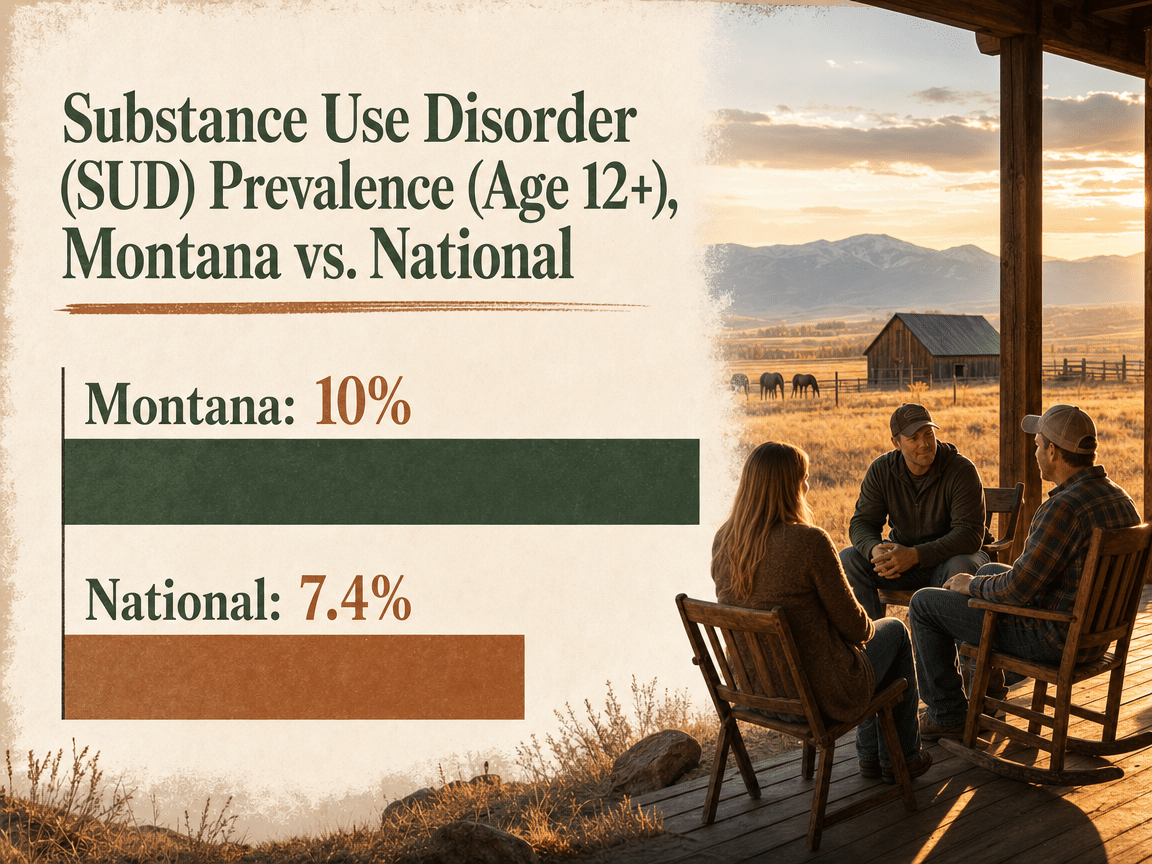
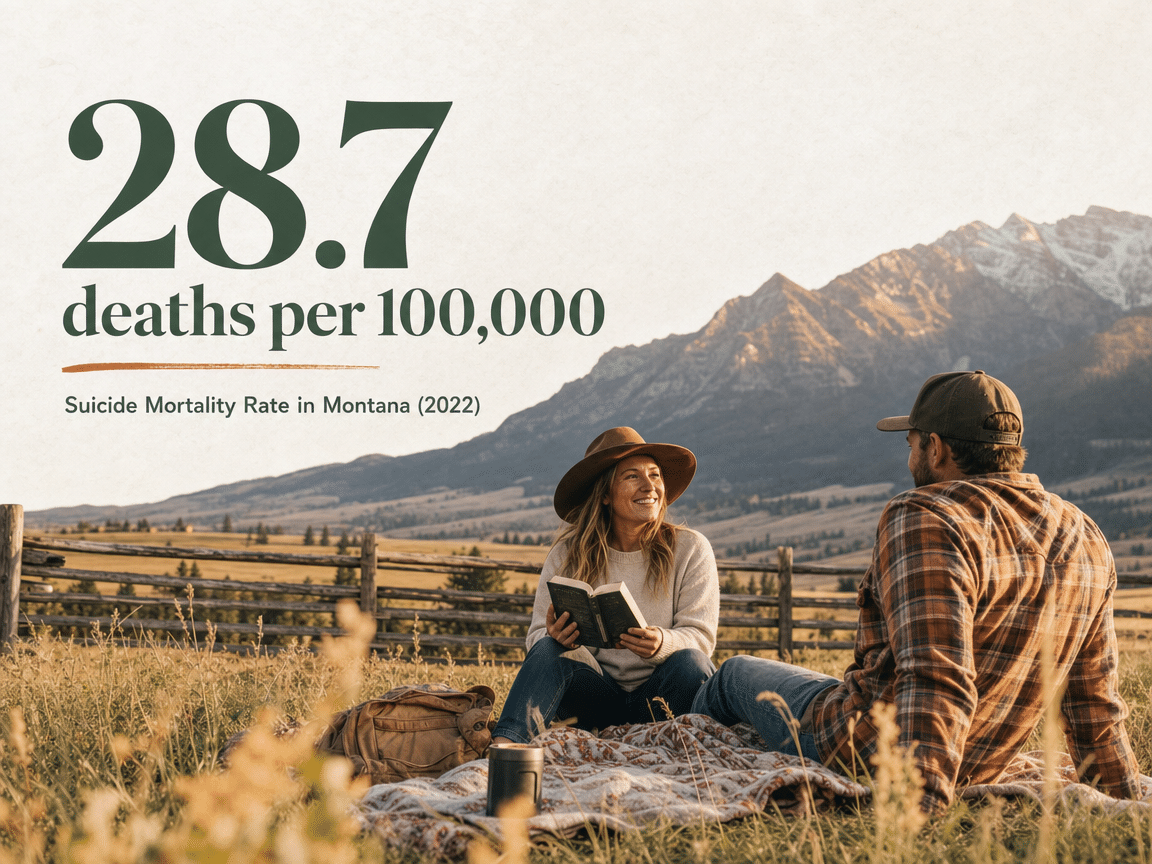
More than 10% of Montanans aged 12 and older meet the criteria for a substance use disorder, compared with 7.4% nationally. Past-month binge drinking sits above 30% in Montana, again well ahead of the country as a whole. And the piece that gets talked about least: Montana’s suicide rate reached 28.7 deaths per 100,000 in 2022, among the highest in the nation, and it often walks hand in hand with untreated drinking and depression.5
Those aren’t numbers to memorize. They’re context for why the person you love is struggling — and why waiting rarely makes it better.
Some of what drives this is the country itself. Long distances between towns. A doctor’s office that’s a two-hour drive one way. Neighbors who know each other’s trucks by sight, which makes anonymity almost impossible. A culture that respects toughness and treats asking for help as something other people do.
None of that is a flaw in your rancher. It’s the water he’s been swimming in. And it’s why the small choices — a private phone call, a conversation nobody else overhears, a treatment center a few counties away instead of the clinic in town — matter so much. Rocky Mountain Treatment Center in Great Falls sees this pattern every week. The setting is Montana. The staff, over 80% of whom are in recovery themselves, know exactly what it costs a proud person to walk through the door. You’re not the first family to make this call, and the load you’re carrying is real.
Picking the moment: not after a fight, not during branding
Timing matters more than the perfect words. If you bring this up after a shouting match, he’ll hear an attack. If you bring it up during branding, weaning, or the middle of second cutting, he’ll hear one more thing you’re piling on. Neither goes anywhere good.
Wait for a slower stretch. Late winter after the calves are on the ground. A rainy afternoon when the swather can’t run. The truck ride home from the sale barn, when it’s just the two of you and the road. Somewhere private, where no hired hand walks in and no phone rings from the co-op.
Pick a moment when he’s sober, or as close to it as the week allows. Early in the day is usually better than late. Don’t do it in front of the kids. Don’t do it in front of his dad. Don’t do it right after a bank call or a bad vet bill — those days already feel like losing.
You don’t need a script memorized. You need the room quiet, the door closed, and enough time that nobody has to leave in ten minutes to move sprinklers. If the conversation gets hard, and it will, having space to sit with the silence is worth more than having the right line ready. Rural culture and privacy concerns already push ag workers away from asking for help. Don’t stack that with bad timing.11
What to say at the kitchen table
Opening lines that don’t corner a proud person
Start soft. Start with what you’ve noticed, not what you’ve concluded. A rancher hears the word “alcoholic” and the door closes before you’ve finished the sentence.
Try something like this:
“I’ve been worried about you. Not mad. Worried. You haven’t seemed like yourself since we shipped calves, and I want to talk about it — just us.”
Or:
“I love you. And I’ve been noticing some things that scare me a little. Can we sit for a minute?”
Or, if you’re his brother or an old friend:
“I’m going to say something and I need you to hear me out. You’ve been carrying a lot. The drinking has gotten heavier. I’m bringing it up because I care what happens to you, not because I’m trying to run your life.”
Notice what those lines don’t do. They don’t diagnose. They don’t list every incident. They don’t say “you always” or “you never.” They put you next to him, not across from him. Rural ag workers already face strong cultural pressure not to ask for help, and privacy concerns run deep in small communities. If your opening feels like a courtroom, he’ll defend himself. If it feels like a neighbor pulling up alongside on a section road, you have a chance.11
When he says ‘I’m fine, leave it alone’
He will say this. Or some version of it. “It’s not that bad.” “I’ve got it handled.” “You worry too much.” “Everybody drinks out here.”
Don’t argue the point. You won’t win it in one sitting, and pushing harder just proves you’re the problem, not the bottle. Instead, hold your ground quietly:
“Okay. I hear you. I’m still worried, and I’m not going to pretend I’m not. I’m here when you want to talk about it.”
Or:
“I believe you think you’re fine. I don’t see it that way, and I love you too much to nod along. Nothing has to happen today. But I’m not going to stop bringing it up.”
That’s it. You don’t need a comeback for every deflection. You need to be the person who doesn’t disappear.
Sometimes it takes two, three, five conversations. Sometimes it takes a hard week — a rollover, a DUI, a call from the banker — before he’s ready to hear it. When that day comes, having Rocky Mountain Treatment Center’s number already saved in your phone matters. Great Falls answers around the clock, and their intake team has talked to a lot of Montana families who started exactly where you are.
Answering the real objection: who runs the place while they’re gone
This is the question that stops most ranchers from getting help. Not shame. Not denial. The cows. The pivot. The lease payment due in April. He’ll say it out loud eventually: “I can’t just leave for 30 days. Who’s going to run the place?”
He’s not wrong to ask. He’s also not the first person to figure it out. Here’s what usually works, in some combination:
- A neighbor or two. The same people who show up when a barn burns will show up for this, if you ask plainly. You don’t have to explain the whole story. “He’s going in for some medical treatment for about a month, and we need help with feeding and checking water” is enough.
- A hired man, part-time or full. If you’re not already running one, calving or haying season neighbors often know a retired rancher or a college kid home for the summer who’ll take chores for a fair wage.
- Adult kids or siblings. Even one who lives in town can cover bookkeeping, phone calls to the vet, and the co-op run on Saturdays.
- Your county extension agent. They know who’s reliable, who needs work, and how other outfits have handled a family emergency. They keep confidences.
- The co-op or brand inspector’s office. Not for personal details — just to reroute a delivery, delay a load, or shift an appointment.
Rural residents already skip specialty care because of stigma, distance, and privacy worries. Adding “the operation will collapse” on top of that makes the door look shut. It isn’t. Rocky Mountain Treatment Center’s intake team in Great Falls has walked plenty of Montana families through this exact conversation, and they offer complimentary pickup from most of the state so nobody has to figure out the drive on a bad morning. Thirty days is shorter than a hard calving stretch. The place will still be there. He might not be, if this waits another year.11
Lining up care that fits a working life
Why residential can be simpler than piecing together local outpatient
On paper, staying home and driving to a counselor sounds easier. In practice, it usually isn’t — not out here.
Rural residents already face fewer providers, longer drives, and thinner specialty coverage than folks in town. If the nearest addiction counselor is 90 minutes away and only takes appointments on Tuesday afternoons, that’s a half-day gone every week during a season when a half-day matters. Miss two in a row because a heifer went down or a swather broke, and the treatment plan quietly dies.10
Then there’s the privacy piece. In a small community, his truck parked outside the county mental health office gets noticed. People talk. Rural culture and privacy worries are two of the biggest reasons ag workers don’t finish outpatient care, even when it’s technically available.11
Thirty days at a residential center in Great Falls solves both problems at once. No weekly drive. No truck sitting where the neighbors count. Medically monitored detox, counseling, group work, and aftercare planning happen under one roof, on one schedule. Rocky Mountain Treatment Center handles the pieces that would otherwise take him ten separate appointments to coordinate — and they offer complimentary pickup from most of Montana, so nobody has to figure out the four-hour drive on the worst morning of his life. That’s not luxury. That’s the practical version of care that actually gets finished.
What 30, 60, and 90 days actually look like
He’ll want to know what he’s signing up for. Fair enough. Here’s the honest shape of it.
The first week is detox. Medically monitored, meaning a nurse checks on him, medications ease the shakes and the sleep, and the goal is getting through withdrawal safely. For someone who’s been drinking hard for years, this part alone is worth the trip — doing it in a hunting cabin or a spare bedroom is genuinely dangerous.
Weeks two through four are the work. Individual counseling a few times a week. Group sessions with other men and women who get it. 12-step meetings. Meals someone else cooks. Time outside. If depression or anxiety is riding along with the drinking, that gets treated too, not shoved aside for later.
Sixty and ninety-day stays add depth, not different activities. More time to practice sobriety before returning to the same shop, the same routine, the same stress triggers. More time to sit with what’s underneath the drinking. Ninety days is what most counselors quietly hope for when the pattern has been long or the relapses have been many.
After discharge, Rocky Mountain follows up at 30, 60, 90, 180, and 365 days, with weekly Zoom aftercare groups he can join from the kitchen table. Recovery doesn’t end at the front gate. Neither does the support.
Equine work: promising, familiar, and honestly adjunctive
For a horse person, this is the part of the brochure that makes him pause. Working with a horse in recovery? That’s a language he already speaks.
Here’s what the research actually shows, and here’s where you deserve straight talk. A randomized controlled trial compared standard substance use treatment with a version that added complementary horse-assisted therapy. Completion rates ran 44% for the horse-assisted group versus 32% for standard care alone — a real-looking gap, but one the researchers noted was not statistically significant 4. A broader review of equine-assisted work found consistent qualitative reports of improved mood, reduced anxiety, and better social connection, but not enough hard quantitative evidence yet to call it a proven driver of long-term sobriety.2
Translation: horse work is promising, culturally right for a rancher, and often the piece that opens someone up who wouldn’t sit still for a talk therapist. It is not a replacement for medically monitored detox or counseling. It’s an addition that makes the rest more likely to land.
Rocky Mountain includes equine therapy as part of its program in Great Falls, alongside the core clinical care. For a man who’s spent a life around livestock, brushing down a horse and being told he’s doing something right may be the first non-critical hour he’s had in a while. That matters, even if the studies are still catching up.
Family, kids, and what happens at home during treatment
You’re going to feel it too. The quiet after he leaves. The relief that shows up first, then the loneliness that shows up right behind it. The kids asking questions you don’t have clean answers for. That’s normal. You’re not doing it wrong.
Tell the kids something true and age-appropriate. “Dad’s getting help so he can feel better and be a better dad” is enough for a seven-year-old. Teenagers usually already know more than you think, and pretending otherwise breaks trust. Farm kids carry a heavier mental health load than most people realize — more than 70% of farm adolescents in one CDC study met the criteria for at least mild depressive symptoms. Don’t underestimate what they’ve been absorbing.6
Rocky Mountain’s three-day Family Week brings you and the kids into the work, in person, in Great Falls. You learn what he learned. You get to say hard things in a room with people trained to hold them. It’s not comfortable. It’s one of the pieces most families later say mattered most.
In between, keep the chores going. Keep bedtime steady. Let the neighbors help. You’re not alone in this, even on the nights it feels that way.
Hotlines and rural-specific resources worth saving to your phone
- SAMHSA National Helpline — 1-800-662-4357. Free, confidential, 24/7. English and Spanish. They’ll help you find treatment options and answer questions without pushing anything.
- 988 Suicide & Crisis Lifeline — call or text 988. For the nights when the drinking has tipped into something darker. No wrong reason to call 1.
- Farm Aid Farmer Hotline — 1-800-327-6243. Staffed by people who understand ag. They can connect you with legal, financial, and mental health resources built for farm families.
- AgriStress HelpLine — 1-833-897-2474. Rural-focused, trained on the pressures of ag life. Call or text.
- MSU Rural Opioid and Stimulant Education Outreach. Montana State University’s program for rural Montanans dealing with opioid and stimulant use in the family.
- Montana Ag Producer Stress Resource Clearinghouse. A one-stop list of Montana-specific stress, mental health, and treatment resources for producers.
- Rocky Mountain Treatment Center, Great Falls. Residential intake answers around the clock. Complimentary Montana pickup available.
You don’t have to call all of them. Pick one that feels least intimidating and start there. The first call is the hardest.
The first 48 hours: a short, direct plan
You don’t have to solve everything by Friday. You just have to do the next few things in order.11
- Hour 1: Save the numbers. Put SAMHSA (1-800-662-4357), 988, and Rocky Mountain Treatment Center’s Great Falls intake line in your phone. That’s it. You’ve already done something.
- Hours 2–6: Make one private call. Not to him. About him. Call intake and describe what you’re seeing. Ask what admission looks like, what insurance they take, and how the complimentary Montana pickup works. No commitment. Just information.
- Hours 6–24: Line up one backup for the operation. One neighbor. One sibling. One hired hand. Not the whole plan — just the first person who could cover chores for a week if things move fast.
- Hours 24–48: Pick your moment and open the conversation. Slow stretch, private room, sober hour. Use the lines from the kitchen-table section. If he says no, you haven’t failed. You’ve planted the first seed, and rural ag workers often need more than one conversation before they’ll accept help.
Two days. Four steps. That’s the whole plan for right now. The rest gets built from there.
Frequently Asked Questions
How do I tell the difference between a rancher just being tired and a real drinking or drug problem?
What do I say when he shuts me down with ‘I’m fine, leave it alone’?
Who runs the ranch while they’re gone for 30, 60, or 90 days of treatment?
Is residential treatment really better than seeing someone locally?
Does equine therapy actually work for addiction?
What hotlines should I save to my phone right now?
References
- Farm Stress and Mental Health Resources. https://www.usda.gov/about-usda/general-information/staff-offices/office-congressional-relations/office-external-and-intergovernmental-affairs/center-faith/farm-stress-and-mental-health-resources
- Equine-assisted services for individuals with substance use disorders and other mental health conditions: A scoping review. https://pmc.ncbi.nlm.nih.gov/articles/PMC9749232/
- Substance use disorders in the farming population: Scoping review. https://pubmed.ncbi.nlm.nih.gov/33955045/
- Complementary horse-assisted therapy for substance use disorders: a randomized controlled trial. https://pmc.ncbi.nlm.nih.gov/articles/PMC7001193/
- Local Innovation Network Technical Initiative: Behavioral Health Needs in Montana. https://dphhs.mt.gov/assets/FutureGenerations/BHSFG-Rec-LocalInnovationNTI.pdf
- Stress, Mental Health, and Risk-Taking among Farm Adolescents in the United States. https://stacks.cdc.gov/view/cdc/208261
- Abuse of alcohol among farmers: Prevalence and associated factors. https://pmc.ncbi.nlm.nih.gov/articles/PMC8341596/
- Montana: National Survey on Drug Use and Health (NSDUH) State Data. https://catalog.data.gov/dataset/montana-mt
- Agricultural Safety: Mental Health. https://www.cdc.gov/niosh/topics/aginjury/mentalhealth.html
- Rural Health Care Access and Policy (Health Services Research). https://www.ncbi.nlm.nih.gov/books/NBK565881/
- Substance Abuse and Mental Health Services in Rural Areas. https://www.ncbi.nlm.nih.gov/books/NBK424851/