
Key Takeaways
- Distance matters less than fit — the right center has licensed staff, evidence-based therapies, and capacity to treat mental health alongside alcohol use 2.
- Verify facility licensure through Montana DPHHS and ask whether counselors hold or are working toward the Licensed Addiction Counselor credential, which requires 330 coursework hours and 1,000 supervised hours 1.
- Match the level of care to severity and home stability — residential suits severe use or unsafe environments, while outpatient and mutual-help fit milder patterns with steady support 9.
- A serious program names its therapies — cognitive behavioral therapy, motivational interviewing — and evaluates every resident for FDA-approved craving medications like naltrexone, acamprosate, or disulfiram 2, 7.
- Co-occurring depression, anxiety, or PTSD should be treated in an integrated way by a licensed mental health professional on the team, not deferred to another clinic 11, 14.
- Family involvement and a written aftercare plan covering weeks and months after discharge are markers of quality treatment worth confirming before admission 2, 11.
- Use a prepared script on the admissions call to ask about licensing, therapies, medication, family sessions, insurance, and aftercare — clear answers signal a program worth considering 4.
- Residential treatment has moderate-quality evidence of improving outcomes but cannot guarantee sobriety; be wary of any center that promises a cure 8, 12.
The Real Question Behind “Near Me”
If you typed “alcohol recovery centers near me” into a search bar tonight, you already did something hard. You admitted, at least to yourself, that things need to change. That matters. Hold onto it for a minute before you scroll further.
Here’s the honest part, though. “Near me” is rarely the question that actually determines whether you get sober and stay sober. The center five minutes from your house might be the right one. It might also be the wrong one. Distance isn’t what heals you. Fit is.
Fit means the counselors are properly licensed and trained to work with alcohol use. It means the therapies they offer have real evidence behind them, like cognitive behavioral therapy and motivational interviewing, rather than a vague promise to “get you back on track” 2. It means the program can handle depression, anxiety, or trauma if those are part of your story too. It means someone thinks about what happens on day 31, day 91, and month six, not just the intake paperwork.
So the real question isn’t which center is closest. It’s which center is set up to help someone in your exact situation. The rest of this guide walks you through how to tell the difference, one decision at a time. You don’t have to figure it all out tonight. You just have to keep reading.
What Licensed and Accredited Actually Means
Facility Licensure: What Montana Requires a Center to Prove
When a center says it’s “licensed,” that word should mean something specific. In Montana, it does.
Before a Substance Use Disorder Facility can open its doors, the Montana Department of Public Health and Human Services requires it to submit a stack of documentation that goes well beyond a business license. That includes local building code approval, State Fire Marshal certification, water and septic sign-offs, and written policies and procedures submitted at least 45 days before the facility opens 6. It’s the kind of paperwork you never see as a resident, but it’s the reason the building you’d be sleeping in has working smoke alarms, safe exits, and a plan for medical emergencies.
You can ask an admissions coordinator, plainly: “Is this facility currently licensed by Montana DPHHS as a Substance Use Disorder Facility, and can you send me proof?” A center that’s doing this right won’t hesitate. They’ll send you a copy or point you to a public listing.
Federal accreditation is a separate layer worth asking about too. SAMHSA advises that quality programs should be “licensed and accredited” — the accreditation piece usually meaning a body like the Joint Commission or CARF has independently reviewed the program’s clinical standards 2. Two different checks. Both worth having.
Staff Credentials: The LAC Standard You Can Ask About by Name
Here’s where a lot of families get stuck. Everyone on a treatment center’s website looks warm and qualified in their photo. So how do you actually tell whether the person who will sit across from you in a counseling room knows what they’re doing?
In Montana, the answer has a name: Licensed Addiction Counselor, or LAC. It’s not a courtesy title. To earn it, a person has to complete a minimum of 330 contact hours of addiction-specific coursework across defined content areas, plus 1,000 hours of supervised addiction counseling experience inside a qualified treatment program, and pass a licensing exam 1. That’s on top of whatever degree they already hold.
Read that again. Three hundred and thirty hours of coursework. One thousand hours of supervised practice. Before they can put LAC after their name.
You don’t need to memorize the numbers. You just need to know they exist, so you can ask the question. Something like: “Are the counselors who will be working with me Licensed Addiction Counselors in Montana, or are they in supervised training toward that license?” Both answers can be fine. A center staffed entirely by unlicensed “recovery coaches” with no clinical oversight is a different situation, and one worth thinking twice about.
There’s another dimension worth asking about that isn’t on any state checklist: lived experience. Some of the strongest programs are staffed heavily by counselors who are in long-term recovery themselves. That doesn’t replace clinical training — it sits alongside it. Ask what percentage of the counseling staff has personal recovery experience. The answer tells you something about the room you’ll be walking into.
Licensed on paper. Human in practice. You want both.
Matching the Level of Care to Your Situation
Inpatient, Outpatient, or Mutual-Help: How Severity and Home Life Decide
Not everyone who drinks too much needs to move into a treatment facility for a month. And not everyone can get sober by going to meetings after work. The difference between those two truths is where a lot of people get stuck.
NIAAA groups professional alcohol treatment into three broad shapes: inpatient or residential care, outpatient care, and mutual-help groups like AA. The guidance is direct — people with more severe alcohol problems, or with limited support at home, tend to benefit from more intensive settings 9. That’s the fit question in one sentence.
Two honest questions can help you place yourself on that map.
How severe is the drinking? If you’ve tried to stop and couldn’t. If you’ve had withdrawal symptoms — shaking hands in the morning, sweats, a racing heart, needing a drink just to feel normal. If your drinking has cost you a job, a relationship, a driver’s license, or your health. Those are markers of a more severe pattern that usually needs a medically supervised setting, at least at the start.
What is home like right now? Is there alcohol in the house? A partner who still drinks? A neighborhood where every route home passes a bar you used to close down? Financial stress, an unsafe living situation, or isolation? Outpatient care asks you to keep going home every night. If home is where the drinking happens, that’s a hard place to get sober from.
Here’s how the three settings tend to compare:
| Setting | Best fit when | Typical duration |
|---|---|---|
| Inpatient / residential | Severe alcohol use, withdrawal risk, unstable or unsafe home, past outpatient attempts that didn’t hold | 30, 60, or 90 days |
| Outpatient | Milder use, stable housing and relationships, work or family obligations that can’t pause | Weeks to months, part-time |
| Mutual-help groups | Ongoing support alongside or after formal treatment, or milder use with strong daily accountability | Indefinite, free |
These aren’t rival teams. Many people move through all three — residential to start, outpatient to step down, mutual-help for the long haul. If you’re not sure where you fit, that’s a fair thing to say out loud on the first admissions call.
Why Proximity Can Mislead You
You searched “near me” for a reason. Being close is easier for family visits. It feels less like exile. Insurance networks often lean local. All fair.
But close can also mean something else. It can mean the same city where your drinking buddies live. The same commute past the liquor store. The same neighbors who saw the ambulance last spring. If part of what you need is a break from the environment that shaped the drinking, a facility twenty minutes away may not give you that break.
Sometimes the better choice is a program a two-hour drive out — somewhere quieter, with room to breathe and fewer familiar triggers pulling at your attention. In Montana, that might mean leaving a larger city for a smaller one, or the other way around. The point isn’t distance for its own sake. It’s whether the setting supports the person you’re trying to become for the next thirty, sixty, or ninety days.
Ask yourself one thing before you filter by miles: would being a little farther from home help me focus, or hurt my recovery? If family involvement matters to you — and for most people it does — check whether the program flies or drives loved ones in for family sessions, or runs them by video. A good center has thought about this already.
Close isn’t wrong. It’s just not the whole question.
The Therapies and Medications a Serious Program Should Offer
Behavioral Therapies to Listen For
When you ask what a program actually does during your day, you should hear a few specific answers. Not “we talk about your feelings.” Not “we work the steps.” Both of those can be part of it. But underneath, you want to hear the names of therapies that have been studied and shown to help.
Two you should listen for: cognitive behavioral therapy and motivational interviewing. Cognitive behavioral therapy helps you spot the thoughts and situations that lead to drinking, then practice different responses before you’re standing in front of them in real life. Motivational interviewing is a way of talking with a counselor that helps you find your own reasons to change, instead of being lectured at. SAMHSA specifically names both as evidence-based practices that quality programs should use 2.
NIDA describes what these therapies are trying to do in plain terms: help people “modify their attitudes and behaviors” around substance use and “increase healthy life skills” they can lean on when treatment ends 10. That second part matters. The goal isn’t just getting through a month sober. It’s leaving with tools.
You might also hear about contingency management, family therapy, and group counseling. Twelve-step work often runs alongside these, not instead of them. Ask which therapies you’ll actually attend each week, and who leads them. Names and schedules — that’s what you want.
Medications That Reduce Cravings
This part surprises a lot of people. There are FDA-approved medications specifically for alcohol use disorder. They aren’t a shortcut, and they aren’t for everyone. But when they fit, they can quiet the cravings enough that the counseling work has room to land.
SAMHSA’s clinical guide walks through the main options — naltrexone, acamprosate, and disulfiram — including who they help, who shouldn’t take them, and what monitoring they need 7. NIAAA points out that effective alcohol treatment often combines behavioral therapies with medication rather than choosing one or the other.
Here’s what to ask an admissions coordinator: Does a medical provider evaluate every resident to see whether medication might help? If I want to try one, is that available on-site or do you coordinate it with a prescriber?
Treating Depression, Anxiety, and PTSD Alongside Alcohol
If you’ve been drinking to quiet something — the racing thoughts at 2 a.m., a memory that won’t stay buried, a sadness that never really lifts — you already know alcohol and mental health aren’t separate stories. The CDC confirms what most people in recovery figure out the hard way: substance use and mental disorders often show up together, and coordinated treatment for both leads to better outcomes than treating one and hoping the other goes away 14.
NIDA puts it in its principles of effective treatment: care should be individualized, and co-occurring disorders should be addressed in an integrated way, not handed off to some other clinic three months from now 11.
So when you’re on the phone with a potential program, ask a direct question. “If I have depression, anxiety, or PTSD along with the drinking, who on your team treats that, and when do those sessions happen?” You want to hear that a licensed mental health professional is part of the treatment team, not a consultant they call once a week. You want to hear that trauma is something they’ve worked with before, gently, on your timeline.
Residential settings have an advantage here — the time and structure to do both at once. That’s part of why inpatient can help when outpatient hasn’t. If a center brushes past the mental health question or acts like sobriety alone will fix everything, keep looking. What you carry into treatment deserves care too.
Family Involvement and What Happens After Discharge
Alcohol didn’t only happen to you. If you have people in your life — a spouse, kids, parents, close friends — they’ve been living inside this too. Any program worth choosing understands that and builds space for it.
SAMHSA specifically names family involvement as a marker of quality treatment 2. That can look like a structured family week, weekly family therapy sessions, education for loved ones about what alcohol use disorder actually is, and video sessions when travel isn’t possible. Ask what family programming looks like on the calendar. Not “do you involve families” — every website says yes. Ask when, how often, and who leads it.
Then ask about the part most people forget until it’s too late: what happens after discharge.
NIDA is direct on this. Staying in treatment long enough matters, and that includes the tail end after residential care ends 11. A serious program should hand you a written aftercare plan before you leave — outpatient sessions, mutual-help meetings, a prescriber if medications are part of the picture, and scheduled check-ins at 30, 60, 90 days and beyond. Some programs run alumni groups by video so you’re not walking out into silence.
If a center can’t tell you specifically what week five looks like, week twelve, month six — that’s a gap. The good ones have thought that far ahead already.
The Admissions Call: A Script You Can Use Today
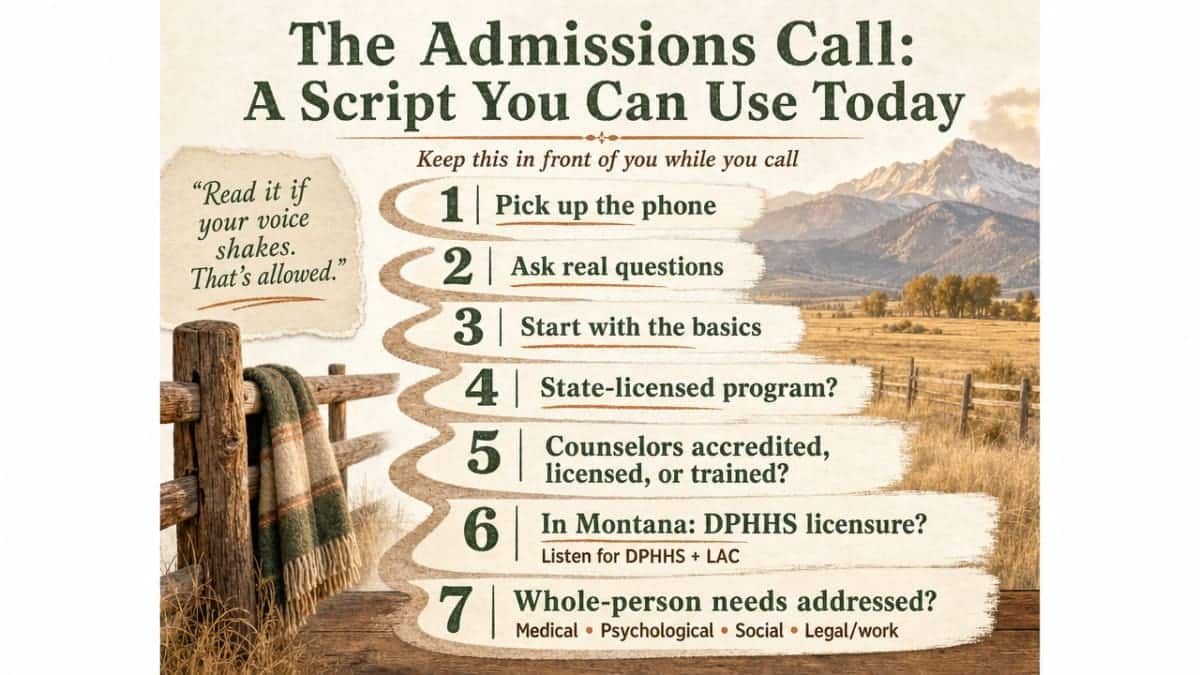
You don’t have to know the perfect thing to say. You just have to pick up the phone and ask a few real questions. SAMHSA’s quick guide lists 12 of them, drawn from decades of watching families try to make this decision without a map 4. You can lean on it.
Here’s a script you can keep in front of you. Read it if your voice shakes. That’s allowed.
Start with the basics. “Is your program licensed by the state, and are your counselors state-accredited, licensed, or trained professionals?” 4 In Montana, you want to hear yes to both — facility licensure through DPHHS, counselors working toward or holding LAC credentials.
Ask about the whole person. “Do you address the full range of needs — medical, psychological, social, and any legal or work issues I’m dealing with?” 4 Alcohol touched more than one part of your life. Treatment should too.
Ask about insurance and cost. “What does my insurance cover, and what would I owe out of pocket for a 30, 60, or 90-day stay?” Get a real number, not a range that ends in “it depends.”
Ask about therapies by name. “What evidence-based therapies do you use, and how often will I be in them each week?” You’re listening for cognitive behavioral therapy, motivational interviewing, group counseling, family sessions.
Ask about medication. “Does a medical provider evaluate whether medication for cravings might help me?”
Ask about family. “When during my stay do family sessions happen, and can loved ones join by video if they can’t travel?”
Ask about after. “What does aftercare look like? Do you schedule check-ins after I go home, and for how long?”
Write the answers down as they come. If a coordinator dodges any of these, that’s information. If they answer clearly and warmly, that’s information too. You’re not being difficult. You’re being careful about your own life. If you’d rather start with a neutral referral first, SAMHSA’s National Helpline is free, confidential, and open around the clock 3.
What Residential Treatment Can and Cannot Promise
Before you say yes to any program, it helps to know what you’re actually buying with those thirty, sixty, or ninety days.
Here’s the honest version. A systematic review of residential treatment for substance use disorders found moderate quality evidence that it improves outcomes across a range of substance use and life domains 8. Moderate. Not miraculous. The review authors also noted real limitations in the studies, which is a fair warning against anyone who promises you a cure.
What a good residential program can offer is real: time away from the drinking environment, medical oversight during withdrawal, evidence-based therapy every day, medication if it fits, treatment for the depression or anxiety underneath, and a plan for what comes next. That combination changes lives. It has changed a lot of them.
Your Next Step
You started tonight by typing a search. That was already something.
Here’s what could come next, in the order it usually helps most. Write down two or three centers within a reasonable drive that look like they might fit. Call the first one tomorrow. Use the script from the last section — licensing, therapies, medication evaluation, family involvement, aftercare. Take notes. Call the second one. Compare what you heard.
If the phone feels like too much on your own, ask someone you trust to sit with you while you dial. Or call SAMHSA’s National Helpline first — it’s free and confidential, and they can point you toward programs in Montana that meet real standards 3.
Rocky Mountain Treatment Center is one of the places you can start that conversation. Whichever door you knock on, the door matters less than the fact that you knocked. Keep going.
Frequently Asked Questions
How do I know if I need inpatient treatment instead of outpatient?
Look at two things honestly: how severe the drinking is, and how safe your home is right now. If you’ve had withdrawal symptoms, tried outpatient before, or live somewhere alcohol is always within reach, NIAAA guidance points toward a more intensive setting 9. Outpatient can work when the use is milder and home is stable. If you’re unsure, say so on the first admissions call.
How long should a residential alcohol treatment program last?
There’s no single right number, but shorter isn’t usually better. NIDA is clear that staying in treatment long enough matters, and appropriate length depends on your specific needs and severity 11. Most residential programs run 30, 60, or 90 days. If you’ve relapsed before or have co-occurring mental health conditions, longer stays often make more sense. Ask the program how they decide length with you.
What credentials should the counselors at a Montana treatment center have?
In Montana, the credential to ask about is Licensed Addiction Counselor, or LAC. Earning it requires a minimum of 330 contact hours of addiction coursework and 1,000 hours of supervised counseling experience, plus a licensing exam 1. Some staff may be working toward the license under supervision — that can be fine. What you want to avoid is a center where no one on the clinical team is licensed at all.
What if I have depression, anxiety, or PTSD along with alcohol use?
You’re not unusual. The CDC notes that substance use and mental health conditions often show up together, and coordinated care for both leads to better outcomes than treating one alone 14. Ask any program you’re considering who on their team treats mental health, how often you’d see them, and whether trauma work is part of the schedule. Residential settings often have more room to address both at once.
Is it better to go to a center close to home or travel farther away?
It depends on what home looks like. Close helps with family visits and lower travel costs. But if home is where the drinking happened — same bars, same people, same stress — some distance can help you focus. A quieter setting a couple of hours out isn’t exile; it can be room to breathe. Ask how each program handles family involvement, including video sessions, before you decide on miles.
What happens after I leave residential treatment?
A good program hands you a written aftercare plan before you go — outpatient sessions, mutual-help meetings, medication follow-up if that’s part of your care, and scheduled check-ins in the weeks and months after discharge. SAMHSA identifies ongoing support and relapse monitoring as markers of quality treatment 2. Some centers run alumni video groups so you’re not walking out into silence. Ask specifically what week five and month six look like.
References
- Licensing Requirements and Application Checklist Licensed Addiction Counselor. https://boards.bsd.dli.mt.gov/Portals/133/Documents/bbh/BBH-LAC-APP_License-App-Checklist.pdf
- Quality Treatment for Mental Health, Drugs and Alcohol. https://www.samhsa.gov/find-support/learn-about-treatment/finding-quality-treatment
- National Helpline for Mental Health, Drug, Alcohol Issues. https://www.samhsa.gov/find-help/helplines/national-helpline
- A Quick Guide to Finding Effective Alcohol and Drug Addiction Treatment. https://www.michigan.gov/-/media/Project/Websites/mdhhs/Folder2/Folder62/Folder1/Folder162/SAMHSA_Quick_Guide_Find_Treatment.pdf
- Licensure Checklist (Montana Board of Behavioral Health). https://boards.bsd.dli.mt.gov/_docs/bbh/Licensure-checklist.pdf
- OIG Licensure Bureau Letter – Substance Use Disorder Facilities. https://dphhs.mt.gov/assets/oig/LicensureBureau/SUDFLetterUpdated_20251.pdf
- Medication for the Treatment of Alcohol Use Disorder: A Brief Guide (PDF). https://library.samhsa.gov/sites/default/files/sma15-4907.pdf
- The effectiveness of residential treatment services for individuals with substance use disorders: A systematic review. https://pubmed.ncbi.nlm.nih.gov/31254749/
- Treatment for Alcohol Problems: Finding and Getting Help. https://www.niaaa.nih.gov/publications/brochures-and-fact-sheets/treatment-alcohol-problems-finding-and-getting-help
- Behavioral Therapies. https://nida.nih.gov/publications/principles-drug-addiction-treatment-research-based-guide-third-edition/evidence-based-approaches-to-drug-addiction-treatment/behavioral-therapies
- Principles of Effective Treatment. https://nida.nih.gov/publications/principles-drug-addiction-treatment-research-based-guide-third-edition/principles-effective-treatment
- Why Do Some People Recover and Others Do Not? Exploring Different Routes to Recovery from Substance Use Disorder. https://www.ncbi.nlm.nih.gov/pmc/articles/PMC3860463/
- Alcohol Use and Your Health. https://www.cdc.gov/alcohol/fact-sheets/alcohol-use.htm
- Substance Use and Co-Occurring Mental Disorders. https://www.cdc.gov/mentalhealth/substance-use/index.html