Key Takeaways
-
- Confirm who leads sessions: a licensed mental health clinician paired with a trained equine specialist is the floor, not a nice-to-have.10
- Ask how equine work connects to counseling, groups, and 12-step meetings — specifics like shared notes and coordinated treatment plans separate real programs from barn visits.
- Expect an honest read on the research: a 2022 systematic review found promising but small and mixed evidence, so avoid programs claiming equine therapy cures addiction.1
- A well-run session has structure — check-in, groundwork, debrief — and builds progressively over weeks rather than repeating the same barn visit.6
- Ask how the program handles trauma responses and cravings mid-session; clear plans with clinician support signal experience, vague answers do not.5
- Safety protocols should cover both people and horses, including written procedures, trained staff, and attention to horse welfare and rest.10,15
- Aftercare is where recovery holds or fades — press for specifics on discharge follow-ups, alumni groups, and family involvement, since gains can slip without a bridge.6
Why the Right Questions Matter More Than the Horses
Here’s the honest truth: a barn photo on a rehab website doesn’t tell you much. A horse in a field looks calming. A person standing next to that horse looks hopeful. But the picture can’t answer the question you’re actually asking — is this program going to help me get sober and stay that way?
That’s why the questions to ask about equine therapy programs matter more than the horses themselves. Equine therapy can be a real, useful part of addiction treatment. A 2022 systematic review of horse-based work for substance use found early signs that it may support treatment retention and mental health, though the studies so far have been small and mixed. Translation: it’s promising, not magic. And a good program will tell you that plainly.1
You’re doing brave work just by researching this. Whether you’re the one heading into treatment or a family member helping someone you love, the fact that you’re reading carefully — not just booking the prettiest facility — puts you ahead of most people making this decision.
The next seven questions are the ones that separate a serious program from a photo op. They cover who runs the sessions, how horse work fits with counseling and 12-step meetings, what the research actually shows, and what happens after you go home. At Rocky Mountain Treatment Center in Great Falls, Montana, equine therapy sits alongside medically monitored detox, group counseling, and family work — one piece of a longer plan, not the whole plan. Ask any program you consider to show you the same.
Who’s Actually Leading the Session?
Start here, because everything else in the program hangs on the answer. Ask directly: who runs the equine sessions, and what are their credentials?
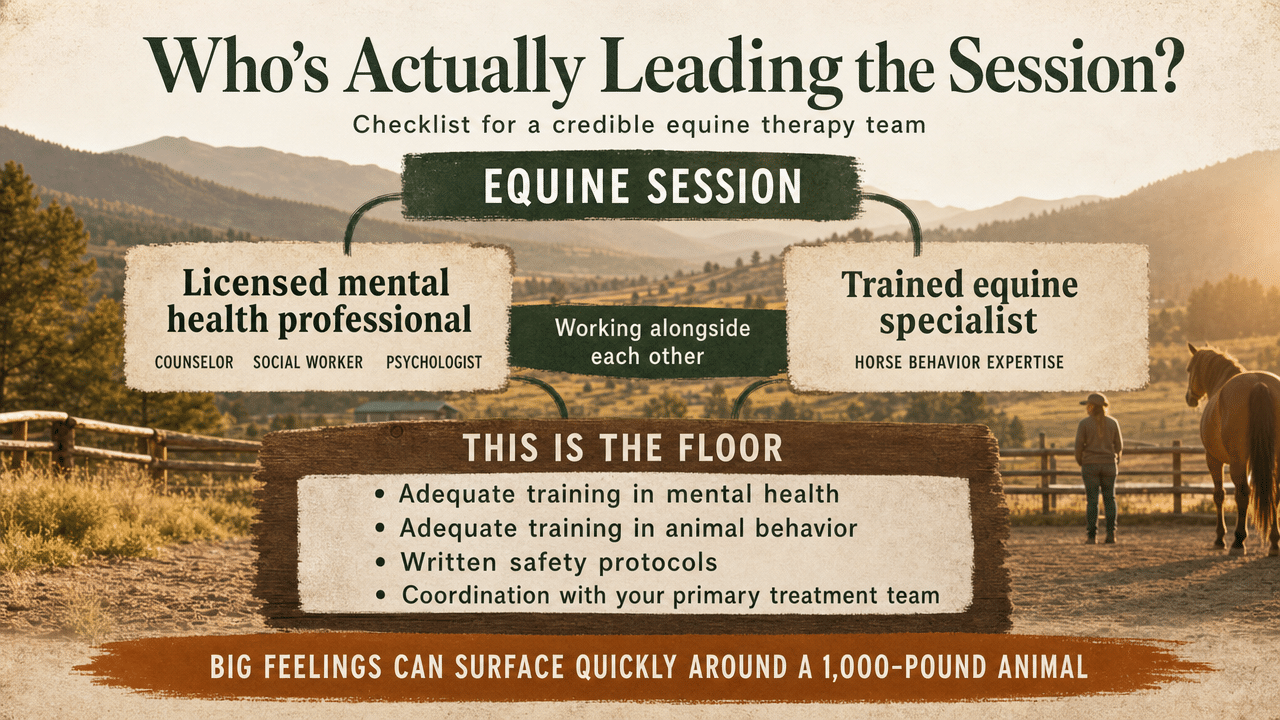
A credible program pairs two kinds of expertise in the arena — a licensed mental health professional (like a counselor, social worker, or psychologist) working alongside a trained equine specialist who knows horse behavior inside and out. Published guidelines on animal-assisted interventions in mental health are clear on this point: these programs “should be conducted by professionals with adequate training in both mental health and animal behavior,” with written safety protocols and coordination with your primary treatment team. That’s not a nice-to-have. It’s the floor.10
Here’s why it matters to you. Being around a 1,000-pound animal can bring up big feelings quickly — grief you’ve been drinking to avoid, shame you didn’t know was still there, a wave of craving out of nowhere. If the person running the session is only a horse trainer, they’re not equipped to help you work through what surfaces. If they’re only a therapist with no horse experience, safety gets thin. You need both skill sets in the space with you.
- A licensed mental health clinician on site during every session
- A trained equine specialist who reads horse body language
- Written safety protocols you can review before enrolling
- Clear session goals tied to your treatment plan
- Regular communication with your counselors and medical team
- Documentation of what happens in each session
- Ethical care standards for the horses themselves
Adapted from guidelines on animal-assisted interventions in mental health and complementary health directives used in large health systems.10,11
When you call a program, ask for names and licenses. Ask how the equine specialist was trained. Ask how the clinician and the horse expert talk to each other about what came up during your session — and how that gets back to the counselor you’re seeing three times a week. A program that welcomes those questions is a program that has answers ready.
At Rocky Mountain Treatment Center, equine sessions are one thread in a larger cloth: medically monitored detox, individual and group counseling, family work, and 12-step support. More than 80% of the staff are in recovery themselves, which means the people helping you process what happened at the barn have been where you are. That’s the kind of continuity to look for anywhere you consider going.
How Does Horse Work Connect to the Rest of My Treatment?
This is the question that separates a real program from a nice afternoon at a barn. Ask it plainly: how do the equine sessions connect to my counseling, my group work, and the 12-step meetings I’ll be attending?
You want to hear specifics. Not “it all works together” — actual specifics. What comes up during a session should show up in your next one-on-one with your counselor. If a groundwork exercise brought up your dad, that goes into your treatment plan. If a horse spooked and you noticed your own body freeze, that becomes material for a group conversation about triggers. The barn isn’t a break from treatment. It’s another room where treatment happens.
The research supports this integration. A pilot study of equine interaction during psychotherapy for people going through substance withdrawal in a residential program found improvements in anxiety and depression by week four, measured with standard screening tools — but only because the horse work sat inside a broader clinical program, not next to it. Studies of equine-assisted therapy for anxiety and PTSD symptoms have shown participants building mindfulness skills and reducing alcohol use, again as part of wider mental health care. Horses can open a door. Counseling walks you through it.3,8
So press for details when you call a program. Ask how often the equine team meets with the clinical team. Ask what gets written down after a session and who reads it. Ask how equine work supports your Step 4 inventory or your relapse prevention plan. If the answers are vague — “the horses help with feelings” — that’s a red flag. If the answers are concrete — “your equine specialist writes a note that goes into your chart, and your primary counselor uses it in your next session” — you’re looking at a real program.
At Rocky Mountain Treatment Center, equine work is woven into a 30, 60, or 90-day residential stay that includes medically monitored detox, individual and group counseling, 12-step support, and a three-day Family Week where your people learn what you’re learning. If a horse session cracks something open on a Tuesday, your counselor knows about it by Wednesday. That’s the kind of stitching you want to hear described — at Rocky Mountain or anywhere else you’re considering. A single strong therapy can’t do the whole job. A well-connected set of therapies can.
What Does the Research Actually Say — and What Doesn’t It Say?
This is the question that separates a marketing brochure from a program you can trust. Ask it out loud: what does the research actually show about equine therapy for addiction — and what doesn’t it show yet?
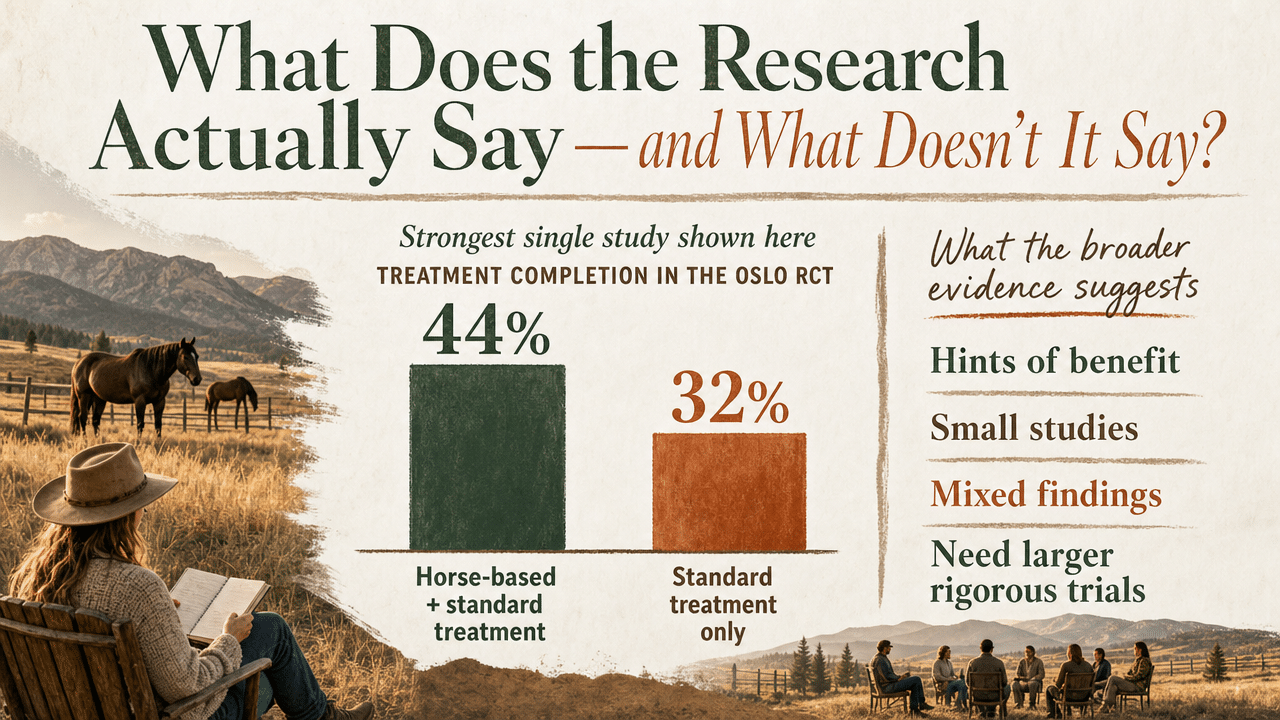
A program that’s honest with you will give you a nuanced answer. The best available summary — a 2022 systematic review of horse-based work for substance use disorders — put it plainly: there are hints of benefit for treatment retention and mental health, but the studies so far have been small and mixed, and the field needs bigger, more rigorous trials before anyone can claim clear results. That’s the truthful picture. Any program that tells you equine therapy is a proven cure for addiction is selling you something the evidence doesn’t back up.1
Here’s what the strongest single study looks like. Researchers at Oslo University Hospital ran a randomized controlled trial with 50 patients in residential addiction treatment, comparing standard care alone to standard care plus horse-assisted therapy. The result: 44% of patients in the horse-assisted group completed treatment, versus 32% in the standard-care group — a 12-point difference that leaned in the right direction but did not reach statistical significance in a sample that size. The authors called it “encouraging” and asked for a larger trial. That’s a fair reading. Not a cure. Not nothing. A signal worth studying more.2
| Treatment Group | Treatment Completion Rate |
|---|---|
| Standard treatment + horse-assisted therapy | 44% |
| Standard treatment alone | 32% |
The 12-point difference was not statistically significant in this small sample. Authors recommended larger trials before drawing firm conclusions.2
Other studies point in similar directions on different outcomes. A pilot found that four weeks of equine sessions during withdrawal added to improvements in anxiety and depression beyond what standard residential care produced on its own. A study of equine-assisted therapy for anxiety and PTSD symptoms measured meaningful gains in mindfulness skills and reductions in alcohol use over the course of the program. A 2024 meta-analysis of 13 studies in military veterans with PTSD — a different population from most addiction clients, so read this carefully — pooled an average 22.6% drop in PTSD symptom scores after equine work, while noting that most of the underlying studies were of low methodological quality.3,8,13
You’ll also want to know that researchers themselves are still asking the same questions you are. A newer clinical trial called EQUI-ADDICT is being set up specifically to test whether a structured 24-week equine program after hospitalization affects mental health and addictive behaviors in people receiving addiction treatment. When a program tells you the science is still developing, that’s not a weakness — that’s someone being straight with you.7
So here’s how to use this in your call. Ask the program: what outcomes do you track, and what does your own data show? Ask what they promise and what they don’t. If someone tells you 80% of clients stay sober because of the horses, walk away — no one has evidence like that. If someone tells you horse work has helped their clients manage cravings, feel calmer during detox, and stay engaged in counseling, and that they’re watching the research alongside you, that’s the answer of a program worth your time. At Rocky Mountain Treatment Center, equine sessions are offered as one piece of a residential plan, not as the reason you’ll get sober. The reason you’ll get sober is the whole plan — and the work you do inside it.
What Happens in a Session — and How Often?
Ask this question early, because the answer tells you whether a program has actually thought through what you’ll be doing at the barn — or is winging it.
A real session has a shape. You should hear something like: sessions run about an hour, once or twice a week, in a small group or one-on-one. Most begin with a check-in — how are you feeling today, what’s on your mind, what came up in counseling this week. Then you move into the arena for groundwork: leading, grooming, or simple exercises that ask the horse to move with you. You’re not usually riding, especially in the first weeks. Groundwork is where most of the therapeutic work happens, because it puts you in relationship with a large, honest animal that mirrors what you bring into the space. Sessions close with a debrief — what did you notice, what surprised you, what will you take into your next counseling appointment.
Ask how many sessions you’ll have over your stay. Ask what happens in week one versus week four. If a program can’t describe a progression — build safety, then trust, then harder emotional work — the sessions may not have a plan behind them. A pilot protocol developed for veterans with PTSD used a manualized 8-session structure, which let researchers track adherence and outcomes carefully. You don’t need a program to hand you a manual, but you should hear that sessions build on each other rather than repeating the same barn visit.6
Here’s what a few weeks of well-run sessions have actually moved in published studies. In residential patients going through substance withdrawal, four weeks of equine work added to psychotherapy produced measurable drops in anxiety and depression scores on standard screening tools by the fourth week. In a program for adults with anxiety and PTSD symptoms, participants finished with a large gain in mindfulness skills (effect size d=1.28) and a moderate reduction in alcohol use (d=0.58). Translation: real, useful changes in how you feel and what you reach for — not a personality transplant.3,8
| Outcome | Result |
|---|---|
| Mindfulness skills (adults with anxiety/PTSD symptoms) | Large gain, d = 1.28 3 |
| Alcohol use reduction (same study) | Moderate drop, d = 0.58 3 |
| Anxiety and depression (residential withdrawal patients, 4 weeks) | Measurable improvement on PHQ-9 and GAD-7 by week four. |
These are small, short-term studies. The signals are real, but not proof of long-term sobriety.8
One more thing worth asking: how many sessions is enough? Pilot work with veterans in a VA residential program found short-term improvements in mood, anxiety, and craving across sessions, and — interestingly — one analysis suggested that more than two sessions didn’t add extra short-term benefit on some measures. That doesn’t mean two sessions is the answer. It means the field is still figuring out the right dose, and the honest answer from any program is that they’re watching too.5
At Rocky Mountain Treatment Center, equine work happens during a 30, 60, or 90-day stay — enough time for sessions to build on each other while you’re also doing individual counseling, group work, and 12-step meetings. Ask any program to walk you through a first session and a fourth session out loud. If the two sound the same, keep looking.
How Do You Handle Trauma, Cravings, and Hard Days?
Ask this one and listen closely. The answer tells you whether a program is ready for the hardest parts of early recovery — or whether they’ve mostly thought about the good days.
Here’s what you’re really asking. Standing next to a horse can crack you open. Grief you drank over, memories you never wanted to look at, a craving that hits like a wave in the middle of grooming — any of it can show up. A good program plans for that. They know that trauma work in the arena has to be paced, not pushed. They coordinate with your primary counselor so nothing gets opened at the barn on Tuesday that doesn’t have a place to land in your one-on-one on Wednesday. And they have someone in the space — a licensed mental health clinician — trained to help you slow down, breathe, and stay grounded when it gets big.
The research points the same way. In residential patients going through substance withdrawal, four weeks of equine work added to counseling produced measurable drops in anxiety and depression scores — but only inside a broader clinical program with clinicians present. Pilot work with veterans in a VA residential substance use program found short-term improvements in negative affect, anxiety, and cravings across sessions, with the authors specifically calling the approach “safe and feasible” for that setting. Horses can help you feel calmer and more connected. They don’t replace the counselor sitting next to you when a hard memory surfaces.5,8
So ask specifics. What happens if I have a panic response in the arena? What if a craving hits mid-session — who do I talk to, and when? How do you decide when I’m ready for deeper trauma work versus just building trust with the horse? A program that answers with a clear plan — pause the session, ground with the clinician, debrief, loop your primary counselor in before end of day — is a program that has done this before. A program that shrugs and says “the horses handle it” is not.
Trauma-specific evidence in equine work is strongest in veteran PTSD populations, not general addiction — a 2024 meta-analysis of 13 veteran studies pooled an average 22.6% short-term reduction in PTSD symptom scores, while noting most of the underlying studies were of low methodological quality. Read that carefully. It’s a signal that horse work can support trauma healing when done well, in the right population, with real clinicians. It’s not proof that a barn visit will heal what you’ve been carrying.13
At Rocky Mountain Treatment Center, hard days are expected, not surprising. Detox is medically monitored. Counselors keep an open door. More than 80% of the staff are in recovery themselves — so when a craving hits or a memory lands hard, the person walking you through it has been on the other side of that same feeling. That kind of continuity between the barn, the counseling room, and the person handing you a cup of coffee at 2 a.m. is what you’re listening for in any program you consider.
What About Safety — for Me and for the Horses?
This question tells you a lot about a program’s character. Ask it directly: what are your safety protocols — for the people in the arena and for the horses themselves?
On the human side, you want to hear real specifics. Helmets when required. Closed-toe boots. A licensed clinician and a trained equine specialist in the space during every session. A clear plan for what happens if a horse startles or a client has a panic response — who steps in, where you go, how the session gets debriefed. Published guidelines on animal-assisted mental health work are pointed about this: programs need written safety protocols and staff trained in both mental health and animal behavior, not one or the other. Large health systems apply the same standard when they bring equine work into clinical settings — the VA’s directive on complementary approaches requires that these therapies be delivered by appropriately trained personnel with attention to safety and coordination with your primary treatment team.10,11
The horses matter too, and how a program talks about them is telling. A working therapy horse needs rest days, veterinary care, appropriate workload, and handlers who read subtle signs of stress. A recent review of equine-assisted interventions explicitly called out the need for more attention to horse welfare — not as a side issue, but as part of what makes a program ethical and effective. If a horse is anxious or exhausted, the calming effect people describe from being near one disappears. Good programs know this and protect it.15
Here’s what to listen for on your call. Ask how many hours per day each horse works and how rest is scheduled. Ask who handles vet care and how the program decides when a horse retires from therapy work. Ask about your own safety orientation — what you’ll learn in your first session before you touch a horse. If a program can answer those questions without hesitation, they’ve thought about this the way you’d want them to. If the answers feel improvised, keep asking, or keep looking. At Rocky Mountain Treatment Center, equine work sits inside a Joint Commission–accredited program where safety planning covers detox, counseling rooms, and the arena alike — a standard worth expecting anywhere you go.
What Happens After I Leave?
This might be the most important question on the list, and the one programs are least likely to bring up on their own. Ask it head-on: what happens to the equine work — and the rest of my recovery plan — after I walk out the door?
The reason to ask is simple. A residential stay is a container. Inside it, you have structure, meals, counselors down the hall, and a horse in the arena on Thursdays. Outside it, you have your life again — the same job, the same house, sometimes the same people who were around when you were drinking. If a program hasn’t thought carefully about that transition, the gains you make at the barn can fade quickly. The manualized 8-session equine protocol developed for veterans with PTSD showed medium-to-large reductions in symptoms right after treatment, but some of those gains didn’t fully hold at follow-up. That’s not a knock on horse work. It’s a reminder that any therapy needs a bridge to what comes next.6
So press for specifics. Ask how they hand you off. Ask what the first 30 days after discharge actually look like — who calls you, what group you’re plugged into, how you’ll keep practicing the skills that came up in sessions. Ask whether family members get a plan too, because the people at home shape the odds of what happens next as much as anything you learned in the arena. A newer clinical trial called EQUI-ADDICT is being set up specifically to study a 24-week equine program in the post-hospitalization period — a sign that researchers see aftercare as where the real work of relapse prevention lives, not the residential stay alone.7
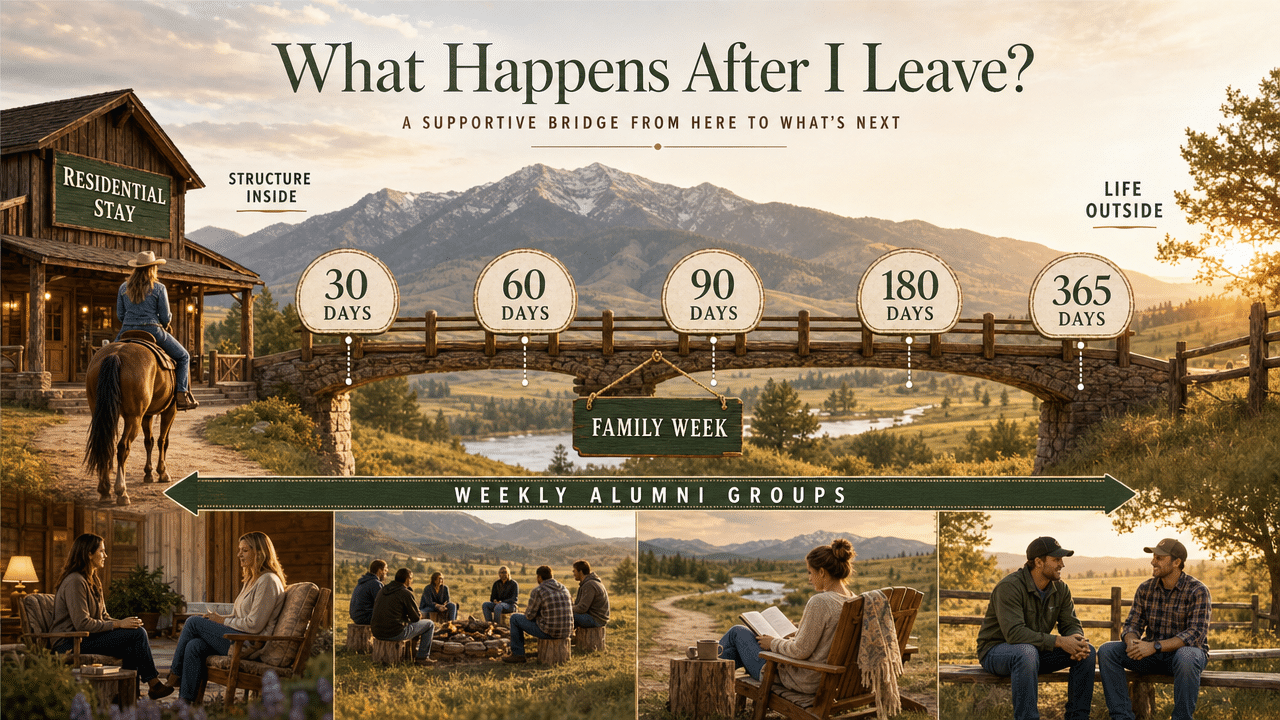
At Rocky Mountain Treatment Center, that handoff is built in. Aftercare check-ins happen at 30, 60, 90, 180, and 365 days post-discharge. Weekly Zoom groups keep alumni connected to the community that walked with them through detox and counseling. The three-day Family Week during your stay means the people picking you up at the airport have language for what you learned. That’s the shape of a real bridge — not a certificate at the door and a goodbye. Ask any program you’re considering to describe theirs out loud. If they can name the calls, the groups, and the follow-ups by month, you’re looking at people who know the story doesn’t end at discharge.
Taking the Next Step
Look at what you just did. You read seven hard questions about a therapy most people accept at face value — and you thought carefully about each one. That’s not small. That’s the same instinct that will carry you through detox, through the first uncomfortable group session, through the phone call to a sponsor at 10 p.m. on a Tuesday. You already have it.
Here’s what to do next. Pick two or three programs that feel worth a real conversation. Call them. Ask about who leads the sessions, how horse work connects to counseling, what happens after you go home. Listen for specifics, not slogans. The right program will welcome your questions and answer them in plain language.
At Rocky Mountain Treatment Center, someone is ready to walk you through those answers — the 30, 60, and 90-day residential plans, the medically monitored detox, the counselors who’ve been where you are, the aftercare calls at 30, 60, 90, 180, and 365 days. Whether you choose Great Falls or somewhere else, keep asking. You’re doing this right.
Frequently Asked Questions
Do I need any experience with horses to do equine therapy?
Will I be riding the horses during sessions?
Can equine therapy replace counseling or a 12-step program?
What if I’m afraid of horses or allergic to them?
How long does it take to feel any benefit from equine sessions?
Is equine therapy covered by insurance?
References
- Equine-assisted services for individuals with substance use disorder: A systematic review of the literature. https://pmc.ncbi.nlm.nih.gov/articles/PMC9749232/
- Complementary horse-assisted therapy for substance use disorders: a randomized controlled trial. https://www.ncbi.nlm.nih.gov/pmc/articles/PMC7001193/
- Equine-assisted therapy for anxiety and posttraumatic stress symptoms. https://pubmed.ncbi.nlm.nih.gov/25782709/
- Emotional Transfer in Human–Horse Interaction. https://pmc.ncbi.nlm.nih.gov/articles/PMC6941042/
- The benefits of equine assisted therapy for veterans in the VA Medical Center residential substance use disorder treatment program. https://extension.usu.edu/tribal-rural-wellness/files/2023-benefits-of-equine-assisted-therapy-for-veterans-presentation.pdf
- Equine-Assisted Therapy for Veterans with PTSD: Manual Development and Pilot Evaluation. https://pmc.ncbi.nlm.nih.gov/articles/PMC7282489/
- The Impact of Equine-Assisted Therapy on Mental Health and Addictive Behaviors in Patients Receiving Addiction Treatment (EQUI-ADDICT). https://clinicaltrials.gov/study/NCT07495839
- Impact of Equine Interaction During Psychotherapy on Anxiety and Depression for Residential Treatment Program Patients Experiencing Substance Withdrawal. https://docs.lib.purdue.edu/cgi/viewcontent.cgi?article=1137&context=paij
- Therapeutic horseback riding for veterans with PTSD: A mixed methods pilot study. https://www.ncbi.nlm.nih.gov/pmc/articles/PMC7761319/
- Animal-assisted interventions in mental health: Guidelines and recommendations. https://www.ncbi.nlm.nih.gov/pmc/articles/PMC8270855/
- VA Directive on Complementary and Integrative Health Approaches. https://www.va.gov/vhapublications/ViewPublication.asp?pub_ID=9844
- Investigating the Effects of Equine-Assisted Therapy in Individuals with Schizophrenia: A Randomized Controlled Trial. https://pubmed.ncbi.nlm.nih.gov/40258216/
- Are Equine-Assisted Services Beneficial for Military Veterans with Posttraumatic Stress Disorder? A Systematic Review and Meta-Analysis. https://pmc.ncbi.nlm.nih.gov/articles/PMC11293092/
- Ground-Based Adaptive Horsemanship Lessons for Veterans with Post-Traumatic Stress Disorder: A Randomized Controlled Pilot Study. https://pmc.ncbi.nlm.nih.gov/articles/PMC11165701/
- Equine-Assisted Interventions for Veterans with Posttraumatic Stress Disorder: A Review of the Literature. https://pmc.ncbi.nlm.nih.gov/articles/PMC10654975/