
Key Takeaways
- Inpatient care fits when withdrawal, daily use, failed outpatient attempts, or a trigger-heavy home make round-the-clock support the only realistic path to stability.1
- Detox handles the body, but inpatient rehab for drugs handles the reasons — clinical guidance is clear that detox alone is not treatment and must be followed by ongoing care.11
- Co-occurring depression, anxiety, or trauma should be treated alongside substance use by the same team, not sequenced or ignored until someone is clean first.5
- Discharge is a handoff, and extended continuing care — outpatient counseling, peer groups, scheduled check-ins out to a year — is what protects the work done inside.13
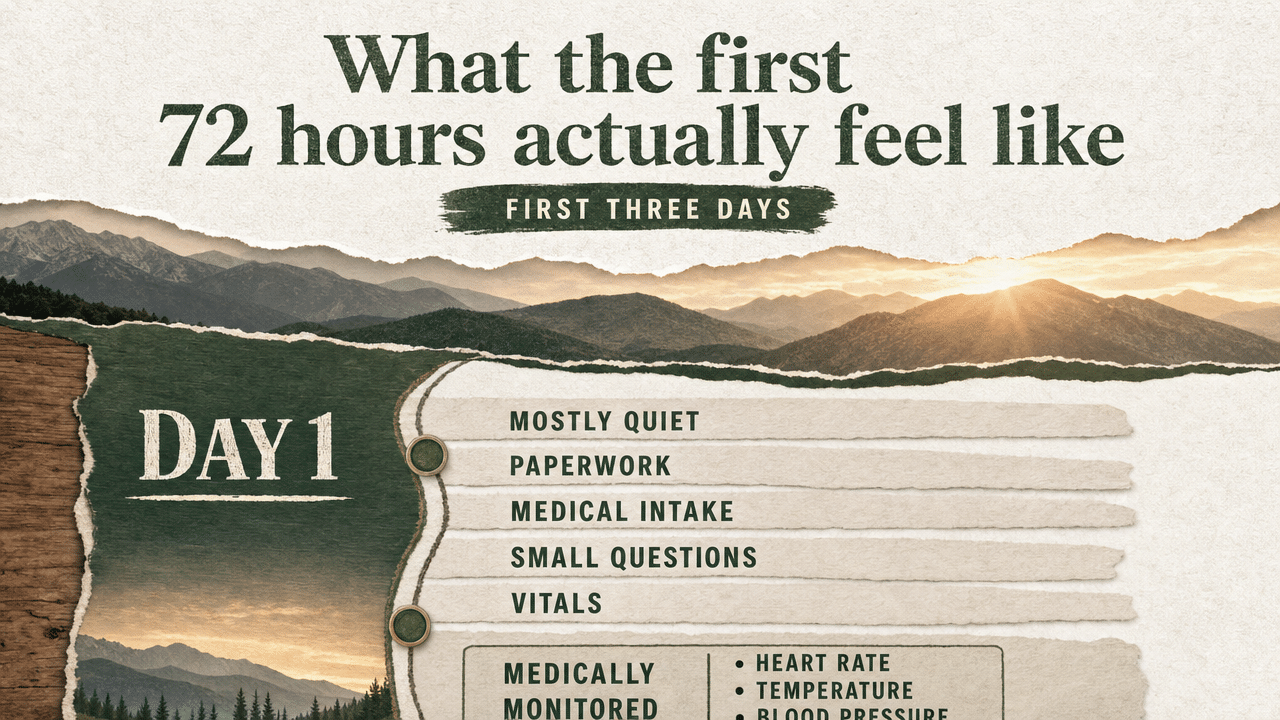
What the first 72 hours actually feel like
If you’re reading this at 2 a.m. with a duffel bag half-packed on the floor, take a breath. You don’t have to know everything before you go. You just have to get through the first three days, and there are people whose entire job is to help you do that.
The first day is mostly quiet, and quieter than you’d expect. There’s paperwork, a medical intake, and a lot of small questions: what you used, when you last used, what you ate, how you slept. A nurse takes your vitals. Someone shows you your room and where the bathroom is. If withdrawal is already starting, you’ll be in a medically monitored setting where staff can watch your heart rate, temperature, and blood pressure and give you medication to keep you safe. You can sleep. You’re allowed to sleep.11
Day two is often the hardest. Your body is loud. You may feel restless, nauseated, sweaty, or convinced you’ve made a mistake. That feeling is not proof of anything. It’s chemistry. Staff have seen it hundreds of times, and in a residential setting there are awake clinicians on the unit around the clock.17
By day three, most people can eat a real meal, sit through a short group, and remember other people’s names. You’re not fixed. You’re just steadier. That’s the whole goal of the first 72 hours, and getting there is already a real thing you’ve done.
Reading the signals that outpatient isn’t enough
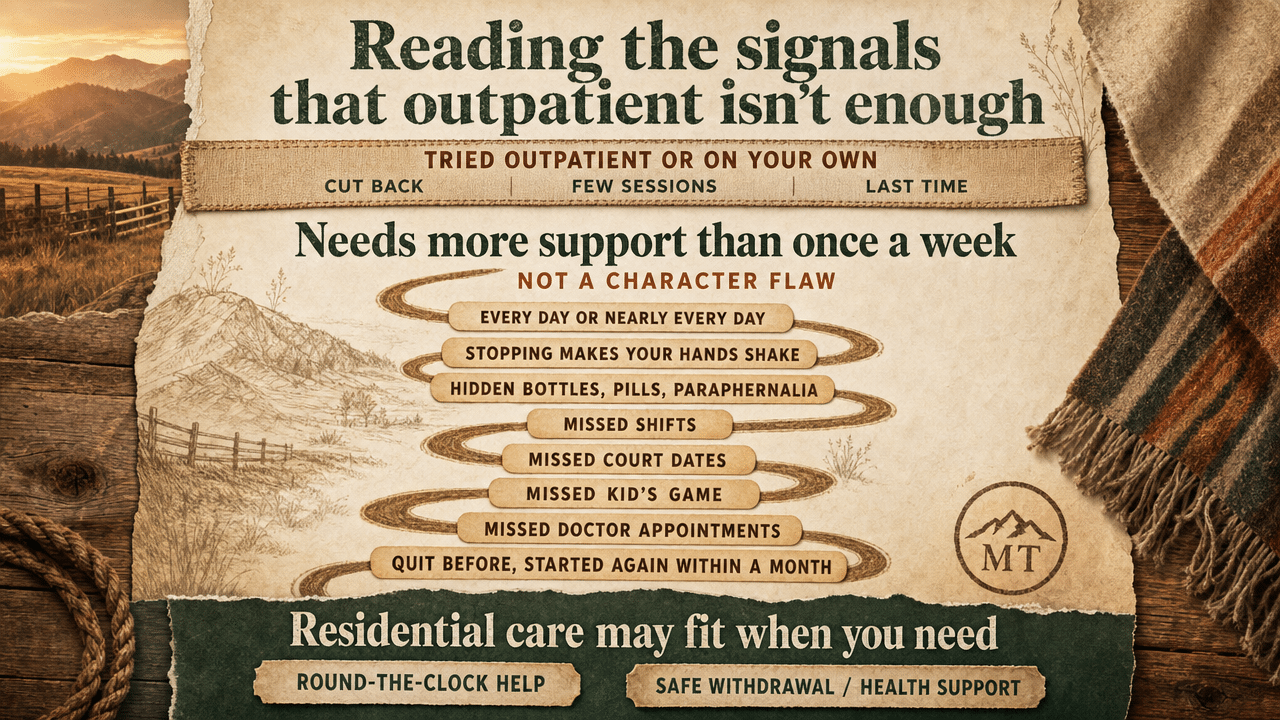
You’ve probably already tried to handle this alone. Maybe you cut back for a week. Maybe you went to a few outpatient sessions, or told yourself the weekend would be the last time. If it worked, you wouldn’t be reading this. That’s not a character flaw. Some situations just need more support than a once-a-week appointment can give you, and NIDA is direct about it: inpatient care is for people who need round-the-clock help to handle withdrawal safely or to manage health problems tied to substance use.1
Here’s what that looks like in real life:
- You’ve been using every day, or nearly every day, and the thought of stopping without help makes your hands shake.
- You’ve hidden bottles, pills, or paraphernalia.
- You’ve missed shifts, court dates, your kid’s game, your own doctor’s appointments.
- You’ve quit before and started again within a month.
- You live with someone who uses, or your apartment is full of triggers you can’t remove.
- You’ve been to the ER for something use-related.
Any one of these on its own is a signal. Two or more, and the case for a residential setting gets stronger.
Programs licensed at the ASAM 3.5 level of care are built for exactly this moment. In Montana, that means 24-hour awake staff on the unit, a physician available, licensed addiction counselors on the team, and a minimum of 30 hours of clinical services every week. Individualized treatment plans and continuing care planning are required, not optional. You’re not signing up for a hotel with therapy attached. You’re stepping into a structure that assumes your recovery needs more than willpower, and staffs accordingly.2,17
If you’re reading this list and quietly recognizing yourself, that recognition is doing real work. Naming the level of care you need is the second step, and you’re already taking it.
Detox: the first step, not the whole treatment
Here’s something worth knowing before you go in: detox is not rehab. Detox is what gets your body through withdrawal. Rehab is what happens after, when you start to figure out why you were using in the first place. Confusing the two is one of the most common reasons people cycle in and out of ERs and short stays without ever getting steady ground under their feet. Clinical guidance is blunt about this — detoxification “is not in itself treatment” and needs to be followed by ongoing rehabilitation to actually change the trajectory.11
In a residential setting, detox is folded into the same building as the rest of your care. That matters more than it sounds. When you finish the physical part of withdrawal, you don’t get discharged into a parking lot with a pamphlet. You walk down the hall to your first group. The nurse who watched your blood pressure at 3 a.m. still knows your name at lunch. That continuity is the point.
What medically monitored detox actually looks like: staff take vitals on a schedule, track withdrawal symptoms with a standard scale, and give medications to ease the worst of it — for alcohol and benzodiazepines, that usually means preventing seizures; for opioids, it means easing the aches, sweats, and cravings enough that you can sleep and eat. You are watched, not judged. If something changes, someone is there.
Depending on what you’ve been using and how much, this phase can last anywhere from a few days to a couple of weeks. Alcohol and benzos tend to be the most medically risky, which is exactly why doing them alone at home is a bad idea. Opioid withdrawal is rarely deadly but is genuinely miserable, and being miserable alone is how most people end up using again by day two.
Once your body settles, the real work opens up. You start sitting in groups. You meet with a counselor. You sleep through the night. The cravings don’t vanish — they just stop running the entire show. That shift, from surviving your body to being able to think again, is what makes the therapy part possible. Detox clears the room. Rehab is what you do once you can hear yourself in it.
A day inside a residential program
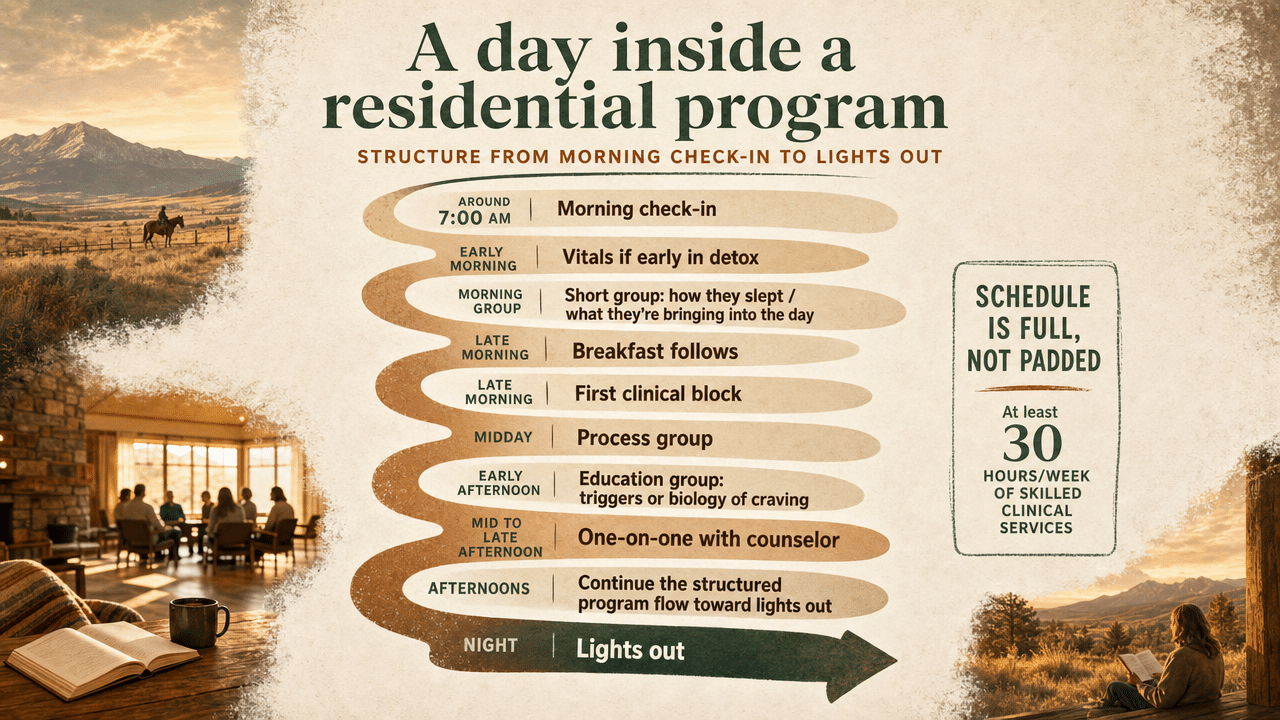
Structure from morning check-in to lights out
One of the strange, small mercies of residential care is that you don’t have to plan your day. Someone else has already done it. That takes more weight off your shoulders than you’d guess, especially in the first week when just deciding what to eat feels like too much.
Mornings usually start around 7 with a check-in — vitals if you’re still early in detox, a short group where everyone says how they slept and what they’re bringing into the day. Breakfast follows. Then the first block of clinical work: a process group, an education group on something like triggers or the biology of craving, or a one-on-one with your counselor. Montana rules require at least 30 hours a week of skilled clinical services for programs at this level of care, so the schedule is genuinely full, not padded.17
Afternoons tend to mix therapy with movement — a walk, the gym, time in the barn, or a recreational activity. There’s a reason the day is built this way. Your nervous system needs to learn that being present in your own body can feel okay again, and that lesson doesn’t come from sitting in a chair for eight hours. Evenings usually bring a 12-step meeting or a peer-led group, then quiet time, journaling, phone calls home during posted hours, and lights out. You will be tired. You’ll also, most nights, actually sleep.
The treatment plan that gets built with you, not for you
Within the first few days, you’ll sit down with a counselor and start building a treatment plan. Not signing one. Building one. Montana rules are specific about this: your plan has to be person-centered and recovery-oriented, with goals, objectives, and interventions written with you, and reviewed with you as things change. If you can’t read it and say “yes, that’s what I’m working on,” it isn’t done yet.3
That matters more than it sounds. Research on patient-centered care in substance use treatment shows that when people help shape their own plan, they engage more, stay longer, and align treatment with what actually matters to them — a job they want back, a kid they want to be present for, a relationship they’re trying not to lose.14
Expect real questions. What are you afraid will happen if you stop using? What has failed before, and why? Who do you want involved, and who do you need distance from? Your counselor brings clinical training. You bring the only expertise on your own life. The plan is what happens when those two things meet, and it will get rewritten as you learn more about yourself in the process.
When drug use is tangled up with depression, trauma, or anxiety
A lot of people don’t just have a drug problem. They have a drug problem and something else — panic attacks that started years before the first pill, a depression that never really lifted, a memory that still wakes them up at 3 a.m. If that’s you, you already know the two things feed each other. You use to quiet the anxiety. The anxiety comes back louder the next morning. Repeat.
The clinical name for this is co-occurring disorders, and the good news is that the field has stopped treating it as two separate problems that have to be handled by two separate systems. SAMHSA’s guidance is direct: integrated care, where the substance use and the mental health condition are treated at the same time by the same team, is the preferred model. That means you shouldn’t have to “get clean first” before anyone will talk to you about the depression, or wait for the depression to lift before anyone will help with the drinking. Both get worked on together, in phases, with room to address the real-life problems that keep pulling you under.4,5
In a residential setting, this shows up in practical ways. Your intake includes a mental health assessment, not just a substance use one. Your treatment plan names both. You may meet with someone about medication for anxiety or depression while you’re also sitting in relapse-prevention groups. Trauma work usually starts gently, once your body is steadier — not dumped on you in week one.
If you’ve been told before that your “real” problem is one or the other, that framing was never going to help you. Treating both, at once, is what the evidence supports. And naming what’s underneath the using is often the first time recovery starts to feel like it’s actually about your life, not just your substance.6,10
Your rights don’t disappear at the door
Walking into a residential program can feel like handing over the keys to your own life. It’s not. Montana law is clear about what you keep, and any facility licensed to treat substance use has to honor it.
You have the right to be treated in the least restrictive setting that still keeps you safe, and to be treated in a way that protects your dignity and self-respect. You have the right to be free from abuse, neglect, and financial exploitation by staff or other clients. You have the right to privacy, to visitation, to communication with people outside the program, to exercise, and to a clear, working grievance process if something goes wrong.16
None of this makes rehab easy. It just means the person walking in still gets to be a person.
Letting family back in
For a lot of people, the family part is the scariest section of the whole thing. Harder than detox. Harder than the first group. There are apologies you don’t know how to make and conversations you’ve been dodging for years. If your first instinct is to keep your family out of this entirely, that’s understandable — and it’s also worth reconsidering, slowly, with help.
The evidence here is unusually clear. Family involvement is linked with higher rates of entering treatment, staying in treatment longer, and doing better in the long run, and structured approaches like behavioral couples therapy are tied to increased abstinence and treatment adherence. Structured family counseling and psychoeducation can reduce returns to use and improve how the whole family functions, not just the person in the program. Families are described in the research as “key resources” that most programs still don’t use as well as they could.7,8,18
In practice, this doesn’t mean everyone shows up on day one. Family programming usually starts with education — helping the people who love you understand what addiction is, what enabling looks like, and what to expect during your stay. From there, most residential programs build in a dedicated block, often a multi-day family week, where relatives come in for guided sessions with a counselor. You practice hard conversations in a room with someone trained to keep them from going sideways. You hear things you didn’t know they were carrying. They hear things you’ve never said out loud.
You get to say who’s involved. If a parent, partner, or sibling is unsafe for your recovery, they don’t have to be in the room. Person-centered planning means your treatment plan reflects your relationships, not a template. Letting family back in doesn’t mean letting everyone in. It means letting the right people close enough to help.14
Time with horses: what it does and what it doesn’t
The barn is not where you’ll get sober. But it might be where you notice, for the first time in a long time, that your hands aren’t shaking and your shoulders have dropped away from your ears.
Equine-assisted work in a residential program usually looks less like riding and more like being near a large animal that responds to whatever you’re actually feeling, not what you’re pretending to feel. You groom. You lead. You stand quietly. A horse can tell when you’re anxious before you can, and that feedback loop is the point. Participants across studies describe better emotional regulation, more trust, and a slow return of self-esteem, which are exactly the muscles that atrophy during active addiction.15
Here’s where honesty matters. A 2022 systematic review looked at equine-assisted services for people with substance use disorders and found one study where horse-assisted therapy participants were significantly more likely than treatment-as-usual participants to complete treatment and stay for 90 days or more (adjusted odds ratio 3.9, p = 0.001). The same review was careful to note that overall quantitative data are still not strong enough to claim a general beneficial effect. That single retention finding is promising. It is not proof that a horse will fix you.9
What time in the barn does do, reliably, is give you a place where the work of recovery doesn’t happen in a chair. That’s worth something. Just don’t ask it to carry more than it can.
How long you’ll stay, and what it might cost
Most residential programs are built around 30, 60, or 90 days, and the honest answer to “how long do I need?” is: probably longer than you want, and that’s part of the point. National survey data on residential providers shows real variation in program length and services, not a single standard, so your stay is more about clinical fit than a fixed calendar.12
- Thirty days gets you through detox and steady on your feet.
- Sixty gives you room to work on the harder material — trauma, relationships, the reasons you started using.
- Ninety is where a lot of people say the recovery actually started to feel like theirs.
NIDA is clear that many people need long-term or repeated episodes of care to reach lasting recovery, so a longer first stay often protects the work later. Your treatment plan and counselor will help you weigh the tradeoffs against your job, your family, and what your body is telling you.1
On cost: prices vary widely across programs, and most residential centers work directly with major insurance to verify what your plan covers before you commit. Call admissions and ask them to run your benefits. Don’t guess from a website.
The day you leave is not the finish line
Discharge day feels bigger than it is. You’ll pack the same duffel you came in with, hug people you didn’t know a month ago, and walk out into a parking lot that looks exactly like it did when you arrived. The temptation, for you and everyone who loves you, is to treat that moment like a graduation. It isn’t. It’s a handoff.
The clearest evidence in the whole field on what happens after residential care points in one direction: staying connected to support after you leave is what protects the work you just did. A review of continuing care research concluded that ongoing outpatient counseling, mutual-help groups, and structured check-ins produce “modest but consistent” improvements in long-term substance use outcomes, and the benefit is strongest when that support is extended in duration rather than front-loaded and dropped. Translation: a phone call at 30 days matters. A phone call at 365 days matters more than you’d think.13
In a well-built residential program, aftercare isn’t something you figure out on the drive home. It’s already scheduled. Most programs will map out touchpoints at 30, 60, 90, 180, and 365 days post-discharge — some by phone, some through weekly online groups, some through alumni meetings you can drop into for the rest of your life. Your treatment plan should include a written continuing care plan before you’re discharged; in Montana, that isn’t a nice-to-have, it’s part of what residential providers are required to do.2
What that looks like in your actual week:
- An outpatient counselor you check in with
- A 12-step or peer group you attend on a set night
- A sponsor or accountability person who has your phone number
- A plan for the first cravings — because they will come, usually in week two or three, often at a moment that looks harmless. A wedding. A Tuesday. The anniversary of something you’d rather not remember.
If you slip, the aftercare arc is also what catches you. A missed group, a bad phone call, a lapse — those are signals your care team is trained to respond to, not reasons to disappear. Recovery is rarely a straight line, and the point of a good continuing care plan is that the line doesn’t have to be straight for the direction to still be forward. The day you leave is the day the rest of it starts.
Making the first phone call
The hardest part of a phone call is picking up the phone. You don’t need a script. You don’t need to know which program, which length, or which insurance card is in your wallet. You just need to dial. Admissions teams talk to people in your exact situation every single day — the 2 a.m. callers, the sisters calling for a brother, the people who hang up twice before they get a full sentence out. None of that is new to them.
Here’s what usually happens. They’ll ask a few questions to understand where you are: what you’ve been using, how long, whether you’re safe right now, and what your insurance looks like. They’ll walk you through what a stay could involve and help verify your benefits before you commit to anything. If you’re a family member calling, they can talk you through how to bring it up with your person without it turning into a fight.
Reading this page is already a step. If you’re in Montana, a program like Rocky Mountain Treatment Center is one call away. If you’re not, the same call exists near you. Pick it up.
Frequently Asked Questions
How do I know if I need inpatient rehab instead of outpatient?
If you can’t stop using without your body reacting hard, if outpatient hasn’t stuck, or if home is full of triggers you can’t remove, that’s a signal you likely need 24-hour care. NIDA describes inpatient as care for people who need round-the-clock support to manage withdrawal safely or handle related health problems. Trust the pattern, not the promise you made yourself last week.1
What happens during detox, and is it the same as rehab?
Detox is the medical process of getting your body through withdrawal. Staff monitor your vitals, ease symptoms with medication, and keep you safe. It usually takes a few days to a couple of weeks. It’s not the same as rehab, and clinical guidance is direct that detox alone “is not in itself treatment” — the therapy work has to follow to protect what your body just did.11
Can my family visit or be involved in my treatment?
Yes, and the evidence says it helps. Family involvement is tied to better entry into treatment, longer retention, and stronger long-term outcomes. Most residential programs include education, structured family sessions, and often a dedicated multi-day family week. You get to say who’s involved. If someone isn’t safe for your recovery, they don’t have to be in the room.7
What if I also struggle with depression, anxiety, or trauma?
You’re not alone, and you don’t have to sort one problem before addressing the other. SAMHSA describes integrated care — where the substance use and the mental health condition are treated together by the same team — as the preferred model for co-occurring disorders. Your intake should include a mental health assessment, and your treatment plan should name both conditions from the start.5
How long will I need to stay in residential treatment?
Most programs offer 30, 60, or 90 days, and national survey data shows real variation in length across residential providers. Thirty days gets you steady. Sixty gives you room for harder work. Ninety is where many people say recovery started to feel like theirs. NIDA notes that long-term or repeated episodes of care are often what lasting recovery actually requires.1,12
What happens after I leave the program?
Discharge is a handoff, not a finish line. A good program schedules continuing care before you leave — often check-ins at 30, 60, 90, 180, and 365 days, plus an outpatient counselor, a peer group, and a plan for early cravings. Research on continuing care shows “modest but consistent” long-term improvements when aftercare is extended in duration rather than dropped early.13
References
- Treatment | National Institute on Drug Abuse (NIDA) – NIH. https://nida.nih.gov/research-topics/treatment
- Montana Summary — State Residential Treatment for Behavioral Health Conditions. https://aspe.hhs.gov/sites/default/files/2021-08/StateBHCond-Montana.pdf
- Rules for Substance use Disorder Facility. https://dphhs.mt.gov/assets/oig/Rules_for_Substance_use_Disorder_Facility.pdf
- TIP 42: Substance Use Disorder Treatment for People With Co-Occurring Disorders. https://library.samhsa.gov/sites/default/files/SAMHSA_Digital_Download/PEP20-02-01_004.pdf
- Substance Use Disorder Treatment for People with Co-Occurring Disorders (Advisory). https://library.samhsa.gov/sites/default/files/pep20-06-04-006.pdf
- Integrated Treatment for Co-Occurring Disorders: Building Your Program. https://library.samhsa.gov/sites/default/files/ebp-kit-building-your-program-10112019.pdf
- Substance Use Disorder Treatment and Family Therapy (Box: Treatment Engagement and Outcomes). https://www.ncbi.nlm.nih.gov/books/NBK571084/box/ch1.b4/
- Chapter 3—Family Counseling Approaches (NCBI Bookshelf). https://www.ncbi.nlm.nih.gov/books/NBK571088/
- Equine-assisted services for individuals with substance use …. https://pmc.ncbi.nlm.nih.gov/articles/PMC9749232/
- Substance Abuse Treatment for Persons With Co-Occurring Disorders (TIP 42 original report). https://files.eric.ed.gov/fulltext/ED489875.pdf
- Detoxification and Substance Abuse Treatment (NCBI Bookshelf). https://www.ncbi.nlm.nih.gov/books/NBK64115/
- Substance Abuse Treatment Providers and Program Characteristics: Findings from a National Survey. https://www.rand.org/pubs/research_reports/RR113.html
- Continuing care research: What we have learned and where we are going. https://www.ncbi.nlm.nih.gov/pmc/articles/PMC3570835/
- Patient-centered care in substance use disorder treatment: A scoping review. https://www.ncbi.nlm.nih.gov/pmc/articles/PMC4085800/
- An evaluation of the effect of equine-facilitated psychotherapy on …. https://pmc.ncbi.nlm.nih.gov/articles/PMC10306210/
- Mont. Admin. r. 37.106.1450 – CLIENT RIGHTS. https://www.law.cornell.edu/regulations/montana/Mont-Admin-r-37.106.1450
- Mont. Admin. r. 37.106.1473 – ASAM 3.5 CLINICALLY MANAGED HIGH-INTENSITY RESIDENTIAL SERVICES. https://www.law.cornell.edu/regulations/montana/Mont-Admin-r-37.106.1473
- Family Involvement in Treatment and Recovery for Substance Use Disorders Among Transition-Age Youth. https://pmc.ncbi.nlm.nih.gov/articles/PMC8380649/
- Implementation of Equine Therapy into Treatment Programming for Substance Use Disorders. https://red.mnstate.edu/cgi/viewcontent.cgi?article=1924&context=thesis