
Key Takeaways
- Confirm state licensing plus independent accreditation from The Joint Commission or CARF — vague answers about oversight are a sign to keep calling 1, 4.
- Ask which therapies the program uses and expect specific, research-backed names like CBT and motivational interviewing, not a single approach doing all the work 2, 5.
- Alcohol withdrawal can turn dangerous fast, so press for details on 24-hour medical coverage, on-site detox, and FDA-approved medications during the first 72 hours 1, 6.
- Find out who will actually be in the room daily — licensed counselors, nurses, and physicians — and whether staff also bring lived recovery experience 2, 7.
- A quality program builds an individualized plan from a full assessment on day one and adjusts it as needs change, rather than running everyone through the same schedule 5, 6.
- Co-occurring conditions like depression, anxiety, PTSD, or ADHD need integrated treatment alongside the alcohol work, not a promise that sobriety alone will fix them 6, 7.
- Structured family programming — education, counseling, and guided sessions — is a core feature of quality care, not an optional extra 3, 4, 7.
- Aftercare should start early and include a written plan with named contacts and scheduled check-ins, not just a resource list handed out at discharge 3, 4, 6.
- Ask about cost and insurance in the first few minutes, request a written benefits check, and walk away from pressure to commit before the numbers are clear 3, 6.
- Residential isn’t automatically the right level of care — a trustworthy program will ask about the situation before recommending 24-hour treatment over outpatient options 8.
- Trust your gut on red flags: pressure to decide immediately, promised success rates, vague credentials, or silence on family and aftercare all warrant hanging up 1, 2, 3, 7.
- SAMHSA’s free, confidential helpline at 1-800-662-HELP is available 24/7 for guidance, referrals, and help interpreting what programs tell you 9.
Before You Pick Up the Phone: What This List Is For
If you’re reading this at 2 a.m. with a notebook open and a knot in your stomach, take a breath. You’re already doing the hard part. Choosing a rehab center for yourself or someone you love is one of the biggest calls you’ll ever make, and most people make it while running on very little sleep.
This isn’t a checklist to intimidate the person on the other end of the phone. It’s a list of questions that federal agencies like SAMHSA and NIDA say every family should feel free to ask, no apology needed 1, 5. Good programs welcome these questions. The ones that get defensive or evasive tell you something important, too.
You’ll find each question paired with what a strong answer sounds like and what should make you pause. Where it helps, you’ll see how a small residential program like Rocky Mountain Treatment Center in Great Falls, Montana handles the question in practice, so the ideas stay concrete instead of theoretical.
Asking these questions can feel awkward. It’s not. It’s the whole point. You’re not being difficult. You’re being careful, and careful is exactly what this moment calls for.
Is the Program Licensed and Accredited?
Start here. If a program can’t answer this cleanly, the rest of the call almost doesn’t matter.
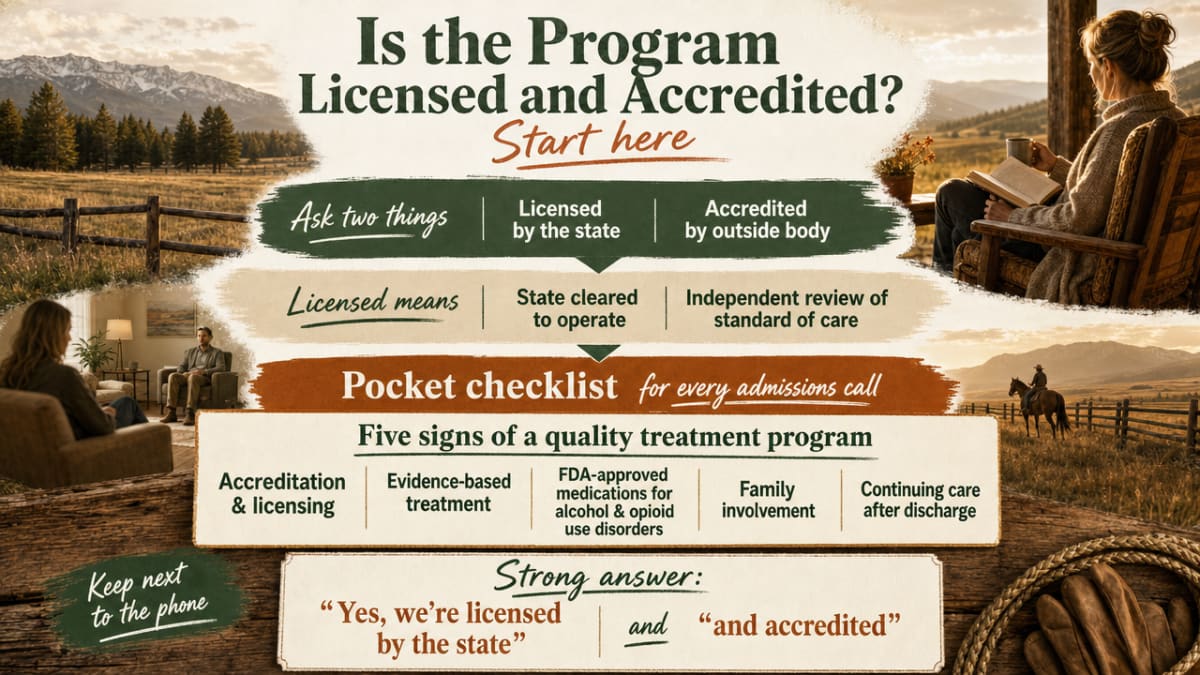
Ask two things: Is the facility licensed by the state? And is it accredited by an outside body like The Joint Commission or CARF? Licensing means the state has cleared them to operate. Accreditation means an independent group has looked under the hood and said the program meets a real standard of care 1, 4.
SAMHSA points to five signs of a quality treatment program you can use as your pocket checklist on every admissions call:
- accreditation and licensing
- evidence-based treatment
- access to FDA-approved medications for alcohol and opioid use disorders
- family involvement
- continuing care supports after discharge 4
Print that list. Keep it next to the phone.
What a strong answer sounds like: “Yes, we’re licensed by the state, and we’re accredited by The Joint Commission. I can send you our current certificates if you’d like to see them.” No hesitation, no dodging.
What should make you pause: Vague language like “we follow all the standards” without naming who accredits them. Or worse, being told accreditation “doesn’t really matter” for their model.
Rocky Mountain Treatment Center in Great Falls is Joint Commission accredited, and admissions staff will tell you that plainly if you ask. That’s the tone you’re listening for anywhere you call.
What Therapies Do You Use, and Are They Backed by Research?
This is the question that separates programs doing real clinical work from programs that mostly hope. Ask it plainly: what therapies do you use, and can you point me to the research behind them?
You’re listening for specific names. Cognitive behavioral therapy (CBT). Motivational interviewing. Medication for alcohol use disorder when it’s clinically appropriate. Group counseling. Family therapy. SAMHSA is direct that quality programs use evidence-based practices like CBT and motivational interviewing, not vague “talk therapy” 2. NIDA puts it even more simply in its patient booklet: ask whether the program uses treatments backed by scientific evidence 5.
What a strong answer sounds like: “Our clinical team uses CBT and motivational interviewing in individual sessions, we run structured group counseling daily, we integrate 12-step work, and we can offer FDA-approved medications for alcohol use disorder when the medical team recommends them.” They name the therapies. They connect each one to a purpose.
What should make you pause: Answers that lean entirely on one method — only 12-step, only holistic activities, only “our unique approach.” NIDA notes that mutual-help programs like 12-step should complement clinical treatment, not replace it 5. A program with equine therapy, hikes, or music sessions can absolutely be a good fit; those just shouldn’t be the whole plan.
At Rocky Mountain Treatment Center, for example, equine therapy and outdoor time sit alongside individual and group counseling, 12-step meetings, and family therapy — the experiential pieces support the clinical work, not stand in for it. That’s the pattern to look for anywhere you call.
How Do You Handle the First 72 Hours and Medical Detox?
This is the question most people are too scared to ask out loud. Ask it anyway. What happens in the first three days? Who watches over the person coming off alcohol? What if things get bad in the middle of the night?
For alcohol, detox isn’t just uncomfortable — it can be medically dangerous. You need to hear a clear answer about how withdrawal is managed on-site and whether a medical team is available around the clock. NIAAA’s provider worksheet spells this out as a fair question to ask any alcohol treatment program, right alongside cost and credentials 6. SAMHSA also names access to FDA-approved medications for alcohol use disorder as one of its five signs of a quality program 1.
What a strong answer sounds like: “We provide medically monitored detox on-site. Nurses do regular vitals checks, a physician oversees the protocol, and FDA-approved medications for alcohol withdrawal are available when clinically appropriate. Someone is awake and available every hour of the night.” Specifics. Names of roles. A clear picture of the room your person will actually be in.
At Rocky Mountain Treatment Center, detox happens on-site as part of the residential stay, so the first 72 hours and the weeks that follow are handled by the same team in the same building. Whatever program you’re calling, listen for that kind of continuity.
Who Is On Staff, and What Are Their Credentials?
You’re about to hand a person you love to a group of strangers. It’s fair to want to know who those strangers are.
Ask who will actually be in the room with your person day to day. Not just the medical director’s name on the website. The counselors. The nurses. The overnight staff. SAMHSA is clear that all programs and their health care professionals should be licensed and accredited 2. The House checklist for evaluating treatment centers puts staff credentials right alongside safety and clinical approach as a core question 7.
What a strong answer sounds like: “Our counselors are licensed by the state. Our nurses are RNs. A physician oversees the medical side. We can tell you the credentials of anyone on the team.” They also tell you about lived experience where it applies — many strong programs employ counselors who are in recovery themselves, which can make the room feel less like a clinic and more like a place someone actually gets you.
What should make you pause: Vague titles like “recovery coaches” with no licensure behind them, or a program that won’t say who oversees the medical care.
At Rocky Mountain Treatment Center, over 80% of the staff are in recovery themselves, working alongside licensed clinicians and medical personnel. Lived experience plus credentials — that’s the mix you’re listening for.
How Will You Build a Plan for This Specific Person?
A good program doesn’t hand every person the same schedule. Ask directly: how do you build the treatment plan, and how will it change if things aren’t working two weeks in?
NIDA is clear that effective treatment is tailored to each patient and adjusted as needs change, not delivered as a one-size-fits-all package 5. NIAAA’s provider worksheet frames the same idea as a plain question you’re welcome to ask: do you start with a complete assessment and diagnosis, and how is the plan built from there 6?
What a strong answer sounds like: “On day one, we do a full medical and psychological assessment. From that, a counselor builds an individual plan — what therapies, what groups, what medical needs, what family piece. We review it in team meetings and adjust as we learn more about the person.”
What should make you pause: “Everyone does the same schedule” with no room for what makes this person different — trauma history, chronic pain, a demanding job, kids at home, a co-occurring anxiety diagnosis.
Length matters too. Ask about program options and what each covers. NIDA notes that sufficient duration is one of the pillars of effective care, and residential programs are commonly offered in 30, 60, and 90-day formats, with longer stays generally giving people more time for the clinical work to hold 5, 11.
Here’s the rough shape of what those durations tend to cover:
| Program length | What it typically makes room for |
|---|---|
| 30 days | Medical detox, stabilization, core counseling, early relapse-prevention skills, initial family contact, discharge plan |
| 60 days | Everything above plus deeper trauma and co-occurring work, more group cycles, stronger family programming |
| 90 days | Extended practice of new skills, sustained co-occurring care, fuller aftercare handoff, more time for identity outside of drinking to take root |
At Rocky Mountain Treatment Center, the 30/60/90-day options exist for exactly that reason — some people need the longer runway, and the plan is built around the person, not the calendar.

How Are Co-Occurring Mental Health Conditions Treated?
A lot of people who struggle with alcohol are also carrying something else — anxiety that won’t quit, depression that started long before the drinking, unprocessed trauma, ADHD, bipolar disorder. If that’s you or your person, this question isn’t optional. Ask it early.
Say it plainly: “There’s also depression in the picture. How do you treat both at the same time?” NIAAA’s provider worksheet includes co-occurring health issues as one of the ten questions every family is welcome to ask an alcohol treatment program 6. The House checklist for evaluating treatment centers puts co-occurring disorder care right alongside detox and family involvement as a core capability, not a bonus feature 7.
What a strong answer sounds like: “We assess for co-occurring conditions on intake. A licensed mental health clinician is part of the treatment team, and psychiatric care is available. We treat the substance use and the mental health piece together, not one after the other.”
What should make you pause: “We just focus on the drinking — the anxiety will get better once they’re sober.” Sometimes it does. Often it doesn’t, and untreated mental health is one of the fastest routes back to a drink.
At Rocky Mountain Treatment Center, dual diagnosis care is built into the residential program, so the depression or PTSD gets attention in the same room as the alcohol work. Wherever you’re calling, listen for that same integrated answer.
What Role Does Family Play During Treatment?
Addiction doesn’t happen to one person. It happens to everyone who loves that person. So when you’re calling programs, ask directly: what do you offer for families, and when do we get to be part of this?
SAMHSA names family involvement as one of its five signs of a quality treatment program, and its detailed guide lists family services as a specific thing to look for when choosing a center 3, 4. The House checklist for evaluating treatment centers puts family involvement in the same tier as detox, staff credentials, and co-occurring care — not an add-on, a core piece 7.
What a strong answer sounds like: “We have structured family programming. Family members are invited in for education about addiction, guided sessions with a counselor, and time together to work on what’s been hard. We’ll tell you exactly when it happens and how to prepare.”
What should make you pause: “Family isn’t really involved during treatment” with no education, no calls, no sessions. Or an open-ended “you can visit sometimes” with no structure around it.
At Rocky Mountain Treatment Center, families are invited into a three-day Family Week — education, counseling, and honest conversation in the same room. Whatever program you’re calling, listen for that kind of built-in seat at the table.
What Happens After Discharge? The Aftercare Question
Here’s the truth nobody wants to say out loud on the admissions call: the day someone leaves residential treatment is often the scariest day of the whole process. Ask what happens next. Ask it before you sign anything.
NIAAA’s provider worksheet puts it plainly as one of the ten fair questions to bring to any alcohol treatment program: what about after treatment, and is ongoing recovery support available 6? SAMHSA’s quick guide names long-term aftercare and relapse monitoring as specific things to look for when choosing a program 3. Continuing care is one of the five signs of a quality program, right alongside licensing and evidence-based therapy 4.
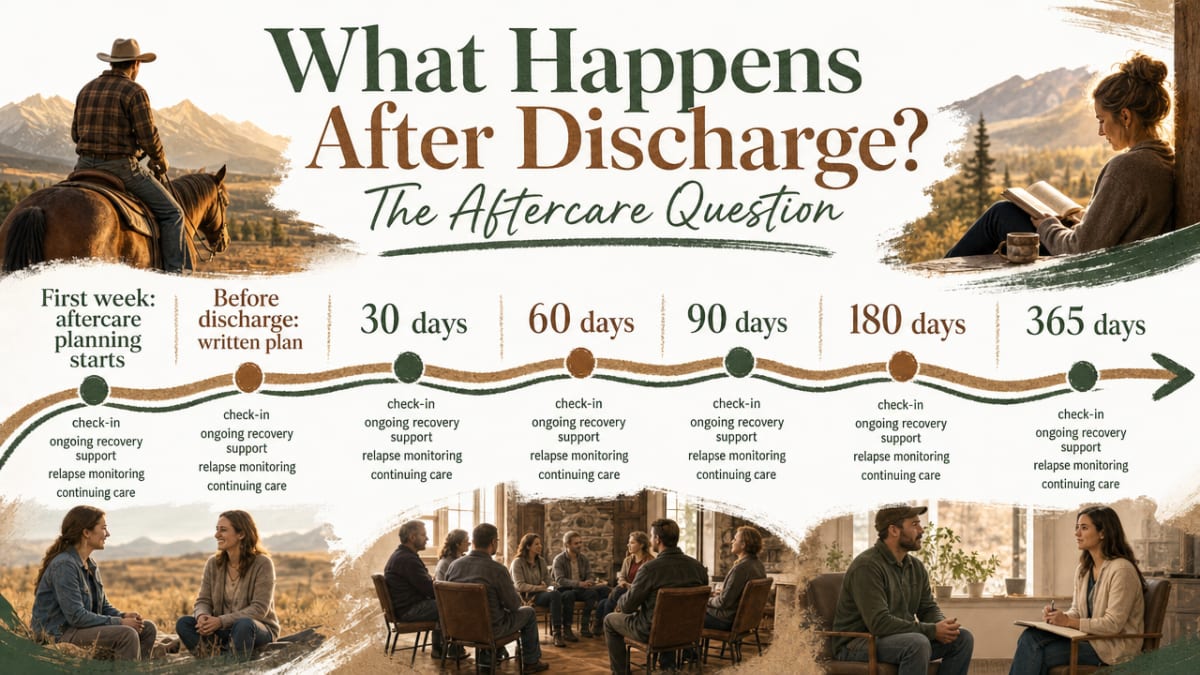
What a strong answer sounds like: “We start aftercare planning in the first week, not the last. Before discharge, your person leaves with a written plan — a therapist or counselor to connect with, a support group schedule, medication follow-up if that applies, and scheduled check-ins from our team at set points over the first year.” Specific dates. A real person who will call.
What should make you pause: “We hand out a resource list at the end.” A stack of phone numbers is not a plan.
At Rocky Mountain Treatment Center, continuing care includes weekly Zoom groups and structured follow-up check-ins at 30, 60, 90, 180, and 365 days after discharge — a full year of “how are you, really?” from a team that already knows the person. Whatever program you’re calling, ask them to draw you a picture of the first year out. If they can, that tells you they’ve built a real bridge home.
What Will This Cost, and What Does My Insurance Cover?
Money is one of the reasons people put this call off for months. You’re allowed to ask about it in the first five minutes. In fact, you should.
NIAAA’s provider worksheet puts cost and insurance at the top of the ten fair questions to bring to any alcohol treatment program, right alongside credentials and treatment approach 6. SAMHSA’s quick guide also names insurance and payment as one of the first things to sort out when choosing a program 3. This is not a question that makes you look like a difficult customer. It’s a question that makes you look prepared.
What a strong answer sounds like: “Give us the name of your insurance and the member ID. We’ll run a benefits check today and come back to you with what’s covered, what your out-of-pocket estimate looks like, and what our payment options are if there’s a gap. If we don’t take your plan, we’ll tell you that up front and point you somewhere that might.”
What should make you pause: A rushed “don’t worry about the cost, we’ll figure it out later,” or pressure to commit before anyone has explained the numbers. Also worth noting: a program that won’t tell you clearly which plans it does and doesn’t accept.
Rocky Mountain Treatment Center works with most major insurance providers and does not currently accept Medicaid or Medicare — the kind of straight answer you want from anywhere you call. Get the numbers in writing before you say yes.
Is Residential the Right Level of Care Right Now?
Here’s a question worth asking yourself before you ask anyone else: is 24-hour residential care actually what this person needs right now, or would a different level of care fit better?
SAMHSA describes a whole range of treatment options — detox, inpatient/residential, outpatient, partial hospitalization — and points people to FindTreatment.gov to match the level of care to the situation 8. Residential makes the most sense when:
- withdrawal from alcohol is medically risky
- home isn’t safe or sober
- outpatient has already been tried
- the person simply cannot get a foothold while life keeps happening around them
Ask any program you’re calling: “Based on what I’ve told you, do you think residential is the right fit, or would you point us somewhere else first?” A good program will tell you honestly. Some people need medical detox before residential. Some do better stepping down from residential into partial hospitalization or intensive outpatient.
Rocky Mountain Treatment Center’s 30/60/90-day residential model is built for people who need that around-the-clock structure to get sober and stay that way. If someone tells you residential is the answer without asking a single question about your person, that’s your cue to keep calling.
Red Flags to Listen For on the Admissions Call
You’ve asked the questions. Now trust your ear. Some answers will feel solid. Others will leave you with a strange, tight feeling in your chest. That feeling is information.
A few things to listen for that should make you slow down:
- Pressure to commit today, with no time to think. Good programs know this is a big decision. “Take the afternoon, talk to your family, call us back” is a healthy answer. “We have one bed left and you need to decide in the next hour” usually isn’t.
- Promises of a cure or a specific success rate. No honest program can guarantee an outcome. SAMHSA and NIDA describe recovery as ongoing care, not a fixed finish line 2, 11.
- Vague answers about accreditation, staff licenses, or medical coverage overnight. These are simple facts a real program can state plainly 1, 7.
- No mention of family, aftercare, or co-occurring mental health. If those aren’t in the answer, they probably aren’t in the program 3, 6.
If something feels off, hang up gently and try the next number on your list. You’re allowed.
If You Don’t Know Where to Start: A Quiet Word on the Helpline
If the list feels like a lot right now, that’s fair. You don’t have to figure this out alone at midnight.
SAMHSA runs a free, confidential helpline at 1-800-662-HELP, staffed 24 hours a day, every day of the year. You can call to talk through what you’re facing, get help understanding what a program told you, or ask for referrals in your area — in English or Spanish 9.
Use it. Then come back to your list. The questions still matter, and so do you.
Frequently Asked Questions
How many rehab centers should I call before making a decision?
There’s no magic number. Most families find that calling three to five programs gives them enough to compare answers without drowning in options. Use the same core questions on every call so you’re comparing apples to apples — licensing, therapies, detox, family, aftercare, cost 4. If two programs feel solid, tour both if you can. Trust your ear as much as the checklist.
What accreditations should a quality rehab program have?
At a minimum, look for state licensing plus accreditation from an independent body like The Joint Commission or CARF. SAMHSA names accreditation and licensing as the first sign of a quality treatment program 1, 4. A licensed, accredited program has been reviewed by outsiders who checked clinical standards, staff credentials, and safety. Ask the admissions team to name their accrediting body and offer to send current certificates. Real programs share that gladly.
How long should a residential rehab stay be?
Long enough for the work to hold. NIDA is clear that sufficient duration is one of the pillars of effective treatment, and residential programs commonly come in 30, 60, and 90-day formats 5, 11. Thirty days covers detox, stabilization, and early skills. Sixty and ninety allow deeper trauma work, co-occurring care, and time for a new routine to take root. Ask the program to recommend a length based on the person, not the calendar.
What if the person who needs help isn’t ready to go?
That’s one of the hardest places to sit, and you’re not alone in it. Readiness often shifts in waves, not one clean moment. Keep the door open, keep gathering answers, and consider calling SAMHSA’s free, confidential helpline at 1-800-662-HELP for guidance on how to talk with your person and what next steps look like 9. Some programs also offer family consultations before admission. Ask.
Will insurance cover residential treatment, and what if it doesn’t?
Often, yes — at least in part. NIAAA and SAMHSA both encourage asking about costs and insurance up front, not at the end 6, 3. Give the program your insurance details and ask for a written benefits check. If your plan isn’t accepted, a good program will say so directly and point you toward options. Payment plans, sliding scales, and public treatment locators through FindTreatment.gov can help you find covered care nearby.
What’s the difference between medical detox and rehab?
Detox is the first step — medically supervised care while alcohol or drugs leave the body, which for alcohol can be dangerous without a clinical team 6. Rehab is what comes after: counseling, group work, family therapy, skill-building, and planning for life outside. SAMHSA describes both as parts of a broader continuum of care 8. Programs that offer detox and residential rehab on-site, like Rocky Mountain Treatment Center, keep the same team through both stages.
References
- Struggling with Addiction? Tips on Finding Quality Treatment. https://www.samhsa.gov/blog/struggling-addiction-tips-finding-quality-treatment
- Quality Treatment for Mental Health, Drugs and Alcohol. https://www.samhsa.gov/find-support/learn-about-treatment/finding-quality-treatment
- A Quick Guide to Finding Effective Alcohol and Drug Addiction Treatment. https://www.michigan.gov/-/media/Project/Websites/mdhhs/Folder2/Folder62/Folder1/Folder162/SAMHSA_Quick_Guide_Find_Treatment.pdf?rev=c45fcb5f2d3a4803adf85828f150a252
- Finding Quality Treatment for Substance Use Disorders. https://library.samhsa.gov/product/finding-quality-treatment-substance-use-disorders/pep18-treatment-loc
- SEEKING DRUG ABUSE TREATMENT: KNOW WHAT TO ASK. https://nida.nih.gov/sites/default/files/treatmentbrochure_web.pdf
- 10 Questions to Ask Providers [Worksheet 3]. https://alcoholtreatment.niaaa.nih.gov/sites/default/files/10-Questions-to-Ask-Providers.pdf
- What to Look for in an Addiction Treatment Center. https://docs.house.gov/meetings/IF/IF02/20171212/106716/HHRG-115-IF02-20171212-SD008.pdf
- Substance Use Disorders Treatment Options. https://www.samhsa.gov/blog/substance-use-disorders-treatment-options
- National Helpline for Mental Health, Drug, Alcohol Issues | SAMHSA. https://www.samhsa.gov/find-help/helplines/national-helpline
- Independent Peer Review – Office of Addiction Services and Supports. https://oasas.ny.gov/independent-peer-review
- Treatment – National Institute on Drug Abuse (NIDA) – NIH. https://nida.nih.gov/research-topics/treatment