
Key Takeaways
- Substance use disorder is a treatable chronic condition that responds to a sequenced plan, not willpower, because addiction changes how the brain handles stress, reward, and impulse.5
- Detox alone is the front porch, not the house; without follow-up counseling, family work, and continuing care, most people return to use within days or weeks.2
- A 30/60/90-day residential stay moves through distinct stages—stabilization, deeper counseling, then practicing reentry—with at least three months often needed for real change.1
- Continuing care after discharge, structured living environments, and family involvement carry recovery forward, and a relapse signals the plan needs adjustment, not that treatment failed.1
The Phone Call You’ve Been Avoiding
You know the one. The call where you finally say it out loud. Maybe it’s to a treatment center. Maybe it’s to your sister, the one who keeps asking how you’re really doing. Maybe it’s to your own voicemail at 2 a.m., the night after another morning you swore would be different.
If you’re reading this, something has already shifted. You’re tired. Tired of waking up sick, tired of lying about where the bottle went, tired of watching your kid watch you. Or you’re the spouse, the parent, the adult child carrying this for someone you love, and you’re tired in a different way. Both kinds of tired are real.
Here’s what’s true: substance use disorder is a treatable chronic condition, and recovery is possible for everyone who gets the right kind of help. Not a willpower contest. Not a moral test. A medical and emotional situation that responds to the right sequence of care.5
This guide walks you through what actual addiction treatment services look like from the inside, day by day, person by person. What happens in the first 72 hours. What 30, 60, and 90 days of residential care really change. How counseling does its slow work. Why your family heals alongside you, not after you. And what continuing care looks like when you go home and life starts asking hard questions again.
You don’t have to have it figured out before you keep reading. Showing up here counts. Let’s walk through it together.
Why Willpower Keeps Failing (and What Actually Works)
If you’ve tried to stop on your own and ended up back where you started, you are not weak. You are dealing with something that doesn’t respond to gritted teeth. Addiction changes how the brain handles stress, reward, and impulse. That’s why the same person who can run a household, hold down a job, or raise three kids can’t just decide their way out of this. The decision part isn’t broken. The wiring underneath it is.
Here’s the part that gets missed: detox by itself is not treatment. Getting the substance out of your body is the first door, not the whole house. Without follow-up care, most people return to use, because the conditions that made using feel necessary—the pain, the sleeplessness, the relationships, the cravings that show up at 4 p.m. on a Tuesday—are all still there. Addiction treatment is a way of managing the condition, not a cure. That sentence sounds small. It changes everything.2
Managing means stacking supports:
- A medically supervised start.
- Enough time in a place where you can’t easily walk out the door at the first hard feeling.
- Counseling that goes deeper than “don’t drink today.”
- Family work that addresses the people around you, because they’ve been affected too.
- Continuing care that keeps a hand on your shoulder when the residential part ends.
Picture two paths side by side. On the first, someone detoxes for a week and goes home. The body is clear. Nothing else has changed. The job is still stressful. The marriage is still strained. The brain hasn’t had time to rewire. Within weeks, often days, use returns. On the second path, detox is the front porch. Behind it sits 30, 60, or 90 days of residential care, then weekly groups, family follow-ups, and check-ins at 30, 60, 90, 180, and 365 days post-discharge. That second path holds because each piece does a job the others can’t.
So if you’ve failed at this before, you didn’t fail. The plan failed you. A staged approach, the kind built into residential programs at places like Rocky Mountain Treatment Center, gives the brain and the family enough time to actually shift. Willpower isn’t the engine. Structure is. Your job is to show up. The structure does the rest of the heavy lifting.
The First 72 Hours: Medically Supervised Detox
The first three days are the ones people fear most, and for good reason. Your body has been running on a substance, and now it has to learn how to run without it. Depending on what you’ve been using, those hours can bring shakes, sweats, nausea, sleep that won’t come, anxiety that won’t quit, and in some cases seizures or dangerously high blood pressure. This is not the part you white-knuckle alone in a basement.
Medically monitored detox means you have nurses and clinicians checking vitals around the clock, medications available to ease the worst of the withdrawal, and a quiet room where the only thing you have to do is get through the next hour. That’s it. You don’t have to be brave. You don’t have to talk about your childhood. You just have to let your body settle.
Day one often feels surreal. You may sleep in fragments. You may eat almost nothing. By day two, the physical symptoms usually peak. Day three is when many people start to notice something they haven’t felt in a long time: a clear thought. Not a peaceful one, necessarily. Just clear.
Three days is hard. Reaching day four matters. You’re not starting over. You’re starting.
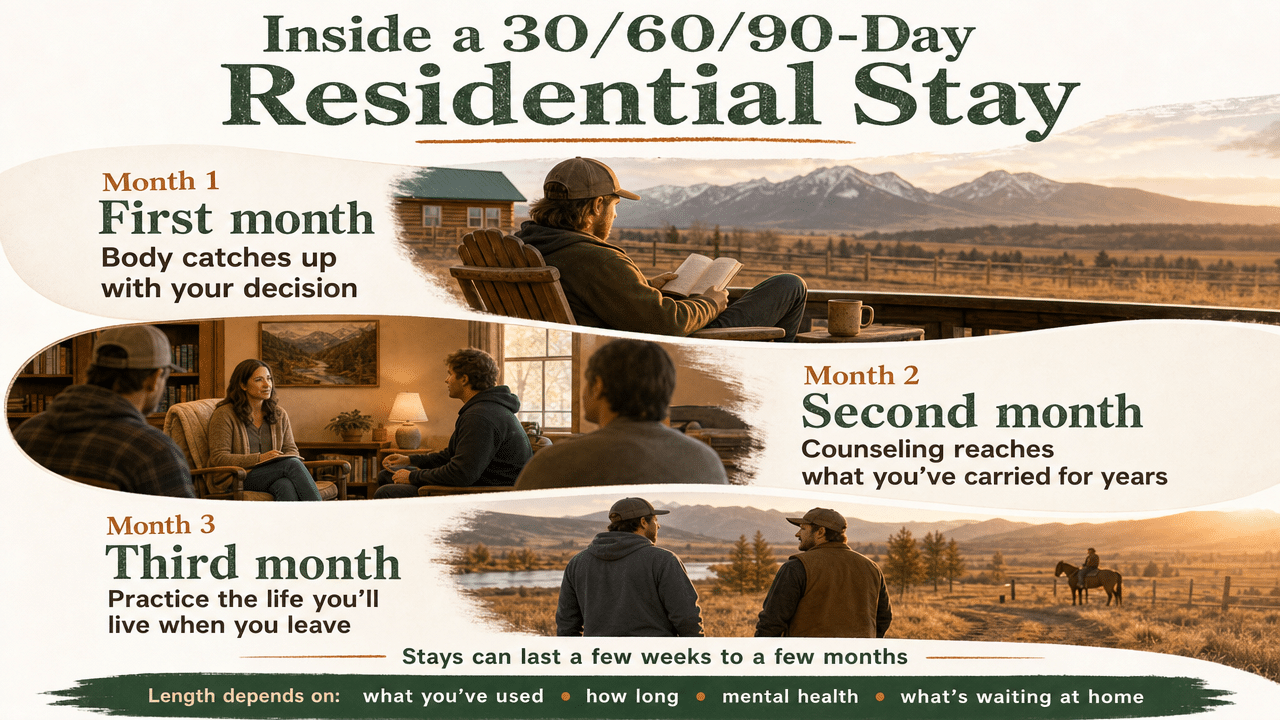
Inside a 30/60/90-Day Residential Stay
People ask what residential treatment actually feels like, and the honest answer is that it changes shape as you go. Week one is not week six. Day forty is not day ten. A 30/60/90-day stay isn’t three identical months stacked on top of each other. It’s a sequence, and each stretch does something the others can’t.
Here’s the broad arc:
- The first month is mostly about your body catching up with your decision.
- The second month is when counseling starts to reach the things you’ve been carrying for years.
- The third month is when you start practicing the life you’re going to live when you leave.
Residential care typically lasts a few weeks to a few months, with more serious conditions needing longer stays. Where you land in that range depends on what you’ve used, how long, what else is going on in your mental health, and what’s waiting for you at home.3
One more thing worth knowing before we walk through the stages: no single treatment plan fits everyone. The schedule you’ll see below is a rhythm, not a script. Your counselor will adjust the pace based on what you actually need, not what looked good on a brochure.1
Days 1–30: Stabilization and Finding Your Footing
The first thirty days are quieter than people expect. You sleep a lot. You eat real food, maybe for the first time in months. Your hands stop shaking. Your skin starts looking like your skin again.
Underneath the rest, the structure is doing its job. You wake up at the same time. You eat at the same time. You go to group, then individual counseling, then a 12-step meeting, then maybe out to the barn for equine therapy or a walk in the Montana cold. The predictability isn’t boring. It’s the first thing your nervous system has been able to count on in a long time.
Counseling in this first stretch is mostly about meeting yourself again. What happened. When the use started. What you were trying to numb. You won’t crack everything open in week two, and your counselor isn’t trying to. The goal of month one is to get you grounded enough that the deeper work in month two has somewhere to land.
If you’re feeling foggy, irritable, weepy, or strangely flat during this stretch, that’s your brain rebalancing. It’s not a sign treatment isn’t working. It’s the sign it is.
Days 31–60: Where the Real Counseling Begins
By day thirty-one, something has shifted. You can sit through a group without watching the clock. You sleep through the night more often than not. You’ve started to trust at least one person in the building. That’s the platform the second month is built on.
This is when counseling starts touching the parts you’ve been working around: the loss you never grieved, the assault you never named, the resentment toward the parent who couldn’t show up, the way you learned to drink at fourteen because nothing else worked. NIDA’s research-based guide notes that most people need at least three months in treatment to see real change, with longer stays often producing better outcomes. Month two is a big reason that threshold matters. The early weeks settle your body. The middle weeks reach the wiring underneath.1
Family week often falls in this stretch too. Your people fly or drive in. You sit in a room together with a counselor and say things that have been waiting years to be said. It’s hard. It’s also where a lot of the actual healing starts, for them and for you.
By day sixty, you’re not finished. But you’re someone who can imagine being finished, which is a place you probably haven’t stood in a long while.
Why Your Family Heals Alongside You
Here’s something most people don’t expect when they walk into treatment: the people who love you are exhausted in ways that mirror your own. Your partner has been lying awake at 3 a.m. doing math on your bank account. Your mother has been screening calls she’s afraid to answer. Your fourteen-year-old has gotten very good at reading the sound of the front door opening.
Substance use is rarely a solo event, even when it feels like one. It reshapes the household around it. Roles shift. The kid becomes the parent. The partner becomes the detective. The sibling becomes the buffer. Everyone learns to adjust, and most of those adjustments leave marks.
This is why good residential programs treat family work as a real part of treatment, not a courtesy add-on. Family counseling is positively associated with treatment engagement, retention, and improved outcomes for the person in treatment. It also helps the family itself begin to recover from what they’ve been carrying. Both things matter. You’re not the only one in this room who needs care.9,11
What that looks like in practice changes by program, but the shape is consistent: education for your loved ones about what substance use actually is, structured conversations with a counselor in the room, and a path for the people closest to you to start naming what’s been happening without it becoming another fight. Family-oriented approaches have been studied and refined specifically for couples and families dealing with substance use, and frameworks now exist for involving family across the full arc of treatment and recovery rather than only at discharge.10,13
The two sections below walk through what’s been happening at home and what it actually feels like when your family sits down in the room with you.
What Substance Use Does to the People Who Love You
Ask any spouse of someone who’s been drinking heavily for a few years what their week looks like, and you’ll hear the same things in different words. They’re tired. They’re hyper-vigilant. They’ve stopped inviting people over. They’ve taken on bills, school pickups, holiday planning, and the emotional weather of the whole house.
Kids in these households often grow up faster than they should. They learn to read moods before they learn long division. They develop what counselors sometimes call a sixth sense for whether tonight is safe. Substance use affects family functioning across communication, finances, parenting, and emotional safety, and those effects can echo for years.9
None of this means your family is broken beyond repair. It means they’ve been adapting to something that was hard to adapt to. When you go into treatment, they don’t automatically heal because you’re getting better. They need their own space to set down what they’ve been holding. That’s the work family counseling does, and it’s why it sits next to your individual counseling instead of behind it.
Family Week, Hard Conversations, and Rebuilt Trust
Family week usually falls somewhere in the middle stretch of a residential stay, after you’ve had time to settle and before you’re getting ready to leave. Your people come in for two or three days of education sessions, group work, and structured time with a counselor in the room with all of you.
The research backs up why this matters. Family counseling moves three specific things at once:11
- It improves how engaged you are in your own treatment.
- It helps you stay in treatment longer.
- It improves the outcomes you walk out with.
Three levers. Not vague benefits. Real, measurable shifts in how recovery goes.
What actually happens in those rooms is hard and ordinary at the same time. Your daughter says she was scared of you at her birthday party last year. You don’t defend yourself. You let it land. Your husband admits he’s been checking your phone for two years and doesn’t know how to stop. Your mother apologizes for something from when you were nine that you didn’t know she remembered.
Nobody fixes everything in three days. That’s not the point. The point is to start telling the truth in the same room, with someone trained to hold it, so that when you go home you have a different starting line than the one you left from. Trust gets rebuilt in small, repeated moments after treatment ends. Family week just gives you the first few.
Counseling, Medication, and the Work That Sticks
When people picture rehab, they often picture one thing: a person on a couch talking to a counselor. That’s part of it. But the work that actually sticks is broader, and it’s done in layers that overlap.
Individual counseling is where you say the things you’ve never said out loud. Your counselor isn’t there to judge what you tell them. They’re there to help you connect the dots between what you used, when you used it, and what was happening underneath. Group counseling does something different. Sitting in a room with seven other people who get it, who don’t need you to explain why you hid the bottle in the laundry hamper, breaks something open that one-on-one work can’t reach on its own. You stop being the only one. That alone shifts things.
12-step meetings layer in a third piece: a language and a community you can keep using after you leave. Equine therapy, art, hiking, music, the experiential pieces that sometimes get dismissed as extras, do real work too. A horse doesn’t care what you did last year. It responds to what you’re doing right now, in your body, with your breathing. That kind of feedback teaches something words can’t always reach.
Medication has a place in this too. For some people, especially those withdrawing from alcohol or opioids, medication is part of safe detox and sometimes part of longer-term recovery. Counseling, family therapy, and medications can each play a role, and the right blend depends on the person. No single treatment is appropriate for everyone. The plan that works is the one built for you, not pulled off a shelf.1,2
What makes any of this stick is repetition over time. Counseling once doesn’t reach the root. Sitting in group for ten weeks does. The work that holds is the work you do over and over until it stops feeling like work and starts feeling like how you live.
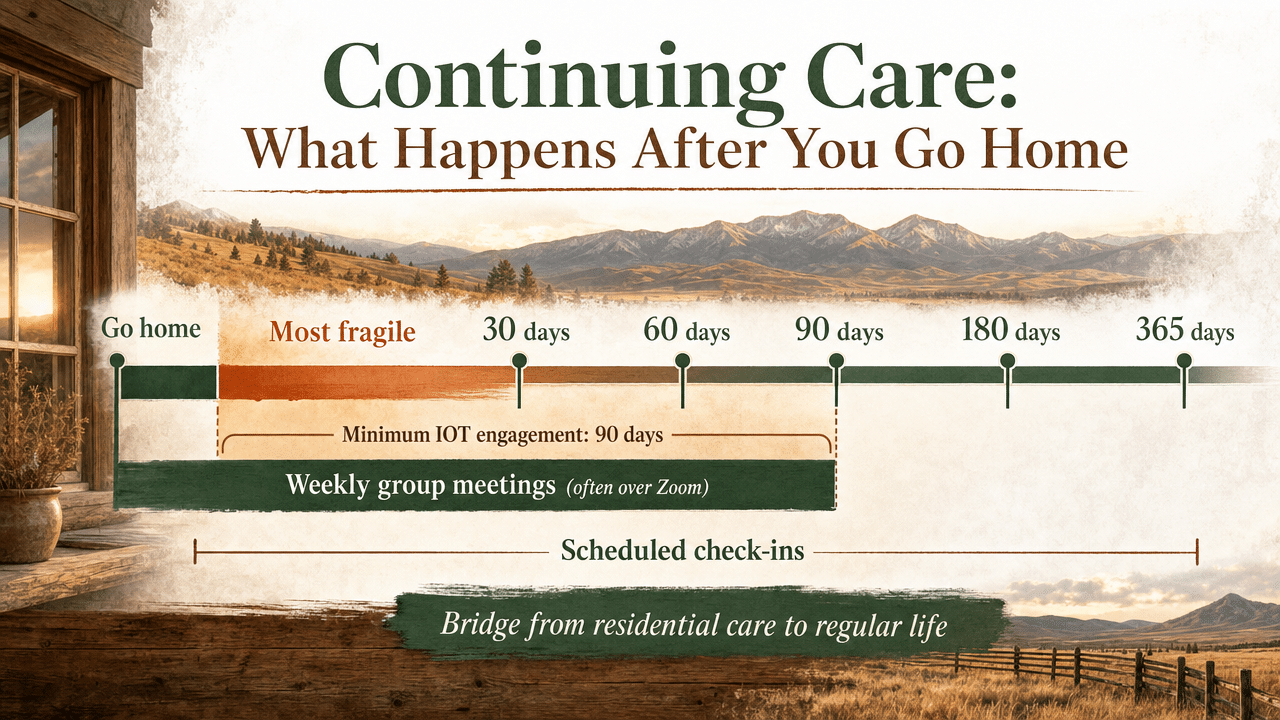
Continuing Care: What Happens After You Go Home
Leaving residential care is its own kind of hard. You’ve spent weeks in a place where the schedule held you, where someone noticed if you didn’t come down for breakfast, where the hardest decision was whether to sit with the group or take a walk first. Then one Tuesday morning, you load your bag into the car and drive back to the kitchen where you used to drink.
The first 30 days home are the most fragile, and the plan you leave with matters as much as the plan you came in on. Continuing care is what bridges the gap between the structure of residential and the open hours of regular life. For most people, that means weekly group meetings, often over Zoom so you can join from your couch after the kids are in bed, plus scheduled check-ins at 30, 60, 90, 180, and 365 days post-discharge. Those check-ins aren’t bureaucratic. They’re someone calling to ask how the wedding went, whether the new boss is as bad as you feared, what you did when your brother offered you a beer at the lake.
The research is clear that sustained engagement is where outcomes get made. The minimum duration of an intensive outpatient phase is often cited as 90 days, and that’s not a coincidence. The brain keeps rewiring well past the residential stay, and the months after discharge are when the new patterns either set or slip.12
Your environment does a lot of the work here too. Living somewhere structured and substance-free in the months after treatment is tied to better discharge outcomes and longer time in care. That might mean a sober living house. It might mean a spare room at your sister’s. It might mean a new lease without a roommate who drinks every night. The point isn’t the address. It’s whether the walls around you make recovery easier or harder.8
A few things help in those first months:
- Keep one standing appointment a week, even when you feel fine. Especially when you feel fine.
- Have two phone numbers you can call before you do anything else, and use them.
- Tell one person at work, if you can, so you’re not white-knuckling alone in a meeting.
- Go to a meeting on the days that don’t feel hard. Those are the deposits.
When the Person Who Needs Help Isn’t You
If you’re the spouse, the parent, the adult child, or the friend reading this for someone else, the ground you’re standing on is shaky in its own way. You can’t make another adult go to treatment. You also can’t keep living the way you’ve been living. Both things are true at the same time, and holding them is exhausting.
Start with what you actually have control over. You can learn what substance use disorder is, so the conversations you do have aren’t built on guesses. You can stop covering for them, the calls to their boss, the made-up reasons at family dinners, because the cover keeps the situation comfortable enough to continue. You can tell the truth about how you’re doing, to a counselor, a friend, a support group for families. The harm substance use does to a household is real and worth treating on its own.9
When you do bring up treatment, bring it up specifically. Not “you need help” but “there’s a residential program, I’ve already looked, here’s what the first week looks like.” Have a number ready. SAMHSA runs a free, confidential helpline that’s open every day of the year for exactly this kind of call.4
And take care of yourself in the meantime. Your healing doesn’t have to wait for theirs to start.
Frequently Asked Questions
How long does addiction treatment usually take?
It depends on what you’ve been using, how long, and what else is going on in your life. Residential care can last from a few weeks to a few months, and people with more serious conditions often need longer stays. The plan should be built around you, not pulled off a shelf. If a program is the right fit, the length you start with may shift based on how you’re doing, not on a calendar.3
Is detox by itself enough to get sober?
No, and that’s not a personal failing. Detox clears your body, but the reasons you used in the first place are still waiting when you walk out. Without follow-up care, most people return to use. That’s why detox works best as the front door to counseling, group work, family support, and continuing care, not as a standalone fix. If a previous detox didn’t hold, you weren’t given a complete plan.2
What happens during a residential treatment stay?
You live on site for the length of the program. Your days have a steady rhythm: meals, individual counseling, group counseling, 12-step meetings, and experiential pieces like equine therapy, hiking, or art. Family week falls somewhere in the middle. The first weeks settle your body. The middle weeks reach the harder material underneath. The final stretch focuses on the plan you’ll take home. No single treatment fits everyone, so your counselor adjusts as you go.1
Why does family need to be part of treatment?
Because they’ve been affected too, and because their involvement changes how recovery goes. Substance use reshapes a household, often for years. Bringing family into the work isn’t sentimental. Family counseling is positively associated with treatment engagement, retention, and improved outcomes. Your spouse, parents, or kids get a chance to set down what they’ve been carrying. You get a different home to return to. Both pieces matter, and they happen in the same room.9,11
What if my loved one relapses after treatment?
A relapse is a signal to adjust the plan, not proof that treatment failed. Pick the phone up. Call their continuing care group, their counselor, or the program they came from. Many people return to a shorter residential stay, a different level of care, or stepped-up outpatient support. What matters is how fast they get back in the room. Day one again is still day one, and it counts. Recovery is managed over time, not earned in a single try.1
How do I help a family member who refuses treatment?
You can’t make another adult go. You can change what you say and what you stop covering for. Bring treatment up specifically: a program you’ve researched, the first week described, a phone number ready. Stop making excuses to their boss or at family dinners. Take care of yourself, too. SAMHSA runs a free, confidential helpline open every day of the year for exactly these calls, including for family members trying to figure out the next step.4
References
- Principles of Drug Addiction Treatment: A Research-Based Guide (Third Edition). https://nida.nih.gov/sites/default/files/podat-3rdEd-508.pdf
- Treatment and Recovery. https://nida.nih.gov/publications/drugs-brains-behavior-science-addiction/treatment-recovery
- Treatment Types for Mental Health, Drugs and Alcohol. https://www.samhsa.gov/find-support/learn-about-treatment/types-of-treatment
- National Helpline for Mental Health, Drug, Alcohol Issues. https://www.samhsa.gov/find-help/helplines/national-helpline
- Treatment of Substance Use Disorders. https://www.cdc.gov/overdose-prevention/treatment/index.html
- National Recovery Month Partner Toolkit. https://www.cdc.gov/overdose-prevention/php/toolkits/national-recovery-month.html
- Recovery housing for substance use disorder: a systematic review. https://pmc.ncbi.nlm.nih.gov/articles/PMC11922849/
- The Role of Recovery Housing During Outpatient Substance Use Treatment. https://pmc.ncbi.nlm.nih.gov/articles/PMC8748296/
- The Impact of Substance Use Disorders on Families and Children. https://pmc.ncbi.nlm.nih.gov/articles/PMC3725219/
- Chapter 3—Family Counseling Approaches. https://www.ncbi.nlm.nih.gov/books/NBK571088/
- Chapter 1—Substance Use Disorder Treatment. https://www.ncbi.nlm.nih.gov/books/NBK571084/
- Chapter 3. Intensive Outpatient Treatment and the Continuum of Care. https://www.ncbi.nlm.nih.gov/books/NBK64088/
- Family Involvement in Treatment and Recovery for Substance Use Disorders: A Conceptual Framework. https://pmc.ncbi.nlm.nih.gov/articles/PMC8380649/