Key Takeaways
- Recovery works best as a matching process across four needs — body, mind, relationships, and what keeps you engaged — rather than picking a single method off a menu.1
- Length of stay often matters more than the specific approach; three months of engagement is where durable change tends to show up, so pick care you can actually finish.7
- Strong residential care weaves detox, medication when it fits, individual and group counseling, family work, and experiential pieces like equine work under one roof.11
- Focus next on aftercare specifics — weekly groups, scheduled check-ins, and medication handoffs — because gaps at the transition home are where people get hurt.2
Matching, Not Shopping: A Better Way to Think About Recovery
If you’ve been searching for help, you’ve probably already run into the menu. Detox. Inpatient. Outpatient. Medication. 12-step. Counseling. Equine therapy. It reads like a list of products, and you’re supposed to somehow pick the right one before you even feel steady enough to make a phone call.
Here’s a gentler way to think about it: you’re not shopping. You’re matching.
Your body has needs. Your mind has needs. Your relationships have needs. And there’s a quieter need underneath all of them — something that keeps you in the room on the hard days, when leaving would feel easier than staying. Good recovery care lines up with all four. No single method carries the whole load, and no single approach fits every person walking through the door.7
That’s why the most helpful question isn’t which method works best? It’s which combination fits me, right now, given my history and what I can actually stick with? The federal guidance is pretty direct about this — treatment should be individualized, and care usually works better when counseling, medication when appropriate, and social support are woven together rather than picked apart.1
The rest of this guide walks you through those pieces one at a time. Read at your own pace. Reading is already a step.
The Quiet Variable Most People Miss: Staying Long Enough
Most articles about addiction recovery methods spend all their energy on which method. They compare therapies like items on a shelf. But the research keeps pointing to something quieter, something that gets less airtime — how long you stay, and whether you finish what you started.
The National Institute on Drug Abuse puts it plainly: staying in treatment long enough is critical, and taking part for at least three months is often what it takes before real, durable change shows up. That’s not a marketing number. It’s a pattern researchers have seen across many studies of people going through counseling, medication support, and residential care. Shorter stays can help. Longer stays tend to help more.7,8
This is why residential programs are usually built in 30, 60, and 90-day shapes. A 30-day stay gets you steady. It gets the substance out of your system, it gets you sleeping again, it gets you into a rhythm. A 60-day stay gives you room to do the harder work — the reasons underneath, the patterns you’ve been carrying since long before the drinking or using started. A 90-day stay is where a lot of people finally feel like the ground has stopped moving.
Here’s the part that matters for how you choose: the method you pick is less important than whether you can stay in it. A 90-day plan you walk out of at week two helps less than a 30-day plan you finish and follow with real aftercare. When you’re weighing options, ask yourself which setting you can actually live inside — which staff you trust, which room feels safe, which schedule you won’t quietly resent. That’s the variable that quietly decides most of the outcome.It’s also why the pieces that come next in this guide — medication when it fits, counseling, family work, time with horses — aren’t decorations. They’re the things that make staying possible on the weeks you’d rather leave.
What Your Body Needs First: Detox and Medical Stabilization
Before your mind can do the work, your body has to catch up. That’s the honest starting point for most people, especially if you’ve been drinking heavily or using opioids, benzodiazepines, or a mix of substances for a while. Stopping suddenly on your own isn’t just uncomfortable — with alcohol and benzos, it can be dangerous.
Medically monitored detox is the first stretch of care for a reason. Nurses check your vitals. A doctor manages the symptoms. If your blood pressure spikes, someone notices. If the shakes get bad or the anxiety climbs, there are medications to bring it down. You’re not white-knuckling it in a bedroom hoping nothing happens. In Montana, the rules governing residential substance use facilities specifically include medication management as part of the core skilled services a good program provides.11
Detox usually takes a few days to a week, depending on what your body has been carrying and for how long. It’s the shortest phase, but it does something important — it clears enough space in your head for the rest of treatment to actually land. Group counseling doesn’t work if you’re still shaking. Family sessions don’t work if you can’t sleep.
Here’s what matters to know: detox by itself is not treatment. It’s the doorway. Stepping through it and going home usually leads right back where you started. That’s why the strongest programs pair medical stabilization with the residential care that comes after it — same building, same staff, no gap where the momentum leaks out. When you’re asking questions of a program, ask what happens on day four, when the worst is over and the real work begins. The answer tells you a lot about whether you’ll stay long enough for the treatment to take.7
Medication as Part of the Plan (When It Fits)
Medication makes some people uneasy. You might have heard that taking a prescription for opioid or alcohol addiction is just swapping one drug for another. That framing has cost a lot of lives. The federal picture is clearer now — for opioid addiction especially, the combination of counseling plus the right medication is one of the most studied, most effective paths we have. It isn’t for everyone. It isn’t the whole answer. But when it fits, it can be the difference between staying alive long enough to do the rest of the work and not.1
The honest version is this: medication is a tool inside a larger plan. It steadies your body so your mind has room to move. It’s paired with counseling, with group work, with the daily rhythm of a residential setting where someone is watching how you’re actually doing. Montana’s rules for treatment facilities list medication management right alongside counseling and family therapy as core skilled services — not a bolt-on, not an alternative to real recovery work. Both live in the same building for a reason.11
How Methadone, Buprenorphine, and Naltrexone Actually Help
Three medications come up most often for opioid addiction, and they work in different ways. Methadone and buprenorphine act on the same brain receptors opioids use, but steadily — no highs, no crashes, no chasing. They quiet the cravings and pull the withdrawal down to something you can live with. Naltrexone works differently. It blocks the receptors, so if you did use, nothing would happen.
Here’s the piece that matters most: staying on methadone or buprenorphine long enough is linked to substantially lower risk of dying — both from overdose and from all causes combined. That’s not a small finding. For someone with a heavy opioid history, medication isn’t a crutch. It’s often the thing that keeps you around long enough for counseling to reach you. Systematic reviews looking at treatment engagement have found these medications significantly reduce illicit opioid use compared with approaches that don’t include them. For alcohol, there are medications too — different mechanisms, but the same principle. Your body gets steadier, and steadier is where change starts.2,9
The Honest Limits: What We Still Don’t Know About Daily Life on Medication
You deserve the full picture. Researchers looking beyond overdose numbers — at things like thinking clearly, driving safely, holding down a job, feeling like yourself with your kids — have found the evidence mixed. A systematic review of these everyday outcomes concluded that current studies are too limited to draw firm conclusions about how medication affects daily functioning. Some people feel sharper on it. Some feel foggy at first and clear up. Some struggle with side effects and switch.3
What that means for you: this isn’t a forever-or-nothing decision. It’s a conversation with a doctor who knows your history, revisited as your life changes. Ask questions. Report what you notice. The plan can adjust.
What Your Mind Needs: Counseling, Groups, and the 12-Step Backbone
Your body can get steady in a week. Your mind takes longer. That’s not a failing — it’s just the honest shape of the work. Underneath the drinking or the using, there are usually reasons. Grief you never fully sat with. Anxiety you were trying to quiet. A childhood that taught you not to trust safety. A trauma that changed how your nervous system reads the room. Counseling is where those reasons get named, and it’s where you start learning to live with them without needing a substance to soften the edges.
In a residential setting, counseling isn’t one thing — it’s a rhythm. You’ll usually sit down one-on-one with a counselor a few times a week to work on what’s specifically yours. You’ll also be in group most days, learning that the shame you’ve been carrying alone is something almost everyone in the room recognizes. Both matter. The individual sessions go deep. The group sessions remind you you’re not the only person who has done what you’ve done, felt what you’ve felt, or wondered if you’re too far gone. Montana’s rules for residential facilities list individual and group counseling as core skilled services for a reason — they carry most of the treatment weight.11
The 12-step framework often runs alongside all of this. You’ve probably heard about it. Meetings, sponsors, the language of one day at a time. For some people it’s the whole scaffolding of their recovery. For others it’s one tool among several. Both are okay. Federal guidance treats mutual-help groups as one of several evidence-based supports, not the only path. What makes 12-step work isn’t the specific steps — it’s the community, the accountability, and the fact that you’re spending time with people further down the road than you are, who can tell you what week six actually feels like.7
If you’re also dealing with depression, anxiety, PTSD, bipolar disorder, or another mental health condition that shows up alongside the addiction, that has to be part of the counseling work — not treated as a separate problem you’ll deal with later. Trying to get sober while an untreated mental health condition is running in the background is like bailing water out of a boat that still has a hole in it. A good program treats both at once, in the same room, with staff who understand how they feed each other.
One last thing worth saying: the counselor you work with matters more than the specific method they use. The research on what makes therapy work keeps pointing back to the relationship — whether you feel safe enough to be honest, whether you trust the person across from you. That’s why the small settings, where staff aren’t rotating through and you’re not one file in a stack of two hundred, tend to hold people. Ask, when you call a program, how many counselors work there and how often you’ll see yours. The answer tells you what your weeks will actually feel like.
The Horses in the Field: Why Experiential Work Keeps People in the Room
Somewhere around week two, a lot of people hit a wall. Detox is behind you. The novelty of being in a new place has worn off. Group has gotten harder, not easier, because now you’re saying things out loud that you spent years not saying. This is the stretch where people leave. Not because they don’t want to get better — because sitting in a room and talking about it starts to feel like more than they can carry.
This is where experiential work earns its place. Time with horses. Time outside. Recreational therapy, art, music, hikes into country that reminds you the world is bigger than what you’ve been living inside. These aren’t extras tacked on to make a brochure look nice. They’re the things that keep people in the room when the room gets hard.
Horse-assisted work is the one that surprises people most. You don’t need any experience. You’re not riding, at least not at first — you’re grooming, leading, standing near a thousand-pound animal that reads your nervous system before you’ve said a word. Horses don’t care about your story. They react to what you’re actually carrying right now. That directness cuts through the defenses a lot of people bring into talk therapy. A qualitative study of people going through horse-assisted therapy in addiction treatment found it opened emotional doors that had stayed closed in traditional sessions, and the researchers had previously observed improved treatment completion when this work was part of the program 5.
A scoping review of equine-assisted services in substance use treatment pulled the quantitative studies together and found signals pointing in the same direction — potential positive effects on treatment retention, on completion of the program, and on mental health outcomes — while being honest that the studies so far have been small and varied in quality. So this isn’t a miracle. Nobody in the research is claiming that. What they are saying is that when you add horse work to a program, more people finish. And finishing is the variable that matters.4
For people also working through mental health conditions alongside the addiction — depression, PTSD, anxiety that predates the substance — equine work seems to help in ways that are hard to name but easy to feel. A review of implementations in programs serving co-occurring conditions found it useful for engagement and for the emotional and relational pieces that talk therapy alone sometimes struggles to reach.10
None of this replaces counseling or medication. It’s the thing that keeps you willing to come back to counseling tomorrow.
What Your Relationships Need: Family Work and Repair
Addiction almost never happens in isolation. It happens inside marriages, inside parent-child bonds, inside sibling relationships that have gotten thin from years of broken promises. By the time someone walks into treatment, the people around them are usually exhausted, angry, scared, or all three at once. Getting sober without doing anything about that fabric of relationships is like fixing an engine and ignoring the rest of the car. You can drive it, but not far.
Family work inside a residential program takes different shapes. There are sessions where a counselor sits down with you and the specific people you’ve hurt or been hurt by, and you say things out loud that have been living underneath the surface for years. There’s family education, where the people who love you learn what addiction actually is — not a character flaw, not a choice they should have prevented, but a condition with a shape and a course. And there’s structured programming, sometimes a full week set aside for it, where families come in and do the work alongside you. Montana’s rules for residential facilities list family therapy and educational groups right alongside counseling and medication management as core skilled services. They’re not extras. They’re part of what a real program does.11
Here’s the part worth sitting with: your family probably needs their own kind of recovery, too. The patterns they built to cope with your using — the walking on eggshells, the covering, the anger, the giving up — those don’t dissolve the day you get sober. Repair takes time on both sides. Doing that work while you’re still in treatment, with a counselor in the room, gives it a much better chance of holding once you go home.
Four Questions to Match Your Care
By now you’ve seen the pieces. Detox. Medication when it fits. Counseling one-on-one and in groups. The 12-step community. Time with horses. Family work. If you’re feeling a little overwhelmed, that’s honest. It’s a lot to hold at once.
Here’s a way to sort it, though. Instead of asking which method is best?, walk yourself through four questions. Each one points to a different part of a good residential plan, and each one lines up with the services that Montana’s rules for treatment facilities call the core skilled work — individual and group counseling, medication management, family therapy, and educational groups. When those four are answered honestly, you have your plan.11
- What does your body need? If you’ve been drinking heavily or using opioids, benzos, or a mix, your body needs medically monitored detox first, and possibly ongoing medication after. That’s not a moral question. It’s a physical one. The answer tells you whether a program’s medical side has to be strong from day one.
- What does your mind need? Individual counseling for what’s specifically yours. Group work for the shame that only lifts around other people who’ve been there. And if depression, anxiety, PTSD, or another mental health condition has been running alongside the addiction, treatment for both — in the same building, with the same team.
- What do your relationships need? If your marriage, your kids, or your parents are part of why you’re here, family programming isn’t optional. It’s the piece that gives sobriety somewhere to land when you go home.
- What will keep you in the room? This is the quietest question and often the most important. Horses. Hikes. Music. A counselor who has been through it themselves and doesn’t flinch when you tell them the worst of it. Whatever engagement feels like for you, it’s the thing that gets you through week two, when leaving would be easier than staying.
Answer those four, and you have your match.
For the Family Member Reading This Instead
If you’re the one doing the research — a spouse, a parent, an adult child, a sibling — this part is for you. The person you love may not be ready to read an article yet. You are, and that already matters.
A few things worth knowing. You didn’t cause this, and you can’t white-knuckle them into recovery on their behalf. What you can do is have a real plan in your pocket for the moment they say yes, so the window doesn’t close while you’re scrambling. That means knowing which residential programs in your area handle medically monitored detox on-site, whether they treat mental health conditions alongside the addiction, and how they involve families in the actual work.11
Ask specifically about family programming. Not whether they have it — most places do. Ask what it looks like, how many days it runs, and whether you’ll be in the room with a counselor doing real repair work. A good program treats you as part of the recovery, not an afterthought.
And take care of yourself while you wait. Your own steadiness is one of the things they’ll come home to.
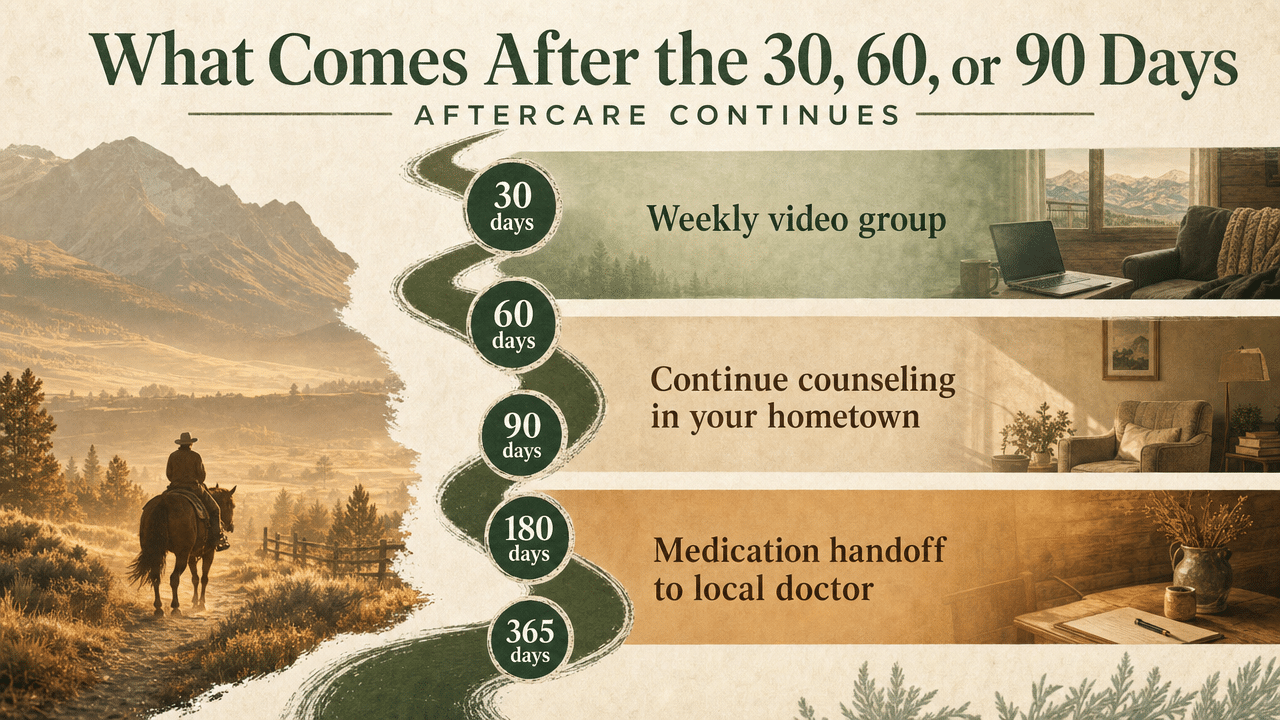
What Comes After the 30, 60, or 90 Days
The day you walk out of a residential program is not the day recovery ends. It’s the day it changes shape. The intensity drops. The structure loosens. The people who held you through the hardest weeks aren’t down the hall anymore. This stretch — the first few months back in your own life — is where a lot of the real test happens, and it’s why the strongest programs treat aftercare as part of the treatment, not something separate that starts once you leave.
Good aftercare has a few pieces. A weekly group, often on video, so the community you built inside doesn’t dissolve the moment you drive home. Scheduled check-ins at 30, 60, 90, 180, and 365 days, so someone is watching your progress on a real timeline instead of hoping for the best. A plan for continuing counseling in your hometown. If you’re on medication, a clear handoff to a doctor who will keep prescribing it — because staying on methadone or buprenorphine long enough is what pulls overdose risk down, and gaps at the transition are where people get hurt.2,9
Ask, before you choose a program, exactly what happens on day 31, day 61, day 91. The answer is the plan.
A Small Place in Montana, and a First Step
Somewhere in this article you may have started picturing what a real program might look like. A small residential setting. Twenty-something beds instead of two hundred. Counselors who have sat where you’re sitting now. Horses in a pasture out back. Family programming that treats the people who love you as part of the work, not as visitors. That’s the shape of the care being described here — a place like Rocky Mountain Treatment Center in Great Falls, Montana, where the pieces we’ve walked through live under one roof.
You don’t have to have it all figured out to pick up the phone. You don’t have to know which medication, which length of stay, which counselor. You just have to be willing to ask one question and see what comes back. That’s the first step. Reading this article was the one before it. Both count.
Frequently Asked Questions
How long should I plan to stay in a residential program?
Most residential programs are built in 30, 60, and 90-day shapes, and the research is fairly consistent — staying in treatment for at least three months is often what it takes for change to hold. That doesn’t mean shorter stays don’t help. It means the longer you can stay, the better the odds. Choose the length you can actually finish.7
Do I have to take medication to recover from opioid or alcohol addiction?
Is equine therapy actually helpful, or is it just a nice extra?
What is the difference between detox and treatment?
How can my family be part of the recovery process?
What happens after I finish a 30, 60, or 90-day program?
References
- Treatment of Substance Use Disorders | Overdose Prevention. https://www.cdc.gov/overdose-prevention/treatment/index.html
- Effectiveness of Medication Assisted Treatment for Opioid Use in Community Corrections. https://pmc.ncbi.nlm.nih.gov/articles/PMC6391743/
- Effects of medication assisted treatment (MAT) for opioid use disorder on functional outcomes. https://pubmed.ncbi.nlm.nih.gov/29706172/
- Equine-assisted services for individuals with substance use disorders. https://pmc.ncbi.nlm.nih.gov/articles/PMC9749232/
- More Than Just a Break from Treatment: How Substance Use Disorder Patients Experience Horse-Assisted Therapy. https://pmc.ncbi.nlm.nih.gov/articles/PMC5054942/
- Inmate Substance Abuse Treatment. https://www.bop.gov/inmates/custody_and_care/substance_abuse_treatment.jsp
- Treatment. https://nida.nih.gov/research-topics/treatment
- Meta-Analyses of Seven of NIDA’s Principles of Drug Addiction Treatment. https://pmc.ncbi.nlm.nih.gov/articles/PMC3290709/
- The Effectiveness of Medication-Based Treatment for Opioid Use Disorder. https://www.ncbi.nlm.nih.gov/books/NBK541393/
- Implementation of Equine Therapy into Treatment Programming for Substance Use Disorders and Co-Occurring Disorders. https://red.mnstate.edu/cgi/viewcontent.cgi?article=1924&context=thesis
- Rules for Substance use Disorder Facility. https://dphhs.mt.gov/assets/oig/Rules_for_Substance_use_Disorder_Facility.pdf