
Key Takeaways
- Co-occurring disorders like anxiety with drinking or depression with pills feed each other, and treating only one side leaves the other to pull recovery back under.
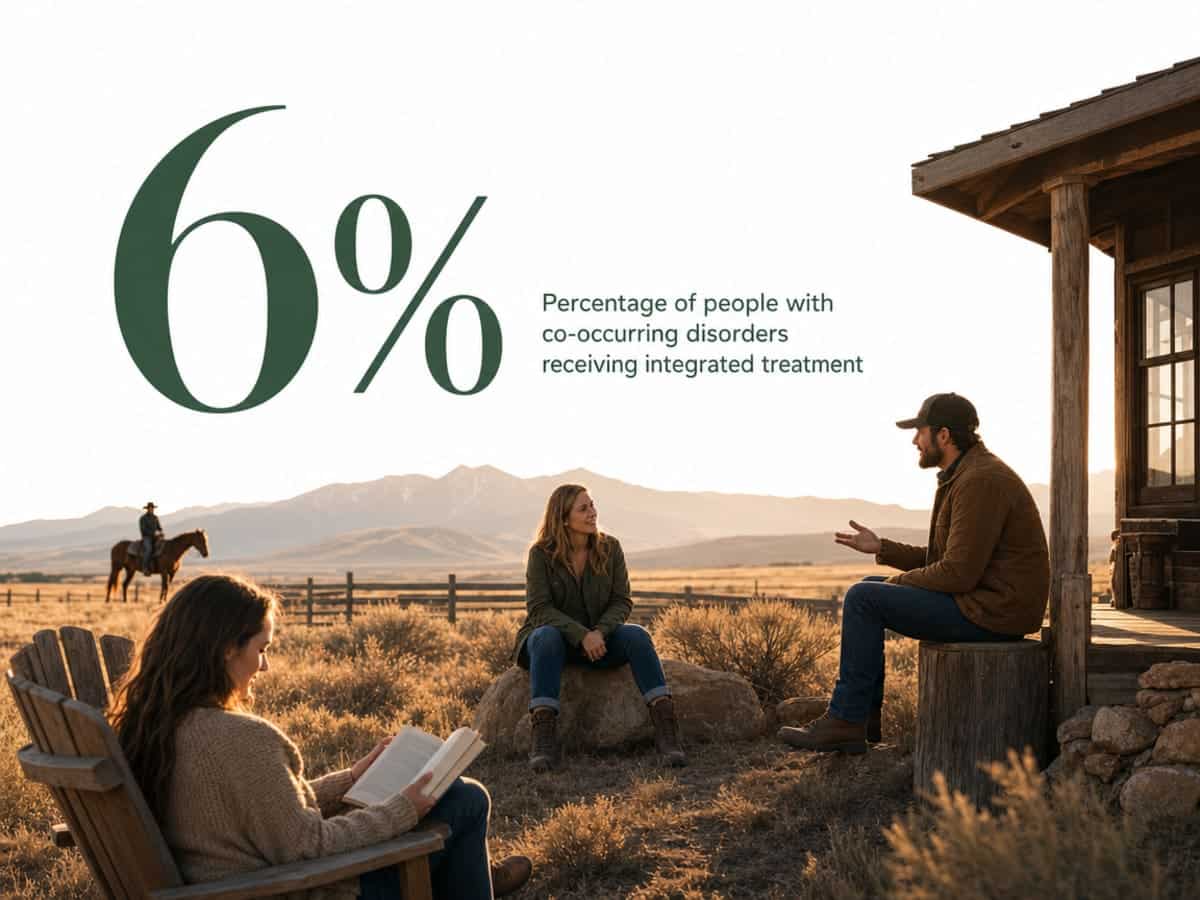
- Only about 6% of people with co-occurring conditions receive both mental health and substance use treatment 10, which is why fragmented care in Great Falls often feels like a revolving door.
- Montana has expanded integrated options through the HEART waiver, the SUD Task Force plan, Medicaid crisis stabilization, and billing codes that recognize dual diagnosis as its own category.
- Before choosing a Great Falls program, ask whether one team handles both conditions, how often they reassess, who manages medication, what aftercare looks like, and what your insurance actually covers.
When Anxiety and Addiction Show Up Together
You’ve probably been told two different stories about yourself. One says the anxiety is causing the drinking. The other says the drinking is causing the anxiety. Maybe a doctor mentioned the depression first, and someone else pointed at the pills. If you’re reading this from Great Falls, or from a small town an hour out, you already know how tiring it is to keep sorting which came first while both keep getting worse.
Here’s the truth that might take some pressure off: both can be true, and both can be treated at the same time. In 2023, about 20.4 million U.S. adults lived with both a mental health condition and a substance use disorder 2. You are not an unusual case. You are not a person who failed rehab. You are someone whose brain and body have been carrying two things that feed each other, and most systems only know how to look at one at a time.
When those two things show up together, clinicians call them co-occurring disorders. The label matters less than what it changes about your care. If a program only treats the drinking, the panic attacks come back and pull you under. If a program only treats the depression, the drinking quietly keeps the depression alive. That’s not failure on your part. That’s a system problem, and there’s a better way to set it up.
The rest of this guide walks you through what integrated care actually looks like in Great Falls, what to ask for, and what a first step feels like.
The Integration Gap Is the Real Problem
If treatment has felt like a revolving door, the problem probably isn’t you. It’s how care gets split up. A December 2024 report from the U.S. Department of Health and Human Services found that only about 6% of people with co-occurring mental health and substance use disorders receive both mental health and substance use treatment 10. That number measures whether people got both kinds of care at all — not whether it was coordinated, not whether it was good. Just whether both sides of what they were living with got any attention.
That gap is the reason so many people cycle through detox, feel better for a few weeks, and then slide back. The drinking or the pills weren’t just a bad habit. They were doing a job — muffling panic, quieting intrusive memories, flattening a depression that made mornings unbearable. Take the substance away without treating what it was covering, and the underlying pain drives right back to the same coping tool. The CDC has flagged this cycle from the other end too: in 2022, roughly one in four people who died of a drug overdose and had a known mental health condition had at least one recent chance for intervention that didn’t lead to connected care 3.
You are not failing the system. The system, in most places, was never built to hold both hands at once. That’s the gap this guide is trying to help you step across.
What Integrated Treatment Actually Means
One Team, One Plan, One Place
The word “integrated” gets thrown around a lot, so it helps to hear it in plain language. The National Institute of Mental Health puts it this way: integrated care combines mental health and substance use treatment so you can receive more convenient, coordinated care in one place 1. Same building. Same team. One story you only have to tell once.
Picture the two paths side by side. On the fragmented side, you’re driving to a counselor on one end of town for the anxiety, then to a separate outpatient group on the other end for the drinking. Two intake forms. Two treatment plans that don’t quite agree. A prescriber who doesn’t know about the group work, and a group facilitator who doesn’t know what you were prescribed last Tuesday. When something falls apart at 9 p.m., neither office is the one to call. You end up translating between them, which is exhausting when you’re already running on fumes.
On the integrated side, the picture flattens out. The SAMHSA-supported IDDT toolkit describes it as combined treatment for mental illness and substance use delivered by the same clinician or the same treatment team 18. The counselor who sits with you through a craving is the same person who knows your trauma history. The doctor managing your medication is in the same conversation as the group facilitator you saw that morning. One chart. One plan. One place where the whole picture of you is being watched.
That’s what “integrated” is supposed to mean on the ground. Not a brochure word. A structure that stops making you the messenger between people who should already be talking.
Why Doing Both at Once Works Better
You might be wondering if this is just a nicer waiting room, or if the outcomes actually differ. They do. A systematic review of integrated care for concurrent disorders found that integrated models showed clear advantages over standard care, with reductions in substance use and improvements in mental health symptoms 14. SAMHSA’s evidence summary reaches the same conclusion: comprehensive, long-term, stage-wise programs with assertive outreach produce better outcomes than treating one disorder and hoping the other sorts itself out 15.
Think about why that would be. When the depression lifts a little, the pull to drink softens. When the drinking eases, the medication for anxiety can actually do its job instead of getting washed out every weekend. Each side of your recovery makes the other side possible. Split the treatment across two buildings and you lose that quiet, daily reinforcement.
There’s also the matter of timing. SAMHSA’s practice principles call for stage-wise care, meaning the work matches where you are right now, not where someone thinks you should be 17. Early on, that might look like getting stable, sleeping through the night, feeling safe enough to name what happened. Later, it might look like grief work, or family repair, or planning for the first sober holiday. A team that treats both conditions can move at that pace without handing you off every time the focus shifts.
That coordination is why integrated care isn’t just kinder. It’s more likely to hold.
How Montana Is Moving Toward Integration
HEART, the SUD Task Force, and Crisis Stabilization
You might feel like the state has been slow to catch up with what you already know from lived experience. The picture is actually shifting, and it’s worth knowing where. In 2022, the Centers for Medicare & Medicaid Services approved Montana’s Healing and Ending Addiction through Recovery and Treatment (HEART) waiver, which funds a broader continuum of substance use care and has been amended several times since to keep expanding what’s covered 5. That’s not just paperwork. It’s the funding backbone behind newer crisis and treatment options across the state.
Alongside HEART, Montana’s Substance Use Disorder Task Force runs a 2024–2028 strategic plan that now explicitly names co-occurring substance use and mental health disorders as part of its scope 6. In plain terms, the state has stopped treating addiction as if it exists in its own separate lane. The plan pulls prevention, treatment, recovery, crisis response, and justice-system coordination into the same conversation, which is closer to how your life actually works.
If things go sideways at 2 a.m., there’s a Medicaid-backed layer for that too. The state’s crisis stabilization program covers behavioral health crises related to a mental health disorder, a substance use disorder, or both together 7. And on the outpatient side, a 2023 provider notice made clear that assertive community treatment and substance use outpatient services can be billed at the same time, so you’re not forced to pick one lane 9. That’s the state quietly saying what you’ve felt all along: these things belong under one plan.
Where Integrated Programs Actually Exist
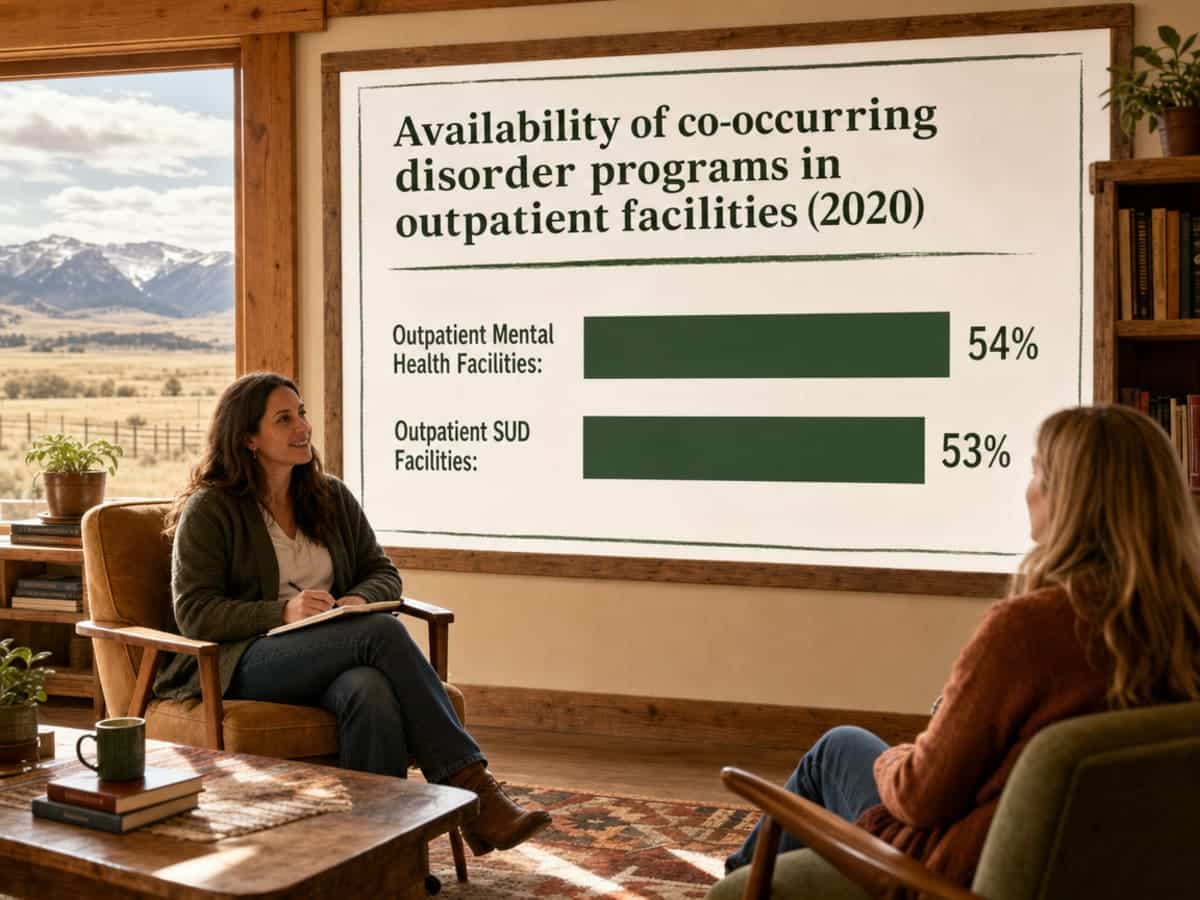
Policy is one thing. What’s actually available near you is another. Nationally, the picture is uneven. In 2020, 54% of outpatient mental health facilities and 53% of outpatient substance use facilities reported offering a special program for co-occurring disorders 11. Encouraging on paper, until you look at the trend line. Mental health facilities held flat at 54% from 2014 to 2020, while substance use facilities grew from 43% to 53% over the same window 10. The addiction side is catching up. The mental health side has barely moved.
What that means for you in Great Falls: if you start on the mental health side of the aisle, you may still land in a program that treats the anxiety or depression well but treats the drinking as someone else’s problem. If you start on the addiction side, especially in a residential program built around dual diagnosis, you’re more likely to walk into a place where both get worked on from day one. Neither door is guaranteed, which is exactly why the questions in the next section matter.
The other Montana reality: distances are real. If you’re driving in from Choteau, Fort Benton, or Lewistown, a program that keeps both kinds of care under one roof isn’t just clinically better. It saves you from making the same trip twice a week for two different appointments. Integrated residential care collapses that logistics puzzle into one address, one schedule, one team who already knows your story.
What a Day of Integrated Residential Care Looks Like
If you’ve only ever pictured rehab as a sterile hallway and a folding chair in a circle, an integrated residential day might surprise you. The shape of it is calmer than you’d think, and busier in the ways that matter.
Mornings usually start with something small and steady — breakfast, a check-in, a few minutes with a nurse if you’re on medication. That check-in isn’t just about cravings. SAMHSA’s practice principles call for ongoing assessment of both disorders, not a one-time intake and then silence 17. So the counselor asking how you slept is also tracking whether the nightmares are easing, whether the new medication is settling, whether yesterday’s group stirred something you’re carrying into today.
Group work fills a chunk of the middle of the day. Some groups look at the addiction directly — triggers, cravings, the 12-step language many programs still use as a backbone. Others sit with what’s underneath: grief, panic, a trauma you’ve never said out loud. In a fragmented setup, those would be two different rooms in two different buildings. Here, the person leading the trauma group has read the same chart as the person leading the relapse-prevention group 18.
Afternoons often make room for something that doesn’t look like therapy at all. A walk. Time with horses. A quiet hour with a workbook. That’s not filler. Evidence summaries of integrated treatment describe comprehensive, long-term, stage-wise care that includes protective environments and activities outside the therapy room 15. Your nervous system needs somewhere to land between hard conversations.
Evenings tend to soften — a meeting, a phone call home, sleep that actually comes. One team saw all of it. One plan held it together. One place, for once, is holding both hands at the same time.
Questions to Ask a Program Before You Say Yes
You get to interview them. That sentence alone is worth writing down, because most people walk into treatment intake feeling like the one being judged. You’re not. You’re handing a team your life for 30, 60, or 90 days, and you’re allowed to ask hard questions before you do.
Here are the ones that actually separate a program that treats both conditions from a program that treats one and refers out for the other. They’re grounded in SAMHSA’s practice principles for integrated care 17and the IDDT model’s description of same-team treatment 18.
- Will the same team handle both my mental health and my substance use? If the answer is “we refer out for the anxiety” or “our therapist only does addiction work,” that’s fragmented care wearing a nicer coat.
- How do you assess both conditions, and how often? A full intake should look at both from day one, and SAMHSA calls for ongoing assessment through the whole stay, not just a checkbox on arrival 17.
- What does treatment look like if I’m not ready to quit everything today? Stage-wise care means the plan meets you where you are. A program that only works with people already committed to full sobriety may not be built for the messier middle 17.
- Who prescribes and manages medication, and do they talk to my therapist? One chart, one conversation. If the prescriber is off-site and hard to reach, that’s a gap.
- What happens after I leave? Continuity of care is one of SAMHSA’s core principles 16. Ask about weekly check-ins, alumni groups, and how they handle the first shaky month back home.
- Does family get to be part of this? Structured family sessions matter, especially if the people you’re going home to have been carrying this with you.
If a program answers most of these clearly and without defensiveness, you’re in a different tier of care. Trust that.
Paying for Care in Montana
Money is usually the question that stops the phone from getting picked up. It’s worth being straight about how it actually works here.
If you have commercial insurance through work or the marketplace, most residential programs in Montana will run a benefits check for you before you commit to anything. That call is free, and it tells you what your plan covers for detox, residential treatment, and dual diagnosis services. Ask for it in writing. If a program only handles addiction and refers the mental health piece out, your plan may end up paying two providers for what should have been one coordinated stay.
Montana Medicaid is a different lane. The state’s July 2025 fee schedule includes co-occurring-specific billing codes, like certified peer support for co-occurring individual sessions, which shows the program is set up to recognize dual diagnosis work as its own category rather than folding it into general SUD care 8. On the outpatient side, a 2023 provider notice confirms that assertive community treatment and substance use outpatient services can be billed at the same time, so Medicaid members aren’t forced to drop one to receive the other 9. If you’re in a behavioral health crisis, Medicaid also covers crisis receiving and stabilization services for mental health, substance use, or both together 7.
Here’s the honest part: not every residential program in Great Falls accepts Medicaid or Medicare. Some work primarily with major commercial insurers and self-pay. That doesn’t make them the wrong fit or the right one — it just means the first phone call should include a plain question about what your specific plan will and won’t cover. A good admissions team will tell you within a day, without pressure.
Getting From the First Call to the First Day
The hardest part is usually the phone. Once you dial, the rest starts to move on rails.
A first call to a residential program in Great Falls is usually short and kinder than you expect. Someone asks what’s going on, what you’ve been using, how the anxiety or depression or trauma has been showing up, and whether you’re safe right now. If you’re in a full crisis at that moment, Montana Medicaid covers crisis receiving and stabilization services for mental health, substance use, or both together, so there’s a bridge even if a residential bed isn’t open the same hour 7. You don’t have to have the language for what’s wrong. You just have to answer honestly.
From there, an admissions coordinator usually walks through insurance, timing, and what to bring. Same-day or next-day admission is often possible when a bed is available. If you’re driving in from Havre, Cut Bank, or somewhere further, ask about transportation help — some programs offer a Montana pickup so the trip itself isn’t the thing that stops you.
The first day is quieter than the movies. A medical check. A longer intake that looks at both the substance use and the mental health side from the start, the way SAMHSA’s guidelines call for 16. A bed, a meal, a first night of sleep somewhere safe. That’s the whole assignment. If a program like Rocky Mountain Treatment Center is the door you walk through, you’ve already done the hardest thing on the list. Everything after that is one day at a time, with a team that’s finally holding both hands.
Frequently Asked Questions
What are co-occurring disorders?
Co-occurring disorders means you’re living with a mental health condition and a substance use condition at the same time. Anxiety and drinking. Depression and pills. PTSD and anything that numbs it. The CDC counts these together in hospital data when both a substance use diagnosis and a mental health diagnosis show up in the same encounter 4. It’s a common pairing, not a rare or complicated one.
How is dual diagnosis treatment different from regular rehab?
Regular rehab focuses on the substance use and often refers the mental health piece somewhere else. Dual diagnosis treatment keeps both in the same room. The National Institute of Mental Health describes integrated care as combining mental health and substance use treatment in one place so it stays coordinated 1. One team reads the same chart, adjusts the same plan, and tracks how the anxiety and the drinking talk to each other day by day.
Can I get integrated care for both addiction and mental health in Great Falls?
Yes. Residential programs in the Great Falls area that offer dual diagnosis treatment handle both sides under one roof. That matters more than it sounds. Nationally, only about 6% of people with co-occurring disorders end up receiving both mental health and substance use treatment 10. Choosing a program built for both from day one is how you land on the right side of that number instead of getting bounced between providers.
Does Montana Medicaid cover treatment for co-occurring disorders?
Montana Medicaid recognizes co-occurring care as its own category. The July 2025 fee schedule includes co-occurring-specific billing codes, including peer support for people with dual diagnoses 8. Medicaid also covers crisis stabilization for mental health, substance use, or both together 7. That said, not every residential program accepts Medicaid or Medicare. Ask about your specific plan on the first call, and get the answer in writing before you commit.
How do I know if a program actually treats both conditions together?
Ask direct questions. Will the same team handle both? Do you assess mental health and substance use on day one and keep checking through the stay? Who prescribes medication, and do they talk to my therapist? What happens after I leave? SAMHSA’s practice principles call for stage-wise care, ongoing assessment of both disorders, and continuity of care 17. If a program answers plainly and without defensiveness, you’re in the right kind of place.
What if I’ve tried treatment before and it didn’t work?
That’s not a mark against you. It’s often a sign the last program only treated half of what you were carrying. Research on integrated care shows better outcomes for substance use and mental health when both are handled together instead of in separate systems 14. Trying again with a team that treats the whole picture, not just the drinking or just the depression, is a different attempt. You’ve learned things. That counts.
References
- Finding Help for Co-Occurring Substance Use and Mental Disorders. https://www.nimh.nih.gov/health/topics/substance-use-and-mental-health
- Substance Use & Mental Health. https://www.cdc.gov/mental-health/about-data/substance-use-mental-health.html
- About Behavioral Health. https://www.cdc.gov/mental-health/about/about-behavioral-health.html
- Drug Use-Associated Hospital Encounters Involving Co-Occurring Disorders. https://www.cdc.gov/nchs/dhcs/drug-use/co-occurring-disorders.htm
- Montana Healing and Ending Addiction through Recovery and Treatment (HEART). https://www.medicaid.gov/medicaid/section-1115-demo/demonstration-and-waiver-list/126901
- Montana Substance Use Disorder Task Force Strategic Plan. https://dphhs.mt.gov/assets/publichealth/EMSTS/opioids/SUDsStrategicPlan2024.pdf
- Medicaid Services Provider Manual for Substance Use Disorder and Adult Mental Health. https://dphhs.mt.gov/assets/BHDD/MedicaidManual/450CrisisStabilizationProgram.pdf
- July 2025 Substance Use Disorder Medicaid. https://medicaidprovider.mt.gov/docs/feeschedules/2025/July2025SUDMedicaid.pdf
- Montana Assertive Community Treatment (MACT) and Substance Use Disorder Services. https://medicaidprovider.mt.gov/docs/providernotices/2023/provnoticeMontanaAssertiveCommunityTreatmentMACTandSUDServices.pdf
- Adoption of Integrated Care for People with Co-Occurring Mental Health and Substance Use Disorders. https://aspe.hhs.gov/sites/default/files/documents/e2ccdd7991f1de5060983598cb66624f/adoption-integrated-care.pdf
- Availability and Correlates of Integrated Treatment for People with Co-Occurring Disorders in Outpatient Behavioral Health Treatment Facilities. https://aspe.hhs.gov/reports/availability-correlates-integrated-treatment-people-cods
- Integrating Treatment for Co-Occurring Mental Health Conditions. https://pubmed.ncbi.nlm.nih.gov/31649837/
- Recommendations for Integrated Systems and Services for People With Co-occurring Mental Health and Substance Use Conditions. https://pubmed.ncbi.nlm.nih.gov/34644127/
- A Review of Integrated Care for Concurrent Disorders: Cost Effectiveness and Clinical Outcomes. https://pubmed.ncbi.nlm.nih.gov/30806190/
- Integrated Treatment for Co-Occurring Disorders: The Evidence. https://library.samhsa.gov/sites/default/files/ebp-kit-the-evidence-10242019.pdf
- Chapter 2—Guiding Principles for Working With People Who Have Co-Occurring Disorders. https://www.ncbi.nlm.nih.gov/books/NBK571016/
- EXHIBIT 2.4. SAMHSA Practice Principles of Integrated Treatment for CODs. https://ncbi.nlm.nih.gov/sites/books/NBK571016/box/ch2.b5/?report=objectonly
- Co-Occurring Disorders Integrated Dual Disorders Treatment (IDDT) Toolkit. https://portal.ct.gov/-/media/dmhas/cosig/iddttoolkitpdf.pdf
- Integrated Treatment for Co-Occurring Disorders Evidence-Based Practices (EBP) KIT (product page). https://library.samhsa.gov/product/integrated-treatment-co-occurring-disorders-evidence-based-practices-ebp-kit/sma08-4366