Key Takeaways
- Idaho defines residential treatment under IDAPA 16.07.17 as 24-hour structured care from nationally accredited, ASAM-certified providers, with 2-1-1 CareLine and DHW Get Help as the confidential entry points 6, 2, 3.
- Rural Idaho counties face real shortages of nearby beds, with outpatient substance use services nearly four times less available in rural hospitals than urban ones 7, often making cross-border care in Great Falls a shorter drive than in-state options.
- Payment splits along two roads: the Idaho Behavioral Health Plan uses participant fees and contracted providers 4, while Rocky Mountain Treatment Center accepts most major private insurance and self-pay but not Medicaid or Medicare.
- A workable next step is calling 2-1-1 for Idaho-contracted programs 2, or requesting an info packet and benefits check from Rocky Mountain Treatment Center to see which door opens sooner.
What residential care actually means when you live in Idaho
If you’re reading this from a kitchen in Salmon, a bunkhouse outside Grangeville, or a rental on the edge of Twin Falls, you already know the shape of the problem. Drinking has stopped being a choice and started running the schedule. You’ve probably tried to cut back on your own more than once. That effort counts, even when it hasn’t stuck.
Residential care — most folks call it inpatient — means you stay somewhere safe for a stretch of time while your body clears alcohol and your head gets room to work. In Idaho, the state defines it as a planned, structured program provided in a 24-hour setting, run by nationally accredited providers with an ASAM level-of-care certification 6. Plain English: you sleep there, meals and medical support are handled, and counselors work with you every day instead of once a week.
Most stays run 30, 60, or 90 days. The longer end isn’t punishment. It’s time for the part of you that isn’t the drinking to come back.
You have real options inside Idaho, and you have one just over the state line at Rocky Mountain Treatment Center in Great Falls, Montana — a 26-bed residential program where more than 80% of the staff are in recovery themselves. This guide walks through both, honestly, so you can pick the door that actually opens for you.
How Idaho’s treatment system is set up (and where it hands you off)
The 2-1-1 CareLine and DHW Get Help: the confidential front door
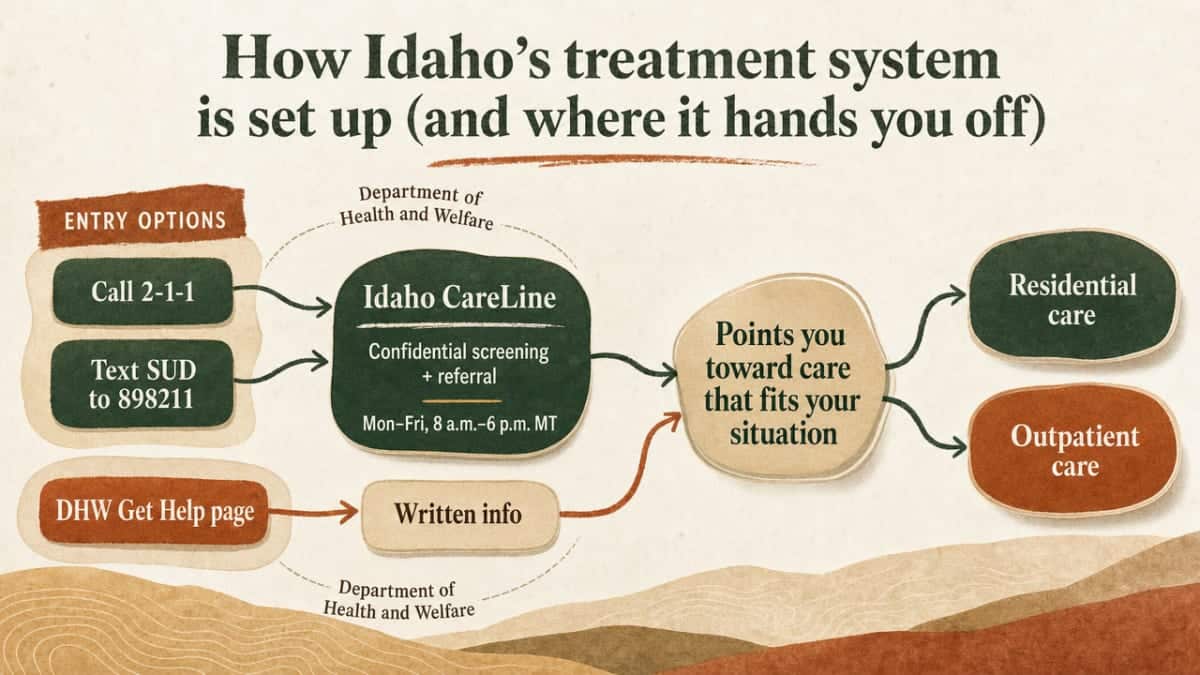
The simplest door in Idaho is a three-digit phone number. Dial 2-1-1, or text SUD to 898211, and you reach the Idaho CareLine — a confidential screening and referral service run through the Department of Health and Welfare. It operates Monday through Friday, 8 a.m. to 6 p.m. Mountain time, and the person on the other end can point you toward residential or outpatient care that fits your situation 2.
No one shows up at your door. No one calls your boss. You can make the call from a truck cab in a Bureau of Land Management pull-off if that’s what feels safest.
If you’d rather read before you talk, the DHW’s Get Help page walks through the same territory in writing. It lists residential and outpatient substance use treatment among the services Idaho residents may qualify for, and it connects you with local behavioral health offices that can start a screening 3. The main DHW behavioral health portal also links to a searchable directory of resources that are free, low-cost, or offered on a sliding scale — worth a look if money is part of what’s kept you stuck 1.
Here’s the honest part: sometimes that first call ends with a referral out of your county, or even out of state. That’s not the system failing you. That’s the system being straight with you about where the beds are.
What the state means by ‘residential treatment’ — IDAPA 16.07.17 and ASAM
You’ll hear the words “inpatient” and “residential” used like they mean the same thing. In Idaho’s rulebook, residential is the term that matters. The Idaho Administrative Code, chapter 16.07.17, defines Residential Treatment Services as “a planned and structured regimen of treatment provided in a 24-hour residential setting.” Programs that contract with the state must be nationally accredited and hold an ASAM level-of-care certification 6.
Translation for a working person: the place has to be staffed around the clock, has to answer to an outside body that checks its work, and has to match the intensity of care to how sick you actually are. You don’t get slotted into a program that’s too light for withdrawal, and you don’t get warehoused in one that’s heavier than you need.
ASAM — the American Society of Addiction Medicine — is the standard most reputable programs use, in and out of Idaho. Rocky Mountain Treatment Center in Great Falls carries Joint Commission accreditation, which is the same kind of outside oversight the Idaho rule is pointing at when it says “nationally accredited.” Different agency, same purpose: someone independent is watching the clinical work.
Who pays: the Idaho Behavioral Health Plan, participant fees, and private insurance
Paying for a month or three of residential care sounds like a wall until you break it into pieces. In Idaho, the Department of Health and Welfare runs the Substance Use Disorder Program through a network of contracted providers, using participant fee determination and set provider reimbursement rates 4. Plain English: the state looks at what you make, decides what you can reasonably chip in, and pays the rest for care at a contracted facility if you qualify. The Get Help page is where residents start that eligibility conversation 3.
Private insurance is the other main road. Most employer plans and marketplace plans cover residential substance use treatment to some degree, though what “covered” means varies. Rocky Mountain Treatment Center works with most major insurance carriers and can run your benefits before you commit to anything — no charge, no obligation. Two straight facts to save you time: RMTC does not currently accept Medicaid or Medicare. If those are your only coverage, the 2-1-1 CareLine 2is the better first call, since it can route you to Idaho-contracted residential programs that do.
The rural reality: hay season, one clinic in town, and the long drive
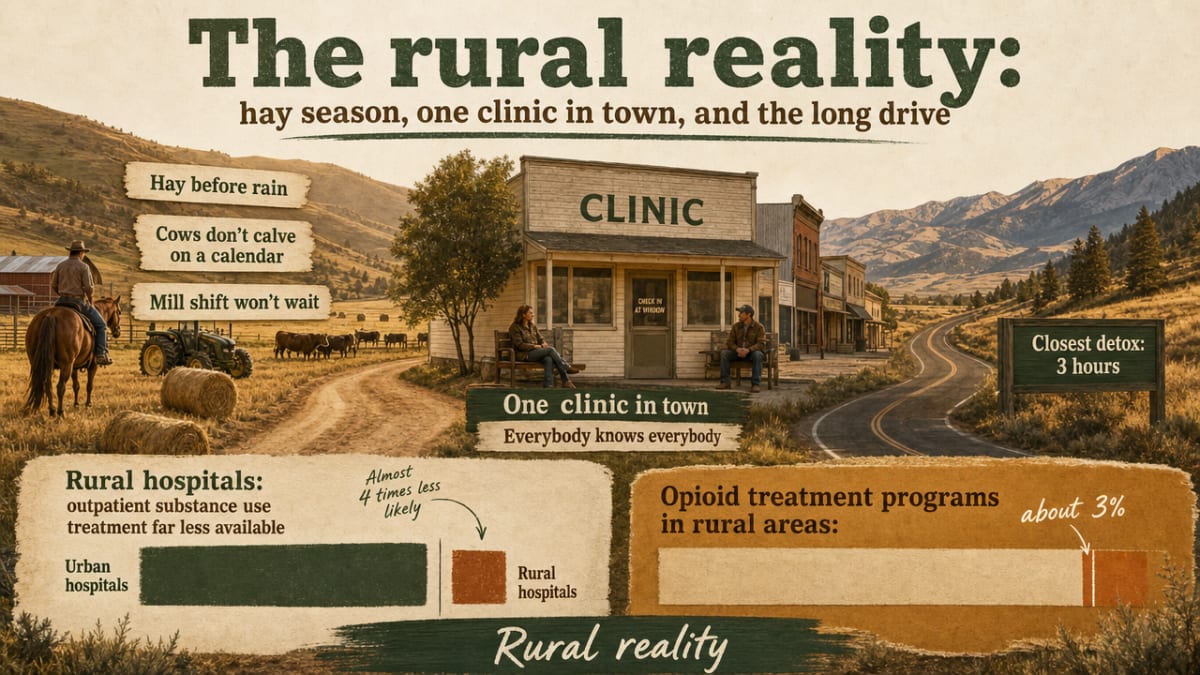
Let’s name what’s actually in the way. It isn’t that you don’t want to stop drinking. It’s that the closest detox is three hours off, the one clinic in town is run by somebody who went to school with your sister, and the tanker driver you carpool with will notice if your truck sits at the wrong parking lot for a week. On top of that, hay’s got to come off before it rains, the cows don’t calve on a calendar, and the mill shift doesn’t hold your slot forever.
None of that is imagined. SAMHSA’s rural behavioral health brief lays out the geography in plain numbers: outpatient substance use treatment services are almost four times less likely to be available in rural hospitals than in urban ones, and only about 3% of all opioid treatment programs are located in rural areas 7. Idaho isn’t the whole rural United States, but the pattern maps onto Lemhi, Boundary, Idaho, Custer, Owyhee, and plenty of other counties where the nearest residential bed is a serious drive no matter which direction you point the truck.
That shortage does two things. It stretches waits at the in-state programs that do exist, and it means the honest answer to “where’s the closest bed that opens this week” is sometimes over a state line. Great Falls is one of those answers for a lot of Idaho — closer than Boise from parts of the Panhandle, and closer than Salt Lake from parts of the east.
Stigma is the other weight. In a town of 900, going to “the clinic” is a conversation the whole coffee shop has. Leaving for 30 days is a story people tell once and then let go. That difference matters, and it’s worth saying out loud when you’re picking a door.
Crossing into Montana: when Rocky Mountain Treatment Center makes sense
Why Great Falls is often closer than you’d guess
Pull up a map and look at the state line honestly. From Bonners Ferry, Great Falls is a straight shot east through Kalispell — the kind of drive you’d make for a good elk tag. From Salmon or Challis, you’re already pointed at Montana; the interstate does most of the work from there. From Idaho Falls or Rexburg, the route north on I-15 gets you to Great Falls in less time than a lot of folks spend crawling south to Salt Lake in Friday traffic.
Nobody’s telling you to skip an Idaho program that fits. If the 2-1-1 CareLine 2finds you a state-contracted bed nearby, that may be the right door. But when the wait is long, the drive is worse in the other direction, or the closest in-state option is somewhere you’d rather not be seen walking in, Great Falls stops being “out of state” and starts being “the next town over that happens to be across a line.”
For a lot of Idaho, that’s the honest geography. Same mountains, same big sky, same kind of people at the diner counter.
A 26-bed setting, staff in recovery, and complimentary Montana pickup
Rocky Mountain Treatment Center runs 26 beds. That number matters. It means the counselor working with you knows your name by the second day, not the second week. It means the group you sit in isn’t fifty strangers — it’s a handful of people who are going through what you’re going through, close enough to actually say something true.
More than 80% of the staff at RMTC are in recovery themselves. When someone tells you the first week is going to feel like your skin is on wrong, they’re not reading it out of a manual. They lived it. For a rancher, a millwright, or a nurse who has spent years being the person other people lean on, that shift — being with folks who don’t need you to explain — is part of what makes staying possible.
The travel piece is handled, too. RMTC offers complimentary Montana pickup, meaning if you can get yourself to an agreed-upon spot in Montana, the center arranges the ride from there. You don’t need a plan for the last leg. You need to make the call and pack a bag.
Payment plainly: insurance, self-pay, and what RMTC does not accept
Here’s the straight version so you’re not guessing. Rocky Mountain Treatment Center works with most major insurance carriers — employer plans, marketplace plans, the common names you’d recognize. Admissions will run your benefits before you commit to anything and tell you what your plan covers and what it doesn’t. That call is free.
Self-pay is an option too, and RMTC’s team can walk you through what a 30-, 60-, or 90-day stay would look like on that basis.
Two things RMTC does not currently accept: Medicaid and Medicare. If either one is your only coverage, don’t spend a week going in circles — call 2-1-1 2or start with DHW’s Get Help page 3and let Idaho’s system route you to a contracted residential program that takes your coverage. That’s the shorter path, and there’s no shame in taking it.
Your first 72 hours: what intake and medically monitored detox feel like
The unknown is heavier than the actual first days. Once you know the shape of them, they get smaller.
Here’s what it looks like at Rocky Mountain Treatment Center. You call admissions. Someone answers who has done this before — either as staff or in their own recovery — and asks you a handful of questions about how much you drink, how long you’ve been drinking that way, and what medications and health conditions are in the picture. That call takes about half an hour. Nobody’s judging your numbers. They need them to keep you safe through withdrawal.
If you’re a fit and there’s a bed, they’ll set an intake date, sometimes the same day. You agree on a meet point in Montana. Complimentary Montana pickup means you don’t drive the last leg alone — someone from the center picks you up and brings you to Great Falls. That ride is quieter than you’d expect. Most people sleep part of the way.
Intake at the center is paperwork and a medical evaluation. A nurse checks your vitals, asks about your last drink, and gets you settled in a room. Then medically monitored detox starts. That means staff watch you around the clock, medications are used to take the edge off withdrawal safely, and the physical stuff — shaking, sweating, sleeplessness, that low-grade panic — gets managed instead of endured. Alcohol withdrawal is one of the few kinds you don’t tough out alone; the seizures and DTs are what make it dangerous, and that’s exactly what the medical piece is there to head off.
Day two, you’ll feel rough but clearer. Day three, most people start eating again, sleep gets a little deeper, and the first one-on-one counselor session happens. Not a deep excavation — a meet-and-greet. What brought you here, what you’re worried about, what you want out of the next 30, 60, or 90 days. Later that day or the next, you sit in your first group. You don’t have to talk. You just have to be in the room.
Idaho’s own system is pushing hard to expand access to medication-assisted treatment as part of the state’s opioid response, and that shift matters here too 5: after detox, the conversation about whether medication belongs in your longer plan — for cravings, for co-occurring conditions — is a real one, not an afterthought. You’ll have it with a counselor who has time.
Seventy-two hours in, you won’t feel fixed. You’ll feel like you can hear yourself think again. That’s the door.
Counseling, 12-step work, and family week over 30, 60, or 90 days
After detox, the real work starts, and it looks less like a hospital and more like a rhythm. Mornings hold group counseling. Afternoons hold one-on-one sessions with your counselor, plus time for whatever the day is teaching you. Evenings hold 12-step meetings — the same rooms, the same steps, the same coffee that have kept people sober for decades. Weekends aren’t empty; they hold recreation, chores, and the kind of downtime that lets you practice being a person who isn’t drinking.
Individual counseling at Rocky Mountain is where the private stuff comes out — the reason you started, the losses you haven’t told anyone about, the shame that keeps you reaching for the bottle after you swore you were done. Group is where you find out you’re not the only one. For folks who have spent a life being the strong one on the crew or in the family, that room does something a book can’t.
Family week is three days built for people who love you and have run out of ideas. Spouses, parents, adult kids, sometimes a sibling — they come in, learn what addiction actually is, sit through guided conversations with you and a counselor, and go home with a different vocabulary. Distance from Idaho is planned around; families drive or fly in for that window and stay in Great Falls.
Thirty days gets you stable. Sixty gets habits into your hands. Ninety gives your brain time to trust it.
Equine therapy, honestly: what the research actually says
You’ve probably seen the photos on rehab websites — someone standing next to a horse, looking calm. If you’ve been around horses your whole life, that image might land differently than it does for a city reader. You already know a horse can tell when you’re lying to yourself. That’s the part that makes this work worth talking about, and worth being straight about.
Equine therapy at Rocky Mountain Treatment Center is part of the week, not the whole plan. You spend time with horses under the guidance of a counselor — grooming, groundwork, learning to be still enough that the animal will stand with you. For people who have gone numb, or who armor up in a room full of humans, a horse gets past that faster than a chair circle does.
Here’s what the research honestly says.
- A 2022 systematic review looked at every study it could find on equine-assisted services for substance use disorder and concluded that the evidence is “inconclusive” — promising, but not yet proven 8.
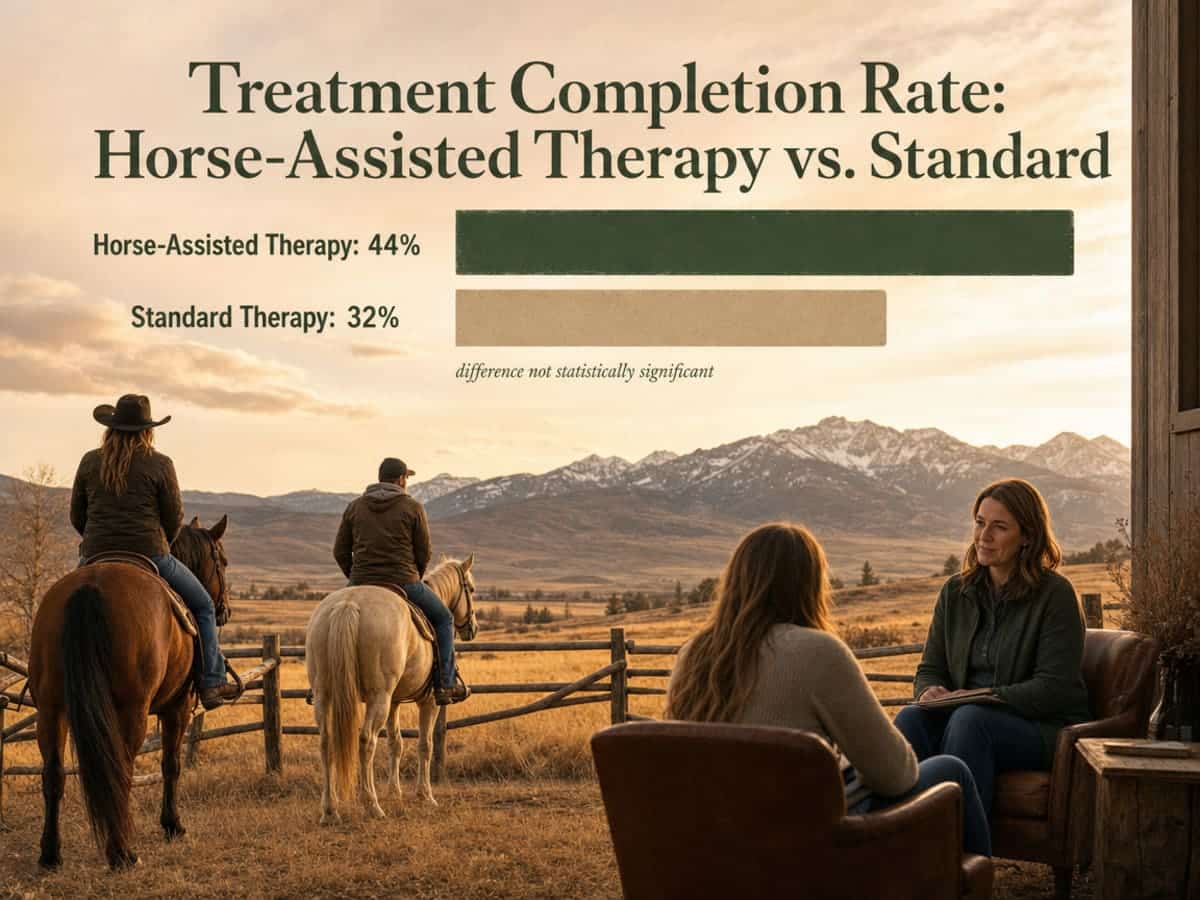
- A randomized controlled trial comparing standard treatment to standard treatment plus horse-assisted therapy found that 44% of the horse-therapy group completed treatment versus 32% of the standard group. The sample was small and the difference was not statistically significant 9.
- A separate prospective study of young adults found a significant association between horse-assisted therapy and staying in treatment longer, though the authors cautioned that association isn’t causation 10.
- A psychiatric study on equine-facilitated psychotherapy found gains in self-esteem, attachment, and trust in both the horse and the therapist 11.
Put plainly: the horses aren’t the cure. Counseling, detox, group work, and the people around you are the cure. But for a lot of ranch-country folks, the barn is where the counseling finally lands.
Coming home to Idaho: aftercare, telehealth, and staying sober through calving and harvest
Discharge day isn’t the finish line. It’s the day you start using what you learned back on your own ground — and the plan for that day gets built well before you pack.
Rocky Mountain Treatment Center runs aftercare as a real program, not a pamphlet. Weekly Zoom groups keep you in the room with the same people you sat next to in Great Falls. Counselors follow up at 30, 60, 90, 180, and 365 days after you leave. That last one matters. A year out is when a lot of folks quietly slip, and a scheduled call from someone who knows your story is a small anchor when calving hits at 2 a.m. or the combine breaks down in August and the old thinking starts whispering.
Telehealth is part of why this works from Salmon or Bonners Ferry. SAMHSA’s rural brief flags telehealth as one of the honest answers to the distance problem — imperfect, but real — for keeping care going after residential discharge 7. A Zoom group from the truck seat during lunch is not a compromise. It’s continuity.
You’ll also plan the local piece before you leave: a 12-step meeting you can actually get to, a counselor in Idaho Falls or Coeur d’Alene or the closest town that has one, and if medication belongs in your longer plan, a prescriber lined up so you’re not scrambling 5. The 2-1-1 CareLine can help with the last piece if you don’t have a lead 2.
Harvest still comes. Calves still drop. You just meet them sober.
Two small next steps you can take today
You don’t have to have the whole plan figured out by tonight. You have to do one thing that moves you an inch closer to the truck door.
- The first small step: request an info packet from Rocky Mountain Treatment Center. It comes to your mailbox or your inbox — your call — and it lays out the 30, 60, and 90-day programs, what a day looks like, how family week is structured, and how complimentary Montana pickup works. No pressure, no follow-up sales calls you didn’t ask for. Just something to read with coffee.
- The second small step: call admissions and ask the questions on your mind. Benefits, timing, what to bring, whether this week or next week is realistic. If Idaho’s system is a better fit for your coverage, the 2-1-1 CareLine 2is a straight-line alternative.
Pick one. Today counts.
Frequently Asked Questions
How do I start looking for inpatient treatment if I live in a rural part of Idaho?
Dial 2-1-1 or text SUD to 898211. That’s Idaho’s CareLine — a confidential screening and referral service through the Department of Health and Welfare that can point you toward residential care in or near your area 2. If you’d rather read first, the DHW’s Get Help page lists what residents may qualify for 3. You can also call an out-of-state program like Rocky Mountain directly.
Is it legal or unusual for an Idaho resident to go to residential treatment in Montana?
It’s legal, and it’s common. Idaho residents cross state lines for care all the time when the nearest bed, the right program, or a private setting sits over the line. Rocky Mountain Treatment Center in Great Falls works with Idahoans regularly, runs benefits through most major insurance carriers, and offers complimentary Montana pickup so you don’t drive the last leg alone.
What actually happens during medically monitored detox in the first few days?
Staff watch you around the clock, check vitals often, and use medications to take the edge off withdrawal — the shaking, the sweating, the sleeplessness, the low-grade panic. Alcohol withdrawal can bring seizures and DTs, which is why doing it alone is dangerous. Day two feels rough but clearer. By day three, most people start eating, sleep better, and meet their counselor for the first time.
Does Rocky Mountain Treatment Center accept Idaho Medicaid or Medicare?
No. RMTC does not currently accept Medicaid or Medicare. If either one is your only coverage, don’t spend weeks going in circles. Call 2-1-1 2or start on DHW’s Get Help page 3and let Idaho’s system route you to a state-contracted residential program that takes your coverage. RMTC works with most major private and employer insurance plans, plus self-pay.
How do people leave a ranch, farm, or job site for 30, 60, or 90 days?
Same way they’d leave for a hospital stay: they tell the people who need to know, hand off what has to be handed off, and go. Neighbors cover chores. A brother-in-law takes the herd. FMLA covers many jobs. Family week is built for people traveling in from out of state. Thirty days feels impossible until you compare it to how many days drinking has already cost.
Does equine therapy really help, or is it just a nice extra?
Honest answer: it helps some people a lot, and the research is still catching up. A 2022 systematic review called the evidence “inconclusive” but promising 8. It’s an adjunct at Rocky Mountain, not the whole plan — counseling, detox, group work, and 12-step meetings do the heavy lifting. For people raised around animals, the barn is often where the counseling finally lands.
References
- Health, Behavioral Health and Substance Use Disorder. https://healthandwelfare.idaho.gov/services-programs/health-behavioral-health-and-substance-use-disorder
- In too deep? Call 2-1-1 or text SUD to 898211 for help. https://healthandwelfare.idaho.gov/services-programs/too-deep-call-2-1-1-or-text-sud-898211-help
- Get Help | Idaho Department of Health and Welfare. https://healthandwelfare.idaho.gov/services-programs/behavioral-health/get-help-0
- Behavioral Health Service Providers. https://healthandwelfare.idaho.gov/providers/behavioral-health-providers/behavioral-health-service-providers
- Idaho’s State Opioid Response. https://healthandwelfare.idaho.gov/providers/behavioral-health-providers/idahos-state-opioid-response
- Idaho Administrative Code – Substance Use Disorders Services (2024 Archive). https://adminrules.idaho.gov/rules/2024%20Archive/16/160717.pdf
- In Brief: Rural Behavioral Health: Telehealth Challenges and Opportunities. https://library.samhsa.gov/sites/default/files/sma16-4989.pdf
- Equine-assisted services for individuals with substance use disorders: A systematic review. https://pmc.ncbi.nlm.nih.gov/articles/PMC9749232/
- Complementary horse-assisted therapy for substance use disorders: A randomized controlled study. https://pmc.ncbi.nlm.nih.gov/articles/PMC7001193/
- Substance use disorder treatment retention and completion: a prospective study of horse-assisted therapy (HAT) for young adults. https://pmc.ncbi.nlm.nih.gov/articles/PMC4672500/
- An evaluation of the effect of equine-facilitated psychotherapy on patients with psychiatric disorders. https://pmc.ncbi.nlm.nih.gov/articles/PMC10306210/