
Key Takeaways
- Residential care fits when withdrawal feels unsafe, outpatient hasn’t held, or mental health struggles are tangled with drinking — it’s a clinical match, not a verdict on how bad things are.
- The first 72 hours center on medically monitored detox, with the hardest stretch usually falling between hours 12 and 48 before the physical symptoms start to ease.
- A 30, 60, or 90-day stay serves different purposes — stabilization, skill-building, or sustained practice — and length is adjusted based on how the work is actually progressing.
- Aftercare runs a full year, with weekly Zoom groups and structured check-ins at 30, 60, 90, 180, and 365 days, because post-discharge continuity is what keeps the stay from unraveling 1.
The drive into Great Falls: what your first day actually looks like
The drive in is usually the longest part. Maybe you’re coming down from Havre, over from Missoula, or up from somewhere across the Hi-Line. If you can’t make the drive yourself, Rocky Mountain will come get you — the complimentary Montana pickup exists for exactly this reason. Nobody should have to white-knuckle their way to their own rehab.
When you pull up, you won’t see a hospital. You’ll see a 26-bed residential building tucked into Great Falls, which is closer to a lodge than a clinic. That’s on purpose. The CDC describes inpatient rehabilitation as a full-time facility that offers a supportive environment without the distractions and temptations of daily life 6, and the physical setting is doing part of that work before anyone says a word to you.
Intake takes a few hours. You’ll meet with a nurse who checks your vitals and asks when you last drank. You’ll meet with a counselor who walks through your history — not to judge it, just to build the plan. Your bag gets checked. Your phone conversation happens here (more on that later). Someone shows you your room.
By late afternoon, you’ll eat a real meal, meet a few of the people you’ll be living with for the next 30, 60, or 90 days, and probably sleep harder than you have in months. Over 80% of the staff you’ll meet that first day are in recovery themselves. When they say they get it, they mean it literally.
The first day is quieter than you’re bracing for. That’s the point.
Why someone lands in residential care instead of outpatient
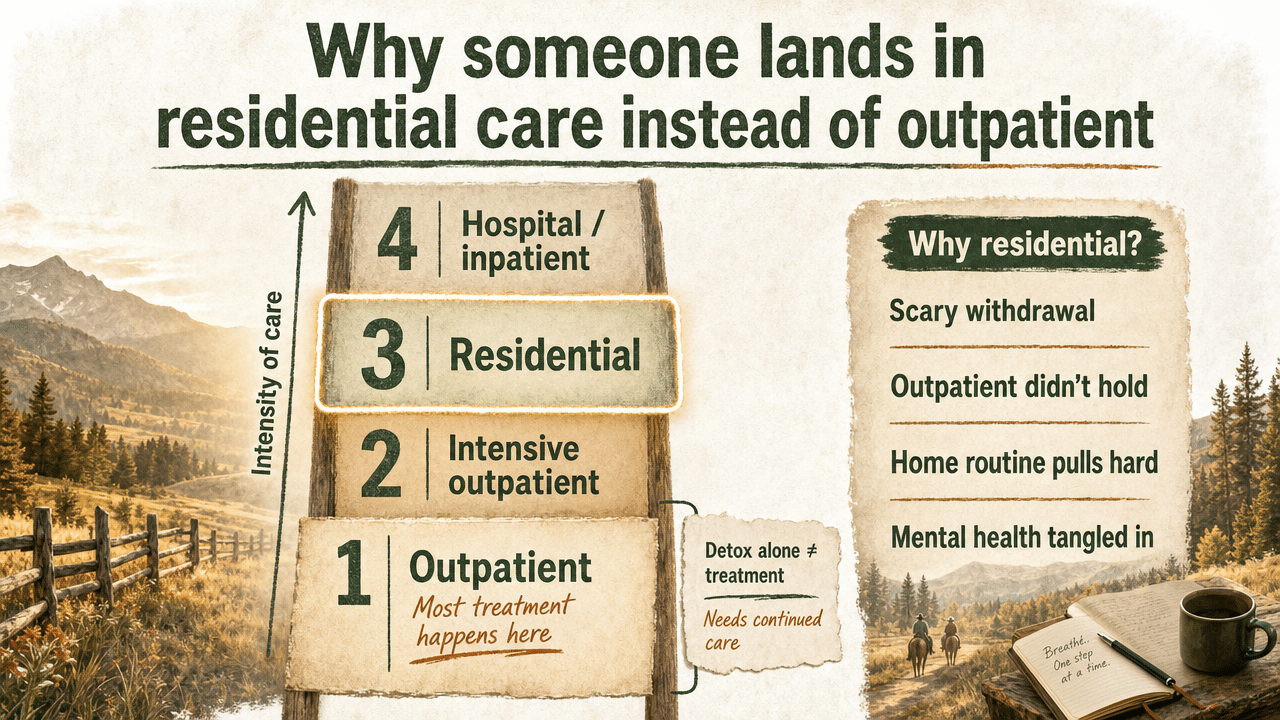
Most people with an alcohol problem don’t end up in a residential program. They start with a counselor down the street, or a weekly group, or a doctor who prescribes something to help with cravings. NIAAA is direct about this: most alcohol use disorder treatment happens in outpatient settings, and detox on its own doesn’t count as treatment — you need continued care afterward for it to hold 9.
So why do you end up here instead? Usually it’s one of a few reasons. You’ve tried to stop on your own and the withdrawal got scary. You’ve been through outpatient before and the pull of your own house, your own fridge, your own routine was louder than the therapy hour. You have a mental health piece — depression, panic, old trauma — tangled up with the drinking, and dealing with one without the other keeps failing. Or your drinking has reached the point where a doctor has told you, clearly, that pulling the alcohol out without medical eyes on you is dangerous.
NIAAA sorts alcohol care into four levels, and it helps to see where residential sits on that ladder 8:
Chart: The four NIAAA levels of alcohol care, from least to most intensive.
- Outpatient. A few hours a week. You live at home, keep working, meet with a counselor or group.
- Intensive outpatient / partial hospitalization. Nine to twenty-plus hours a week. Still at home, but treatment becomes closer to a part-time job.
- Residential. You live at the facility. Structure runs 24 hours a day. This is where Rocky Mountain sits — a 26-bed home in Great Falls where the drinking cues of daily life are turned off for a while.
- Intensive inpatient. Hospital-based care for the most medically complex situations, usually short-term.
Landing in residential isn’t a verdict on how bad you are. It’s a match. The setting fits what your body and your life actually need right now. That’s it.
The first 72 hours: detox, safety, and getting steady
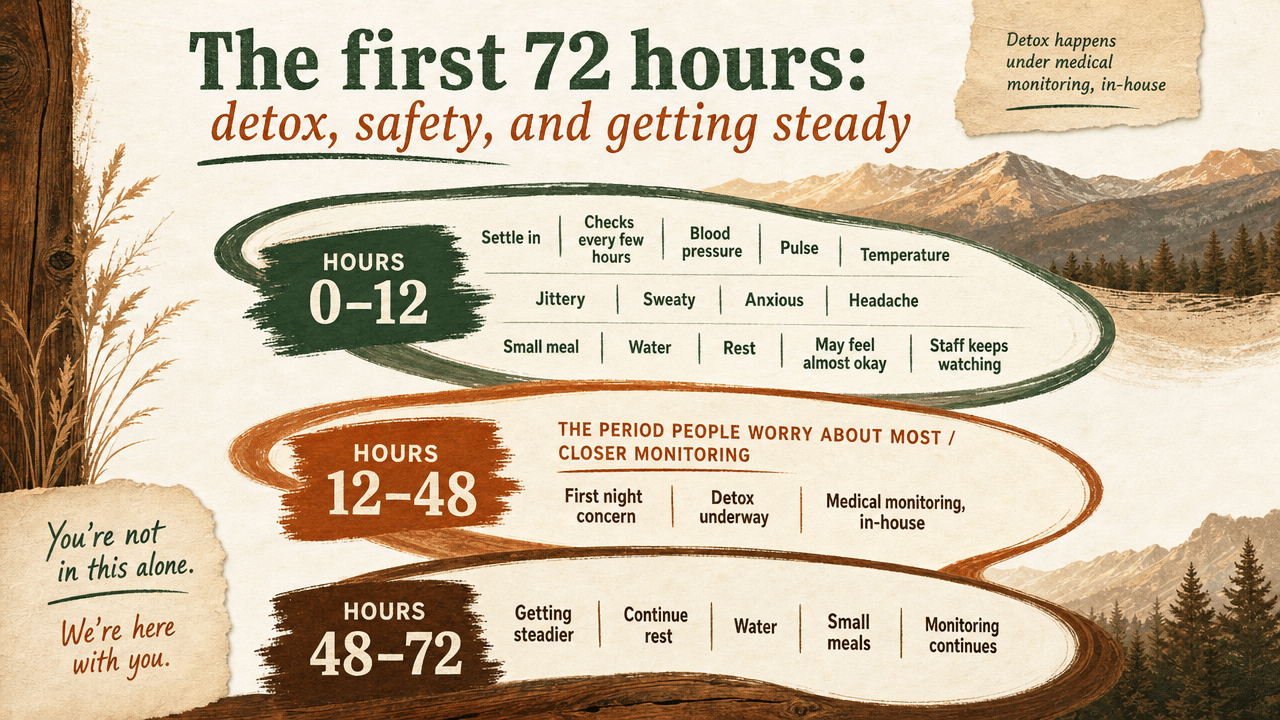
The first night is the one people worry about most. If you’ve been drinking heavily, your body has gotten used to alcohol being in the system, and pulling it out kicks off a physical response. That’s what detox is — your body relearning how to run without alcohol in it. At Rocky Mountain, detox happens under medical monitoring, in-house, so you don’t have to move from one place to another when you’re already shaky.
Here’s what the first 72 hours usually look like.
Hours 0 to 12. You settle in. A nurse checks your blood pressure, pulse, and temperature every few hours. You may feel jittery, sweaty, anxious, maybe a headache. You’ll be encouraged to eat something small, drink water, and rest. If your last drink was recent, you might feel almost okay — that’s normal, and it’s also why staff keeps watching.
Hours 12 to 48. This is usually the hardest stretch for alcohol. Shakes, nausea, trouble sleeping, a racing heart, the kind of anxiety that feels like it’s coming from nowhere. Staff can give medications to bring the intensity down safely. MedlinePlus notes that combining medicine with counseling gives most people the best chance of success, and detox is where that combination starts 3. You’re not being asked to white-knuckle this. If it hurts, you tell someone, and something is done about it.
Hours 48 to 72. The physical storm usually starts to break. You’ll sleep a little longer. Food starts tasting like food again. You’ll begin easing into the daily schedule — maybe sitting in on a group, meeting with a counselor, walking outside for a few minutes. NIAAA is clear on this point: detox by itself isn’t treatment 9. It’s the doorway. What you do in the weeks after is where recovery actually gets built.
You may finish detox thinking, that wasn’t as bad as I feared. Or, that was worse than I thought and I’m glad I wasn’t alone. Both are common. Both mean the same thing: you got through the part your body was scared of. The rest of the work is on steadier ground.
A Tuesday at Rocky Mountain: your day from 6:30 a.m. to lights out
Mornings: waking up, breakfast, and the first group
You’ll wake up around 6:30. Not to an alarm clock in a hotel-quiet room, but to the sound of a building starting its day — someone in the hallway, coffee going somewhere down the way, boots on the floor above. If you slept badly, that’s normal for the first week. Sleep is one of the things drinking was doing for you, poorly, and your body is relearning it.
You’ll shower, get dressed in your own clothes, and head to breakfast. Real food, sitting at a table with the people you’re living with. Some mornings the conversation is easy. Some mornings nobody says much. Both are fine.
By 8 or so, you’re in the first group of the day. This one usually sets the tone — a check-in, a short reading, maybe a topic like resentment or fear or what happened the last time you tried to quit. You don’t have to talk the first day. You don’t have to talk the second day. But you’ll notice, pretty quickly, that when you do say something honest, the room doesn’t flinch. That’s the whole point of doing this with other people.
Midday: individual counseling, lunch, and equine therapy
Late morning is usually when you meet one-on-one with your counselor. At Rocky Mountain, there’s a good chance the person across from you has been where you are — over 80% of the staff are in recovery themselves. That changes the shape of the hour. You’re not explaining what a craving feels like to someone who read about it in a textbook.
These sessions are where the personal work happens. What are you drinking at? Who did you hurt? What are you scared of on day 31? MedlinePlus is straightforward on this: combining medicine with counseling gives most people the best chance of success 3. The counseling piece is where you build the version of your life that doesn’t require alcohol to work.
Lunch is another shared meal. Then, a few afternoons a week, you may head out to the arena for equine therapy. Standing next to a 1,200-pound animal that reads your energy before you’ve said a word does something a folding chair in a group room can’t do. Horses don’t care about your resume or your last DUI. They respond to whether you’re actually present. A lot of people find they’ve been faking presence for years, and the horse is the first thing that calls them on it.
Evenings: 12-step meetings, reflection, and the phone question
After dinner, most evenings include a 12-step meeting — sometimes in-house, sometimes with an outside group that comes in. If 12-step isn’t familiar, don’t worry about the language yet. Just show up and listen. People say things out loud that you’ve been carrying around in your head for years, and you realize you’re not the only one.
Then comes the phone question, which is what most people are quietly wondering about all day. Yes, you’ll have access to your phone — with structure. There are set times to make calls, and reasons for that. The first week especially, being tethered to every text and voicemail from home can pull you right back out of the room you flew in to be in. By week two, most people are grateful for the guardrail.
Lights out comes earlier than you’re used to. You’ll lie there thinking about the day, maybe about someone at home, maybe about tomorrow. You made it through one. That counts.
Treating what’s underneath: depression, anxiety, and trauma alongside drinking
Here’s something a lot of people figure out about a week into treatment: the drinking was doing a job. It was quieting something. Maybe the panic that hits at 3 a.m. Maybe the grief you never sat with. Maybe a stretch of your life you’ve never said out loud to anyone.
MedlinePlus is direct about this: when a mental health condition and a substance problem are both in the picture, it’s usually better to treat them at the same time rather than one after the other 5. At Rocky Mountain, that means your counselor isn’t only asking about your drinking. They’re asking about your sleep, your moods, the memories that show up when the room gets quiet, the medications you’ve tried, the ones that helped, the ones that didn’t.
Some of this work happens one-on-one. Some of it happens in group, where you’ll hear someone else describe the exact feeling you thought only you had. Both matter. You’re not being asked to hand over your whole story on day three. You’re being asked to stop carrying it alone.
Family Week: the three days that change the conversation at home
Somewhere around week two or three, your family gets an invitation. Not to visit for an afternoon — to come stay for three days and do the work with you. Family Week at Rocky Mountain isn’t a tour or a meet-and-greet. It’s the part of treatment where the conversations that have been stuck at home finally get a room, a facilitator, and enough time to actually go somewhere.
Your spouse, your parent, your grown kid — whoever has been on the other end of this — comes to Great Falls and sits in the same kind of groups you’ve been sitting in. They learn what alcohol use disorder actually is, not the version they’ve been arguing with. They hear from other families who’ve been where they are. And then, with a counselor in the room, you talk to each other. About the night you don’t remember. About the promises. About what everyone is scared will happen next.
These conversations are hard. They’re supposed to be. What’s different is that nobody has to stop mid-sentence to make dinner or answer a text. You have three days.
People often ask what changes after Family Week. Usually it’s this: the story shifts from something one person is doing to something a family is healing from together. That shift is what makes the phone calls after discharge sound different.
30, 60, or 90 days: what each length of stay actually buys you
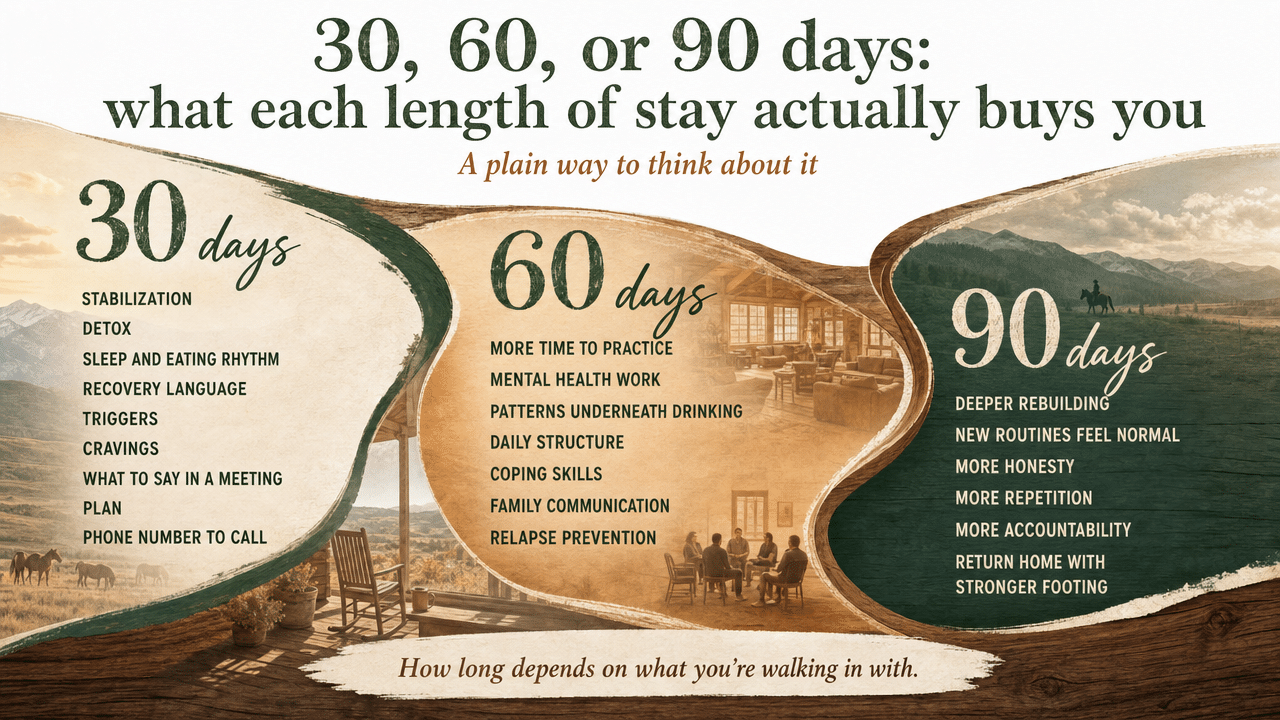
This is the question most families ask on the first phone call: how long? The honest answer is that it depends on what you’re walking in with — how long you’ve been drinking, whether there’s a mental health piece, what home looks like when you get back. NIDA describes residential care as lasting a few weeks to a few months for a reason. That range isn’t a marketing choice, it’s how much time the work actually takes for different people 2.
Here’s a plain way to think about it.
Infographic: What 30, 60, and 90 days at Rocky Mountain typically cover.
- 30 days. Stabilization. You get through detox, your body starts sleeping and eating on a rhythm again, and you learn the language of recovery — what a trigger is, what a craving actually feels like, what to say in a meeting. You leave with a plan and a phone number to call. For someone with a shorter history and a solid support system at home, 30 days can be enough to reset.
- 60 days. Skill-building. The first month clears the fog. The second month is where you start practicing — sitting with hard feelings without reaching for a drink, having the conversation with your spouse that used to end in a fight, showing up to group even when you don’t feel like it. Sixty days gives new habits time to feel less like a performance.
- 90 days. Sustained practice. If your drinking has been long or heavy, if you’ve relapsed after shorter stays, or if depression or trauma is tangled in, 90 days lets the new normal become the normal. You leave having lived it, not just learned it.
At Rocky Mountain, the length isn’t a package you pick on day one and can’t change. Your counselor watches how you’re doing, and if 30 days is turning into a soft finish, you’ll have that conversation before it’s too late. Longer isn’t better for everyone. It’s better when the work isn’t done yet.
Day 31 and beyond: the aftercare cadence most people don’t know exists
Discharge day is not the finish line. It’s more like the day you take the training wheels off. You leave Rocky Mountain with a plan, a set of phone numbers, and something a lot of programs don’t build in — a schedule of check-ins that keeps going for a full year.
Here’s what the year after looks like. Weekly Zoom groups run for as long as you want to be in them. Your counselor or a member of the team reaches out at 30 days post-discharge, then 60, then 90, then 180, then 365. Five formal check-ins across the first year, plus a group meeting every week in between. That’s not a courtesy call — it’s someone asking how you slept, whether you made it to a meeting, how the conversation with your spouse went on Sunday, and what needs to happen next.
Infographic: The Rocky Mountain continuing care timeline — weekly Zoom groups plus check-ins at 30, 60, 90, 180, and 365 days after discharge.
This cadence matters because of what the research actually shows. A systematic review of residential treatment for substance use disorders found moderate-quality evidence that residential care improves outcomes, and the authors were specific about why: mental health treatment and post-discharge continuity of care were two of the key ingredients 1. The stay does the heavy lifting. The year after keeps it from unraveling.
You’ll notice the shape of the check-ins changes as you go. Day 30 is often about the immediate stuff — cravings, sleep, whether the meetings you found at home feel like a fit. Day 90 is usually about the harder relational work: the marriage, the job, the family gathering you were dreading. By day 365, the conversation tends to sound different. Less about staying sober and more about what you’re building.
If a check-in catches you on a bad week, that’s the point. You don’t have to be doing well to answer the phone. You just have to answer it.
If you’re the family member reading this at 11 p.m.
You’re the one still awake. The house is quiet. You’ve been reading pages like this one for a week, maybe longer, trying to figure out if this is the moment to say something, or push harder, or wait one more day. First — you’re not overreacting. If you’re this deep into a search bar at 11 p.m., something in you already knows.
Here’s what would help. Stop trying to convince the person you love that they have a problem. That fight rarely lands. Instead, get specific about what a next step looks like so that when they’re ready — even for a five-minute window — you have something concrete to hand them. A phone number. A name. The fact that Rocky Mountain will drive to them if getting behind the wheel isn’t safe.
You don’t need to have the whole plan figured out. You need one call ready. The intake team at Rocky Mountain talks to families every day who are exactly where you are right now — tired, scared, unsure whether it’s their place to make the call. It is. Making the call doesn’t commit anyone to anything. It gives you actual answers instead of the ones you’ve been guessing at.
And when your person does walk through the door, Family Week is waiting for you too.
Frequently Asked Questions
Can I bring my phone into inpatient rehab?
Yes, you can bring your phone to Rocky Mountain. You won’t have it on you 24/7 — there are set times for calls and messages, especially the first week when constant contact with home can pull you right back into the noise you came to step away from. Most people find the structure a relief within a few days. You stay connected. You just get a break from the alerts.
How bad is alcohol withdrawal during the first few days?
It varies. Hours 12 to 48 are usually the hardest — shakes, nausea, poor sleep, and anxiety that feels like it’s coming from nowhere. The good news is you won’t tough it out alone. Medically monitored detox means a nurse is checking on you and medications are available to bring the intensity down safely. MedlinePlus notes that combining medicine with counseling gives most people the best shot at success 3. You tell someone when it hurts. Something gets done.
Will insurance cover a 30, 60, or 90-day stay?
Rocky Mountain works with most major insurance providers, and the intake team will run your benefits before you commit to anything. What’s covered depends on your plan and what your clinical needs actually are — a longer stay is often approved when the medical picture supports it. One note: Rocky Mountain does not currently accept Medicaid or Medicare. Call the intake line and they’ll walk you through your specific coverage in plain language, not policy-speak.
Can my family visit me while I’m in treatment?
Yes, and more than that — they’re invited into the work. Around week two or three, your family comes to Great Falls for Family Week, three days of groups, education, and facilitated conversations with you in the room. It’s not a visiting hour. It’s part of the treatment. Between then, phone contact happens at scheduled times. If your family can’t make Family Week in person, the team will talk through what’s possible for your situation.
What if I’ve been through rehab before and it didn’t stick?
You’re not alone in that, and it doesn’t mean you’re a lost cause. NIAAA is clear that detox by itself isn’t treatment and that continued care afterward is what helps recovery hold 9. If a past stay didn’t stick, something was probably missing — the length, the mental health piece, the aftercare, the family work. At Rocky Mountain, your counselor will ask what happened last time and build the plan around what didn’t get addressed before.
What should I pack for inpatient rehab at Rocky Mountain?
Keep it simple. Comfortable clothes for two weeks (laundry is available), sturdy shoes for outdoor time and equine therapy, toiletries without alcohol in the ingredients, any prescription medications in their original bottles, and a photo or two from home. Skip valuables, anything with alcohol content, and outside food. If you’re not sure about something, ask when you call intake — they’ve answered this question a thousand times and won’t make you feel silly for asking.
References
- The effectiveness of residential treatment services for substance use disorders: A systematic review. https://pubmed.ncbi.nlm.nih.gov/31254749/
- Treatment | National Institute on Drug Abuse (NIDA) – NIH. https://nida.nih.gov/research-topics/treatment
- Drug Use and Addiction. https://medlineplus.gov/druguseandaddiction.html
- Opioid Use Disorder (OUD) Treatment. https://medlineplus.gov/opioidusedisorderoudtreatment.html
- Dual Diagnosis. https://medlineplus.gov/dualdiagnosis.html
- Treatment of Substance Use Disorders. https://www.cdc.gov/overdose-prevention/treatment/index.html
- Treatment of Opioid Use Disorder. https://www.cdc.gov/overdose-prevention/treatment/opioid-use-disorder.html
- What Types of Alcohol Treatment Are Available?. https://alcoholtreatment.niaaa.nih.gov/what-to-know/types-of-alcohol-treatment
- Recommend Evidence-Based Treatment: Know the Options. https://www.niaaa.nih.gov/health-professionals-communities/core-resource-on-alcohol/recommend-evidence-based-treatment-know-options
- Treatment for Alcohol Problems: Finding and Getting Help. https://www.niaaa.nih.gov/sites/default/files/treatment.pdf