
Key Takeaways
- Residential care works by putting 24-hour structure, medical monitoring, integrated mental health treatment, and community in one place, so recovery stops competing with the demands of daily life.
- The 30/60/90-day arc moves from body stabilization in week one, to root-cause and trauma work in the middle stretch, to family repair and reentry planning by month three.
- Evidence for residential treatment is moderate rather than absolute, and head-to-head comparisons with outpatient are mixed 9; the real advantage is stacking outcome-linked ingredients for the right person.
- When choosing a program, focus on integrated mental health care, ASAM-based admission reasoning 12, written medical and psychiatric coverage 11, and a scheduled continuing care plan after discharge.
What changes when you sleep, eat, and heal in the same place
You’ve probably tried before. Maybe outpatient counseling, a short detox, a promise to yourself on a Sunday night. That doesn’t mean this won’t work. It means the pieces haven’t all been in the same room yet.
When you live where you’re being treated, the small hours stop being the dangerous ones. There’s no drive home after group. No empty apartment at 9 p.m. Someone is awake at 3 a.m. if you can’t sleep, and someone is at breakfast when you can. Meals happen on a schedule. So does therapy, so does rest, so does the walk outside. That structure isn’t punishment. It’s the thing that lets your body and brain quiet down enough to actually do the work.
Residential care is defined by that 24-hour, on-site structure inside a licensed facility, with counseling, skills-building, and support layered on top of it 1. The evidence for this model is described as moderate — meaning it helps a lot of people across substance use, mental health, and social outcomes, especially when programs weave in mental health care and follow-through after discharge 2.
For now, the shift is simpler than it sounds. You stop managing recovery in the margins of a life that’s already breaking. You get to put the phone down, close the door, and let someone else hold the schedule for a while. That’s not weakness. That’s the first quiet win.
The 30/60/90-day arc, week by week
Week one: stabilization, sleep, and the body coming back online
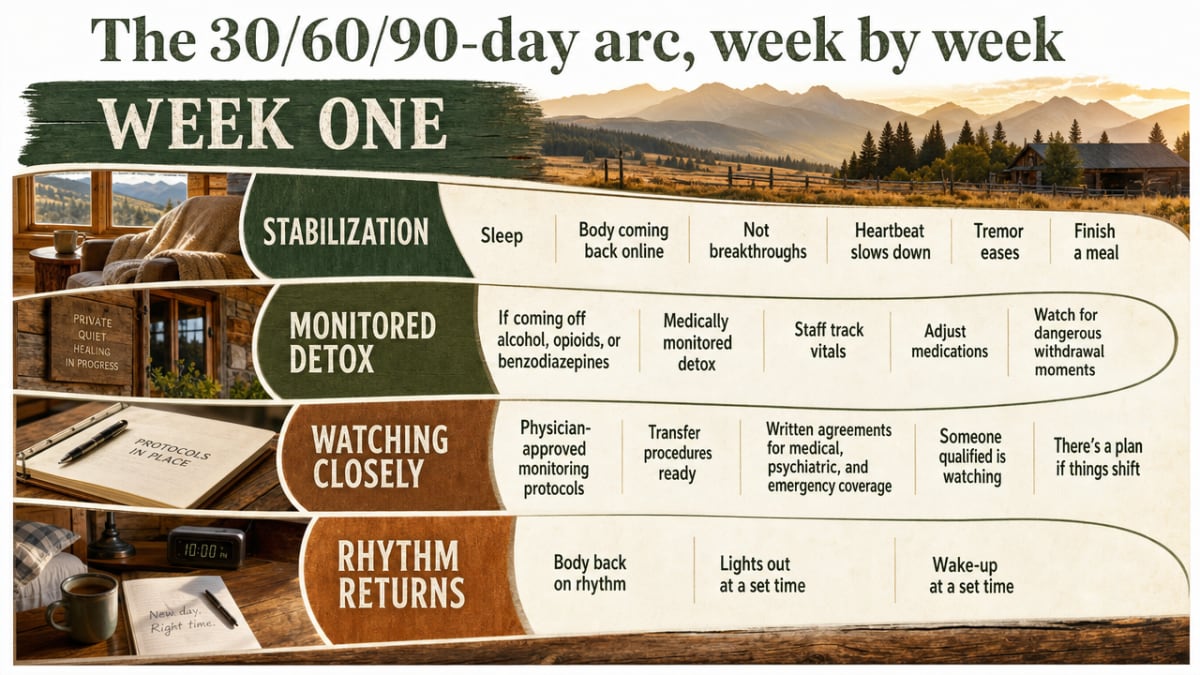
The first week isn’t about breakthroughs. It’s about a heartbeat that slows down. A tremor that eases. A meal you finish.
If you’re coming off alcohol, opioids, or benzodiazepines, the first days often start in medically monitored detox, where staff track vitals, adjust medications, and watch for the moments withdrawal can turn dangerous. Montana requires programs to run physician-approved monitoring protocols, keep transfer procedures ready, and hold written agreements for medical, psychiatric, and emergency coverage 11. Translation: someone qualified is watching, and there’s a plan if things shift.
Between the medical piece and everything else, the week is mostly about getting your body back on a rhythm you haven’t felt in a while. Lights out at a set time. Wake-up at a set time. Water on the nightstand. A counselor introducing themselves, not asking you to spill your whole story on day one. You’ll probably sleep in fragments before you sleep well. That’s normal. A first full night of sleep, when it comes, tends to arrive somewhere around days four through seven, and it’s worth noticing when it does.
You’ll do an intake assessment that looks at your substance use, mental health, medical history, and what’s waiting for you at home. That assessment isn’t paperwork for its own sake — it’s how your treatment plan gets built, and it’s why programs licensed under ASAM criteria ask about moderate to severe symptoms before admitting you to this level of care 12.
The goal of week one is small and huge at the same time: you’re still here, you’re safer, and your nervous system is starting to trust that.
Weeks two through four: the root-cause work begins
Once your body settles, the harder, quieter work starts. This is the stretch that decides how much you actually get out of a residential stay.
Your days take on a shape. Individual counseling once or twice a week, where you and one person go deeper than group allows. Group counseling most days, usually mornings, where you hear other people say the thing you’ve been carrying alone. Twelve-step meetings in the evenings for people who want that framework, and other options if you don’t. Somewhere in there: a walk, a meal, a phone break, a nap you didn’t know you needed.
The reason this middle stretch matters is that addiction rarely stands alone. Anxiety, depression, grief, chronic pain, unprocessed trauma — they’re usually tangled up in it. Programs that integrate mental health care into residential treatment tend to move the needle more across substance use, mental health, and social functioning than programs that treat addiction as if it lives in its own box 2. That integration is what “dual diagnosis” means when you see it on a website — treating the drinking or using and the depression or PTSD in the same building, by the same team, in the same week.
You’ll probably start naming things you haven’t named before. A memory. A pattern. A person you’ve been protecting. It won’t feel triumphant. It’ll feel tired, and a little raw, and occasionally like relief. That’s the work landing. If you’re leaving after 30 days, this is where most of your growth happens. If you’re staying for 60 or 90, this is the foundation everything else is built on.
Days 30 to 90: community, family repair, and what you’re building toward
If you stay past the first month, the room changes around you. New people arrive scared and shaky. You’re not the new one anymore. You know where the coffee is, when group starts, which counselor to find when you can’t sleep. That shift — from being helped to helping — is one of the quietest, most powerful things a longer stay gives you.
This is also when family work usually deepens. A structured family week brings the people closest to you into the room for education, honest conversations, and boundary-setting that’s been overdue for years. It’s not about assigning blame. It’s about giving everyone the same language and the same plan, so that when you go home, you’re not translating recovery to people who never got to see it.
Days 60 to 90 tilt toward reentry. You start planning what your Tuesday nights look like. Which meetings you’ll go to. Who you’ll call at 9 p.m. when the craving hits. What job or classes or routines will hold your weeks together. Programs that do this well don’t hand you a discharge date — they hand you a continuing care plan, because addiction is understood as a chronic condition that needs ongoing management, the way heart disease or asthma does 8. That framing matters. Finishing residential care isn’t the finish line. It’s the moment you shift from intensive care to long-term management.
The arc, if it works, looks something like this: month one is your body coming back. Month two is your story coming into focus. Month three is your life starting to fit around who you’re becoming. Then the continuing care tail — check-ins at 30, 60, 90, 180, and 365 days after discharge — carries you through the year when relapse risk is highest.
Does residential care actually work better than outpatient?
Here’s the honest answer: sometimes yes, sometimes not measurably, and the studies don’t all agree.
A 2019 systematic review of adult residential substance use treatment found moderate-quality evidence that residential care improves outcomes across three domains that matter — substance use itself, mental health, and social functioning like relationships, housing, and work 2. “Moderate” isn’t a hedge word to skim past. It means the research is real and consistent enough to trust the direction, but not strong enough to promise you a specific number. An earlier evidence review reached a similar conclusion and added the piece most brochures leave out: when researchers compared residential care head-to-head with other levels of treatment, results were mixed 9. Some studies showed residential coming out ahead. Others showed roughly the same outcomes as intensive outpatient. That’s the truth of the literature.
So why do so many people still say residential changed their life? Because averages hide what happens to individuals. If you’ve relapsed multiple times, if your home isn’t safe to sober up in, if your mental health is tangled into the using, if your body needs medical monitoring to come down — the average outpatient result was probably never going to apply to you. Residential care isn’t a magic upgrade. It’s a different tool, built for a different situation. When it works, it tends to work because it removes the things that were undoing your progress between sessions and puts intensive help, sleep, food, and other people in recovery around you all at once.
What the evidence actually points to isn’t “residential wins.” It’s this: the ingredients tied to better outcomes — enough time, integrated mental health work, trauma-informed care, family involvement, and real continuing care after discharge — are exactly what a well-run residential program can deliver in the same building, in the same month. That’s the case for it. Not that it beats outpatient in every chart, but that for the right person, it stacks the ingredients in one place.
Why the setting itself matters: belonging, meaning, and choosing your own recovery
There’s a question researchers have been quietly asking for years: why does residential treatment change some people’s lives and barely move the needle for others, even when the program on paper is the same? A realist review of adult residential care landed on three answers that show up again and again — the need to belong, meaning in life, and self-determination 10. Not clinical checklists. Human things.
Belonging is what happens the third or fourth night when someone you barely know saves you a seat at dinner. It’s the group member who catches your eye when a story hits close and nods, because they know. You stop being the person hiding what they use. You become part of a room where nobody’s hiding.
Meaning is harder to name, but you’ll feel it start to show up. Maybe it’s a memory you finally talk about. Maybe it’s realizing you want to be a decent parent again, or a working musician again, or just someone who calls their sister back. Programs that give you space for that — through counseling, quiet time, family work, time outside — aren’t padding the schedule. They’re making room for the thing that will actually pull you forward when nobody’s watching.
Self-determination is the one people miss. Recovery doesn’t stick when it’s handed to you. It sticks when you start choosing it — which meeting to attend, which sponsor to call, which parts of the old life to keep and which to let go. The setting matters because it gives you enough safety and structure to start making those choices again, one small one at a time.
Trauma-informed care, and why it isn’t just a phrase on a brochure
You’ll see the term “trauma-informed” on almost every treatment website. It’s worth knowing what it actually means when a program lives it, and what it looks like when a program just prints it.
At its core, trauma-informed care assumes that most people walking through the door are carrying something — abuse, loss, violence, medical trauma, a childhood that never felt safe — and that the using is often tangled into it. So the program is built to not make things worse. Doors close softly. Staff explain what’s about to happen before it happens. You’re asked, not told. Groups are structured so nobody gets ambushed into disclosing more than they’re ready to. When something hard comes up in session, you’re given a way back to steady ground before you leave the room.
A 2024 systematic review of trauma-informed care in substance use settings found positive effects on substance use, mental health and trauma symptoms, retention, and satisfaction when programs implement it as an organizational commitment rather than a single training 3. That distinction matters. The same year, a broader review across health care settings mapped what actually works to ten domains — leadership, staff training, screening, the physical environment, how policies get written, how patients get involved in their own care 4. In plain language: trauma-informed care isn’t one workshop the counselors attended. It’s how the building runs.
What this looks like from your side is quieter than you’d expect. A counselor who asks before touching your shoulder. A room that isn’t fluorescent-bright. Being told you can step out of group without explaining why. The sense, over days, that you’re not being managed — you’re being met.
Equine therapy: what actually happens in the arena
The first time you walk into the arena, you’re probably not thinking about therapy. You’re thinking about how big the horse is. How it smells like hay and dust and something older than the parking lot outside. A counselor is there, and someone who works with the horses, and they’re not in a hurry. Nobody hands you a worksheet.
What happens next depends on the session, but it usually starts with something small. Standing near the horse. Noticing your breath. Being asked to lead the horse across the arena and watching what happens when your attention drifts, or when you go tense, or when you finally soften your shoulders. Horses read bodies. They react to what’s actually happening in you, not the version you’ve been performing all week in group. That’s the whole point.
The research on equine work in substance use treatment is early but pointing in a real direction. A mixed-methods review found that equine-assisted services show a potential positive effect on treatment retention and completion, alongside qualitative gains in self-efficacy and motivation 5. In one residential program, participants who took part in horse-assisted therapy stayed in treatment for a significantly longer period and were more likely to complete their agreed program 6. A study with college-age adults in residential care found that scores for emotional safety and skills climbed meaningfully by the end of their equine work 7. Longer stays. More completions. A stronger sense of being safe in your own body. Those aren’t small things when you’re trying to build a life again.
What you’ll notice on your side is quieter. A horse leaning its head toward you when you stop trying to force it. The first time you laugh in weeks. A five-minute stretch where you weren’t thinking about the drink or the drug. That’s the arena doing what it does — not replacing counseling, but giving the work somewhere else to land.

What quality and safety look like inside a Montana residential program
You don’t need to become an expert in licensing to know if a program is safe. You just need to know what to ask, and what the answers should sound like in a state that takes this seriously.
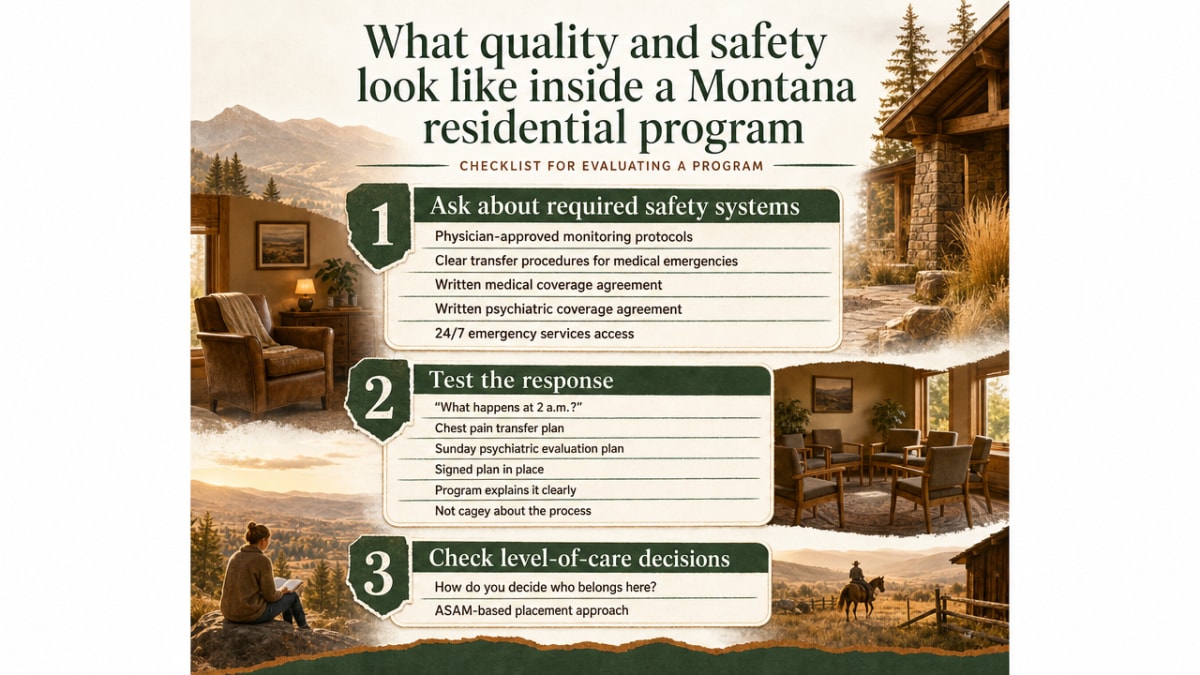
Montana licenses residential substance use disorder facilities against real standards. Programs are required to run physician-approved monitoring protocols, keep clear transfer procedures for medical emergencies, hold written agreements for medical and psychiatric coverage, and maintain access to emergency services around the clock 11. If someone develops chest pain at 2 a.m. or needs a psychiatric evaluation on a Sunday, there’s a signed plan for that. Ask a program to walk you through it. A good one will, without getting cagey.
The second signal is how they decide who belongs at this level of care in the first place. Montana ties residential admission and continued stay to ASAM criteria — a nationally used framework that matches the intensity of care to the severity of what someone is dealing with. For residential care at the level most 30/60/90-day programs operate, that means you or your loved one need to meet moderate or severe substance use disorder criteria, and the assessment has to document why a less intensive setting wouldn’t be safe or effective 12. If a program admits anyone who walks in without that kind of clinical reasoning, that’s a flag.
What this looks like from your side: an intake that asks careful questions instead of skipping to a credit card. A nurse who knows your medications by day two. A building where the fire exits are marked and the medication room is locked. Staff who can tell you, plainly, who covers medical and who covers psychiatric. Quality isn’t a feeling. It’s a set of small, boring things done consistently.
Continuing care: the part that decides whether the work holds
Here’s the part most brochures bury at the bottom. The residential stay isn’t the win. The win is what happens on a random Wednesday six months later, when you’re tired, someone said something that stung, and you know exactly who to call before you know what you’re going to do.
Addiction is understood as a chronic condition, closer to heart disease or asthma than to a broken bone that heals and stays healed. That framing comes from the National Institute on Drug Abuse, and it’s not academic — it’s the reason continuing care exists 8. You wouldn’t treat someone with high blood pressure for 30 days and then never check on them again. You’d expect follow-ups, adjustments, a plan for when things drift. Recovery works the same way.
Good continuing care looks like a schedule, not a suggestion. Weekly group meetings by video that keep you connected to the people who saw you at your rawest. Check-in calls at 30, 60, 90, 180, and 365 days after discharge — the stretches where relapse risk is highest and where most people quietly disappear from view. A counselor who already knows your history when you pick up the phone, so you’re not starting over with a stranger.
What this gives you is simple and hard to overstate. The first Tuesday you almost drink and don’t. The call you make instead of the one you don’t. A year from now, a life that started to fit around the person you were becoming in month two, because someone kept showing up long enough for it to hold.
Choosing a program without getting sold to
By the time you’re calling programs, you’re tired. You’ve probably heard a lot of polished language. Here’s how to cut through it without becoming a research project unto yourself.
- Ask what a typical Tuesday looks like from 7 a.m. to 9 p.m. A program that can walk you through it — meals, groups, individual sessions, outside time, phone access, evening meetings — is running a real schedule. Vague answers are the tell.
- Ask how they handle mental health alongside the substance use, in the same building, by the same team. Integrated care is one of the ingredients tied to better outcomes across substance use, mental health, and social functioning 2. If they hand off the depression or the PTSD to someone across town, that’s a gap you’ll feel in week three.
- Ask who’s on staff at 2 a.m., and what happens if you need a doctor or a psychiatric evaluation on a Sunday. In Montana, licensed facilities are expected to have those coverage agreements in writing 11. You want to hear specifics, not reassurances.
- Ask what continuing care actually looks like after you leave — not whether they offer it, but the schedule. Weekly groups, check-ins at set intervals, a counselor who’ll know your name a year from now. That’s the part that decides whether the work holds.
And trust the small things. Whether the person on the phone slows down when you get quiet. Whether they ask about you or about your insurance first. Programs like Rocky Mountain Treatment Center are built on the idea that the people answering the phone should sound like the people you’ll meet inside. If they don’t, keep calling.
Frequently Asked Questions
How long should I stay in residential treatment: 30, 60, or 90 days?
The honest answer: longer stays generally give the root-cause work more room to land, but the right length depends on your history. If you’ve cycled through short detoxes or relapsed quickly after outpatient, 60 or 90 days lets you move past stabilization into real change and reentry planning. Thirty days can be enough if your situation is more contained. Ask the program to explain their reasoning for the length they’re recommending.
Is residential treatment actually more effective than outpatient care?
Not universally. The evidence is moderate for improvements across substance use, mental health, and social functioning, and head-to-head comparisons with other levels of care are mixed 9. What residential does well is stack the ingredients tied to better outcomes — time, integrated mental health work, safety, community — in one place. For someone whose home isn’t safe to sober up in, or who needs medical monitoring, that concentration matters more than an average.
What happens during the first week of a residential program?
The first week is mostly about your body settling. If withdrawal is a risk, you’ll start in medically monitored detox with staff tracking vitals and adjusting medications. You’ll do an intake assessment covering substance use, mental health, and medical history. Sleep comes in fragments before it comes fully. Meals happen on a schedule. Nobody’s asking you to spill your whole story on day one. The goal is simple: safer, steadier, still here.
Can my family be involved while I’m in treatment?
Yes, and good programs build family into the plan rather than treating it as optional. A structured family week brings the people closest to you into the room for education, honest conversations, and boundary-setting. It gives everyone the same language and the same plan, so that when you go home, you’re not translating recovery to people who never got to see it. Ask what family programming looks like before you admit.
What kind of aftercare should I expect once residential treatment ends?
Real aftercare is a schedule, not a suggestion. Expect weekly group meetings by video, check-in calls at set intervals like 30, 60, 90, 180, and 365 days post-discharge, and a counselor who already knows your history when you pick up the phone. Addiction is understood as a chronic condition that needs ongoing management 8. If a program treats aftercare as a pamphlet at discharge, that’s the gap where relapse quietly happens.
How do I know if a residential program is safe and reputable?
Look for signs of accreditation, licensure, and clinical reasoning at intake. In Montana, licensed facilities must run physician-approved monitoring protocols, hold written agreements for medical and psychiatric coverage, and maintain emergency access around the clock 11. Admission decisions should reference ASAM criteria and document why this level of care is appropriate 12. Ask who covers medical and psychiatric care at 2 a.m. A good program answers plainly, without getting cagey.
References
- Residential Treatment for Substance Use Disorder: A Review of Clinical Effectiveness. https://www.ncbi.nlm.nih.gov/books/NBK541232/
- The effectiveness of residential treatment services for individuals with substance use disorders: A systematic review. https://pubmed.ncbi.nlm.nih.gov/31254749/
- A Systematic Review of Trauma Informed Care in Substance Use Settings. https://pubmed.ncbi.nlm.nih.gov/39641885/
- Effectiveness of Trauma-Informed Care Implementation in Health Care Settings: A Systematic Review. https://pmc.ncbi.nlm.nih.gov/articles/PMC10940237/
- Equine-assisted services for individuals with substance use disorders. https://pmc.ncbi.nlm.nih.gov/articles/PMC9749232/
- More Than Just a Break from Treatment: How Substance Use Disorder Patients Experience Horse-Assisted Therapy. https://pmc.ncbi.nlm.nih.gov/articles/PMC5054942/
- Equine assisted psychotherapy and learning as an effective complementary form of substance use disorder treatment for college-age young adults in a residential treatment program. https://pmc.ncbi.nlm.nih.gov/articles/PMC9758116/
- Treatment and Recovery | National Institute on Drug Abuse. https://nida.nih.gov/publications/drugs-brains-behavior-science-addiction/treatment-recovery
- Residential treatment for individuals with substance use disorders: assessing the evidence. https://pubmed.ncbi.nlm.nih.gov/24445598/
- A realist review of residential treatment for adults with substance use disorder. https://pubmed.ncbi.nlm.nih.gov/36747370/
- Rules for Substance use Disorder Facility. https://dphhs.mt.gov/assets/oig/Rules_for_Substance_use_Disorder_Facility.pdf
- Department of Public Health & Human Services, OTD, Fiscal Bureau. https://dphhs.mt.gov/assets/BHDD/SubstanceAbuse/535_SUD_ASAM_3.1_eff.3.8.25.pdf