
Key Takeaways
- The first week of rehab moves through medically monitored detox, comprehensive assessment, and early group work, with staff prioritizing safety and stabilization before deeper therapeutic work begins 8.
- Withdrawal symptoms peak in the first 12 to 72 hours, and detox alone rarely produces lasting sobriety, which is why counseling and structure follow immediately 7.
- Day-two assessments screen for depression, anxiety, and trauma alongside alcohol use, because co-occurring conditions belong in the treatment plan from the start 11.
- Early therapeutic alliance with counselors, guided introduction to 12-step meetings, and family contact during the first week all predict better outcomes months later 9.
The Drive to Great Falls: What Happens Before You Walk In
The drive to Great Falls is probably the loudest quiet you’ve ever sat through. Maybe someone you love is behind the wheel. Maybe a Rocky Mountain staff member picked you up at the airport or a bus station as part of the complimentary Montana pickup, and you’re watching the landscape flatten and stretch, wondering what you agreed to.
Your body might already be arguing with you. Sweaty palms. A stomach that won’t settle. A voice in your head running through every reason to turn around. That voice is not a character flaw. It’s alcohol talking to a brain that’s been drinking with it for a long time.
Before you arrive, someone from the admissions team has usually already spoken with you by phone. They’ve asked about your last drink, your medications, your medical history, and whether anyone at home is depending on you. That call is not a test. It’s how the clinical team gets a head start on keeping you safe once you walk through the door, because withdrawal management starts with assessment, not medication 8.
Pack light. A week of comfortable clothes, closed-toe shoes for the barn, a notebook, photos if they help you remember why. The 26-bed facility in Great Falls is smaller than most people picture. That’s on purpose. You are not walking into a hospital wing. You are walking into a house where someone is expecting you by name.
Day 1: Intake, the Bag Search, and Your First Quiet Hour
The front door opens and someone says your name. Not your last name on a clipboard. Your first name, the way a friend might say it. That small thing matters more than you’ll realize until later.
Intake takes a while. Expect two to four hours of paperwork, vitals, a breathalyzer, a urine screen, and a nurse asking careful questions about your last drink, your medications, and any health conditions you’ve been ignoring. This is the assessment piece that clinical guidelines put at the front of everything else, because you can’t treat what you haven’t measured 8. The nurse isn’t judging the number of drinks. She’s calculating how to keep you comfortable tonight.
Then comes the bag search. Someone will go through your suitcase item by item. Mouthwash with alcohol, hand sanitizer, over-the-counter cold medicine, anything with a razor blade, sometimes even your own vitamins get held at the med station. It can feel exposing. It’s not personal. It’s how a small facility keeps everyone safe, including you at 3 a.m. when your brain is looking for exits.
You’ll get a tour. The dining area, the group room, the laundry, your bedroom, where the coffee pot lives. Someone will show you the whiteboard schedule for tomorrow. You will probably not remember any of it.
At some point, a counselor sits down with you. Often, they’ll mention their own recovery early in the conversation, because over 80% of Rocky Mountain’s staff have walked this same hallway as clients. That disclosure isn’t a script. It’s them saying: I know what tonight feels like. Early conversations like this one carry real clinical weight; the first days of a warm, person-centered connection predict how well the rest of treatment goes 9.
Dinner is usually early. You may not be able to eat much. That’s okay. Someone will offer you crackers, ginger ale, a protein shake later. You’ll get your first dose of any comfort medications the doctor ordered. Then they’ll show you to your room, hand you a notebook, and let you have a quiet hour before lights out.
The quiet hour is the one nobody warns you about. The adrenaline of arriving drops. The house goes still. You might cry. You might sleep hard. You might lie awake counting ceiling tiles. All of it is normal. You made it through Day 1, which is the day most people are most afraid of.
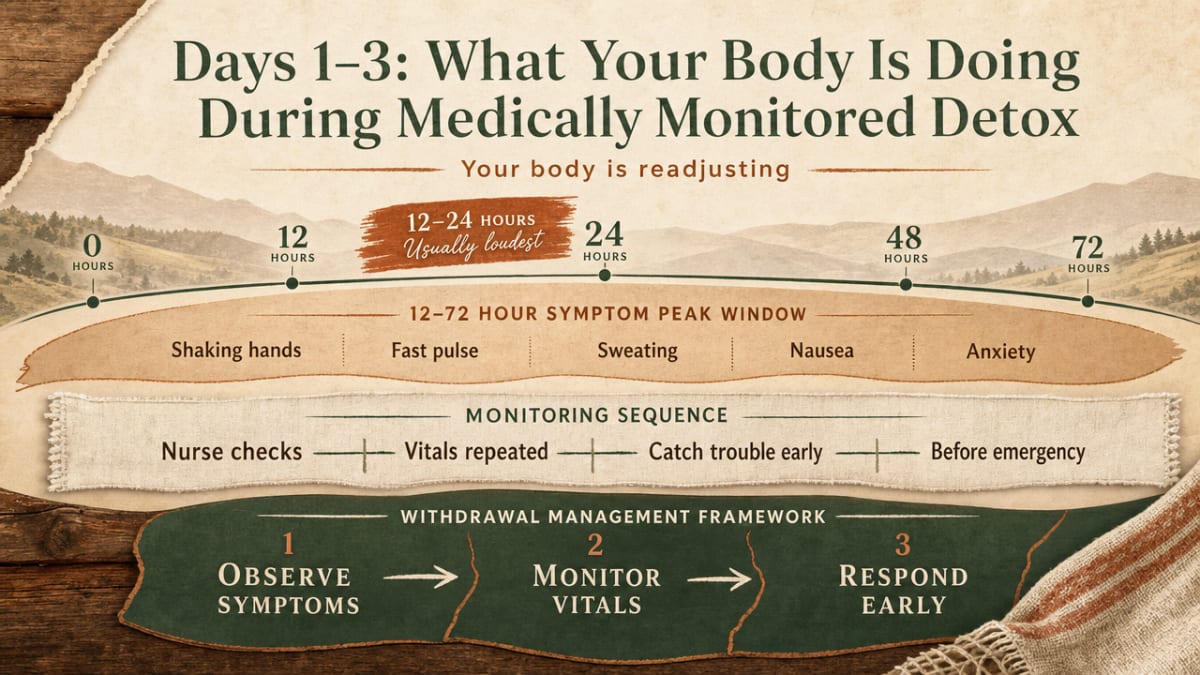
Days 1-3: What Your Body Is Doing During Medically Monitored Detox
Here’s what nobody tells you about the first three days: your body is not betraying you. It’s readjusting. For years, alcohol has been part of your internal chemistry. Now that chemistry is rewriting itself in real time, and it’s going to make some noise on the way.
The first 12 to 24 hours are usually the loudest. Hands that shake when you reach for a coffee cup. A pulse that feels like it’s running from something. Sweat that soaks the pillow. Nausea that shows up right when the tray arrives. Anxiety with no target, just a low buzz behind your eyes. A nurse will check on you every few hours through the night. Your vitals get taken more times than you can count. This is not overkill. This is how a medically monitored detox catches trouble early, before it becomes an emergency.
Days two and three are when many people hit the wall. Sleep comes in scraps. Food tastes like cardboard. Your emotions arrive uninvited and stay too long. You might feel rageful at 10 a.m. and weepy at 2 p.m. and numb by dinner. That’s your nervous system finding a new baseline. It is not who you are now. It is what leaving alcohol looks like.
The clinical framing behind all of this is straightforward. Withdrawal management has three jobs:
- assess what’s happening in your body,
- stabilize you safely, and
- get you ready to actually engage in treatment 8.
That third goal matters. Detox isn’t the finish line. On its own, getting the alcohol out of your system rarely produces long-term sobriety, which is why the counseling, groups, and structure that follow are the real work 7. The medical team’s job in these first 72 hours is to hand you off to that work with a body that can sit in a chair and a brain that can hear another person’s voice.
Small things help more than you’d expect:
- Sip water even when you don’t want it.
- Eat what you can, even if it’s four crackers.
- Ask for a second blanket.
- Tell the nurse when something changes, even if it feels stupid.
- Walk the hallway when your legs will carry you.
- If you cry, cry.
The staff at Rocky Mountain has seen every version of this. Many of them lived it in the same building. Nothing you’re doing right now surprises them.
By the end of day three, most people notice one true thing: the worst hour is behind them. Not all the hard hours. Just the worst one. That’s enough to build on.
Day 2: The Assessment Marathon and the Question About Depression
Day 2 arrives with better light and a worse headache. You slept in pieces. Someone knocks on your door around 6:30 a.m., and you realize you have to do this all over again, this time without the adrenaline that carried you through arrival.
After breakfast, the assessments begin in earnest. A counselor sits across from you with a stack of forms and starts asking questions that go far beyond alcohol. When did you first drink? Who else in your family drinks? How’s your sleep been for the last year? How’s your mood been for the last five? What have you been prescribed and did you take it? Any head injuries, any surgeries, any hospitalizations you’d rather not think about? Comprehensive assessment across medical, psychological, and social needs is what a good residential program is supposed to do in the first days, and the reason is simple: you can’t build a treatment plan around a story you haven’t finished telling 5.
Somewhere in that conversation, the question shifts. Have you ever felt hopeless for more than two weeks at a time? Ever thought about not being here? Any panic attacks, any trauma you’ve been drinking around? This is the co-occurring screen, and it’s not a trap. Roughly half the people who walk into alcohol treatment are also living with depression, anxiety, PTSD, or something the drinking has been quietly medicating. SAMHSA’s guidance is that every substance treatment setting should screen for these conditions at intake, because treating the alcohol without treating what’s underneath it is how people end up back in a room like this a year later 11.
Answer honestly. The counselor is not going to be shocked. If depression comes up, it goes into the treatment plan alongside the drinking, not instead of it. If trauma comes up, no one is going to force you to unpack it today. They’re just noting it exists so the therapist you’ll see later this week doesn’t have to guess.
You might also meet the medical director or a nurse practitioner today for a physical. Blood pressure, bloodwork, a look at your liver numbers, a conversation about any medications you take for blood pressure, diabetes, or sleep. Bring the list you couldn’t remember yesterday. If you take something and stopped a week ago because you were embarrassed, tell them now.
By afternoon, you’ll be tired in a way that doesn’t match what you did. That’s normal. Assessments are emotional labor. Take the nap if they offer it.
Day 3: The First Group Where You Don’t Have to Speak
By day three, someone will hand you a schedule and point you toward the group room. You will not want to go. Your body still feels like a rented apartment. Your hair is doing something weird. You haven’t decided yet whether you trust anyone in this building. Go anyway. Sit in the chair closest to the door if you need to.
Here is what most people don’t know about the first group: you don’t have to talk. The facilitator will say your name, welcome you, and tell the room you’re new. That’s usually it. Nobody is going to make you share your worst story on day three. The other clients will nod. A few will smile at you. One of them will probably say something in their own share that sounds exactly like a thought you had at 2 a.m. last month. That recognition is the point of being in the room.
Groups in the first week are usually psychoeducational rather than deep-dive. The topic might be sleep, or cravings, or what alcohol did to your brain chemistry, or how to ask for help without collapsing. This is by design. Residential programs typically build the first days around structured activities, group work, and educational sessions before the harder therapeutic work begins 6. You are being oriented, not excavated.
Somewhere on day three, you’ll also have your first real one-on-one with your primary counselor. Not the intake conversation. An actual sit-down. They’ll ask what you want out of this month. They’ll ask what you’re afraid of. They may share a piece of their own story, because at Rocky Mountain, most of the people asking these questions have sat in the chair you’re sitting in now.
Here’s what the research says about that conversation, and it’s worth knowing: the quality of the connection you build with your counselor in the first few days is one of the strongest predictors of how the rest of your treatment goes. Early therapeutic alliance ratings are significantly associated with subsequent substance use outcomes 9. Meaning: whether you feel seen this week matters, clinically, months from now. You don’t have to force it. You just have to show up honestly, even when honestly is small.
If you cry in group, someone will hand you a tissue and keep listening. If you don’t say a word, someone will find you at dinner and ask how you’re doing. Neither response is a test you passed or failed. It’s just Wednesday.
Days 4-5: Meeting the Horses
By day four, your body has stopped fighting you quite so hard. The tremor in your hands has softened. You slept four hours in a row last night, which felt like a miracle. Then someone points you toward a pair of closed-toe shoes and tells you it’s barn day.
The walk to the arena is short. Montana sky, cold air on your face, gravel under your boots. You might feel silly. You might feel scared. Horses are big animals, and you have not been around one since a birthday party in the third grade. That’s fine. Nobody is going to hand you a saddle. Most of the first equine session isn’t about riding at all.
What you’ll actually do on day four looks something like this: stand in an arena with a horse, notice how the horse responds to you, and talk about what you notice. If you walk in tense, the horse will not come near you. If you walk in with your shoulders down and your breath slow, the horse might follow you across the arena without a lead rope. This is the part that catches people off guard. You cannot fake calm to a 1,200-pound animal. Whatever you’re carrying, the horse reads it. And then a counselor asks you what you think that means about how you’ve been showing up to the rest of your life.
Here’s what the research says about why Rocky Mountain includes this alongside counseling and 12-step work. A 2023 randomized controlled trial of adults with substance use disorders found that adding equine-assisted therapy to standard treatment produced measurably greater gains than standard treatment alone in three areas: emotion regulation, self-efficacy, and self-esteem 2. Those are exactly the muscles that atrophy in active alcohol dependence. You lose the ability to steady yourself when a feeling hits. You lose the belief that you can do the hard thing. You lose the sense that you are worth the effort. The horses give you a low-stakes place to start rebuilding all three.
A separate 2023 study looked at what happens between session one and session four of equine-facilitated psychotherapy for people in SUD treatment, and it found short-term gains in health-related quality of life across those early sessions 4. Translation: the good feeling you might notice walking back to the house on day four is not imagined, and it’s likely to grow across the next few sessions rather than fade.
One honest caveat, because you deserve one. A 2022 systematic review of equine-assisted services in addiction treatment concluded that while the early findings look promising for retention and mental health, the overall evidence base is still developing, with small samples and methodological limits 1. Which is another way of saying: the horses are not the whole treatment. They are a doorway into the emotional work you’ll do everywhere else in the building.
By day five, if the schedule circles back to the barn, you might notice something different. You reach for the horse’s neck without flinching. You breathe out before you speak. A counselor watches and says almost nothing, because you already saw it.
What a Day Actually Looks Like by Midweek
By Wednesday or Thursday, the days start to have a shape. You wake up before you want to, but you wake up without the panic that used to greet you. The whiteboard in the hallway has become something you actually check.
Here’s the rough shape of it. Wake-up around 6:30. Coffee and a real breakfast, even if you still can’t eat much of it. A morning check-in group where people say how they slept and what’s on their mind. Then a psychoeducational group, usually an hour, on something practical: how alcohol rewires reward, what a craving actually is, why you keep waking up at 4 a.m.
Lunch. A break. Sometimes laundry day falls in here, and there is something absurdly grounding about folding your own socks in a place like this.
Afternoons hold the harder work. Individual counseling once or twice a week. Another group, often more process-oriented, where people talk about what’s actually going on. An activity block that might be equine work, a walk, art, or the gym. Dinner. An evening 12-step meeting or a speaker. A little free time. Lights out earlier than you’d choose at home.
The structure isn’t a punishment. It’s the point. Residential programs are built around structured activities, group therapy, individual counseling, and educational sessions precisely because a predictable day gives your nervous system something to lean on while it heals 6. You are not being managed. You are being held.
By midweek, you might notice you know where the coffee pot is without thinking.
Day 6: The First Phone Call Home and the First 12-Step Meeting
Day six is the day two hard things happen on purpose. You get to call home. And you sit in a room where people say their first name and the word alcoholic in the same sentence.
The phone call comes first for most people. By now you’ve been off your phone for the better part of a week, and the counselor hands you a landline or a supervised phone window and points you toward a quiet corner. You dial. Someone picks up on the second ring because they’ve been waiting near the phone for days.
You will not know what to say. That’s normal. Most people cry in the first thirty seconds and then apologize for crying. Don’t. On the other end, your spouse or your mom or your kid is doing the same thing. Keep it short if you need to. Tell them you’re safe. Tell them you’re eating. Tell them the horses are bigger in person. Family contact usually starts early in residential treatment because families are valuable allies in engagement and retention, not because you owe anyone a report card 12. Rocky Mountain’s three-day Family Week is coming later. This call is just a bridge to it.
That evening, someone drives a group over to a local AA meeting, or a meeting comes into the building. You’ll sit in metal folding chairs. Someone will pass a basket you don’t have to put anything in. A person you’ve never met will read something out loud, and then people will take turns talking about their week.
Nobody will ask you to speak. If they do a round of introductions, you can say your first name and pass. That’s it. The evidence on 12-step facilitation is straightforward: guided introduction to meetings during treatment increases the odds you’ll keep going after discharge, and staying connected to a mutual-help group is linked to better substance use outcomes down the road 10. You’re not being converted tonight. You’re being shown a room that will still be there in six months, in whatever town you live in.
What surprises most people on day six is how ordinary both moments feel. Your family still loves you. The meeting is just people in chairs. The unknown is shrinking, one true thing at a time.
Day 7: The Shape of the Week You Just Survived
Sunday morning of week one arrives with light in the window and a body that recognizes the room. You wake up before the knock. You know where the coffee pot is. You know the name of the person sitting across from you at breakfast, and you know one true thing about their life.
That’s what a week bought you. Not a cure. Not a personality transplant. A body that has been alcohol-free for seven days and is starting to remember how to sleep. A schedule your nervous system can follow without flinching. A counselor whose face you’d recognize in a grocery store. A horse that walked toward you. A mother on the other end of a phone call who cried and then laughed.
Day 7 usually feels quieter than the days before it. You might do a Sunday group, a longer break, a walk outside, a meeting in the evening. Some people write in the notebook they were handed on day one and cannot believe the person who wrote the first page. That person is still you. They just had a harder Monday.
What you’ve actually done this week, clinically, is the whole point of the first week: you got safely through withdrawal, completed the assessments that will shape the next 30, 60, or 90 days, and started building the relationships that carry the rest of treatment 5. The work ahead is longer and, in some ways, harder. But you already did the day you were most afraid of.
Tomorrow, the schedule starts again. You’ll be ready for it.
For the Person Helping Someone Pack: A Short Note to Family
If you’re the one folding shirts into a duffel bag while your person sits on the edge of the bed, this paragraph is for you.
You are allowed to be scared. You are allowed to be angry at how you got here. You are also allowed to feel a small, guilty flicker of relief. All of those feelings can ride together in the car to Great Falls.
A few honest things. You will not hear from them much in the first few days. That’s not rejection. That’s detox, assessments, and a phone kept in a drawer. When the first call comes, keep it short and warm. Tell them you’re proud. Tell them the dog is fine. Save the hard conversations for Family Week.
Ask the admissions team what you can send and when. Family involvement is built into good residential care from the beginning, not tacked on at the end 12. Your job this week isn’t to fix anything. It’s to eat dinner, sleep, and be reachable when the phone rings.
Frequently Asked Questions
Will detox hurt, and how long does it last?
The first 12 to 72 hours are usually the hardest, with shakes, sweating, nausea, and anxiety peaking early. A medically monitored detox is designed to keep you safe and comfortable through that window, using assessment, stabilization, and medications when needed to ease symptoms and prepare you for the therapy work that follows 8. Most people feel meaningfully better by day four or five.
Can I bring my phone, and when can I call my family?
At Rocky Mountain, personal phones are typically held during the first several days so you can focus on stabilizing. Supervised phone calls home usually start around day five or six, once detox is behind you and you’re settled into the schedule. Early family contact is built into good residential care, because families are allies in your engagement and retention, not intrusions on it 12.
What if I don’t want to talk in group on the first day?
You don’t have to. The facilitator will introduce you, and you can pass on sharing for as long as you need to. First-week groups lean toward education and orientation rather than deep disclosure 6. Just being in the chair counts. The connection you start building with your counselor and peers during these early days is what predicts how the rest of treatment goes 9.
What should I pack for my first week?
Keep it simple. A week of comfortable clothes, closed-toe shoes for the barn, a light jacket for Montana weather, toiletries without alcohol as an ingredient, a notebook, and a few photos. Leave mouthwash, hand sanitizer, and anything with a razor at home. Rocky Mountain will give you a specific list at admission, and the intake team can walk you through it during your pre-admission call.
What happens if I’m also dealing with depression or anxiety?
You’re in the right place to say so. Every substance treatment setting should screen for co-occurring mental health conditions at intake, and the counselor doing your day-two assessments will ask directly about mood, anxiety, trauma, and past treatment 11. If something comes up, it goes into your plan alongside the drinking, not instead of it. Rocky Mountain provides dual diagnosis care for exactly this reason.
Can I leave if I decide rehab isn’t for me on day three?
Legally, yes. As an adult you can request to leave against medical advice. Day three is also when many people feel the strongest urge to walk out, right when withdrawal is easing and the emotional work is starting. Talk to your counselor first. Detox alone rarely produces lasting sobriety 7. The days after the worst is over are exactly when the real change begins.
References
- Equine-assisted services for individuals with substance use disorders: a systematic review of the literature. https://pmc.ncbi.nlm.nih.gov/articles/PMC9749232/
- Equine-assisted therapy effectiveness in improving emotion regulation, self-efficacy, and perceived self-esteem in patients with substance use disorders. https://pmc.ncbi.nlm.nih.gov/articles/PMC10576391/
- Complementary horse-assisted therapy for substance use disorders: a randomized controlled trial. https://pmc.ncbi.nlm.nih.gov/articles/PMC7001193/
- An evaluation of the effect of equine-facilitated psychotherapy on health-related quality of life in patients with substance use disorders. https://pmc.ncbi.nlm.nih.gov/articles/PMC10306210/
- Treating Drug Problems: Volume 1 – Chapter on Residential Treatment. https://www.ncbi.nlm.nih.gov/books/NBK64116/
- Residential Treatment for Substance Use Disorder: A Review of Clinical Effectiveness and Guidelines. https://pmc.ncbi.nlm.nih.gov/articles/PMC5720615/
- Detoxification and Substance Abuse Treatment: A Review. https://pmc.ncbi.nlm.nih.gov/articles/PMC5648704/
- Withdrawal Management and Treatment of Drug Dependence in Closed Settings. https://pmc.ncbi.nlm.nih.gov/articles/PMC2652466/
- The Role of the Therapeutic Alliance in Substance Use Disorder Treatment Outcomes. https://pmc.ncbi.nlm.nih.gov/articles/PMC6602453/
- Twelve-Step Facilitation and Mutual-Help Groups for Substance Use Disorders. https://pmc.ncbi.nlm.nih.gov/articles/PMC4498550/
- Substance Use Disorder Treatment for People With Co-Occurring Disorders (TIP 42). https://www.ncbi.nlm.nih.gov/books/NBK424859/
- Substance Abuse Treatment and Family Therapy (TIP 39). https://www.ncbi.nlm.nih.gov/books/NBK64042/