
Key Takeaways
-
- The opening scene reframes early alcohol addiction as small, deniable patterns like pouring more than planned or needing more to feel the same, not the dramatic version most people picture.
- The NIAAA’s 11-question DSM-5 check is the real yardstick — two yes answers within the past year meets criteria for alcohol use disorder, and severity climbs from there.8
- Score yourself without grading on a curve against other drinkers, count ‘sort of’ as a yes, and let the number guide what kind of help fits.
- Risky drinking thresholds are either/or: more than 14 drinks a week or 4 in a day for men, 7 a week or 3 a day for women, and standard drink sizes are smaller than most pours.3
- Internal signs like tolerance, quiet cravings, and the gap between what you planned to drink and what you actually drank are among the most reliable early signals.7,8
- External signs often show up first at work and home — missed deadlines, short fuses, family walking on eggshells — which is why screening now focuses on life friction, not just drink counts.4
- Family members noticing patterns aren’t overreacting; leading with a specific moment rather than a verdict tends to land, and admissions teams will talk to relatives too.
- Withdrawal risk is where concerning becomes urgent — about 40% of people who misuse alcohol develop acute withdrawal, symptoms can start within 6-8 hours, and severe cases warrant supervised detox.1
- Binge drinking counts even without daily use — four drinks in two hours for women, five for men — and carries higher health risks even when dependence isn’t present.10
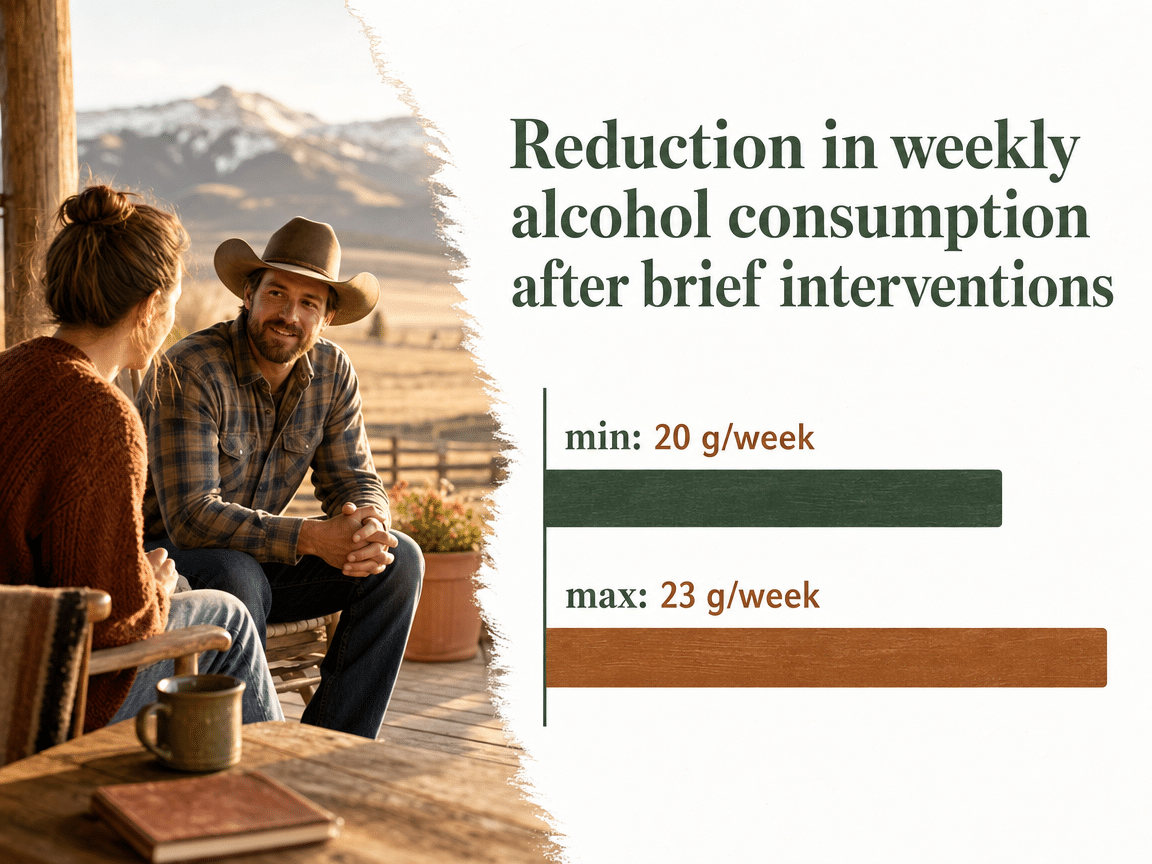
- The first real step is naming the problem out loud to yourself; even brief structured conversations reduce weekly drinking by roughly 20-23 grams on average.2
- A call to Rocky Mountain Treatment Center is a conversation, not an intake machine, with over 80% of staff in recovery and Montana pickup available for those without transportation.
- The program’s core pieces — 12-step work backed by outcome research, equine therapy with emerging qualitative support, and Family Week — each play a distinct role in recovery.6,9
When Two Drinks Quietly Become Six
You poured a glass while you started dinner. That was around six. Now it’s a little after ten, the ice has melted twice, and you’re not sure if this is your fourth or fifth. Or sixth. The bottle answers that question, but you’re not looking at the bottle.
If you’re reading this, part of you already knows something is off. That took guts. Most people don’t get this far — they change the subject in their own head and go to bed.
Here’s the thing nobody says out loud: early signs of alcohol addiction in myself almost never looks like the movies. It doesn’t kick down the door. It shows up as small, deniable patterns — drinking a little more than you planned, needing a little more to feel the same, waking up foggy on a Tuesday and promising yourself Wednesday will be different. Then Wednesday is fine and Thursday isn’t.This article is a plain-language check-in, not a verdict. You’ll find a real symptom list you can score yourself, a clear line between “concerning” and “call today,” and an honest look at what reaching out to a place like Rocky Mountain Treatment Center in Great Falls actually feels like. No sales pitch. Just information you can sit with.
The 11 Questions That Actually Tell You Something
The Self-Check: NIAAA’s DSM-5 Symptom List in Plain English
Forget the pop quizzes online. The National Institute on Alcohol Abuse and Alcoholism uses an 11-question check that clinicians actually rely on to diagnose alcohol use disorder. You need at least two “yes” answers within the past year for it to count as AUD, and the more yes-answers you rack up, the more serious the picture. Two to three is considered mild. Four to five is moderate. Six or more is severe.8
Here they are, in the plainest English we can give you. In the past year, have you:
1. Had times when you ended up drinking more, or longer, than you meant to?
2. Wanted to cut down or stop drinking, or tried to, and couldn’t?
3. Spent a lot of time drinking, being sick from it, or getting over the aftereffects?
4. Wanted a drink so badly you couldn’t think about anything else?
5. Found that drinking — or being hungover — got in the way of your family, your job, or your school?
6. Kept drinking even though it was causing trouble with people you love?
7. Given up or cut back on things that used to matter to you — hobbies, sports, being around certain friends — because of drinking?
8. Gotten into situations while drinking, or after, that raised your chances of getting hurt (driving, swimming, walking home, unsafe sex, using a weapon)?
9. Kept drinking even though it was making you feel depressed or anxious, adding to another health problem, or worsening a blackout?
10. Had to drink much more than you once did to get the effect you want? Or noticed the same amount hits you less than it used to?
11. Found that when the effects of alcohol were wearing off, you had withdrawal symptoms — trouble sleeping, shakiness, restlessness, nausea, sweating, a racing heart, or a seizure? Or that you drank to avoid feeling that way?
NIAAA is careful with the language here, and so are we: “any of these symptoms may be cause for concern. The more symptoms, the more urgent the need for change”. You don’t need six yeses to deserve a real conversation. Two is enough to matter.7
How to Score Yourself Without Flinching
Read the list twice. The first time, your brain will argue with you — “that was one weekend,” “that was a bad month,” “everyone does that.” Let it argue. Then read it again and answer honestly, out loud if you need to. Only the past 12 months count.
A few ground rules that help:
- Don’t grade on a curve against your uncle or your coworker. The question is about you and your year, not the worst drinker you know.
- A “sort of” is a yes. If you had to think about it for more than a second, mark it.
- Don’t stop counting at two. Keep going. The number matters because it tells you what kind of help fits — a conversation with your doctor, an outpatient plan, or medically monitored care at a place like Rocky Mountain Treatment Center.
And if your score surprised you? Good. That’s the whole point of a self-check. You just learned something true about your life, and you’re still the person who can do something with it.
What Counts as Risky Drinking (and Why ‘I Only Drink Beer’ Doesn’t Save You)
Here’s a yardstick you can actually use against your week. The thresholds primary care doctors use to flag risky drinking are straightforward: for men, more than 14 drinks in a week or more than 4 in a single day; for women, more than 7 drinks in a week or more than 3 in a day. Cross either line — the weekly one or the daily one — and you’re in territory the medical world considers hazardous.3
Read that again. It’s not the weekly total OR the daily total. It’s either. You can stay under 14 for the week and still land in risky territory if Friday night went sideways.
And this is where the beer defense falls apart. A standard drink isn’t a container — it’s an amount of alcohol. 12 ounces of regular beer, 5 ounces of wine, and 1.5 ounces of spirits all count as one drink. That tall boy is closer to two. That generous pour of red at dinner is closer to two. The double bourbon your friend made you is two. Most people underestimate their own count by 30 to 50 percent, and it’s not because they’re lying. It’s because the glass is bigger than the standard.
Do the honest math on last week. Not your best week. Last week. Count the pours the way a bartender would, not the way you’d like to remember them.
If you’re over the line — even once — that doesn’t automatically mean you have alcohol use disorder. What it means is that your drinking has moved into a range where the odds of harm start climbing, and where a real conversation is worth having. That could be with your primary care doctor. It could be with the admissions team at Rocky Mountain Treatment Center, who will talk with you on the phone without pushing you into anything. The number on your yardstick just tells you the conversation is earned.
The Signs That Show Up at Work, at Home, and in the Mirror
Patterns You Can Feel: Tolerance, Cravings, and ‘One More’
Some signs live under your skin. Nobody else sees them yet, but you do.
Tolerance is usually the first one to arrive, and it’s sneaky because it feels like a win. Two drinks used to warm you up. Now two drinks feel like nothing, so you pour a third without thinking, and a fourth to actually feel the edge come off. You didn’t decide to drink more — your body just moved the goalposts. NIAAA flags this exact shift as one of the 11 signs of alcohol use disorder.7
Cravings are the second one. Not the movie version, where someone shakes at a bar. The real version is quieter. It’s the 4 p.m. clock-watch. It’s opening the fridge for something else and reaching past it. It’s the thought that shows up before the thought — you’re already halfway to the cabinet before you notice you moved.
And then there’s “one more.” You told yourself two. You had four. Not because tonight was special. Just because stopping got harder than starting. That gap between what you planned and what you drank is one of the most reliable early signals there is.8
Patterns Other People See First
The tricky part about early alcohol addiction is that other people often clock it before you do. Not because they’re keeping score — because they’re standing outside the fog.
Work is usually where it shows up first. Monday mornings that feel like a slog you can’t explain. A short fuse in meetings you used to sit through fine. Missing a small deadline, then covering for it. Choosing calls over in-person because your breath is a variable. None of these are dramatic on their own. Stacked over a few months, they’re a pattern.
Home is next. You get quieter, or louder. You disappear into a show earlier. Sunday dinners get skipped because Saturday ran long. Your kid learns not to ask for help with homework after 7 p.m. Your partner stops mentioning the recycling bin.
The medical world has been pushing screening to focus on exactly these problems — health, family, work friction — not just how many drinks you had. Because the drinks are the input. The life around you is the readout. If people who love you have started walking on eggshells, that’s data. Take it seriously without punishing yourself for it.4
If You’re the Spouse, Parent, or Adult Kid Reading This
You might be the one who found this article. Maybe you searched at 11 p.m. after another night of counting empties in the recycling. Maybe you’re reading it on your phone in a parking lot.
First — you’re not crazy, and you’re not overreacting. If you’re noticing patterns, there are patterns. The list in the last section wasn’t just for the drinker. It’s for you too, as a way to name what you’ve been watching without a script.
Here’s what actually helps. Bring up a specific moment, not a verdict. “I was scared on Tuesday when you drove home from the lake” lands. “You have a problem” doesn’t. Ask what they want, not what you want for them. And know that one conversation almost never does it — you’re planting, not harvesting.
You don’t have to have the whole plan figured out before you call somewhere. The admissions team at Rocky Mountain Treatment Center will talk to family members too. You can ask questions on behalf of someone who isn’t ready yet. That’s not going behind their back — that’s you doing your own homework so you’re ready when the door opens.
The Line Between ‘Concerning’ and ‘Call Today’: Withdrawal Risk
Most of what we’ve talked about so far — tolerance, cravings, drinking more than you planned, the arguments at home — is serious but not usually an emergency. This one is different.
If your body has gotten used to alcohol being there, taking it away can make you sick. Not “hangover sick.” Medically sick. According to the NICE clinical guideline on alcohol-use disorders, roughly 40% of people who misuse alcohol develop acute alcohol withdrawal syndrome when they stop or significantly cut back, and minor symptoms can start as early as six to eight hours after that last drink. Six to eight hours. That’s before lunch, if you stopped at breakfast.1
Early withdrawal looks like shakiness in your hands, sweating for no reason, a racing heart, trouble sleeping, feeling anxious or nauseated, sometimes throwing up. The NIAAA lists these same signs as the eleventh symptom on the AUD self-check — the one where you drink again just to make the feeling stop. If you’ve ever had a morning drink to steady yourself, or if the idea of skipping tonight makes your chest tight in a physical way, your body is telling you something the checklist already suspected.7
Here’s the part that matters most. Alcohol is one of the few substances where quitting cold turkey at home can be genuinely dangerous. In more severe cases, withdrawal can escalate to seizures or delirium tremens, which is why NICE recommends supervised — and often inpatient — withdrawal for people showing signs of physical dependence.1
You don’t have to be at the worst version of yourself to earn that kind of care. You just have to be honest about where your body is right now.
‘But I’m Not That Bad’ — Where Binge Drinking Fits
Here’s the sentence a lot of people hang their hat on: “I only drink on weekends.” Or, “I never drink alone.” Or the classic — “I don’t drink every day, so I’m fine.”
Binge drinking is its own thing, and it deserves an honest look. The CDC is clear that most people who binge drink are not alcohol dependent — but they still face a higher risk of serious health effects than people who don’t drink that way. Read that twice. Not dependent doesn’t mean not at risk. It means the door is still open, and the pattern is trying to walk you through it.10
What does binge drinking actually look like? Four or more drinks in about two hours for women. Five or more in that window for men. So the Saturday where you “only had a few” between kickoff and the fourth quarter probably counts. So does the wedding. So does most of last summer.
If you scored one or two yeses on the self-check and you binge every weekend, you’re not “not that bad.” You’re early. And early is the best possible place to be when you’re deciding what to do next.
What a First Step Actually Looks Like
The Honest Conversation Before the Phone Call
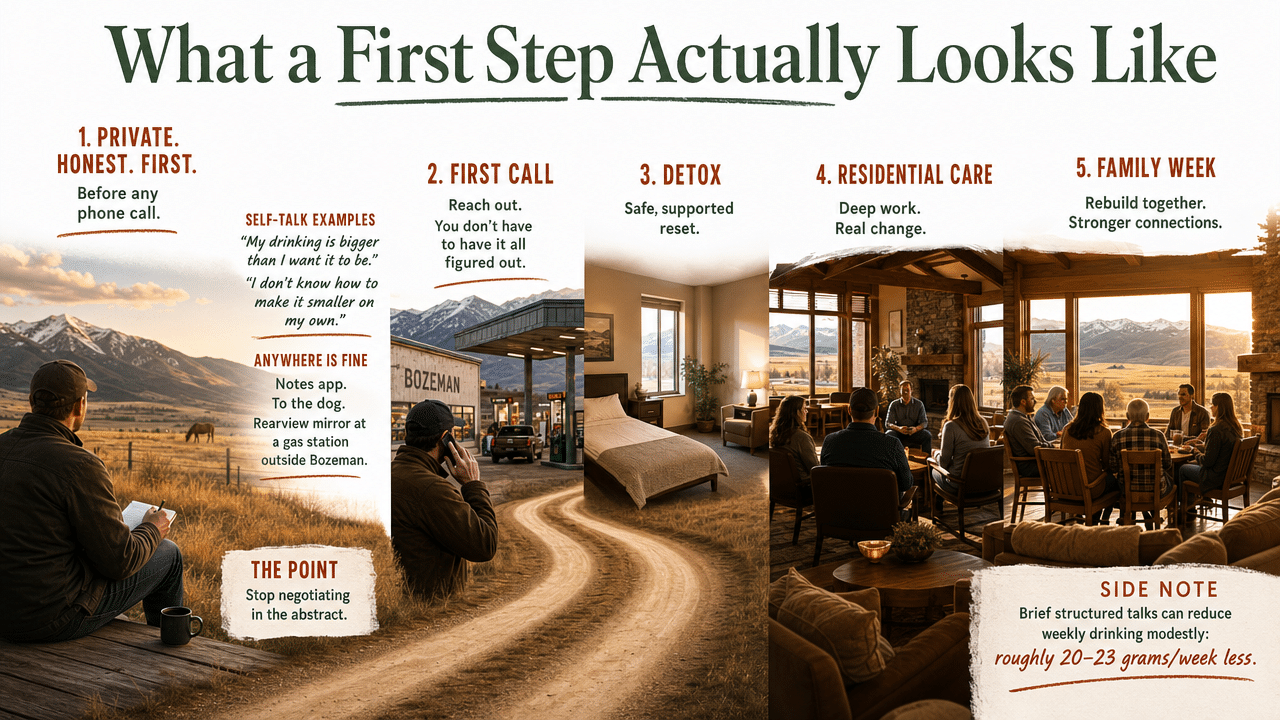
Before you dial anyone, you have to say it out loud. Not to a professional. To yourself. Something like, “My drinking is bigger than I want it to be, and I don’t know how to make it smaller on my own.” That sentence is the whole first step. Everything after it is logistics.
Some people write it in the notes app. Some say it to the dog. One client we heard about said it into his truck’s rearview mirror at a gas station outside Bozeman. It doesn’t matter where. It matters that you stop negotiating with yourself in the abstract.
The research on brief conversations backs this up in its own quiet way. Structured talks — even short ones with a primary care doctor — reduce weekly drinking by roughly 20 to 23 grams a week on average, which is real, if modest. That’s not a solution for someone who’s physically dependent. But it does prove something worth holding onto: naming it changes it. The words are not decoration.2
Once you’ve said it once, the phone gets lighter. You’re not calling to confess. You’re calling to ask questions.
What a Warm Landing at Rocky Mountain Feels Like
When you call Rocky Mountain Treatment Center, you’re not walking into an intake machine. You’re calling a 26-bed residential facility in Great Falls where the person on the other end has, more likely than not, been where you are. Over 80% of the staff are in recovery themselves. That’s not a marketing sentence. It shows up in how they talk to you — no clinical distance, no performance.
Here’s what an admissions call actually is: a conversation. They’ll ask about your drinking, your health, your last drink, and what’s happening at home. They’ll answer questions about insurance without making you feel like you’re being qualified for a loan. If you’re in Montana and don’t have a way to get there, they’ll come pick you up. Not metaphorically. Someone drives.
For most people whose bodies are used to daily drinking, the first stop inside the building is medically monitored detox. That’s the part the NICE guideline describes as necessary when there’s physical dependence — nurses on shift, doctors managing symptoms, a real bed instead of a couch. It usually runs a few days. From there, you step into the residential program, which is where most people spend 30, 60, or 90 days depending on what they need.1
And it’s residential in the true sense. You eat meals with other people who understand. You sleep in the same building where your counselors work. When something breaks open at 9 p.m. — and it will — someone is there. That’s the whole point of choosing inpatient over trying to muscle through outpatient while your regular life keeps happening around you.
12-Step Work, Equine Therapy, and Family Week — What They Actually Do
The therapy schedule at Rocky Mountain isn’t a menu you order from. It’s a rhythm built into the day. A few pieces are worth knowing about now, so you’re not walking in cold.
12-step work is the backbone. If that phrase makes you flinch — many people flinch — know that the research is on its side. In studies of people with both substance use and co-occurring mental health conditions, more participation in 12-step facilitation was linked to better substance use outcomes and lower drinking frequency and intensity. You don’t have to believe anything to start. You have to show up.9
Equine therapy is the piece people ask about the most. You spend time with horses — grooming, leading, being still with them — under the guidance of a counselor. The honest truth about the evidence: a systematic review found mostly qualitative reports of benefit, things like better emotional regulation and stronger engagement in treatment, and researchers say more rigorous studies are still needed. But something happens when a 1,200-pound animal reads your mood before you can name it. People who don’t cry in a therapist’s chair cry in the arena.6
Family Week is three days built for the people who’ve been watching. Your spouse, your parents, your adult kids come to Great Falls, sit in structured sessions with counselors, and start learning a different way to talk to you and to each other. This isn’t optional connective tissue. It’s often where the shift from “individual recovery” to “a family that can actually hold this” begins.
Frequently Asked Questions
How do I know if my drinking is a real problem or just a rough patch?
A rough patch usually ends. If you’re still drinking more than you meant to, or still trying to cut back and failing, months after the stress passed, that’s not a patch anymore. Two “yes” answers on the NIAAA self-check within the past year is enough to meet the definition of alcohol use disorder. Trust the pattern, not the story you’re telling about it.7
Can I just quit drinking on my own at home?
Sometimes yes, sometimes genuinely no. If you drink daily, drink in the morning, or have felt shaky or nauseated within a day of your last drink, please don’t try it alone. Alcohol withdrawal can escalate to seizures, which is why clinical guidelines recommend supervised withdrawal when there are signs of physical dependence. Call Rocky Mountain and ask. That question over the phone costs you nothing.1
What should I say to a spouse or parent I think is drinking too much?
Lead with a specific moment, not a label. “I was worried Tuesday when you fell asleep on the couch with the stove on” lands. “You’re an alcoholic” doesn’t. Ask how they’re actually doing before you ask about the drinking. One conversation rarely fixes it — you’re opening a door, not closing a case. And you can call Rocky Mountain’s admissions line yourself to ask questions on their behalf.
I only binge drink on weekends — does that still count as addiction?
Not automatically. The CDC notes that most people who binge drink are not alcohol dependent, but they still face higher risk of serious health effects than people who don’t drink that way. Translation: you might not meet criteria for AUD yet, and you’re still on a road that leads there. Early is the best possible place to make a change. Don’t wait for it to get worse to count.10
What actually happens when I call Rocky Mountain Treatment Center?
A conversation. Someone asks about your drinking, your health, when you last drank, and what’s happening at home. They walk you through insurance without a hard sell. If you’re in Montana without a ride, they’ll arrange to pick you up. If your body’s used to daily alcohol, you’ll start in medically monitored detox before moving into the 30, 60, or 90-day residential program. No commitment on the first call.
Do I have to be ready to quit forever before I reach out?
No. Almost nobody who calls is fully sure. “Forever” is a distance that can freeze anyone in place. All you need for that first phone call is enough honesty to say the drinking is bigger than you want it to be. The counselors at Rocky Mountain — over 80% of whom are in recovery themselves — have started from exactly where you are. Ready enough is ready.
References
- Alcohol-use disorders: diagnosis, assessment and management of harmful drinking and alcohol dependence (National Clinical Practice Guideline 115). https://www.ncbi.nlm.nih.gov/books/NBK65487/pdf/Bookshelf_NBK65487.pdf
- Brief Interventions in Primary Care: an Evidence Overview. https://pmc.ncbi.nlm.nih.gov/articles/PMC5984646/
- Screening and Brief Intervention in Primary Care Settings. https://pmc.ncbi.nlm.nih.gov/articles/PMC6601648/
- Should brief interventions in primary care address alcohol problems more strongly?. https://pmc.ncbi.nlm.nih.gov/articles/PMC4153955/
- Brief intervention for heavy drinking in primary care. https://pmc.ncbi.nlm.nih.gov/articles/PMC4592373/
- Equine-assisted services for individuals with substance use disorders: A systematic review. https://pmc.ncbi.nlm.nih.gov/articles/PMC9749232/
- Understanding Alcohol Use Disorder. https://www.niaaa.nih.gov/publications/brochures-and-fact-sheets/understanding-alcohol-use-disorder
- Alcohol Use Disorder: From Risk to Diagnosis to Recovery. https://www.niaaa.nih.gov/health-professionals-communities/core-resource-on-alcohol/alcohol-use-disorder-risk-diagnosis-recovery
- 12-Step Facilitation for the Dually Diagnosed. https://pmc.ncbi.nlm.nih.gov/articles/PMC3976999/
- Data on Excessive Alcohol Use. https://www.cdc.gov/alcohol/excessive-drinking-data/index.html