Key Takeaways
- A faith-friendly Great Falls program keeps licensed clinical care as the foundation, with Bible study, prayer, and reflection offered as options you can accept or skip.
- Montana requires a treatment plan within three days of admission, a written continuing care plan before discharge, and 24/7 staffing in clinically managed residential withdrawal management.7,8
- Before committing, compare how faith participation actually works, whether MAT and psychiatric medications are permitted, insurance and Medicaid coverage, transportation, and how staff answer clinical questions.
- Life after discharge holds through three layers chosen at your pace: certified sober living verified through the state registry, structured aftercare, and a faith community if it fits.9,12,13
What a faith-friendly recovery program actually looks like in Montana
If you’re looking for a spiritual programs Great Falls that respects your faith without pushing it on you, start with a simple picture: a licensed residential setting where the clinical care is the foundation, and spiritual support is something you choose to add. Not the other way around.
In practice, that means a program handles the hard medical part first. Montana rules require clinically managed residential withdrawal management facilities to have staff on duty 24 hours a day, seven days a week, with written emergency transfer procedures if something goes wrong. You should not have to trade safety for spiritual openness. A good program gives you both.7
From there, the shape of your days runs through counseling, group work, and 12-step meetings. Optional pieces layer on top: Bible study if you want it, quiet reflection, meditation, prayer, or none of the above. State residential standards also require a treatment plan started within three days of admission and a written continuing care plan before you’re discharged, so the program has a real arc, not just a stay.8
Faith-friendly here means invited, not required. You keep the pen. The program keeps the guardrails.
The fear of being preached at, and why it’s fair
Let’s name it out loud: you’re worried that if you walk into a program that mentions spirituality, someone will corner you in a folding chair and tell you what to believe. Maybe you’ve had that experience before. Maybe you’ve only heard stories. Either way, the worry is fair, and it should not be brushed off.
Here’s the honest version. A program that respects your faith journey treats Bible study, prayer, and reflection the way it treats yoga or art: available, offered on a schedule, and yours to accept or skip. If you’re curious one week and not the next, that’s fine. If you never open a Bible during your stay, no one should treat you differently in group, at meals, or in your counseling sessions.
The opposite fear matters too. You might worry that a clinical program will roll its eyes at your faith, or quietly steer you away from it. That’s also fair, and also not how a good program operates. Your beliefs belong in the room with you.
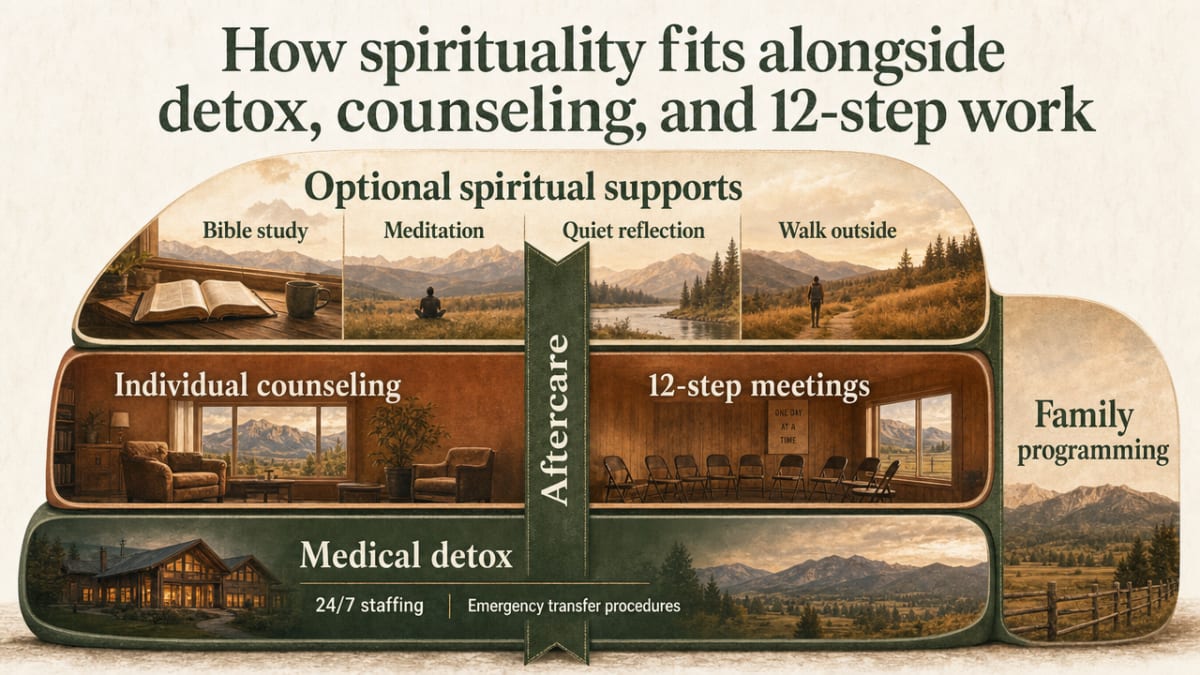
How spirituality fits alongside detox, counseling, and 12-step work
The clinical floor: medical detox and 24/7 staffing
Before anyone hands you a devotional or asks how you feel about a Higher Power, your body needs to be safe. That’s the floor everything else stands on.
In Montana, a clinically managed residential withdrawal management facility has to keep staff on duty 24 hours a day, seven days a week, and it must have written emergency transfer procedures in case something changes fast. That’s not a nice-to-have. It’s the baseline the state expects.7
Picture the layers stacked from the ground up. Medical detox sits at the bottom, with nurses and counselors on the floor around the clock. Individual counseling and 12-step meetings come next, giving your days a shape. On top of that sit the optional pieces, including Bible study, meditation, quiet reflection, or a walk outside with your own thoughts. Above that, family programming brings people you love into the work. And running through all of it is aftercare, the plan for what happens when you go home.7,8
Faith fits into that stack. It does not replace any of it. A program that suggests otherwise is asking you to skip the floor and stand on the ceiling.
Counseling and 12-step meetings as the daily rhythm
Once detox settles, your days start to have a beat. That beat is mostly counseling and meetings, not sermons.
Individual counseling gives you a private hour to look at the parts of your life that hurt. What you drank around. Who you called at 2 a.m. What you have been carrying since childhood. A good counselor will ask about your faith the same way they ask about your family or your job: as a real part of you, worth knowing, not a project to fix.
Group counseling adds the mirror. You hear someone else describe a shame you thought was yours alone, and something loosens. 12-step meetings run in a similar key. People take turns telling the truth, and the truth is often enough.
You may notice the 12 steps mention God, a Higher Power, or a power greater than yourself. Nobody in a well-run meeting is going to define that for you. Some people fill it with Jesus. Some people fill it with the group itself. Some people leave it blank for a while and come back to it. That is the honest tradition of the room.
Optional Bible study, prayer, and quiet reflection
Here is where the spiritual part actually lives. A faith-friendly Great Falls program will usually put Bible study on the weekly schedule the way it puts equine sessions or art on the schedule. It’s on the board. You can show up. You can also not show up.
What does a session look like? Often it’s a small group with a facilitator, an open text, and time to talk about what a passage stirs up. Sometimes it’s more like a guided conversation about hope, forgiveness, or what to do with anger. If you have not opened a Bible in twenty years, that’s fine. If you have questions your church home would not let you ask out loud, this can be the place to ask them.
Prayer and quiet reflection are usually even lower-key. A few minutes before a meal. A journal on the nightstand. A pause outside before group. Some people call it prayer. Some people call it thinking. Both count.
The federal Alcohol Treatment Navigator lists faith communities among long-term recovery supports for a reason. It can hold weight over time, on your terms, at your pace.13
Higher Power language: room for Christian faith, room for questions
The 12 steps ask you, more than once, to think about a power greater than yourself. That language trips people up in both directions. If you’re Christian, you might wonder if the meeting will water down what you already believe. If you’re not sure what you believe, you might feel like the room is quietly asking you to sign a doctrine on the way in. Neither is what’s happening.
Here is the honest version. The steps use open language on purpose. Your Higher Power can be the God you grew up praying to. It can be Jesus, plainly and by name, if that’s where your faith lands. It can also be the group in the room, the mountains outside the window, or a question you’re not ready to answer yet. Nobody at a well-run meeting is going to correct you.
That matters for a faith-seeker. You are not required to trade your Christian language for something vaguer to belong. You are also not required to have it all figured out. Federal recovery guidance treats faith communities and mutual-help groups as complementary layers of long-term support, not competing camps.13
Bring your Bible. Bring your questions. Both fit.
What a week inside a small residential program feels like
Picture a 26-bed program tucked into Great Falls, with the foothills visible from the parking lot. Small enough that the counselors learn your name by the second day. That scale matters more than any brochure.
Your first three days are front-loaded. Montana requires a treatment plan started within 72 hours of admission and a written continuing care plan before you’re discharged. So intake is not a formality. You’ll meet with a counselor, talk through your history, and set the shape of what you’re working on. If faith is part of your story, you say so. If you’re still figuring it out, you say that.8
By midweek, the rhythm settles. Mornings usually open with a check-in and breakfast. Group counseling stretches through late morning. Afternoons might hold individual sessions, a 12-step meeting, equine time in a paddock outside town, or a walk. Evenings tend to soften: journaling, an optional Bible study, a quiet hour before lights out.
Weekends breathe differently. Fewer scheduled blocks. More space for family visits, for reading, for sitting with what came up in group.
By the end of week one, you’re not fixed. You’re steadier. That’s the goal.
Family involvement without pressure
Addiction rarely happens to one person alone. Your spouse, your kids, your parents, whoever has been carrying pieces of this with you, they carry it too. A good Great Falls program builds room for them without turning them into a project.
In practice, that usually looks like family therapy sessions and a family education week where relatives come in, learn what addiction actually does to the brain and the household, and get their own space to talk. Not to be lectured. Not to be handed a script. Federal caregiver support materials treat family involvement as its own layer of recovery, worth its own attention.14
Faith stays optional here too. If your family prays together, you can pray together. If your sister is not sure what she believes and your dad is a lifelong churchgoer, both of them belong in the room. Nobody should be asked to perform a faith they don’t hold, and nobody should be asked to hide the one they do.
The point is simple. Your people get supported. Nobody gets pressured. You come out the other side with a household that knows a little more about how to stand next to you.13
Cost, coverage, and the practical Great Falls picture
Money and logistics are usually the part nobody wants to talk about first, but they’re often the reason someone waits another six months to make the call. So let’s put them on the table.
Great Falls is a working city of about 60,013 people, with a median household income around $63,934 and roughly 14.0% of residents living in poverty. That mix means cost, time off work, and how you’ll get to and from a program are real questions, not embarrassing ones. Most residential facilities in Montana work with major private insurance, though every program handles Medicaid and Medicare differently, so ask directly before you assume. Montana’s HEART 1115 demonstration has expanded Medicaid-supported substance use disorder services statewide since 2022, which has changed the coverage picture for some residents. The state’s Substance Use Disorder Services page is a neutral place to start if you want to see what public pathways look like without a sales pitch.5,6
Transportation is the other quiet barrier. If you don’t have a car, Great Falls Transit District runs local service that can get a family member to and from visits, and complimentary pickup from elsewhere in Montana is sometimes offered by residential providers. Ask.1
What Montana requires of any program you consider
You don’t have to become a policy expert to make a good choice, but a short list of what the state actually requires can save you from a bad one.
Residential treatment in Montana is licensed and structured. A written treatment plan has to be started within three days of your admission, and a continuing care plan has to be in place before you’re discharged. If a program can’t tell you clearly how those two things work, that’s a signal. Clinically managed residential withdrawal management facilities also have to keep staff on duty around the clock and follow written emergency transfer procedures if something goes sideways medically.7,8
Recovery residences, the sober-living homes people often step into after treatment, sit under their own rules. Since October 1, 2023, they have to register with DPHHS, and certification unlocks access to things like rental voucher support. Certified residences also have to permit residents to receive prescribed treatment and medication, which matters if you’re on MAT or psychiatric meds. Montana law bars operators from making misleading claims or paying kickbacks for referrals, so honest marketing is not optional.9,10,11
Ask. A program that welcomes the questions is usually the one worth trusting.
Life after discharge: sober living, aftercare, and church
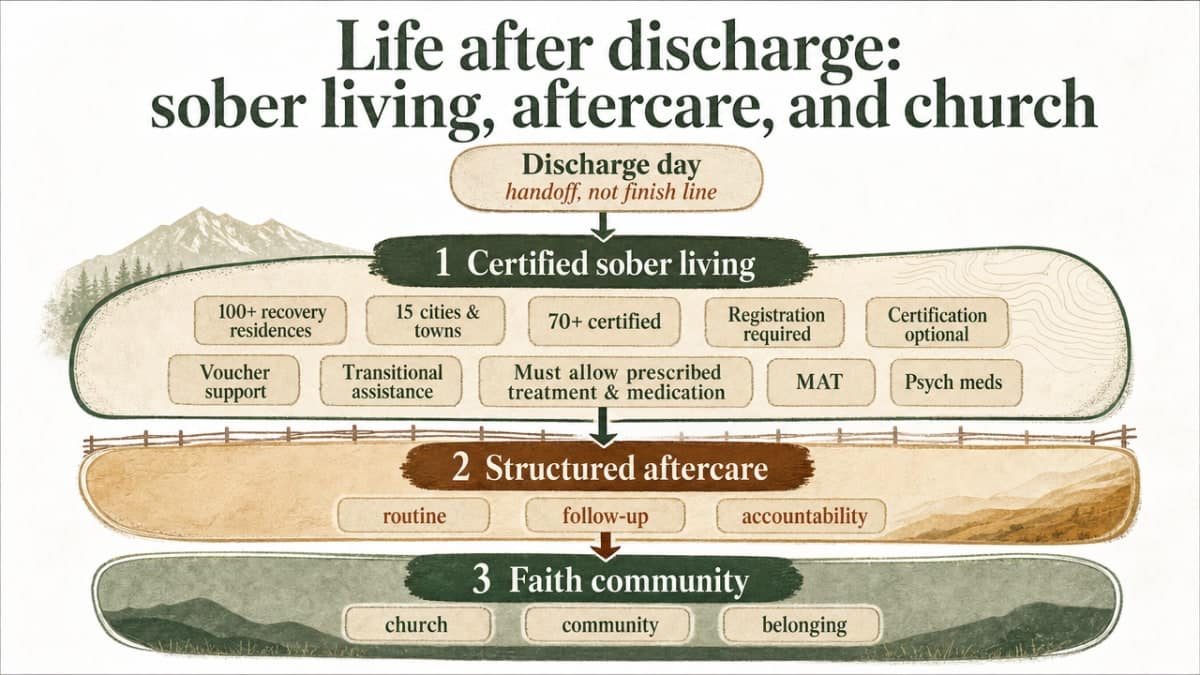
Discharge day is not the finish line. It’s the handoff. What happens in the weeks after you leave residential care usually decides whether the work sticks, and Great Falls has more pieces in place than most people realize.
Sober living is often the next step. Montana’s landscape has grown quickly since SB 94 took effect on October 1, 2023: more than 100 recovery residences were operating across 15 cities and towns, with more than 70 certified as of August 2025. Registration is required. Certification is optional, but it unlocks real things, including access to rental voucher support and transitional assistance funds. Certified residences also have to permit residents to receive prescribed treatment and medication, which matters if you’re on MAT or on psychiatric meds you cannot afford to interrupt. You can verify any home you’re considering through the state’s registry.9,11,12
Aftercare is the second layer. Montana already requires a written continuing care plan before you’re discharged, so you should leave with something concrete on paper, not vague encouragement. That might mean weekly group sessions by video, individual counseling, or check-ins at 30, 60, and 90 days. Federal recovery guidance treats these ongoing touchpoints as essential, not optional.8,13
Church, if it fits, is the third layer. A Sunday service, a small group, a men’s or women’s Bible study midweek. It’s not a replacement for clinical care, and no honest program will tell you it is. But a faith community that knows your name and expects to see you can hold weight over months and years 13.
Three layers, chosen at your pace. That’s how life after discharge actually holds.
How to vet a Great Falls program without getting oversold
You will hear a lot of warm language when you start calling around. Some of it is real. Some of it is not. A few plain questions will tell you the difference faster than a website tour.
Ask how faith participation actually works. Is Bible study optional? What happens if you skip it? If the answer is vague, or if you hear anything that sounds like a requirement dressed up as encouragement, keep looking. Then ask the clinical questions. When is the treatment plan started, and what does the continuing care plan look like before discharge? Montana requires both, so a solid program should answer without pausing. Ask how staffing works overnight; the state expects 24/7 coverage in clinically managed residential withdrawal management.7,8
Ask about medication. If you’re on MAT or psychiatric meds, you need to know you can keep taking them. Certified recovery residences are required to permit prescribed treatment and medication, and any program worth your time will say yes plainly.11
A next step that doesn’t require certainty
You do not need to know what you believe before you make the call. You do not need a favorite verse, a home church, or a clean answer to the God question. You just need a next step small enough to actually take today.
That step can be tiny. Look up the state’s Substance Use Disorder Services page and read one paragraph. Save a phone number. Tell one person in your household that you’re thinking about it. Pack a bag before you decide, just to see how it feels. Ask a program whether Bible study is optional and listen for how they answer.5
Great Falls has the pieces for this: licensed residential care with real clinical guardrails, 12-step rooms that leave the Higher Power line open, family programming that welcomes your people, and a growing recovery-housing landscape for what comes after. Rocky Mountain Treatment Center is one door among them.
Bring your faith. Bring your questions. Bring the uncertainty. All three are welcome.
Frequently Asked Questions
Will I be required to participate in Bible study or prayer if I choose a spiritual program in Great Falls?
No. In a faith-friendly Great Falls program, Bible study, prayer, and quiet reflection sit on the schedule as options, the same way equine sessions or art do. You can show up one week and skip the next. If you ask a program how participation works and the answer sounds like a soft requirement, keep looking. Your beliefs, questions, and pace stay yours.
How does the 12-step Higher Power idea work if I’m still figuring out my faith?
The steps use open language on purpose. Your Higher Power can be Jesus by name, the God you grew up praying to, the group in the room, or a question you’re not ready to answer. Nobody at a well-run meeting will define it for you. Federal recovery guidance treats faith communities and mutual-help groups as complementary layers of long-term support, not competing camps.13
Can I stay on my prescribed medications, including MAT or psychiatric meds, in a faith-friendly Montana program?
Yes, and this is a fair question to ask up front. Certified Montana recovery residences are required to permit residents to receive prescribed treatment and medication. Residential treatment programs work the same way; a good one will confirm plainly that you can continue MAT or psychiatric meds. If a program hesitates or steers you off your prescriptions, that’s a signal to look elsewhere.11
What does Montana require of a residential treatment program I’m considering?
A written treatment plan has to be started within three days of admission, and a continuing care plan has to be in place before discharge. Clinically managed residential withdrawal management facilities must keep staff on duty around the clock and follow written emergency transfer procedures. Montana law also bars misleading claims and referral kickbacks. A solid program answers these questions without pausing.7,8,10
What happens after I leave residential treatment in Great Falls?
You leave with a written continuing care plan, not vague encouragement. From there, most people layer aftercare touchpoints, a possible sober living stay, and a faith community if it fits. Montana had more than 100 recovery residences across 15 cities and towns, with more than 70 certified as of August 2025. You can verify any home through the state’s registry.8,9,12
How can my family be involved without being pressured into a specific faith?
Family therapy and family education weeks give your people a place to learn, talk, and be supported, without a script handed to them. Federal caregiver resources treat family involvement as its own layer of recovery. If your household prays together, you can pray together. If a family member is still working out what they believe, they belong in the room too. No performances required.14
References
- Great Falls District Public Transit | Montana Department of Transportation. https://www.mdt.mt.gov/publictransit/greatfalls.aspx
- Our Councils. https://greatfallsmt.gov/277/Our-Councils
- Comprehensive Planning | Great Falls, MT. https://greatfallsmt.gov/894/Comprehensive-Planning
- Government | Great Falls, MT. https://www.greatfallsmt.gov/164/Government
- Substance Use Disorder Services and Resources. https://dphhs.mt.gov/bhdd/SubstanceAbuse/
- Montana Healing and Ending Addiction through Recovery and Treatment (HEART). https://www.medicaid.gov/medicaid/section-1115-demo/demonstration-and-waiver-list/126901
- Rules for Substance use Disorder Facility. https://dphhs.mt.gov/assets/oig/Rules_for_Substance_use_Disorder_Facility.pdf
- Montana | State Residential Treatment for Behavioral Health Conditions. https://aspe.hhs.gov/sites/default/files/2021-08/StateBHCond-Montana.pdf
- Montana Recovery Residence Registry. https://dphhs.mt.gov/BHDD/MontanaRecoveryResidenceRegistry
- CHAPTER 24. ALCOHOLISM AND DRUG DEPENDENCE. https://archive.legmt.gov/bills/mca/title_0530/chapter_0240/part_0030/section_0120/0530-0240-0030-0120.html
- 46-23-1041 Rental vouchers. https://mca.legmt.gov/bills/mca/title_0460/chapter_0230/part_0100/section_0410/0460-0230-0100-0410.html
- Montana’s Recovery Residences. https://archive.legmt.gov/content/Committees/Interim/2025-2026/CJOC/Sept-2025/CJOC-SB94-Summary-2023.pdf
- Long-Term Recovery Support | Alcohol Treatment Navigator | NIAAA. https://alcoholtreatment.niaaa.nih.gov/support-through-the-process/long-term-recovery-support
- Caretaker Support Services | Alcohol Treatment Navigator. https://alcoholtreatment.niaaa.nih.gov/support-through-the-process/caretaker-support-resources
- The Neighborhood Guide. https://greatfallsmt.gov/883/The-Neighborhood-Guide