
Key Takeaways
- Idaho funds substance use treatment through IDHW-contracted providers after an eligibility screening and ASAM assessment, and the state has no separate license for adult SUD programs 9.
- Residential care removes the home environment that trained the drinking, which matters for loggers, ranchers, and trades workers whose industries normalize heavy use after shift.
- NIDA points to at least 90 days as the threshold where changes tend to stick, so 30-, 60-, and 90-day tracks let treatment teams extend based on what recovery actually requires 1.
- Idaho Medicaid points toward in-state IDHW providers, while commercial insurance opens cross-border options like Great Falls — the next step is a benefits check and a straight conversation about coverage at each length of stay.
When Outpatient Stops Holding: The Idaho Worker’s Reality
You already know how this goes. You told yourself you’d only have two after your shift on the crew, and somewhere between the truck door and the kitchen sink it turned into six. You’ve tried the outpatient thing — the once-a-week counselor in Coeur d’Alene, the group in Boise, the Zoom call you took from the cab of your F-250 outside a job site in Sandpoint. Maybe it worked for a stretch. Maybe it didn’t.
The problem isn’t you. The problem is that outpatient care sends you back to the exact life that trained you to drink in the first place.
Fire season pushes 16-hour days. Calving is round-the-clock in April. Logging camps run on diesel, coffee, and whatever’s in the cooler at the end of the week. When drinking is the culturally approved way your industry decompresses, an hour of therapy on Thursday is trying to bail out a jon boat with a shot glass.
Residential rehab flips the equation. Instead of squeezing recovery around your job, recovery becomes the job — with a bed, three meals, and a schedule someone else builds for you. NIDA is clear that medically supervised detox by itself does little to change long-term substance use, and that most people need at least three months of care to meaningfully cut back or stop 1. That’s not a sales pitch. That’s the research talking.
This guide is for the Idahoan quietly wondering if it’s time. No shame, no big-city gloss — just what residential care actually is, how Idaho’s system works, and what your options look like, including a small program across the Montana line.
What Residential Rehab Actually Is (and What It Isn’t)
24/7 Care, Room and Board, One Job to Do
Picture a bunkhouse for getting sober. That’s closer to the truth than the hospital drama you might be imagining.
Residential rehab means you live at the treatment center. You sleep there, eat there, do group there, meet with a counselor there. Staff are awake at 2 a.m. when the shakes hit or when you can’t stop thinking about the pallet of Coors in your garage. NIDA describes residential care as extended treatment lasting a few weeks to a few months, usually combining counseling, medications when needed, mutual support meetings, and a plan for what happens after you walk out 8.
The whole point is that recovery becomes your full-time job. No shift schedule. No driving past the liquor store on the way home. No spouse asking if you can grab beer on the way back.
At a place like Rocky Mountain Treatment Center in Great Falls, that looks like a 26-bed program — small enough that the counselors actually know your name and your story. Days include individual sessions, group work, 12-step meetings, family programming when you’re ready, and time outside. It’s not a spa. It’s not a lockdown, either. It’s a structured place where the only thing you have to figure out today is how to get through today sober.
Why Detox Alone Doesn’t Hold
A lot of people think if they can just get through the shakes, they’ll be fine. You white-knuckle a weekend, dump the bottles, and swear this time is different.
Monday comes. So does the craving.
NIDA is blunt about this: medically supervised detox by itself does very little to change long-term substance use. It’s a first step, not the whole staircase 1. Getting alcohol out of your system is the medical piece. Learning why you reached for it in the first place — and what to do instead when the reach comes back — is the recovery piece.
That’s why medically monitored detox at Rocky Mountain flows straight into counseling, group work, and the longer residential stay. The detox bed isn’t the destination. It’s the door.
Residential vs. PHP: It’s an Environment Question
What Your Tuesday Looks Like at Each Level
Partial hospitalization, or PHP, is what clinicians call ASAM Level 2.5. You show up to a treatment building around 9 a.m., do groups and counseling for six or so hours, and go home at night. A physician assesses you within seven days of starting 5. It’s a real step up from once-a-week outpatient. It’s also still part-time.
Residential is a different animal. ASAM breaks it into three rungs:
- 3.1 is clinically managed low-intensity, where you live on-site with lighter clinical hours.
- 3.5 is clinically managed high-intensity, with 24-hour staff supervision — someone is awake in the building all night.
- 3.7 is medically monitored intensive inpatient, meaning a physician evaluates you within 24 hours of admission because your body needs closer eyes on it 5.
So your Tuesday at PHP: alarm, coffee, drive to the clinic, groups, drive home, dinner, whatever comes next. Your Tuesday at 3.5 or 3.7 residential: wake up in the program, breakfast with the people going through it with you, groups, individual counseling, a meeting, time outside, lights out. Same day. Very different exposure.
Rocky Mountain Treatment Center’s medically monitored detox lines up with that 24-hour physician-evaluation standard, then flows into the residential program’s structured days. You don’t have to guess what to do at 6 p.m. Someone already built that hour for you.
When Home Is Where the Bottle Lives
Here’s the honest question PHP asks you to answer: can you go home every night and not drink?
For a lot of Idahoans, home isn’t neutral ground. Home is the fridge where the beer lives. Home is the shop with a bottle behind the toolbox. Home is a spouse who drinks too, or a bunkhouse full of guys who’ll razz you for ordering a Coke. Home might just be quiet — and quiet is what you’ve been drinking at for years.
PHP can work when the house is stable, someone sober is around, and the triggers aren’t stacked at the door. When those things aren’t true, sending yourself home at 4 p.m. is asking a lot of the same willpower that got you here.
How Idaho’s System Actually Works
IDHW, ASAM Screening, and Contracted Providers
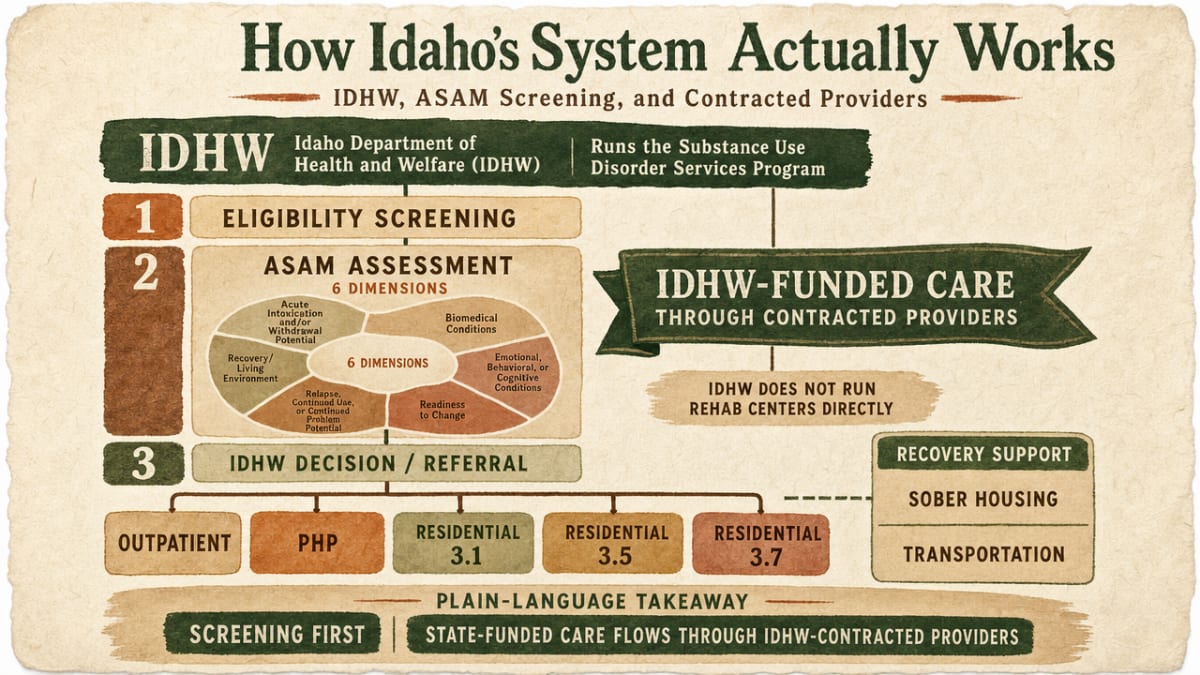
Idaho doesn’t run rehab centers directly. The Idaho Department of Health and Welfare (IDHW) runs the Substance Use Disorder Services Program, which pays for care through a network of contracted providers around the state — outpatient, residential, and recovery support like sober housing and transportation 4.
To get into that funded pipeline, you start with an eligibility screening. If you qualify, a clinician does a full assessment using ASAM criteria — the same six-dimension framework used nationally to figure out how much support you actually need 9. That’s what decides whether you’re pointed toward outpatient, PHP, or one of the residential rungs (3.1, 3.5, or 3.7) covered earlier 5.
What this means in plain terms: you don’t just call a rehab and check in on the state’s dime. There’s a screening door. If you’re using private insurance or paying another way, you can go directly to a provider — including one outside Idaho.
Rocky Mountain Treatment Center works with most major insurance plans but does not currently accept Medicaid or Medicare. If you’re on Idaho Medicaid, an IDHW-contracted in-state provider is usually the practical path. If you have commercial insurance through your employer — timber outfit, ranch, trades, mining — a program across the Montana line is on the table.
The Licensure Quirk Most Articles Skip
Here’s something most rehab websites won’t tell you: Idaho doesn’t have a separate state license for adult substance use disorder programs. The HHS ASPE report on Idaho’s system spells it out — for adult SUD services, “there are no licensure, certification, or approval requirements” at the state level. Quality is instead handled through IDHW contracts, ASAM-guided screening, and staff credential rules 9.
That’s not a scandal. It’s just a thing to know when you’re comparing options.
What it means practically: when there’s no state license doing the vetting, third-party accreditation carries more weight. That’s why Joint Commission accreditation matters — it’s a national body that audits programs on safety, clinical practice, and patient rights. Rocky Mountain Treatment Center is Joint Commission accredited, which gives you an outside-the-brochure way to check that a program is running the way it says it is.
Ask any program — in Idaho or out — who accredits them, what ASAM level they treat, and who their medical director is. Straight answers are a good sign.
How Long Is Long Enough: 30, 60, or 90 Days
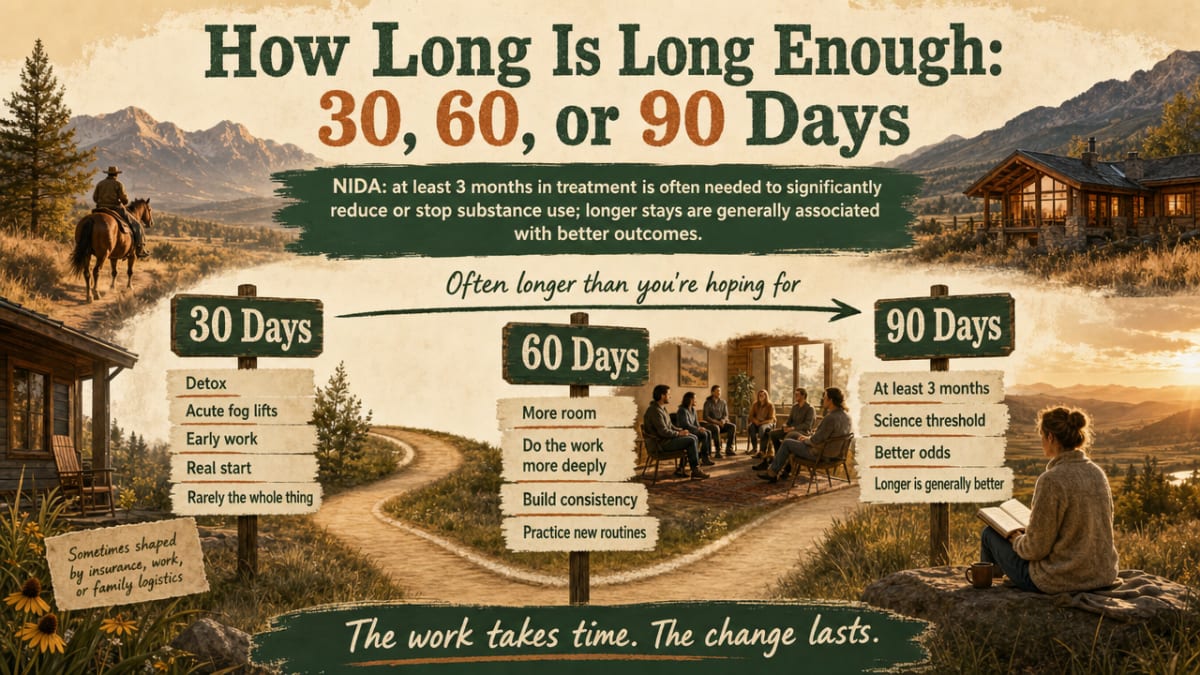
Most programs offer three doors: 30 days, 60 days, or 90 days. The honest answer to which one you need is usually longer than the one you’re hoping for.
NIDA’s research is pretty clear on this. Most people who are addicted need at least three months in treatment to significantly reduce or stop their substance use, and staying longer is generally associated with better outcomes 1. That’s not a marketing number. That’s what the science keeps landing on across decades of studies.
So why does 30 days even exist? Because for some people it’s what insurance will cover, what a job will allow, or what family logistics can absorb. Thirty days gets you through detox, through the acute fog, and into the early work of figuring out what you’re going to do differently. It’s a real start. It’s rarely the whole thing.
Sixty days gives you room to do the harder counseling — the stuff about why you drank, not just that you did. Ninety days lines up with what NIDA points to as the threshold where changes tend to stick 1. NIDA also describes residential care as extended treatment lasting a few weeks to a few months, combined with counseling, medications when needed, mutual support meetings, and a real discharge plan 8.
Rocky Mountain Treatment Center runs 30-, 60-, and 90-day residential tracks so you don’t have to pick a length before you know what your body and head actually need. A lot of people start with 30 and extend once they feel what the work is really asking of them. That’s not failing at 30 days. That’s your treatment team reading the room and telling you the truth.
Horses, Hiking, and the Evidence Behind Them
What Equine Work Does Well
You might roll your eyes at the idea of a horse fixing your drinking. Fair. A horse isn’t going to fix your drinking.
What a horse can do is hold up a mirror. A 1,200-pound animal reads your body language before you’ve said a word. If you walk into the arena tense, jaw locked, still buzzing from whatever you were chewing on that morning, the horse tells you — by planting its feet, by drifting away, by refusing the ask. You can’t sweet-talk your way out of it. You have to actually slow your breathing, drop your shoulders, and try again. For a guy who’s spent twenty years muscling through problems, that’s a new skill.
The research is starting to catch up to what people who’ve done the work already know. A 2023 study of adults with substance use disorders found that equine-assisted therapy produced statistically significant improvements in emotion regulation, self-efficacy, and self-esteem compared to a control group 7. A 2015 prospective study of young adults in residential treatment found that horse-assisted therapy participants were more likely to stay in treatment longer and more likely to make it to the 90-day mark than those in standard care 6.
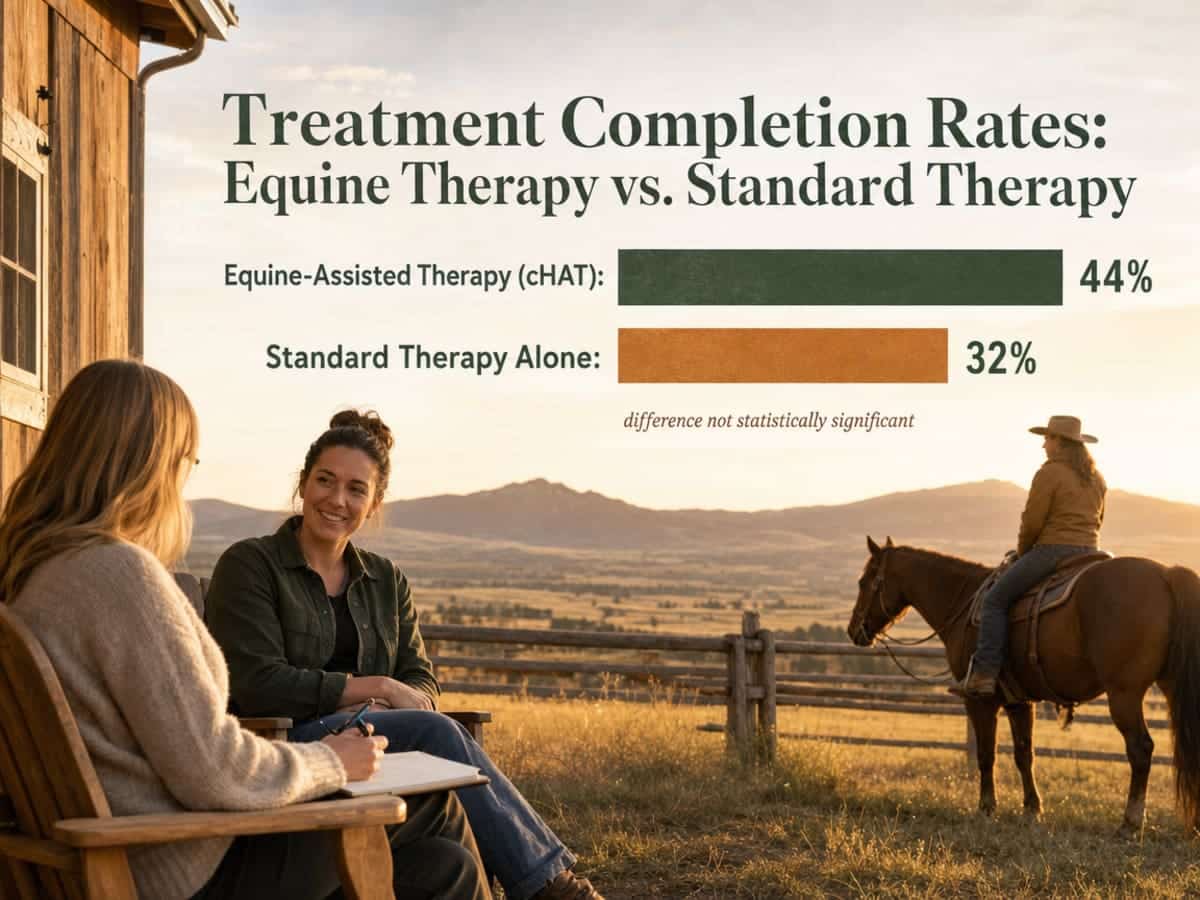
A 2020 randomized controlled trial put numbers on the completion piece: 44% of the horse-assisted group finished treatment compared to 32% of the group getting standard therapy alone 3. That’s the kind of gap that gets your attention. It’s also why Rocky Mountain Treatment Center works horses into its residential program alongside the counseling, group work, and 12-step meetings that do the heavier clinical lifting.
Where the Evidence Is Still Thin
Here’s the part most rehab websites won’t tell you: that 44% vs. 32% gap in the 2020 trial wasn’t statistically significant 3. Meaning the researchers can’t rule out that the difference was chance. Encouraging, worth watching, not proof.
A 2022 scoping review looked across the equine-assisted services literature and landed on “inconclusive” — the studies are few, the methods are mixed, and the field needs better trials before anyone can claim horses reliably move the needle on substance use outcomes 2. An earlier systematic review called the results “promising” but flagged the same need for more rigorous controlled studies 10.
So the honest read: equine work is a good adjunct. It helps people engage, opens doors that a folding chair in a group room doesn’t, and appears to build the emotional muscle you’ll need after discharge. It is not a substitute for counseling, medically monitored detox, or the 12-step community you’ll lean on at 11 p.m. on a Saturday six months from now. At Rocky Mountain, the horses are part of the work — not the whole of it.
The Cross-Border Option: A Montana Program That Feels Like Idaho
Great Falls Is a Drive, Not a Flight
When people hear “out-of-state rehab,” they picture a plane ticket to Malibu and a monthly bill that would buy a used skidder. That’s not what this is.
Great Falls, Montana sits a day’s drive from most of Idaho. From Coeur d’Alene or Sandpoint you’re crossing into familiar country — pine, ranchland, small towns where the diner still knows your order. From Boise or Idaho Falls it’s a longer haul, but it’s a haul, not a flight. Rocky Mountain Treatment Center offers complimentary pickup from within Montana, so once you’re across the line, someone meets you.
The program itself is small on purpose. Twenty-six beds. Medically monitored detox that follows the same clock ASAM uses for 3.7 care — a physician evaluates you within 24 hours of admission 5. Joint Commission accredited, which does some of the quality-checking that Idaho’s system leaves to accreditation and contracts. Residential tracks run 30, 60, or 90 days so you can settle in for what the work actually asks of you.
It’s a mountain-town program run for people who live in mountain towns. That matters when the alternative feels like checking into a hotel in a city you’ve never wanted to visit.
Staff Who’ve Been Where You Are
Here’s the thing about talking to a counselor who’s never been drunk in their life: they can be good at their job, and there’s still a gap. They read about the shakes. You’ve had them.
At Rocky Mountain, more than 80% of the staff are in recovery themselves. That’s not a talking point — that’s who’s sitting across from you in the individual session, who’s leading the group, who’s walking down the hallway at 6 a.m. when you can’t sleep because your kid’s birthday is Saturday and you don’t know how to be at it sober.
For an Idaho logger, rancher, or trades worker, that ratio changes the room. Nobody is theorizing about what it’s like to worry your crew will look at you different. Somebody in that building already had that phone call with their foreman. They know how it landed. They can tell you what came after.
Family Week and What Happens After Discharge
Getting sober alone is hard. Coming home sober to people who don’t understand what changed in you is harder.
Rocky Mountain runs a three-day Family Week — your spouse, your parents, whoever’s in your corner comes in and does the education and counseling piece alongside you. They learn what happened to your brain. You learn what your drinking did to their nervous system. Some of what gets said is uncomfortable. Most of it needed to be said years ago.
Discharge day isn’t the finish line, either. Aftercare includes weekly Zoom groups and structured check-ins at 30, 60, 90, 180, and 365 days out. That matters because NIDA is clear that recovery is a longer arc than one residential stay — extended care and a real discharge plan are part of what makes residential work stick 8.
So when you drive back across the line into Idaho, you’re not driving back alone. There’s a group meeting on your calendar Thursday. Somebody’s calling at 30 days to see how the first month home actually went. That’s the shape of a program that expects you to have a life after this — and plans for it.
Paying for It Without Getting Played
The money question is the one that keeps a lot of Idahoans from picking up the phone. Fair enough. Rehab isn’t cheap, and the industry has earned some of its reputation for opaque billing.
Here’s the short version. If you’re on Idaho Medicaid, your practical path is an IDHW-contracted in-state provider — the state’s Substance Use Disorder Services Program pays for outpatient and residential care through that network after an eligibility screening and ASAM assessment 4. Rocky Mountain Treatment Center does not currently accept Medicaid or Medicare, so that route points you toward Idaho programs.
If you have commercial insurance through your employer — the timber outfit, the ranch payroll, the union card, the trades benefits package — a lot more doors open. Rocky Mountain works with most major insurance plans and can run your benefits before you commit to a length of stay.
Questions to ask any program before you sign anything:
- What does my insurance actually cover for detox and residential?
- What’s my out-of-pocket at 30, 60, and 90 days?
- What happens if my treatment team recommends I extend?
Any program that dodges those questions is telling you something. Straight answers up front are how you avoid the surprise bill later.
Telling Your Crew Boss, Your Spouse, and Yourself
The clinical stuff is the easy part. The hard part is three conversations.
The crew boss call is short. You don’t owe a life story. “I need to take care of a medical thing. I’ll be out 30 days. I’ll let you know when I’m back.” Most foremen have watched a good hand disappear the slow way. They’d rather lose you for a month than for good.
The spouse conversation is longer, and usually overdue. Say the thing out loud. That you know it’s been bad. That you’re going somewhere it can’t follow you home at night. Family Week means they’ll be part of what comes next, not left guessing on the porch.
The one with yourself is the quietest. It sounds like: this isn’t working, and pretending it is costs more than 30 days.
You don’t have to have the whole plan today. You just have to make the call. Someone on the other end has already had every version of your morning, and they’ll pick up.
Frequently Asked Questions
How do I know if I need residential rehab instead of outpatient or PHP?
Ask yourself one question: can you go home tonight and not drink? If home is where the bottle lives, the crew drinks after shift, or you’re isolated for weeks at a stretch, outpatient and PHP are asking a lot of the same willpower that got you here. Residential removes the variable by keeping you out of that environment while you do the work 1.
How long should I plan to stay — 30, 60, or 90 days?
NIDA’s research points to at least three months as the threshold where changes tend to stick, with longer stays generally linked to better outcomes 1. Thirty days is a real start and sometimes what work or insurance allows. If your team recommends extending, that’s not failure — it’s them reading what your recovery actually needs.
Can I go to a rehab in Montana if I live in Idaho?
Yes. If you have commercial insurance through your employer, an out-of-state program like Rocky Mountain Treatment Center in Great Falls is on the table — it’s a drive, not a flight. If you’re on Idaho Medicaid, your practical path stays in-state through IDHW-contracted providers, since Rocky Mountain does not currently accept Medicaid or Medicare 4.
Does Idaho license adult substance use disorder programs?
No — and this catches families off guard. The HHS ASPE report on Idaho notes that for adult SUD services, there are no separate licensure, certification, or approval requirements at the state level 9. Quality gets handled through IDHW contracts, ASAM-guided screening, and third-party accreditation like the Joint Commission. Ask any program who accredits them.
Does equine therapy actually work, or is it just a nice extra?
It’s a promising adjunct, not a stand-alone cure. A 2023 study showed statistically significant gains in emotion regulation, self-efficacy, and self-esteem 7, and a 2015 study linked horse-assisted therapy to longer stays and better 90-day retention 6. A 2022 scoping review still calls the broader evidence base inconclusive 2. The counseling does the heavy lifting.
What if I can’t afford to take 30 days off work?
It’s a real question, and the honest answer is that most foremen would rather lose a good hand for a month than for good. FMLA may protect your job. Insurance often covers more than you think. And NIDA is direct that detox alone doesn’t hold — a shorter stay you can actually complete beats a longer plan you never start 1.
References
- Principles of Drug Addiction Treatment: A Research-Based Guide (Third Edition). https://nida.nih.gov/sites/default/files/podat_3rdEd-508.pdf
- Equine-assisted services for individuals with substance use disorders: A scoping review. https://pmc.ncbi.nlm.nih.gov/articles/PMC9749232/
- Complementary horse-assisted therapy for substance use disorders: a randomized controlled trial. https://pmc.ncbi.nlm.nih.gov/articles/PMC7001193/
- About Substance Use Disorder | Idaho Department of Health and Welfare. https://healthandwelfare.idaho.gov/services-programs/behavioral-health/about-substance-use-disorder
- Clinical Resources in Idaho for Substance Use Disorder. https://cme.shamp.uidaho.edu/sites/default/files/media/2025-07/Clinical%20Resources%20in%20Idaho%20for%20Substance%20Use%20Disorder_0.pdf
- Substance use disorder treatment retention and completion: a prospective study of horse-assisted therapy for young adults. https://pmc.ncbi.nlm.nih.gov/articles/PMC4672500/
- Equine-assisted therapy effectiveness in improving emotion regulation, self-efficacy and self-esteem in patients with substance use disorders. https://pmc.ncbi.nlm.nih.gov/articles/PMC10576391/
- Treatment – National Institute on Drug Abuse (NIDA) – NIH. https://nida.nih.gov/research-topics/treatment
- State Residential Treatment for Behavioral Health Conditions: Idaho. https://aspe.hhs.gov/sites/default/files/2021-08/StateBHCond-Idaho.pdf
- Equine-assisted activities and therapies in counseling and psychotherapy: A systematic review. https://pubmed.ncbi.nlm.nih.gov/26273763/