
Key Takeaways
- Residential treatment is a graded ladder of ASAM sublevels (3.1, 3.3, 3.5, 3.7) that differ by medical oversight, weekly clinical hours, and typical length of stay 1.
- Level 3.5 is the standard adult rehab most families picture, delivering at least 20 hours of weekly psychotherapy, while 3.7 adds 24-hour nursing for detox and complex cases 15.
- Length of stay isn’t fixed by the brochure — 30, 60, or 90 days is set by ongoing assessment based on substance history, co-occurring conditions, and the stability of the home environment 4.
- Continuing care after discharge — structured outpatient step-down, peer support, and scheduled check-ins — is what actually protects the gains made inside residential, not time in the facility alone 10.
Translating Clinical Labels Into a Decision You Can Actually Make
If you’re reading this, you’ve probably already spent months, maybe years, trying to figure out what to do about your adult child’s drinking or drug use. You’ve heard terms like “inpatient,” “residential,” “ASAM Level 3.5,” “therapeutic community,” and “medically monitored detox” thrown around by intake coordinators, insurance reps, and other parents in support groups. None of it tells you what you actually want to know: what will daily life look like, how long will your child be there, and will you be shut out or invited in?
Here’s the honest version. Residential treatment isn’t one thing. It’s a graded ladder of programs that differ by how much medical oversight is on-site, how many hours of counseling happen each week, and how long people typically stay 1. Federal guidance describes residential care as living at a facility while getting intensive daytime services, usually for a few weeks to a few months, with longer stays for more complex situations 12.
The rest of this article translates each rung of that ladder into plain English, walks you through how length of stay actually gets decided, and shows you where family programming and continuing care fit in. You’re not being asked to become a clinician. You’re being asked to make one care decision for someone you love, and that decision gets easier when the labels stop being a wall.
What ‘Residential’ Actually Means When Your Adult Child Lives There
When people say “residential,” they usually mean the same core arrangement: your adult child lives at the treatment facility, sleeps there, eats there, and spends most of the day in structured therapy and support activities 13. The building is staffed around the clock. There’s a schedule taped to the wall. There are counselors on-site, peers in the same program, and enough distance from the outside world that the pull of old routines quiets down for a while 1.
That’s the shared piece across every residential program you’ll come across. What changes from one program to another is the intensity of the clinical work, the level of medical oversight on staff, and how long a typical stay lasts. Federal guidance puts the common range at a few weeks to a few months, with residential care for substance use most often falling in the 30 to 90 day window 12, 13.
It helps to know what residential is not. It’s not a locked psychiatric hospital. It’s not detox alone, though detox often happens on-site before residential treatment begins. It’s not outpatient counseling with a bed attached. And it’s not a permanent placement. Residential is a defined stage of care with a beginning, a middle, and a planned handoff to whatever comes next.
Length of stay isn’t a fixed calendar sentence, either. Reputable programs adjust it based on ongoing assessments of how your adult child is actually doing, not just how many days have passed on the intake paperwork 4.
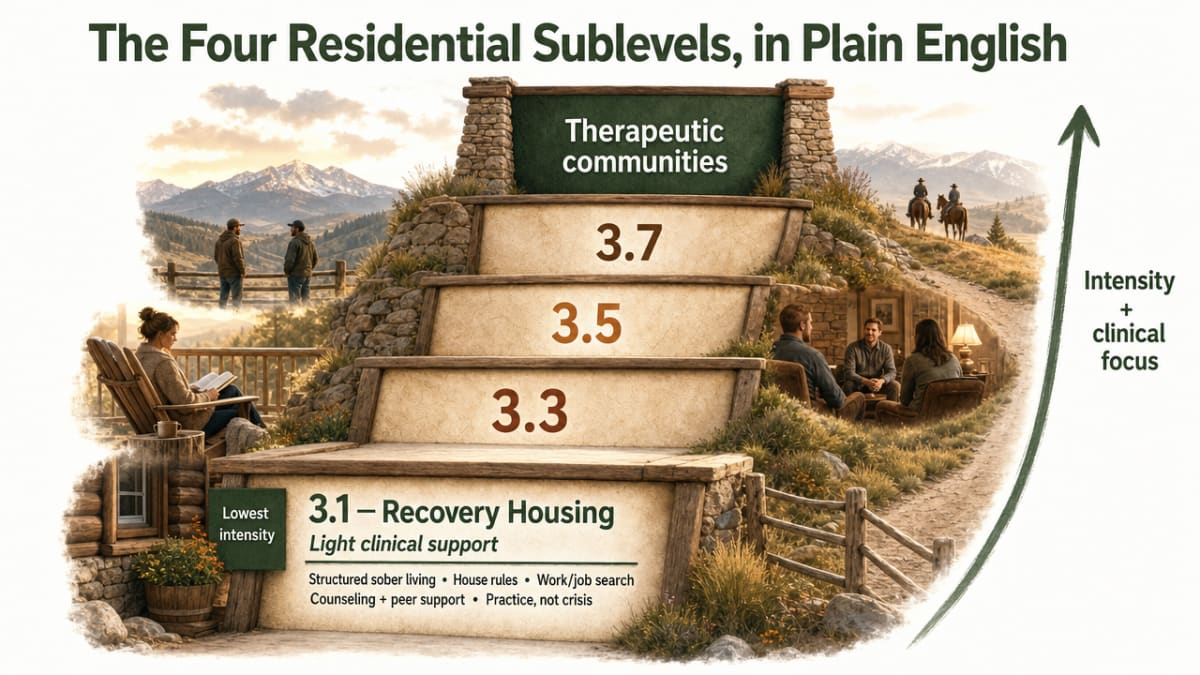
The Four Residential Sublevels, in Plain English
Level 3.1: Recovery Housing With Light Clinical Support
Level 3.1 is the lowest-intensity rung on the residential ladder. In plain terms, it’s a structured sober living environment — sometimes called a halfway house or recovery house — where your adult child lives with other people in recovery and gets some clinical support during the week, but not the full-day, therapist-heavy schedule you might picture when you hear the word “rehab” 3.
The point of 3.1 isn’t crisis stabilization. It’s practice. Your adult child sleeps in a supervised setting, follows house rules, holds down responsibilities like work or job search, and stays connected to counseling and peer support. Federal guidance describes it as a safe, stable place to build recovery skills and prevent relapse 4.
This level fits people who already have some sobriety under their belt and mainly need protected housing plus light structure — usually after finishing a more intensive residential program, not instead of one.
Level 3.3: Long-Term Residential for Cognitive or Functional Impairment
Level 3.3 is a longer-term residential setting with medium-intensity treatment, built for adults whose thinking, memory, or ability to function day-to-day has been affected by long-standing substance use or other cognitive issues 3. The pace is slower on purpose. Groups move more gradually, material gets repeated, and staff give people time to actually absorb what’s being taught.
If your adult child has years of heavy drinking behind them, a traumatic brain injury, or persistent cognitive fog that makes standard fast-paced group therapy hard to follow, 3.3 exists for exactly that situation. Stays here are typically longer than the standard 30-to-90-day window, because the goal is rebuilding basic functioning alongside recovery skills.
Most adults don’t need this level. But if you’ve watched your child struggle to keep up in a prior rehab, this is the sublevel that was designed with them in mind.
Level 3.5: Clinically Managed High-Intensity Residential (The Common Adult Rehab)
If you’ve pictured a residential program in your head — your adult child living at a facility for 30, 60, or 90 days, spending most of the day in individual and group counseling, with peers going through the same thing — you’ve been picturing Level 3.5. It’s the workhorse of adult addiction treatment, and it’s what most people mean when they say “rehab” 2.
The building is staffed 24/7 by trained counselors. The clinical bar is real: under the ASAM criteria, a Level 3.5 program is expected to deliver at least 20 hours per week of clinical services, with a strong focus on psychotherapy — meaning individual sessions, group work, family involvement, and skills-building make up the bulk of the schedule 15. Lower-intensity 3.1 recovery housing doesn’t come close to that clinical volume, and Level 3.7 shifts more of the weekly hours toward medical and nursing care 15.
What Level 3.5 is for: stabilizing someone who is in real, present danger from their substance use, getting them out of the environment that’s been feeding it, and preparing them to step down to outpatient care with actual skills in place 2. It’s designed for people whose addiction is moderate to severe but who don’t need a hospital-level medical team on-site around the clock.
The 30/60/90-day residential programs you’ll see advertised across the country almost all sit inside Level 3.5. That’s the level where the balance of clinical intensity, family programming, and length of stay tends to give the best return on the enormous emotional and financial investment you’re about to make.
Level 3.7: Medically Monitored Inpatient for Detox and Complex Cases
Level 3.7 is where medicine takes the wheel. It’s still residential — your adult child lives at the facility — but the staffing is different. There’s 24-hour nursing on-site and a physician available for the significant medical or psychiatric problems that can come with heavy substance use 2. Treatment planning at this level is led by medical staff, with more focus on withdrawal management and biomedical care 15.
This is the level that handles medically monitored detox and the first days of stabilization for people coming off alcohol, benzodiazepines, or opioids, when the body’s reaction to stopping can be genuinely dangerous. It’s also where someone with a serious co-occurring health condition, a complicated psychiatric picture, or a history of severe withdrawal starts their stay.
Here’s a practical note: the same building often delivers both 3.7 and 3.5. Many programs move your adult child from medically monitored detox at 3.7 into clinically managed high-intensity residential at 3.5 as the acute medical risk drops 16. You may not see a change of address, but the level of care around them shifts as their body stabilizes.
Therapeutic Communities: The Long-Stay End of the Spectrum
Therapeutic communities are the far end of the residential ladder — long-term programs where residents live in a highly structured environment for many months, sometimes a year or more, working on substance use alongside the social, vocational, and legal wreckage that often comes with it 5. They’re intensive, community-driven, and unmistakably a bigger commitment than a 30-to-90-day stay.
The research on them is real but mixed. Analyses of therapeutic communities have found that a year or more of participation is linked to reduced heroin use, less criminal involvement, and higher employment — meaningful gains for people whose lives have unraveled hard 11. At the same time, the same body of work notes low completion rates for extended residential programs and higher per-diem costs than outpatient medication-based treatment 11.
For most adults with a moderate-to-severe alcohol or drug problem, a therapeutic community isn’t the first move. It’s usually considered when previous shorter stays haven’t held, when there’s significant criminal justice involvement, or when the environment your child would return to is genuinely unsafe.
30, 60, or 90 Days: How Length of Stay Is Actually Decided
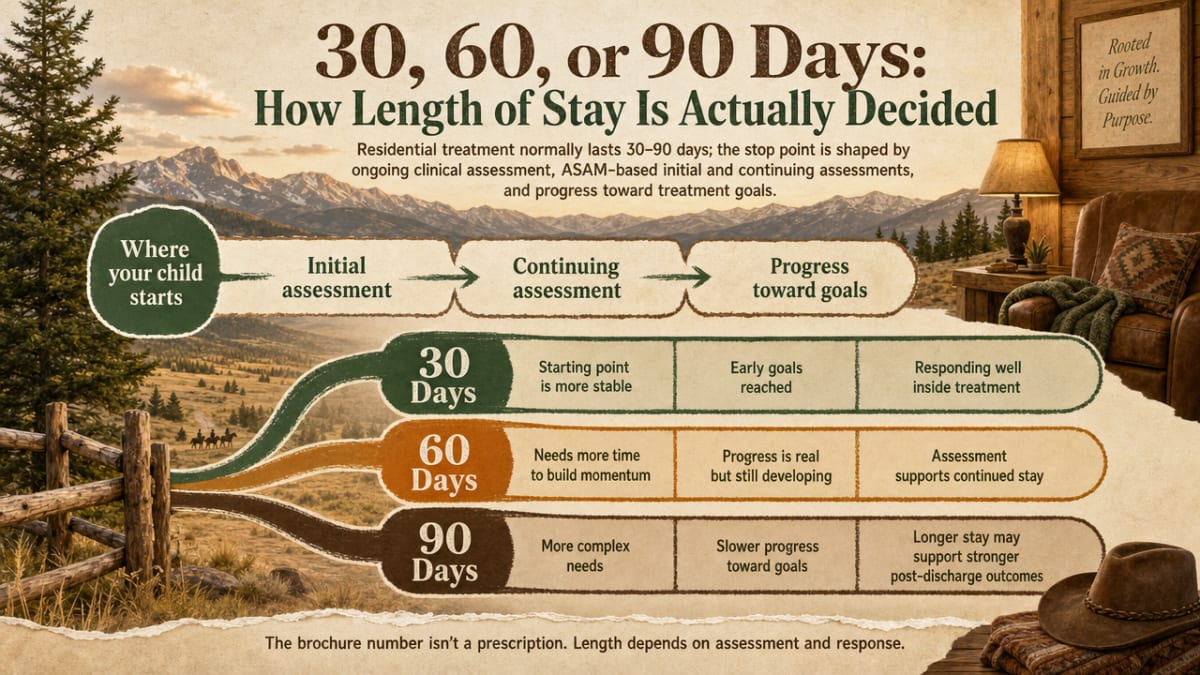
The 30, 60, or 90 number on a program brochure isn’t a prescription. Federal guidance describes residential treatment as normally lasting 30 to 90 days, with the specific stop point driven by ongoing clinical assessment rather than the calendar 13. State fact sheets say the same thing more directly: length of stay depends on initial and continuing assessments against ASAM criteria and how your adult child is actually progressing toward treatment goals 4.
That means the honest answer to “how long?” is: it depends on where your child starts and how they respond once they’re inside.
Here’s what the research suggests when you’re weighing the three common options. A longitudinal study of women in residential drug treatment found that staying at least 90 days was associated with lower substance use six months after discharge, compared with shorter stays 9. It’s one study, in one population, at one follow-up point — but the 90-day threshold shows up often enough in the literature that clinicians take it seriously as a planning target.
Practically, here’s how the three lengths tend to fit:
- 30-day stay
- Often enough for someone with a shorter substance use history, a stable home to return to, strong outpatient care lined up, and no serious co-occurring mental health issues. It’s the minimum runway for real clinical work after detox is done.
- 60-day stay
- Makes more sense when your adult child has relapsed after a prior 30-day program, when there’s a co-occurring anxiety or depression picture that needs more time to stabilize, or when the home environment needs work before they walk back into it.
- 90-day stay
- The strongest fit when the substance use is severe, when previous shorter treatment hasn’t held, or when there’s significant work to do on trauma, medication management, and rebuilding daily structure before stepping down.
Reputable programs revisit the plan as your child progresses. A 30-day admission can be extended. A 90-day plan can be shortened if the work gets done faster. The number on the door is a starting frame, not a verdict.
Inside a Typical Week: Therapy, Structure, and Daily Rhythm
One of the questions parents ask most often is the simplest one: what does my adult child actually do all day in there? The honest answer is that the days are full, and on purpose. A clinically managed high-intensity residential program is expected to deliver at least 20 hours per week of clinical services, with a strong focus on psychotherapy — individual sessions, group work, and skills-building 15. That’s roughly three to four hours of real therapy every weekday, on top of everything else.
A typical weekday starts early. Mornings usually open with breakfast, a check-in group, and a chance for staff to see how everyone is doing. From there, the day moves through a mix of individual counseling, process groups, education sessions on how addiction affects the brain and body, and skills groups focused on things like managing cravings, handling difficult emotions, and rebuilding relationships 1.
Afternoons often bring the parts of treatment that don’t happen sitting in a chair. Depending on the program, that can include experiential work like equine therapy, recreational activities, time outdoors, or hands-on projects. These aren’t filler. Structured routines and evidence-based therapies delivered inside a predictable schedule are among the factors most linked to better residential outcomes 17.
Evenings tend to wind down with 12-step meetings, peer support time, journaling, or reflection. Weekends stay structured but breathe a little more. The rhythm itself is doing work — your adult child’s nervous system gets a chance to remember what regular sleep, regular meals, and a day without chaos feels like.
Family Week and Ongoing Family Programming
You are not a spectator in this. You may have been told, gently or otherwise, that addiction is your adult child’s problem to solve. That framing doesn’t hold up against the evidence. SAMHSA’s guidance for clinicians is direct: including family members in a client’s treatment is beneficial and makes achieving and sustaining long-term recovery more likely 7. Family engagement isn’t a nice extra tacked onto the schedule. It’s a strengths-based strategy that can improve treatment engagement and long-term recovery in its own right 6.
In most residential programs built around this evidence, family involvement takes two shapes. The first is a concentrated block of time, often called a family week or family program, where you come to the facility for two to five days of education, group work with other families, and joint sessions with your adult child and their counselor. You learn how substance use rewires the brain. You get honest language for the patterns you’ve been living inside — enabling, walking on eggshells, the sudden calls at 2 a.m. You practice hard conversations in a room where a therapist can catch what’s actually happening.
The second shape is ongoing. Family therapy sessions continue through the stay, often by phone or video if you can’t travel, and family education keeps going after discharge. NIDA notes that family therapy helps both the person with the substance use problem and the family address influences on use patterns and improve overall functioning 8.
Here’s what to look for when you ask a program about family involvement:
- Is there a structured, protected block of family programming, or is “family involvement” mentioned only in the brochure?
- Are joint sessions scheduled, or left to chance?
- Is there support for you as a parent — not just information about your adult child?
Programs that treat you as part of the recovery community are the ones matching the evidence.
What Happens After Discharge: Continuing Care Is the Point
Here’s the part most brochures skip. The residential stay isn’t the finish line. It’s the part where your adult child gets stable enough to do the actual long work of recovery, which happens after they walk out the door. A review of continuing care models makes this plain: ongoing outpatient engagement and structured support after residential treatment are what protect the gains made inside 10. Time in a facility isn’t the active ingredient by itself.
That reframes what you should be asking a program about. Not just “how long is the stay?” but “what happens on day 31, day 61, day 91 — and day 180?”
Good continuing care usually has a few pieces that fit together:
- There’s a written discharge plan that names specific outpatient counselors, support meetings, and medical follow-up your adult child is expected to keep.
- There’s a step-down in intensity, often into intensive outpatient or standard outpatient care, so the drop from 24/7 structure to regular life isn’t a cliff.
- There are ongoing peer connections — 12-step meetings, alumni groups, sober community — because isolation is where relapse tends to find people.
- And there’s scheduled contact from the residential program itself, often at 30, 60, 90, 180, and 365 days after discharge, so someone is actually checking in on how things are going.
Video-based groups have made this easier than it used to be. If your adult child comes home to a town without much of a recovery community, weekly Zoom groups run by their former counselors can keep the residential relationships alive while local outpatient care gets established. That matters, because the counselor who sat with them at week three of detox is often the person they’ll answer honestly when things get hard at month four.
Ask the program directly: what does the first year after discharge look like, and who is responsible for staying in touch? A vague answer is a warning. A specific one — with names, cadences, and a plan for what happens if your adult child slips — is what the evidence says actually works 10.
Matching the Right Level to Your Adult Child’s Situation
Here’s the shorthand, stripped of clinical labels. If your adult child is coming off alcohol, benzodiazepines, or opioids and hasn’t been medically cleared, they start at medically monitored inpatient (Level 3.7) for detox, then step down to clinically managed high-intensity residential (Level 3.5) once their body stabilizes 16. That’s the pathway most adults with moderate-to-severe addiction follow, and the same facility often delivers both pieces without a change of address 16.
If detox is already done — or wasn’t medically necessary — and the addiction is moderate to severe, clinically managed high-intensity residential is where the real work happens. A 30-day stay fits when the substance use history is shorter and outpatient care is lined up. A 60- or 90-day stay fits when a prior program didn’t hold, when there’s co-occurring depression or anxiety, or when returning home too soon means returning to the same pull 4.
If your adult child has cognitive impairment from long-term use or a brain injury, the slower pace of long-term residential (Level 3.3) is the better match 3. If they’ve completed a high-intensity stay and mostly need a protected place to practice recovery while working, recovery housing (Level 3.1) is the step-down 3. Therapeutic communities enter the picture when shorter stays haven’t held or the home environment is genuinely unsafe 5.
Trust the assessment. A good intake team will tell you which level fits, and adjust as your child progresses 4.
Frequently Asked Questions
What’s the difference between residential treatment and inpatient rehab?
In everyday use, people mean the same thing. Both describe living at a treatment facility with 24-hour staffing and intensive daytime services 13. Clinically, “inpatient” sometimes points to the medically monitored end (ASAM Level 3.7), where 24-hour nursing and physician availability handle detox and complex medical needs, while “residential” often refers to Level 3.5, where the focus is counseling rather than medicine 2.
How do I know if my adult child needs 30, 60, or 90 days?
You won’t know from the outside, and that’s okay. The length is set by an assessment at intake and adjusted as your child progresses, not by a calendar rule 4. A shorter history with strong outpatient support lined up may fit a 30-day stay. A prior relapse, co-occurring depression or anxiety, or an unstable home usually points toward 60 or 90 days. Trust the assessment, and ask the program how they decide when to extend.
Does insurance usually cover residential treatment?
Most major commercial insurance plans cover residential treatment at Levels 3.5 and 3.7 when the ASAM assessment supports it, though coverage details, prior authorization requirements, and length-of-stay approvals vary by plan 2. Not every facility accepts every payer, and some do not accept Medicaid or Medicare. Call the admissions team, share your insurance card, and ask for a benefits check in writing before you commit.
Can my adult child be forced into residential treatment, or do they have to agree?
For most adults, treatment is voluntary. Your child has to agree to admission and can leave against medical advice. A handful of states allow limited involuntary commitment for substance use when there’s imminent danger, but the rules are narrow and vary. What usually moves things is a structured family conversation, sometimes with a counselor or interventionist, that makes the choice to go feel possible rather than cornered.
What happens if my adult child relapses after leaving residential treatment?
Relapse doesn’t erase what happened inside the program, and it doesn’t mean treatment failed. It means the plan needs adjusting. Research on continuing care makes clear that recovery gains are protected by ongoing outpatient engagement and structured support after discharge, not by the residential stay alone 10. Call the program. A good one will help you figure out whether more outpatient care, a return to residential, or a different level fits.
How involved will I be as a parent during residential treatment?
More than you might expect, if you choose a program built around family engagement. SAMHSA’s guidance frames family involvement as beneficial and associated with better long-term recovery 7. In practice, that usually looks like a dedicated family week, joint counseling sessions with your adult child, family education, and continued contact through discharge planning and follow-ups. Ask directly what’s scheduled and what’s optional.
References
- Overview of Substance Use Disorder Care Clinical Guidelines for the States. https://www.medicaid.gov/state-resource-center/innovation-accelerator-program/iap-downloads/reducing-substance-use-disorders/asam-resource-guide.pdf
- The ASAM Criteria® (AHCCCS Brochure). https://www.azahcccs.gov/PlansProviders/Downloads/CurrentProviders/ASAMCriteriaBrochure.pdf
- Levels of Care – Definitions (Maryland Department of Health). https://health.maryland.gov/dca/Documents/ADAADefinition4411b.pdf
- Substance use disorder outpatient treatment and residential services (Washington HCA Fact Sheet). https://www.hca.wa.gov/assets/program/fact-sheet-sud-residential-outpatient-treatment.pdf
- Addiction Treatment | National Institute on Drug Abuse (NIDA). https://nida.nih.gov/nidamed-medical-health-professionals/treatment/addiction-treatment
- Chapter 1—Substance Use Disorder Treatment (TIP 39: Families). https://www.ncbi.nlm.nih.gov/books/NBK571084/
- Executive Summary (TIP 39: Including Families in Substance Use Disorder Treatment). https://www.ncbi.nlm.nih.gov/sites/books/NBK571078/?report=classic
- Treatment and Recovery (Drugs, Brains, and Behavior: The Science of Addiction). https://nida.nih.gov/publications/drugs-brains-behavior-science-addiction/treatment-recovery
- Stability of Outcomes Following Residential Drug Treatment for Women. https://pmc.ncbi.nlm.nih.gov/articles/PMC3146302/
- The Continuing Care Model of Substance Use Treatment. https://pmc.ncbi.nlm.nih.gov/articles/PMC4007701/
- The Effectiveness of Treatment (Treating Drug Problems). https://www.ncbi.nlm.nih.gov/books/NBK235506/
- Treatment Types for Mental Health, Drugs and Alcohol. https://www.samhsa.gov/find-support/learn-about-treatment/types-of-treatment
- Treatment Types | Treatment (Indian Health Service Alcohol and Substance Abuse Branch). https://www.ihs.gov/asab/treatment/treatmenttypes/
- Pathway to ASAM Fourth Edition Level 3.5 Clinically Managed High-Intensity Residential Treatment (Webinar Slides). https://hcpf.colorado.gov/sites/hcpf/files/ASAM%20Fourth%20Edition%203.5%20Residential%20Pathway%20Webinar%20Slides.pdf
- The ASAM Criteria (Fourth Edition Dissemination Summary). https://hcpf.colorado.gov/sites/hcpf/files/ASAM-Fourth-Ed-Disseminate-Summary.pdf
- ASAM 3.5-3.7 PowerPoint from 10.1.18 Meeting with HealthChoices Representatives. https://www.pa.gov/content/dam/copapwp-pagov/en/ddap/documents/professionals/documents/asam-page/asam-update/asam%203.5-3.7%20powerpoint%20from%2010.1.18%20meeting%20with%20healthchoices%20representatives.pptx
- Residential Treatment of Adolescents with Substance Use Disorders: A Review (example peer‑reviewed article). https://www.ncbi.nlm.nih.gov/pmc/articles/PMC4412038/