
Key Takeaways
- Inpatient rehab is a live-in setting where someone stays around the clock while a team helps them stabilize and rebuild, described by SAMHSA as “a living environment with treatment services”.1
- Most families picture residential rehab, not hospital inpatient care — the hospital handles acute medical crises, while residential offers a home-like setting focused on stabilizing and daily recovery work.2
- A live-in setting works because addiction is “a chronic brain disease”— physical distance from triggers, medically monitored detox, and structured days give the body and mind room to reset.6
- Family involvement isn’t optional support; SAMHSA reports it “can positively affect client engagement, retention, and outcomes”, and aftercare extends recovery across a full year and beyond.4
What Families Actually Mean When They Ask About Inpatient Rehab
If you’re reading this late at night, phone in hand, trying to figure out what “inpatient rehab” actually is, take a breath. You’re not looking for a policy definition. You’re trying to picture where your husband, your daughter, your brother would sleep, who would be with them at 3 a.m., and whether any of this could actually help.
Here’s the plain-English version. Inpatient rehab definition is a live-in treatment setting where someone stays around the clock, usually for a few weeks to a few months, while a team helps them stabilize from alcohol or drugs and start rebuilding. SAMHSA describes these programs as “a living environment with treatment services”. Meals, sleep, counseling, medical checks, group sessions, quiet time — all under one roof, away from the bar, the dealer, the stressor, the pattern.1
Most families use “inpatient rehab” as a catch-all. What they usually picture is residential treatment — a home-like setting, not a hospital ward. Those two things are related but different, and the distinction matters for what your loved one’s days will look like and where you fit in.
The rest of this guide walks you through that, gently and specifically.
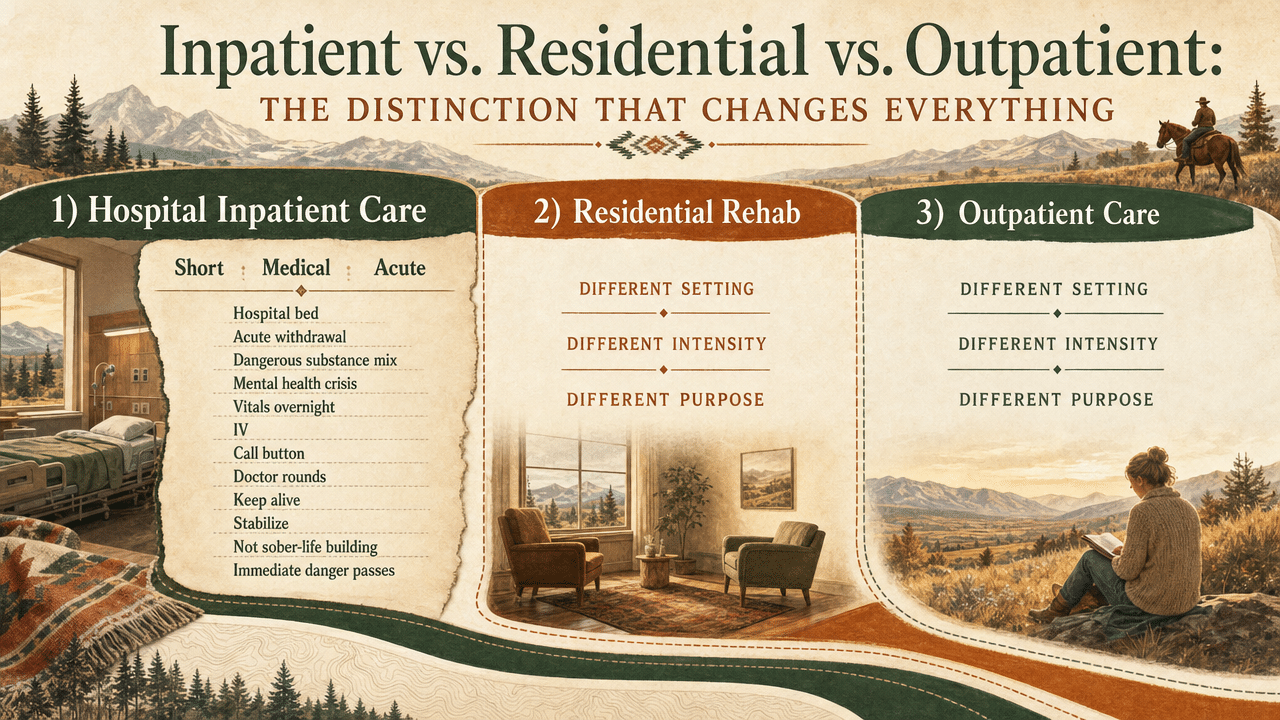
Inpatient vs. Residential vs. Outpatient: The Distinction That Changes Everything
Hospital-Based Inpatient Care: Short, Medical, Acute
When a doctor says “inpatient,” they often mean a hospital bed. That kind of stay is short, focused, and medical. Someone might be admitted because they’re in acute withdrawal, because a mix of substances turned dangerous, or because a mental health crisis needs immediate stabilization. Nurses check vitals through the night. There’s an IV pole, a call button, and a doctor rounding in the morning.
Hospital inpatient care is not designed to teach your loved one how to build a sober life. It’s designed to keep them alive and stable through the sharpest edge of a medical emergency. Once the immediate danger passes, the hospital’s job is basically done. The HHS environmental scan on residential treatment draws this line clearly, describing residential care as nonhospital services — a separate category from hospital-based acute care.2
If your loved one is in a hospital right now, that’s often a starting point, not the whole plan.
Residential (Live-In) Rehab: The Setting Most People Mean
When most families say “inpatient rehab,” this is what they’re picturing without knowing the technical name. Residential rehab is a live-in program that isn’t a hospital. Think bedrooms instead of hospital rooms, a shared dining space instead of a cafeteria tray, counselors and peers instead of nurses on twelve-hour shifts.
SAMHSA describes residential programs as “a living environment with treatment services”. That phrase does a lot of work. It means your loved one sleeps there, eats there, does group work there, meets with a counselor there — and the whole environment is part of the treatment, not just the scheduled sessions.1
The HHS scan groups residential SUD care into three shapes: short-term, long-term, and detox-focused nonhospital services. In practical terms, that maps to the 30, 60, and 90-day programs families see advertised, plus dedicated detox settings for the first days. Same category. Different lengths. Different intensities.2
How These Options Compare Side by Side
Here’s the picture families keep asking for — the three settings laid out next to each other, without the jargon.1,2
| Feature | Hospital Inpatient | Residential Rehab | Outpatient |
|---|---|---|---|
| Setting | Hospital ward | Live-in, home-like facility | Clinic visits; sleeps at home |
| Typical length | Days | Short-term, long-term, or detox-focused | Weeks to months of visits |
| Medical supervision | Highest; 24/7 nursing | 24/7 staff; medically monitored detox available | Scheduled check-ins |
| Family involvement | Limited; crisis-focused | Built in — family sessions, family week | Occasional sessions |
| Typical use | Acute medical or psychiatric crisis | Stabilizing and rebuilding away from triggers | Milder cases or step-down after residential |
Notice what changes as you move left to right. The medical intensity drops. The daily life practice goes up. The family gets more room to participate. That last column matters — a lot of people cycle through outpatient care first and only move to a live-in setting when the pattern won’t break on its own. That’s not a failure. It’s information.
Why a Live-In Setting Helps When Addiction Has Taken Over
Here’s something worth saying out loud: if willpower alone were enough, you wouldn’t be reading this. Addiction isn’t a character flaw your loved one can push through with a stern talk or a promise made on Sunday night. MedlinePlus describes drug addiction as “a chronic brain disease”, and that framing matters. It changes what treatment has to look like.6
When someone’s brain has been rewired by months or years of heavy use, the cues around them — the parking lot at work, the friend who always brings a bottle, the drawer where the pills live, even the argument that always ends the same way — pull them back before they’ve had a chance to think. Substance use disorder, MedlinePlus notes, shows up as “health issues or problems at work, school, or home”. Home is on that list for a reason. Home is often where the pattern lives.7.
A live-in setting does something the kitchen table can’t. It puts physical distance between your loved one and every automatic cue that has been pulling the lever. It puts staff in the hallway at 2 a.m. when the cravings hit hardest. It replaces the empty afternoon — the dangerous one — with a schedule that has somewhere to be and someone waiting.
It also gives their body time. Withdrawal from alcohol or certain drugs isn’t just uncomfortable; it can be medically serious. A residential program can monitor that safely instead of hoping it passes at home.
And it gives their mind time. Time to sit with a counselor without one eye on the clock. Time to hear another person in group say the exact thing they thought only they had ever felt. Time to sleep, eat real meals, and remember what a regular Tuesday feels like without a substance in it. None of that is fluff. It’s the raw material recovery is built from.
Inside the Day: What Your Loved One Will Actually Experience
The First Days: Medically Supervised Detox and Stabilization
The first stretch is usually the hardest, and it’s also the one families worry about most. If your loved one has been drinking heavily or using opioids, benzodiazepines, or a mix of substances, their body is going to protest when it stops. That protest — withdrawal — can range from miserable to medically dangerous, especially with alcohol.
In a live-in program, this is where medically monitored detox comes in. Staff check vitals, watch for complications, and, when appropriate, use medication to make withdrawal safer and less brutal. AHRQ’s review of alcohol use disorder treatment notes that medication decisions should be made collaboratively between the patient and the clinician.10
Detox is not treatment on its own. It’s the doorway. Once the body is steady enough to think clearly, sleep a little, and eat a real breakfast, the actual work of rehab can begin. For most people this is a matter of days, not weeks. But those days matter. Getting them right, in a place with someone in the hallway, changes what’s possible next.
The Daily Rhythm: Morning Group, Counseling, Experiential Therapy
Once detox settles, the days start to have a shape. That structure is part of the medicine. When someone has been living inside chaos — hiding bottles, missing work, dodging calls — a predictable Tuesday is almost startling.
Mornings usually start with a check-in group. Coffee, chairs in a circle, and a simple prompt: how did you sleep, what’s on your mind, what are you working on today. It sounds small. It isn’t. It’s often the first honest morning conversation your loved one has had in months.
From there the day layers in different kinds of work. Individual counseling — one person, one counselor, one hour — is where the harder threads get pulled: the reason it started, the loss that never got grieved, the moment things really came apart. Group counseling adds the piece that no solo session can, which is hearing another human being describe your exact feeling out loud.
Then there’s the experiential part. This is the piece families sometimes underestimate. Time with a horse in an arena, a walk on a trail, an hour in the gym, an afternoon of art — these aren’t extras. They’re where the nervous system learns it’s safe to be present again. The CDC frames rehab as a supportive, full-time setting for a reason. The support isn’t only in the counseling room. It’s in the whole day.3
Treating Both Conditions at Once: When Depression, Trauma, or Anxiety Are Part of the Picture
Here’s something you may have been quietly wondering. Is the drinking or the drug use the whole story — or is there something underneath it? For a lot of families, the answer is: both, tangled together.
In a well-run inpatient setting, this shows up in practical ways. Your loved one’s counselor isn’t only asking about substances. They’re asking about sleep, mood, panic, flashbacks, the years they haven’t wanted to talk about. Medication for depression or anxiety, if it’s part of the picture, gets managed alongside recovery work rather than pushed off to “deal with later.”
If you’ve been carrying a private worry that something more than the substance is going on, you’re probably right. A good program will meet that head-on, not sidestep it.
Where Family Fits In (And Why It’s Not a Bolt-On)
What the Research Says About Family Involvement
You may have been told, gently or not, that your loved one’s recovery is “their journey” and you should step back. That advice is well-meaning, and it’s also incomplete. The research points the other direction.
SAMHSA puts it plainly in its family therapy advisory:“Involving family members in substance use disorder treatment can positively affect client engagement, retention, and outcomes”.4Read that again slowly. Three things move in the right direction when family is in the room — whether your loved one shows up and stays with treatment (engagement), whether they finish the program instead of walking out at day nine (retention), and how they do afterward (outcomes).
A peer-reviewed review reinforces this, framing family involvement as important across the whole continuum of substance use services, not only at admission or discharge.12
What this means for you is simple. Showing up to a family session isn’t a favor you’re doing. It’s part of the treatment.
What Family Week and Family Sessions Look Like in Practice
So what does that actually look like on a Wednesday afternoon? Family programming in a live-in setting usually has two shapes: individual family sessions scattered through the stay, and a dedicated block — often called a family week or family program — where you come in for two or three days of structured work together.
The individual sessions are what you’d expect. You, your loved one, and a counselor in a room. Sometimes it’s the first honest conversation you’ve had in years. Sometimes it starts with silence and a box of tissues. Both count.
Family week is different. It’s education, group work with other families going through the same thing, and guided conversations that would be almost impossible to have at the kitchen table. You learn what addiction is doing to the brain, why the promises kept breaking, and what your part of the pattern has been — not to blame you, but because you’re inside the system too. The impact review on families is direct about that: substance use disorder reshapes the whole family, not just one person.13
You also learn what to do next. How to talk about hard things without a fight. What to say when they come home. What boundaries actually sound like out loud. The NIH-hosted treatment chapter names family counseling as an important support in effective care for a reason— the work you do that week keeps going long after the drive home.11
The Arc of a Stay: From Detox to a Year Out
It helps to see the whole shape of this before you’re standing in it. Inpatient rehab isn’t a black box your loved one disappears into. It’s a chapter with a beginning, a middle, and a long, quieter after — and each part does something the others can’t.
The first days are about the body. Medically monitored detox, sleep, food, vitals checked, staff in the hallway when the nights are hard. Nothing fancy — just the stabilization that has to happen before deeper work is even possible.
The middle stretch is where the daily rhythm lives. Morning check-in group. Individual counseling. Group work. Experiential therapy — a horse, a trail, a gym, an art table. The CDC’s plain description of inpatient rehabilitation as “a full-time facility” that offers “a supportive environment” is really pointing at this: the whole day is the medicine, not just the hour with the counselor.3
Somewhere inside that middle sits family programming — the family sessions and family week where you’re pulled in, not left on the outside waiting for phone calls.
Then comes discharge planning, which starts earlier than most families expect. Where will they sleep. What meetings will they go to. Who’s the counselor they’ll keep seeing. What’s the plan if a Tuesday goes sideways.
And then the part families almost never hear about upfront: continuing care. Weekly video groups, check-ins at 30, 60, 90, 180, and 365 days out. That timeline exists because SAMHSA describes recovery as “a process of change through which individuals improve health and wellness, live a self-directed life, and strive to reach their full potential”. That kind of change doesn’t wrap up on discharge day. It gets built, week by week, across a year and beyond.5
How to Tell If Inpatient Rehab Is the Right Next Step
You’ve probably been asking yourself some version of this question for months. Is it bad enough? Are we overreacting? Should we try one more outpatient program, one more promise, one more Monday?
Here are the honest signals families keep bringing to counselors:7,8
- Outpatient care has been tried and the pattern keeps coming back.
- Withdrawal at home has become scary — shakes, seizures in the past, blackouts, using just to feel normal in the morning.
- The substance use is tangled with depression, trauma, or anxiety that never got treated on its own.
- Home has become part of the trigger set — the same kitchen, the same coworker, the same argument.
- Work, school, or family life is unraveling in ways that used to be fixable and aren’t anymore.
You don’t have to hit every item on that list. One or two is often enough to justify a live-in setting, because the whole point of a full-time facility is a supportive environment that outpatient care can’t physically provide.3
If you’re not sure, you don’t have to decide alone tonight. SAMHSA runs a free, confidential helpline at 1-800-662-HELP that’s available 24/7. You can call as the family member. You do not have to have your loved one’s permission to ask questions.9
What Happens After Discharge
Discharge day is not the finish line. It’s the handoff. And knowing that ahead of time changes how you show up for it.
Before your loved one walks out the door, a good program builds a plan with them, not for them. Where they’ll sleep the first week. Which meetings they’ll go to and on what nights. The counselor they’ll keep seeing. A phone number for the moment a Tuesday goes sideways. If medication is part of their alcohol use disorder treatment, that plan gets handed off too — AHRQ notes those decisions should be made collaboratively, not left to guesswork.10
Then comes the quieter part. Weekly video groups. Check-ins at 30, 60, 90, 180, and 365 days out. It sounds like a lot because it is. SAMHSA describes recovery as“a process of change through which individuals improve health and wellness, live a self-directed life, and strive to reach their full potential”.5That doesn’t finish in 30 days. It gets built over a year, and often longer.
Your role shifts too. Less crisis. More presence. The family work you did during the stay becomes the language you use at the kitchen table now.
A Note for Families Making the Call Tonight
If you’ve read this far, you’re probably tired. Maybe scared. Maybe carrying a phone that keeps not ringing, or one that rings at the wrong hours. That weight is real, and you’re not being dramatic for feeling it.
Whether the next step is Rocky Mountain Treatment Center or somewhere else entirely, you don’t have to figure out the whole year tonight. You only have to figure out the next call. That’s enough for right now.
Frequently Asked Questions
What is the difference between inpatient rehab and residential rehab?
Most families use the terms interchangeably, and that’s okay. Technically, hospital inpatient care is short and medical — think acute withdrawal or a psychiatric crisis. Residential rehab is a live-in, nonhospital setting that SAMHSA describes as “a living environment with treatment services”. When someone says “inpatient rehab,” they usually mean residential.1
How long does a typical inpatient rehab stay last?
It depends on what your loved one needs. HHS groups residential care into short-term, long-term, and detox-focused programs. In practice, families see 30, 60, and 90-day options most often. Length isn’t about severity as a score — it’s about how much time someone needs to stabilize, do the deeper work, and build a plan for after.2
Can my loved one be treated for depression, trauma, or anxiety at the same time?
Yes, and honestly, they should be. MedlinePlus notes that when a mental health condition and a substance use disorder happen together, “it is usually better to treat both conditions at the same time rather than separately”. A good live-in program will ask about mood, sleep, panic, and past trauma from day one — not treat those as a separate problem for later.8
How is family actually involved during an inpatient stay?
You’re not left in the waiting room. Most programs schedule individual family sessions during the stay and offer a dedicated family week — a few days of education, guided conversations, and group work with other families. The NIH-hosted treatment chapter identifies family counseling as an important part of effective care, so showing up is part of the treatment, not an extra.11
How do we know if inpatient rehab is the right next step versus outpatient care?
A few honest signals: outpatient has been tried and the pattern keeps returning, withdrawal at home has felt scary, home itself is part of the trigger set, or daily life at work and with family is unraveling. The CDC frames inpatient rehabilitation as “a full-time facility” with “a supportive environment” — the kind of round-the-clock structure outpatient can’t physically offer.3,7
What happens after discharge, and does recovery just end there?
Discharge is a handoff, not a finish line. A good program builds an aftercare plan — meetings, ongoing counseling, medication follow-up if needed, and check-ins over the first year. SAMHSA describes recovery as “a process of change through which individuals improve health and wellness, live a self-directed life, and strive to reach their full potential”. That change gets built week by week.5
References
- What Is Substance Abuse Treatment? A Booklet for Families. https://library.samhsa.gov/sites/default/files/sma14-4126.pdf
- State Residential Treatment for Behavioral Health Conditions. https://aspe.hhs.gov/reports/state-residential-treatment-behavioral-health-conditions-regulation-policy-environmental-scan-0
- Treatment of Substance Use Disorders. https://www.cdc.gov/overdose-prevention/treatment/index.html
- The Importance of Family Therapy in Substance Use Disorder Treatment. https://library.samhsa.gov/sites/default/files/pep20-02-02-016.pdf
- SAMHSA’s Working Definition of Recovery. https://library.samhsa.gov/sites/default/files/pep12-recdef.pdf
- Drug Use and Addiction. https://medlineplus.gov/druguseandaddiction.html
- Substance use disorder: MedlinePlus Medical Encyclopedia. https://medlineplus.gov/ency/article/001522.htm
- Dual Diagnosis. https://medlineplus.gov/dualdiagnosis.html
- National Helpline for Mental Health, Drug, Alcohol Issues. https://www.samhsa.gov/find-help/helplines/national-helpline
- Updated Systematic Review Examines Pharmacotherapy for Adults with Alcohol Use Disorder. https://www.ahrq.gov/news/newsroom/press-releases/alcohol-use-disorders.html
- Chapter 1—Substance Use Disorder Treatment. https://www.ncbi.nlm.nih.gov/books/NBK571084/
- Family Involvement in Treatment and Recovery for Substance Use Disorders. https://pmc.ncbi.nlm.nih.gov/articles/PMC8380649/
- The Impact of Substance Use Disorders on Families and Children. https://pmc.ncbi.nlm.nih.gov/articles/PMC3725219/
- Mental Health & Substance Use Disorder. https://www.hhs.gov/programs/prevention-and-wellness/mental-health-substance-use-disorder/index.html