
Key Takeaways
- Start with one phone call: SAMHSA’s 24/7 helpline or Montana’s DPHHS Behavioral Health division can route you to state-approved providers that unlock free-care funding streams 1, 3.
- Montana’s SUD Voucher covers residential room and board at $35/day up to $1,000 yearly for residents at or below 200% FPL who meet ASAM 3.1 medical necessity 2.
- Medicaid’s HEART Demonstration now covers clinically managed residential withdrawal management, and intake staff can start a Medicaid application while you stabilize 8, 10.
- If you’re uninsured, federal block grant dollars and county alcohol-tax funds quietly cover treatment through state-approved providers — say you can’t pay and let intake work the funding 3, 5.
- Certified Community Behavioral Health Clinics must serve any Montanan seeking substance use or mental health care regardless of ability to pay, and offer assessments and warm handoffs to residential detox 6.
- Emergency rooms handle acute withdrawal danger but rarely provide multi-day detox; safety-net hospitals are less likely to have addiction services, so ask for a residential referral after stabilization 11.
- At intake, answer honestly about substance use so clinicians can safely manage withdrawal, and let admissions staff sort out which funding stream — voucher, Medicaid, block grant, or county — applies 3.
- When helping someone else, gather their rough income for funding conversations and stay with them between the yes and the intake, since that gap is where people back out 1, 3.
If You’re Reading This at 2 a.m.
If you’re reading this at 2 a.m., shaky and scared, with a phone screen too bright and a body that won’t stop shaking — you’re already doing something hard. You’re looking. That counts.
Maybe you’re the one who needs help. Maybe it’s your sister, your kid, your partner passed out in the next room. Either way, the fear about money is real, and it’s often what keeps people from making the call. Free or nearly free medically supervised detox is not a myth in Montana. It’s a real stack of programs — a state voucher for room and board, Medicaid’s HEART waiver, federal block grant dollars, county alcohol-tax funds, and community clinics that legally cannot turn you away for lack of money 6.
This guide walks you through those doors in the order that helps when you’re actually in crisis. First 24 hours. First week. Longer coverage. No jargon you have to decode at 2 a.m.
You don’t have to figure everything out tonight. You just have to make one call. Keep reading — the first number to dial is in the next section.
The First Phone Call: SAMHSA and the Montana Front Door
Start with one number. When your hands are shaking and your brain is running in circles, one number is all you can manage — and that’s enough.
The SAMHSA National Helpline (1-800-662-HELP) runs 24 hours a day, seven days a week. It’s free. You don’t need insurance to call, and you don’t have to give your real name if you’re not ready. The people on the other end can point you to treatment locators for drug, alcohol, and mental health services in your area, including programs that take sliding-scale or public funding 1. If English isn’t your first language, they can help in Spanish too.
What that call actually does: it hands you a shorter list. Instead of scrolling through pages of centers that may or may not take someone in your situation, you get names of local providers that are known to the federal system. That’s a real shortcut when you’re tired.
The second number worth having is Montana’s own front door — the Behavioral Health and Developmental Disabilities Division at DPHHS. This is the state office that oversees substance use providers, block grant dollars, and the voucher program that can cover your room and board 3. If you tell them you need medically supervised detox and you can’t pay, they can point you toward a state-approved provider near you. That label — state-approved — matters, because those are the only providers that can tap the funding streams we’ll talk about next.
Here’s what to do before you dial, if you can:
- Write down your ZIP code and county. You’ll be asked.
- Write down a rough income number — weekly or monthly, whatever you know.
- Note your insurance status, even if the answer is “none.”
- If you know what you’ve been using and roughly how much, jot that down too. It helps the intake team match you to the right level of care.
You don’t need any of this to make the call. If you have none of it, still call. Making the call is the win. Everything else is paperwork someone will help you fill out.
Who Actually Pays for a Free Detox Bed in Montana
The State Voucher for Room and Board
Here’s a program most people have never heard of, even though it was built for exactly this moment.
Montana runs a Substance Use Disorder Voucher Program that pays for the room-and-board part of residential treatment when insurance won’t and you can’t. It exists because lawmakers recognized that a lot of people would go to detox tomorrow if a bed and a pillow weren’t the reason they couldn’t 4. The voucher doesn’t cover clinical care directly — that piece usually gets picked up by Medicaid, block grant dollars, or another funding stream — but it removes one of the biggest barriers: the daily cost of just being there.
To use the voucher, four things need to be true:
- You live in Montana.
- You’re age 14 or older.
- Your family income is at or below 200% of the federal poverty level.
- You meet medical necessity for what’s called ASAM 3.1 residential care — in plain language, a clinician needs to agree that a residential level of care is what you need 2.
The reimbursement runs $35 per day, with a $1,000 cap per person per state fiscal year 2. That’s not a huge pot, but it’s often enough to bridge a first stabilization stay while other coverage gets sorted out.
You don’t apply for the voucher yourself in some online portal. A state-approved provider does the paperwork with you at intake. That’s part of why the phone call matters more than the forms right now — the people picking up the phone at these facilities have done this hundreds of times.
If your income is a little over 200% FPL, or you’re not sure, still ask. Providers can often layer other funding on top when the voucher doesn’t quite fit.
Medicaid’s HEART Waiver and Withdrawal Management
If you have Montana Medicaid — or you think you might qualify — this is the section to slow down on.
Montana runs something called the HEART Demonstration, short for Healing and Ending Addiction through Recovery and Treatment. It’s a special agreement with the federal Medicaid agency that lets the state cover types of treatment regular Medicaid usually won’t, including short residential stays for substance use 8. That’s a big deal for detox. Before HEART, a lot of Medicaid enrollees hit a wall trying to get residential withdrawal management covered. Now the state covers the full range of care that addiction medicine specialists recommend, including clinically managed residential withdrawal management (the technical name is ASAM 3.2-WM) 10.
Through the expanded HEART services, 1,612 Montanans received treatment they wouldn’t have had access to before 10. You might be number 1,613. That’s not a small thing.
What this means when you make the call: if you’re on Medicaid, ask specifically whether the facility takes Montana Medicaid for residential withdrawal management under HEART. If you’re not on Medicaid but you think you might qualify — low income, no employer coverage, on disability, recently lost a job — ask if the intake team can help you apply. Many facilities will start that application while you’re stabilizing, so coverage kicks in for the rest of your stay.
HEART also covers crisis stabilization and mobile crisis services for people who aren’t on Medicaid yet 8. Translation: even if your paperwork isn’t sorted, there are doors that will still open.
A note of honesty: not every residential facility in Montana takes Medicaid. Some don’t. That’s not personal — it’s a billing decision. If one door closes, ask them who does.
Block Grant Dollars for the Uninsured
What if you have no insurance at all, and Medicaid isn’t in the picture? This is where federal block grant money comes in.
The Substance Use Prevention, Treatment, and Recovery Services Block Grant — people at the state office call it SUBG or SABG — is federal funding routed through Montana DPHHS to pay for treatment and prevention services, especially for people who aren’t covered by Medicaid 7. It’s the safety net underneath the safety net. The 2023 SABG report shows the state directing these dollars across prevention, treatment, and recovery, with specific attention to low-income and uninsured Montanans 9.
Here’s the part worth writing down: state-approved providers can apply block grant funds specifically for people with incomes between 139% and 200% of the federal poverty level who aren’t Medicaid-eligible 3. That’s the exact income band where a lot of people fall through the cracks — too much income for Medicaid, not enough for private insurance premiums.
You won’t see “block grant” listed as a payment option on any website. It happens behind the scenes. When you call a state-approved provider and say, “I have no insurance and I can’t pay,” this is often the fund they draw from to say yes anyway. So don’t self-eliminate. Call, share your situation honestly, and let the intake staff run the numbers.
County Alcohol-Tax Funds
There’s one more pocket of money, and it’s a local one.
Every time someone buys a bottle of wine or a case of beer in Montana, a slice of that tax revenue gets earmarked for substance use services. Specifically, 20% of alcohol tax dollars are distributed to counties for prevention, treatment, and recovery — and only state-approved providers can receive those funds 3. Missoula County, for example, uses its allocation to support outpatient, residential, inpatient, and detox services for residents who qualify 5.
This is why the phrase “state-approved provider” keeps coming up. It’s not marketing language. It’s the legal label that unlocks these county dollars, along with block grant funding and the voucher program. A facility without state approval can be a fine facility — but it cannot access these funds for you.
What to do with this: when you call, ask two questions. “Are you a state-approved substance use disorder provider?” and “Do you use county alcohol-tax funds to help self-pay patients?” The answers won’t be the same in every county, and availability shifts through the year as budgets get spent. But asking directly puts you in front of money you didn’t know was set aside for someone in your exact situation.
Comparing Your Coverage Options at a Glance
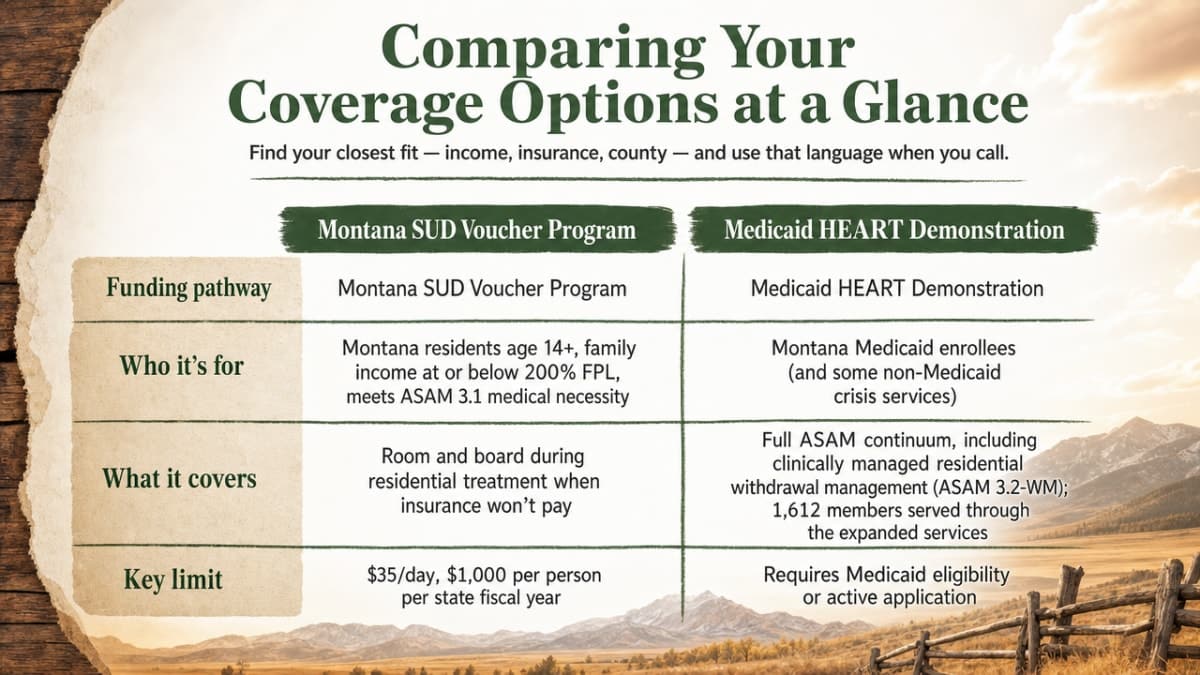
You’ve read a lot of names and numbers in the last few sections. Here’s the whole picture on one page, so you can find your row and know what to ask for.
Match yourself to the closest fit — income, insurance, county — and use that language when you call.
| Funding pathway | Who it’s for | What it covers | Key limit |
|---|---|---|---|
| Montana SUD Voucher Program | Montana residents age 14+, family income at or below 200% FPL, meets ASAM 3.1 medical necessity | Room and board during residential treatment when insurance won’t pay | $35/day, $1,000 per person per state fiscal year 2 |
| Medicaid HEART Demonstration | Montana Medicaid enrollees (and some non-Medicaid crisis services) | Full ASAM continuum, including clinically managed residential withdrawal management (ASAM 3.2-WM); 1,612 members served through the expanded services | Requires Medicaid eligibility or active application for most residential coverage 10 |
| Substance Use Block Grant (SABG/SUBG) | Uninsured Montanans, especially those between 139% and 200% FPL who aren’t Medicaid-eligible | Treatment services not covered by Medicaid, including detox and residential care | Only state-approved providers can apply the funds 3 |
| County alcohol-tax funds | County residents referred through state-approved providers | Prevention, outpatient, residential, inpatient, and detox services at the local level | 20% of state alcohol tax revenue routed to counties; availability varies by county and budget cycle 3, 5 |
A few things worth noticing as you scan.
The voucher isn’t clinical coverage — it’s a bed-and-meals subsidy. It works best stacked with something else, usually Medicaid or block grant dollars, which is why intake staff put the pieces together for you.
Medicaid, if you have it, is the strongest single card in your hand for residential detox. If you don’t have it and think you might qualify, say so on the first call.
Block grant and county alcohol-tax funds are invisible from the outside. You will not see them on a website. They surface when you tell a state-approved provider you can’t pay and let them work the phones on your end.
If more than one row could apply to you, that’s good news — it usually means more chances of a yes.
Community Clinics That Can’t Turn You Away
Here’s a door that opened recently, and a lot of people don’t know it exists yet.
Montana was chosen for the federal Certified Community Behavioral Health Clinic program — CCBHC for short. These clinics have to serve any Montanan who walks in seeking mental health or substance use care, no matter your age, where you live, or whether you can pay 6. That last part is not a soft promise. It’s the rule that comes with the funding.
What a CCBHC can do for you in a detox crisis: crisis services, an assessment, and a warm handoff to a residential program if you need a higher level of care 6. Think of them as the coordination point when you don’t know where else to start. They can help you begin a Medicaid application while you’re still in the room. They can connect you to a state-approved residential provider for medically supervised detox. They can also plug you into ongoing counseling for after detox, which is the piece that keeps a lot of people from staying stuck in the same cycle.
Ask when you call: “Are you a Certified Community Behavioral Health Clinic?” If yes, they can’t send you away for lack of money. If no, they can usually tell you which nearby clinic is one.
Why the Emergency Room Alone Often Isn’t Enough
If you’ve been told “just go to the ER,” that advice isn’t wrong — but it’s not the whole picture either.
Emergency rooms are built to keep you alive through the acute danger of withdrawal. If your blood pressure is spiking, if you’re seizing, if you’re a heavy drinker who suddenly stopped and your body is going into shock — the ER is where you belong tonight. Go. Don’t second-guess that.
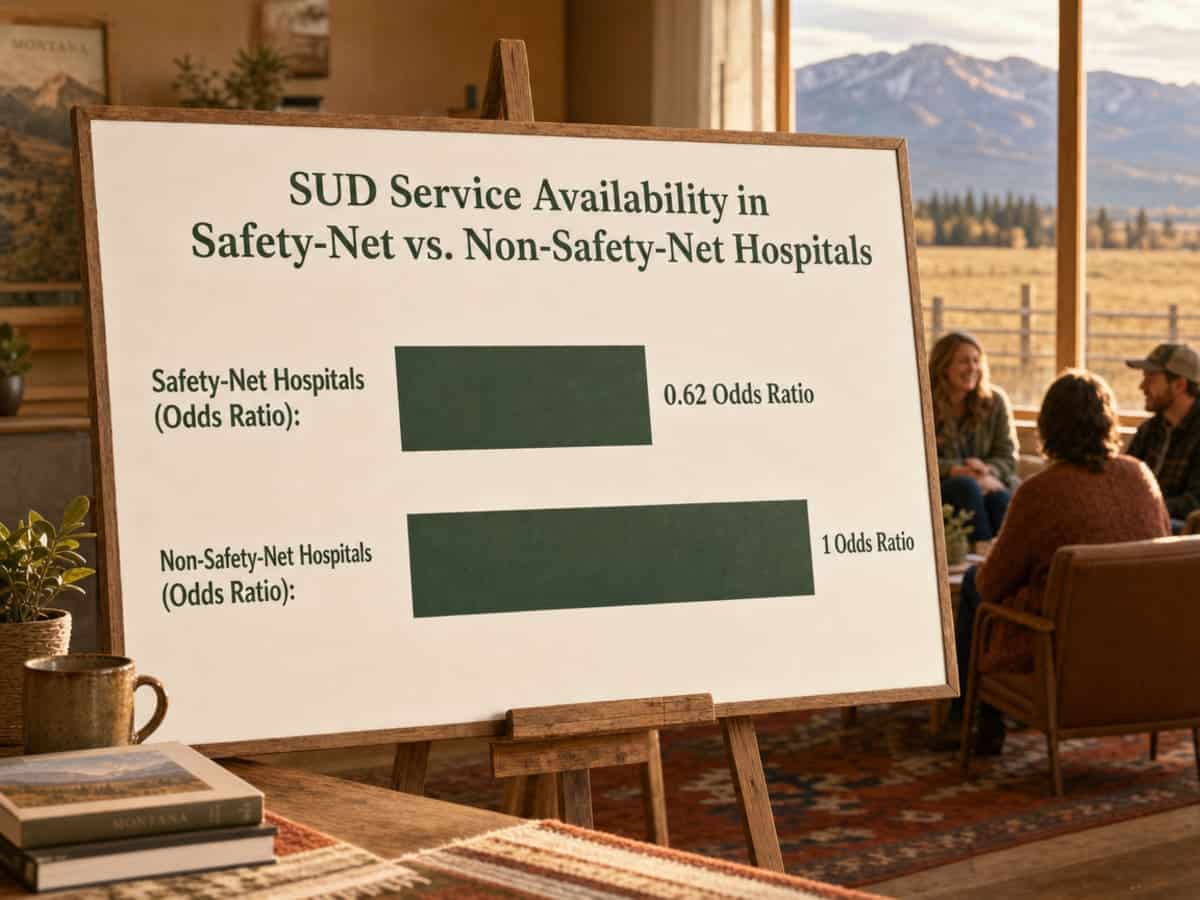
What ERs usually don’t do is hold you for the several days it actually takes to get through withdrawal safely, or hand you a warm bed in a program the next morning. And the gap is measurable. A 2023 study of U.S. hospitals found that safety-net hospitals — the ones serving the highest share of Medicaid and uninsured patients — were significantly less likely to offer substance use disorder services than other hospitals, with an odds ratio of 0.62 for both screening and consultation services 11. Translation: the hospitals most likely to see you if you’re broke are the least likely to have a full addiction team on staff.
That’s not the ER’s fault. It’s a system gap. And it’s exactly the gap that state-approved residential detox programs are set up to catch. When the ER stabilizes you and asks where you want to go next, that’s your moment to say the words: I need medically supervised detox, and I need help paying for it.
What to Expect Walking In the Door
Once you’ve made the call and someone has said “come in,” the next fear is usually the door itself. What happens when you get there? Will they judge you? Will they turn you away because you look like you’ve been up for three days?
Here’s what usually happens, in the order it happens.
You’ll sit down with an intake staffer, sometimes called an admissions coordinator. They will ask you what you’ve been using, how much, and when you last used. Answer honestly. This isn’t a moral test. It’s how they figure out whether you need a doctor watching your vitals every few hours or something less intensive. Lying about your use is the one thing that can actually put you in danger during withdrawal.
A nurse or medical provider will do a physical check — blood pressure, pulse, sometimes bloodwork. If you’re a heavy drinker or using benzos, they take this part seriously, because those withdrawals can be medically dangerous. Medications may be offered to make you more comfortable and to keep you safe. You can ask questions about anything they give you.
Someone will sit with you and fill out the financial paperwork. This is where the voucher, Medicaid application, block grant, or county funds get sorted 3. You don’t have to know which one applies. That’s their job.
Then you get a bed. You sleep. That’s the first win.
Helping Someone Else Get to a Bed
If you’re the one making calls for someone else — a partner, a parent, a grown kid who finally said yes — the rules shift a little.
You can call the SAMHSA helpline and DPHHS on their behalf and ask general questions without their consent 1. But intake at a residential program will need to talk to the person entering care. That’s not a hoop to jump through. It’s how they confirm the person actually wants to come in, and how they gather the medical details that keep withdrawal safe.
Two things help more than anything else. First, have the person’s rough income handy — that’s what unlocks the voucher and block grant conversations for state-approved providers 3. Second, don’t leave them alone between the yes and the intake. That gap is where a lot of people talk themselves out of it.
Drive them if you can. Sit in the lobby while they fill out paperwork. Bring a phone charger. You’re not fixing them. You’re just making sure the door stays open long enough for them to walk through it.
One Last Thing Before You Call
You’ve read a lot. Your body is still doing what it’s doing. Here’s the part that matters most.
The call itself is the hard part. Not the eligibility rules, not the paperwork, not knowing which fund pays for what. Someone on the other end of the line has done this hundreds of times. Let them carry it.
Say the true thing when they pick up: I need medically supervised detox, and I can’t pay. That one sentence opens the doors we’ve walked through together — the voucher, HEART, block grant dollars, county funds, the CCBHC down the road.
If you’re in Montana and want a warm voice to start with, Rocky Mountain Treatment Center’s admissions line is one place you can begin. Whatever number you dial first, dial one. That’s the win tonight.
Frequently Asked Questions
What if I don’t have an ID or insurance card with me?
Come anyway. Missing paperwork does not disqualify you from a bed. Intake staff can start the process with your name, date of birth, and county, then help you replace an ID or apply for coverage after you’re stable. If a family member can bring documents later, that helps — but no one is going to send you back out the door because your wallet is gone.
Can I bring my kids with me to detox?
Residential detox facilities are set up for one patient in a bed, not families. Kids can’t stay with you during the medical part of your stay. Before you call, line up someone you trust — a relative, a close friend, a co-parent — to keep them safe for a few days. If you have no one, tell intake. They can loop in county services to help arrange short-term care so you can still come in.
What should I pack for a detox stay?
Keep it simple. A few days of comfortable clothes, socks, slippers or slip-on shoes, a toothbrush, and any current prescription medications in their original bottles. Bring a phone charger and a list of emergency contacts. Leave alcohol, drugs, mouthwash with alcohol, sharp items, and valuables at home. If you forget something, the staff has spares. Don’t let packing be the thing that stops you.
What if I have no insurance and don’t qualify for Medicaid?
You still have options. State-approved providers can pull from the Substance Use Block Grant for uninsured people between 139% and 200% of the federal poverty level, and county alcohol-tax funds cover residents in many counties 3. The room-and-board voucher can also stack on top when you meet residential medical necessity 2. Say the words “I have no insurance and I can’t pay” — that opens the funding conversation.
Will my job or my landlord find out I went to detox?
No. Federal law (42 CFR Part 2) protects substance use treatment records more strictly than regular medical records. The facility can’t share that you’re there without your written permission — not with your boss, not with your landlord, not with family. If you need documentation for FMLA leave, staff can help you request only what’s needed, without spelling out the diagnosis. Your privacy is the default, not the exception.
How long does it take to get a bed once I call?
It depends on the day, the facility, and your medical situation. Some state-approved providers offer same-day or next-day admission when a bed is open. Others may ask you to wait a day or two while paperwork or transportation gets sorted. If one place can’t take you tonight, ask them to call ahead to another. Community clinics designated as CCBHCs can also start crisis services immediately while a residential bed opens up 6.
References
- Treatment Locators: Mental Health, Drug, Alcohol Issues. https://www.samhsa.gov/find-help/locators
- Notice of ARM Proposal with Public Hearing (Substance Use Disorder Voucher Program). https://archive.legmt.gov/content/Committees/Interim/2023-2024/Children-Families/CFHHS_Meetings/2024_Mar_12/MAR_37-1040_proposal.pdf
- State Approval Forms – Behavioral Health and Developmental Disabilities Division. https://dphhs.mt.gov/BHDD/SubstanceAbuse/ProviderForms
- Chemical dependency treatment room and board voucher program (Montana Code Annotated, Title 53, Chapter 24, Part 2). https://mca.legmt.gov/bills/mca/title_0530/chapter_0240/part_0020/sections_index.html
- Alcohol Tax Fund | Missoula County, MT. https://www.missoulacounty.gov/departments/grants-community-resources/county-funded-grants/alcohol-tax-fund/
- Governor Gianforte Announces Montana Secures Federal Funding to Establish Behavioral Health Clinics. https://news.mt.gov/Governors-Office/Governor-Gianforte-Announces-Montana-Secures-Federal-Funding-to-Establish-Behavioral-Health-Clinics
- Substance Use Block Grant – DPHHS. https://dphhs.mt.gov/BHDD/Prevention/SubstanceUseBlockGrant
- DPHHS Updates on HEART Demonstration and Federal Grants (July 23, 2025). https://archive.legmt.gov/content/Committees/Interim/2025-2026/CJOC/July-2025/CJOC_DPHHS-Updates-7.23.2025.pdf
- 2023 Substance Abuse Block Grant (SABG) Report – Montana. https://dphhs.mt.gov/assets/BHDD/Prevention/substanceabuseblockgrant/2023SABGReport.pdf
- Healing and Ending Addiction Through Recovery and Treatment (HEART) Initiative Report – Montana. https://archive.legmt.gov/content/Committees/Interim/2023-2024/Children-Families/CFHHS_Meetings/2024_Sept_11/16-12-122-Healing-and-Ending-Addiction-Through-Recovery-and-Treatment-Report-FINAL.pdf
- Substance Use Disorder Program Availability in Safety-Net and Non–Safety-Net Hospitals. https://pubmed.ncbi.nlm.nih.gov/37639270/