
Key Takeaways
- Montana saw roughly 132 nonfatal and seven fatal overdoses in just six weeks during spring 2025, driving more residents to seek medically supervised withdrawal care 1.
- Under Montana’s ASAM Level 3.7-WM rules, medically monitored detox requires a 24-hour on-site nurse, physician-approved medication protocols, emergency equipment, and a same-day biopsychosocial assessment 6.
- Rural geography and small-town visibility shape the choice in Montana, with licensed beds clustered in counties like Cascade and Flathead, often hours from home 10.
- Detox is the doorway, not the destination — Montana’s care plan hands patients off into 30, 60, or 90 days of residential treatment and continuing care 2.
What the First Phone Call Feels Like in Montana
You’re holding the phone. Maybe it’s three in the morning in Billings and the shaking has started again. Maybe you’re a mother in Kalispell standing in the kitchen with the lights off so your kids don’t hear. Maybe you’ve already pulled into a parking lot off I-90 because you couldn’t make the call from the house.
Whatever brought you here, the fact that you’re reading this is already something. People who don’t care don’t research at midnight. People who’ve given up don’t type “medically monitored detox” into a search bar. So before anything else: you’re doing a brave thing right now, and it counts.
The first phone call to a detox program in Montana is usually shorter than people expect. You don’t have to have your story rehearsed. You don’t have to know what insurance you have or whether you can get there tomorrow. The person on the other end has talked to thousands of people in exactly your spot, including people calling for someone they love who doesn’t know they’re calling yet. They’ll ask what you’ve been using, how much, how long, and when you last had it. They’ll ask if you’ve had seizures or been through withdrawal before. That’s mostly it for the first call.
You’re probably scared. That makes sense. Withdrawal is hard, and reaching out feels like admitting something you’ve been trying not to admit for a long time. Both of those things can be true, and you can still pick up the phone.
Why More Montanans Are Asking About Detox This Year
If you feel like the conversation around drugs and alcohol in Montana has gotten louder this year, you’re not imagining it. Between March 1 and April 15, 2025, state health officials counted roughly 132 nonfatal overdoses and seven fatal ones in just six weeks 1. That number landed in the news, in church bulletins, in text threads between siblings. It’s part of why you’re reading this right now.
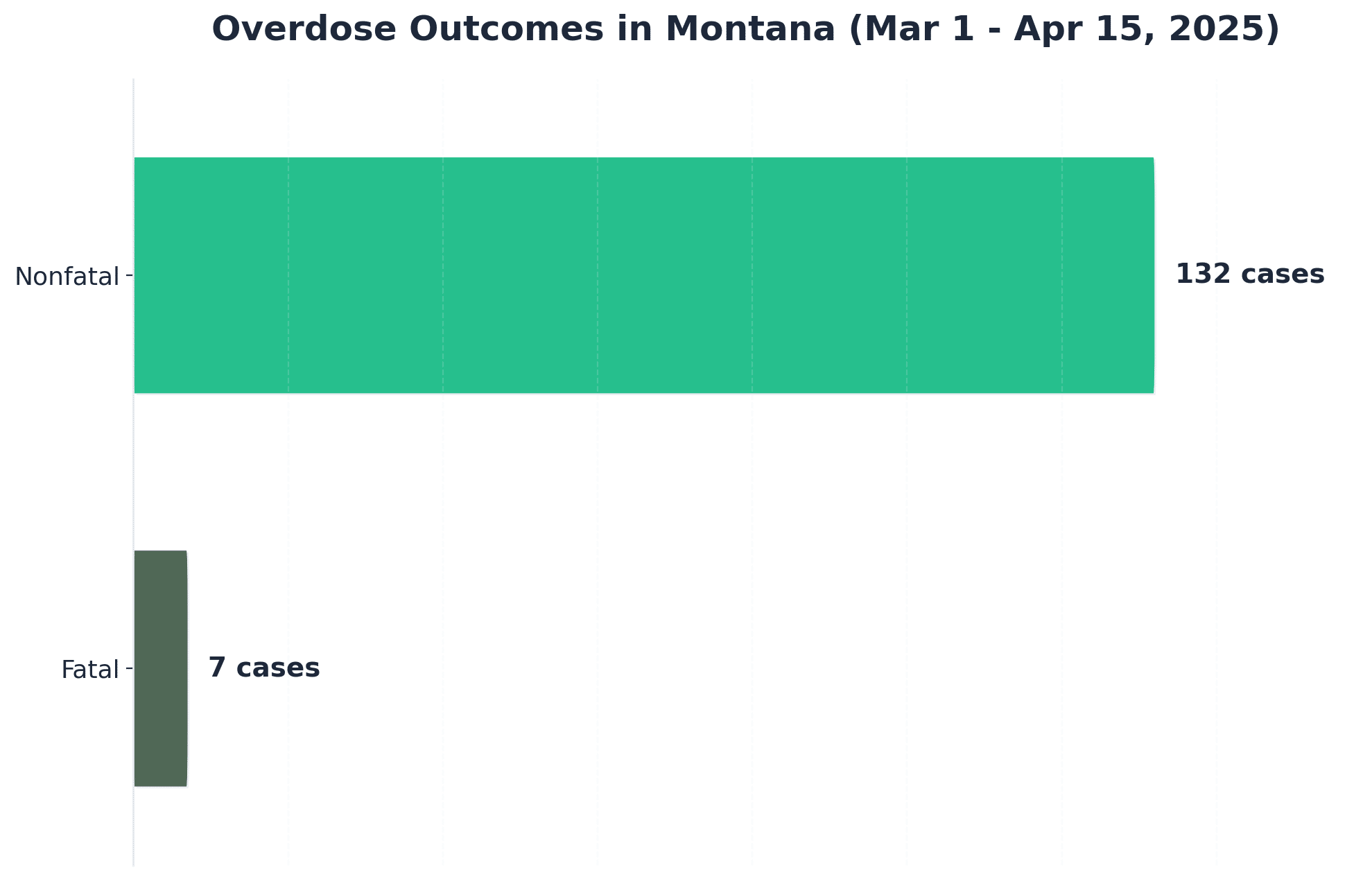
Sit with that ratio for a second, though, because it matters: 132 people lived. Seven did not. The vast majority of overdoses in Montana this spring were survived. That doesn’t make any of them small, and it doesn’t erase the seven families changed forever. But it does mean something important for you or the person you love. Overdose is not the end of the story for most people. It’s a terrifying chapter, and then there’s another chapter after it. Detox is often where that next chapter starts.
The reasons behind the rise are layered. Drug supplies have gotten more unpredictable, with fentanyl showing up in pills and powders that didn’t used to contain it. Long winters, isolation, the kind of grief that piles up in small towns, the way alcohol gets normalized when there’s not much else to do on a Tuesday night in February — all of it adds up. Counties from Cascade to Yellowstone to Missoula are seeing more people reach out, more often, and earlier in the spiral than before.
Here’s the thing nobody says out loud enough: more people calling about detox is not a bad sign. It’s a sign that the silence is breaking. For decades in Montana, the unwritten rule was to handle it at home, alone, quietly. That rule has cost too many people. The fact that you, or someone you love, is even considering medically supervised care puts you in a growing group of Montanans who decided this year that white-knuckling it wasn’t going to work anymore. That’s not weakness. That’s a course correction, and the data suggests you’re far from alone in making it.
What ‘Medically Monitored’ Actually Means When You Walk Through the Door
The phrase “medically monitored detox” sounds like jargon, and honestly, it kind of is. But in Montana it has a very specific meaning, written into state law, that you have a right to understand before you sign anything or pack a bag. Knowing what’s on the other side of the door tends to make the door less scary.
Under Montana’s withdrawal management rules — the ones licensed facilities have to follow to keep their doors open — a medically monitored detox program (what the state calls ASAM Level 3.7-WM) has to meet four non-negotiable standards 6. These aren’t suggestions or marketing language. They’re the floor.
A nurse on duty around the clock. Not on call. Not down the hall in another building. A registered nurse has to be physically on-site twenty-four hours a day, every day you’re there 6. That means at three in the morning, when the sweats are at their worst and your heart is doing something that scares you, someone trained to handle exactly that is twenty steps away.
A doctor’s protocols guiding your care. The medications used to ease withdrawal — and there are good ones now, especially for alcohol and opioids — aren’t being improvised. A physician has reviewed and approved the plan for how each substance gets managed, what symptoms trigger what response, and when something needs to escalate 5. The nurse at your bedside is following a script written by a doctor who has done this for years.
Emergency equipment in the building. Oxygen. An AED. Suction. The kinds of things you hope nobody ever needs but that have to be there anyway 6. Most withdrawals don’t get anywhere near needing them. The point is that if your body throws a curveball, the tools are in the room, not twenty miles down a county road.
A real conversation about you, not just your symptoms. Within the first day, someone sits down with you for what’s called a biopsychosocial assessment 5. That’s a clunky word for a human conversation: what you’ve been using, yes, but also what your life looks like, who’s at home, what you’re afraid of, what you’ve already tried, what trauma you’re carrying. It shapes what happens next, because detox that ignores the rest of your life isn’t really treatment.
Put it together and “medically monitored” stops sounding clinical. It means you are not alone in a room. Someone with training is watching the things you can’t watch yourself — your blood pressure, your pulse, the small signals your body sends before a problem gets big. You get to stop being the one in charge of keeping yourself alive for a few days. For a lot of people, that’s the first real rest they’ve had in years.
Your First Seven Days: An Hour-by-Hour Picture
Most people who haven’t been through detox imagine it as one long blur of suffering. It isn’t. It’s a week with a real shape to it — a beginning, a middle, and an end — and knowing that shape ahead of time makes the whole thing less frightening. Here’s what the first seven days usually look like in a Montana medically monitored program, from the moment you walk in to the moment you start thinking about what comes next.
Arrival and the First Night
You’ll probably arrive tired. Most people do. Maybe someone drove you in from Helena or Lewistown. Maybe you drove yourself and sat in the parking lot for fifteen minutes before going in. Either way, the first thing that happens is quieter than you’d expect.
Intake is mostly paperwork and a conversation. Someone takes your vital signs — blood pressure, pulse, temperature — and asks again about what you’ve used and when. They’ll go through your bag with you, partly for safety and partly because Montana programs have rules about what stays with you and what gets stored. They’ll show you your room. It’s not a hospital room. There’s a bed, a window, usually a roommate or the option of one.
Within the first day, a clinician sits down with you for a longer conversation about your life — not just the using, but the shape around it 5. This is the part that surprises people. They expected to be poked and prodded. Instead someone asks how you’re sleeping, what your kids’ names are, whether your mom is still alive.
That first night, a nurse will check on you more than once. If your last drink or last use was recent, you may not feel much yet. If it’s been twelve or eighteen hours, the early shakes might be starting. Either way, you’re not handling it alone. You can sleep. Someone is awake for you.
Hours 24 to 72: The Hardest Stretch
This is the part nobody wants to talk about, so let’s talk about it honestly. The window between roughly twenty-four and seventy-two hours after your last use is usually the worst. For alcohol, that’s when tremors peak and the risk of seizures is highest. For opioids, it’s when the muscle aches, the chills, the restlessness, and the gut symptoms hit their loudest pitch. Benzodiazepines have their own slower, more dangerous curve.
Under Montana’s licensing rules for this level of care, vital signs get checked on a schedule throughout these hours, and the medications a doctor pre-approved for your specific situation get adjusted as your body asks for more or less 5. You’re not being left to ride it out. If your blood pressure climbs, somebody knows. If you can’t keep water down, somebody brings something that helps.
The infographic below sketches what these days actually look like — the assessment work on day one, the close monitoring through the peak window, the easing on days four and five, the shift toward what’s next by the end of the week. The shape is real. The end of the bad part is real.
What people remember most about this stretch isn’t the physical part, surprisingly. It’s the mental part. Your brain, which has spent months or years organizing itself around the next drink or the next pill, suddenly has nothing to do. Old feelings come up. Regret. Anger. A grief you didn’t know was sitting there. This is normal. This is, in fact, the whole point. The fog has to lift before anything underneath it can get touched.
Days Four Through Seven: Stabilization and What Shifts
Something changes around day four. It’s not dramatic. You wake up and notice you slept three hours in a row. Coffee tastes like coffee again. You eat half a sandwich without thinking about it. The room is quieter because your body is quieter.
Vital signs are still being checked, but less often. Medications taper. The licensed plan that guided the harder days starts to shift toward what comes next 5. You start spending more time in the common areas, more time in conversation with other people who arrived a few days before or after you, more time with counselors who want to talk about what got you here and what could keep you out.
Days six and seven are mostly about transition. Where do you go from here? Home isn’t usually the answer, not yet. The cravings haven’t been tested by a Tuesday afternoon at your kitchen table. Your brain hasn’t relearned how to handle stress without the substance. This is when staff start helping you map the next thirty, sixty, or ninety days — what residential treatment looks like, what a continuing-care plan includes, who in your life needs to be part of it.
You’ll feel a strange thing on day seven, if you let yourself feel it: a small flicker of something that isn’t quite hope but is in the same family. Hold onto that. It’s the thing the rest of recovery gets built on.
Who Actually Shows Up for Detox in Montana
If you’ve been picturing the people in detox as some other kind of person — younger, rougher, more obviously broken than you — let that picture go. The folks who walk into Montana detox programs look a lot like your neighbors, because they are.
The biggest single group is people roughly twenty-five to forty-four. In 2021, that age range accounted for fifty-eight percent of Montana’s opioid overdose deaths 8. These are working-age adults: ranch hands, nurses, teachers, oilfield guys, accountants, moms in their thirties who started taking something for back pain after a second C-section. People with jobs, kids, mortgages, and the kind of life that makes admitting a problem feel like it could cost everything.
You also see a lot of people in their fifties and sixties, especially when alcohol is the substance. Decades of a drink after work, a drink with dinner, a drink to sleep, until one day the body says it can’t do this anymore without help getting off it. There’s no age cap on needing detox, and there’s no age where it’s too late.
The point is that there isn’t a type. You’re not going to walk in and feel like the only one of your kind. The roommate down the hall might be a foreman from Butte. The woman in the next chair at breakfast might be a paralegal from Bozeman. What you’ll have in common isn’t a story — it’s the decision to stop trying to do this alone.
The Rural Reality: Distance, Smallness, and Shame
There’s a version of this article that pretends Montana works like Denver or Seattle. It doesn’t. The state has a small number of licensed residential treatment facilities, clustered in a handful of counties — Cascade, Flathead, and a few others on the state’s published list 10. If you live in Glasgow or Ekalaka or somewhere off a county road past Roundup, the closest medically monitored bed might be three or four hours away. That’s a real obstacle, and pretending it isn’t doesn’t help anyone.
Then there’s the other thing nobody puts in a brochure: Montana towns are small, and small towns talk. The pharmacist knows your mom. Your kid’s teacher goes to the same church as your boss. The fear of being seen walking into a treatment center in your own zip code keeps a lot of people drinking or using for years longer than they needed to. If that’s part of what’s holding you back, you’re not being dramatic. You’re being honest about how your life actually works.
Here’s what helps. Going somewhere that isn’t your own town is often a feature, not a bug. A program a few hours away — Great Falls if you’re east, somewhere on the western side if you’re closer to Idaho — gives you distance from the gas station where you used to buy, the bar where everybody knows your order, the parking lot where things went bad. The drive itself becomes part of the threshold you cross.
And on the smallness: the same closeness that makes shame loud in Montana also makes recovery loud, once you find it. The person who picks you up from your hometown, the cousin who drives you home in a week, the neighbor who quietly tells you they got sober in 2009 — those people exist in your county too. You just haven’t been looking for them yet. The shame is real. It’s also temporary. The drive is real. It’s also worth it.
What Comes After the First Week
By day six or seven, your body is mostly clear, but the parts of you that drove the using are still there. The reason you started. The reason you couldn’t stop. The friends you only see when something’s in your hand. The grief, the trauma, the boredom, the marriage that’s been falling apart for three years. None of that got detoxed. That’s what the next thirty, sixty, or ninety days are for.
Montana’s strategic plan for substance use disorder care is built around this exact handoff — making sure people don’t fall off the edge of detox into nothing, but instead step into evidence-based treatment that actually addresses why they were using in the first place 2. In practice, that usually means residential care: a structured program where you stay on-site, work with counselors most days of the week, sit in groups with people doing the same work, and slowly rebuild a life that doesn’t need a substance to function.
Thirty days is the floor for most people. Sixty is better. Ninety is what a lot of clinicians quietly recommend when someone has tried shorter stays before. The longer your brain has to practice being sober in a safe place, the better the odds when you walk back into your regular life.
What you’ll notice during this stretch is that the staff in good Montana programs often includes people who have been sober for years themselves — counselors who can say “I remember day eight” and mean it. That changes the room. You’re not being lectured at. You’re being walked alongside by someone who knows the trail because they hiked it.
And then there’s the after-after. Continuing care. Weekly check-ins, alumni groups, follow-up calls at thirty, sixty, ninety days, six months, a year. The first week of detox is a door. Everything past it is the house you’re learning to live in.
How to Tell If Now Is the Moment to Make the Call
Almost nobody who calls a detox program feels one hundred percent ready. If you’re waiting for the moment when it stops being scary, that moment isn’t coming. The moment that does come, for most people, is quieter: a Sunday night when you realize you’ve been counting the hours until you can drink again. A morning when your hands shake too much to button your shirt. A look on your kid’s face that you can’t unsee.
You don’t need rock bottom to qualify. That’s a myth, and it’s killed people. Here are some honest signals it’s time:
- You’ve tried to stop on your own and the withdrawal scared you enough to start again.
- You’re using more, or more often, just to feel normal instead of high.
- You’ve had a seizure, a blackout, or a near-overdose, even once.
- Someone who loves you has asked you, in plain words, to get help.
- You’re hiding bottles, pills, or how much is gone from the bottle.
- You’re already reading articles like this one at odd hours.
If two or three of those landed, the answer is probably yes, and probably soon. Montana’s licensed programs are set up to take a call today and a person tomorrow 10. You don’t have to have it all figured out before you dial. You just have to be willing to let someone else carry the next step with you. That’s the whole job for tonight.
Frequently Asked Questions
Is medically monitored detox the same as going to a hospital?
How long does medically monitored detox usually last?
Is it actually dangerous to detox at home in Montana?
What happens after the first week of detox is over?
Will I have to drive across the state to find a bed?
What should someone bring to a Montana detox facility?
References
- State Health Officials Report Significant Increase in Overdoses. https://dphhs.mt.gov/news/2025/April/SignificantIncreaseinOverdoses
- Montana Substance Use Disorder Task Force Strategic Plan. https://dphhs.mt.gov/assets/publichealth/EMSTS/opioids/SUDsStrategicPlan2024.pdf
- Drug Overdose Morbidity in Montana, 2025 YTD. https://dphhs.mt.gov/assets/publichealth/Epidemiology/DOSE_Quarterly_Report.pdf
- Behavioral Health Barometer: Montana, Volume 6. https://www.samhsa.gov/data/sites/default/files/reports/rpt32843/Montana-BH-Barometer_Volume6.pdf
- Rules for Substance use Disorder Facility. https://dphhs.mt.gov/assets/oig/Rules_for_Substance_use_Disorder_Facility.pdf
- Mont. Admin. r. 37.106.1480 – WITHDRAWAL MANAGEMENT PROGRAM REQUIREMENTS. https://www.law.cornell.edu/regulations/montana/Mont-Admin-r-37.106.1480
- Montana Substance Use Disorders Task Force Strategic Plan. https://dphhs.mt.gov/assets/publichealth/EMSTS/opioids/MontanaSubstanceUseDisordersTaskForceStrategicPlan.pdf
- Opioid Use/Misuse in Older Adults Fact Sheet. https://www.montana.edu/extension/health/opioid_resources/opioid_fact_sheet.html
- Residential Substance Use Disorder Treatment Centers. https://cor.mt.gov/Facilities/ResidentialSubstanceUseDisorderTreatmentCenters
- Treatment Provider Information. https://dphhs.mt.gov/BHDD/SubstanceAbuse/treatmentproviderinformation