
Key Takeaways
- Substance use among clinicians is far more common than break-room silence suggests, with 10–15% of healthcare professionals misusing drugs and up to 20% of nurses affected 1, 2.
- Fear of losing a license drives clinicians into hiding, but 42 CFR Part 2, HIPAA, and Montana’s board assistance programs create a real confidential pathway into care 3, 7, 8.
- A small residential setting, peer staff who have been through recovery, and control over any board or employer disclosure make discreet treatment realistic rather than a marketing promise.
- Plan the sequence carefully: enter treatment first, use FMLA and PTO to cover 30–90 days, and decide with a counselor if and how to loop in a licensing board 4, 6.
You are the patient now, and that changes everything
You know how to read a chart. You know what a tremor looks like at 7 a.m. before the first patient. You know the exact weight of a badge on a lanyard when you have not slept and the wine bottle in the recycling is one you do not remember finishing. And now you are the one searching, quietly, from a phone you hope no one checks.
That takes a kind of courage most people will never understand. You spend your shifts holding other people through the worst days of their lives, and somewhere along the way, the coping stopped working. Maybe it was the pandemic. Maybe it was a divorce, a death, a back injury, a stretch of nights that never really ended. It does not matter how it started. What matters is that you are here, reading this, which means part of you is already reaching.
Being a clinician who needs treatment is not the same as being any other patient. You are worried about your license. You are worried about the coworker who might see your name on an admission list. You are worried about who has access to what, and whether one honest conversation could end the career you spent a decade building. Those fears are not paranoia. They are a rational read of the environment you work in.
The rest of this guide is written for you as a peer, not a prospect. It walks through what discreet residential care actually looks like, what federal and Montana law protects, and how a small program in Great Falls handles people who wear scrubs to work.
How common this really is among people who wear scrubs
Here is something you probably suspected but never said out loud on shift: you are not the only one. Not on your unit, not in your hospital, not in your graduating class. The research says so plainly, even if the break room never will.
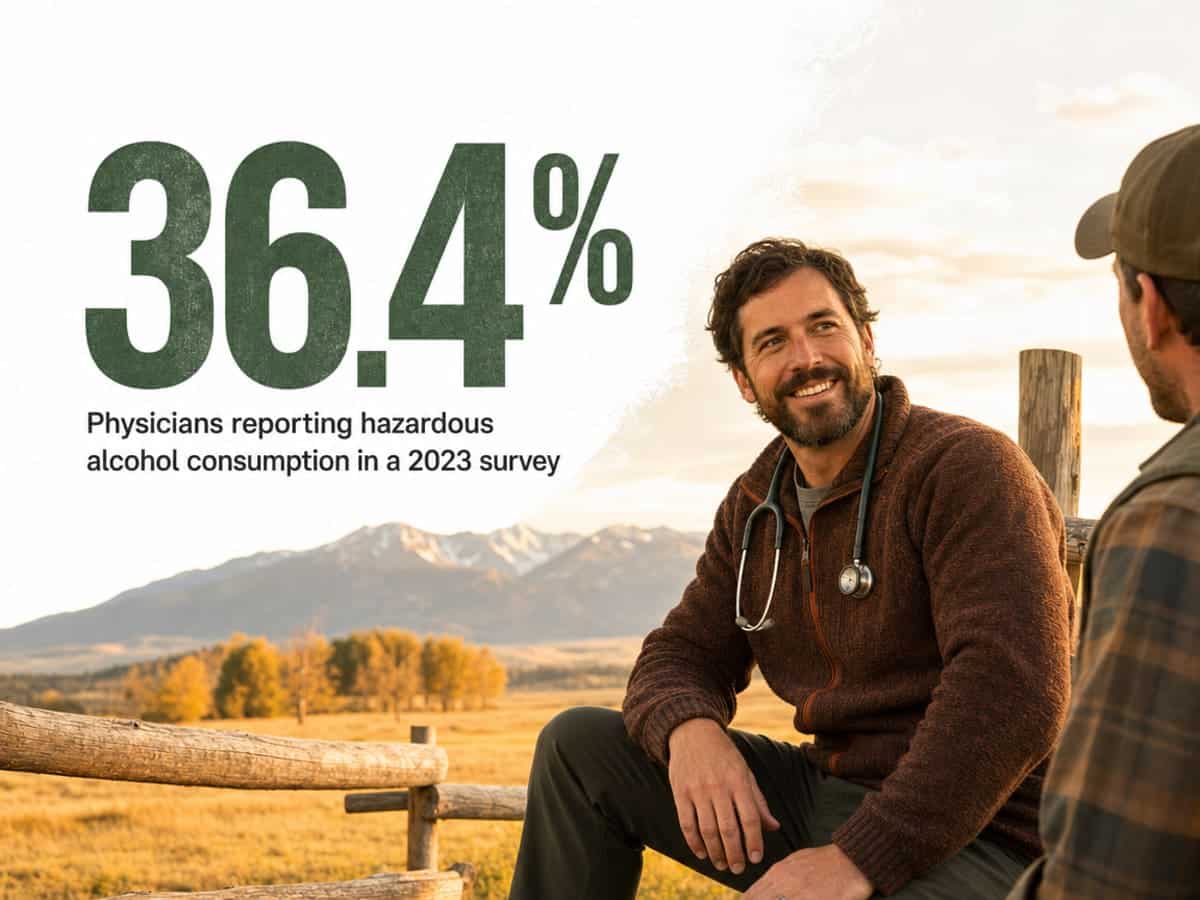
Global reviews estimate that 10–15% of healthcare professionals misuse drugs at some point in their careers, and 6–8% of physicians meet criteria for a substance use disorder 1. Those are worldwide figures with all the caveats that come with self-reported data in a profession where disclosure can end a career, so the real numbers are almost certainly higher. Among nurses, a review of the literature places substance misuse and addiction rates as high as 14–20% 2. A 2023 survey of physicians found 36.4% reporting hazardous alcohol consumption in the year measured 10. Different studies, different methods, same message: this is not a rare condition happening to a handful of unlucky people. It is happening across every role, every shift, every specialty.
Think about what those percentages mean in a normal week. The charge nurse who covers your breaks. The hospitalist who signs your orders. The CNA who trained you on transfers. The tech who runs your labs. Statistically, someone in that group is fighting the same fight you are, quietly, right now, and probably telling themselves the same thing you tell yourself: I am handling it. I have to.
You are not broken in a way no one else is broken. You are inside a profession that runs on adrenaline, grief, and 12-hour shifts, and a meaningful slice of that profession has landed exactly where you have landed. That does not make the problem smaller. It does mean the shame you are carrying is out of proportion to how common this actually is.
The team at Rocky Mountain Treatment Center has seen this pattern for decades in Great Falls. Nurses, aides, medics, respiratory therapists, physicians. Different badges, same story. You are joining a group that is much larger and much more familiar than the isolation in your head is telling you.
Why discretion is not optional in this profession
In most jobs, a struggle with alcohol is a private problem. In yours, it is also a licensing question, a patient safety question, and a payroll question. That is not fair, but it is the environment you signed up for the day you took your boards. Pretending otherwise would insult your intelligence.
The research on your colleagues backs up what your gut has been telling you. A 2023 survey of physicians found that 66.9% rated privacy and anonymity as highly important when seeking care for a substance use disorder 10. That is not a soft preference. That is two out of three doctors saying, in effect, I will not walk through that door unless I know who is watching. The same survey mapped the barriers keeping physicians out of treatment: denial, self-medication, fear of judgment from peers, and worry about who might see their records 10. If you have felt any of those, you are not being dramatic. You are responding, sensibly, to a profession that has historically treated impairment as a character flaw first and a medical condition second.
The nursing literature tells a similar story. Reviews of nurse addiction have long argued that punitive, exposure-first responses drive nurses deeper into hiding, and that confidential, non-punitive programs are what actually get people into care 2. When the cost of asking for help feels like your livelihood, most people stop asking. That is not weakness. That is math.
This is why a discreet residential setting matters more for you than it might for someone in a different field. It is not about hiding. It is about giving you a fair shot at recovery without the process itself becoming the thing that ends your career. The Rocky Mountain Treatment Center approach in Great Falls is built with this in mind: small census, careful intake, quiet admission, and a team that understands that the woman in the parking lot with a suitcase is also somebody’s charge nurse. You get to be a patient here first, and a clinician second, in the order that actually helps you heal.
What actually protects your license and your record
Here is the part most people never get explained to them clearly, because the pages that talk about it are written for lawyers instead of the person on the other end of the pager. There is a real stack of protections that stands between your admission and your employer’s HR inbox. It is not a promise on a brochure. It is federal law, layered with Montana licensing statute, and it exists specifically because legislators understood that people in your position will not seek care if the door swings both ways.
The foundation is 42 CFR Part 2, the federal rule that governs substance use disorder records. In plain language: a federally assisted treatment program cannot share any information that would identify you as someone with a substance use disorder without your specific, written consent 3. That covers your identity, your diagnosis, your prognosis, and your treatment. Not to your manager. Not to your hospital’s medical staff office. Not to a colleague who calls the front desk pretending to check on a friend. The regulation itself says these records “may not be disclosed” without patient consent or narrow legal authority 4.
HIPAA sits on top of that as a second layer, governing your protected health information more broadly. But Part 2 is stricter than HIPAA in one direction that matters to you: it also controls redisclosure. If you sign a consent form allowing the treatment center to talk to, say, your board’s monitoring program, that recipient cannot then turn around and share the information further without another consent from you 6. The chain of custody stops where you say it stops.
There is also a documentation practice worth knowing about. Federal guidance on SUD screening advises programs to use neutral chart notations and to consult patients about what gets disclosed and to whom 5. When you sit down for intake at a program like the one in Great Falls, you are not signing away control. You are the one deciding which doors open.
On top of the federal floor, Montana has its own framework built for licensees. The Montana Board of Nursing is required by statute to run a medical assistance program for nurses impaired by alcohol, addictive drugs, or mental illness—one designed to help them into treatment and monitor rehabilitation rather than punish first and ask questions later 7. Physicians have a parallel structure through the Board of Medical Examiners, which operates an assistance, rehabilitation, and after-care monitoring program that explicitly encourages rehabilitation when public safety can be assured 8. These programs are the reason a nurse or physician in Montana can go through residential treatment and come out the other side still holding a license, provided the process is handled correctly.
Put the pieces together and here is what it means for you in practical terms:
- Your admission to Rocky Mountain Treatment Center is protected by Part 2.
- Your medical records are protected by HIPAA.
- Your license is governed by a Montana board that has a treatment-oriented pathway built into its own rules.
Nothing moves from one of those buckets to another without your signature. If you decide to loop in a board assistance program because it helps you stay employed while you get well, you choose when and how much. If you decide not to, that is also your choice to make with your counselor, not a decision the facility makes over your head.

Why a 26-bed facility protects you better than a 200-bed campus
Size is not a marketing detail here. It is a privacy variable, and it changes what your stay actually feels like from the first hour.
Picture a 200-bed corporate campus somewhere off an interstate. Rolling admissions, multiple wings, a cafeteria line, group therapy rooms that turn over every hour. Now do the math on who else is in that building on any given day. Traveling nurses between contracts. Former patients you discharged. A respiratory therapist from the hospital two towns over. The pharmacy rep who calls on your unit. In a building that size, the odds of a familiar face are not theoretical. They are a Tuesday.
Rocky Mountain Treatment Center has 26 beds. That is the entire census. You will see the same small group of people at breakfast, in group, on the walking path, and at evening reflection. The intake team knows which shift you worked last week. The counselors know which chair you sit in. Nobody is checking you in as a room number.
Smaller also means the admission process itself is quieter. A large facility often runs intake in a shared waiting area with paperwork moving through several hands before it lands with a clinician. In Great Falls, your arrival is handled by a small team that already knows you are coming and already knows why the discretion matters. Federal law under 42 CFR Part 2 sets the floor for what a program can share about you 3, but the number of people who ever touch your file inside the building is a separate question, and it is a much shorter list here.
The other quiet advantage is geography. Great Falls is not on the standard rehab tourism map. You are not walking into a nationally branded campus that half your unit has heard of. You are walking into a small residential program in central Montana where the front door does not face a highway billboard.
If your first fear when you imagine treatment is who will see me, that fear deserves a real answer. A smaller room, fewer hallways, and a team that can actually keep track of who you are is a better answer than a bigger brochure.
The team you would work with has been where you are
One of the harder parts of asking for help as a clinician is the fear of being read like a chart. You have spent years doing the reading. You know what the raised eyebrow means when a patient minimizes their intake. You do not want to sit across from someone doing that to you.
At Rocky Mountain Treatment Center, more than 80% of the staff are in recovery themselves. That is not a slogan on a wall. It is the person handing you your intake paperwork, the counselor running your first group, the tech walking the hallway at night. They have sat in the chair you are about to sit in. Some of them are nurses and aides who lost jobs and got them back. Some are people who used to hide bottles in the same places you hide yours.
What that changes, practically, is the temperature of the conversation. You do not have to translate what a 12-hour shift does to a body, or explain why a pyxis override still shows up in your dreams. The person listening already knows. Reviews of nurse addiction have argued for years that non-punitive, peer-informed settings are what actually pull clinicians into care instead of pushing them further into hiding 2. The Great Falls team is built around that finding, not despite it.
You are not walking in to be diagnosed by strangers. You are walking in to be met by people who have already made the walk.
What 30, 60, and 90 days actually look like against a shift schedule
The first question most clinicians ask is not will this work. It is how do I disappear from the schedule long enough for it to work. That is a fair question, and it has a real answer that does not require you to burn down your career on the way in.
Start with the medical piece. The first several days of a residential stay in Great Falls are focused on supervised detox, monitored by clinical staff so that alcohol or drug withdrawal does not become the emergency. You are not expected to power through this. Your body has been holding a lot, and it gets to rest. For most people, this week feels less like treatment and more like finally being allowed to stop.
A 30-day stay is the shortest of the three tracks. Detox rolls into individual counseling, group work, family sessions, and the 12-step foundation the program is built around. Against your work calendar, 30 days lines up cleanly with the federal Family and Medical Leave Act (FMLA) window most healthcare employers use, and it is short enough that accrued PTO plus FMLA often covers the gap without requiring a detailed public explanation. Your manager gets a leave form, not a diagnosis.
A 60-day stay gives you a second month to actually change something. The first 30 days pull the substance out. The next 30 days let you start rebuilding around the empty space. This is the range where clinicians who have been white-knuckling for years tend to say the ground finally stopped moving. If your role involves controlled substance access, an extra month of documented residential care is also the kind of engagement the Montana Board of Nursing assistance program and the Board of Medical Examiners impaired-provider program tend to see as serious rehabilitation rather than a check-the-box stint 7, 8.
A 90-day stay is the longest and, for many healthcare workers, the most protective of the license itself. Ninety days lets equine therapy, family week, dual-diagnosis work for anxiety or depression, and repeated group cycles do their slow work. It also gives a board monitoring agreement, if you enter one, a substantive treatment history to build on rather than a two-week snapshot. Coming back to a shift with 90 days of structured recovery behind you is a different re-entry than coming back with two.
Whichever length you choose, continuing care with the Great Falls team does not stop at discharge. Weekly Zoom groups and structured check-ins at 30, 60, 90, 180, and 365 days keep the connection open on your schedule, not the clinic’s. You can dial into aftercare from a break room, a car, or a quiet room at home. The stay ends. The relationship does not.
Coordinating with Montana licensing boards without losing control of the story
If you decide to loop in a Montana licensing board, the goal is simple: you tell the story, not the other way around. Both the Board of Nursing and the Board of Medical Examiners run assistance-oriented programs that are built to work alongside treatment, not against it 7, 8. That means the sequence you choose matters more than most clinicians realize.
The version that tends to protect people best is this one:
- You get into treatment first.
- You start supervised detox, you begin counseling, you have a real clinical record in progress.
- Then, with your counselor, you decide what a board conversation looks like—if and when it happens.
Because your treatment records at Rocky Mountain Treatment Center are protected under 42 CFR Part 2, nothing goes from the Great Falls team to a board without your written consent, and any consent you sign controls what can be redisclosed after that 4, 6.
Federal guidance also supports the practice of neutral chart notations and patient consultation about disclosures, which means you should expect to be part of the conversation about wording, not handed a form after the fact 5. If a board monitoring agreement becomes part of your path forward, the treatment center can document engagement, attendance, and progress in the specific language the board needs—no more, no less. You are not signing a blank check.
The point to hold onto is that a Montana board is not a trapdoor. It is a program with its own rehabilitation-oriented rules 7, 8, and you get to walk into that conversation already in treatment, already stabilizing, already the person doing the work.
Reaching out without leaving a trail
The first call is the one that feels the biggest, so it helps to think through the small stuff before you dial:
- Use your personal phone, not the one your employer pays for.
- Call from your car, your kitchen, or a quiet spot outside the building where you work—anywhere the number that shows up on the other end is yours alone.
- If you would rather not talk yet, the Rocky Mountain Treatment Center site has a contact form you can fill out from a personal browser in a private window.
Either way, you control the entry point.
Insurance is the next quiet worry, and it is worth naming. When benefits are verified for a residential admission, the information exchanged with your insurer is governed by the same federal confidentiality rules that cover the rest of your treatment record 3. Your explanation of benefits may show a claim, but the details are protected, and nothing flows back to your employer or your board without your written consent.
You do not have to have a plan today. You do not have to know which length of stay is right, or how you will explain the time off. You only have to make contact. The Great Falls team can walk through the rest with you, one quiet step at a time. That call you have been rehearsing in your head is smaller than the fear around it, and you are already closer than you were yesterday.
Frequently Asked Questions
Will my employer or licensing board automatically find out if I check into residential treatment?
No. Under 42 CFR Part 2, a federally assisted treatment program cannot share information identifying you as a person with a substance use disorder without your written consent 3, 4. Your employer, your unit manager, and your licensing board do not get a notification when you admit to Rocky Mountain Treatment Center. Any conversation with a board assistance program or employer happens only if you choose it, and you decide the wording.
Can I keep my nursing or medical license while going through inpatient rehab in Montana?
Yes, in most cases. The Montana Board of Nursing runs a statutorily required medical assistance program that helps impaired nurses into treatment and monitors rehabilitation rather than defaulting to discipline 7. The Board of Medical Examiners operates a parallel assistance, rehabilitation, and after-care monitoring program for physicians and other licensed providers, and explicitly encourages rehabilitation when public safety can be assured 8. Engaging in residential care is often what preserves the license, not what threatens it.
How do I take 30, 60, or 90 days away from my shift schedule without raising red flags?
Most healthcare workers use a combination of accrued PTO and FMLA. A 30-day stay usually fits inside a single FMLA leave window without a detailed explanation to your manager. Your employer receives a leave certification from a clinician, not a diagnosis. Longer stays of 60 or 90 days often still fit within FMLA’s 12-week protection. Your admissions team in Great Falls can help you time the paperwork so the leave request looks routine.
What if a coworker or former patient recognizes me at the facility?
The 26-bed size in Great Falls makes this much less likely than at a large corporate campus, and the intake team can flag conflict concerns before admission. If a recognition does happen, every person inside the building is bound by the same confidentiality expectations you are, and staff communications are governed by 42 CFR Part 2 3, 4. Your presence cannot be confirmed to anyone outside without your signed consent. Recognition is not the same as disclosure.
Do I have to self-report to the Montana Board of Nursing or Board of Medical Examiners before I get treatment?
Not before you get help. Montana’s board programs are structured to support licensees entering treatment, and both are rehabilitation-oriented rather than punishment-first 7, 8. Whether and when to engage the assistance program is a decision you make with your counselor once you are stable, not a prerequisite to admission. Federal guidance also supports patient consultation on any disclosures 5. Get the clinical care in motion first, then decide the board conversation on your terms.
How can I make the first call without leaving a record on my work phone or insurance?
Use your personal phone from a private location, or fill out the Rocky Mountain Treatment Center contact form in a private browser window. Skip the work laptop and hospital Wi-Fi. Insurance verification is covered by the same federal confidentiality rules that protect your treatment record 3, so claim details do not flow to your employer or board. If you want to pay privately for the intake conversation, ask the admissions team about that option directly.
References
- Substance use among healthcare professionals. https://pmc.ncbi.nlm.nih.gov/articles/PMC11932460/
- Don’t ask don’t tell: Substance abuse and addiction among nurses. https://pmc.ncbi.nlm.nih.gov/articles/PMC6415967/
- Understanding Confidentiality of Substance Use Disorder Patient Records (Part 2). https://www.hhs.gov/hipaa/part-2/index.html
- 42 CFR Part 2 – Confidentiality of Substance Use Disorder Patient Records. https://www.law.cornell.edu/cfr/text/42/part-2
- Appendix B—Legal and Ethical Issues in Screening and Assessing Adults for Substance Use Disorders. https://www.ncbi.nlm.nih.gov/books/NBK64825/
- Confidentiality protections versus collaborative care in the treatment of substance use disorders. https://pmc.ncbi.nlm.nih.gov/articles/PMC3766245/
- Montana Code Annotated Title 37, Chapter 8 – Nursing. https://boards.bsd.dli.mt.gov/_docs/mca/2019-MCA-Title-37-Ch-8-NUR—Nursing.pdf
- Mont. Admin. r. 24.156.430 – Impaired Physician Program. https://www.law.cornell.edu/regulations/montana/Mont-Admin-r-24.156.430
- Mont. Admin. r. 24.162.2301 – Unprofessional Conduct (Nursing Home Administrators). https://www.law.cornell.edu/regulations/montana/Mont-Admin-r-24.162.2301
- Substance use among physicians: How do they perceive the creation of a dedicated healthcare system?. https://pmc.ncbi.nlm.nih.gov/articles/PMC10752955/