Key Takeaways
- Montana licenses residential SUD facilities through DPHHS, and the HEART 1115 Medicaid demonstration expanded access to residential care, though 92% of Montanans with a substance use disorder still go untreated 11.
- Equine assisted therapy is not a standalone cure; research shows it helps with emotion regulation, self-efficacy, and self-esteem when layered alongside detox, counseling, and 12-step work 12.
- Staying in Montana for treatment keeps family close, shortens travel, and lets aftercare fit the life you’re rebuilding, which matters in a state shaped by long drives and alcohol-heavy social norms 4.
- Call a licensed Montana program and ask about bed availability, insurance verification, and transportation; if Medicaid is your coverage, request a referral to a HEART-participating facility 1.
The First Time You Walk Into a Barn Sober
If you’re reading this at 2 a.m., trying to figure out whether a place with horses could actually help you or someone you love stop drinking, take a breath. You’re not the first person to end up here. And you’re not weak for looking.
Maybe you’ve tried before. Maybe this is your first real search. Either way, picture it for a second: a Montana morning, the kind where your breath still shows. Gravel under your boots. A barn door sliding open. A horse turns its head, ears forward, and just looks at you. No lecture. No judgment. No small talk about how you ended up here.
That first quiet moment is what a lot of people remember when they talk about equine assisted therapy in Montana. Not a miracle. Not a movie scene. Just the surprising feeling of a big animal treating you like you’re worth paying attention to, on a morning when you’re not sure you agree.
Here’s the honest part, up front: horses will not detox you. They will not walk you through a step study or sit with your spouse during family week. But when they’re woven into a full residential program, the kind licensed by Montana and built around counseling, medical care, and community, they can help you feel something again. Groundedness. Trust. A body that isn’t buzzing.
This guide walks you through what equine assisted therapy really is, what the research shows, how it fits into Montana treatment, and how a place like Rocky Mountain Treatment Center in Great Falls uses it as one piece of a bigger, gentler picture. You get to take it slow.
What Equine Assisted Therapy Actually Is (and Isn’t)
Let’s clear something up early, because the phrase gets tossed around a lot. Equine assisted therapy isn’t a trail ride. It isn’t a petting zoo. And in a real treatment setting, it isn’t the horse doing the therapy while a counselor stands off to the side sipping coffee.
Here’s what it actually looks like on a typical morning. You meet a licensed counselor and an equine specialist in a barn or arena. You spend time on the ground with a horse. You might brush her. You might learn how to lead her across the arena without a rope, using only your body language. You might just stand next to her and breathe. Afterward, the group sits down and talks about what happened. Who felt frustrated when the horse didn’t move? Who wanted to give up? Who noticed their shoulders drop for the first time in months?
That last part, the talking, is where equine work quietly connects to the rest of your treatment. The 2022 scoping review of equine-assisted services for people with substance use and mental health disorders describes the outcomes these sessions target: emotion regulation, self-esteem, interpersonal functioning, and staying engaged in treatment 2. Those aren’t small things when you’re trying to stop drinking. They’re the muscles that keep you in the room on day four when everything in you wants to leave.
Now the isn’t part. Equine assisted therapy isn’t a substitute for medical care during the first shaky days when your body is clearing alcohol. It isn’t a substitute for a counselor who knows your history, or for a group of people in the same fight as you. It isn’t a fast track. And it isn’t for everyone. Some folks feel the connection right away. Others take a week. A few never quite click with the horse and click hard with something else, like hiking or music or family sessions.
At Rocky Mountain Treatment Center in Great Falls, equine work sits alongside detox, individual and group counseling, 12-step meetings, family programming, and other experiential pieces. It’s one thread. Not the whole rope.
What the Research Actually Says About Horses and Alcohol Recovery
You deserve straight talk here, not a sales pitch. So let’s look at what the studies actually show, including the parts that are still uncertain.
Start with the good news. A 2023 randomized controlled trial found that adding equine-assisted therapy to standard substance use treatment produced significant improvements in three things that matter a lot when you’re trying to stay sober: emotion regulation (handling the wave of a bad afternoon without reaching for a drink), self-efficacy (believing you can actually do this), and perceived self-esteem 12. That study was specifically about adults in SUD treatment, not a general wellness group, which makes it more relevant to your situation than a lot of the horse-therapy content floating around online.
A broader 2022 scoping review of equine-assisted services for people with substance use and mental health disorders found what the authors called “preliminary evidence” of benefit for mental health symptoms, self-regulation, and social functioning 2. Preliminary is the honest word. It means the direction looks promising, but there aren’t enough large, high-quality trials yet to say something bold like “horses will help you quit drinking.” Anyone who tells you that is selling something.
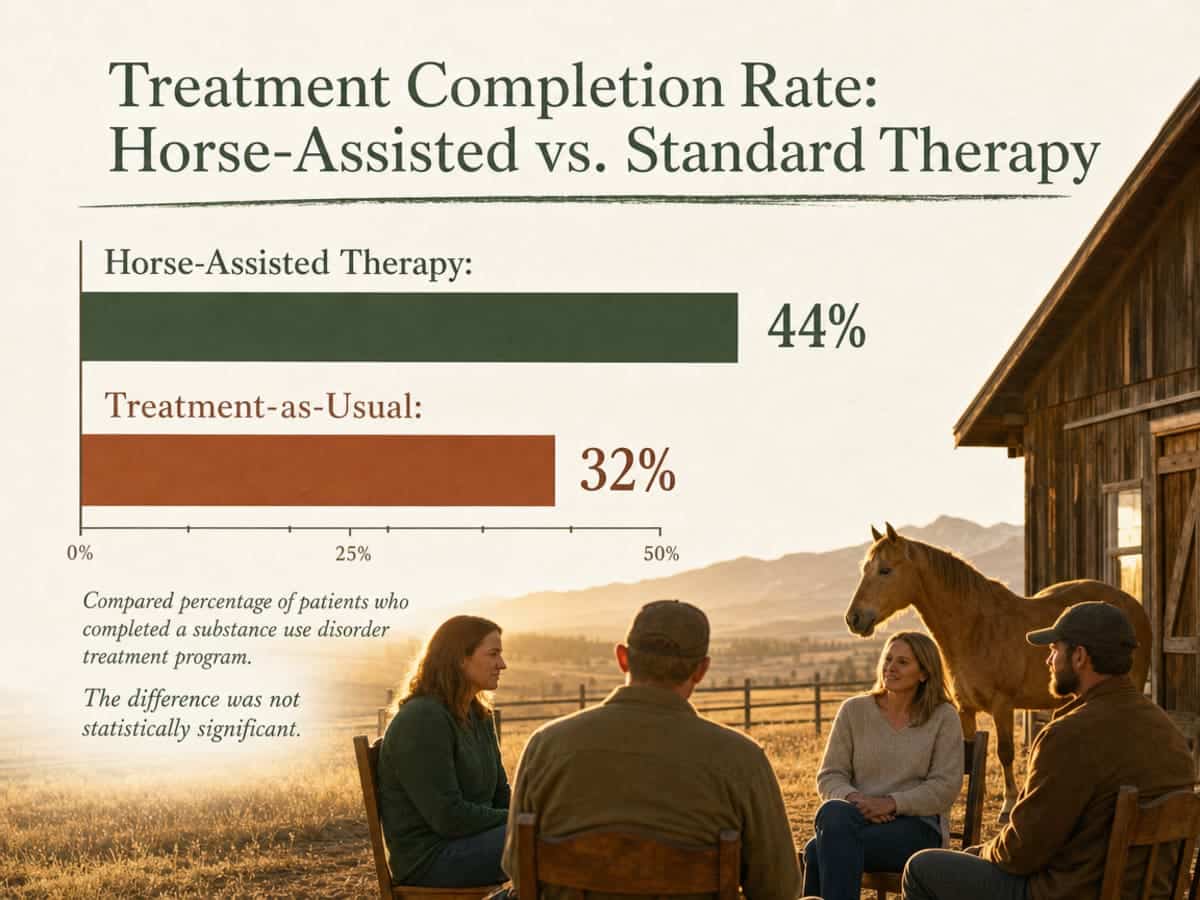
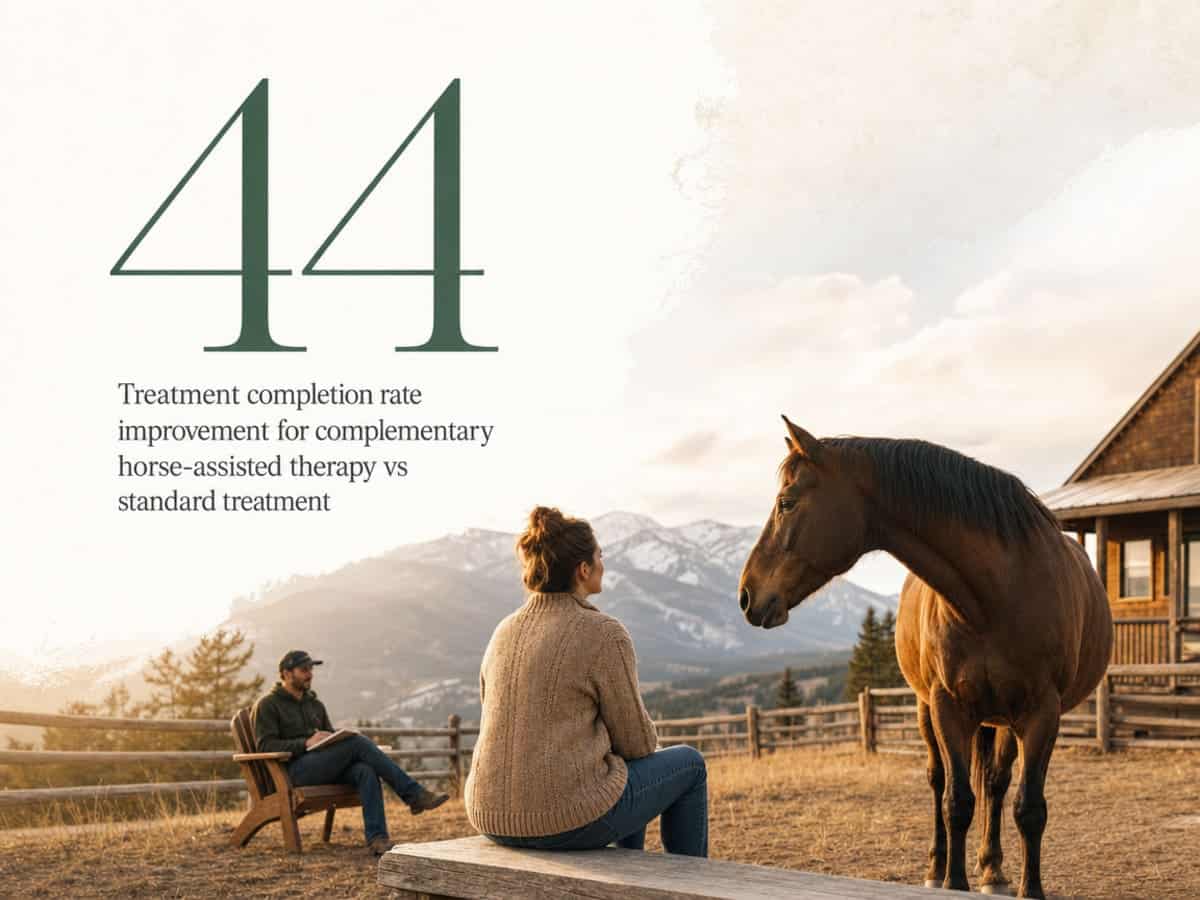
Now the mixed part. In 2020, researchers ran a randomized controlled trial comparing standard inpatient substance use treatment against the same treatment plus complementary horse-assisted therapy. Completion rates favored the horse group: 44% of participants who got horses finished their program, compared to 32% who got treatment alone 3. That’s a real difference on paper. But the study authors were clear that the gap did not reach statistical significance, likely because the sample was too small to prove the pattern wasn’t chance 3. So: encouraging trend, not confirmed result.
At Rocky Mountain Treatment Center, equine work is offered in that spirit. It’s a chance to build coping muscles alongside detox, counseling, and 12-step support, not a replacement for any of them. If the horse helps you take one steadier breath in group the next day, that’s a win worth counting.
Why Montana, Specifically
You could technically look for equine work in any state with pastures and a barn. So why does it matter that you’re searching from Montana?
Start with the hard number. Montana’s Substance Use Disorders Task Force Strategic Plan reports that 92% of Montanans with a substance use disorder are not receiving treatment 11. Read that again. If you or someone you love is looking for help right now, you are already in the small minority who are actually reaching for it. That’s not nothing. That’s a real step, taken on a hard day, in a state where most people never make the call.
The reasons behind that gap are the ones you already know if you live here. Long drives. Small towns. Winters that swallow appointments. A culture that quietly says handle it yourself. Alcohol woven into ranch work, hunting weekends, and Friday nights at the bar in a way that makes stopping feel like leaving your own community. The state’s 2024 alcohol use report backs up what you’re feeling: binge drinking and alcohol-related harms remain among Montana’s leading behavioral health concerns 4.
Here’s why equine work fits Montana in particular. This is a state where a lot of people grew up around horses, or at least around the idea of them. A barn isn’t a foreign place. For someone who feels ashamed walking into a clinical building, walking into an arena can feel more like home. It lowers the drawbridge just enough to get through the first week.
Staying in Montana for treatment also means your family can actually show up. Your partner can drive to family week. Your kids can visit. Your aftercare doesn’t have to survive a plane ticket. Rocky Mountain Treatment Center sits in Great Falls, in the middle of the state, and offers a complimentary Montana pickup so the logistics don’t become another reason to quit before you start. You don’t have to figure that part out alone.
The point isn’t that Montana is special because of its scenery. It’s that recovery works better when it’s close enough to the life you’re actually trying to rebuild.
How Equine Work Fits Inside a Real Residential Program
If you’ve never been in residential treatment before, it can be hard to picture how a barn session actually connects to the rest of your day. So let’s walk through it.
The first days of a stay are usually the hardest. Your body is clearing alcohol. You might be shaky, sleepless, sweating through sheets, and wondering if you made a mistake. During this stretch, you’re not going anywhere near a horse. You’re in medically monitored detox, where nurses check your vitals, help with symptoms, and make sure the withdrawal doesn’t hurt you. That’s not the horse’s job. That’s medicine’s job.
Once your body settles, the real weaving begins. A typical week starts including individual counseling, where you sit with one person and unpack the story under the drinking. Group counseling, where you hear other people say things you thought only you had thought. 12-step meetings. Family sessions when your people are ready. And somewhere in the middle of that schedule, an equine session.
Here’s why the order matters. The 2022 scoping review points out that equine work seems to help most with emotion regulation, self-esteem, and staying engaged in treatment 2. Those are exactly the things a counseling session the next day can build on. You struggled to stay calm when the horse wouldn’t follow you? That’s a conversation with your counselor. You noticed the horse didn’t care about your job title or your rock bottom? That’s a group share. The barn gives you raw material. The therapy room turns it into something you can use.
The mechanisms behind this are quieter than people expect. Research on nature-based equine interventions points to reduced anxiety, better emotional regulation, and a stronger sense of connection with the humans helping you 8. In plain language: horses can lower your guard just enough for the harder work to land.
At Rocky Mountain Treatment Center, the schedule reflects that layering. Detox comes first. Then a rhythm of counseling, 12-step, family programming, and experiential pieces like equine work, hiking, and recreation. Roughly 80% of the staff are in recovery themselves, so when you walk from the barn back into a group room, the person leading it likely knows what your Tuesday feels like from the inside. That continuity, from pasture to counselor to peers, is the point. The horse opens a door. The rest of the program walks you through it.
How Montana Regulates and Pays for This Kind of Care
The barn part gets the attention. The paperwork behind it doesn’t. But if you’re trusting a program with your recovery, it helps to know the guardrails are real.
Any residential substance use treatment facility in Montana has to be licensed by the state Department of Public Health and Human Services. That’s not a suggestion. Montana Code Annotated 53-24-302 requires SUD facilities to meet DPHHS standards for staffing, services, and safety before they can open their doors 7. So when a program tells you they offer inpatient care, that license is the floor, not the ceiling. Ask about it. A reputable place will tell you without hesitation.
On the horse side, Montana has its own rules. The state’s equine liability statute (MCA 27-1-727) limits what an equine professional is liable for when it comes to the inherent risks of being around horses, but only if they meet requirements around posted warnings and written waivers 6. That’s why you’ll sign paperwork before you ever pick up a lead rope. It’s not bureaucracy for its own sake. It’s the state making sure everyone knows horses are animals, not machines.
Now the money question, because it’s often the one that keeps people from calling. Montana’s HEART 1115 Medicaid demonstration expanded coverage for a full continuum of substance use treatment, including residential care at ASAM 3.1 and 3.5 levels. In state fiscal year 2024, 1,350 Montanans received ASAM 3.5 residential SUD treatment through HEART-expanded services 1. That’s meaningful access for people with Medicaid coverage.
What to Look For When You Call a Program
Making the first call is often the hardest part. Your hands might shake. Your voice might crack. That’s okay. The person on the other end has heard it before. What matters is what you listen for while you’re on the phone.
- Ask if they’re licensed by DPHHS. Any residential substance use treatment facility in Montana is required to be, and a reputable place will answer that question in one breath 7. If they get vague, hang up. You deserve better than vague.
- Ask what a typical day looks like. You want to hear about medical care during those first shaky days, individual counseling, group work, and how experiential pieces like equine sessions actually connect to the therapy room. If they describe horses as the main event, gently press for more. The 2022 scoping review on equine-assisted services is clear that these sessions work best as a complement to core treatment, not a replacement 2. A program that understands that will explain the weaving without prompting.
- Ask who leads the equine sessions. You want a licensed mental health professional working alongside an equine specialist, not just a horse handler. And ask about the paperwork. Montana’s equine liability statute requires posted warnings and written waivers before you handle a horse, so a legitimate program will walk you through that 6.
- Ask about family. Can your spouse come for a week? Can your kids visit? Can your parents call your counselor? Recovery that ignores your people rarely holds.
- Ask about aftercare. What happens on day 31, or day 91, when you go home? A program that only talks about the residential stay is only telling you half the story.
- Finally, ask about money before you get too far in. Which insurance plans do they take? Do they accept Medicaid? Rocky Mountain Treatment Center works with most major insurance providers but does not currently accept Medicaid or Medicare, so if that’s your coverage, ask them to point you toward a HEART-participating option 1. A good program will help you find the right door, even if it isn’t theirs.
One Montana Example: Rocky Mountain Treatment Center in Great Falls
You’ve read what equine work is, what the research supports, and how Montana shapes access. Here’s what it looks like in one real place, so you have something concrete to hold onto.
Rocky Mountain Treatment Center has been in Great Falls since 1983. It’s a 26-bed residential facility, Joint Commission accredited and licensed under Montana’s DPHHS framework for substance use treatment 7. Small on purpose. When you walk in, you’re not a chart number in a wing of two hundred. You’re one of a couple dozen people trying to get their lives back, with counselors who mostly know the walk from the inside. Roughly 80% of the staff are in recovery themselves.
The program runs 30, 60, and 90-day residential stays. It starts with medically monitored detox, then layers in individual counseling, group work, 12-step meetings, family programming including a three-day Family Week, and experiential pieces like equine sessions, hiking, and recreation. Equine work isn’t the headline. It’s one honest thread in the weave, targeting the same skills the 2023 SUD trial found equine sessions can strengthen: emotion regulation, self-efficacy, and self-esteem 12.
Practical things that often matter more than a brochure: complimentary Montana pickup, so getting there isn’t a solo drive on a bad day. Same-day admission when a bed is open. Aftercare that follows you at 30, 60, 90, 180, and 365 days post-discharge, plus weekly Zoom groups. RMTC works with most major insurance providers but does not currently accept Medicaid or Medicare, so if HEART-covered care is your route, a HEART-participating program is the right call 1.
Making the Call
You’ve read enough. You know what horses can do and what they can’t. You know Montana is hard on people trying to stop drinking, and that being one of the folks actually reaching for help puts you in rare company.
So here’s the small next step. Not the whole staircase. Just the step.
Pick up the phone. If you’re calling Rocky Mountain Treatment Center in Great Falls, ask three things: whether a bed is open, whether they can run your insurance today, and whether Montana pickup can be arranged so you don’t have to drive yourself on the worst morning of the year. If Medicaid is your coverage, ask them to point you toward a HEART-participating program instead 1. Either way, you’ll be further along than you were an hour ago.
The horse will still be there when you arrive.
Frequently Asked Questions
Can equine assisted therapy replace detox or counseling for alcohol addiction?
No, and any program telling you otherwise isn’t being honest with you. Horses can’t manage withdrawal symptoms when your body is clearing alcohol, and they can’t replace a counselor who knows your story. In reputable Montana programs like Rocky Mountain Treatment Center, equine work sits alongside medically monitored detox, individual and group counseling, and 12-step support, not in place of any of them.
Do I need to have experience with horses to benefit from equine therapy?
Not at all. Most people who walk into their first session have never touched a horse. That’s actually part of the point. You get to be a beginner at something, which is a rare feeling for adults. The equine specialist and counselor teach you what you need to know. If you’re nervous, say so. Nervous is a normal place to start.
Is equine assisted therapy covered by insurance or Medicaid in Montana?
Coverage depends on your plan and the program. When equine sessions are woven into a licensed residential level of care, they’re generally billed as part of the overall treatment stay rather than as a separate line item. Montana’s HEART 1115 demonstration expanded Medicaid coverage for residential SUD treatment at HEART-participating facilities 1. Rocky Mountain Treatment Center works with most major insurance providers but does not currently accept Medicaid or Medicare.
What actually happens during an equine therapy session in residential treatment?
You meet a licensed counselor and an equine specialist in a barn or arena. You might groom a horse, learn to lead her without a rope, or just stand next to her and notice what your body does. Nobody’s making you ride. Afterward, the group sits down and talks about what came up — frustration, calm, memories, whatever surfaced. That reflection is where the session connects back to your counseling work.
Is there real evidence that equine therapy helps people recover from alcohol addiction?
There’s promising evidence, and it’s fair to call it that rather than overselling it. A 2023 randomized controlled trial found equine-assisted therapy significantly improved emotion regulation, self-efficacy, and self-esteem in adults with substance use disorders 12. Broader reviews call the field’s overall state “preliminary” and note more rigorous trials are still needed 2. The takeaway: horses aren’t a cure, but as a complement to core treatment, the direction of the evidence is encouraging.
How do I find a reputable equine assisted therapy program in Montana?
Start with licensing. Any residential SUD facility in Montana must be licensed by DPHHS, so ask that first 7. Then ask how equine work connects to counseling, who leads the sessions, and what aftercare looks like. If you’re near central Montana, Rocky Mountain Treatment Center in Great Falls offers equine sessions inside a full residential program and provides complimentary Montana pickup so getting there isn’t another obstacle.
References
- Healing and Ending Addiction Through Recovery and Treatment (HEART) Initiative Report. https://archive.legmt.gov/content/Committees/Interim/2023-2024/Children-Families/CFHHS_Meetings/2024_Sept_11/16-12-122-Healing-and-Ending-Addiction-Through-Recovery-and-Treatment-Report-FINAL.pdf
- Equine-assisted services for individuals with substance use and other mental health disorders: A scoping review. https://pmc.ncbi.nlm.nih.gov/articles/PMC9749232/
- Complementary horse-assisted therapy for substance use disorders: A randomized controlled trial. https://pubmed.ncbi.nlm.nih.gov/32019584/
- Alcohol Use in Montana: 2024 Report. https://dphhs.mt.gov/assets/BHDD/PreventionResources/AlcoholUse2024Final.pdf
- 2023 Montana State Report: Underage Drinking Prevention and Enforcement. https://library.samhsa.gov/sites/default/files/montana-iccpud-state-report-2023.pdf
- Montana Code Annotated 27-1-727: Equine liability limitations. https://leg.mt.gov/bills/mca/title_0270/chapter_0010/part_0070/section_0270/0270-0010-0070-0270.html
- Montana Code Annotated 53-24-302: Substance use disorder treatment facilities – licensing. https://leg.mt.gov/bills/mca/title_0530/chapter_0240/part_0030/section_0020/0530-0240-0030-0020.html
- Nature-based interventions and health: A scoping review of equine-assisted therapy. https://pmc.ncbi.nlm.nih.gov/articles/PMC8866013/
- Equine-assisted activities and therapies in mental health: A review of the evidence and future directions. https://pmc.ncbi.nlm.nih.gov/articles/PMC9057139/
- 2023 Substance Abuse Block Grant (SABG) Report – Montana DPHHS. https://dphhs.mt.gov/assets/BHDD/Prevention/substanceabuseblockgrant/2023SABGReport.pdf
- Montana Substance Use Disorders Task Force Strategic Plan – DPHHS. https://dphhs.mt.gov/assets/publichealth/EMSTS/opioids/MontanaSubstanceUseDisordersTaskForceStrategicPlan.pdf
- Equine-assisted therapy effectiveness in improving emotion regulation, self-efficacy, and self-esteem among patients with substance use disorders. https://pubmed.ncbi.nlm.nih.gov/37833688/
- Investigating the Effects of Equine-Assisted Therapy in Individuals with Schizophrenia. https://pubmed.ncbi.nlm.nih.gov/40258216/