Key Takeaways
- Definition: Equine therapy is an experiential treatment where you interact with horses on the ground to build emotional awareness, trust, and coping skills.
- Key Characteristics:
- Horses provide immediate, non-judgmental feedback by mirroring your emotions.
- Activities are ground-based (no riding) and include grooming, leading, and observing.
- It helps lower stress, improve heart rate variability, and build self-confidence.
- Who It’s For: This therapy is most relevant for individuals recovering from addiction, trauma, anxiety, or depression who benefit from a hands-on, active approach to healing.
How Does Equine Therapy Work?
At Rocky Mountain Treatment Center, we believe in holistic healing that goes beyond the traditional office setting. If you are wondering how does equine therapy work, it begins with stepping outside and connecting with a living, breathing partner in your recovery. Equine-assisted therapy is an experiential form of treatment where you interact with horses under the guidance of a mental health professional and an equine specialist.
Unlike talk therapy, which relies heavily on words, this approach uses action and connection. You don’t need to be a horse expert or even know how to ride. In fact, most of the work happens with your feet firmly on the ground. Through activities like grooming, leading, and observing, you learn to build trust, set boundaries, and understand your own emotions in real-time.
What Is Equine-Assisted Therapy and How Does Equine Therapy Work?
Equine-assisted therapy incorporates horses into the therapeutic process to address emotional and behavioral challenges. It is a collaborative effort between you, the therapist, and the horse. The core of this method lies in the horse’s unique ability to sense and respond to human emotions. Because horses are prey animals, they are hyper-aware of their surroundings and the energy of those around them.
When you step into the arena, the horse acts as a mirror. If you are anxious, the horse may become restless. If you are calm and assertive, the horse will likely respond with cooperation. This immediate feedback loop is the answer to “how does equine therapy work”—it makes your internal state visible, allowing you to address feelings you might not even realize you were holding onto.
“The horse acts as a biofeedback machine, providing honest, non-judgmental information about your emotional state that helps you learn and grow.”
Defining Equine Therapy in Recovery
In the context of recovery at Rocky Mountain Treatment Center, equine therapy is about using the horse as a partner to practice life skills. It provides a safe, non-judgmental space to explore vulnerability. For someone overcoming addiction, the barn becomes a classroom for patience, accountability, and emotional regulation.
Research indicates that working with horses can significantly improve emotion regulation and self-esteem for those with substance use disorders2. The horse doesn’t care about your past; it only cares about how you show up in the present moment.
The Unique Role of Horses in Healing
Horses are powerful partners because they are authentic. They cannot be manipulated or lied to. This honesty helps you build authentic relationships. If you try to hide your fear or anger, the horse will sense the disconnect between your outer behavior and inner feelings.
By learning to be congruent—where your outside matches your inside—you develop a skill that is essential for maintaining long-term sobriety. Studies show that this unique connection helps build emotional awareness and trust over time3.
Who Benefits from Equine Therapy?
This therapy is versatile and effective for many different people. It is particularly valuable for:
- Individuals recovering from substance use disorders.
- Veterans and others dealing with PTSD or trauma.
- People struggling with anxiety, depression, or low self-esteem.
- Those who find traditional “talk therapy” difficult or intimidating.
Research shows that the benefits are similar to, and sometimes greater than, those from regular talk therapy, especially for people who find it hard to open up in an office setting6.
The Science: How Does Equine Therapy Work Physiologically?
The connection between humans and horses isn’t just emotional; it is biological. When you interact with a horse, your nervous system begins to synchronize with theirs. Horses have a naturally slower heart rate than humans, typically 30-40 beats per minute compared to our 60-100.

Being in close proximity to a calm horse can influence your own autonomic nervous system. This phenomenon, known as co-regulation, can lower your blood pressure, reduce stress hormones like cortisol, and increase the release of oxytocin, the bonding hormone. This biological foundation creates a state of calm that allows for deep healing.
| Feature | Human Response | Horse Response |
|---|---|---|
| Heart Rate | Often elevated due to stress (60-100+ bpm) | Naturally slow and calming (30-40 bpm) |
| Awareness | Often distracted or focused on the past/future | Hyper-aware of the present moment |
| Reaction | Can mask emotions with words | Reacts instantly to body language and energy |
Neurobiological Changes During Sessions
During a session, your brain is actively changing. The multi-sensory experience of touching, smelling, and moving with the horse engages different parts of the brain than sitting in a chair does. Research suggests that equine-assisted interventions may activate brain regions associated with emotional regulation, such as the prefrontal cortex7.
This activation helps “rewire” the brain, making it easier to process trauma and develop new, healthier patterns of thinking.
Stress Reduction Through Heart Rate Sync
As mentioned, your heart rate can sync with the horse’s. This isn’t just a metaphor. Studies using heart rate monitors have shown that as a person grooms or leads a horse, their heart rate variability (HRV) improves4. Improved HRV is a key indicator of resilience and the ability to handle stress.
Emotional Regulation and Self-Awareness
Learning to regulate your emotions is a critical skill in recovery. The horse provides immediate feedback on your emotional state. If you approach a horse with aggression or high anxiety, they may back away. To invite the horse closer, you must learn to calm yourself down, breathe deeply, and lower your energy.
This practice of self-regulation in the moment translates directly to real-life situations, helping you manage triggers and cravings outside of therapy.
What Happens in an Equine Therapy Session
If you’ve never been to a session at Rocky Mountain Treatment Center, you might be picturing riding lessons. However, our therapy sessions are quite different. They typically last 60 to 90 minutes and take place in a secure arena or pasture.

You will work with a team: a licensed therapist, an equine specialist, and the horse. The focus is on ground-based activities that mirror real-life challenges.
Ground-Based Activities and Exercises
The activities are designed to be simple yet revealing. You might be asked to:
- Groom the horse: This builds intimacy and trust. It requires you to be gentle and attentive to the animal’s comfort.
- Lead the horse: This tests your leadership and communication. You cannot force a 1,000-pound animal to move; you must invite it to follow you.
- Navigate obstacles: You might guide the horse through cones or over poles without using a lead rope, relying entirely on body language and connection.
These tasks require problem-solving and patience. If the horse refuses to move, you have to figure out why. Are you being too pushy? Are you distracted? This problem-solving builds resilience and flexibility5.
The Therapist-Client-Horse Partnership
Your therapist is there to help you interpret the interaction. They might ask, “I noticed the horse stepped away when you started talking about your family. What were you feeling in that moment?” This helps connect the physical experience with your internal emotional landscape.
View a Case Study Example: Sarah’s Breakthrough
Consider Sarah, who arrived at her first session feeling anxious and skeptical. Her therapist asked her to lead a mare named Willow through a simple course of cones. Sarah gripped the lead rope tightly, her shoulders tense. Willow stopped moving and turned her head away.
The therapist helped Sarah recognize that her anxiety was being communicated through her tight grip. When Sarah took a deep breath and relaxed her hands, Willow immediately responded, walking calmly beside her. This moment taught Sarah a powerful lesson about how her internal state affects her relationships—a breakthrough she carried into her recovery.
Proven Benefits for Addiction Recovery
Equine therapy is more than just a pleasant activity; it is an evidence-based intervention that supports lasting recovery. By engaging the body and mind simultaneously, it accelerates the healing process.
Improved Treatment Retention
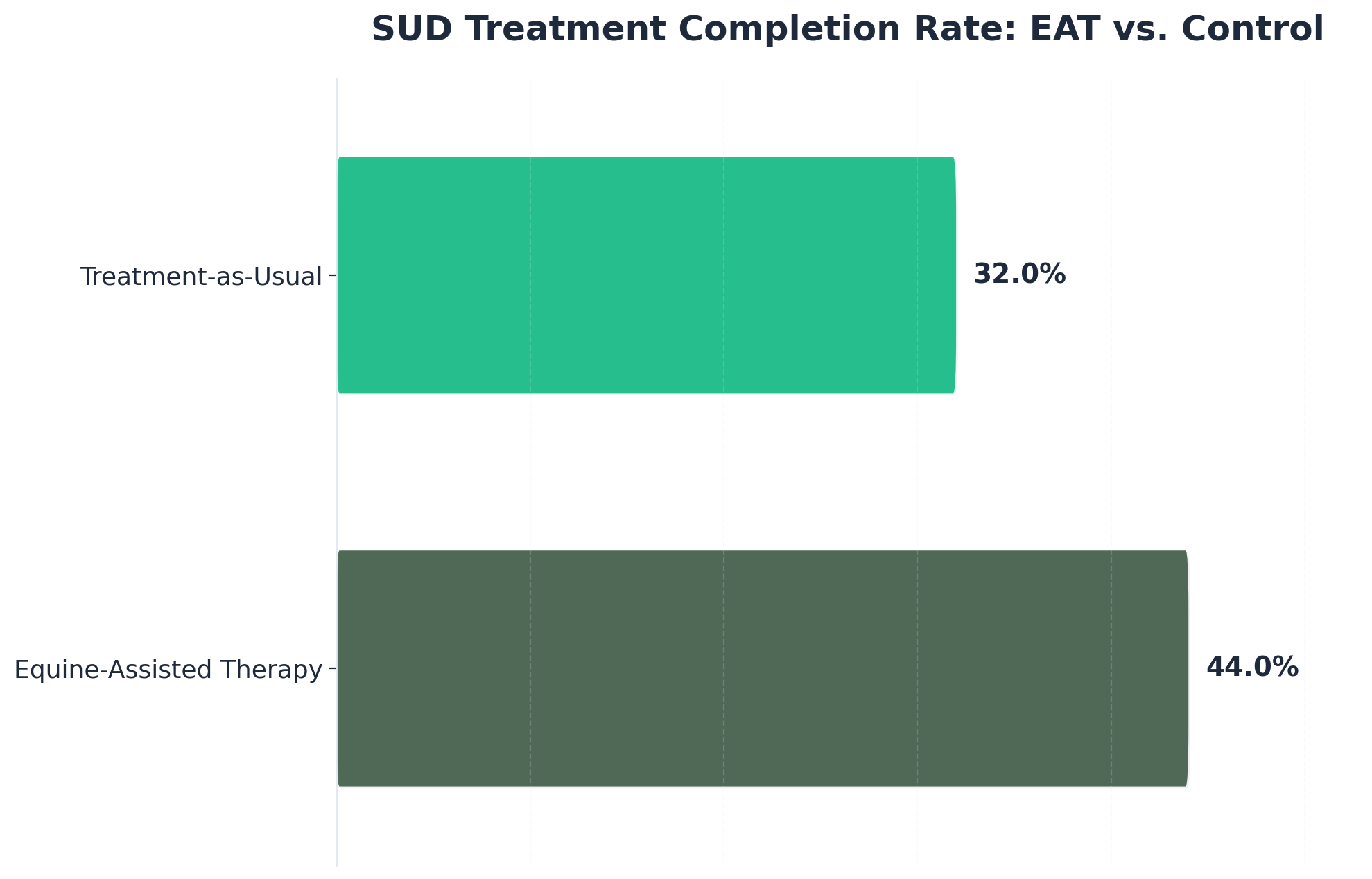
One of the biggest challenges in addiction treatment is keeping people engaged. Equine therapy is engaging and fun, which helps break through resistance. Studies show that participants in equine-assisted programs are more likely to complete their treatment compared to those in standard therapy alone—44% completion vs. 32%8.
The bond formed with the horse provides a powerful motivation to show up and do the work, even when it feels difficult.
Building Self-Efficacy and Confidence
Addiction often erodes self-worth. Successfully communicating with and directing a large, powerful animal restores a sense of capability. This is called self-efficacy—the belief that you can succeed.
As you master new skills in the arena, you prove to yourself that you can overcome challenges, set boundaries, and achieve goals. This renewed confidence is vital for navigating life in recovery without substances5.
Experience Equine Therapy in Montana
The setting of your recovery matters. At Rocky Mountain Treatment Center, we leverage the natural beauty of Montana to enhance the therapeutic experience. Being outdoors in a restorative environment reduces stress and helps you disconnect from the triggers of your daily life.
Our program integrates equine therapy with clinical excellence. We ensure that every session is purposeful and tied to your broader treatment goals. Whether you are grooming a horse under the vast Montana sky or working through a difficult emotion in the round pen, you are in a place designed for healing.
Frequently Asked Questions
Do I need any horse experience to participate in equine therapy?
No, you don’t need any horse experience. Many participants have never worked with horses before. The sessions are guided by experienced therapists who ensure your safety. The focus is on building trust and coping skills, not on riding or equestrian knowledge.
Is equine therapy the same as horseback riding lessons?
No, it is not the same. Equine therapy focuses on emotional growth and mental health through ground-based activities like grooming and leading. The goal is healing, whereas riding lessons focus on equestrian skills.
How effective is equine therapy for substance use disorders?
It is highly effective. Studies show that equine-assisted programs can improve treatment completion rates and help build emotion regulation and self-esteem, which are critical for long-term recovery8.
Will I be riding the horses?
Generally, no. Most sessions at Rocky Mountain Treatment Center focus on ground-based activities. This allows for better communication and interaction with the horse as a partner rather than a vehicle.
Is it safe if I have anxiety or PTSD?
Yes, it is considered safe and beneficial. Therapists are trained to manage trauma responses, and the horses are selected for their calm nature. Many people with PTSD find the non-verbal connection with horses less intimidating than traditional talk therapy.
Does insurance cover this therapy?
Coverage varies by plan. Some insurers cover it if it is part of a comprehensive addiction treatment program at a licensed facility. It is best to check with your provider regarding behavioral health benefits.
Conclusion
Equine-assisted therapy offers a unique and powerful path to healing. By answering the question “how does equine therapy work” with hands-on experience, you gain tools that go far beyond the arena. You learn to trust, to feel, and to connect—skills that are the bedrock of a sober, healthy life.
If you or a loved one is struggling, consider how the gentle strength of a horse and the guidance of our team at Rocky Mountain Treatment Center can support your journey. Recovery is possible, and sometimes, the best partner for the journey has four legs.
References
- Horse Therapy Helps Veterans Overcome Trauma. https://www.columbiapsychiatry.org/news/horse-therapy-helps-veterans-overcome-trauma
- Equine-assisted therapy effectiveness in improving emotion regulation, self-efficacy, and self-esteem in substance use disorder patients. https://pmc.ncbi.nlm.nih.gov/articles/PMC10576391/
- Emotional Transfer in Human–Horse Interaction. https://pmc.ncbi.nlm.nih.gov/articles/PMC6941042/
- Impact of Equine-Assisted Interventions on Heart Rate Variability in Individuals with Neurodevelopmental Conditions. https://pmc.ncbi.nlm.nih.gov/articles/PMC8617898/
- Equine-assisted services for individuals with substance use disorders: A systematic review. https://pmc.ncbi.nlm.nih.gov/articles/PMC9749232/
- At-risk youth receive similar benefits from equine-assisted psychotherapy and traditional psychotherapy; an applied analysis. https://pmc.ncbi.nlm.nih.gov/articles/PMC12069370/
- Neural changes following equine‐assisted therapy for posttraumatic stress disorder: A longitudinal multimodal imaging study. https://pmc.ncbi.nlm.nih.gov/articles/PMC7978114/
- Complementary horse-assisted therapy for substance use disorders: A randomized controlled trial. https://pmc.ncbi.nlm.nih.gov/articles/PMC7001193/
- Effects of Equine-Assisted Therapy: A Systematic Review and Meta-Analysis on Motor Function Outcomes. https://pmc.ncbi.nlm.nih.gov/articles/PMC12156428/
- Effects of Equine Therapy on Individuals with Autism Spectrum Disorder: A Systematic Review. https://pmc.ncbi.nlm.nih.gov/articles/PMC6178825/