
Key Takeaways
- Shifting from rescuing to structured involvement—through family therapy, education, and collaborative relapse planning—improves treatment engagement and reduces substance use after discharge.10
- Your own wellbeing functions as a clinical lever, not a reward; therapists, Al-Anon, and Nar-Anon meetings sustain the steadiness your loved one’s recovery depends on.12
- Start this week by calling SAMHSA’s helpline at 1-800-662-HELP and booking your own support, then use the first 90 days to learn CRAFT-style communication and build a written relapse emergency plan.14,9
- Treat addiction as a chronic, treatable condition where setbacks call for rapid re-engagement with care rather than punishment, and choose programs with structured family components when home support is no longer enough.4,9
The Shift From Rescuing to Structured Involvement
You’ve likely spent countless nights replaying scenarios in your head, wondering if a different action or word could have changed things. The exhaustion of trying to manage another person’s addiction carries a particular weight, one you’re probably familiar with. Understanding how to help with addiction recovery can provide a clearer path forward for families facing these challenges.
The key to shifting this dynamic is understanding that helping someone recover is less about controlling their decisions and more about transforming the family system around them. This means learning to communicate in ways that encourage treatment rather than creating distance. Instead of absorbing every consequence, you allow natural ones to occur while maintaining connection. Rather than facing this alone, you seek structured support, such as family therapy, education, and collaborative relapse planning with their care team.
Research supports this approach: family involvement in treatment leads to better engagement, reduced substance use post-discharge, and stronger relationships, especially when guided. This isn’t a shift from caring to not caring, but from rescuing—which can be draining and inadvertently shield your loved one from the realities that motivate change—to structured involvement, informed by experts who have guided many families through similar challenges.10
You don’t have to navigate this new role by yourself. This guide provides a clear sequence: immediate actions for this week, foundational steps for the first 90 days, and a perspective for the long-term journey.
Why Your Own Wellbeing Is a Clinical Lever, Not an Afterthought
Often, self-care is relegated to an afterthought in discussions about addiction recovery. However, your wellbeing is not a reward for stability; it’s a crucial component that makes stability possible in the first place.
Consider your capacity to engage effectively when you’re sleep-deprived, constantly anxious, and monitoring every message. In such a state, you’re more likely to react impulsively rather than respond thoughtfully. This isn’t a character flaw, but a natural consequence of trying to bear the burden of an entire care team alone.
The scope of this issue is vast. In 2023, nearly 19 million U.S. children, approximately 1 in 4, lived with a parent or primary caregiver with a substance use disorder. This statistic highlights that you are not isolated in this struggle. Addiction impacts the entire family system, and that includes you.17
SAMHSA’s guidance emphasizes that family support is vital, and families themselves require support through therapy, support groups, and education about recovery. Practically, this means prioritizing your own therapist, attending meetings like Al-Anon or Nar-Anon, or dedicating an hour to yourself where others are on call. These aren’t luxuries; they are essential for sustaining your involvement in the long-term recovery process.12
Furthermore, prioritizing your own well-being sets an important example. It demonstrates that seeking help is a sign of strength, not weakness, making a powerful case for treatment without needing a single speech. If children are involved, your steadiness provides a vital anchor. This steadiness is not inherent; it’s cultivated, often with external support.
Before considering what to say to your loved one, ask yourself: who is supporting you this week?
What the Research Actually Says About Family Involvement
If you’ve been told that recovery is solely your loved one’s responsibility and your role is to step back, this perspective isn’t fully supported by evidence. Research on family involvement in addiction treatment offers a more nuanced and helpful understanding.
A systematic review of randomized controlled trials on family therapy for substance use revealed that involving family members in treatment“produces benefits by diminishing consumption and improving family functioning”13This indicates that when families are integrated into care in a structured manner, both the individual’s substance use and the family’s overall functioning tend to improve, creating a reinforcing cycle.
Retention in treatment is another critical factor. Studies from the NIDA Clinical Trials Network highlight that positive family involvement is a primary reason patients engage in treatment, and structured family contact helps clients remain in care, reducing early dropout rates. Effective family involvement can be a powerful tool against the significant costs associated with early treatment disengagement.11
Regarding relapse, a longitudinal study of individuals with substance use disorders found that strong family function and support play a significant role in prevention. While observational, this finding, combined with other data, consistently suggests that families who develop healthy communication, set clear expectations, and maintain connection without rescuing contribute to better long-term outcomes for the person in recovery.1
Despite families being “powerful resources for enhancing treatment and recovery success,” they are not routinely included in clinical practice due to factors like training gaps, billing structures, and privacy regulations. This means you shouldn’t assume automatic inclusion in a program. Actively seek out programs that offer formal family components, such as family therapy sessions, Family Week, structured phone contact, or educational resources for relatives, as these programs are intentionally addressing this gap.10
It’s also important to note that the effectiveness of family therapy varies, and the quality of implementation significantly impacts the benefits a family experiences. Your active participation matters, as does engaging with programs specifically designed for families, rather than attempting to improvise support independently.13
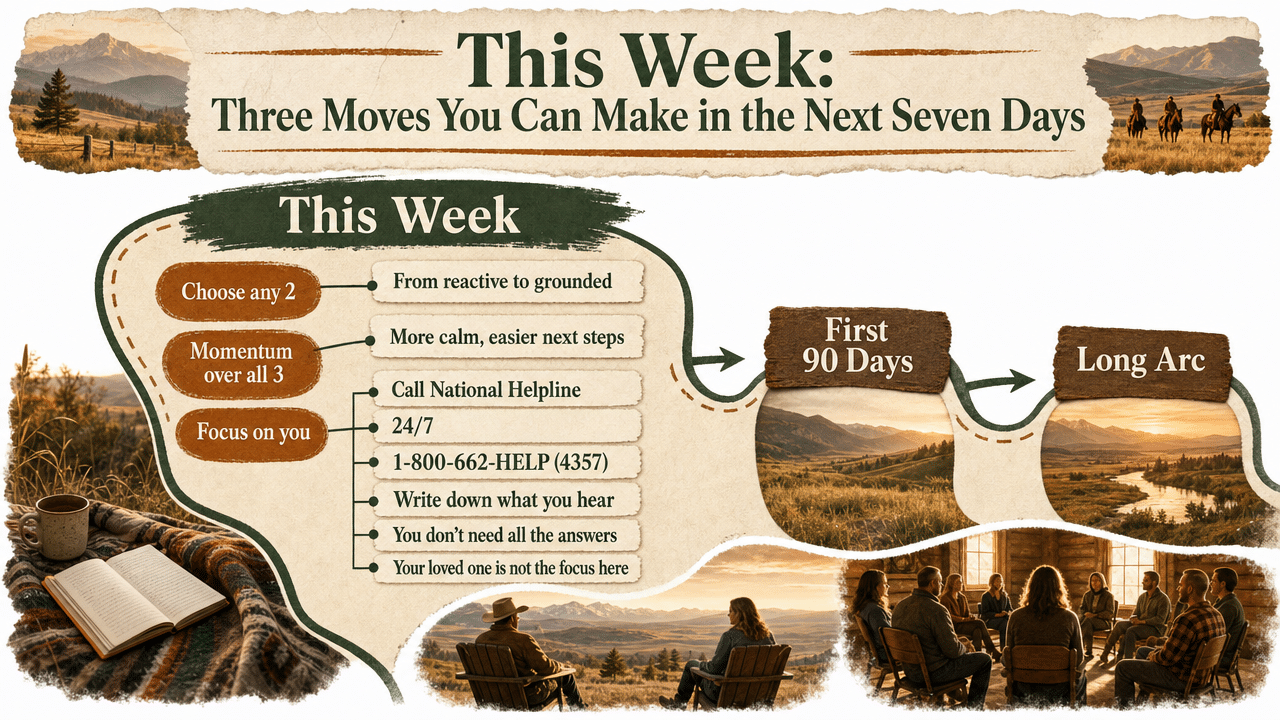
This Week: Three Moves You Can Make in the Next Seven Days
You don’t need an elaborate plan right now. Focus on a few manageable actions this week to shift from a reactive stance to a more grounded position. Choose two that feel achievable; momentum is more important than completing all three.
Crucially, every action in this section centers on you—what you learn, who you contact, and how you establish your own stability. Your loved one is intentionally not the focus here. When your own nervous system finds a bit more calm, the rest of the work becomes significantly easier.
Call the National Helpline and Write Down What You Hear
SAMHSA offers a free, confidential helpline at 1-800-662-HELP (4357), available 24/7. You don’t need to have all the answers before calling. You can simply state your situation, for example, “My husband is drinking again, and I don’t know what to do next,” and a specialist will help you explore local options, including residential programs and family services.14
Keep a notebook handy. Jot down two or three program names, the levels of care they provide, and whether they include family components like family therapy or a Family Week. This isn’t about making immediate commitments, but about creating a short list so you’re prepared when your loved one agrees to treatment or a crisis necessitates action, preventing frantic midnight searches.
If your loved one is already in treatment, this call can also help you locate a family support group in your area for yourself.
Book Your Own Therapy or Mutual-Help Meeting
This step is often overlooked, but it’s vital: your personal support is not a luxury. SAMHSA’s family guidance explicitly recommends family therapy, support groups, and education as ways families can help a loved one initiate and maintain recovery. Notice that support groups for you are included, not just actions you take for the person using substances.12
Consider two practical options. Find a therapist experienced with addiction in families; many can schedule an initial session within a week or two if you inquire about cancellations. Alternatively, locate an Al-Anon or Nar-Anon meeting, either in person or online, and attend once to see if it’s a good fit. Most meetings welcome newcomers without requiring a commitment.
One conversation or one meeting this week is a significant achievement. If you gain even one phrase that helps you feel calmer, you’ve already initiated a positive change that will resonate throughout your family.
The First 90 Days: Building a Family System That Holds
The initial three months are crucial for establishing the foundation of recovery. Your loved one is learning to live without substances, and you are learning to live alongside someone in early recovery without reverting to old, draining patterns. Perfection isn’t the goal for either of you.
These 90 days can help you establish a functional family system—one with shared language, improved communication skills, and a written plan for potential setbacks. The following two sections outline the core work involved. Address them one at a time.
Learn the CRAFT-Style Basics: Positive Communication and Reinforcement
CRAFT, or Community Reinforcement and Family Training, is a family-based approach that teaches you how to communicate with your loved one in a way that encourages treatment and sobriety, rather than escalating conflicts. While the name sounds clinical, the principles are highly practical.
The evidence for CRAFT is promising. A meta-analysis cited in family-engagement guidance found that substance use treatment involving significant others led to greater reductions in substance use compared to individual therapy alone. The methods are straightforward, though they require practice. You learn to acknowledge and respond positively when your loved one is sober or making healthy choices—like picking up a child on time or attending a meeting. Conversely, you learn to disengage from arguments during intoxication without lecturing, addressing concerns later when they are sober.2
For example, instead of saying, “I can’t believe you only went to that meeting because I begged you,” you might say, “I noticed you went. Thank you. That meant a lot to me.” This isn’t about following a script, but about shifting your focus. The first time you experience the positive impact of this approach, you’ll feel the change in the atmosphere.
Attend Family Week and Build a Relapse Emergency Plan Together
Most reputable residential programs include a structured family component, often called Family Week, which involves relatives in several days of education, group work, and guided conversations with the person in treatment. If invited, it’s highly beneficial to attend. SAMHSA’s family guidance identifies family therapy and education as key ways relatives can support loved ones in initiating and maintaining recovery, and state addiction services encourage families to help develop recovery plans and attend mutual-support meetings alongside the individual in care.6,12
While the specific activities vary by program, the core elements are consistent: you gain an understanding of how addiction impacts the brain and the household, practice difficult conversations with a counselor present, and collaboratively build the next phase of the plan. This collaborative approach fosters unity rather than conflict.
During this week, one document stands out as particularly valuable: a written relapse emergency plan. Treatment guidelines recommend that families create such a plan to ensure everyone knows how to respond if the person returns to substance use. Your plan should address specific questions:9
- Who is called first?
- Which counselor or program is the re-entry contact?
- What does the person in recovery want you to do—and not do—in the first 24 hours of a slip?
- Where will children go if a parent needs to detox again?
Document these details, sign it, and keep copies accessible, perhaps on the fridge and in your phone.
The Long Arc: Trust, Mutual-Help, and Why Recovery Isn’t Linear
Around month four or five, the initial intensity of family meetings may wane. The treatment program is in the past, and your loved one is reintegrating into work, parenting, and daily responsibilities. You might find yourself still observing them, perhaps less overtly, but the vigilance persists. This marks the beginning of the long arc—the quiet period after structured support diminishes.
NIDA characterizes addiction as a chronic, treatable condition, akin to diabetes or hypertension, rather than a one-time event that is simply “fixed”. This perspective reframes expectations for both you and your loved one. Individuals managing chronic conditions experience good periods and more challenging ones. They may adjust medications, alter routines, or occasionally require a higher level of care. These fluctuations don’t signify failure; they indicate that recovery is an ongoing process, and so is your role in supporting it.4
Three elements typically sustain families through this extended period. First, continuing your own mutual-help meetings, even when the immediate crisis subsides. State addiction services guidance specifically encourages families to keep attending support meetings, either with the person in recovery or independently. The support system that helped you cope in earlier stages will continue to help you maintain perspective when minor setbacks occur.6
Second, trust, which rebuilds gradually through consistent small actions from both sides—a promised text, an avoided difficult conversation, a Friday night that unfolds as planned. You will experience weeks where things feel almost normal, and others where a familiar scent or a phone call triggers old anxieties. Both are part of the journey.
Third, maintaining a connection, even a loose one, with the care team. If your loved one is in a residential program with continuing care—such as weekly groups or scheduled check-ins at various intervals—utilize these touchpoints. Inquire about how you can support their ongoing work at home. A slip, if it happens, is not the end of the story. The guideline on family and relapse prevention emphasizes rapid re-engagement with care after a return to use, rather than punishment. The emergency plan you developed during Family Week becomes a living document in this long arc.9
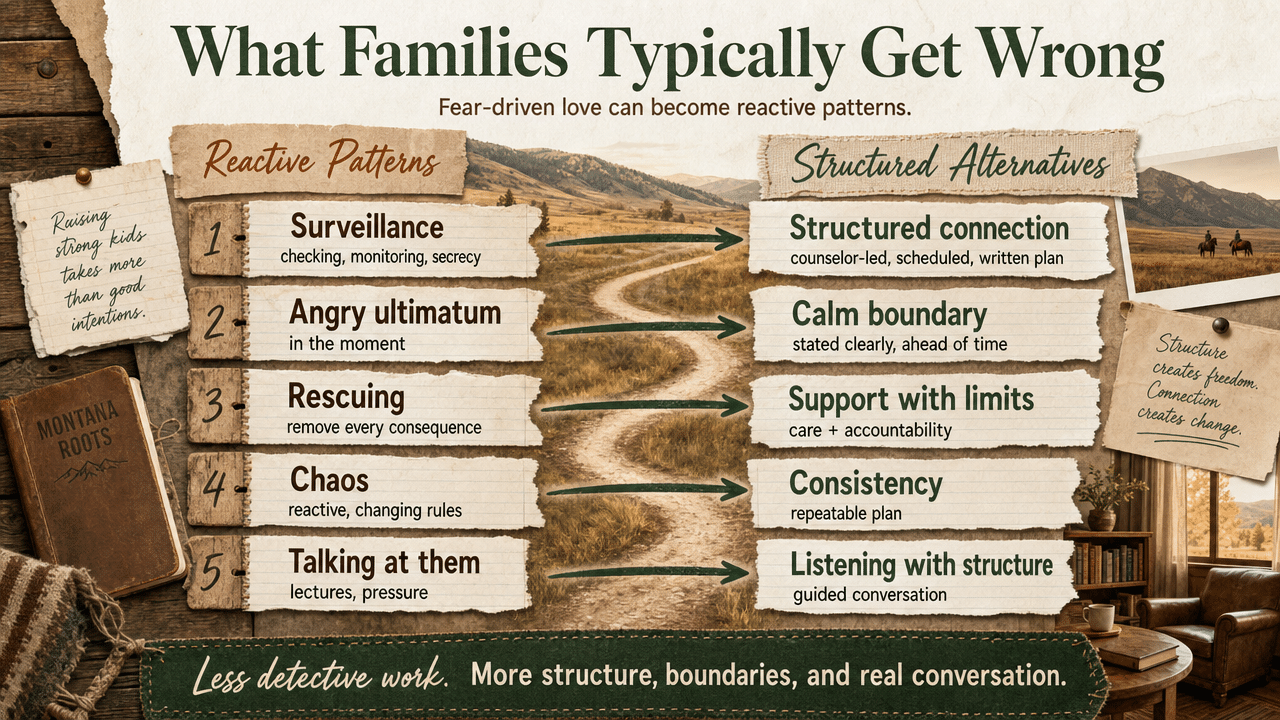
What Families Typically Get Wrong
This section isn’t meant to criticize past choices made under pressure; these patterns often arise from fear-driven love. Identifying them is simply a way to avoid repeating them.
Surveillance instead of connection. Constantly checking trash, cars, browser history, or bank statements can feel productive, and sometimes you might find what you’re looking for. However, continuous monitoring often pushes a loved one further into secrecy and drains your energy needed for genuine conversations. Family-engagement research indicates that unstructured involvement, lacking clear boundaries or skills, can be more detrimental than helpful. Structured family contact—such as counselor-led sessions, scheduled check-ins, or a written plan—is far more effective than amateur detective work.11
Ultimatums delivered in anger. A boundary stated calmly on a Tuesday is effective. The same words shouted at midnight after a relapse become a threat, and threats lose their impact if not consistently followed through. If you need to communicate a difficult boundary, write it down first. Deliver it when no one is intoxicated, and be prepared to uphold it.
Confrontational interventions. The dramatic, surprise-ambush intervention often depicted in media is not the approach supported by evidence. CRAFT-style methods, which emphasize positive communication, reinforcement, and your own skills training, lead to greater reductions in substance use than working with the individual alone. This approach prioritizes practice over theatrics.2
Secret-keeping with children. Children are perceptive. Pretending that nothing is happening teaches them to distrust their own observations, which can be harmful. NIMH guidance on family-based interventions stresses the importance of improving communication across the entire household, not just between adults. Age-appropriate honesty—such as “Dad is sick and getting help”—is almost always preferable to concealment.5
Treating one slip as the end of the story. Addiction is a chronic, treatable condition, not a pass-fail test. The objective after a return to use is prompt re-engagement with care, which is precisely what the emergency plan developed during Family Week is designed for.4
When Residential Care and Family Week Make Sense
Not every family requires a residential program. Outpatient counseling, medication for opioid or alcohol use disorder, and consistent attendance at mutual-help meetings can support many individuals. However, there comes a point when the home environment can no longer adequately manage the situation, and it’s important to acknowledge this honestly.
Several indicators often lead families to consider residential care:5
- withdrawal symptoms requiring medical supervision,
- multiple unsuccessful outpatient treatment attempts,
- or a co-occurring mental health condition intertwined with substance use, which NIMH notes often necessitates integrated treatment and family-based interventions like Functional Family Therapy.
- Other factors include a household where children are impacted, or where the risk of overdose from another slip is significant.
NIDA’s principles of effective treatment clearly state that serious substance use disorders typically require comprehensive care addressing medical, psychological, and social needs simultaneously, rather than in isolation.8
The argument for choosing a program with a built-in family component is distinct and compelling. Family-inclusive treatment is associated with better engagement and stronger recovery outcomes compared to care that treats the individual in isolation. A structured Family Week—typically two or three days of education, guided conversations, and planning with the care team—is where the principles discussed in this article transition from intention to practical application. You collaboratively create the relapse emergency plan, engage in difficult conversations with a counselor present, and connect with other families facing similar challenges.10
If you are considering this option for a loved one, the warm, family-oriented residential setting at Rocky Mountain Treatment Center in Great Falls is a valuable resource. The most important step is to stop bearing this burden alone.
Frequently Asked Questions
What should I do if my loved one refuses treatment?
Refusal is common, but it’s not the end of the conversation. CRAFT-style approaches teach families to use positive communication and reinforcement to gently guide a loved one toward care over time, which has been shown to lead to greater reductions in substance use than working with the individual alone. In the interim, contact the SAMHSA National Helpline at 1-800-662-HELP for local resources and begin seeking your own support—whether through a therapist, Al-Anon, or family education—so you are prepared when they are ready for help.2,14
Am I enabling my loved one by helping them?
The concept of “enabling versus tough love” can be misleading. Family-engagement research indicates that unstructured involvement, without clear skills or boundaries, can be counterproductive, whereas structured family contact and guided sessions improve treatment retention and outcomes. Therefore, the question isn’t whether to help, but whether your help is guided by a plan developed with a counselor—including communication skills, agreed-upon boundaries, and a written relapse plan—or if it’s improvised during a crisis. The former is constructive; the latter is exhausting.11
What happens if my loved one relapses after treatment?
A slip is an opportunity for learning, not a final judgment. Addiction is a chronic, treatable condition, and a return to use can be part of how chronic conditions sometimes manifest. Treatment guidelines specifically recommend that families create an emergency plan in advance so everyone knows how to respond, with the goal being rapid re-engagement with care rather than punishment. Contact the program, follow the plan you developed during Family Week, and resist the urge to assign blame in the immediate aftermath.4,9
Do I have to attend family therapy or Family Week for it to work?
While your loved one can make progress independently, family-inclusive care is associated with better engagement, reduced substance use, and stronger relationships. SAMHSA specifically recommends family therapy and education as ways relatives can support loved ones in initiating and sustaining recovery. If attending in person isn’t feasible due to distance, work, or safety concerns, inquire about virtual sessions or shorter family days. Any structured involvement is better than none. Moreover, your participation can transform you, which in turn positively impacts the home environment your loved one returns to.12
How do I talk to my children about a parent’s addiction?
Age-appropriate honesty is more beneficial than silence. Children are perceptive, and pretending nothing is wrong teaches them to distrust their own observations. NIMH guidance highlights family-based interventions that improve communication across the entire household, not just between two adults. For younger children, use brief, truthful statements like: “Dad is sick and is getting help from doctors who understand this.” For older children, answer their questions directly and reassure them that it’s not their responsibility to fix the situation.5
How long does it take for trust to come back?
Trust rebuilds over time and without a fixed schedule. It is re-established through consistent small actions—a text sent as promised, a difficult conversation faced rather than avoided, a sober Friday night that unfolds as intended. A longitudinal study of individuals with substance use disorders found that good family function and support play an important role in preventing relapse. Expect the process to be uneven. Acknowledge and celebrate the small victories; they are significant.1
References
- Family Function Impacts Relapse Tendency in Substance Use Disorder: A Longitudinal Study. https://pmc.ncbi.nlm.nih.gov/articles/PMC8882822/
- Engaging Family and Others in Recovery. https://www.iris.ssw.umaryland.edu/rc-family-recovery
- Equine-assisted services for individuals with substance use disorders: A scoping review. https://pmc.ncbi.nlm.nih.gov/articles/PMC9749232/
- Treatment and Recovery. https://nida.nih.gov/publications/drugs-brains-behavior-science-addiction/treatment-recovery
- Finding Help for Co-Occurring Substance Use and Mental Disorders. https://www.nimh.nih.gov/health/topics/substance-use-and-mental-health
- Understanding & Supporting a Loved One’s Recovery. https://oasas.ny.gov/recovery/understanding-supporting-loved-ones-recovery
- Family-focused practices in addictions: a scoping review protocol. https://pmc.ncbi.nlm.nih.gov/articles/PMC5781095/
- Treatment Approaches for Drug Addiction DrugFacts. https://nida.nih.gov/publications/drugfacts/treatment-approaches-drug-addiction
- The Role of Family in Relapse Prevention. https://www.ncbi.nlm.nih.gov/books/NBK571079/box/ch4.b9/
- Family Involvement in Treatment and Recovery for Substance Use Disorders. https://pmc.ncbi.nlm.nih.gov/articles/PMC8380649/
- Retention Toolkit: Family Involvement. https://adai.uw.edu/retentiontoolkit/family.htm
- Helping Families Cope with Mental Health and Substance Use Conditions. https://www.samhsa.gov/mental-health/children-and-families/coping-resources
- Effects of family therapy for substance abuse: A systematic review of randomized controlled trials. https://pubmed.ncbi.nlm.nih.gov/36564902/
- National Helpline for Mental Health, Drug, Alcohol Issues. https://www.samhsa.gov/find-help/helplines/national-helpline
- Engaging Loved Ones in Recovery Management for Substance Use Disorders (R61/R33 Clinical Trial Required). https://grants.nih.gov/grants/guide/rfa-files/RFA-DA-26-024.html
- Treatment of Substance Use Disorders | Overdose Prevention. https://www.cdc.gov/overdose-prevention/treatment/index.html
- Millions of U.S. kids live with parents with substance use disorders. https://www.nih.gov/news-events/nih-research-matters/millions-us-kids-live-parents-substance-use-disorders