
Key Takeaways
- Quality drug treatment programs share five verifiable traits: accreditation and licensing, evidence-based therapies, real medical care including mental health, genuine family involvement, and a written aftercare plan.
- Treat the intake call as your interview. Ask about accreditors, therapies used, one-on-one counseling frequency, co-occurring mental health care, and what happens on day 31 after a 30-day stay.
- Detox is a starting line, not treatment. Its job is evaluation, stabilization, and readiness for ongoing care, and detox alone does little to change long-term drug use 5, 19.
- Walk away from guaranteed cures, missing license numbers, detox pitched as the whole plan, vague aftercare, family shut out, or pressure to commit today, and ask openly about how to pay.
You’re Already Doing Something Right
If you’re reading this, something in you is already fighting for a different life. Maybe it’s you looking for help. Maybe it’s a parent, a sibling, or a partner who loves someone and doesn’t know what to do next. Either way, sitting down to figure out what a good drug treatment program actually looks like is not a small thing. It’s the part most people put off for months, sometimes years. You didn’t.
Here’s the honest part: choosing a program is confusing on purpose. Every website says the same warm words. Every phone call sounds reassuring. And you’re supposed to make a life decision while you’re scared, tired, and probably arguing with someone you love.
So this guide skips the marketing. You’ll learn the five things federal health agencies actually use to define a quality program 1, 2, the questions to ask before you hand over a credit card or a family member, and the red flags that mean keep looking. Not a checklist to memorize. A way to trust what you’re seeing when you see it.
The Five Signs a Program Is Actually Good
Accreditation and Licensing You Can Verify
Accreditation is not a sticker on a website. It’s a paper trail you can check. The two names to look for are The Joint Commission and CARF. Either one means an outside team of clinicians has walked through the building, read the charts, watched the groups, and signed off that the place does what it says it does. If a program can’t tell you which body accredits them and when the last survey happened, that’s your answer.
State licensing is the second layer. In Montana, residential programs for adults with substance use disorders operate under a specific rule that spells out staffing ratios, how assessments are done, what a treatment plan has to include, and how discharge is supposed to be handled 16. You don’t need to read the rule yourself. You just need to know it exists, and ask the intake person what license the facility holds and which state office issued it. A quality program will answer without hesitation.
SAMHSA lists accreditation as the first of five signs of a higher-quality program for a reason 1, 2. It’s the one credential that doesn’t depend on a marketing team. Ask for it, write down what they say, and if something feels evasive, that’s data too. You’re allowed to be a careful person right now.
Evidence-Based Therapies, Not Just Amenities
Beautiful grounds don’t treat addiction. Therapy does. When you look at what a program offers, the question is not “do they have a pool,” it’s “what actually happens in the room?”
The therapies with the most research behind them have plain names: cognitive behavioral therapy, motivational interviewing, contingency management, and structured 12-step facilitation. A meta-analysis of NIDA’s treatment principles found strong support for matching therapy to a person’s specific needs, addressing the full picture of what’s going on in their life, using behavioral counseling, and reassessing the treatment plan as things change 6. Those four things are the engine.
Group therapy is usually the biggest chunk of the day in residential care. Done well, groups aren’t just people taking turns talking. They follow a format, they’re led by a trained clinician, and different groups do different jobs, some focused on skills, some on process, some on relapse prevention 18. Ask what the group schedule looks like on a Tuesday. If nobody can describe it, that’s a sign.
Individual counseling matters just as much. You should be able to ask how often you’ll meet one-on-one with a counselor, who they are, and whether your plan gets rewritten as you go. If the answer is “we do groups” and nothing else, keep looking 4, 7.
Real Medical Care During Detox and Beyond
Coming off alcohol, opioids, or benzodiazepines is not just uncomfortable. It can be medically dangerous. A quality program either provides medically monitored detox on-site or has a tight partnership with a facility that does, and they’ll tell you which one before you show up at the door.
Detox itself has three jobs: evaluate what’s in your system and what else is going on medically, stabilize you so withdrawal doesn’t hurt you, and get you ready to walk into actual treatment 19. That last part is the one people miss. Detox alone is not treatment. If a program pitches a five-day detox as the whole plan, they’re selling you the doorway and calling it the house.
Medical care doesn’t stop when withdrawal ends. Somewhere between a third and half of people in treatment also have a mental health condition, sometimes depression, anxiety, PTSD, or bipolar disorder, that’s tangled up with the substance use. Federal guidance is clear that these need to be treated together, not in sequence 4, 7. Ask if a psychiatric provider is available during your stay, how medications are managed, and whether the counselors are trained to work with co-occurring conditions. If a program says “we don’t really deal with mental health,” that’s not humility. That’s a gap.
Family Treated as Part of Recovery, Not a Visitor Log
Addiction happens inside relationships, and recovery has to happen there too. The programs that take this seriously don’t just allow phone calls on Sunday. They build family into the treatment itself.
SAMHSA names family involvement as one of the five signs of a quality program 1, 2. What that looks like in practice varies, but the pattern is recognizable: education sessions so family members understand what addiction actually is, family counseling where the hard conversations happen with a clinician in the room, and structured programs, often three or four days long, that bring loved ones into the treatment center for real work.
If you’re the family member reading this, you should be asking: what will I be invited to do? Will there be a specific week or weekend for us? Will I get my own counselor, at least briefly, so I can figure out what to carry and what to put down? If you’re the person entering treatment, you get to say who counts as family. A partner, a sibling, a chosen parent, a best friend. Quality programs ask that question instead of assuming. If the answer to “how is family included” is a visitor policy and nothing else, that’s not family involvement. That’s visiting hours.
A Plan for After You Leave
The residential stay is the beginning of treatment, not the whole thing. This is the part programs are most likely to gloss over, and it’s the part that most affects whether the work sticks.
Look for a program that talks about aftercare on the first phone call, not the last day of your stay. That means a written plan for what happens next: outpatient counseling, a step-down level of care, sober living if you need it, a primary care handoff, medication continuation, and scheduled check-ins from the treatment center itself, often at 30, 60, 90, 180, and 365 days after discharge. Research on outcomes after residential treatment consistently shows that people who stay connected to some form of ongoing care do better on substance use and mental health measures at 6 months and beyond 11, 15.
What to Actually Ask on the Intake Call
The first phone call is not a sales pitch. It’s your interview. Grab a piece of paper, write these down, and don’t apologize for asking any of them. A good program expects these questions and answers them without a script.
Start with credentials. Who accredits you, and when was your last survey? What state license do you hold? Who is the medical director, and is a psychiatric provider available during my stay? If the person on the phone has to check and call you back, that’s fine. If they get defensive, that’s information.
Ask about the actual treatment. What therapies do you use, and can you name them? How often will I meet with a counselor one-on-one? What does a typical Tuesday look like from wake-up to lights-out? Who leads the groups, and what are their credentials 18? If I have depression or anxiety along with the addiction, how is that handled in the same treatment plan 4?
Ask about medical care. Do you provide medically monitored detox on-site, or do I detox somewhere else first? What medications do you offer for cravings or withdrawal, and who prescribes them? What happens if I get sick during my stay?
Ask about family and life outside. When and how are family members involved? Is there a dedicated family program? Can I keep working with my outside therapist or doctor while I’m there 3?
Ask about what happens after. What does the aftercare plan look like on paper? Do you check in after discharge, and for how long? What’s your relationship with outpatient providers and sober living homes near me 1, 2?
Write the answers down. Two days later, compare notes across programs. The differences will be obvious.
The 30-Day Question Nobody Answers Honestly
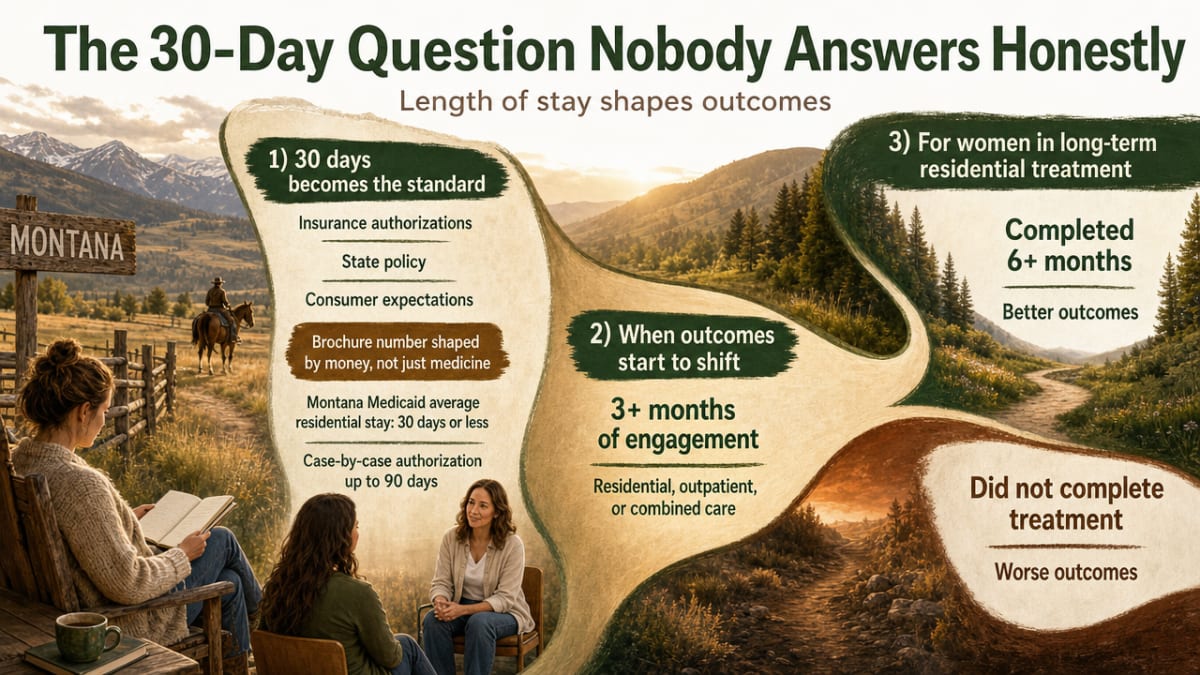
Almost every program you’ll see markets a 30-day stay as the standard. That’s not because 30 days is the clinical sweet spot. It’s because insurance authorizations, state policy, and consumer expectations all settled there. Montana’s own Medicaid demonstration, for example, holds the statewide average length of stay in residential care to 30 days or less, while still allowing case-by-case authorization up to 90 17. The number you see on the brochure is shaped by the money, not just the medicine.
Here’s what the research actually says. Federal treatment principles have long pointed to three months or more of engagement as the point where outcomes really shift, whether that time is spent in residential care, outpatient counseling, or some combination 10. One study of women in long-term residential treatment across three national samples found that those who stayed six months or more had abstinence rates of 68 to 71 percent at follow-up, compared to 51 to 52 percent for women who did not complete treatment 12. That’s a meaningful gap.
But it’s not as simple as “longer is better.” A meta-analysis of federal treatment principles found strong support for matching, whole-person care, counseling, and plan reassessment, and did not find consistent support for a fixed minimum length of stay as an independent predictor across every setting 6. Translation: what you do in treatment, and whether you finish what you started, matters more than hitting a specific number of days.
So when a program pitches you 30 days, the honest question is not “is 30 enough?” It’s “what happens on day 31?” A 30-day stay followed by a real step-down plan, weekly outpatient counseling, and scheduled check-ins can hold up. A 30-day stay with a handshake at the door usually doesn’t. Ask the program to draw the whole arc for you, not just the part that fits in a billing cycle.
How Detox Should Feel and What It Should Lead To
Detox is the part people fear most, and understandably so. If you’ve tried to quit at home, you already know what your body does when the substance leaves. A good program takes that fear seriously and treats detox as a medical event, not a test of willpower.
Federal treatment guidance breaks detox into three jobs: evaluation, stabilization, and fostering readiness for ongoing treatment 19. Evaluation means someone actually examines you, asks what you’ve been using and for how long, checks for other medical issues, and screens for mental health conditions that are going to matter once the fog lifts. Stabilization means medications and monitoring so withdrawal doesn’t hurt you, doesn’t scare you into leaving, and doesn’t cause a seizure or a heart problem you didn’t see coming. Readiness means the staff is already talking to you about what happens next, before the last dose of medication wears off.
That third job is the one to listen for. Detox alone does very little to change long-term drug use 5. If a program treats detox as the finish line, you’re being handed a clean slate with no pen. The right question to ask is simple: on the day my detox ends, what am I walking into the next morning, and who is walking me there?
Red Flags That Should Make You Walk Away
Some warning signs are subtle. These aren’t. If you hear any of these on a call or read them on a website, close the tab and keep looking.
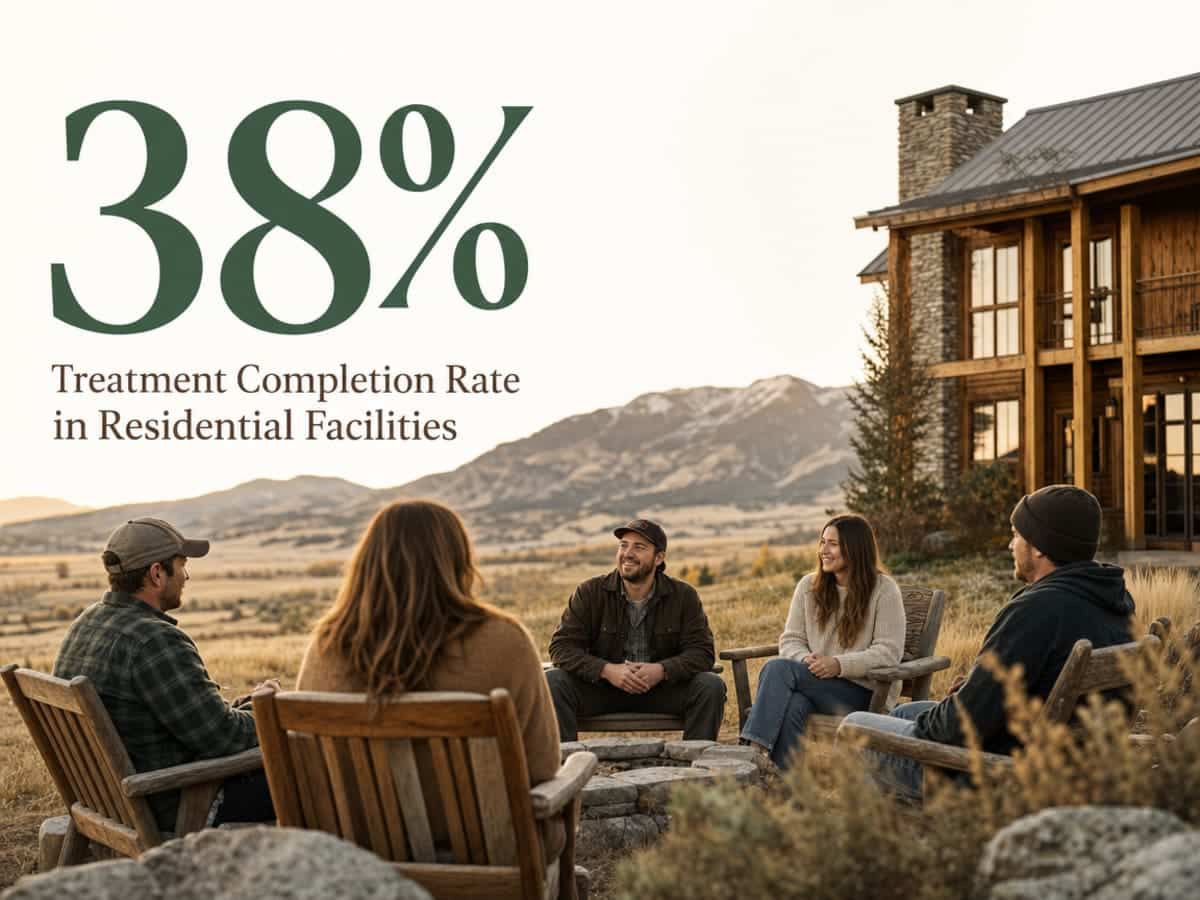
Guaranteed cures or specific success rates. Nobody can promise you a percentage. In a study of residential substance use facilities, an average of 38% of residents completed their index treatment episode, with average stays around 103 days 13. That’s the real range across the field. A program advertising a 95% success rate is either counting something misleading (like people who finished the first week) or making it up. Honest programs talk about outcomes in ranges and conditions, not slogans.
No accreditation, no license number, no clear answer about either. This one is non-negotiable. If the person on the phone can’t tell you who accredits them or which state office licenses them, there’s a reason 1, 2.
Detox pitched as the whole treatment. A five- or seven-day medical stay is a starting line, not a finish 19. If nobody is talking about what comes after, that’s the pitch.
No aftercare plan on paper. “We’ll figure it out at discharge” is not a plan. Quality programs talk about the step-down before you arrive.
Family dismissed or blocked. If loved ones are treated like an inconvenience instead of part of recovery, that tells you how the program sees relationships in general.
Pressure to decide today. Urgency about your safety is real. Urgency about your credit card is not.
Paying for It Without Being Ashamed to Ask
Money is the question people whisper. Ask it out loud. Every good program has staff whose entire job is helping you figure out how to pay, and they are not judging you for asking. If they act like they are, that’s another data point.
Start with insurance. Most residential programs work with major commercial insurance plans, and many will run a verification of benefits for free before you commit to anything. What you want to know: is this program in-network with my plan, what’s my deductible, what’s my out-of-pocket maximum, how many days will they authorize up front, and what happens if my clinical team recommends more time than the initial authorization covers? Accreditation matters here too. An accredited, in-network facility usually means lower cost-sharing and cleaner claims than an out-of-network program with the same brochure 1, 2.
Two honest things to know. Public insurance is not universal in this space, some private residential programs don’t accept Medicaid or Medicare, so if that’s your coverage, ask before the tour. And if you’re uninsured or underinsured, ask about sliding scale, payment plans, scholarships, and state-funded options. SAMHSA’s own consumer checklist puts payment among the first questions to raise on the intake call, right alongside licensing and services 3. You are not being pushy. You are doing what you’re supposed to do.
Choosing, Not Just Shopping
Somewhere in the middle of all this comparing, something shifts. You stop clicking through galleries and start listening for the specifics. A voice on the phone who names their accreditor without pausing. A counselor who explains how family week actually runs. A discharge plan drawn on paper before you’ve packed a bag. That’s the moment shopping becomes choosing.
You don’t have to get this perfectly right. You have to get it honestly right. A program with a real license, therapies you can name, medical care that includes mental health, family built into the schedule, and a plan that keeps going after you leave, that’s a program worth trusting. Everything else is decoration.
If you’re looking at Montana, Rocky Mountain Treatment Center is one place where those pieces come together in a smaller residential setting. Whichever door you walk through, walk through it knowing what you asked, what they answered, and why you chose. That clarity is already recovery starting.
Frequently Asked Questions
How long should a drug treatment program last?
There’s no single right number, but the research points toward three months or more of engagement, whether that’s residential, outpatient, or a mix 10. A 30-day stay can work when it’s followed by real step-down care and check-ins. What matters most is finishing what you started and staying connected after, not hitting a specific day count 6.
What’s the difference between detox and treatment?
Detox handles the medical piece of getting a substance out of your body safely. Its three jobs are evaluation, stabilization, and getting you ready for what comes next 19. Treatment is what happens after: counseling, groups, medication management, family work, and building new habits. Detox alone does very little to change long-term drug use 5. You need both.
How do I know if a program is actually accredited and licensed?
Ask two questions on the intake call: who accredits you, and what state license do you hold? Accreditation usually comes from The Joint Commission or CARF, and either name should come back without a pause. State licensing in Montana falls under a specific rule for residential programs 16. SAMHSA lists accreditation as the first sign of quality for a reason 1, 2.
Will insurance cover residential drug treatment?
Most residential programs work with major commercial insurance and will verify your benefits for free before you commit. Ask if the program is in-network, what your deductible and out-of-pocket maximum are, and how many days they’ll authorize up front 3. Public insurance coverage varies by program, so if you have Medicaid or Medicare, confirm acceptance before the tour. Never assume.
What should I ask when I call a treatment center for the first time?
Cover five areas: credentials (accreditor, license, medical director), actual therapies used and who leads them 18, medical care during detox and for co-occurring mental health conditions 4, how family is included, and what the written aftercare plan looks like 1, 2. Write the answers down. Compare notes across two or three programs two days later. The differences will show up fast.
What happens after residential treatment ends?
A good program hands you a written plan before discharge: outpatient counseling, a step-down level of care, sober living if needed, medication continuation, and scheduled check-ins from the treatment center at intervals like 30, 60, 90, 180, and 365 days. Research consistently shows that people who stay connected to ongoing care have lower readmission rates and better substance use outcomes 11, 15.
References
- Quality Treatment for Mental Health, Drugs and Alcohol. https://www.samhsa.gov/find-support/learn-about-treatment/finding-quality-treatment
- Finding Quality Treatment for Substance Use Disorders. https://library.samhsa.gov/product/finding-quality-treatment-substance-use-disorders/pep18-treatment-loc
- A Quick Guide to Finding Effective Alcohol and Drug Addiction Treatment. https://www.michigan.gov/-/media/Project/Websites/mdhhs/Folder2/Folder62/Folder1/Folder162/SAMHSA_Quick_Guide_Find_Treatment.pdf
- Principles of Drug Addiction Treatment: A Research-Based Guide (3rd ed.). https://nida.nih.gov/sites/default/files/podat-3rdEd-508.pdf
- NIDA Treatment Guidelines (Drexel University summary). https://webcampus.med.drexel.edu/nida/module_1/content/5_0_Treatment.htm
- Meta-Analyses of Seven of NIDA’s Principles of Drug Addiction Treatment. https://www.ncbi.nlm.nih.gov/pmc/articles/PMC3290709/
- Tracking the Quality of Addiction Treatment Over Time and Across States: Using the Federal Government’s “Signs” of Higher Quality. https://www.ncbi.nlm.nih.gov/books/NBK559647/
- Substance Use Disorder Treatment. https://www.samhsa.gov/substance-use/treatment
- Federal Guidelines for Opioid Treatment Programs (2024). https://library.samhsa.gov/product/federal-guidelines-opioid-treatment-programs-2024/pep24-02-011
- The Continuing Care Model of Substance Use Treatment. https://pmc.ncbi.nlm.nih.gov/articles/PMC4007701/
- Stability of Outcomes Following Residential Drug Treatment: Role of Aftercare. https://pmc.ncbi.nlm.nih.gov/articles/PMC3146302/
- Effectiveness of long-term residential substance abuse treatment for women: findings from three national studies. https://pubmed.ncbi.nlm.nih.gov/15540492/
- Association of facility characteristics and substance use treatment outcomes in residential facilities. https://pmc.ncbi.nlm.nih.gov/articles/PMC8940653/
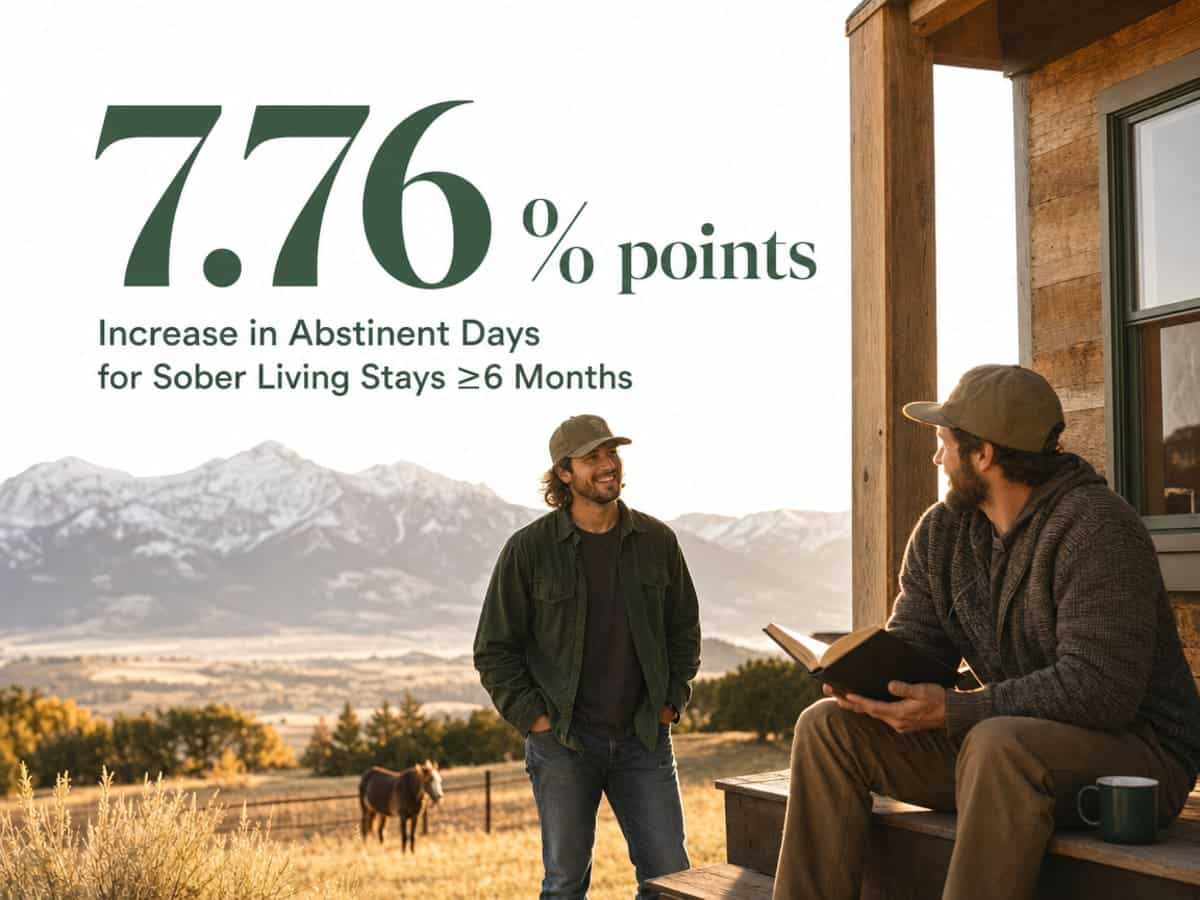
- Six-month length of stay associated with better recovery outcomes in sober living houses. https://pmc.ncbi.nlm.nih.gov/articles/PMC12841932/
- Stay in residential facilities and mental health care as predictors of readmission for substance abuse and psychiatric problems. https://pubmed.ncbi.nlm.nih.gov/7895125/
- Mont. Admin. r. 37.106.1473 – ASAM 3.5 Clinically Managed High Intensity Residential Substance Use Disorder Facility Requirements. https://www.law.cornell.edu/regulations/montana/Mont-Admin-r-37.106.1473
- Montana Section 1115 SUD Demonstration – Implementation Plan Excerpt. https://www.medicaid.gov/medicaid/section-1115-demonstrations/downloads/montan-heart-monitor-renty-invte-imptn-pln-aprvl-athmntH.pdf
- Substance Abuse Treatment: Group Therapy (TIP 41 Quick Guide). https://library.samhsa.gov/product/substance-abuse-treatment-group-therapy/sma15-4024
- Quick Guide for Clinicians Based on TIP 45 — Detoxification and Substance Abuse Treatment. https://nida.nih.gov/sites/default/files/samhsa_detoxification_and_substance_abuse_treatment.pdf