
Key Takeaways
- A treatment center is a staffed place offering medical care, counseling, and daily support together, though no single official definition exists across the field 2.
- Detox is only the doorway — federal guidance is explicit that detoxification alone is not treatment and must be followed by ongoing counseling and rehabilitation 16.
- Residential care tends to fit when outpatient hasn’t held, withdrawal needs monitoring, home environments pull toward use, or co-occurring mental health conditions are present 5.
- Length of stay matters: research-based principles link significantly better outcomes to stays of three months or longer, with shorter programs often serving as a starting dose 7.
If You’re Reading This, You’re Already Doing Something Hard
Take a breath. Searching the phrase “treatment center” — actually typing it into a box and hitting enter — is not a small thing. It usually means something inside you (or someone you love) has shifted. You’re tired of how things are, and you’re starting to wonder what a different version of your life could look like.
That counts. Even if nothing else changes today, that counts.
This guide is for you if you’re young, scared, and not totally sure what any of these words mean. Inpatient. Residential. Detox. Continuum of care. They sound clinical and far away from your actual life. They don’t have to.
Over the next few minutes, you’ll get a plain-language answer to what a treatment center actually is, what happens inside one, and how to tell if residential care is the right fit. No jargon dumps. No pressure. Just the information you’d want a friend who works in this field to sit down and explain.
So What Is a Treatment Center, Really?
The Plain-Language Definition
A treatment center is a place — staffed, organized, and built on purpose — where people who are struggling with alcohol or drug use can get medical care, counseling, and day-to-day support all in one spot. That’s it. That’s the heart of it.
You can think of it less like a hospital and more like a working community with a job to do. The job is helping you stop using and start figuring out what your life looks like without the substance running it.
Different centers package this in different ways. Some you go to during the day and then head home at night. Others you live at for a stretch of weeks while everything from your meals to your therapy sessions happens under one roof 1. The CDC describes treatment as some mix of medications, counseling, and sometimes a stay at a residential facility, depending on what your situation actually needs 3.
So when you hear “treatment center,” picture this: a building, yes, but also a team of people whose entire workday is pointed at helping you get better. That’s a lot less scary than the word makes it sound.
Why There’s No Single Official Definition
Here’s something that might actually be a relief to hear: even the experts don’t fully agree on one tidy definition.
A widely used clinical reference flat out states that no single definition of treatment exists, and there’s no standard vocabulary for the different types of facilities 2. Programs vary in their services, how intense the schedule is, who’s on staff, and what philosophy guides the work. One “treatment center” might lean heavily medical. Another might blend counseling, 12-step support, and time outside with horses.
That sounds confusing, but it actually helps you. It means you shouldn’t get hung up on the label above the door. What matters is what’s happening inside — the services, the people, the structure, the follow-through after you leave. Those are the things worth asking about, and those are the things the rest of this guide will walk you through.
What Actually Happens Inside
The Core Services You’ll Find Under One Roof
If you’ve never set foot in a treatment center, the word “services” probably sounds vague. Let’s make it real. Most residential programs offer a handful of core building blocks, and once you can name them, the whole place feels less like a mystery.
Here’s what’s usually happening on any given week inside the building:
- Medically monitored detox. That’s a fancy way of saying nurses and clinicians check on you around the clock while your body clears the substance. It’s the first step, not the whole treatment 3.
- Individual counseling. One-on-one sessions with a counselor where you actually talk about what’s going on underneath the using.
- Group counseling. A small circle of people doing the same hard work you are, led by a counselor. This is where a lot of the shift happens.
- Behavioral therapies like cognitive behavioral therapy (CBT) and motivational interviewing — structured ways of working with the thoughts and patterns that keep pulling you back toward use 14.
- 12-step support. Most residential programs build in meetings and structured 12-step work, because research backs facilitation that connects you to a long-term recovery community 13.
- Family programming. Family therapy, education sessions, and structured weeks where the people who love you get to be part of your recovery 11.
- Experiential therapies like equine-assisted work, where time with horses helps you notice things about yourself that talk therapy alone can miss 12.
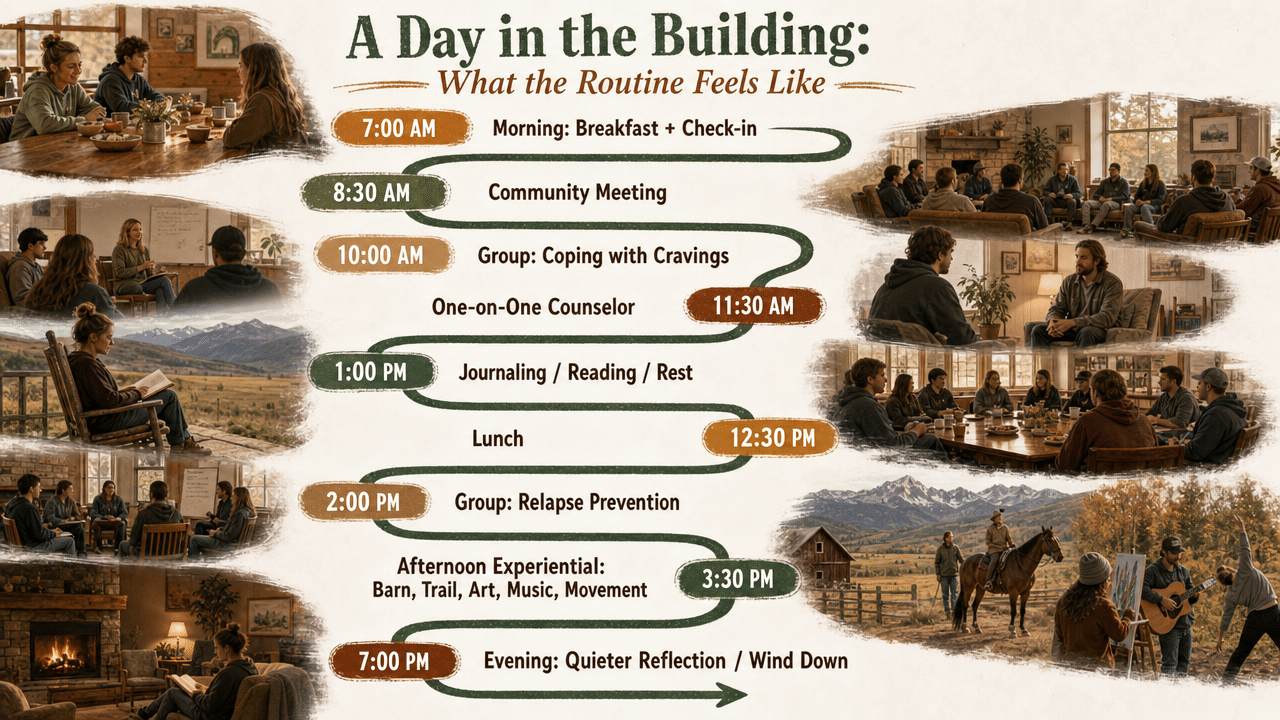
A Day in the Building: What the Routine Feels Like
The schedule is one of the things that surprises people most. Not because it’s harsh, but because it’s predictable in a way your life maybe hasn’t been in a while.
Mornings usually start with breakfast and a check-in. You eat with the same people you’ll see at group later. Then there’s a community meeting — a short gathering where everyone in the program is in the same room, setting an intention for the day.
From there, the day breaks into blocks. A group session on something like coping with cravings. A one-on-one with your counselor. Time for journaling, reading, or just resting. Lunch. Another group, maybe focused on relapse prevention or processing what came up that morning.
Afternoons often hold the experiential pieces. That might mean a session at the barn, time on a trail, art, music, or movement. Evenings tend to be quieter — a 12-step meeting, study time, a short reflection, and sleep.
You’re not running. You’re not bored either. The rhythm gives your nervous system something it’s been missing: a container. When you don’t have to figure out what to do next every five minutes, your brain finally has space to start healing.
The People You’ll Be Around
This is the part most websites skip, and it’s probably what you actually want to know. Who is going to be in that building with you?
You’ll be living alongside a small group of other adults working on the same thing you are. In a smaller program, that might be a couple dozen people at most. You eat with them, sit in group with them, and slowly stop feeling like the only person in the world who’s been through what you’ve been through.
The staff is the other half of the picture. Counselors, nurses, therapists, and support staff are around throughout the day. At many residential centers, a significant share of the counselors are in recovery themselves — meaning the person sitting across from you in session has actually walked the road they’re asking you to walk.
That changes how it feels to open your mouth. You’re not explaining addiction to someone who only read about it in a textbook.
Where a Treatment Center Sits in the Bigger Picture
The Continuum of Care, Explained Without the Jargon
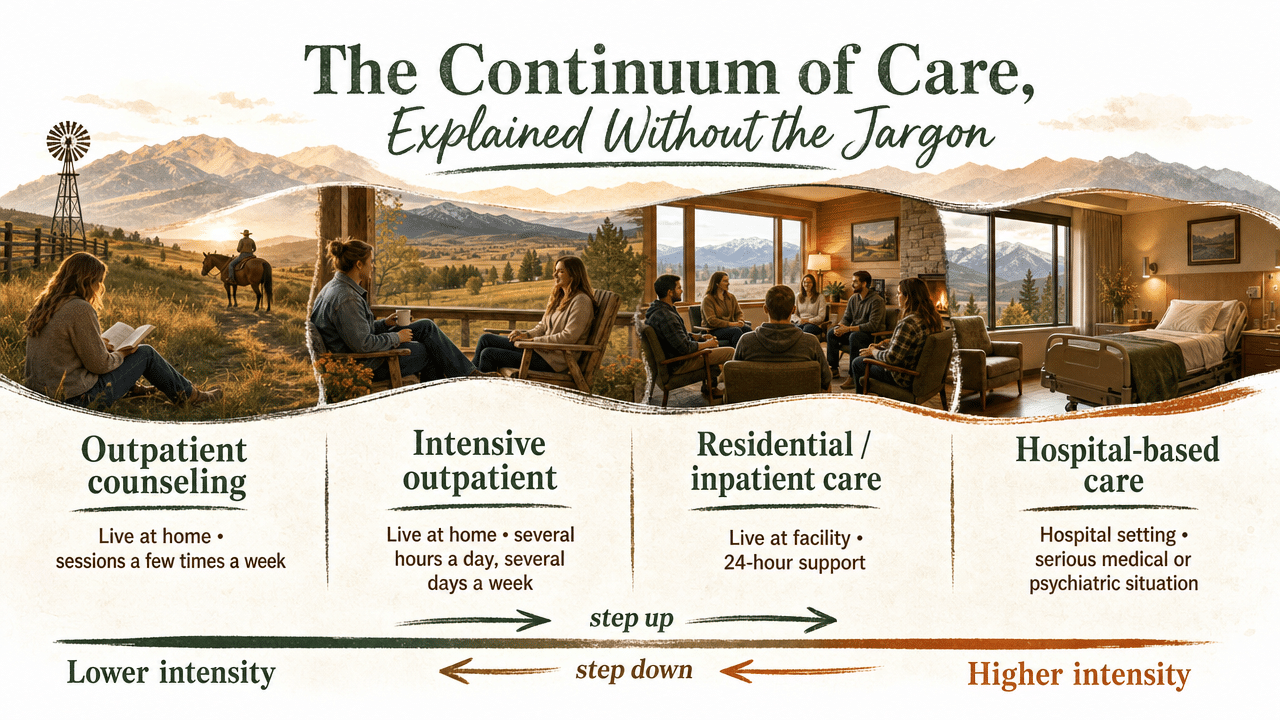
You’ll hear the phrase “continuum of care” a lot once you start reading about treatment. It sounds heavier than it is. All it really means is this: there are different levels of help, and people move between them depending on what they need that week, that month, that year.
Picture a line, low intensity on one end and high intensity on the other.
On the lighter end is outpatient counseling — you live at home, you go to sessions a few times a week. Next comes intensive outpatient, where you’re still living at home but spending several hours a day, several days a week, in treatment. Then comes residential or inpatient care, where you live at the facility and have 24-hour support around you. At the most intense end is hospital-based care, used when there’s a serious medical or psychiatric situation that needs a hospital setting 1.
The thing that makes this a continuum, not a ladder, is that you can move in both directions. People step up when their needs get more intense and step down when they’re ready for less structure 4. Finishing residential doesn’t mean you’re done. It usually means you slide down to outpatient or recovery groups while you rebuild your everyday life.
Where does a residential treatment center fit? Roughly in the middle-to-upper end. It’s chosen when home isn’t a safe enough place to do this work and when you need the day stitched together for you while your brain and body settle.
Detox Is a Starting Step, Not the Whole Thing
One of the biggest misconceptions about treatment is that detox is the treatment. It isn’t.
Detox is the medically supervised process of letting your body clear the substance, usually with nurses and clinicians monitoring you so withdrawal stays as safe and comfortable as possible. It’s the doorway. It’s not the room.
That’s why most residential programs put detox first and then keep going — counseling, group work, behavioral therapies, and recovery skills layered on top, day after day, until something inside you starts to rewire. If a place only offers detox and sends you home a few days later, you’re getting the doorway without the room.
What Continuing Care Looks Like After You Leave
Here’s the part that surprises a lot of first-timers in a good way: the support doesn’t end when you walk out the front door.
Treatment is one stage inside a longer arc that also includes recovery support — the ongoing help that holds you steady once the structured program is over 8. A good residential center plans for that exit from the day you arrive.
What continuing care actually looks like:
- Weekly online groups. A standing video meeting where you check in with familiar faces from your time in the program.
- Scheduled follow-up calls. Many programs reach out at set points after discharge — often around 30, 60, 90, 180, and 365 days — to see how you’re doing and adjust support.
- Aftercare planning. Before you leave, a counselor maps out local meetings, an outpatient therapist if you need one, and a plan for the first few weeks home.
- Alumni community. The people you went through it with don’t disappear. They become part of your network.
Residential vs. Outpatient: How People Actually Get Matched
How a Counselor Decides Which Setting Fits You
You don’t have to figure this out alone, and you definitely don’t have to guess. When you call a treatment center or a helpline, the first real conversation is usually an assessment — a structured chat with a counselor whose job is to listen and then help you land in the right level of care.
They’ll ask about how much you’ve been using and for how long. Whether you’ve tried to stop before. What withdrawal has looked like for you. Whether there’s anxiety, depression, or trauma sitting underneath the using. What your home life is like — who you live with, whether the environment feels safe, whether the people around you are using too. They’ll ask about work, school, legal stuff, and what kind of support you have.
None of this is a test you can fail. It’s how clinicians match people to the right setting, which research describes as essential for effective treatment 15. The same assessment that lands one person in outpatient counseling lands another in residential — not because one of you is “worse,” but because your situations are genuinely different.
Signs Residential Care Is the Right Call
There’s no perfect formula, but there are patterns. Research on inpatient versus outpatient care points to specific situations where a residential setting tends to make sense: more severe dependence, co-occurring mental health conditions, and unstable or unsafe environments at home 5.
In plainer language, residential care is often the right call when:
- You’ve tried to stop on your own or in outpatient and it hasn’t held.
- Withdrawal has been rough enough that you need medical eyes on it 16.
- The people or places around you keep pulling you back toward using.
- There’s something else going on — anxiety, depression, trauma — that tangles up with the substance use.
- You can’t picture yourself getting through a normal week without something changing first.
How Long Programs Last and Why That Matters
You’ve probably seen treatment programs advertised in 30, 60, or 90-day lengths and wondered what the difference actually is. Is a month enough? Is three months overkill? The honest answer is that length matters more than most people realize, and the research is pretty clear about which direction it leans.
NIDA’s research-based guide to addiction treatment notes that staying in treatment for an adequate period of time is one of the principles most tied to better outcomes — with significant improvements often associated with stays of three months or longer 7. That’s a synthesized principle pulled from a body of research, not a single study or a guarantee for any one person. But it’s the closest thing the field has to a rule of thumb on duration.
Here’s what that means in real life. Thirty days gets your body stable, breaks the daily pattern, and gives you the basics of what recovery work looks like. Sixty days gives the new habits room to actually take hold. Ninety days lets you go deeper into the things underneath the using — the grief, the anxiety, the patterns you couldn’t see when you were running on the substance.
None of these lengths is a finish line. They’re more like doses. The longer your brain and body get to settle into a structured environment with the same people doing the same work alongside you, the more the changes have a chance to stick. If you’re scared of committing to 90 days, that’s normal. Most people are. Plenty start at 30 and extend once they realize what’s possible with more time.
What This Looks Like for Young Adults Specifically
Why Age-Appropriate Peer Support Changes the Experience
If you’re in your twenties, sitting in a room with people who could be your parents’ age can feel like another reason to clam up. Your story doesn’t sound like theirs. The substances are different. The reasons you started using are different. The pressure points — school, dating apps, social media, figuring out what to do with your life — aren’t even on their radar.
Research on young adults with substance use disorders backs up what you probably already sense: you need care that’s actually built for where you are developmentally, not just a smaller version of what works for someone twice your age 10. That same review points out a hard truth — a lot of young adults don’t get the full range of evidence-based options, partly because programs aren’t tailored to them 10.
What does age-appropriate care look like in practice? Group sessions where other people are wrestling with the same chapter of life. Counselors who don’t flinch when you bring up things you’ve never said out loud. A peer community that becomes one of the most important parts of what makes the work stick.
Where Family Fits In
Family is complicated. For some of you, the people who raised you are part of why you’re here. For others, they’re the reason you’ve made it this far. Most of you are somewhere in between, and that’s normal.
Here’s what the research keeps finding: when families are actually brought into the treatment process — not just kept in the loop, but given their own therapy, education, and time on the schedule — outcomes for young adults get measurably better 11. The same review notes that families remain underused in most programs, which is part of why structured family programming exists in the first place 11.
A lot of residential centers build this in as a dedicated stretch — sometimes called a family week — where the people closest to you come in for therapy sessions, education about addiction, and guided conversations that probably haven’t happened in years. You’re not on trial. They’re not being blamed. Everyone learns the same language at the same time, and that’s what gives you a shot at going home to something different.
Taking the Next Step Without Overthinking It
You don’t have to decide everything today. You just have to decide the next small thing.
If you’re not sure where to start, one good option is calling SAMHSA’s National Helpline. It’s free, confidential, and runs around the clock — and the person on the other end can point you toward treatment options based on what you actually need and where you live 9. You don’t have to commit to anything. You just have to ask one question.
If you’re ready to talk directly to a treatment center, that conversation usually looks like the assessment we talked about earlier — a counselor on the phone asking gentle questions to figure out the right level of care for you. No quizzes, no judgment.
One last thing worth saying. The fact that you read this far means part of you is already moving toward a different version of your life. Hold onto that. Rocky Mountain Treatment Center, and places like it, exist for exactly this moment — when you’re tired enough to look, and brave enough to ask what’s possible next.
Frequently Asked Questions
What is the simplest definition of a treatment center?
A treatment center is a staffed, organized place where people struggling with alcohol or drug use can get medical care, counseling, and daily support in one location. There’s actually no single official definition across the field 2, so what matters more than the label is what the place offers: who works there, what services run on the schedule, and how they support you after you leave.
What’s the difference between a treatment center and detox?
Detox is the medical process of letting your body clear the substance, usually with nurses watching over you so withdrawal stays safe. A treatment center provides detox plus everything that comes after — counseling, group work, behavioral therapies, and recovery skills. Federal guidance is clear that detox alone is not full treatment and should be followed by ongoing care 16.
How do I know if I need residential care instead of outpatient?
Residential care often fits when outpatient hasn’t held, when withdrawal needs medical monitoring, when home keeps pulling you back toward using, or when something else like anxiety or trauma is tangled up with the substance use 5. You don’t have to decide alone — a counselor does an assessment and helps match you to the right level of care 15.
What actually happens during a typical day inside a treatment center?
Your day has a rhythm. Breakfast and a community check-in, then blocks of group counseling, one-on-one sessions with your counselor, and structured behavioral therapy work like CBT or motivational interviewing 14. Afternoons often include experiential pieces — time outside, art, or equine sessions. Evenings tend to be quieter, with a 12-step meeting 13, reflection time, and sleep.
Can my family be involved while I’m in treatment?
Yes, and it actually helps. Research on young adults shows that when families get their own therapy, education, and time in the program, outcomes improve measurably 11. Many residential centers build in a dedicated family week with therapy sessions and guided conversations. You’re not on trial and they’re not being blamed — everyone learns the same language so home can feel different.
What happens after I leave a treatment center?
You step down to a lighter level of care, not into nothing. Treatment sits inside a longer arc that includes ongoing recovery support 8. That usually means weekly online groups, scheduled follow-up calls at set points after discharge, an aftercare plan with local meetings or an outpatient therapist, and an alumni community of people who went through the program alongside you.
References
- Treatment Types for Mental Health, Drugs and Alcohol. https://www.samhsa.gov/find-support/learn-about-treatment/types-of-treatment
- Chapter 5—Specialized Substance Abuse Treatment Programs. https://www.ncbi.nlm.nih.gov/books/NBK64815/
- Treatment of Substance Use Disorders. https://www.cdc.gov/overdose-prevention/treatment/index.html
- Chapter 3. Intensive Outpatient Treatment and the Continuum of Care. https://www.ncbi.nlm.nih.gov/books/NBK64088/
- Inpatient vs outpatient treatment for substance dependence revisited. https://pubmed.ncbi.nlm.nih.gov/8391147/
- Principles of Drug Addiction Treatment: A Research-Based Guide (Third Edition). https://nida.nih.gov/sites/default/files/podat-3rdEd-508.pdf
- Principles of Drug Addiction Treatment: A Research-Based Guide (full PDF). https://nida.nih.gov/sites/default/files/podat_1.pdf
- The Institute of Medicine’s Continuum of Care. https://www.samhsa.gov/resource/sptac/institute-medicines-continuum-care
- National Helpline for Mental Health, Drug, Alcohol Issues. https://www.samhsa.gov/find-help/helplines/national-helpline
- Evidence-Based Treatment for Young Adults with Substance Use Disorders. https://pmc.ncbi.nlm.nih.gov/articles/PMC7879425/
- Family Involvement in Treatment and Recovery for Substance Use Disorders among Transition-Age Youth. https://pmc.ncbi.nlm.nih.gov/articles/PMC8380649/
- Equine-assisted services for individuals with substance use disorders. https://pmc.ncbi.nlm.nih.gov/articles/PMC9749232/
- A Combined Group and Individual 12-Step Facilitative Intervention. https://pmc.ncbi.nlm.nih.gov/articles/PMC3408890/
- Chapter 4—Behavioral Therapies for Drug Abuse and Dependence. https://www.ncbi.nlm.nih.gov/books/NBK64952/
- Chapter 2—Screening and Assessment. https://www.ncbi.nlm.nih.gov/books/NBK64101/
- Detoxification and Substance Abuse Treatment. https://www.ncbi.nlm.nih.gov/books/NBK64364/