Key Takeaways
- North Dakota licensed only 37 residential substance use programs as of October 2024, pushing many residents to look across state lines for accessible care 8.
- Residential care aligns with how North Dakota funds treatment, with roughly 85% of FY2017 SUD expenditures going to residential and inpatient services 7.
- Location factors like travel distance, insurance fit, and family involvement matter; Medicaid holders should use the state directory since RMTC does not accept Medicaid or Medicare 4, 5.
- The practical next step is a phone call to admissions to verify benefits, arrange complimentary Montana pickup, and confirm whether a 26-bed program fits the situation.
Navigating the Journey to Recovery: Complimentary Pickup from North Dakota
Before considering programs or therapies, a common concern for many North Dakotans is the practical challenge of reaching a treatment center. Given the vast distances within the state, travel logistics are a significant factor in accessing care.
Rocky Mountain Treatment Center is located in Great Falls, Montana. While distances from North Dakota cities like Williston (five hours), Minot (seven hours), Bismarck (eight hours), and Fargo (ten hours) can seem daunting, especially for someone needing care, RMTC addresses this directly.
We offer complimentary Montana pickup. This means you can contact our admissions team, discuss your starting location, and we will help arrange your transportation. This service removes the burden of coordinating travel, allowing you to focus on your recovery without the added stress of a long drive or complex logistics. This simple detail transforms the question from “how do we get there?” to “when can we start?”
This guide will further explore what residential care looks like for North Dakotans, how our 26-bed model offers a unique alternative to larger facilities, and how insurance and continuing care are managed. Starting with the journey, we aim to make the path to recovery as smooth as possible.
Residential Care Options for North Dakota Residents
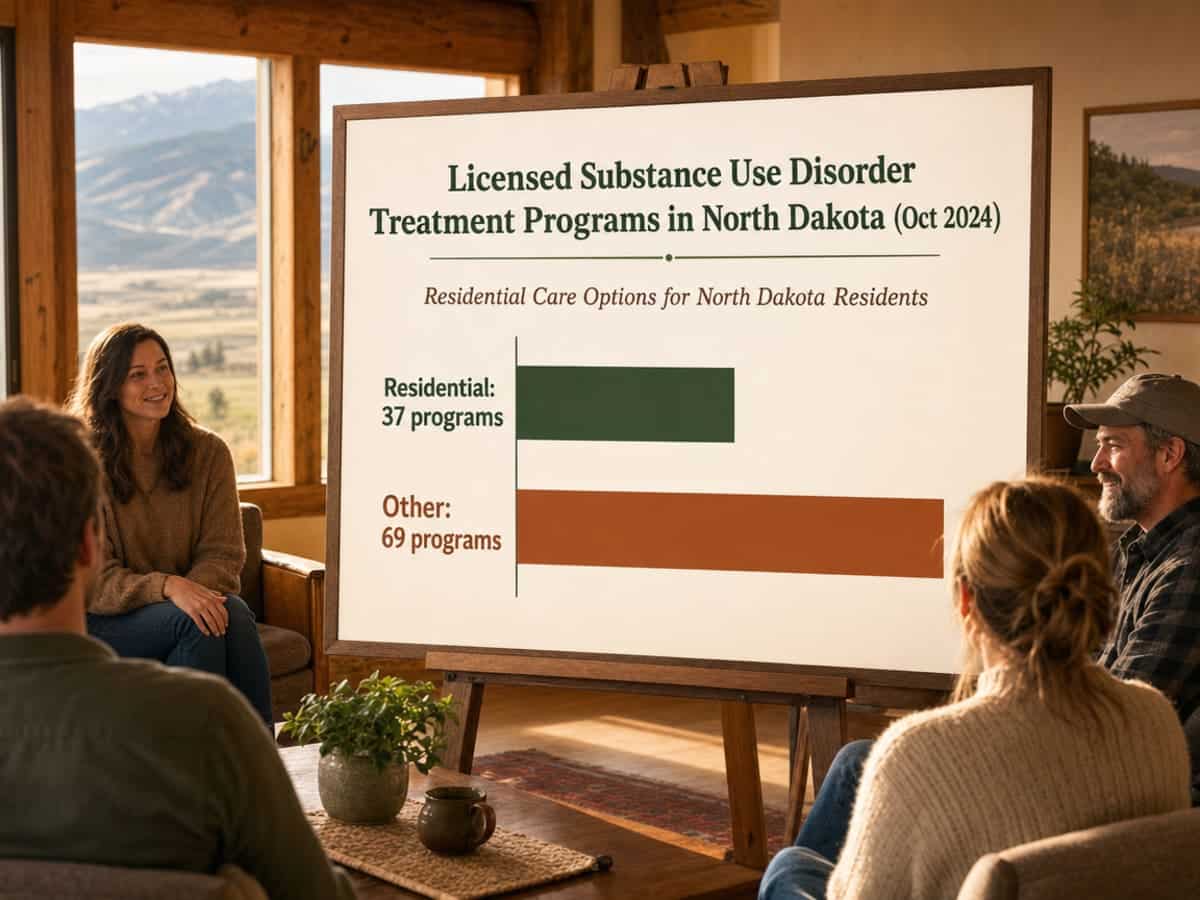
Searching for residential addiction treatment in North Dakota can often yield limited results. As of October 1, 2024, North Dakota had 106 licensed substance use disorder treatment programs, but only 37 of these were licensed for residential treatment 8. The remaining programs offered outpatient, day treatment, or other levels of care. Distributing 37 residential programs across a large state like North Dakota means that families in areas like Williston or Devils Lake may need to look beyond their immediate vicinity for suitable options.
The state maintains a directory of these licensed programs, which is a valuable resource for identifying facilities near you 4. State licensure ensures that a facility meets specific admission and operational standards set by North Dakota’s behavioral health division 2, confirming its legitimacy. The challenge then becomes finding a legitimate program that is the right fit, accessible, and affordable.
For many North Dakotans, “nearby” extends beyond state lines. Great Falls, Montana, can be more accessible from western North Dakota than some in-state options. Rocky Mountain Treatment Center, with its 26-bed residential program, offers a more personal and less bureaucratic experience compared to larger institutions. Our complimentary Montana pickup service further reduces the perceived distance, making our facility a practical choice.
While in-state programs are excellent if they meet your needs, if you encounter long wait times, difficult travel, or an unsuitable fit, consider expanding your search. A brief call to our admissions team can quickly determine if crossing the state line to RMTC aligns with your specific situation and insurance coverage.
Residential Treatment: A Mainstream Approach in North Dakota
Residential care is a widely supported and funded treatment option in North Dakota. In FY2017, residential and inpatient services constituted approximately 85% of North Dakota’s substance use disorder treatment expenditures 7. This significant investment highlights the state’s commitment to providing comprehensive care that removes individuals from environments conducive to substance use, allowing them dedicated time for healing.
If you’ve been advised to consider inpatient care by a medical professional, legal authority, or loved one, you are aligning with a well-established and effective treatment path. Alcohol dependence, for instance, often requires more than intermittent appointments. If previous attempts at outpatient counseling or self-management have been unsuccessful, it’s not a personal failing but an indication that a higher level of care may be necessary. Residential treatment provides a structured environment where every aspect of your day supports recovery, from safe surroundings to consistent access to counselors and peer support.
Choosing a smaller residential program like Rocky Mountain Treatment Center in Great Falls is not an unusual step; it’s a continuation of the care model North Dakota prioritizes. Our 26-bed facility is designed to offer intimate, focused care where counselors are readily available. You are seeking a level of care that your state already champions. Contact our admissions team to discuss how we can facilitate this essential step in your recovery journey.
Understanding Levels of Care: Outpatient, PHP, and Residential
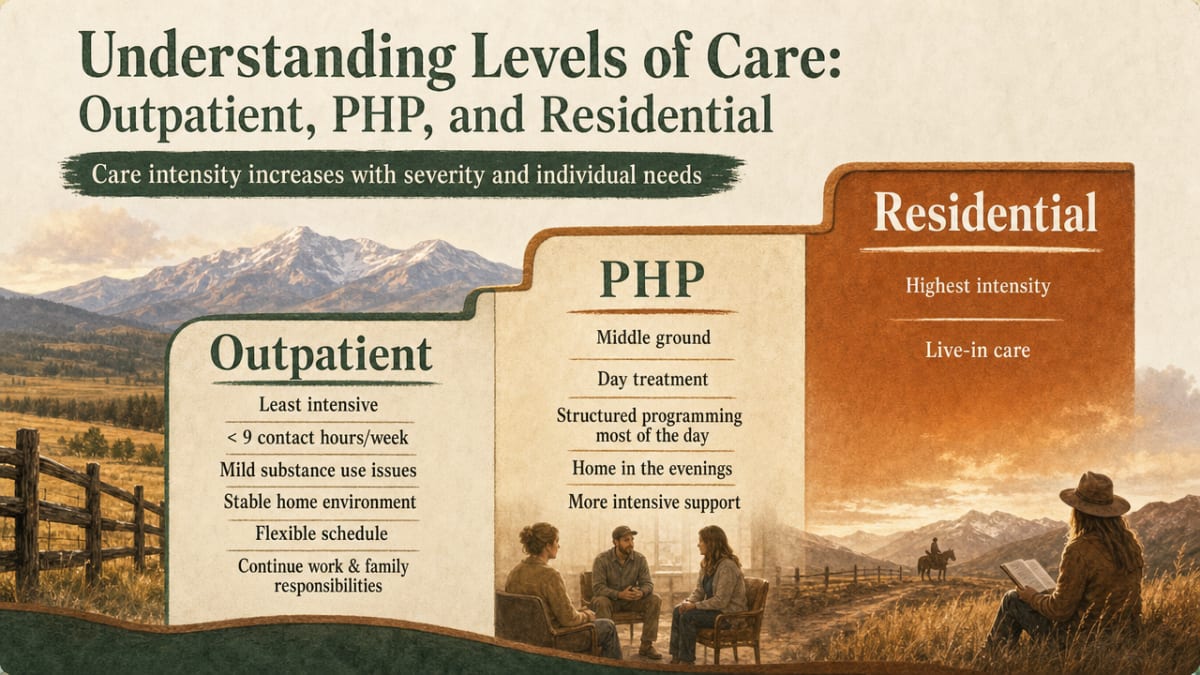
When exploring addiction treatment, you’ll encounter terms like outpatient, partial hospitalization (PHP), and residential care. These represent a spectrum of intensity, with the appropriate level determined by the severity of substance use and individual needs.
- Outpatient care
- The least intensive level, typically involving fewer than nine contact hours per week in North Dakota 10. This model is suitable for individuals with mild substance use issues, stable home environments, and flexible schedules. It allows for continued work and family responsibilities while receiving support.
- Partial Hospitalization Programs (PHP)
- Also called day treatment, PHP offers a middle ground. Participants engage in structured programming for most of the day but return home in the evenings 11. PHP is effective for those who need more intensive support than outpatient care but have a stable and supportive home environment.
- Residential care
- The most comprehensive level, where individuals live at the facility. This immersive environment integrates counseling, group therapy, meals, and downtime within the same setting, removing external triggers and distractions.
If previous attempts at less intensive care have not been successful, it often indicates that the level of care did not match the severity of the illness. North Dakota’s admission rules emphasize matching clients to the appropriate intensity of care to ensure effectiveness 9.
If your current environment poses challenges to sobriety, residential care offers a crucial opportunity for sustained recovery. Rocky Mountain Treatment Center’s 26-bed program provides this highest level of care, offering a supportive and structured environment within reach.
The Intimate Experience of a 26-Bed Residential Program
Unlike large institutional facilities that can feel impersonal, a 26-bed residence like Rocky Mountain Treatment Center offers a distinctly different atmosphere. Our smaller scale is intentional, fostering a sense of community and personalized attention.
At RMTC, you’ll find that staff quickly learn your name, and counselors are easily accessible. The consistent group dynamic in therapy sessions and during meals allows for deeper trust and connection to develop among residents. This intimate setting, within a state that has a limited number of residential programs 8, makes our Montana facility feel more like a supportive home than a clinical institution.
A typical day at RMTC involves waking in a private room, sharing meals with peers, participating in group therapy, and engaging in one-on-one counseling. We prioritize structured downtime to allow for mental and physical rest. A significant aspect of our program is that over 80% of our staff are in recovery themselves, offering a profound level of empathy and understanding. When a counselor says, “I understand that feeling,” it comes from personal experience.
Our small scale also enhances family involvement. During Family Week, a three-day program designed for loved ones, there’s ample opportunity for meaningful conversations and collaborative planning. Activities like equine therapy, gym access, hiking, and meditation are integrated into a manageable daily routine. The journey to our center is simplified by our complimentary Montana pickup service from North Dakota, ensuring a smooth transition to our supportive environment.
You don’t need to have all the answers before reaching out. A call to admissions is the first step, and our team is ready to guide you through the process.
Understanding Insurance and Coverage at Rocky Mountain Treatment Center
Financial concerns are often a primary barrier to seeking treatment. At Rocky Mountain Treatment Center, we aim for transparency regarding costs and insurance coverage.
RMTC partners with most major insurance providers, which typically includes many employer-sponsored plans held by North Dakota families. When you contact our admissions team, one of their first tasks is to verify your insurance benefits for residential care. This process clarifies what your plan covers, eliminating the need for you to navigate complex insurance language alone.
For individuals with private insurance, employer plans, or those considering self-pay, our admissions team will provide a detailed breakdown of costs. This includes information on deductibles, the potential cost of a 30, 60, or 90-day stay against your benefits, and any pre-authorization requirements. Our goal is to provide clear answers, not a sales pitch.
A single call with your insurance information and a brief overview of your situation can provide more clarity in twenty minutes than days of online research.
Detoxification, the Initial Days, and Packing Essentials
For individuals with prolonged heavy alcohol use, the initial 72 hours of withdrawal can be a significant concern. This apprehension is valid, as alcohol withdrawal can present serious health risks.
At Rocky Mountain Treatment Center, detox is medically monitored to ensure your safety and comfort. Our nursing staff provides continuous oversight, and a doctor develops an individualized plan. Medications are available to manage withdrawal symptoms, such as shakes, sweats, rapid heart rate, insomnia, and to prevent more severe complications like seizures. You are not expected to endure this process alone; you are under professional care.
The first 72 hours are typically focused on rest, hydration, and light meals as tolerated. Vitals are regularly checked, and a counselor will check in to offer support and let you know they are available once you feel clearer.
Regarding packing, simplicity is key. Bring:
- Comfortable clothing for about a week, suitable for layering due to Montana’s variable weather
- Closed-toe shoes
- Toiletries that do not contain alcohol
- Essential documents including your insurance card, identification, and any current prescriptions in their original containers
- A notebook for journaling can be beneficial
We recommend leaving laptops, work phones, and valuables at home to minimize distractions.
Our admissions team will provide a comprehensive packing list upon inquiry, ensuring you have everything you need.
Addressing Family, Work, and the Benefits of Out-of-State Treatment
Many North Dakotans hesitate to seek treatment due to concerns about work responsibilities, childcare, pet care, and communicating with employers. These are valid concerns, but they are manageable and should not prevent you from seeking necessary care.
Regarding employment, the Family and Medical Leave Act (FMLA) protects your job at most eligible employers for treatment of a substance use disorder. You are not required to disclose specific details to your supervisor; HR departments typically handle the necessary paperwork. A call to your HR office or a doctor’s note is usually sufficient to initiate leave. Our admissions team at Rocky Mountain Treatment Center can guide you on the required documentation.
Family arrangements require honest conversations. If you are a primary caregiver, it’s essential to arrange temporary support from a spouse, sibling, friend, or other trusted individual. Loved ones are often eager to help when directly asked.
While it may seem counterintuitive, leaving the state for a few weeks can be highly beneficial for long-term family stability. Distance from familiar triggers, such as local bars, social circles, or routines associated with substance use, creates a crucial “firebreak” for recovery. This separation allows for focused healing without the immediate pressures of home life.
Our small residential program in Great Falls actively involves families. Family Week is a three-day program designed to integrate your loved ones into the recovery process, fostering open communication and collaborative planning for your return. Between visits, Zoom groups and family counseling sessions maintain ongoing connection and support.
A commitment of two to three weeks, or even 30 to 90 days, is a relatively short period compared to the long-term impact of untreated addiction. Contact our admissions team to discuss timelines, FMLA paperwork, and how your family can be involved from the outset.
Sustaining Recovery: Continuing Care Upon Returning to North Dakota
Discharge from residential treatment marks a transition, not an end. The initial weeks back home are critical for solidifying recovery, and Rocky Mountain Treatment Center emphasizes comprehensive continuing care.
Our continuing care plan is established before you leave. This includes weekly Zoom groups, allowing you to stay connected with your peers from treatment, whether you’re in Grand Forks or Dickinson. We also provide follow-up check-ins at 30, 60, 90, 180, and 365 days post-discharge. This year-long support ensures ongoing accountability and a consistent point of contact to monitor your progress.
Additionally, we assist in connecting you with local support in North Dakota. The state’s directory lists licensed outpatient programs and Licensed Addiction Counselors across various regions, which can help you arrange weekly sessions close to home 4. If you have Medicaid, these services are covered without requiring service authorization 5. We also help identify local AA and other 12-step meetings that fit your schedule before you return. Coming home is a significant part of the recovery journey, and you don’t have to navigate it alone. Our admissions team can provide more details on our year-long follow-up program.
Taking the Next Step: Making the Call
If you’ve read this far, you’re likely considering the next step. That step is a phone call, not further research.
When you call Rocky Mountain Treatment Center admissions, you’ll speak with a person, not an automated system. You can share your location, your substance use, and your current situation. We’ll discuss your insurance, explain the complimentary Montana pickup service from your part of North Dakota, and provide clear answers about bed availability, timing, and costs.
Typically, within twenty minutes, you’ll have a clear understanding of whether our 26-bed residence in Great Falls is the right path for you, or if an in-state licensed program might be a better fit. You don’t need to be fully prepared; you just need to make the call. Contact admissions this week to discuss travel and insurance, and let us help you build the rest of your recovery plan.
Frequently Asked Questions
Do I have to stay in North Dakota to get residential addiction treatment?
No. While in-state care is a valid option, with only 37 residential programs licensed statewide as of October 2024 8, many North Dakotans seek treatment out of state. Rocky Mountain Treatment Center in Great Falls, Montana, is a close alternative, especially for those in western North Dakota. The state’s directory of licensed programs is a good starting point for in-state options 4.
How do I actually get from North Dakota to Rocky Mountain Treatment Center in Great Falls?
Simply call our admissions team and inform them of your starting location. RMTC provides complimentary Montana pickup, eliminating the need for you to drive during withdrawal or burden family members with travel. Our team coordinates the trip from your city, whether it’s Williston, Minot, Bismarck, Fargo, or elsewhere. The logistics are handled with one phone call.
Does Rocky Mountain Treatment Center accept my insurance, Medicaid, or Medicare?
RMTC works with most major insurance providers, including many employer plans common among North Dakota families. However, we do not currently accept Medicaid or Medicare. If Medicaid is your primary coverage, North Dakota’s state directory of licensed programs is your best resource, as ND Medicaid covers SUD services without prior authorization 5, 4. For private or employer insurance, admissions will verify your benefits during the call.
How long will I be away from home, work, and family?
Programs at RMTC typically range from 30, 60, or 90 days, depending on individual needs. A 30-day stay is common for initial treatment, while longer periods can provide more sustained recovery. Your job is generally protected under the Family and Medical Leave Act during treatment, and our admissions team can assist with documentation. HR departments usually manage the paperwork without requiring detailed explanations to supervisors.
What is a 26-bed residential program like compared to a larger facility?
Our 26-bed program offers a more intimate and tranquil environment. Staff quickly learn your name, counselors are easily accessible, and consistent group dynamics foster trust. Over 80% of our staff are in recovery, providing authentic empathy and understanding. Family Week is designed for genuine interaction, not large presentations. This smaller scale creates a supportive, home-like atmosphere.
What happens with continuing care once I come back to North Dakota?
Continuing care is integrated into your treatment plan before discharge. This includes weekly Zoom groups to maintain connections with peers and follow-up check-ins at 30, 60, 90, 180, and 365 days after leaving. Our counselors also help you identify local support options in North Dakota, such as outpatient programs from the state directory 4or 12-step meetings in your community. Returning home is a crucial phase, and you’ll have ongoing support.
References
- NSDUH Behavioral Health Barometer: North Dakota, Volume 8. https://www.samhsa.gov/data/report/nsduh-behavioral-health-barometer-north-dakota-volume-8
- Licensing | Health and Human Services North Dakota. https://www.hhs.nd.gov/behavioral-health/licensing
- North Dakota Century Code t50c31. https://ndlegis.gov/cencode/t50c31.pdf
- ND Substance Abuse Treatment Programs. https://www.hhs.nd.gov/behavioral-health/substance-abuse-treatment-programs
- Substance Use Disorder Services. https://www.hhs.nd.gov/sites/www/files/documents/medicaid-policies/substance-use-disorder-treatment-services.pdf
- Evidence-Based Treatment and Recovery Strategies for …. https://www.hhs.nd.gov/behavioral-health/addiction/opioid/treatment
- Behavioral health – North Dakota State Government. https://www.nd.gov/dhs/info/testimony/2019-2020-interim/health-care/2020-9-11-substance-use-disorder-voucher.pdf
- Annual Report Template. https://ndlegis.gov/assembly/69-2025/testimony/HAPPHUM-1012-20250116-29768-F-SAGNESS_PAMELA.pdf
- North Dakota Administrative Code – Title 75 Article 9.1 Chapter 1. https://www.ndlegis.gov/api/acdata/pdf/75-09.1-01.pdf
- North Dakota Administrative Code – Title 75 Article 9.1 Chapter 7. https://www.ndlegis.gov/api/acdata/pdf/75-09.1-07.pdf
- North Dakota Administrative Code – Title 75 Article 9.1 Chapter 5.1. https://www.ndlegis.gov/api/acdata/pdf/75-09.1-05.1.pdf
- Rural Health Clinics | Health and Human Services North Dakota. https://www.hhs.nd.gov/health/regulation-licensure-and-certification/health-facilities-unit/rural-health-clinics