
Key Takeaways
- The first call is answered by a real person who gathers your location, drinking history, and safety status without pressuring you to commit to anything upfront.
- A twenty-minute ASAM-based screening determines whether you need medically monitored detox on arrival or can go straight into residential care 12.
- Intake coordinators can verify insurance and check prior authorization while you’re on the phone, since federal privacy rules already permit sharing for treatment and payment 3.
- A single 2024-updated Part 2 consent covers all future coordination with your doctor, insurer, and aftercare team, replacing the old repeat-signature model 6.
- Complimentary Montana pickup removes the solo drive from Idaho, Wyoming, or the Dakotas, with logistics arranged during the same screening call.
- Packing stays small: bring ID, insurance card, medications list, and comfortable clothes, and leave anything containing alcohol, weapons, or work devices at home.
- Arrival at the 26-bed Great Falls facility starts with a quiet medical check, the single consent signature, a meal, and an early bedtime.
- Discharge planning begins in the first days because national quality measures track follow-up within 7 to 14 days after residential treatment 1.
The 11 PM Phone Call: What Actually Happens When You Dial
It’s late. The house is quiet. You’ve been staring at the phone number for a residential program in Great Falls, Montana, and your thumb keeps hovering over the call button. Making that call is the hardest part, and the person answering the line at Rocky Mountain Treatment Center knows that. They’ve picked up this call before.
Here’s what actually happens when you dial. Someone answers — a real person, not a menu. They’ll ask your first name and where you’re calling from. If you’re in Idaho Falls, Casper, Williston, or somewhere off US-2, they’ll write that down because it matters for the ride later. They won’t push you to commit to anything in the first minute. Most of that first minute is them letting you breathe.
Then the conversation shifts, gently, into a few practical questions. How much have you been drinking, and when was your last drink? Any medical conditions, medications, or past withdrawal episodes? Are you safe right now? These questions aren’t a test. They map to a standard placement framework that helps the team confirm residential care is the right fit before you get in a car 12. If detox is needed, they want to know that before you arrive, not after.
You’ll also hear something that surprises a lot of first-time callers: the intake coordinator can start verifying your insurance and coordinating with your current doctor without you signing anything first. Federal privacy rules already allow providers to share information for treatment, payment, and basic operations 3. That means the paperwork burden on your end is smaller than you think.
By the end of that first call, you’ll usually have a next step — often the fuller screening conversation, sometimes a bed hold, sometimes both. And you’ll have a name to ask for when you call back.
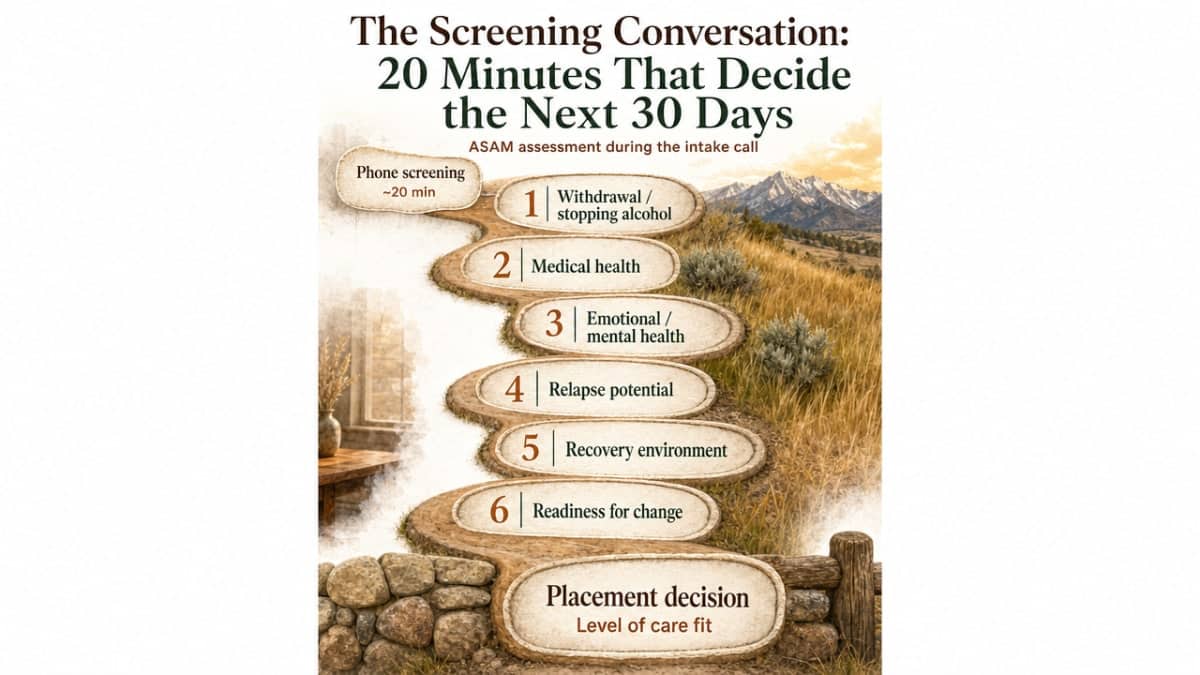
The Screening Conversation: 20 Minutes That Decide the Next 30 Days
If the first call is the doorway, the screening conversation is the room you step into. It usually happens the same night or the next morning, and it takes about twenty minutes. You can do it from your couch, your truck, or a parking lot behind a gas station in Sheridan. Wherever you are, you don’t need to prepare anything. The intake counselor at Rocky Mountain will walk you through it.
The questions follow a framework called the ASAM criteria — the most widely used guidelines in the country for figuring out what level of care fits a person’s situation 12. That sounds clinical, but on the phone it feels more like someone taking careful notes while you tell your story. The counselor is quietly checking six areas:
- how your body might handle stopping alcohol,
- your general medical health,
- what’s going on emotionally,
- how ready you feel for treatment,
- whether you’ve tried to stop before, and
- what your home environment looks like when you go back to it.
Some questions land harder than others. “When was your last drink?” is easy. “Have you had a seizure or the shakes when you’ve tried to stop?” is not. Answer honestly anyway. The team isn’t grading you. They’re trying to figure out whether you need medically monitored detox the moment you arrive in Great Falls, or whether you can go straight into the residential side of the house. Getting that right is the difference between a safe first night and a scary one.
You’ll also be asked about mental health — depression, anxiety, trauma, anything you’ve been prescribed. Rocky Mountain treats co-occurring conditions alongside the drinking, so this isn’t a side conversation. It shapes your treatment plan from day one.
By the end of the twenty minutes, the counselor usually has enough to confirm a bed, flag anything the medical team needs to know before you get there, and start mapping out the ride. You’ll hang up knowing three things: whether you’re a fit for the program, roughly when you can come in, and who to text if you get scared between now and then. That’s a lot of ground to cover in one call. Most people are surprised how much lighter their chest feels when it ends.
Insurance Verification While You’re Still on the Line
Here’s something that catches most callers off guard: the intake coordinator can start checking your insurance before you’ve signed a single form. You give them the name on the card, the member ID, and the group number — that’s it. Federal privacy rules already permit providers to share health information for treatment, payment, and health care operations without extra patient authorization 3. Rocky Mountain uses that same permission every day to call your insurer, ask what your plan covers for residential substance use treatment, and get an answer while you’re still on the line.
What the team is really doing during that call is sorting two piles. In the first pile: things they can confirm on their own — your in-network status, your deductible, whether residential care is a covered benefit, roughly what your out-of-pocket share might look like. In the second pile: things that need your insurance company to say yes before you arrive. Some plans require prior authorization for residential substance use disorder treatment, and some don’t 8. If yours does, the intake team submits the clinical information from your screening call and waits for approval. That step is why the benefits check happens before the pickup gets scheduled, not after.
If you’re calling from Idaho, Wyoming, North Dakota, or South Dakota, your plan probably works across state lines for medically necessary care. But every plan is different, and the language matters. “Out-of-network” doesn’t mean “not covered” — it usually just means a different cost share. The intake coordinator will tell you plainly what your plan says, including the parts you won’t like. If prior authorization is going to take a day or two, they’ll tell you that too, and they’ll help you think through what to do in the meantime.
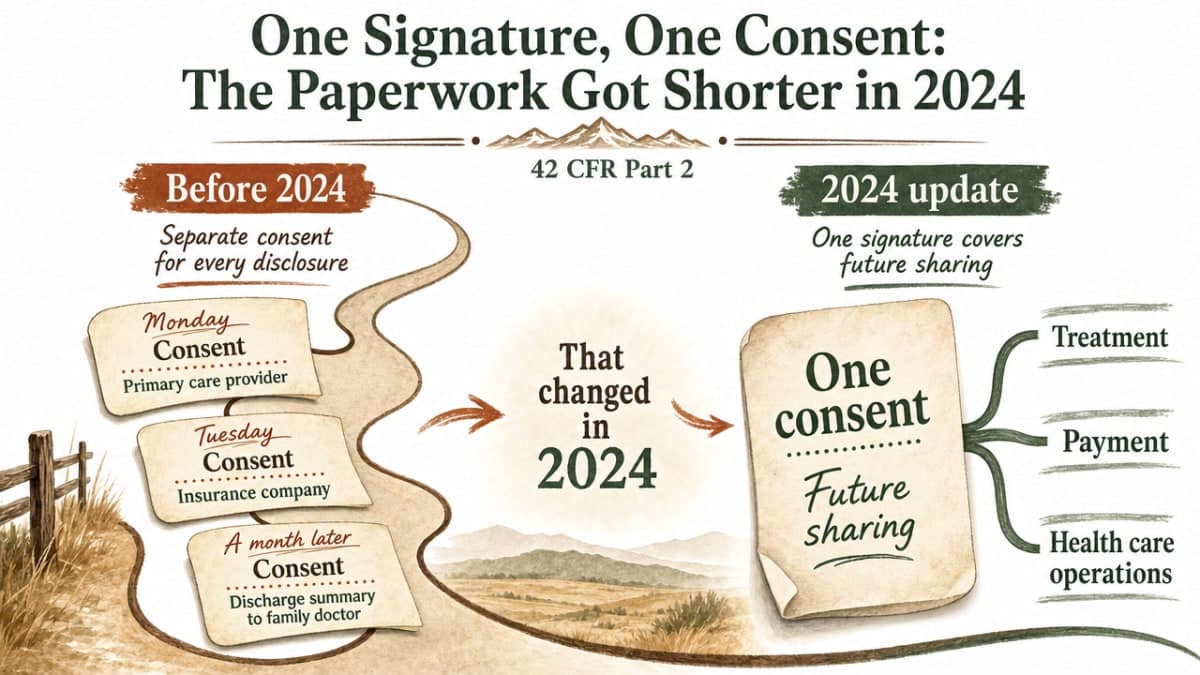
One Signature, One Consent: The Paperwork Got Shorter in 2024
If you’ve been through any kind of medical care before, you know the drill: forms, more forms, another form because the first one was for a different department. Substance use treatment used to be worse. For decades, sharing your addiction records — even between your own doctors — meant signing a separate consent for every disclosure. If Rocky Mountain needed to talk to your primary care provider on Monday and your insurance company on Tuesday, that was two signatures. If your family doctor needed a copy of your discharge summary a month later, that was a third.
That changed. In 2024, the federal rule that protects substance use records — called 42 CFR Part 2 — was updated. Now you can sign one consent that covers all future sharing of your records for treatment, payment, and basic health care operations 6. One signature. One time. It covers the intake team calling your insurer, the medical staff coordinating with your doctor at home, and the aftercare team sending a summary to whoever picks up your care after Great Falls.
Here’s what that looks like at the kitchen table. When you arrive at Rocky Mountain, someone walks you through the consent form and explains it in plain language — what it covers, who it can be shared with, and how you can pull it back if you ever want to 13. You sign once. The team doesn’t ask you to re-sign every time a new coordination call needs to happen during your 30, 60, or 90 days. That’s not a shortcut. It’s the new standard, and it exists specifically because the old repeat-consent model made continuing care harder than it needed to be 5.
You still have control. You can name specific people you don’t want records shared with. You can revoke consent in writing. And Part 2 records get stronger protection than regular medical records if anyone ever tries to use them outside of treatment 7. The point of the 2024 change wasn’t to give away your privacy. It was to stop making you sign the same form ten times while you’re trying to focus on getting well.
For you, coming in from Idaho or Wyoming or the Dakotas, this matters in a practical way. Your first day in Great Falls has enough on it already. Fewer forms means more time with the counselor, the nurse, the meal, the bed.
The Complimentary Montana Pickup From Your Bordering State
Here’s the part most other places don’t mention until page four: you don’t have to figure out how to get to Great Falls on your own. Rocky Mountain Treatment Center offers complimentary Montana pickup, and the team will work with you on the ride whether you’re driving out of Idaho Falls on I-15, coming east from Spokane, dropping down from Williston on US-2, or heading north from Casper. If you can get yourself to a manageable meeting point in Montana, someone from the team can meet you. If your situation is more fragile than that, the intake coordinator will walk through options with you on the phone.
Why does this matter? Because the drive is often the scariest part. It’s the space between deciding and arriving. It’s the hours where the old voice in your head starts arguing with the new one. Removing that solo drive — or at least shortening it — takes one very real obstacle off the table. You don’t have to trust yourself for eight hours behind the wheel. You have to trust yourself for the first phone call, and then again when the car door closes.
The logistics get sorted during the same call as the screening and benefits check. The coordinator will ask where you’re leaving from, who’s helping you (a spouse, a parent, a friend, or nobody), whether you have a vehicle, and what time of day works. Then they’ll suggest a plan. Sometimes that’s a family member driving you to a pickup point near the Montana line. Sometimes it’s a bus or a flight into Great Falls where a staff member meets you at the door. Sometimes, if you’re already partway there, it’s someone driving out to meet you at a truck stop off the interstate. The team has done this before from every direction.
A few practical notes. If you’re going to be on the road for several hours and your last drink was recent, tell the coordinator. Alcohol withdrawal can start within six to twelve hours of your last drink, and the medical team needs to know what to expect when you arrive so medically monitored detox is ready for you. Bring water, snacks, your ID, and your insurance card in the front seat, not buried in a suitcase. Keep your phone charged. If anything goes sideways during the drive — a panic attack, a change of heart, a car problem — you call the same number you called the first time.
The pickup isn’t a luxury. It’s the team meeting you where you are, literally, because they know the distance between your kitchen table and a bed in Great Falls is measured in more than miles.
What to Pack, What to Leave, What Not to Bring
Packing is the first thing you can do with your hands while you wait for pickup day. It gives the anxious part of your brain a job. Keep the suitcase small — one medium bag and a small backpack is plenty for 30, 60, or 90 days. Rocky Mountain has laundry on site. You don’t need to pack for every possible weather in Montana.
Bring these.
- Your driver’s license or state ID.
- Your insurance card.
- A short list of medications you take, with doses.
- Comfortable clothes for a full week — jeans, t-shirts, sweatshirts, pajamas, underwear, socks.
- A pair of sturdy closed-toe shoes for walking and for the equine therapy paddock.
- A jacket, even in summer, because mornings in Great Falls can bite.
- A refillable water bottle.
- Any glasses or contacts you need.
- A journal and a couple of pens if writing helps you think.
Bring these if you have them.
- A few printed photos of the people you love — a spouse, your kids, a parent, the dog. These matter more than you’d guess during Family Week and in the quieter evenings.
- A book you’ve been meaning to read.
- Cash for small incidentals, though you won’t need much.
Leave these at home.
- Laptops, tablets, work phones, and anything that pulls you back into the life you’re stepping away from for a month.
- Expensive jewelry.
- Large amounts of cash.
- Anything with sentimental value you’d be crushed to lose.
Do not bring these under any circumstance.
- Alcohol, obviously, including anything sealed “for the drive.”
- Any non-prescription drugs.
- Mouthwash, hand sanitizer, cologne, aftershave, hairspray, or any personal care product that contains alcohol — the front label may not say it, but the ingredients often do, and these get flagged at intake because they can trigger withdrawal cues or be misused.
- Weapons of any kind.
- Over-the-counter medications not on your list; the medical team will provide what you need.
If you’re unsure about something in your bag at 9 p.m. the night before pickup, call the intake line and ask. That’s what the number is for. Nobody at Rocky Mountain will be annoyed that you called about shampoo.
Arrival Day at Great Falls: Detox, First Meal, First Sleep
You’ll roll into Great Falls tired. That’s normal. Whether you drove in yourself, rode with family, or met the pickup somewhere along the way, the last leg feels longer than the miles say. When you pull up to the 26-bed facility, someone is expecting you by name. That matters more than it sounds like it should.
The first hour is quieter than you’d guess. A brief medical check happens first — vitals, a few questions about your last drink, a look at anything the intake counselor flagged during your screening call. If you need medically monitored detox, that starts right away. The nursing team already knows what to watch for because you told them on the phone, so nobody is scrambling. If you’re past the withdrawal window, you skip that step and move into the residential side of the house.
Then comes paperwork, but less than you’re bracing for. You’ll sign the single Part 2 consent that lets the team coordinate with your doctor at home and your insurance without asking you to re-sign every week 6. Someone walks you through it in plain language and answers your questions.
After that: a meal. A shower if you want one. A bed that’s already made. Your roommate, if you have one, has been told you’re coming. Lights out is earlier than you’re used to.
That first sleep in Great Falls is often the deepest one you’ve had in months. You made it. The hardest calls are already behind you. Tomorrow the real work starts — but tonight, you rest.
The 24 Hours Between Deciding and Leaving
There’s a stretch of time nobody warns you about — the hours between hanging up the phone and getting in the car. You’ve made the decision. The bed is held. Pickup is arranged. And now you’re sitting in your own living room with a suitcase half-packed, and the old voice in your head is louder than it’s been in weeks. That voice is going to try to talk you out of it. Expect that. It doesn’t mean you’ve changed your mind. It means you’re scared, and scared makes sense.
Give your hands something to do. Finish the packing list. Text the person driving you to confirm the time. Write a short note for whoever is watching your house or your dog. Set your out-of-office. Put your ID and insurance card in your front pocket. Small tasks quiet a loud brain.
Eat something, even if you don’t want to. Drink water. If your last drink was recent and you’re worried about how your body will feel on the drive, call the intake line back — that’s what the number is for, and the medical team would rather know now than at the front door. The team at Rocky Mountain has walked people through this exact night before.
Then sleep if you can. Morning comes, the car starts, and the hardest 24 hours of the whole process end the moment you cross into Montana.
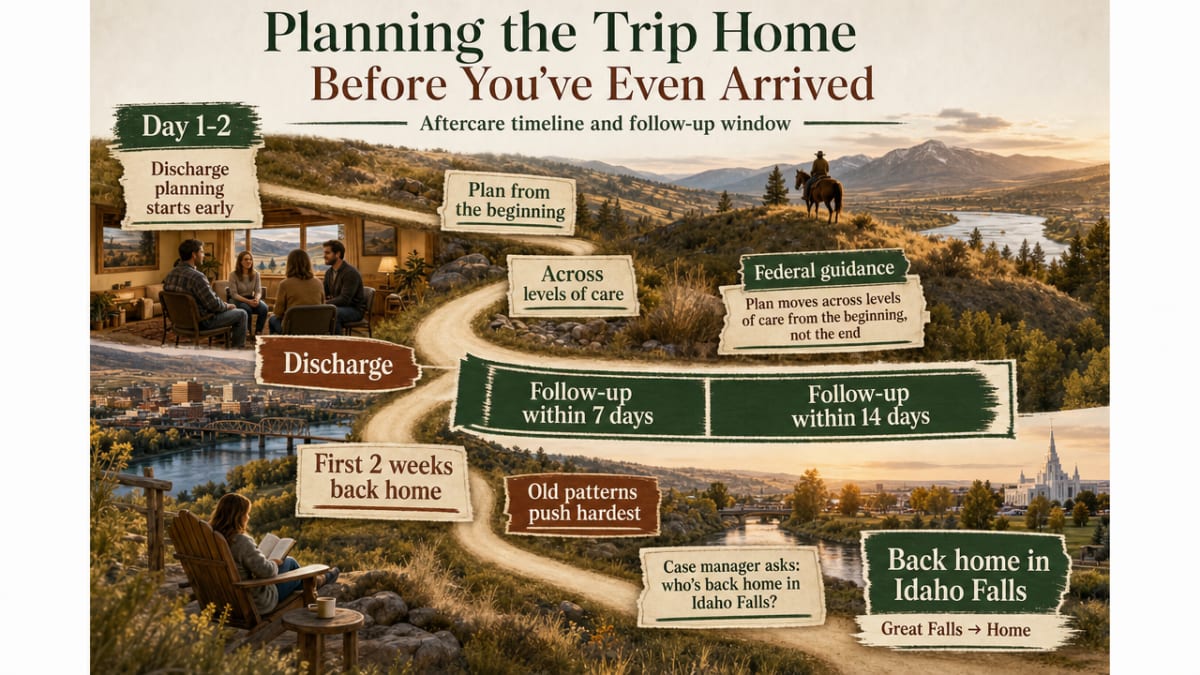
Planning the Trip Home Before You’ve Even Arrived
This part surprises people. On day one or two, while you’re still finding the coffee pot and learning your roommate’s name, someone on the team starts talking with you about what happens after Great Falls. Not to rush you out. To make sure the ride home lands as softly as the ride in did.
There’s a reason for the early start. National quality measures for residential substance use treatment look at whether someone gets a follow-up service within 7 or 14 days of discharge 1. That window is short, and it’s short on purpose — the first two weeks back home are when old patterns push hardest. Federal guidance also asks treatment programs to plan for the move across levels of care from the beginning, not the end 2. Rocky Mountain builds that in.
What it looks like in practice: your case manager asks who’s back home in Idaho Falls, Casper, Williston, or wherever you came from. Is there a counselor you’ve worked with before? A primary care doctor who should get a summary? A local 12-step meeting you’d feel okay walking into? The single Part 2 consent you signed on arrival covers those coordination calls, so the team can line up your next appointment while you’re still finishing week two of equine therapy.
Then there’s the follow-up you get from Rocky Mountain itself. Weekly Zoom groups. Check-in calls at 30, 60, 90, 180, and 365 days. Those aren’t a formality. They’re the team keeping a hand on your shoulder from Montana while you rebuild the rest of your life somewhere else.
When you’re ready to make the first call, the intake line is open. Making it is the hardest part. Everything after is planned for you.
Frequently Asked Questions
Do I need a referral from my doctor to be admitted from out of state?
No. You can call Rocky Mountain Treatment Center directly and start the process yourself. A referral from your primary care doctor isn’t required. If you do have a doctor you’d like the team to coordinate with — for medication history or medical background — that’s helpful, but it isn’t a prerequisite. The intake coordinator can handle the clinical screening on the phone without any outside paperwork.
What if my insurance is based in Idaho, Wyoming, North Dakota, or South Dakota — will it still work in Montana?
Usually, yes. Most private plans cover medically necessary residential substance use treatment across state lines, though your cost share may be different if Rocky Mountain is out-of-network. Some plans require prior authorization before admission 8. The intake coordinator calls your insurer while you’re on the line, tells you plainly what your plan covers, and starts the authorization if it’s needed. Rocky Mountain doesn’t currently accept Medicaid or Medicare.
Can someone else call on my behalf, like a spouse or parent?
Yes, and it happens all the time. A spouse, parent, sibling, or close friend can make the first call and gather information. The team can explain the program, the pickup, and general insurance questions to a family member. At some point, though, the person coming to treatment needs to be on the phone for the screening conversation. That’s how the team confirms the fit and holds the bed in your name.
What happens if I start withdrawing during the drive to Great Falls?
Call the intake line right away. Tell them where you are, what you’re feeling, and when your last drink was. Alcohol withdrawal can start within six to twelve hours, and the medical team would rather know mid-drive than at the front door. If your symptoms are serious — shaking, confusion, chest pain — pull over and call 911 or head to the nearest emergency room. The team can coordinate with the hospital and get you to Great Falls once you’re stable.
How do I know Rocky Mountain Treatment Center is a licensed program?
Rocky Mountain is licensed in Montana and Joint Commission accredited. You can also verify state-licensed treatment providers through the federal locator at FindTreatment.gov, which lists programs that specialize in substance use and mental health treatment 10. If you want to see the accreditation or licensing details before you call, ask the intake coordinator — they’ll walk you through what the facility is credentialed to do.
What if I change my mind between the phone call and pickup day?
Call the team. Don’t disappear. The people at Rocky Mountain have talked people through cold feet before, and they’d rather hear from you than wonder. Sometimes the fear passes with a short conversation. Sometimes it means adjusting the pickup time by a day. And sometimes it means talking honestly about what’s really in the way. You keep the bed by staying in touch, not by having a perfect answer.
References
- Advancing Quality Measurement in Behavioral Health – SAMHSA. https://www.samhsa.gov/substance-use/treatment/advancing-quality-measurement-behavioral-health
- PEP20-02-01_004.pdf. https://library.samhsa.gov/sites/default/files/SAMHSA_Digital_Download/PEP20-02-01_004.pdf
- Treatment, Payment, and Health Care Operations Disclosures – HHS.gov. https://www.hhs.gov/hipaa/for-professionals/faq/treatment-payment-and-health-care-operations-disclosures/index.html
- Guidance: Treatment, Payment, and Health Care Operations – HHS.gov. https://www.hhs.gov/hipaa/for-professionals/privacy/guidance/disclosures-treatment-payment-health-care-operations/index.html
- Understanding Confidentiality of Substance Use Disorder Patient Records – HHS.gov. https://www.hhs.gov/hipaa/part-2/index.html
- Fact Sheet 42 CFR Part 2 Final Rule – HHS.gov. https://www.hhs.gov/hipaa/for-professionals/regulatory-initiatives/fact-sheet-42-cfr-part-2-final-rule/index.html
- 42 CFR Part 2 — Confidentiality of Substance Use Disorder Patient Records. https://www.ecfr.gov/current/title-42/chapter-I/subchapter-A/part-2
- Affordable Care Act Implementation FAQs – Set 7. https://www.cms.gov/cciio/resources/fact-sheets-and-faqs/aca_implementation_faqs7
- Prior Authorization in Medicaid – MACPAC. https://www.macpac.gov/wp-content/uploads/2024/08/Prior-Authorization-in-Medicaid.pdf
- Find Substance Use Disorder Treatment – SAMHSA. https://www.samhsa.gov/substance-use/treatment/find-treatment
- Become an Opioid Treatment Program (OTP) – SAMHSA. https://www.samhsa.gov/substance-use/treatment/opioid-treatment-program/become-otp
- ASAM Criteria for Patients with Addiction and Co-occurring Conditions – SAMHSA. https://www.samhsa.gov/resource/ebp/asam-criteria-patients-addiction-co-occurring-conditions
- Model Part 2 Patient Notice – HHS.gov. https://www.hhs.gov/hipaa/for-professionals/privacy/guidance/privacy-practices-part-2/index.html
- What’s the Interstate Medical Licensure Compact? How can it help …. https://www.ama-assn.org/medical-residents/transition-resident-attending/what-s-interstate-medical-licensure-compact-how-can