
Key Takeaways
- Insurance verification is a short benefits check confirming active coverage, covered levels of care, out-of-pocket costs, and whether prior authorization is needed before admission 1.
- Gather both sides of your insurance card, IDs, policyholder details, current prescriptions, and prior treatment dates so the call takes fifteen minutes instead of fifty 1.
- Verification typically follows six steps: calling admissions, running benefits, completing a clinical assessment, securing prior authorization, reviewing finances with you, and admission.
- Ask the insurer about covered levels of care, deductibles, coinsurance, prior authorization rules, concurrent review, and the appeals process, and record a reference number 1, 13.
- Marketplace and employer plans must cover SUD treatment as an essential health benefit, while Rocky Mountain does not currently accept Medicaid or Medicare as primary coverage 6.
- Parity law prevents plans from applying stricter limits to SUD care than to medical or surgical care, giving you grounds to challenge restrictive answers 11, 12.
- A clean verification is not a payment guarantee, since concurrent reviews, coding differences, and plan changes can all shift what gets covered mid-stay 1.
- A denial can be reversed through peer-to-peer review, internal appeal, external review, or a single-case agreement, and care can often begin while paperwork moves 13.
The phone call that stands between you and treatment
You know something has to change. Maybe you’ve known for a while. And now, when you’re finally ready to look at residential treatment, there’s a phone call sitting between you and the door. It’s the one about insurance. It’s the one that makes your stomach tighten because you’re afraid of what you’ll hear.
That call is worth making, and it’s smaller than it feels right now.
Insurance verification is the short, structured conversation that confirms what your plan will pay for so you can start care without a surprise bill later. It usually takes hours, not days. And you don’t have to do it alone. At Rocky Mountain Treatment Center in Great Falls, Montana, admissions staff make that call with you or on your behalf, using the number on the back of your card and a set of questions the federal government actually recommends you ask 1. Their job is to translate insurance language into something you can act on.
This guide walks you through what happens on that call, what to have ready, what protections you have that most people don’t know about, and what to do if the first answer isn’t the one you wanted. You’ll also see, honestly, what verification can’t promise, and where Rocky Mountain fits (and where it doesn’t, because the center does not currently accept Medicaid or Medicare).
You’re closer to treatment than you think. Let’s take the next small step.
What insurance verification actually is (and isn’t)
Verification is a check, not a contract. When you call Rocky Mountain Treatment Center, or when your insurer picks up the line, the goal is to find out what your plan currently says about substance use disorder care: which levels are covered, what you’ll owe out of pocket, whether the plan wants a prior authorization before you start, and how many days it will approve at a time 1. That’s it. It’s a snapshot of your benefits on the day of the call.
Here’s what verification is:
- A confirmation that your policy is active and you’re eligible for benefits today.
- A list of covered levels of care, usually detox, residential, partial hospitalization, and outpatient 13.
- An estimate of your financial responsibility, meaning your deductible, copay, coinsurance, and out-of-pocket maximum.
- A read on whether the insurer requires prior authorization or a specific clinical assessment before admission.
- A note on whether Rocky Mountain is in-network or out-of-network with your plan, which changes what you’ll owe.
Here’s what verification isn’t:
It isn’t a promise of payment. Even a clean verification can be reviewed again once claims are submitted, and coverage can shift if the insurer decides at some point that a different level of care is more appropriate. That’s why concurrent review exists, and it’s a normal part of a residential stay.
It also isn’t a moral test. No one at the other end of the phone is deciding whether you deserve treatment. They’re reading a benefits file. The clinical decision, whether you need detox, a 30-day stay, or a longer program, comes from a person, not a policy line item. Verification just tells you what the money side looks like so the care side can start.
What to have in front of you before you call
Set yourself up so the call takes fifteen minutes, not fifty. When you have the basics in one spot, the person on the other end can pull your benefits quickly and give you real answers instead of asking you to call back 1.
Grab these before you dial:
- Your insurance card. Both sides. The member ID, group number, and the phone number on the back are the pieces that unlock everything else 1.
- A photo ID for the person who needs treatment, and their date of birth. If you’re calling for a spouse or adult child, you’ll be asked to confirm these.
- The policyholder’s information. If the plan is through a parent, spouse, or employer, know whose name is on the policy and their date of birth.
- A current list of prescriptions, including doses. This matters for detox planning and for confirming coverage of any medications used during treatment 4.
- Prior treatment dates, even rough ones. If there’s been a detox, a rehab stay, or an outpatient program in the last year or two, jot down where and when. Insurers sometimes ask.
- An authorized contact form if you’re the family member making the call. Most insurers will not discuss benefits with anyone other than the member without written permission. Rocky Mountain’s admissions team can send you a simple release to sign before the call 1.
- A notepad and a pen. Write down the representative’s name and a reference number for the call. If anything gets disputed later, that reference is your proof.
If you’re missing a piece, don’t let it stop you. Call Rocky Mountain first at (406) 216-8300. Admissions can start the conversation with what you do have and coach you through gathering the rest.
How verification actually works, step by step
Here’s the honest version of what happens between the moment you decide to call and the moment you walk through the door at Rocky Mountain Treatment Center. It’s a sequence, not a mystery. Once you see the steps laid out, the whole thing gets smaller.
Step 1: You (or a family member) call admissions. The number for Rocky Mountain is (406) 216-8300. You give the basics: who needs treatment, what’s going on, and what insurance is in hand. If you’d rather call your insurer directly first, use the member services number on the back of the card 1. Either way, you’re starting the same clock.
Step 2: Admissions runs the benefits check. With your card info and a signed authorization, the admissions team contacts your insurer and asks the specific questions that matter for residential SUD care: is the policy active, are detox and inpatient covered, what’s in-network versus out-of-network, what days and dollars apply, and does the plan want a prior authorization 1. This is the part most people dread doing alone. You don’t have to. Rocky Mountain does it while you catch your breath.
Step 3: Clinical assessment. A clinician talks with you (or the person entering treatment) about drinking or drug use history, medical issues, mental health, prior treatment, and current medications. This isn’t for the insurance company yet, it’s for the care team. It also produces the documentation the insurer will want if a prior authorization is required.
Step 4: Prior authorization, if the plan requires it. The clinical team sends the assessment and a proposed level of care to the insurer’s review line. In many cases you’ll get a decision the same day or the next business day. Sometimes an insurer pushes back and asks for a peer-to-peer call between their reviewer and Rocky Mountain’s clinician. That’s normal. It doesn’t mean no.
Step 5: Financial review with you. Once benefits are confirmed and (if needed) authorization is in hand, admissions walks you through what you’ll owe: any remaining deductible, per-day or per-stay copay, coinsurance percentage, and where you sit against your out-of-pocket maximum for the year. If there’s a gap, you talk through options before anyone signs anything.
Step 6: Admission. Same-day admission is possible when the timing lines up, and complimentary Montana pickup is available if getting to Great Falls is part of the hurdle. You arrive at the 26-bed facility, and the care your insurance just got sorted out actually begins.
The whole flow mirrors the sequence CMS lays out for using behavioral health coverage: confirm coverage, get your card, choose a provider, make the appointment, prepare, and follow the plan the clinician builds with you 8. The difference is that at a residential center, admissions collapses several of those steps into one phone call so you don’t have to run them yourself.

What to ask when you (or admissions) call the insurer
Whether Rocky Mountain’s admissions team is on the line for you or you’re making the call yourself, the questions are the same. SAMHSA has published the exact list, and it’s shorter than you’d expect. Keep this within reach when you dial the number on the back of the card 1.
Start with the basics of coverage:
- Does this plan cover substance use disorder treatment, and at what rate? Ask specifically about detox, residential (inpatient) rehab, partial hospitalization, and outpatient counseling, because plans handle each level differently 1, 13.
- How many days of inpatient or residential care are covered per year, and how many outpatient appointments 1?
- Is Rocky Mountain Treatment Center in Great Falls in-network or out-of-network under this plan? If you’re not sure who to name, admissions can give you the exact provider information to read to the representative 13.
Then get the numbers you’ll actually pay:
- What’s the deductible, and how much of it has already been met this year?
- What’s the copay or coinsurance for detox and residential care?
- What’s the out-of-pocket maximum, and how close are you to it?
Ask about the rules that can slow things down:
- Does this plan require prior authorization before detox or residential admission 1?
- If yes, what clinical information does the reviewer need, and how fast do they turn decisions around?
- How does concurrent review work once treatment starts? In other words, how often will the insurer re-check whether you still need this level of care?
Close with the safety net:
- What’s the appeals process if a request is denied 13?
- Can I get this in writing, and what’s your reference number for this call?
Write down the representative’s name, the time, and that reference number. If a claim gets disputed later, those three details do more work than any policy document. And if a question stumps you mid-call, put the insurer on hold and loop in Rocky Mountain admissions at (406) 216-8300. You’re allowed to ask for help while you’re on the phone.
What your plan type usually covers for addiction care
Every plan is a little different, but the category of plan you have gives you a strong first read on what should be covered. Federal rules set a floor. Your specific plan document sets the details. Here’s the quick lay of the land so you know what to expect before you dial.
Private and Marketplace plans
If your coverage comes through an employer or the Health Insurance Marketplace, the news is generally good. Marketplace plans are required to treat behavioral health treatment, mental and behavioral health inpatient services, and substance use disorder treatment as essential health benefits, which means they have to be covered 6. Private employer plans typically follow the same shape, and parity rules require that SUD coverage not be more restrictive than the coverage for medical or surgical care, including copays, coinsurance, day limits, and rules like prior authorization 11.
What that looks like in practice at Rocky Mountain: your plan almost certainly covers detox and residential care at some level. The real questions are whether Rocky Mountain is in-network under your specific plan, what your out-of-pocket costs will be, and whether the insurer wants a prior authorization before you’re admitted 1. Admissions can pull those answers in one call once they have your card.
Medicaid and Medicare: what to know before you call Rocky Mountain
For context on what those plans cover elsewhere: Medicaid is the single largest payer for mental health services in the country and a growing payer for SUD treatment 2. States must cover medications for opioid use disorder along with related counseling and behavioral therapy, a benefit Congress made permanent in 2024 3, 4. Parity rules apply to Medicaid and CHIP, so SUD care can’t be treated more restrictively than medical or surgical care 11. In Montana specifically, providers verify Medicaid membership through the state’s online eligibility portal before admission 9.
Medicare also carries parity protections for behavioral health 1. If you have Medicare, a supplemental plan, or a Medicare Advantage plan, ask the plan directly which residential SUD facilities are in-network in Montana, and call Rocky Mountain if you want a second set of ears on what you’re told.
Parity: the rule that changes the conversation
If you learn one piece of insurance law before you make the call, make it this one. The Mental Health Parity and Addiction Equity Act, usually just called parity, says your plan cannot treat substance use disorder care more strictly than it treats care for a broken leg or a heart condition 11. That covers the obvious stuff, like copays and coinsurance, and it also covers the less obvious stuff, like day limits and the rules that decide whether you need prior approval before you can start 11, 12.
Here’s why that matters on the phone. When a representative tells you your plan only covers a handful of days of residential care, or that detox needs three levels of approval before you can be admitted, you have the right to ask a specific question: does the plan apply the same kind of limit to comparable medical or surgical care? If the answer is no, or if they can’t tell you, that’s a parity issue 12. You don’t have to argue the law yourself. You just have to name it and ask for the parity analysis in writing.
Some states go further. New York, for example, prohibits insurers from requiring prior authorization for certain inpatient and outpatient SUD treatment and blocks concurrent review during the first two weeks of care at approved facilities 5. Montana’s rules are different, but the federal parity floor still applies to your plan wherever you live 11.
Two phrases worth writing on your notepad before you dial: “Is that limit consistent with parity?” and “Please send me the plan’s parity analysis.” You may never need to say them. But if the first answer feels wrong, those words shift the conversation from you asking a favor to the insurer explaining a rule. Rocky Mountain’s admissions team knows this territory and will push back on your behalf when the numbers don’t add up.
What verification cannot tell you
A clean verification feels like a green light. It isn’t. It’s more like a weather report, accurate for the day it was pulled, and still subject to change once you’re on the road.
Here’s what a benefits check cannot promise you:
- That every day of treatment will be paid. Insurers run concurrent reviews during a residential stay, checking in every few days to decide whether the current level of care is still medically necessary. A verified benefit is not a locked-in length of stay.
- That the final bill will match the estimate. Coinsurance percentages apply to the amount the insurer actually allows, not the sticker price. If a claim is coded differently than expected, your share can shift.
- That an approval today survives a plan change tomorrow. If you switch jobs, lose coverage, or hit a new plan year mid-stay, the math resets 1.
- Whether treatment will work. That’s a clinical question, not a benefits one.
None of this is a reason to skip verification. It’s a reason to keep Rocky Mountain’s admissions team in the loop while you’re in treatment, so surprises get caught early instead of at discharge.
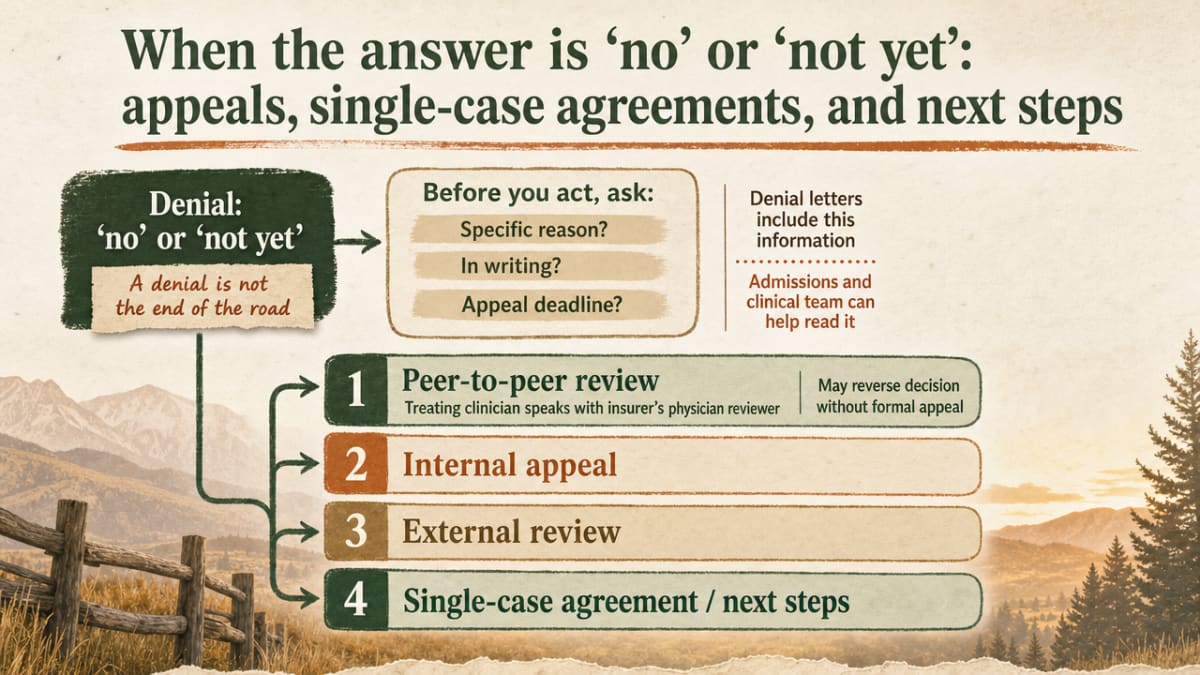
When the answer is ‘no’ or ‘not yet’: appeals, single-case agreements, and next steps
A denial is not the end of the road. It’s a paper decision, and paper decisions can be reviewed. If the insurer says no to residential care, or approves only a handful of days when your clinician says you need more, take a breath and ask three questions before you do anything else: What is the specific reason for the denial? Is it in writing? What is the deadline to appeal? Every denial letter is required to include that information, and Rocky Mountain’s admissions and clinical team can help you read it.
From there, you generally have a few paths:
- Peer-to-peer review. If a reviewer denied the request, your treating clinician can request a direct call with the insurer’s physician reviewer to explain why this level of care is medically necessary. This often flips the decision without a formal appeal.
- Internal appeal. You (or Rocky Mountain on your behalf, with your written permission) submit a written appeal to the insurer with clinical documentation. Ask specifically whether the denial’s limits are consistent with parity and request the plan’s parity analysis in writing 11, 12.
- External review. If the internal appeal fails, most plans must offer an independent external review by a reviewer who does not work for the insurer 13. This is where a lot of denials get overturned.
- Single-case agreement. If Rocky Mountain is out-of-network under your plan, admissions can sometimes negotiate a one-time in-network rate for your stay, especially if in-network residential options are limited in Montana.
While the paperwork moves, care doesn’t have to stop. Talk with admissions at (406) 216-8300 about starting detox or beginning your stay under a self-pay arrangement that converts to insurance once approval lands. “Not yet” is a very different answer than “never,” and it’s usually the one you’re actually getting.
The emotional part nobody warns you about
Nobody hands you a script for calling about money when your life is on fire. You’re asking about copays while your hands shake. A parent is reading a member ID out loud while their kid is in the next room, sick. It’s a strange, hard thing to do, and the shame of doing it can make the whole call feel bigger than it is.
Name it out loud if you can. “This is uncomfortable, and I’m going to make the call anyway.” That’s the whole trick. You are not asking for a favor. You are gathering information you have a right to have 1.
A few things that help:
- Make the call from a room where you feel safe. A kitchen table, a parked car, a friend’s couch.
- Let someone else dial. A spouse, a sibling, a friend, or Rocky Mountain’s admissions team at (406) 216-8300. You do not have to be the voice on the line.
- Give yourself one small next step, not the whole plan. Today’s step is the call. Tomorrow’s step is tomorrow.
You showed up to read this. That already counts.
Frequently Asked Questions
How long does insurance verification for addiction treatment usually take?
In most cases, hours, not days. Once Rocky Mountain’s admissions team has your insurance card and a signed authorization, the benefits check itself often takes a single phone call to your insurer. If your plan requires prior authorization, add a clinical assessment and a review turnaround that’s often same-day or the next business day 1. Same-day admission is possible when the timing lines up.
What information do I need to have ready before I call?
Both sides of your insurance card, the member’s date of birth and photo ID, the policyholder’s name and date of birth, a current list of prescriptions with doses, and rough dates of any prior treatment in the last year or two 1. If you’re calling for a spouse or adult child, ask admissions for a simple authorized-contact release so the insurer can speak with you. A notepad helps too.
Does Rocky Mountain Treatment Center accept Medicaid or Medicare?
Not currently. Rocky Mountain does not accept Medicaid or Medicare as primary coverage. That doesn’t mean you’re out of options. Call admissions at (406) 216-8300 anyway. The team can point you toward Montana programs that do accept those plans and help you understand what your benefits cover, including the mandatory Medicaid coverage of medications for opioid use disorder and related counseling that Congress made permanent in 2024 3, 4.
Can my insurer require prior authorization before I start detox or residential care?
Often yes, though parity rules limit how strictly they can apply that requirement compared to medical or surgical care 11, 12. Some states go further; New York, for instance, prohibits prior authorization for certain SUD treatment and blocks concurrent review during the first two weeks 5. Ask the insurer directly whether prior auth is required, what clinical information they need, and how fast they turn decisions around 1.
If my benefits are verified, is that a guarantee that treatment will be paid for?
No, and anyone who tells you otherwise is oversimplifying. Verification confirms what your plan says on the day of the call: active coverage, covered levels of care, cost-sharing, and whether prior auth is required 1. Insurers still run concurrent reviews during your stay to decide whether the current level of care remains medically necessary, and final claims can be coded or allowed differently than the estimate. Stay in touch with admissions throughout.
What can I do if my insurer says no or approves fewer days than I need?
Ask for the specific reason in writing and the deadline to appeal. From there, your clinician can request a peer-to-peer review with the insurer’s physician reviewer, which often flips the decision. If that doesn’t work, file an internal appeal and, if needed, an external review by an independent reviewer 13. Ask specifically whether the limit is consistent with parity 11, 12. Rocky Mountain’s admissions team can help you through each step.
References
- Mental Health Treatment: What Does Health Insurance Cover?. https://www.samhsa.gov/find-support/how-to-pay-for-treatment/know-what-your-insurance-covers
- Behavioral Health Services | Medicaid. https://www.medicaid.gov/medicaid/benefits/behavioral-health-services
- SMD# 24-004: Extension of Medicaid Coverage of Substance Use Disorder Treatment and Managed Care Medical Loss Ratio Provisions in the Consolidated Appropriations Act, 2024. https://www.medicaid.gov/federal-policy-guidance/downloads/smd24004.pdf
- State Health Official Letter 20-005: Mandatory Medicaid State Plan Coverage of Medication Assisted Treatment. https://www.hhs.gov/guidance/document/state-health-official-letter-20-005-re-mandatory-medicaid-state-plan-coverage-medication
- Insurance Circular Letter No. 13 (2018): Preauthorization for Substance Use Disorder Treatment. https://www.dfs.ny.gov/industry_guidance/circular_letters/cl2018_13
- Assisting Individuals with Substance Use or Mental Disorders with Health Insurance Enrollment. https://www.cms.gov/marketplace/technical-assistance-resources/substance-use-mental-disorder-insurance-enrollment.pdf
- CMS Releases Long-Awaited EPSDT Behavioral Health Toolkit for States. https://ccf.georgetown.edu/2026/02/24/cms-releases-long-awaited-epsdt-behavioral-health-toolkit-for-states/
- Roadmap to Behavioral Health: Considerations for Health Insurance Coverage and Behavioral Health Services. https://www.cms.gov/About-CMS/Agency-Information/OMH/Downloads/Coverage-to-Care-Behavioral-Roadmap.pdf
- Addictive and Mental Disorders Division Medicaid Policy Manual (Effective July 1, 2020). https://dphhs.mt.gov/assets/BHDD/MedicaidManual/AMDDMedicaidPolicyManual7.1.2020.pdf
- Addictive and Mental Disorders Division Medicaid Services Provider Manual (Effective October 1, 2019). https://dphhs.mt.gov/assets/BHDD/MedicaidManual/AMDDMedicaidManualeff10012019.pdf
- Parity in Medicaid and CHIP for Mental Health and Substance Use Disorder Services. https://www.medicaid.gov/medicaid/benefits/behavioral-health-services/parity
- Parity for Mental Health and Substance Use Disorder Benefits in Medicaid Managed Care. https://www.medicaid.gov/medicaid/managed-care/guidance/parity-for-mental-health-and-substance-use-disorder-benefits
- A Roadmap to Behavioral Health: A Guide to Mental Health and Substance Use Disorder Services. https://www.cms.gov/files/document/roadmap-behavioral-health-english.pdf