
Key Takeaways
- Most adults with co-occurring conditions never get treatment for both, so finding a program that addresses mental health and substance use together closes a real gap in care 5.
- The label ‘dual diagnosis’ means different things on different websites, so press programs to describe how one team handles both conditions under a shared plan 2.
- Proximity matters less than integration — the closest program rarely treats both conditions together, so widen the search before settling for half-care 7.
- Integrated care puts counselors, therapists, and prescribers on one team writing one plan, while co-located care just shares a building and leaves coordination to you 4.
- People with co-occurring conditions face 1.71 times the risk of relapse, ER visits, and rehospitalization, and integrated treatment is what shifts those odds 1.
- On the admissions call, ask who’s on the team, whether there’s one plan or two, and how medication, therapy, and family work stay coordinated 2.
- Verify state licensure, accreditation through Joint Commission or CARF, and ask whether the program has been scored using the DDCAT for dual diagnosis capability 12.
- Earlier treatment that didn’t stick often reflects incomplete care rather than personal failure, and the next attempt should hold to one team, one plan, both conditions 3.
The Treatment Gap Most People Don’t Know Exists
If you’re searching for dual diagnosis help right now, take a breath. The fact that you typed those words is already a step most people never take. And here’s something nobody tells you upfront: the reason your last attempt at treatment may not have worked, or the reason a loved one keeps cycling through programs, often has nothing to do with willpower. It has to do with a gap in how care gets delivered.
According to SAMHSA’s 2024 National Survey on Drug Use and Health, roughly 21.2 million U.S. adults had both a mental health condition and a substance use disorder. In 2023, only 8.7% of those adults received treatment for both. More than half — 53.2% — got no treatment at all. Another 34.7% received care for the mental health side only, and 3.4% got help for substance use alone 5. That figure comes from a self-reported national survey of U.S. adults, so it captures what people say they received, not clinical chart reviews. Even with that limit, the pattern is hard to miss.
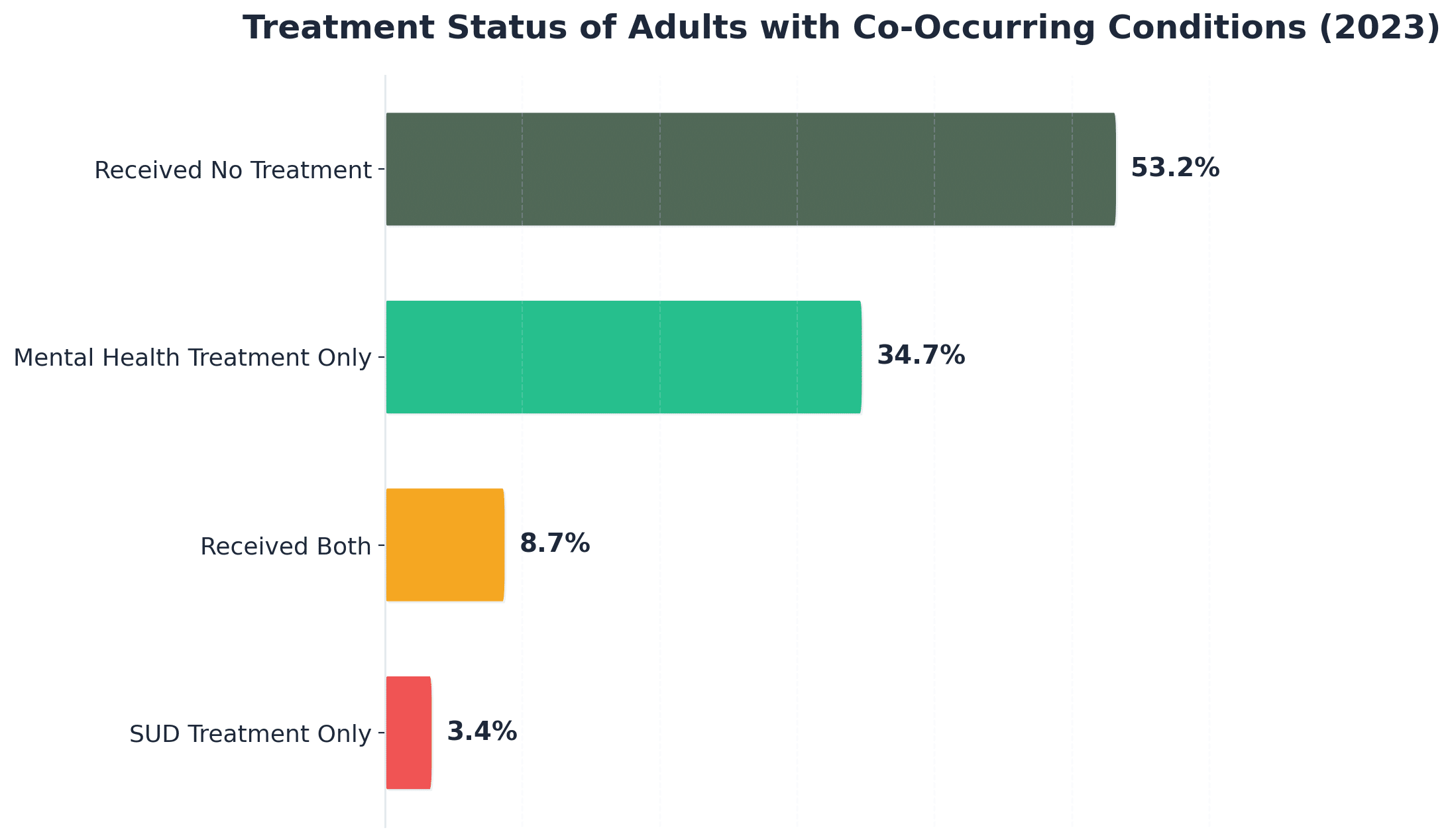
Read those numbers again. If you’ve ever been handed a referral for therapy after detox, or sent home from a psychiatric stay with a pamphlet about meetings, you weren’t imagining things. The system genuinely splits people in half. One door for the drinking or the pills. A different door, often a different building, for the anxiety that won’t quit, the depression that flattens everything, the trauma that keeps showing up at 3 a.m.
You deserve a program where one team treats both, in the same place, at the same time. That’s what the rest of this guide will help you find — and how to tell the real thing apart from a website that just uses the right words.
What ‘Dual Diagnosis’ Actually Means When a Program Says It
Here’s where it gets tricky. The phrase “dual diagnosis” shows up on hundreds of treatment websites, and almost none of them mean exactly the same thing by it. Some programs use it to signal that they accept people with mental health conditions. Some mean they have a psychiatrist on call. A smaller group means what the research actually points to: one team treating both your substance use and your mental health condition, in the same place, at the same time, with one shared plan 2.
That last version has a clinical name — Integrated Dual Disorder Treatment, or IDDT. The model exists because researchers kept seeing the same thing you may have lived through: when the drinking gets treated in one building and the depression in another, neither one tends to get better. The evidence-based version pulls counselors, medical staff, and mental health clinicians onto a single team that meets, plans, and adjusts care together 4.
So when you see “dual diagnosis” on a website, don’t take the label at face value. Ask what it means there. A program that genuinely treats both will be able to describe how the team communicates, who writes the treatment plan, and how therapy and medication get coordinated week to week 2. A program using the term loosely will get vague fast, or it’ll describe a referral relationship with someone down the road. Both can be useful. Only one matches what the research says actually helps.
Why ‘Near Me’ Is the Wrong First Question
You typed “near me” because you want help close to home. That makes sense. Driving an hour each way to therapy when you’re already exhausted is a real obstacle, and family visits matter. But here’s the truth that took the field a long time to admit: the program closest to you is rarely the program best equipped to treat both conditions at once.
Think about what “near me” usually surfaces. A search returns the addiction center across town, the outpatient clinic by the hospital, maybe a psychiatric practice taking new patients. Each of those places might be excellent at what it does. The harder question is whether any of them does both, together, with the same team and the same plan 2. SAMHSA’s “no wrong door” policy was written precisely because so many people walk into one of those doors and get told the other half of their care happens somewhere else 7.
So flip the question. Instead of asking what’s closest, ask what’s actually integrated, and then ask how far you’d have to travel to reach it. Sometimes it’s down the road. Sometimes it’s a few hours away in a residential setting where you can step back from daily life entirely. Either can work. What doesn’t work is settling for a program that only treats half of you because it happens to be on the way home.
Integrated vs. Co-Located: The Difference That Decides Outcomes
What Integrated Care Looks Like in Practice
Imagine walking into one building. You meet a counselor who handles your substance use. Down the hall, the same week, you sit with a clinician who works on your depression or PTSD. Here’s the part that matters: those two people talk to each other. They’re on the same team. They share notes, attend the same staff meetings, and write one treatment plan together — yours 4.
That’s integrated care. Not a referral. Not a partnership across two organizations. One team, one plan, one place 2.
In day-to-day practice, you’d see this: your therapy sessions actually mention your medications, and your medication appointments actually mention what came up in therapy. If you’re working through trauma, the counselor knows you’re three weeks into sobriety and adjusts the pace. If a craving spikes after a hard family session, the team catches it before it becomes a relapse. The research backs this up — combinations like motivational interviewing, cognitive behavioral therapy, and family therapy work together when one team is running them, not when they’re scattered across providers who never compare notes 2.
Good integrated programs also meet you where you are. If you’re not ready to commit to total abstinence on day one, the team doesn’t kick you out — they match the work to your readiness and build from there 3. Family gets pulled in too, because the people who love you usually have their own version of exhaustion to work through. That coordination isn’t a luxury. It’s the thing that makes both conditions actually start to lift at the same time, instead of one improving while the other quietly gets worse.
How Co-Located Programs Quietly Fall Short
Co-located sounds close enough to integrated that the difference is easy to miss. Co-located means the services exist in the same building, or the same network, or the same campus. Integrated means they share a team and a plan. The first one is a real estate arrangement. The second one is a clinical one.
Here’s what co-located often looks like from the inside: you see an addiction counselor on Tuesdays and a psychiatrist on Fridays. They’re under the same roof, but they don’t meet about you. You’re the one carrying messages between them — what your medication is, what came up in group, why you skipped a session. When you’re already running on empty, that translation work falls apart fast.
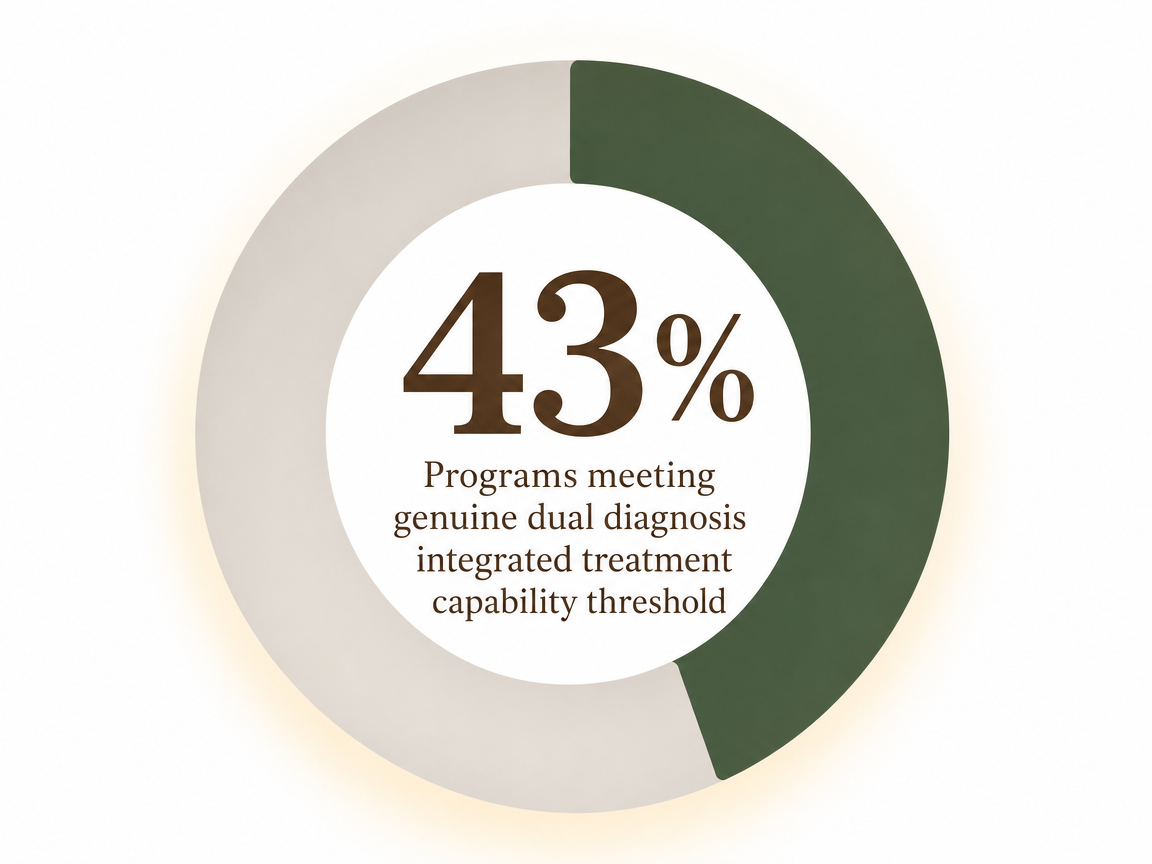
The tell is usually in the small details. Ask who writes the treatment plan, and a co-located program will say two people wrote two plans. Ask how the medication prescriber learns what’s happening in therapy, and you’ll hear something vague about charts. Those answers matter more than any brochure language.
Why Treating Both Conditions Together Changes the Math
If you’ve watched someone you love cycle through treatment, or if you’ve been the one cycling, you already know the cost of separate care. It shows up as the relapse two months after detox. The ER visit when the panic comes back harder. The hospital stay when the depression returns and the drinking with it. That pattern isn’t a moral failure. It’s what the research keeps finding when mental health and substance use get treated apart instead of together.
A 2024 meta-analysis pooled outcomes across multiple studies and put a number on it: people with co-occurring conditions are 1.71 times more likely to experience adverse outcomes — relapse, emergency department visits, rehospitalization, and death — than people with a single disorder 1. Read that as a probability, not a verdict. It means the deck is genuinely stacked, and it means the stacking eases when one team treats both at once.
That’s not theoretical. Integrated treatment, where motivational interviewing, cognitive behavioral therapy, and family work happen under one shared plan, has been shown to outperform separate or sequential care across study after study 2. The reason is almost boringly practical: a craving doesn’t wait for your next therapy appointment, and a panic attack doesn’t pause for your next group session. When the same team sees both, they catch the early signals and adjust before a hard week becomes a hospital week.
So when you’re weighing programs, you’re not just comparing amenities or locations. You’re comparing the odds. Integrated care doesn’t promise an easy road. It tilts the math back toward you.
The Admissions Call: Questions That Separate Real Programs From Marketing
Questions About the Clinical Team
The first phone call is where you find out who actually works there. Not the names — the structure. Pick up the phone, take a breath, and ask plainly: “Who would be on my care team, and do they all work for your program?”
Listen for whether the answer includes both addiction counselors and mental health clinicians under the same roof. A truly integrated program has a multidisciplinary team that meets regularly about each client — counselors, medical staff, therapists, and a prescriber who can handle psychiatric medications 4. Then ask: “Does the same team treat both my substance use and my mental health condition, or do you refer the mental health side out?” If you hear the word “refer,” that’s information. It doesn’t make the program bad. It tells you what kind of program it is.
One more question, and it’s a quiet tell: “How often does the team meet about each client?” A real integrated team will name a rhythm — weekly staff meetings, daily handoffs, something concrete. A vague answer means coordination probably isn’t built in. You’re not being difficult by asking. You’re doing the work the system should have done for you.
Questions About the Treatment Plan
This is where the marketing language tends to break down, so it’s worth pressing gently. Ask: “Will I have one treatment plan that covers both conditions, or two separate plans?”
One plan, written by one team, is the standard the research points to 2. Two plans usually means two programs sharing a building. Then ask: “How does the plan change if I’m not ready to fully stop using on day one?” A program built around stage-wise care will have a real answer here — they’ll talk about meeting you where you are, building motivation, adjusting the work as your readiness shifts 3. A program that says “you have to be committed to abstinence before we can help you” is telling you something honest about its limits.
Also ask how progress gets measured. Good programs track both sides — sobriety milestones and mental health symptoms — and adjust the plan when one starts slipping. If the answer focuses only on clean time, or only on mood scores, the other half is probably running on autopilot. You want to hear that both get watched, both get talked about, and both shape what happens next week.
Questions About Medication, Therapy, and Family
Medication is often where co-located programs quietly fall apart, so start there. Ask: “If I need medication for depression, anxiety, or another mental health condition, who prescribes it, and how does that prescriber communicate with my therapist?” You want to hear that the prescriber is part of the team — not an outside referral, not someone you’ll see in three weeks. The same person, or the same team, should be making sure your medication and your therapy are pulling in the same direction.
Then ask about therapy. “What kinds of therapy do you use, and are they evidence-based for both conditions?” Look for combinations like motivational interviewing, cognitive behavioral therapy, and family therapy — the mix that research has consistently shown works for co-occurring conditions 2. Group support, including 12-step participation alongside clinical work, has its own track record too.
Finally, family. Ask: “How are families included?” The people who love you have been through their own version of this, and a good program builds them in — through family sessions, education, and a real role in your recovery, not a single visiting day 3. If family work is an afterthought, that’s worth knowing now.
Verifying Credentials Without Getting Lost in Acronyms
Once a program passes your phone-call test, you’ll want to confirm it’s actually licensed and accredited. This is where the alphabet soup starts — and where it’s easy to feel like you need a translator. You don’t. There are really only a few things to check, and most of them take five minutes.
Start with state licensure. Every legitimate residential treatment facility has to be licensed by the state it operates in. In Montana, for example, that licensing runs through the Department of Public Health and Human Services, which posts active facility licenses publicly 10. Most states have a similar online registry. If a program can’t tell you their license number, or you can’t find them on a state list, that’s a red flag worth taking seriously.
Next, ask about accreditation. The two names you’ll hear most are the Joint Commission and CARF. Either one means an outside body has reviewed the program against published standards. Accreditation isn’t proof of integrated care on its own, but its absence usually tells you something.
For dual diagnosis specifically, the strongest benchmark is the DDCAT — short for Dual Diagnosis Capability in Addiction Treatment. It’s a scoring tool researchers use to measure whether a program is actually built for both conditions 12. You don’t need to score the program yourself. Just ask: “Have you been assessed using the DDCAT, and what did you score?” A program proud of its integrated work will know the answer.
If You’ve Been Through Treatment Before and It Didn’t Stick
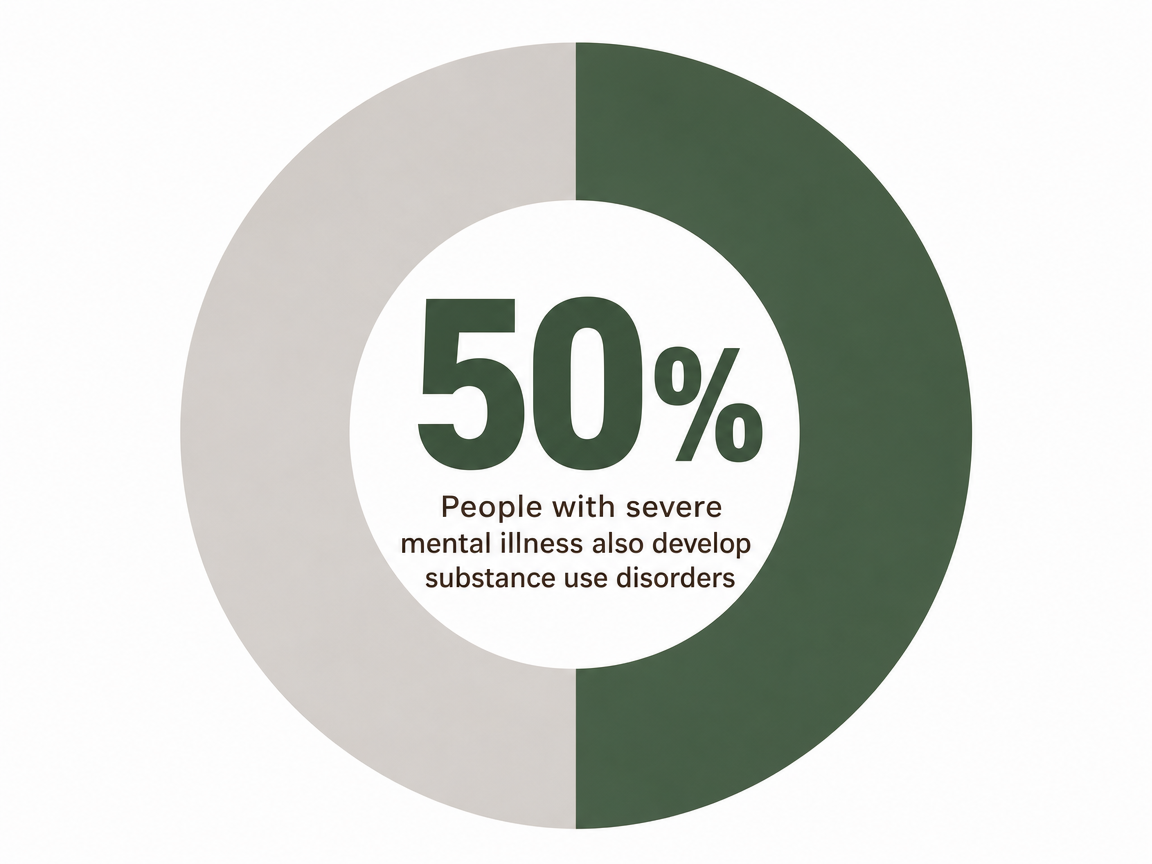
If you’re reading this after a second or third try, that’s not a sign you can’t get better. It’s often a sign the care you got was only built for half of you. People with severe mental illness have a co-occurring substance use disorder at some point in their lifetimes more than half the time 4. That’s the size of the population the system has historically split in two.
Think back to what those earlier programs actually did. Did one team handle the drinking while the depression got a referral somewhere else? Did the trauma work pause until you hit a certain number of clean days? Did anyone ask how your medication was landing alongside your therapy? If those pieces never met in the same room, the relapse that followed wasn’t proof of failure. It was the predictable shape of incomplete care 2.
This time, you know what to look for. One team. One plan. Both conditions, treated together, with the pace adjusted to where you actually are 3. The fact that you’re still trying says something about you that earlier outcomes couldn’t measure. Bring what you learned the last time into the next phone call. It’s information now, not a verdict.
Starting the Search Today: A Simple First Move
You don’t have to figure all of this out in one afternoon. The next move is smaller than that.
Pick up the phone and call SAMHSA’s National Helpline at 1-800-662-HELP. It’s free, confidential, open 24 hours a day, and available in English and Spanish 6. The person on the other end can point you toward integrated programs in your area and answer questions you might not feel ready to ask a treatment center directly. You don’t need a diagnosis, a plan, or the right words. You just need to dial.
From there, take the questions from earlier in this guide into your next call with a program. Who’s on the team. Whether one plan covers both conditions. How medication and therapy stay coordinated. How families get included. You’re not interviewing them to be difficult — you’re doing the homework the system should have done for you the first time around.
If a residential setting feels like the right kind of reset, places like Rocky Mountain Treatment Center in Great Falls offer integrated dual diagnosis care alongside family programming and continuing support, with a staff that often understands recovery firsthand. Whatever program you choose, the standard is the same: one team, one plan, both conditions treated together.
Making this one call is the hard part. You’re already doing it.
Frequently Asked Questions
What’s the difference between dual diagnosis and co-occurring disorders?
Does insurance usually cover dual diagnosis treatment?
How long does dual diagnosis treatment typically last?
Can I go to dual diagnosis treatment if I’m not sure about my mental health diagnosis yet?
What if the closest dual diagnosis program isn’t actually near me?
How do I help a family member who refuses to get treatment for both conditions?
References
- Concurrent Disorders and Treatment Outcomes: A Meta-Analysis. https://pubmed.ncbi.nlm.nih.gov/40906595/
- Integrated Treatment of Substance Use and Psychiatric Disorders. https://pmc.ncbi.nlm.nih.gov/articles/PMC3753025/
- Integrating Treatment for Co-Occurring Mental Health Conditions. https://pmc.ncbi.nlm.nih.gov/articles/PMC6799972/
- [PDF] Clinical Guide for Integrated Dual Disorder Treatment (IDDT). https://case.edu/socialwork/centerforebp/sites/default/files/2021-03/iddtclinicalguide.pdf
- Co-Occurring Disorders and Other Health Conditions | SAMHSA. https://www.samhsa.gov/substance-use/treatment/co-occurring-disorders
- National Helpline for Mental Health, Drug, Alcohol Issues – SAMHSA. https://www.samhsa.gov/find-help/helplines/national-helpline
- Managing Life with Co-Occurring Disorders – SAMHSA. https://www.samhsa.gov/mental-health/serious-mental-illness/co-occurring-disorders
- Dual diagnosis capability in mental health and addiction treatment …. https://pmc.ncbi.nlm.nih.gov/articles/PMC3594447/
- Dual Diagnosis Capability in Mental Health and Substance Use …. https://pmc.ncbi.nlm.nih.gov/articles/PMC3655772/
- Residential Treatment Facilities – licensure – dphhs. https://dphhs.mt.gov/qad/licensure/healthcarefacilitylicensure/lbfacilityapplications/residentialtreatmentfacilities
- Chapter 7—Treatment Models and Settings for People With Co …. https://www.ncbi.nlm.nih.gov/books/NBK571024/
- [PDF] Dual Diagnosis Capability in Addiction Treatment (DDCAT) Toolkit. https://www.dpbh.nv.gov/siteassets/programs/clinicalsapta/dta/partners/certification/DDCAT_Toolkit.pdf
- Finding Help for Co-Occurring Substance Use and Mental Disorders. https://www.nimh.nih.gov/health/topics/substance-use-and-mental-health