
Key Takeaways
- Sort out whether residential care matches your situation by understanding the four specialty levels, since outpatient, IOP, residential, and intensive inpatient each fit different needs 2.
- Check whether your drinking history calls for medically monitored detox first, because alcohol withdrawal can be dangerous and federal guidance treats it as a medical event 4.
- Start your search with non-commercial sources like the NIAAA Alcohol Treatment Navigator and your state licensing directory before wading through ads or marketing pages 1, 3.
- Verify a program’s state license, accreditation, clinical staff credentials, and named behavioral therapies on your first phone call, so you know who is actually delivering care 3, 11.
- Confirm insurance coverage line by line with member services, since parity law requires fairness where coverage exists but doesn’t guarantee residential treatment is covered at all 6, 8.
You’re Already Doing the Hardest Part
If you’re reading this, you’ve already done something quietly courageous: you opened a browser, typed the words, and started looking. That takes more than people realize, especially if you’re tired, hungover, scared of what a program might say, or worried about what the people in your life will think.
You don’t need to have your whole plan figured out. You just need a clear path through the next few decisions. This guide walks you through five practical steps to find inpatient alcohol treatment near you: sorting out whether residential care is the right level, checking if your body needs medically monitored detox first, starting your search with sources that aren’t selling you anything, verifying that a program is properly licensed and staffed, and confirming what your insurance will actually pay.
Alcohol use disorder is treatable, and evidence-based care is out there 1. You’re not being dramatic for looking. You’re doing the reasonable, adult thing — gathering information before you make a real decision about your health. Take it one step at a time.
Step 1: Figure Out If Residential Is the Right Level of Care
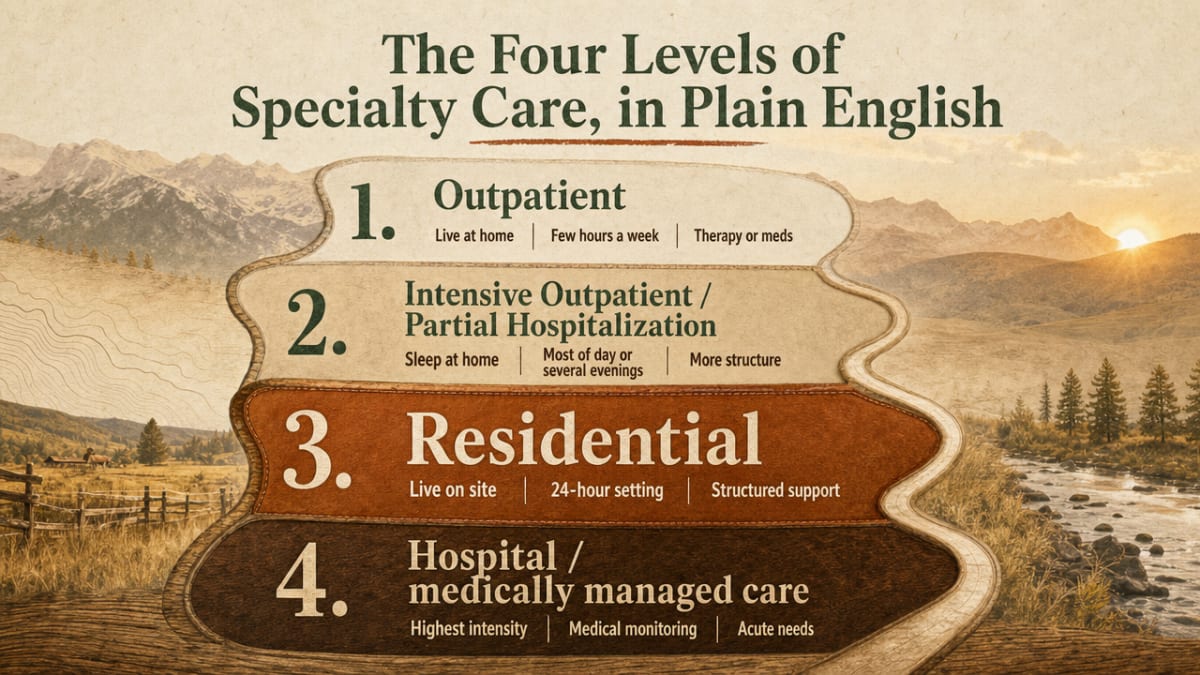
The Four Levels of Specialty Care, in Plain English
Before you spend hours reading facility websites, it helps to know that specialty alcohol treatment isn’t one thing. It’s a range. The National Institute on Alcohol Abuse and Alcoholism sorts specialty care into four basic levels, and each one fits a different situation 2.
Outpatient is the lightest touch. You live at home, keep working or parenting, and go to appointments — therapy, medication management, or both — a few hours a week. It fits people whose drinking is a real problem but whose bodies and lives can handle recovery without stepping out of daily life.
Intensive outpatient and partial hospitalization (sometimes called IOP or PHP) sit in the middle. You still sleep at home, but you’re at the program most of the day or several evenings a week. Think of it as a heavier scaffold for people who need more structure than a weekly session but don’t require 24-hour care.
Residential means you live at the treatment facility. Staff are there around the clock. Your days are structured with counseling, group sessions, and recovery activities. This is what most people picture when they say “rehab,” and it’s usually where alcohol dependence is treated when outpatient hasn’t been enough or the home environment isn’t safe for early recovery.
Intensive inpatient is the most medical setting — a hospital-level environment for people with severe withdrawal risk, serious co-occurring medical issues, or acute psychiatric needs alongside the drinking.
Residential and intensive inpatient often get lumped together in searches, but they’re not the same. Knowing which one you’re actually looking for saves you a lot of confused phone calls 2.
Signs Residential Care Fits Your Situation
So how do you know if residential is your level, and not something lighter? A few honest questions can point you toward the answer.
Ask yourself: Have you tried to cut back or stop before and found yourself back at it within days or weeks? Is drinking woven into your home — the fridge, the routine, the people you live with — in a way that makes stopping there feel almost impossible? Do you drink daily, or heavily most days, to the point that a morning without a drink feels physically wrong? Are you managing depression, anxiety, trauma, or another mental health condition alongside the drinking?
If you’re nodding at any of those, residential care is worth serious consideration. Living somewhere else for a few weeks does something outpatient can’t: it puts distance between you and the cues that keep the cycle going, while giving you counseling, peer support, and medical staff in the same building 1.
You don’t have to hit some imagined breaking point to qualify. Wanting a real reset, in a place built for it, is reason enough to ask. And residential doesn’t mean forever — most programs are measured in weeks, not months, and they’re designed to hand you back to your regular life with a plan.
Step 2: Check Whether You Need Medically Monitored Detox First
Why Withdrawal Is a Medical Question, Not a Willpower Question
The VA/DoD Clinical Practice Guideline for substance use disorders recommends inpatient, medically supervised withdrawal management for people with severe withdrawal or other high-risk situations, and it recommends benzodiazepines with adequate monitoring for moderate-to-severe alcohol withdrawal 4. Translation: for some people, the safest place to stop drinking is a setting where a nurse can check on you, a doctor can order medication, and someone is watching for the symptoms that get scary fast.
The risk signals that push you toward monitored detox are pretty concrete:
- A history of withdrawal seizures or delirium tremens (the shakes-plus-confusion state sometimes called DTs).
- Heavy daily drinking, especially over months or years.
- Prior withdrawals that got complicated.
- Co-occurring medical conditions — heart issues, liver problems, uncontrolled diabetes — that make the physical stress of withdrawal harder on your body.
- Moderate to severe symptoms like tremors, sweating, racing heart, nausea, or hallucinations when you try to skip a drink 4.
The federal Veterans Health Administration reinforced the same monitored approach in its 2024 policy on alcohol withdrawal management 5. None of this means you’re too far gone. It means you deserve a safe start.
What to Ask a Program About Detox Before You Say Yes
Not every residential facility handles detox on-site. Some are strictly rehabilitation programs that expect you to arrive already stabilized, which usually means a short stay at a hospital or a dedicated detox unit first. Others offer medically monitored detox in the same building where you’ll do the rest of your treatment. Both models can work — you just need to know which one you’re calling.
When you get someone on the phone, ask these questions plainly:
- Do you provide medically monitored detox on-site, or do I need to complete detox somewhere else before admission?
- Who is on the medical team during detox — is there a nurse on duty around the clock, and how quickly can a physician be reached?
- How do you assess withdrawal severity when I arrive, and what medications do you use if symptoms get worse?
- What happens if something goes wrong medically? Is there a hospital nearby, and how do you handle transfers?
- How long does detox usually take before I move into the counseling and group parts of the program?
You are not being difficult by asking. A program that takes withdrawal seriously will answer these calmly and specifically. If the person on the phone dodges, changes the subject, or promises you’ll be “just fine” without addressing your history, that’s information too. Trust it and keep calling.
Step 3: Start Your Search With Sources That Aren’t Trying to Sell You Anything
Use the NIAAA Treatment Navigator and State Directories First
Type “inpatient alcohol treatment near me” into a search bar and you’ll get pages of ads before you get anything useful. That’s not your fault. It’s just how the internet works when there’s money in the click. So before you start calling numbers, spend fifteen minutes on the sources that don’t get paid when you pick up the phone.
Start with the NIAAA Alcohol Treatment Navigator. It’s a free, federally maintained tool built specifically to help people find quality alcohol treatment near them, and it walks you through questions about your situation before showing options 1. It won’t hand you a single answer, but it will help you sort programs by level of care and by the kinds of evidence-based treatment you actually want to see — things like cognitive behavioral therapy, motivational enhancement, family therapy, and 12-step facilitation 3.
From there, check your state’s licensing directory. Every state keeps a public list of licensed substance use disorder facilities, and searching that list tells you which nearby programs are actually authorized to operate. NIAAA also encourages non-judgmental, supportive framing when connecting people to specialty care — a good reminder that a decent program will speak to you the same way 13.
Read Facility Websites Like a Skeptic
Once you have a short list, visit each program’s website with your guard up in a healthy way. Marketing pages are designed to make you feel something. Your job is to look past the sunset photos and find the specifics.
Look for concrete answers to concrete questions:
- Does the site name the therapies used, or does it just say “personalized care”? You want to see specific behavioral approaches — CBT, motivational enhancement, 12-step facilitation, family therapy — not vague phrases 3.
- Does it say who is on staff, with credentials, and mention whether counselors have lived recovery experience?
- Does it clearly describe the levels of care offered, including whether detox happens on-site?
- Does it name a licensing body and accreditation?
A trustworthy program tells you what it does, who does it, and how long you’ll be there. If a site is heavy on testimonials and light on specifics, that’s a signal to ask more questions, not to rule the place out yet. Save your short list. You’ll bring these questions to the phone in the next step.
Step 4: Verify the Program Is Licensed and Actually Staffed for the Job
Questions to Ask on the First Phone Call
By the time you pick up the phone, you’ve earned the right to ask real questions. Admissions staff talk to scared people every day. A good one will slow down, answer plainly, and not rush you toward a deposit.
Here’s a short list worth having in front of you when you call:
- Is this facility licensed by the state for residential substance use disorder treatment, and can you tell me the license type and number?
- Are you accredited by an outside body like the Joint Commission or CARF?
- Who’s on your clinical staff — counselors, therapists, nurses, medical director — and what are their credentials?
- Do any of your counselors have lived recovery experience? How does that shape day-to-day care?
- What behavioral therapies do you use? You’re listening for specifics like cognitive behavioral therapy, motivational enhancement, 12-step facilitation, and family therapy 3.
- How is family involved during and after the stay?
- What does aftercare look like — weekly groups, follow-up check-ins, alumni support?
- What’s a typical length of stay, and how do you decide when someone is ready to step down?
Write down the answers. Call two or three programs and the differences will surface fast. A program that answers with real names, real credentials, and real timelines is telling you something. So is one that can’t.
If You’re Searching in Montana: A State-Specific Licensing Lens
If you’re looking in Montana specifically, you have a few extra tools most people don’t know about. The state licenses substance use disorder facilities through the Department of Public Health and Human Services, and the rules are unusually concrete. Montana licenses four types of SUD facilities and requires each one to have things like an approved floor plan, local building code sign-off, fire marshal certification, written policies and procedures, and — for some settings — water and septic documentation on file 11. You can ask any facility for its current license and verify it with DPHHS directly.
Montana also defines its residential levels of care in the state Medicaid manual, using categories like clinically managed high-intensity residential and clinically managed low-intensity residential 12. Those labels matter because they describe the intensity of clinical support you’ll actually receive, not just the vibe of the building.
Residential care is a real, funded part of Montana’s behavioral health system. In state fiscal year 2024, 1,350 Montanans with serious substance use disorders received Medicaid-reimbursable clinically managed residential services through the state’s HEART waiver, with short-term stays generally averaging around 30 days 10, 9. You are not the only person in this state making this call, and you’re not asking for something rare or extreme.
One important caveat: not every Montana residential facility accepts Medicaid, and coverage rules vary by plan. That’s the bridge to the next step — confirming what your specific insurance will actually pay.
Step 5: Confirm Insurance Coverage Before You Pack a Bag
What Parity Law Does and Doesn’t Guarantee
Before you commit to a program, you need to know what your plan will actually pay for. This is where federal parity law helps — and where it stops helping. It’s worth understanding both.
The Mental Health Parity and Addiction Equity Act says that if a health plan covers mental health and substance use disorder benefits, it can’t make those benefits harder to use than medical and surgical benefits in the same category 6. In practice, that means your copays, deductibles, visit limits, and prior authorization hurdles for inpatient alcohol treatment can’t be more restrictive than what your plan applies to comparable medical care 8. Parity also covers medical-necessity criteria and care-management tools, which matters when a plan tries to cut a stay short 7.
A Coverage Call Script You Can Use Today
Grab the member services number on the back of your insurance card. Have a pen, your policy number, and the name of the facility you’re considering. Then work through this script. Ask the rep to stay on while you write down each answer, and get a reference number for the call before you hang up.
- Is inpatient substance use disorder treatment a covered benefit under my plan? Is residential treatment covered specifically, or only hospital-based inpatient?
- Is [facility name] in-network? If not, what are my out-of-network benefits?
- Is prior authorization required before admission? Who submits it — me or the facility?
- What are the medical-necessity criteria my plan uses to approve a residential stay?
- What’s my deductible, and how much have I met? What’s my coinsurance or copay per day once I’m admitted?
- Are there day limits on residential care, and how are extensions requested if my clinical team recommends more time?
- Is detox covered separately from residential treatment, and does it count against a different benefit?
If an answer feels unfair — a low day cap, a stricter authorization process than your plan uses for medical hospitalization — that may be a parity issue worth pushing back on 8. Most facility admissions teams will also run a benefits check for you. Do both. Two sets of eyes on your coverage is not overkill.
What a Good Day Inside Residential Treatment Actually Looks Like
If you’ve never been inside a residential program, the unknown can loom larger than the drinking itself. So here’s a picture of what a decent day tends to feel like, based on the kinds of care NIAAA describes as evidence-based 3.
Mornings usually start slow and predictable. Breakfast with the other residents, a check-in with staff, sometimes a short group focused on how you slept and what you’re bringing into the day. If you’re early in your stay and still finishing detox, a nurse checks vitals and asks about symptoms before anything else happens.
The middle of the day is where the real work lives. You’ll sit in individual counseling with a therapist trained in approaches like cognitive behavioral therapy or motivational enhancement — talk therapy that actually has evidence behind it for alcohol use disorder 3. You’ll join group sessions where other people describe patterns that sound eerily like yours. Many programs weave in 12-step facilitation, mindfulness practice, and family therapy sessions when the timing is right 3. In a lot of programs, the counselors leading these groups have their own recovery stories, which changes the room in a way that’s hard to fake.
Afternoons and evenings tend to soften. Recreation, time outside, journaling, a group meal, an evening meeting. Some programs use equine time, hiking, art, or music as another way to reach parts of you that talking doesn’t always touch. Family week — a few concentrated days with the people closest to you — usually lands somewhere mid-stay, once you’ve steadied.
None of this is glamorous. It’s structured, human, and quietly repetitive. That’s the point.
A Direct Next Step
Here’s the smallest, most useful thing you can do today: pick one of the sources you trust — the NIAAA Alcohol Treatment Navigator, your state’s licensing directory, or a program’s admissions line — and spend fifteen minutes with it 1. Not a decision. Just fifteen minutes.
Write down two or three programs that look real. Note their license type, the therapies they name, and whether they handle detox on-site. Tomorrow, call one. Ask the questions you’ve already got in front of you. If you’re in Montana and want a residential program with medically monitored detox, counseling, family involvement, and staff who’ve been where you are, Rocky Mountain Treatment Center in Great Falls is one place to start that conversation.
You’ve done the hardest part by reading this far. The next call is smaller than it feels.
Frequently Asked Questions
How do I know if I need inpatient alcohol treatment instead of outpatient?
Residential care tends to fit when outpatient hasn’t worked, when your home environment keeps pulling you back into drinking, or when you’re managing another mental health condition alongside alcohol use. If you drink daily or heavily most days and can’t picture stopping while staying in your current routine, that’s a real signal. NIAAA describes residential as one of four specialty levels for exactly this situation 2.
Do I need medical detox before entering a residential program?
Maybe. If you have a history of withdrawal seizures or DTs, drink heavily every day, or get shaky, sweaty, or nauseated when you skip a drink, federal clinical guidance recommends inpatient medically supervised withdrawal management with adequate monitoring 4. Some residential programs handle detox on-site; others expect you to stabilize first. Ask directly when you call. A safe start protects everything that comes after.
Will my insurance actually cover inpatient alcohol treatment?
It depends on your specific plan. Federal parity law says if your plan covers substance use disorder benefits, it can’t make them harder to use than comparable medical benefits 6, 8. But parity doesn’t force any plan to cover residential care in the first place, and network status and prior authorization still apply 7. Call member services with the facility name and ask about coverage line by line.
How can I verify that a treatment facility is properly licensed?
Ask the facility for its license type and number, then check it against your state’s licensing directory. In Montana, the Department of Public Health and Human Services licenses four types of SUD facilities and requires items like an approved floor plan, fire marshal certification, and written policies 11. Accreditation from a body like the Joint Commission or CARF is a second signal worth asking about.
What actually happens during a day in residential alcohol treatment?
Days are structured and predictable. You’ll do individual counseling and group sessions built on evidence-based approaches like cognitive behavioral therapy, motivational enhancement, 12-step facilitation, and family therapy 3. Mornings often include check-ins and, early on, medical monitoring. Afternoons soften into recreation, journaling, or experiential activities like equine time or hiking. Family programming usually lands mid-stay. It’s quiet, repetitive work — and that repetition is the point.
How long does inpatient alcohol treatment usually last?
Most residential programs run in weeks, not months, with 30-, 60-, and 90-day options being common. Length depends on your clinical needs and what your insurance approves. In Montana, short-term residential stays under the state’s HEART Medicaid waiver generally average around 30 days 9. Your clinical team can request extensions if you need more time. You’ll leave with an aftercare plan, not an empty calendar.
References
- Treatment for Alcohol Problems: Finding and Getting Help. https://www.niaaa.nih.gov/publications/brochures-and-fact-sheets/treatment-alcohol-problems-finding-and-getting-help
- Recommend Evidence-Based Treatment: Know the Options. https://www.niaaa.nih.gov/health-professionals-communities/core-resource-on-alcohol/recommend-evidence-based-treatment-know-options
- Alcohol Use Disorder: From Risk to Diagnosis to Recovery. https://www.niaaa.nih.gov/health-professionals-communities/core-resource-on-alcohol/alcohol-use-disorder-risk-diagnosis-recovery
- VA/DoD Clinical Practice Guideline for the Management of Substance Use Disorders. https://www.healthquality.va.gov/guidelines/MH/sud/VADoDSUDCPGProviderSummary.pdf
- VHA Notice 2024-09, Alcohol Withdrawal Management. https://www.va.gov/vhapublications/ViewPublication.asp?pub_ID=11928
- The Mental Health Parity and Addiction Equity Act (MHPAEA). https://www.cms.gov/marketplace/private-health-insurance/mental-health-parity-addiction-equity
- Parity. https://www.medicaid.gov/medicaid/benefits/behavioral-health-services/parity
- Mental Health and Substance Use Disorder Parity. https://www.dol.gov/agencies/ebsa/laws-and-regulations/laws/mental-health-and-substance-use-disorder-parity
- Clarification Regarding Institutions for Mental Disease Under the HEART Waiver. https://medicaidprovider.mt.gov/docs/providernotices/2023/ClarificationRegardingInstitutionsforMentalDiseaseUndertheHEARTWaiver.pdf
- Section 1115 HEART Demonstration Waiver Legislative Summary. https://archive.legmt.gov/content/Publications/services/2024-agency-reports/MCA_53-2-215_HEART_Waiver.pdf
- OIG-Letter. https://dphhs.mt.gov/assets/oig/LicensureBureau/SUDFLetterUpdated_20251.pdf
- Addictive and Mental Disorders Division Medicaid Services Provider Manual. https://dphhs.mt.gov/assets/BHDD/MedicaidManual/AMDDMedicaidManualeff10012019.pdf
- Promote Practice Change: Take Manageable Steps Toward Better Care. https://www.niaaa.nih.gov/health-professionals-communities/core-resource-on-alcohol/promote-practice-change-take-manageable-steps-toward-better-care