Key Takeaways
- Horses read body signals directly, so their responses give honest, shame-free feedback that reaches places talk therapy sometimes cannot, especially for adults managing both anxiety and substance use 2.
- Structured protocols drive the measurable gains. Six-week groundwork programs have improved emotion regulation, self-efficacy, and PTSD or anxiety symptoms, while unstructured barn time lacks that evidence 2, 9.
- Systematic reviews place equine work as a promising adjunct, not a stand-alone cure. It belongs woven into counseling, medical care, and recovery support, not in place of them 4, 7.
- When choosing a program, weigh three things: a clear session structure, real coordination with your clinical team, and honest talk about what the evidence does and does not support.
What happens in your body when you stand next to a horse
Anxiety is exhausting. You already know that. The tight chest, the mind that won’t stop running scenarios, the shallow breath you keep forgetting to deepen. If you’ve lived with anxiety alongside addiction, you know the loop can feel like a room with no door.
Here’s something worth sitting with, though: the first time you walk into an arena and stand three feet from a horse, your body notices before your thoughts do. Your shoulders drop a fraction. Your breath, for a second, catches on something bigger than itself. You are near an animal that weighs more than half a ton, and instead of feeling scared, most people feel quieter. That reaction isn’t imaginary. It’s the beginning of what equine work actually does.
Horses are prey animals. They survive by reading the nervous systems around them, constantly. When you stand near one, the horse is reading your breathing, your posture, the small tension in your hands. If you’re wound tight, the horse notices. If you soften, the horse softens too. You don’t have to say a word.
That’s the piece that makes this different from sitting on a couch and describing your anxiety. Talk therapy asks your head to explain what’s happening. A horse responds to what’s happening. For adults working through anxiety and substance use together, that shift from talking about your body to being in it matters more than most people expect 2.
The mechanism nobody explains: horses mirror your nervous system
Why a 1,200-pound animal is honest about your anxiety
Here’s the part most articles skip: horses can’t lie to you, and they can’t be lied to.
When you tell a friend you’re fine, they mostly take your word for it. Your counselor might see through it, but even a skilled counselor is working from your face, your tone, the words you choose. A horse is not doing any of that. A horse is watching the flick of your fingers, the shallow rise of your chest, the way your weight sits on your heels instead of your whole foot. If your mouth says calm and your body says panic, the horse believes the body every time.
That sounds unsettling at first. For a lot of people living with anxiety and addiction, being read that clearly by anything is uncomfortable. You’ve spent years learning to mask. You’ve had reasons. The mask kept you employed, kept the family peace, kept the shame at arm’s length.
A horse doesn’t judge the mask. It just doesn’t respond to it. If you walk up tense, the horse steps away. If you walk up softer, the horse stays. There is no lecture, no worksheet, no explaining yourself. The feedback is instant and physical, and it happens without a single word of blame. For adults working on both anxiety and substance use, that kind of honest, no-shame feedback can land in a place talk therapy sometimes can’t reach 2.
The co-regulation loop: breath, heart rate, and the horse’s response
Once you understand that horses read your body, the next piece falls into place. Your body can read theirs back.
Stand next to a calm horse for a few minutes. Not doing anything, just standing. Most people find their breathing slows without deciding to slow it. Your shoulders let go of a little of what they’ve been carrying. This isn’t magic. It’s what happens when a nervous system that has been alone with itself finally has company that isn’t reacting to it, isn’t asking anything of it, isn’t performing anything for it.
Then the loop starts. Your breath slows. The horse notices and settles further. You feel the horse settle, and something in you settles more. The horse feels that, and stays with you. Around and around, quietly, for as long as you’re both there.
This is the piece the 2023 randomized trial in an inpatient addiction unit was measuring, even if the researchers used more technical language. After six weeks of groundwork sessions — no riding, just being with the horses, leading them, brushing them, learning to read them — patients showed real gains in emotion regulation, self-efficacy, and self-esteem 2. Those aren’t abstract concepts. Emotion regulation is what lets you feel a wave of anxiety without immediately reaching for something to numb it. Self-efficacy is the quiet belief that you can handle what’s coming. Both are exactly what the co-regulation loop is teaching your body to do, one breath at a time.
What the research actually says (and where it falls short)
The promising evidence: anxiety and PTSD symptom reduction
You deserve to know what the science actually shows before you sign up for anything. So here it is, without the hype.
The cleanest number comes from a clinical trial of adults with trauma-related PTSD and anxiety who went through six weekly sessions of an equine-assisted program called Equine Partnering Naturally. By the end, participants reported significantly fewer posttraumatic stress symptoms, less generalized anxiety, and fewer depressive symptoms, with effect sizes around Cohen’s d of 0.54 — a moderate-to-large real-world change 9. In plain language, that means people weren’t just saying they felt a little better. They were reporting the kind of shift you notice in your sleep, your patience, and how often your chest is tight for no reason.
That 0.54 figure sits alongside the 2023 randomized controlled trial in an inpatient addiction unit, where a six-week groundwork program improved emotion regulation, self-efficacy, and self-esteem in patients with substance use disorders 2. Different measures, but pointing in the same direction: the skills your body needs to ride out a wave of anxiety were getting stronger.
Zoom out and the pattern holds across populations. A 2023 systematic review of equine-assisted interventions for veterans with PTSD reported reduced trauma symptoms, improved mood, and better social functioning across ten studies 5. For young women with social anxiety, a small randomized trial called Project Stride showed significantly greater reductions in social anxiety compared to a no-treatment control, and those gains held at follow-up 10. Different ages, different diagnoses, different arenas — same rough shape of result. Something about structured time with a horse tends to move the anxiety needle in the right direction.
The honest caveat: why the 2014 review pumped the brakes
Now the part most brochures leave out.
In 2014, a systematic review looked at every peer-reviewed study of equine-related treatments for mental disorders it could find. The conclusion was blunt: every study reviewed had serious problems with how it was designed — small samples, no control groups, measures that couldn’t rule out the passage of time or simple attention from a caring adult. The authors wrote that the evidence base did not justify marketing equine therapy as a proven mental health treatment, and that such services shouldn’t be offered as evidence-based care until better studies existed 8.
That is a hard sentence to sit with if you’re hoping horses will be the thing that finally helps. But you deserve the truth, because the truth is what lets you make a real decision.
Here’s what that review does not mean. It doesn’t mean people weren’t getting better in those older studies — many were. It means we couldn’t tell for sure whether the horses did the work, or whether being outside, being taken seriously, being handed a job to do, and having someone pay attention to you did it. Those are hard things to untangle, and they matter. What the 2014 review really pumped the brakes on was the overclaiming — the language that treats a horse like a cure. Reading it carefully doesn’t rule equine work out. It rules the marketing out.
Where the current state of evidence lands in 2025
Eleven years after that critical review, the field has moved — not as far as its biggest fans claim, but further than its harshest critics predicted.
A 2025 systematic review of equine-assisted interactions for PTSD, anxiety, and mood disorders found that nearly every quantitative study reported at least some positive treatment effect on symptoms. In the same breath, the authors noted that well-designed randomized trials are still sparse, and program designs vary so widely that it’s hard to compare one to the next 7. A separate 2022 systematic review focused on substance use disorders reached a similar verdict: promising early signals for engagement and emotional regulation, but not yet enough rigorous evidence to recommend broad adoption as a standalone addiction treatment 4.
Inside a session: what you actually do with the horse
Approach, halter, lead: groundwork before riding
You’re not going to gallop off into a sunset. Most sessions, especially early ones, happen entirely on the ground. That’s not a downgrade. That’s the work.
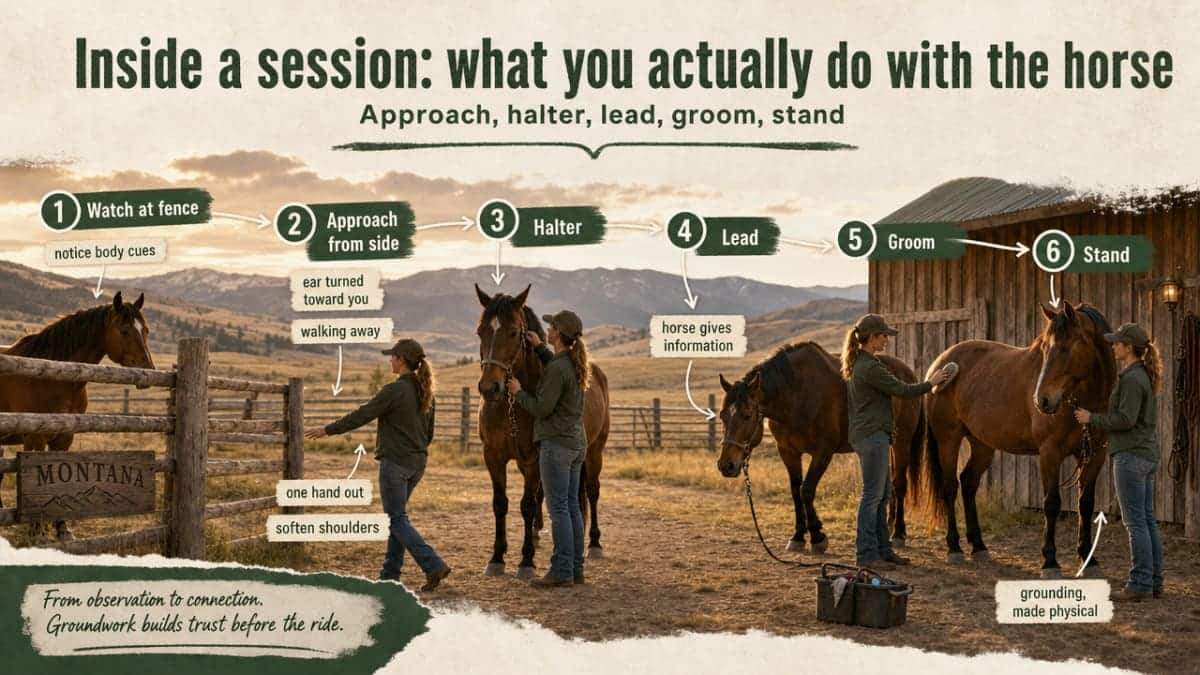
A typical session starts before you even touch the horse. You stand at the fence and watch. Which horse is grazing, which one has an ear turned toward you, which one is walking away. You’re already learning something about noticing, about paying attention to what a body is telling you instead of what a story in your head is saying.
Then you approach. Slowly, from the side where the horse can see you, one hand out. If your shoulders are up around your ears, the horse will drift a few steps. You learn to soften them, not because someone told you to relax, but because the horse just gave you information. That is grounding, made physical.
Next comes the halter. You slide the leather over the horse’s nose, buckle it at the poll. Your fingers are close to a mouth that could bite but won’t. You’re practicing being close to something bigger than you and staying steady. That’s boundaries, made physical.
Leading comes after. You ask the horse to walk beside you, not in front, not behind. If you drift, the horse drifts. If you steady, the horse steadies. Then grooming — long, slow strokes with a curry comb. Then a few minutes of just standing, hand on the horse’s shoulder, watching its ribs rise and fall. Each piece is a skill. Each skill maps to something anxiety has been stealing from you 2.
Why structured sessions beat unstructured barn time
There’s a version of this where you just hang out at a barn, and people will tell you it’s therapy. Being outside near animals is good for you. That’s true. It’s also not what the research is measuring.
The sessions that actually move anxiety numbers are structured ones. Someone is guiding you through specific steps with a specific skill in mind. The Reining in Anxiety program that reduced anxiety and improved emotional regulation in youth wasn’t unstructured pasture time — it was a ten-week program built on cognitive-behavioral principles, delivered by trained equine professionals with a clear sequence of activities 6. The 2023 inpatient trial that showed gains in emotion regulation and self-efficacy for adults with substance use disorders followed a six-week protocol, not open barn hours 2.
What that means for you, practically: ask what happens during a session. If the answer is a shrug and “we see what the horses want to do,” that program may still feel nice, but it isn’t what the studies are showing works. Look for a plan — a beginning, a middle, and a debrief where you talk about what came up. The horses are half of the medicine. The structure around them is the other half.
When anxiety and addiction feed each other
The loop: racing thoughts, avoidance, using, more anxiety
If you’ve lived this, you don’t need it explained. But naming it out loud can help.
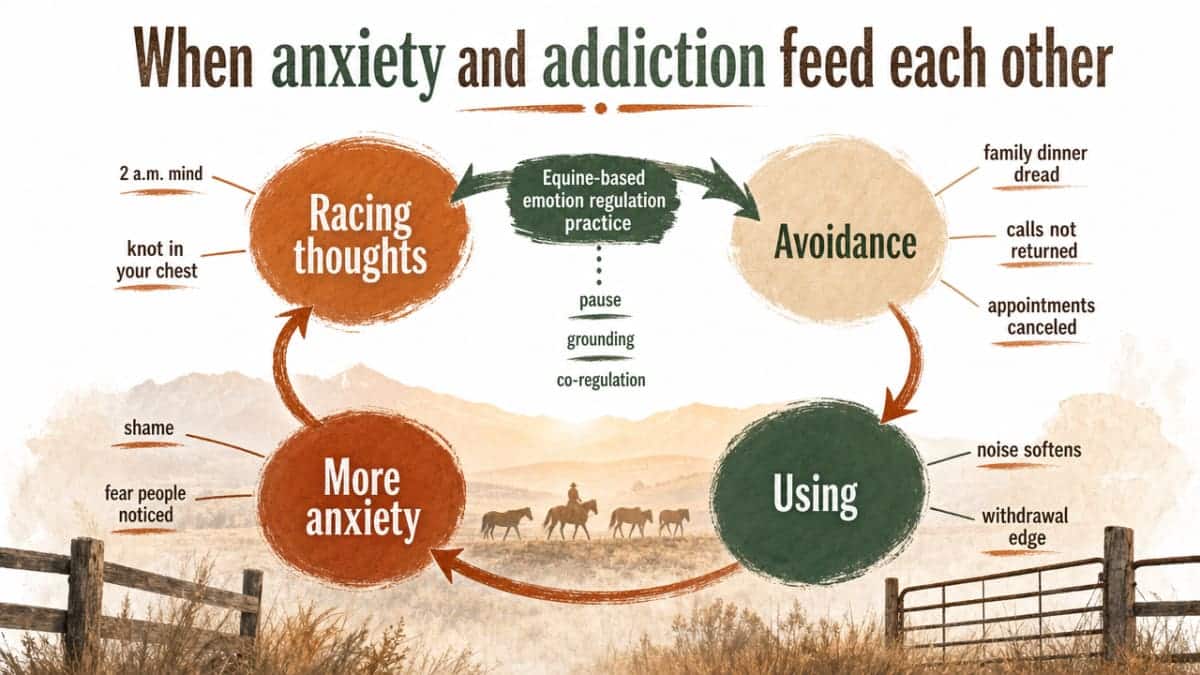
The anxiety shows up first for a lot of people. A racing mind at 2 a.m. A knot in your chest before a family dinner. A dread that doesn’t have a clean reason. So you find something that turns the volume down. A drink. A pill. A line. For a few hours, the noise softens. Your shoulders come down.
Then the substance wears off, and the anxiety comes back louder. Now it’s carrying interest — shame about last night, the withdrawal edge, the fear that people noticed. So you use again to quiet what the last use created. That’s the loop. Anxiety feeds the using. The using feeds the anxiety. Both of them feed the avoidance — the calls you don’t return, the appointments you cancel, the rooms you don’t walk into.
Breaking that loop isn’t about willpower. It’s about giving your nervous system something else to do when the wave hits. That’s exactly where the emotion regulation and self-efficacy gains from structured equine work start to matter — small daily proof that you can feel a hard feeling and stay in the room with it 2.
Where equine work fits inside a fuller treatment plan
Here’s the honest version: no horse is going to detox you, and no arena hour replaces the counseling that helps you understand why the loop started in the first place.
Think of a good treatment plan as woven threads, not a single fix. Medically monitored detox handles the body’s first crisis. Individual counseling gives you a place to look at the stories underneath the using — the trauma, the losses, the beliefs about yourself that anxiety has been feeding on. Group work and 12-step meetings put you in a room with people who get it, so the shame has less to grip. Family programming brings the people who love you into the same room, learning together. Equine work threads through all of that. It’s the piece where the skills you’re learning in the counselor’s office get practiced in your body, with a large animal giving you real-time feedback.
The 2022 systematic review of equine-assisted services for substance use disorders makes this point carefully: the evidence supports equine work as an adjunct — a supportive thread — not a stand-alone addiction treatment 4. That’s not a demotion. It’s an accurate placement. Programs that get results build the horses into a fuller plan of counseling, medical care, recovery community, and family repair. Rocky Mountain Treatment Center is designed around that kind of woven approach, and equine sessions land inside it, not instead of it.
Trauma, social anxiety, and the specific fears horses help with
Anxiety isn’t one thing. The word gets used for a dozen different experiences, and the ones that show up alongside addiction tend to be the heaviest.
Trauma-linked anxiety is the version where your body braces before your mind knows why. A car door slams and your chest is already tight. Someone raises their voice and you’re gone, twenty years back, in a different room. If that’s your version, the veterans PTSD research is worth knowing about. A 2023 systematic review of ten studies found that equine-assisted interventions consistently reduced PTSD symptoms, lifted mood, and improved how veterans functioned socially — even though the studies had methodological limits the authors were careful to name 5. Being with a horse gives a startled nervous system a chance to practice staying, one minute at a time, with something that isn’t going to hurt you.
Social anxiety is a different animal. It’s the dread before a group meeting, the sweat when a stranger makes eye contact, the room you leave early because staying feels dangerous. In Project Stride, young women with social anxiety went through six structured sessions of equine work paired with skills-based coaching. Compared to a no-treatment control, they showed significantly greater drops in social anxiety, and the gains held at follow-up 10. Horses don’t do small talk. They don’t judge your outfit. Practicing calm, direct connection with an animal that expects nothing performative is a gentler runway back into rooms full of people — including the group therapy and 12-step rooms that recovery asks you to walk into.
How to tell if a program is doing this well
You don’t have to become an expert on equine therapy to ask a few good questions. Three things separate a serious program from a scenic one.
- Ask about structure. The programs with real anxiety data — the six-week inpatient protocol with adults in addiction treatment, the CBT-based riding program that lowered anxiety in youth — used clear session plans with named skills, not open barn time 2, 6. If nobody can describe what a session builds toward, that’s your answer.
- Ask how equine work connects to counseling. Does the horse instructor talk with your therapist? Do you debrief after sessions in a way that ties back to what you’re working on in individual and group work? Equine time works as an adjunct to a full treatment plan, not as a stand-alone 4.
- Listen to how the program talks about outcomes. If someone promises horses will cure your anxiety, walk away. Honest programs will tell you what the evidence supports and what it doesn’t. That kind of straight talk is what you deserve — and it’s how you can tell the people running the program actually respect the work.
Frequently Asked Questions
Is equine therapy actually effective for anxiety, or is it just a nice barn experience?
Both, honestly. Being outside near animals feels good on its own. But structured equine programs have shown real symptom reductions in adults with trauma-related anxiety and in young women with social anxiety, and the effects held past the final session 9, 10. The evidence is promising, not conclusive. What separates therapy from a pleasant barn visit is the session plan and the clinical team standing behind it.
Do I have to ride the horse, or can I stay on the ground?
You can stay on the ground. Most of the strongest research in addiction settings used groundwork only — approaching, haltering, leading, grooming — with no riding involved 2. Riding is one path, not a requirement. If mounting a horse feels like too much, especially early on, tell the program. The relational work that lowers anxiety happens whether or not your feet leave the dirt.
Can equine therapy replace medication or traditional counseling for anxiety?
No. Systematic reviews are consistent on this point: equine work is best used as an adjunct to established care, not a substitute 4, 7. If a medication is helping you sleep or a counselor is helping you understand the story underneath your anxiety, keep those. Equine sessions add a body-based layer where you practice the skills. Anyone telling you horses can replace your other treatment is overselling it.
What if I’m scared of horses or have never been around one?
That’s more common than you’d think, and it’s not a problem. First sessions usually happen at a fence, not next to the horse. You watch, you breathe, you get closer when you’re ready. Instructors are trained to move at your pace. Some people find that working through the fear itself becomes part of the anxiety work — proof your body can meet something big and stay.
How does equine therapy help when anxiety and addiction are happening at the same time?
The 2023 inpatient trial with adults in addiction treatment found that a six-week groundwork program improved emotion regulation, self-efficacy, and self-esteem 2. Those are exactly the muscles the anxiety-and-using loop keeps you from building. When a hard feeling shows up, emotion regulation is what lets you sit with it instead of numbing it. Equine work gives your body repeated, real-time practice at that, alongside counseling and recovery support.
How long does it take before equine sessions start helping with anxiety?
Many trials use six-week protocols and show measurable anxiety reductions by the end 2, 9, 10. Some people notice small shifts sooner — a calmer breath after the first session, a night of easier sleep after the second. Others need more time. Progress isn’t linear. If you’re a few sessions in and you had one quieter afternoon, that counts. Small wins are how this work actually adds up.
References
- Mental health benefits of mounted equine-assisted therapies: A scoping review. https://pubmed.ncbi.nlm.nih.gov/35811394/
- Equine-assisted therapy effectiveness in improving emotion regulation, self-efficacy, and perceived self-esteem of patients suffering from substance use disorders. https://pmc.ncbi.nlm.nih.gov/articles/PMC10576391/
- Investigating the Effects of Equine-Assisted Therapy in Individuals With Schizophrenia: A Randomized Controlled Trial. https://pubmed.ncbi.nlm.nih.gov/40258216/
- Equine-assisted services for individuals with substance use disorders: A systematic review. https://pmc.ncbi.nlm.nih.gov/articles/PMC9749232/
- Equine-assisted interventions for veterans with posttraumatic stress disorder: A systematic review. https://pmc.ncbi.nlm.nih.gov/articles/PMC10654975/
- Reducing Anxiety and Stress among Youth in a CBT-Based Adaptive Riding Program: Reining in Anxiety. https://pmc.ncbi.nlm.nih.gov/articles/PMC9558534/
- Are Equine Assisted Interactions (EAI) a Dark Horse Bet? A Systematic Review on Measuring the Psychological and Physiological Effects of EAI on PTSD, Anxiety and/or Mood Disorders. https://pmc.ncbi.nlm.nih.gov/articles/PMC12410245/
- Equine-related treatments for mental disorders lack empirical support: a systematic review of empirical investigations. https://pubmed.ncbi.nlm.nih.gov/24953870/
- Equine-assisted therapy for anxiety and posttraumatic stress symptoms. https://pubmed.ncbi.nlm.nih.gov/25782709/
- Project Stride: An Equine-Assisted Intervention to Reduce Symptoms of Social Anxiety in Young Women. https://pubmed.ncbi.nlm.nih.gov/26386749/