
Key Takeaways
- Ministry burnout, isolation, and the pressure of constant moral visibility push many pastors toward alcohol as a private coping tool between Sunday services 8, 10.
- Federal rule 42 CFR Part 2 blocks a substance use treatment program from confirming a pastor is even a patient without written, name-specific consent 1.
- Distance, optional faith-based programming, and psychotherapy note protections let a pastor be treated as a patient first without performing their role 4, 7.
- Reentry is where recovery breaks or holds, so plan a short disclosure list, structured aftercare, and outside relationships before returning to the pulpit 10.
The Fear That Keeps the Bottle Hidden
You already know how the story goes in your head. The elder board finds out. The search committee gets a call. Someone whispers to a friend at the district office, and by Tuesday there is a file with your name on it. Sunday is still coming, and you have a sermon to preach, and the bottle in the drawer is the only thing that has quieted the noise long enough to write it.
That fear is not weakness. It is math. Your job description assumes a level of moral visibility most professions never carry, and church culture often treats private struggles as public liabilities. Research on churches and mental health names this out loud: shame and stigma keep people from getting help, and honoring privacy is what makes disclosure feel possible in the first place 6. If that dynamic keeps regular members quiet, imagine what it does to the person standing at the pulpit.
Here is what you may not have heard yet. Federal law puts substance use treatment records inside some of the strongest privacy protections in American healthcare. Rocky Mountain Treatment Center pairs those legal walls with a quiet 26-bed facility in Great Falls, Montana, a staff where more than 80 percent are in recovery themselves, and faith-based programming that is entirely optional.
You are already doing something brave by reading this. Keep going. The next sections walk through exactly what stays private, what does not, and what a first phone call actually sounds like.
What the Law Actually Protects When You Enter Treatment
42 CFR Part 2: Why a Treatment Center Cannot Even Confirm You Are There
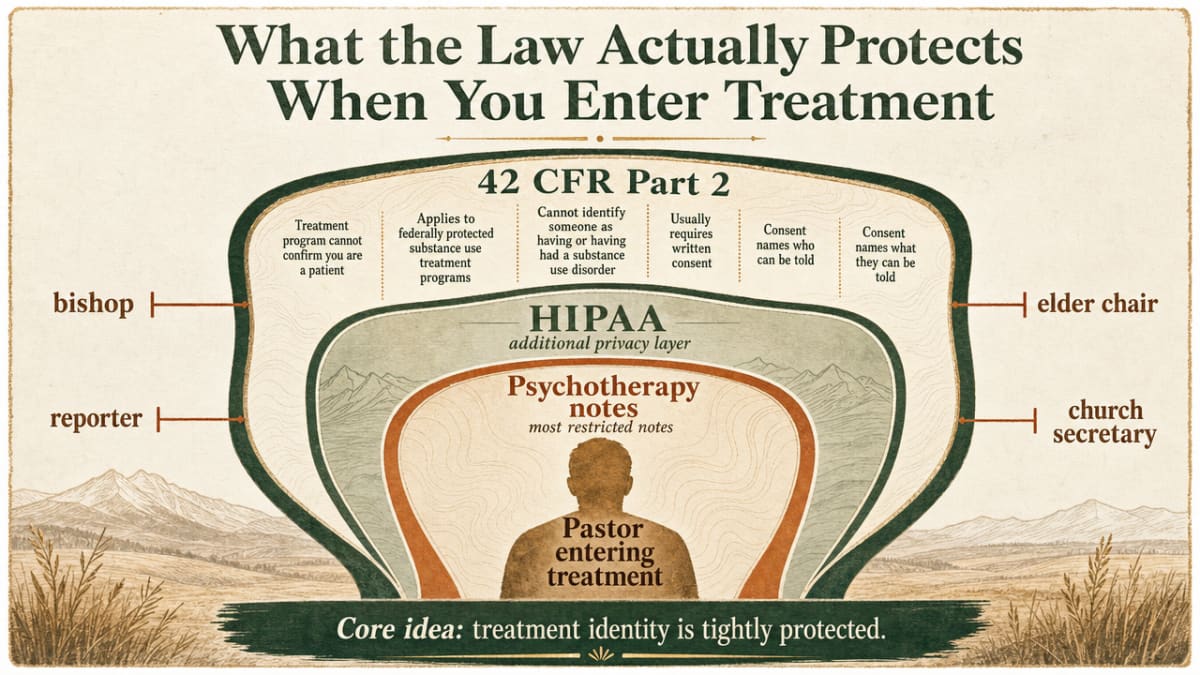
Here is the single most important sentence for a pastor to read this week: a federally protected substance use treatment program cannot tell anyone you are a patient. Not your bishop. Not the elder chair. Not a reporter. Not a well-meaning church secretary who thinks she is helping. That protection lives in a federal rule called 42 CFR Part 2, and it is written specifically for programs that treat substance use disorders.
What this looks like at Rocky Mountain Treatment Center in practice: if a caller asks whether you are a patient there, staff do not say yes, no, or “we cannot say.” They do not confirm that the person exists in their system at all. Your admission, your room, your presence in group counseling, your name on a schedule, none of it can be handed over without your signature.
The comparison is stark. Without your written consent, essentially nothing that ties you to a substance use disorder can leave the building. With your consent, and only in the specific ways you define on the form, targeted disclosure becomes possible, and you can revoke that consent later 1, 2. You are the gatekeeper on your own record.
HIPAA, Clergy Inquiries, and the Church Member Who Calls Looking for You
Now picture the more ordinary scenario. A church member has not seen you for three Sundays. She hears a rumor. She calls the front desk of a treatment center in Montana and asks, kindly, if you are there.
Under HIPAA, hospitals and treatment providers sometimes maintain a facility directory that lets them share a patient’s condition and location with people who ask for that person by name, and religious affiliation may be shared with clergy under narrow conditions 2. That sounds alarming until you read the next layer. Substance use treatment programs covered by Part 2 follow the stricter rule when both apply, which means the HIPAA directory exception does not override the Part 2 wall around your identity as a patient 5.
The practical result: at a Part 2 program like Rocky Mountain Treatment Center, you can ask to be kept out of any directory entirely, and staff will not confirm your presence to a caller no matter how polite, persistent, or connected that caller is. If you later want your spouse to be able to reach you, you sign a specific release naming your spouse. Nobody else on that same form. Nobody else gets a call back. You choose the list, and it can be one name long.
Psychotherapy Notes: The Extra Wall Around What You Say in Counseling
What you say in a counseling room is where a pastor often feels most exposed. You have watched confession get weaponized in other people’s lives. You do not want the sentences you finally speak out loud sitting in a file that could be pulled someday.
HIPAA treats most medical records one way and psychotherapy notes another. A counselor’s private session notes get an extra layer of protection, and “the Privacy Rule requires a covered entity to obtain a patient’s authorization prior to a disclosure of psychotherapy notes for any reason, including a disclosure for treatment purposes” to another provider 4. That is a higher bar than general medical information, and it exists precisely because what happens in counseling is more intimate than a lab result 3.
At Rocky Mountain Treatment Center, that means the individual counseling sessions where you finally talk about the funeral you preached hungover, or the fight with your spouse last Easter, sit behind a separate lock. Your general treatment record is one thing. The counselor’s session notes are another, and they do not travel without your signature.
How Ministry Wears You Down Into a Drinking Problem
The Burnout Profile Almost No One Names From the Pulpit
Nobody hands you the burnout checklist at ordination. You learn it by living it. A study of parish-based clergy found that pastors who met criteria for burnout tended to share a specific profile:
- they were younger,
- they identified themselves as depressed,
- they were dissatisfied with their own spiritual life,
- and they had endured a traumatic church placement.
The same study noted that having interests and activities outside of ministry appeared to protect against burnout 10.
Read that list slowly, in private, without answering to anyone. Younger than you thought you would be when the weight got this heavy. Depressed in a way you have not said out loud because you are the one people come to when they are depressed. Dissatisfied with your own prayer life while you write sermons about prayer. A church placement that broke something in you, whether it was a split, a scandal, a funeral you never processed, or a board meeting that turned personal. Few real interests outside of the work, because the work never stops asking.
A wider review of clergy burnout draws the line further. Burnout is not just fatigue. It is linked to poorer mental health overall and, in the research on Catholic clergy, to possible associations with substance addictions 8. That is not an accusation. It is a warning label the profession has quietly earned.
You do not need to score yourself against the checklist to know where you land. If two or three items just made your chest tighten, that is information. Rocky Mountain Treatment Center sees this pattern often, which is one reason the counseling staff, more than 80 percent of whom are in recovery themselves, do not flinch when a pastor finally says it out loud.
Alcohol as the Quiet Coping Tool Between Sunday Services
Almost nobody starts drinking to become an alcoholic. They start drinking because Sunday night is loud in their head, Monday morning is loud in their inbox, and one glass makes the volume drop. Then two. Then the bottle in the drawer, because the recycling bin at home tells a story you do not want your spouse or your kids to read.
For pastors, alcohol slides in as a coping tool because it does not look like a crisis at first. It looks like a reward after a hospital visit. It looks like sleep after a board meeting that went sideways. It looks like the only thing that stops the replay of the counseling session where you did not have an answer. The clergy burnout research links this exhaustion to poorer mental health and to the risk of self-medication, which is the clinical way of describing the drawer, the glove box, and the drive home the long way 8.
Here is the part worth holding onto. A drinking problem that grew out of ministry stress is not proof that your calling was fake. It is proof that you are a human being who ran out of other ways to put the day down. Medically monitored detox at Rocky Mountain Treatment Center is designed for exactly this moment, so your body can stop first while the rest of the work waits.
Why Distance Is Its Own Kind of Privacy
Great Falls, Montana is not on the way to anywhere your congregation is going. That is the point. When you leave a treatment center, the legal protections around your record travel with you. When you enter one, geography does part of the work that paper cannot.
Think about who might actually spot you. The deacon whose sister-in-law works at the hospital forty minutes from your church. The associate pastor’s college roommate who tends bar near the outpatient clinic in your county. The former youth group kid, now a nurse, who rotates through the regional detox unit. Local care is often good care, but for a pastor, local means a hallway where someone might know your face.
Rocky Mountain Treatment Center sits in a small city surrounded by open country, with a 26-bed facility that does not look like a hospital campus your board members would drive past. Staff arrange transportation from Montana airports for people traveling in, so you are not renting a car under your own name at a counter three blocks from a denominational office. The distance is not a gimmick. It is a practical layer stacked on top of the federal privacy rule that already shields your identity as a patient 1.
There is a quieter benefit, too. Clergy who feel anxious and under-trained about mental health often hesitate to walk into a system where they are known 7. Being a stranger in Montana lets you be a patient first and a pastor second, maybe for the first time in years.
Faith in the Program, on Your Terms
Optional Bible Study, Not a Required Curriculum
Here is something worth saying plainly: at Rocky Mountain Treatment Center, the Bible study is optional. Not optional in the polite sense where everyone notices who skipped. Optional in the actual sense. You can attend every session, some sessions, or none, and your treatment plan does not shift because of that choice.
That matters more for a pastor than it might for a lay client. You have spent years leading Bible studies. You have prepped them at midnight after a hospital call. The idea of sitting in one as a participant, while a counselor takes notes on your posture, can feel like performing your job at the worst possible moment. If that is where you are, you get to pass.
The core clinical work at Rocky Mountain Treatment Center, the medically monitored detox, the individual counseling, the group sessions, the family week, the equine therapy, the 12-step meetings, does not depend on whether you open a Bible while you are there. Faith-based programming sits alongside that work as a choice you make each day, not a requirement stamped on your intake paperwork. For a pastor, that difference is the difference between a treatment center that respects your calling and one that tries to script it.
When You Are in a Faith Crisis and Do Not Want More Scripture Right Now
Some pastors arrive at treatment angry at God. Some arrive numb. Some arrive wondering if the last decade of preaching was honest. If that is you, please hear this: you are not the first clergy person to walk through the door in a faith crisis, and the staff will not try to talk you out of it.
Research on clergy notes that even trained pastors often feel anxious and under-prepared when their own inner life gets loud 7. A treatment center that hands you a devotional the moment you sit down misreads the room. What you may need first is sleep, food, medical stabilization, and a counselor who lets you say the sentence you cannot say at home.
Choosing to skip Bible study at Rocky Mountain Treatment Center is not a black mark on your chart. It is a clinical detail, like preferring decaf. When and if you want to return to scripture, on your own or in the optional group, it will be waiting. Until then, getting sober does not require you to have your theology sorted out.
What the First Confidential Phone Call Actually Looks Like
You probably rehearse the call in the car. You picture yourself dialing, saying the wrong thing, being asked to leave a voicemail with your real name. That is not how it goes.
When you reach admissions at Rocky Mountain Treatment Center, the first questions are clinical, not curious. What are you drinking, how much, how often, when was the last drink, are you having withdrawal symptoms, do you have other health conditions the medical team should plan around. You do not have to say the word pastor. You do not have to say where you preach. Your title is not a required field.
Next comes insurance. Rocky Mountain works with most major insurance providers, though it does not currently accept Medicaid or Medicare. Verification runs through the billing side of the house, and staff can walk you through what your plan is likely to cover before you commit to a date. If you are worried about how a claim might read on a statement your church business office could see, ask that question out loud on the call. It is a normal one.
Then logistics. If you are flying in, complimentary Montana pickup from area airports means you are not standing at a rental counter using a card tied to a church account. You arrive at a 26-bed facility, not a sprawling campus. Medically monitored detox begins with a nurse, not a lecture.
The whole call can happen from your car in a parking lot you picked on purpose. Nothing you say obligates you to admit. You are gathering information, and the person on the other end knows that.
Telling the People You Have To Tell, and Not the Ones You Do Not
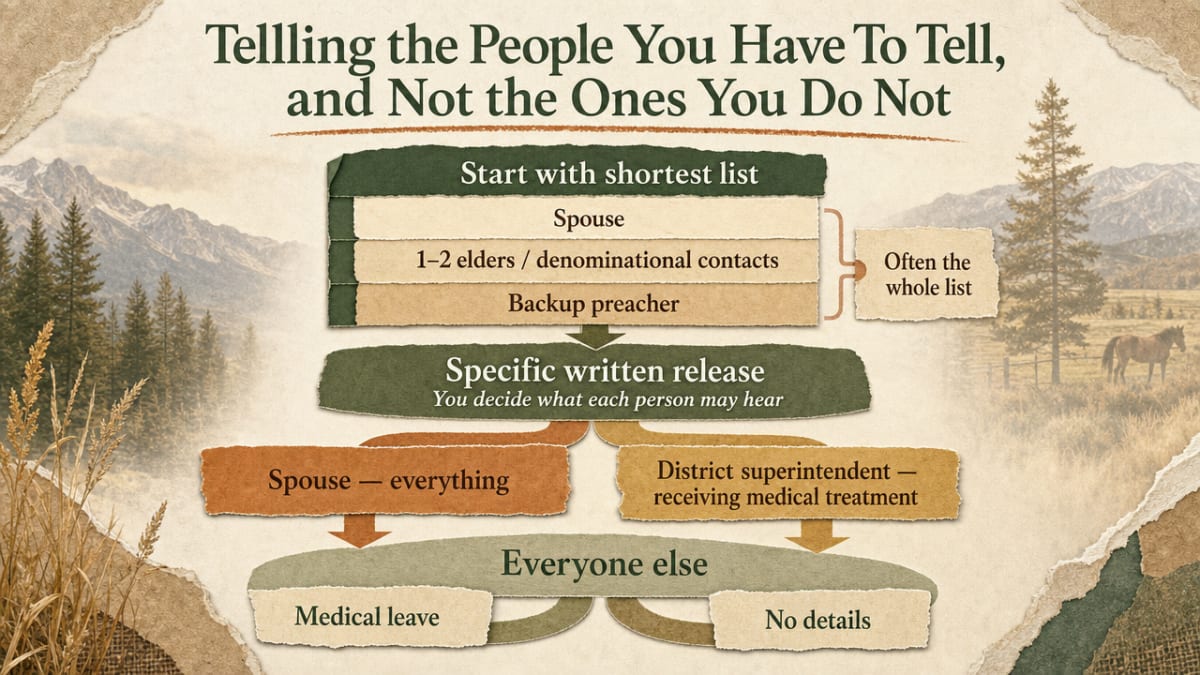
You do not owe your whole church an explanation. You may owe a very small number of people the truth, and part of getting well is learning to tell the difference.
Start with the shortest possible list:
- A spouse, if you have one.
- One or two elders or denominational contacts whose signatures you actually need to be away for 30, 60, or 90 days.
- A backup preacher.
That is often the whole list. Everyone else can be told you are taking a medical leave, which is accurate, or nothing at all, which is also your right.
Here is where the paperwork works in your favor. At Rocky Mountain Treatment Center, each person on your disclosure list gets named on a specific written release, and you decide what they are allowed to hear. Your spouse can be told everything. A district superintendent can be told only that you are receiving medical treatment and expected back on a certain date, without the words alcohol or substance appearing anywhere. You can revoke any of it later 1.
The instinct in church culture is to over-disclose, to confess broadly, to preempt gossip by getting ahead of it. Research on churches and mental health is blunt about the cost of that instinct: shame and stigma keep people silent, and public disclosure rarely produces the grace it promises 6. You are allowed to protect your recovery from a room that has not earned it yet.
After Detox: Coming Home Without Coming Undone
Detox is the door, not the house. Once your body stabilizes, the harder work is quieter: rebuilding a week that does not need a drink to get through it. For a pastor, that means going home to a job that will still ask everything of you by Wednesday afternoon.
Rocky Mountain Treatment Center’s aftercare is built for that reentry. Follow-ups happen at 30, 60, 90, 180, and 365 days after discharge, and weekly Zoom groups let you stay connected to a recovery community from a locked office or a parked car. You are not walking back into ministry alone, and you are not driving across three counties to sit in a folding chair where someone might recognize you.
The clergy burnout research is clear that interests and relationships outside of the work protect against relapse into old patterns 10. Aftercare is where those get rebuilt. A sponsor. A counselor you keep seeing. One honest person in your life who is not a congregant.
Coming home does not have to mean coming undone. It can mean coming back with more of yourself intact than you left with.
Frequently Asked Questions
Can my denomination or elder board find out I am in treatment?
Not unless you tell them, or unless you sign a written release naming them specifically. Federal rule 42 CFR Part 2 prevents a substance use treatment program from identifying you as a patient without your written consent 1. Your bishop, district office, and elder chair have no legal way to pull that information from Rocky Mountain Treatment Center on their own.
What happens if a church member calls the treatment center asking for me?
Staff will not confirm you are a patient, and they will not say you are not. Under Part 2, a program cannot acknowledge your presence at all without your signed authorization 1. You can also ask to be kept out of any facility directory entirely, so a caller who guesses your name gets no useful information, no matter how kind or persistent they sound.
Do I have to participate in Bible study or faith-based programming?
No. Bible study and faith-based programming at Rocky Mountain Treatment Center are optional, not required. Your treatment plan, counseling, detox, and group work do not depend on whether you attend a single session. If you arrive angry at God, exhausted by scripture, or simply wanting a break from leading, that is a clinical detail, not a character judgment. You get to choose day by day.
Will using my insurance create a paper trail my church can see?
Only if your church controls your insurance plan and someone there reviews claims. Rocky Mountain works with most major insurers but does not accept Medicaid or Medicare. Ask admissions to explain how a claim is likely to appear on any statement before you commit. HIPAA also limits what insurers can disclose, and Part 2 adds a stricter layer around anything tied to substance use treatment 2, 5.
Can what I say in counseling sessions be subpoenaed or shared later?
Counseling session notes get an extra layer of protection under HIPAA. A provider must obtain your authorization before disclosing psychotherapy notes for almost any purpose, including sharing them with another provider 4. That is a higher bar than general medical records 3. Combined with Part 2 protections around substance use records, the sentences you finally say out loud in individual counseling do not travel without your signature.
How do I explain being away for 30 or more days without revealing why?
Medical leave is accurate and sufficient. You do not owe your congregation a diagnosis. Tell the small list of people whose signatures you need, name a backup preacher, and let the rest be told you are away for medical reasons and will return on a set date. Church culture pressures pastors to over-disclose, but shame and gossip rarely produce grace 6. Protect your recovery from rooms that have not earned it.
References
- Understanding Confidentiality of Substance Use Disorder Patient Records (Part 2). https://www.hhs.gov/hipaa/part-2/index.html
- HIPAA Privacy Rule and Its Major Provisions. https://www.hhs.gov/hipaa/for-professionals/privacy/laws-regulations/index.html
- Constraints on Sharing Mental Health and Substance-Use Treatment Information Imposed by Federal and State Medical Records Privacy Laws. https://www.ncbi.nlm.nih.gov/sites/books/NBK19829/
- Does HIPAA provide extra protections for mental health information compared to other health information?. https://www.hhs.gov/hipaa/for-professionals/faq/2088/does-hipaa-provide-extra-protections-mental-health-information-compared-other-health.html
- Additional FAQs on Sharing Information Related to Treatment for Mental Health or Substance Use Disorder. https://www.hhs.gov/sites/default/files/new-faqs-on-sharing-information.pdf
- Hospitality Towards People with Mental Illness in the Church. https://pmc.ncbi.nlm.nih.gov/articles/PMC8554182/
- Challenges to sanctuary: the clergy as a resource for mental health care in the community. https://pubmed.ncbi.nlm.nih.gov/17482330/
- Burnout Syndrome Among Catholic Clergy: A Systematic Review. https://pubmed.ncbi.nlm.nih.gov/37682353/
- An Examination of the Impact of Clergy-Involved Mental Health Activities on Mental Health Treatment Utilization. https://pmc.ncbi.nlm.nih.gov/articles/PMC11385630/
- The impact of behaviors upon burnout among parish-based clergy. https://pubmed.ncbi.nlm.nih.gov/20162452/