Key Takeaways
- Transportation is one of the top reasons Montanans stall before entering treatment, so naming the ride problem as real removes the shame of asking for help 9.
- Distances from Billings, Missoula, Kalispell, Bozeman, Havre, and Miles City to Great Falls make a working car, valid license, and sober driver a fragile combination for most people.
- One phone call to Rocky Mountain Treatment Center replaces the entire logistics problem, with staff arranging the pickup while you’re still on the line 10.
- You don’t need a packed bag, a story, or sobriety to make the call — staff ask questions warmly, and ‘I don’t know’ is a valid answer.
- The drive to Great Falls is quiet unless you want to talk, with no intake happening in the vehicle and detox support available on arrival.
- Pack a small bag with a week of clothes, medications in labeled bottles, and ID; leave alcohol, non-prescribed items, and valuables at home.
- Self-arranged options like Medicaid NEMT, family drivers, or the bus each carry real limits, and Rocky Mountain doesn’t accept Medicaid 1.
- Court-ordered, post-DUI, and probation clients use the same pickup process, and staff coordinate directly with POs and treatment court liaisons 6.
When you can’t get there, you can’t get better
Maybe you’ve been ready for a while. Or maybe you got ready sometime in the last twelve hours, after a night that scared you or someone who loves you. Either way, you’re here now, reading this, and there’s one thing standing between you and a bed in a treatment center: you don’t have a way to get there.
That’s not a small thing. In rural states like Montana, people trying to get sober name transportation as one of the top reasons they never start treatment or drop out before it helps them 9. It’s not laziness. It’s not lack of willingness. It’s a car that won’t start, a license that got taken, a friend who used to drive and doesn’t answer anymore, or two hundred miles of highway between your kitchen table and the nearest open bed.
Here’s what this article is for. If you’re in Montana and you want to go to residential rehab, Rocky Mountain Treatment Center in Great Falls will arrange complimentary pickup for you. One phone call. You don’t need a plan. You don’t need a ride lined up. You don’t need to have your paperwork together or your bag packed perfectly. You just need to call.
The rest of this piece walks through exactly how that works, what to expect on the drive, what to bring, and what to do if you’d rather try to arrange the ride yourself. It’s also written for the person who might be reading this on someone else’s behalf at 2 a.m. You count too. Making the call is the hard part. The drive is ours.
Why ‘I don’t have a ride’ is the reason so many Montanans stall
Montana is big in a way that shows up on your gas gauge. The state’s certified substance use treatment providers are scattered across cities and small towns, which means the closest open residential bed is rarely down the street 3. Distances to Great Falls:
- From Billings, Great Falls is roughly 220 miles.
- From Missoula, about 165.
- Kalispell sits around 215 miles away.
- Bozeman is close to 180.
- Havre is the shortest at about 115.
- Miles City is the long haul at roughly 360 miles one way.
Those numbers assume you have a working car, a valid license, gas money, and someone sober enough to ride shotgun if withdrawal starts on the road. Take any one of those pieces away and the math falls apart. Researchers who talked to rural residents about why they don’t start or finish treatment heard the same thing over and over: the ride wasn’t there 9. Not the willingness. The ride.
And it’s not just distance. It’s a suspended license after a DUI. It’s a truck you can’t afford to fix. It’s a family member who used to drive you and finally said no. It’s the shame of asking a neighbor to take a whole day off work to drop you at rehab in Great Falls.
If any of that sounds familiar, you’re not making excuses. You’re describing a real problem. Rocky Mountain Treatment Center exists on the other end of those miles, and the pickup is the part we handle so you don’t have to.
How complimentary pickup to Rocky Mountain Treatment Center actually works
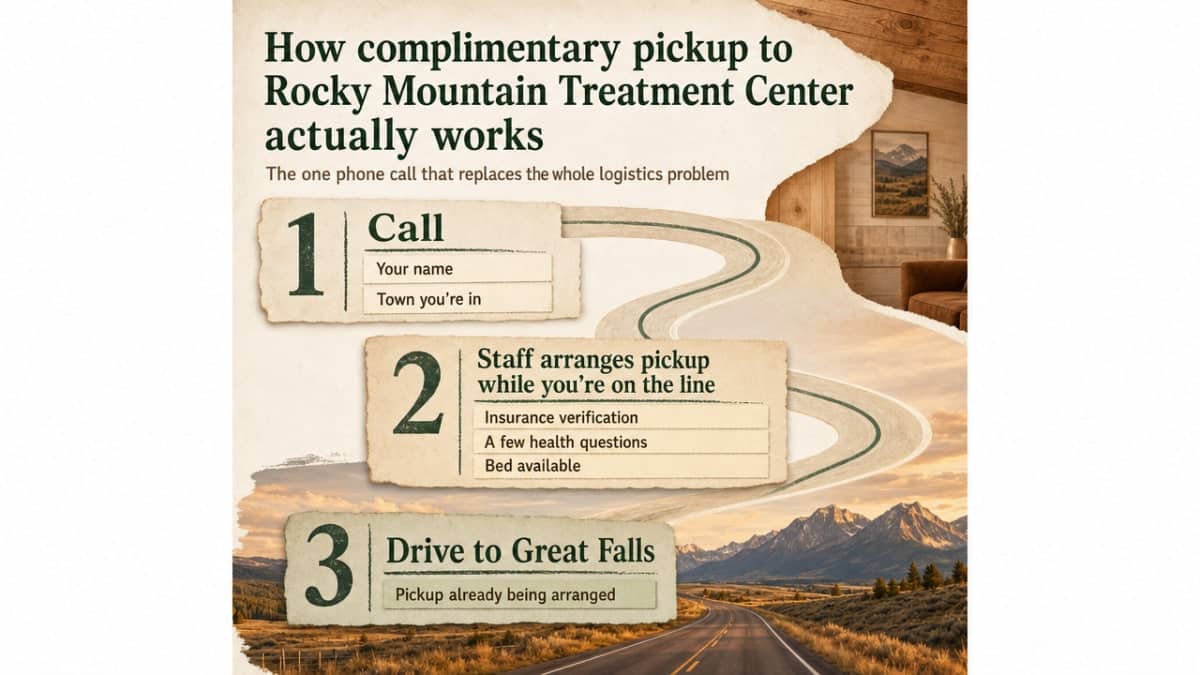
The one phone call that replaces the whole logistics problem
Here’s the part that surprises people the most: you don’t build the plan. We do. When you call Rocky Mountain Treatment Center in Great Falls, the person on the other end of the line has one job in that first conversation, and it isn’t to sell you anything. It’s to figure out where you are and how to get you here.
The call itself is short. You say your name, or the name of the person you’re calling for, and the town you’re in. That’s enough to start. From there, the staff member walks you through insurance verification, asks a few questions about your health, and then, if a bed is available, starts arranging the pickup on their end while you’re still on the phone. You don’t hang up and wait for a callback to hear whether a ride is possible. The ride is the point.
If you’re in Havre, Miles City, Missoula, or somewhere the map barely names, that doesn’t change the answer. Rocky Mountain arranges complimentary pickup for Montana residents coming into residential treatment. Program-led transportation isn’t a courtesy add-on. Research on transportation supports for people with behavioral health needs shows this kind of direct assistance meaningfully raises the odds that someone actually shows up to care 10. That’s why we do it this way.
What a staff member will ask, and what you don’t need to have ready
You will be asked some questions. None of them are trick questions. The staff member wants to know your date of birth, your insurance card if you have one nearby, when you last drank or used, and whether you’re on any prescription medications. If you’re calling for someone else, you give what you know and leave the rest blank. “I don’t know” is a real answer, and it’s fine.
What you don’t need to have ready is almost everything else. You don’t need a packed bag. You don’t need your ID in your wallet — a photo of it on a phone works, and if you don’t have that either, we’ll figure it out. You don’t need to have told your boss or your landlord. You don’t need to be sober right now. You don’t need to have stopped shaking. You don’t need a story that makes sense.
More than half our staff at Rocky Mountain are in recovery themselves, so the voice on the phone has almost certainly made a version of this call, once, from the other side. That matters. The questions are asked warmly and in the order that makes it easiest for you to answer. If you need to put the phone down and cry for a minute, that’s part of the call, not an interruption of it.
The drive to Great Falls: what to expect on the road
Once your pickup window is confirmed, the staff member will tell you when to expect the vehicle and where to meet it — usually your home, but sometimes a gas station, a relative’s driveway, or a spot in town that’s easier to find. If you’re worried about a neighbor seeing, say so. We’ll work with you on where to meet.
The drive itself is quiet unless you want it not to be. You can sleep. You can look out the window at whatever stretch of Montana you’re crossing — the Highline, the Rocky Mountain Front, the Judith Basin. You can talk if you want to talk. There is no intake interview happening in the car. That comes later, at the facility, after you’ve had water and a chance to sit down.
If you’re worried about withdrawal starting on the road, tell the staff member on the phone when you call. That changes the timing conversation, not the answer. Rocky Mountain has medically monitored detox on-site, and getting you here safely is part of what the pickup is for. The drive to Great Falls is the last piece of logistics you have to think about for a while.
What to pack, what to leave, and what to tell the people at home
Keep the bag small. A duffel or a backpack is enough. Seven to ten days of comfortable clothes, layers for Great Falls weather, closed-toe shoes you can walk in, sneakers or boots you don’t mind getting dusty around the horses, a jacket, pajamas, and whatever toiletries you actually use. If you wear glasses, bring them and a backup pair if you have one. If you take prescription medication, bring the bottles with the labels still on. Insurance card, ID, and a small amount of cash if you have it. That’s the list.
Leave the things that will make the first week harder. Alcohol, obviously. Anything not prescribed to you. Mouthwash and hand sanitizer with alcohol in them — swap for alcohol-free versions or wait and buy them here. Weapons. Anything valuable you’d be sick to lose. If you’re wondering whether something’s okay, ask on the phone when you call. The staff member arranging your pickup can tell you before the vehicle pulls up, so you’re not repacking on the porch.
Now the harder part: what to tell the people at home. You don’t owe anyone a speech. “I’m going to treatment for a while. I’ll call when I can” is a full sentence. If there are kids in the house, a partner, or a parent who’s going to worry, write it down before you leave so you don’t have to find the words twice. If the person reading this is the family member doing the calling, you can be the one who makes those short phone calls after the vehicle leaves. Program-arranged transportation is linked to higher appointment adherence in vulnerable groups, which is a clinical way of saying that when someone else handles the ride, more people actually make it through the door 10. That includes the door at Rocky Mountain Treatment Center in Great Falls. Pack light. Say less than you think you need to. Get in the vehicle.
If you’d rather arrange the ride yourself: an honest walkthrough
Montana Medicaid rides, family drivers, and the bus: what each one really takes
Some people want to try to handle the ride themselves. That’s a fair choice, and this section is written honestly so you can make it with your eyes open.
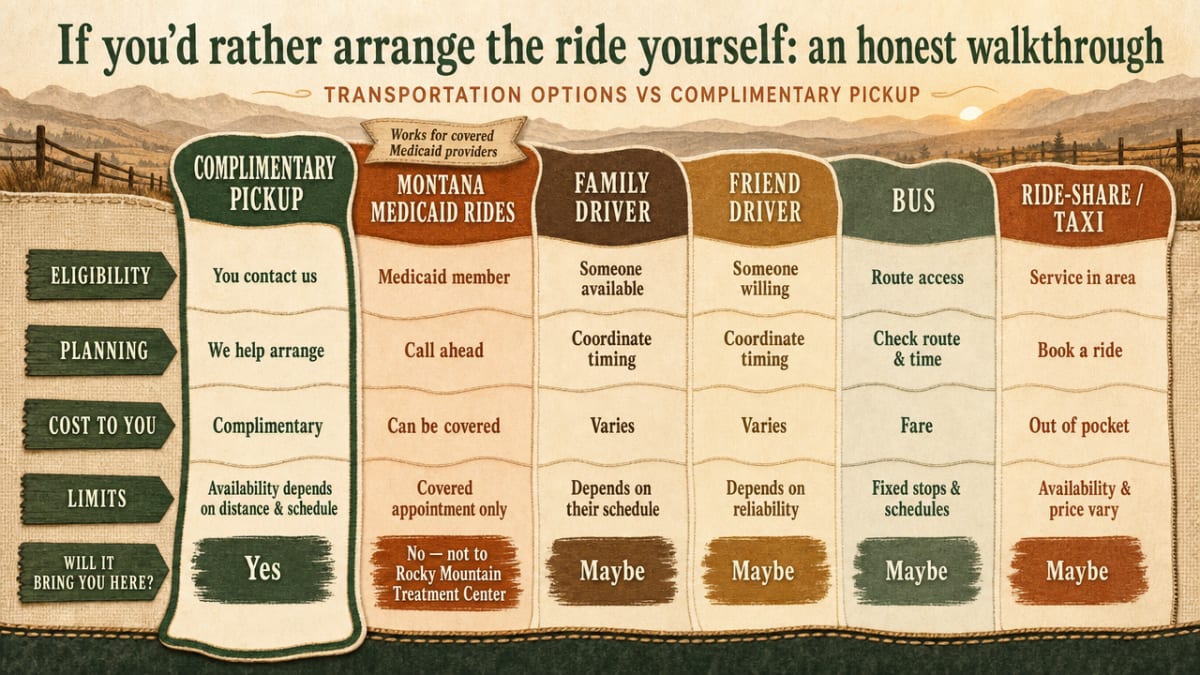
Montana Medicaid can help pay for transportation to medical appointments, including substance use treatment, for eligible members 1. That’s real, and for people already enrolled it’s worth knowing about. The catch: you have to be a Medicaid member, you usually need to call ahead to schedule the ride, and the ride has to be tied to a covered appointment at a provider that accepts Medicaid. Rocky Mountain Treatment Center does not currently accept Medicaid, so a Medicaid-arranged ride won’t bring you here. If you want to use Medicaid transportation, you’d be arranging travel to a different Montana provider — DPHHS keeps a statewide list you can start from 2, 3.
A family member driving you is the option most people try first. It works when it works. It falls apart when the driver has to take a full day off, when the truck needs tires, when the person driving is also the person you’ve been fighting with about your drinking, or when withdrawal starts an hour outside town and nobody in the car knows what to do.
The bus is the third option. Intercity routes run through parts of Montana, but schedules are limited, stations aren’t in every town, and you’d need to get yourself to the station, ride several hours, and then get from the Great Falls stop to the facility. If you’re already shaking, carrying a duffel, or trying not to drink on the way, that’s a long day.
None of these are wrong. They’re just more work than a phone call. Program-led transportation, where the treatment provider handles the ride directly, is linked to higher rates of people actually making it to care 10. That’s why Rocky Mountain built the pickup into the process instead of leaving it on your shoulders.
Self-arranged ride vs. complimentary pickup, side by side
Here’s the same information laid out plainly, so you can see the trade-offs without anyone selling you anything.
| Option | Who arranges it | Phone calls & paperwork | Typical wait | Reliability concerns ||—|—|—|—|—|| Personal vehicle | You | None, if the car runs | Same day | Gas, license, sobriety to drive || Family or friend driving | You + driver | A few calls to line up a day | 1–7 days | Driver availability, tension in the car || Montana Medicaid (NEMT) | You + Medicaid | Enrollment check, ride request, provider must accept Medicaid — Rocky Mountain does not 1| Days, per scheduling rules | Only works for Medicaid-accepting providers || Intercity bus | You | Ticket, schedule, transfers | Depends on route | Limited stops, long travel day, no medical support || Complimentary pickup from Rocky Mountain | Rocky Mountain staff | One phone call | Confirmed on the call | Handled by the program |
The honest read: if you already have a running car, a valid license, and someone sober to ride with, driving yourself is fine. If you have Medicaid and want to use a provider that takes it, NEMT is a real tool 1. For most people who land on an article called “how to arrange pickup for rehab in Montana,” the shortest path from where you’re sitting to a bed in Great Falls is one call. Program-arranged rides raise the odds that people actually reach the care they’ve decided they want 10. That’s the whole point.
Court-ordered, post-DUI, and probation pickups
If a judge, probation officer, or treatment court is the reason you’re going to rehab, the pickup still works the same way. You call. We drive. The court paperwork isn’t a barrier we care about at the door — it’s context that helps us coordinate on your end.
Montana’s treatment courts and DUI courts are set up to connect people with substance use treatment rather than just hand down a sentence 6. That’s good news, but it also means the court is going to want proof you actually showed up and stayed. Rocky Mountain Treatment Center is used to working with probation officers, public defenders, and treatment court coordinators. When you call, tell the staff member that your treatment is court-related and give the name and number of your PO or court liaison if you have it handy. If you don’t have it handy, that’s fine too — we can help track it down after you’re safe here in Great Falls.
A suspended license is one of the most common reasons people can’t drive themselves to rehab after a DUI. It’s also one of the most common reasons people feel too embarrassed to ask for help getting there. You don’t need to explain the ticket or apologize for the case. The pickup exists precisely for the person whose license is gone, whose car got impounded, or whose sober driver options ran out somewhere between the arrest and the arraignment.
One practical note for court-ordered clients: bring any paperwork you have — the court order, a probation contact card, a treatment referral letter. A photo on your phone is enough. If there’s an active warrant unrelated to your treatment case, say so on the call. We’ll talk through it honestly rather than let it become a surprise later. The goal is the same as everyone else’s on this page: get you in the vehicle, get you to Great Falls, and let the 30, 60, or 90 days start doing what they’re supposed to do.
Why the drive is worth it once you’re through the door
Here’s what waits for you on the other end of that highway. Rocky Mountain Treatment Center is a 26-bed facility in Great Falls, which means you’re not a number in a wing of two hundred. The counselor you meet in the first week is the counselor you’ll still be sitting across from in the last week. More than 80% of our staff are in recovery themselves, so the person handing you a cup of coffee at 6 a.m. has been up at 6 a.m. sober for a lot longer than you have, and knows exactly how that feels.
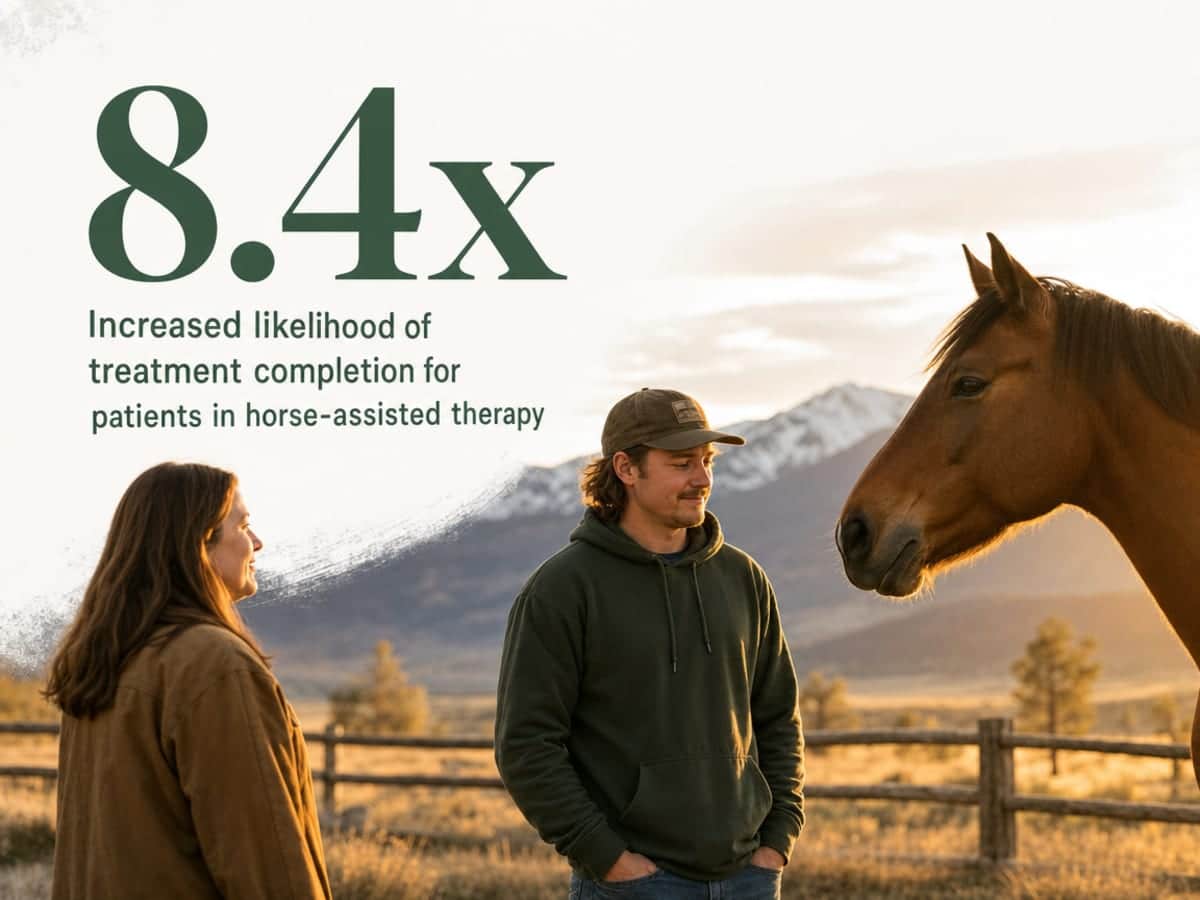
The 30, 60, or 90 days include medically monitored detox, individual and group counseling, family therapy, 12-step meetings, and the piece that surprises most people: equine therapy. You work with horses. Actual horses, on actual Montana ground. It sounds soft until you try it. A small study of patients who added horse-assisted therapy to standard substance use treatment found they were about 8.4 times more likely to complete treatment than those who didn’t, though the sample was small and the design observational, so treat the number as suggestive rather than a guarantee 8. A broader 2022 review of equine-assisted services reached the same cautious conclusion: promising signals on retention and mental health, limited by study size 7.
The drive is a few hours. What’s on the other side is thirty to ninety days of your life pointed somewhere different. That’s the trade.
After the 30, 60, or 90 days: the ride home isn’t the end of the ride
The pickup gets a lot of attention because it’s the first hurdle. The last day matters too. When your program at Rocky Mountain Treatment Center wraps up, you don’t get dropped at a bus station in Great Falls and wished good luck. The team helps you plan where you’re going next, whether that’s home, a certified recovery residence somewhere in Montana, or a mix of both. The state keeps a registry of sober living homes with formal oversight, and your counselor can help you look at options that fit your town, your job situation, and how much structure you want after residential care 5.
Continuing care keeps going too. Weekly Zoom groups, check-ins at 30, 60, 90, 180, and 365 days out, and a counselor who still knows your name. The ride home is real, and so is the fact that recovery is longer than the drive. You called once to get here. You can call again from wherever you land next.
Making the call today: what to say, and what happens next
You don’t need a script, but here’s one anyway, because sometimes it helps to know the first sentence before you dial.“Hi, my name is , I’m in , Montana, and I need to come to treatment. I don’t have a way to get there.”That’s it. That’s the whole opener. If you’re the family member calling, swap in “I’m calling for my son / my wife / my dad” and the same sentence still works.
From there, the person on the other end takes over. They’ll ask about insurance, a few health questions, and where you are on the map. If a bed is available, they start arranging your pickup while you’re still on the line. You’ll hang up knowing roughly when the vehicle will reach you and where to meet it. Then you pack the small bag we talked about earlier, tell the people at home what you need to tell them, and sit down.
Frequently Asked Questions
Does Rocky Mountain Treatment Center really pick people up for free anywhere in Montana?
Yes. If you’re a Montana resident coming into residential treatment at Rocky Mountain, the pickup is complimentary. When you call, a staff member will confirm your location and the pickup window on that same call. You don’t need to have a plan for the ride figured out before you dial. Getting you from your town to Great Falls is part of the admission, not something extra.
How fast can a pickup be arranged after I call?
Same-day pickup is often possible when a bed is open and your insurance clears quickly. Sometimes it’s the next day, depending on where you are, weather, and staff availability. The staff member on the phone will give you a real time window before you hang up, not a vague “we’ll be in touch.” If withdrawal is starting, say so — that changes the timing conversation.
What if I have a suspended license, an active warrant, or a pending DUI case?
None of that stops the pickup. A suspended license is one of the most common reasons people need the ride in the first place. If you’re in a Montana treatment court or DUI court, we’re used to coordinating with your PO or court liaison 6. If there’s an active warrant unrelated to your treatment, tell the staff member on the call — we’d rather talk it through honestly than have it surprise anyone later.
What should I bring, and what should I leave at home?
Bring a small bag: about a week of comfortable clothes, layers, closed-toe shoes, sneakers or boots for around the horses, toiletries, glasses if you wear them, and any prescription bottles with the original labels. Insurance card and ID if you have them. Leave alcohol, anything not prescribed to you, alcohol-based mouthwash or hand sanitizer, weapons, and valuables. If you’re unsure about an item, ask on the call.
What if I have Montana Medicaid — should I use NEMT instead?
Montana Medicaid can help pay for rides to covered appointments, including substance use treatment at Medicaid-accepting providers 1. Rocky Mountain Treatment Center does not currently accept Medicaid, so Medicaid transportation won’t bring you here — it would bring you to a different Montana provider, which DPHHS lists statewide 2, 3. If you want to come to Rocky Mountain, the complimentary pickup is the direct route. If you want to use Medicaid, we can point you toward the list.
Can a family member ride along, or call on behalf of someone who isn’t ready to talk yet?
Yes to both. Family members call for their person all the time — a spouse, a parent, an adult child. You can start the conversation, share what you know, and hand the phone over when the person going to treatment is ready. Whether a family member can ride along in the vehicle depends on the specifics of the pickup, so ask on the call. The staff member will walk you through what works.
References
- Help for mental health, drugs, alcohol: MT Medicaid, CHIP | SAMHSA. https://www.samhsa.gov/find-support/health-care-or-support/professional-or-program/medicaid-or-chip/montana
- Substance Use Disorder Services and Resources. https://dphhs.mt.gov/bhdd/SubstanceAbuse/
- Treatment Provider Information – DPHHS. https://dphhs.mt.gov/BHDD/SubstanceAbuse/treatmentproviderinformation
- Governor Gianforte, DPHHS Launch Housing Support Services Initiative to Help Montanans with Mental Illness and Substance Use Disorders. https://dphhs.mt.gov/News/2025/June/HousingSupportServices
- Montana Recovery Residence Registry. https://dphhs.mt.gov/BHDD/MontanaRecoveryResidenceRegistry
- Treatment/DUI Courts | Montana Department of Transportation. https://mdt.mt.gov/visionzero/plans/dui-courts.aspx
- Equine-assisted services for individuals with substance use disorders: A systematic review. https://pmc.ncbi.nlm.nih.gov/articles/PMC9749232/
- Contribution of the patient–horse relationship to substance use disorder treatment: Patients’ experiences. https://pmc.ncbi.nlm.nih.gov/articles/PMC4904069/
- Barriers to substance use treatment in rural areas: A qualitative study. https://www.ncbi.nlm.nih.gov/pmc/articles/PMC7548270/
- Transportation and health: Policy interventions for disadvantaged populations. https://www.ncbi.nlm.nih.gov/pmc/articles/PMC6007538/