
Key Takeaways
- Family Week is a three-day, on-site block at Rocky Mountain Treatment Center where loved ones join education, joint counseling sessions, and aftercare planning built into the inpatient stay.
- Pulling family into treatment raises the odds someone enters care and stays through it, which is why the room includes spouses, parents, or whoever functions as family 6.
- Day one grounds the family in what addiction does to the brain, day two opens hard conversations with a counselor present, and day three produces a written plan everyone helped shape.
- The three-day format exists because stretched-out weekly programs lose most families to scheduling and distance, with one study showing only 22.6% completion across multi-session curricula 10.
Why Your Family Sitting in That Room Changes Everything
You’ve probably rehearsed this conversation in your head a hundred times. The one where you tell your mom, your husband, your grown daughter that you’re going to treatment — and then the one where you ask them to show up for three days in Great Falls to sit in a room and talk about what alcohol has done to all of you. Both conversations feel heavy. Both feel like too much to ask.
Here’s what the research actually shows, and it might make the ask feel a little smaller. When families get pulled into treatment instead of left in the waiting room, people are more likely to walk through the door in the first place, and they’re less likely to leave before the work is done. Family involvement in substance use treatment is linked with higher rates of entry into care and lower dropout rates once someone is inside 6. That isn’t a soft benefit. That’s the difference between a stay that sticks and a stay that ends at day nine.
Family Week at Rocky Mountain Treatment Center is how that research gets translated into a room with chairs, coffee, and the people who love you. It’s a three-day, on-site block built into your inpatient stay — not a Zoom call, not a pamphlet mailed home. Your family drives into Great Falls (or we pick them up), they meet your counselor, they learn what addiction actually is, and they leave with a plan they helped build.
If you’re the one reading this from your phone in the family room at RMTC, keep reading — this is what you’d be inviting them into. If you’re the mother, the partner, the sibling reading this because someone you love is here, keep reading too. The rest of this walks through what those three days actually look like, hour by hour, so nobody arrives blind.
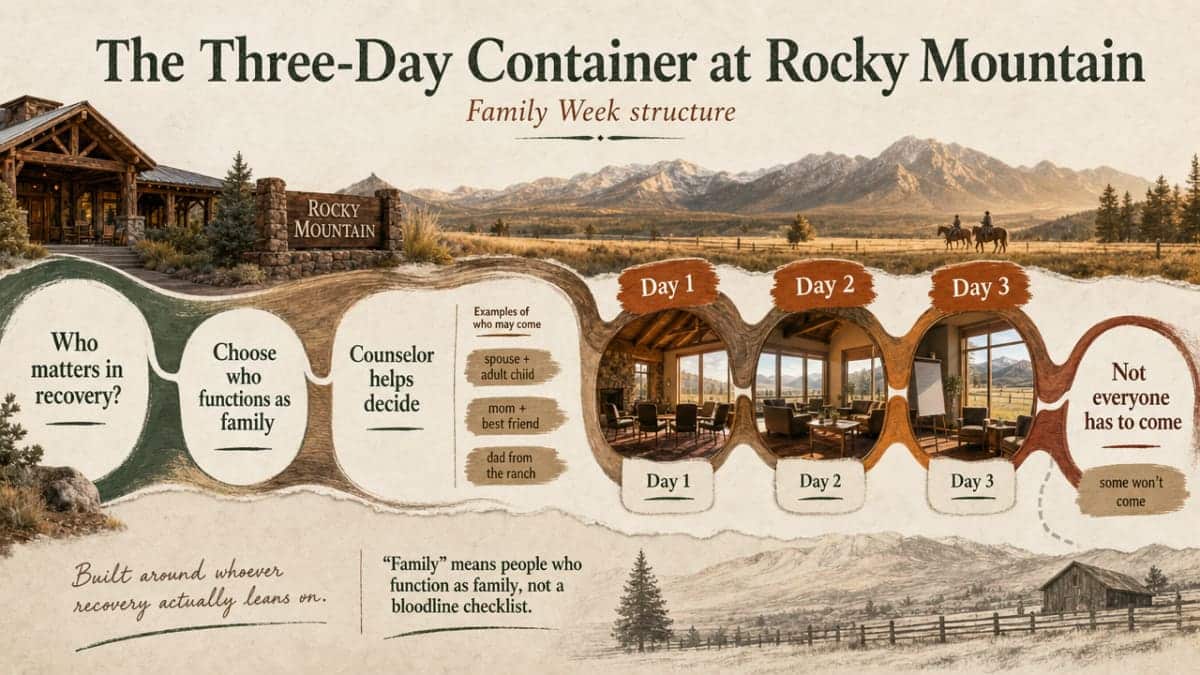
The Three-Day Container at Rocky Mountain
Who Actually Shows Up (and Who Doesn’t Have To)
There’s no rule that says everyone from the family group text has to come. Family Week is built around whoever your recovery actually leans on — the people whose phone calls you dodge, whose opinions still land, whose presence in the room would matter. Sometimes that’s a spouse and one adult child. Sometimes it’s your mom and your best friend since seventh grade. Sometimes it’s just your dad, driving in alone from a ranch two hours out.
The SAMHSA guidance behind residential family programming assumes exactly this kind of flexibility — that “family” in recovery means the people who function as family, not a bloodline checklist 1. Your counselor will help you decide who to invite based on what your relationships actually look like, not what a form says.
Some people won’t come. A brother who’s still drinking. A parent who thinks addiction is a character flaw. An ex-partner where the wound is too fresh. That’s okay. You’re not failing Family Week if the guest list is short. One person who shows up and listens for three days can shift the whole shape of your recovery. If someone you love is on the fence, admissions can talk through how to invite them without making it a demand.
The Drive Into Great Falls: What the First Morning Feels Like
The drive in is quieter than most families expect. Whether they’re coming from Bozeman, Billings, Spokane, or a small town off Highway 87, there’s a stretch where the conversation runs out and it’s just road and mountains and whatever’s been left unsaid for years. If travel is a barrier, RMTC offers complimentary Montana pickup — one less thing to negotiate on a morning that already feels like a lot.
Pulling into the 26-bed facility, families usually expect something more clinical than what they find. It’s smaller. Warmer. There’s coffee. Someone at the front desk knows their name because your counselor put it there yesterday. The first hour isn’t a session — it’s a walk-through, a handshake, a look at where you’ve been sleeping, eating, and doing the hard work for the last few weeks.
Then everyone sits down. And yes, that first sit-down feels heavy. Your family may not have seen you sober in a long time. You may not have seen them without a drink in your hand in longer. That awkwardness is part of the program, not a sign it’s going wrong. The counselor in the room has almost certainly lived some version of this morning — more than 80% of RMTC’s staff are in recovery themselves — and they know how to hold the quiet until the talking starts.
Day One: Learning What Addiction Actually Did to Your Brain
Day one is mostly education, and that’s on purpose. Before anyone talks about what happened last Thanksgiving, or the car in the ditch, or the missed graduation, your family needs a shared language. Right now they’re working from whatever they’ve pieced together from movies, from Al-Anon meetings they may or may not have attended, from a cousin who “got sober one time.” That’s a rough foundation to build hard conversations on.
So the first day feels more like a classroom than a therapy room. A counselor walks your family through what addiction actually is — not a willpower problem, not a moral failure, but a condition that hijacks the reward circuits in the brain and rewires the way a person makes decisions about the very thing hurting them. If you’re the one in treatment, you’ve probably already heard some version of this in group. Day one is the day your family catches up.
This isn’t filler. Including family members in structured education about addiction has been shown to improve treatment outcomes, reduce returns to use, and lift the whole family’s functioning 4. When your mother finally understands why you kept drinking after the doctor’s warning, something loosens in her. When your husband learns that cravings are a physical event and not a signal you love the bottle more than him, he can stop taking it personally. That shift is the whole point of day one.
Expect some quiet moments too. Some family members cry during the education piece — not because anything dramatic was said, but because a decade of confusion just got a name. Others get angry. A few sit very still and don’t say much until the drive back to the hotel. All of it is normal. Your counselor at RMTC has seen every version of this room, and more than 80% of the staff have lived some version of it themselves. Nobody’s grading your family on how they react.
By the end of day one, your family isn’t fixed. Nothing about addiction gets fixed in eight hours. But they leave the building knowing what they’re actually dealing with, which means day two — the harder day, the one where you’re in the room together — starts from solid ground instead of guesswork. If you’re weighing whether to invite them, this is the piece to picture first: not a confrontation, just a room where somebody finally explains the thing that’s been eating your family alive.
Day Two: Sitting in the Same Room With Your Counselor
Day two is the day people are most nervous about, and honestly, they should be. This is the one where you and your family sit down together with your RMTC counselor in the room. Not to relitigate every argument. Not to assign blame. Just to finally have the conversations that have been circling the house for years, with someone in the room whose job is to keep everyone safe while they happen.
Your counselor spent day one getting your family grounded in what addiction actually is. On day two, they use that shared language to walk your family through what your specific recovery is going to require — and to hear, from the people who love you, what living with the drinking has actually been like. This is the piece SAMHSA guidance calls collaborative goal setting: everyone in the room gets a voice in what the plan looks like, so nobody drives home carrying a plan they didn’t help make 1.
Some of what gets said is hard. Your wife might name the night she found the empty bottles in the garage. Your son might say he stopped inviting friends over three years ago. You might hear your own mother apologize for something she thinks she should have caught sooner. Bring tissues. Bring water. Bring your patience with people who love you and are finally allowed to say the quiet part out loud.
The counselor’s job in that room isn’t to referee. It’s to help your family practice a different way of talking to each other — clearer, less loaded, more honest — so the conversations don’t have to be this hard every time 4. You’ll practice listening without defending. Your family will practice naming what they feel without turning it into an accusation. It’s clumsy at first. That’s expected.
By late afternoon, most families are quieter than they were that morning, but in a different way. Less tense. More tired. There’s usually a break where people wander outside, look at the mountains, and don’t say much. That’s the day doing its work. You don’t leave day two with everything resolved. You leave with the sense that the next conversation — the one that happens at your kitchen table three months from now — has a shot at going somewhere useful. That’s the whole point of putting everyone in the same room with a counselor who’s likely walked a version of this road themselves.
Day Three: Building the Plan Everyone Drives Home With
Day three is the shortest day, and it’s the one most families remember longest. By now the shock of day one has worn off. The hard conversations of day two are already twelve hours behind you. What’s left is the practical question: what does Tuesday morning look like when your family is back home and you’re still here in Great Falls finishing your stay?
That’s what day three is for. Your counselor walks everyone through a written plan — not a form letter, a plan your family helped shape. Who calls whom on hard nights. What happens if you relapse instead of pretending it can’t. Which conversations stay between you and your counselor, and which ones your spouse gets to be part of. The SAMHSA guidance behind this kind of work is clear that families do better when they leave with concrete goals they helped build, not instructions handed down to them 3.
You’ll also talk about what your family’s own recovery looks like. Because they need one. Al-Anon meetings back home. A therapist for your teenager. Permission for your mom to stop calling every night at nine to check if you’re alive. Family Week isn’t only about your recovery — it’s about the fact that everyone in that room has been living inside the same disease, and everyone gets to put something down.
The last piece is the hand-off to what comes next. Your family learns how RMTC’s continuing care actually works — the weekly Zoom groups, the follow-up calls at 30, 60, 90, 180, and 365 days after you leave. This matters because family therapy has been shown to lower relapse risk and support long-term recovery precisely when it doesn’t stop at discharge 2. Your family isn’t being handed a diploma and shown the door. They’re being folded into a support system that keeps going after they drive back to Missoula or Sheridan or wherever home is.
Goodbyes on day three are usually quieter than hellos on day one. Some hugs. Some tears. A lot of “I’ll see you in two weeks.” You go back to your room. They start the drive home. Nothing is fixed. But for the first time in a long time, everybody in the car is working from the same map.
Why Three Days on Site Instead of Twelve Weeks on Zoom
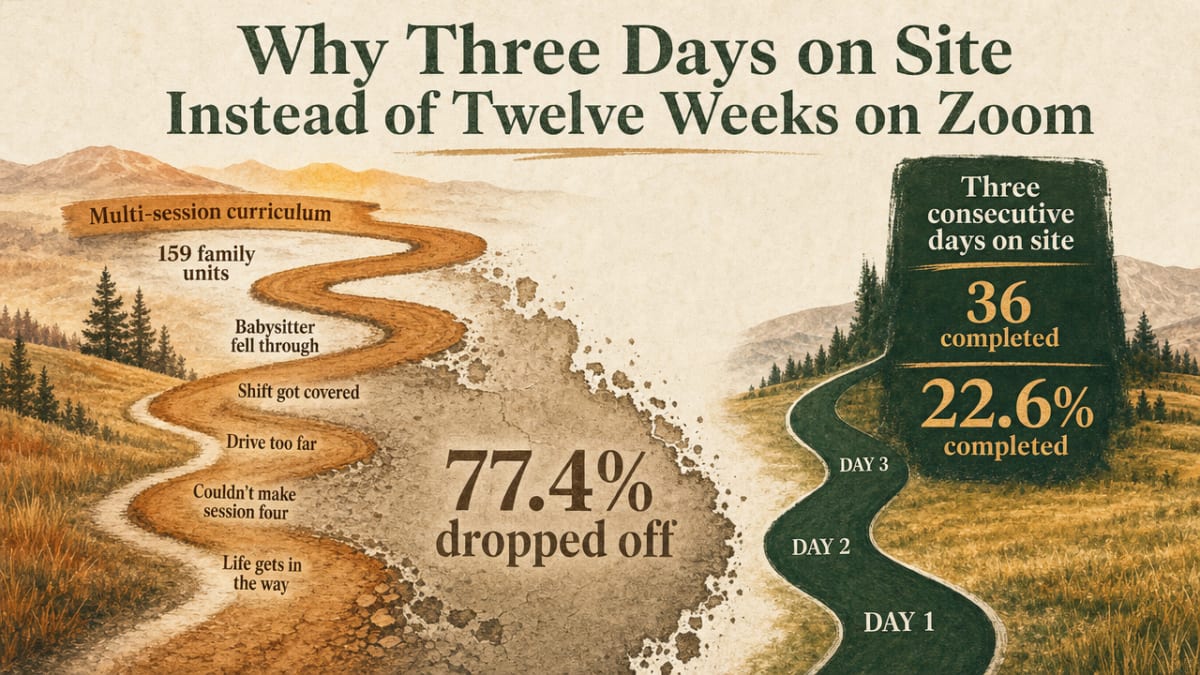
You might be wondering why RMTC packs Family Week into three intense days in Great Falls instead of spreading it across a couple of months of weekly video calls. The honest answer is that the longer version keeps failing families — not because the material is wrong, but because life gets in the way.
Look at what happens when a hospital tries the stretched-out format. A 2023 study of a family psychoeducation program for inpatients tracked 159 family units through a multi-session curriculum. Only 36 of them — about 22.6% — actually completed the program. The other 77.4% dropped off somewhere in the middle 10. Not because they stopped caring. Because the babysitter fell through, the shift got covered, the drive was too far on a Tuesday night, the sister who was supposed to come couldn’t make session four.
Three consecutive days on site is designed around that reality. Your family takes time off once. They drive to Great Falls once. They sit through the education, the shared sessions, and the aftercare planning in one continuous block, while the emotional momentum is still moving. Nobody has to remember what was said in session two when session three lands eleven days later.
It also matches how families actually decide to show up. A mother from Kalispell can burn three vacation days in a row. She has a harder time carving out Thursday nights from 6 to 8 for the next twelve weeks. SAMHSA’s own guidance on family involvement flags scheduling and distance as the biggest reasons families don’t finish 3. The 3-day container isn’t a shortcut. It’s a design choice built to actually get finished.
The Awkward Parts Nobody Warns You About
Every brochure about family programming skips over the parts that actually rattle people, so here they are. The first hour is stiff. Your mom might not know whether to hug you or shake your hand. Your husband might sit two chairs away instead of next to you. There will be a stretch where nobody knows where to look, and the counselor lets it stay quiet on purpose. That silence isn’t a mistake. It’s the room settling.
Someone will probably cry at a moment that surprises everyone, including them. Sometimes it’s not you. Sometimes it’s the brother who swore he was fine. Grown men who haven’t cried since a funeral will lose it during the education piece on day one, when a counselor explains what cravings actually feel like in the body. Let them. Nobody in that room is keeping score.
Old resentments come up sideways. A comment about a birthday party in 2019. A jab about money. The counselor will slow it down and ask what’s underneath, and what’s underneath is almost never what got said. This is the piece SAMHSA guidance calls examining the patterns of family interaction — the loops your family has been running for years without noticing 1.
And you might feel exposed in a way you didn’t sign up for. Your family is meeting the version of you that goes to group, that talks about feelings, that uses words like trigger. That’s disorienting for everyone. It passes. Awkward is not the same as wrong. Awkward is what growth sounds like before it has better words.
What Happens After the Family Drives Home
The truck pulls out of the parking lot on Sunday afternoon, and suddenly it’s just you and your room again. Your family is somewhere on I-15 heading south, or on 200 heading west, replaying the last three days in their heads. This is the moment the work usually falls apart at other places. Not here.
Before your family left the building, they got the phone numbers, the Zoom links, and the schedule for RMTC’s continuing care. That’s the weekly online group they can join from a kitchen table in Kalispell. That’s the follow-up calls that hit at 30, 60, 90, 180, and 365 days after you finish your stay — not just for you, for them too. The reason this piece matters isn’t sentimental. Family therapy has been shown to lower relapse risk and support long-term recovery specifically when it keeps going after residential treatment ends 2. Three days on site starts something. The check-ins are what keep it alive.
In the first week, your family will probably feel a strange mix of tired and lighter. Your husband might sleep through the night for the first time in months. Your mom might catch herself not checking her phone every twenty minutes. That’s real. That’s also fragile. Small things will test it — a bad day at work, a memory that ambushes them at a stoplight, an anniversary you all used to drink through.
How to Get Your Family on the Next Family Week
If you’ve read this far, you already know whether you want your family in that room. The next step is smaller than it feels. One phone call to RMTC admissions gets the conversation started — what dates work with your stay, who you want to invite, whether they need pickup from a Montana airport or a ride from a small town off the highway, and how to prep a nervous parent or spouse for what day one actually looks like.
You don’t need every answer before you call. You don’t need a finalized guest list, or a plan for what to say to your sister who isn’t talking to you, or a solved version of the marriage. Admissions has walked hundreds of families through this exact hesitation. They’ll help you sort out who to invite, how to invite them, and what to do if someone says no.
Pick up the phone. Ask how your family can join the next Family Week. That’s the whole next move.
Frequently Asked Questions
Who can I invite to Family Week at Rocky Mountain?
Anyone your recovery actually leans on. That usually means a spouse, a parent, an adult child, or a close friend who functions like family. You don’t need a bloodline match. Your counselor will help you sort out who to invite based on your relationships and safety, which is the same approach SAMHSA guidance recommends for family counseling 1. Call admissions if you’re unsure.
What if my family member refuses to come or isn’t ready?
That happens more than you’d think, and it’s not the end of the road. There’s a body of research on training willing family members to help engage a reluctant loved one over time, and it works 14. If a parent or spouse won’t come to Family Week, admissions can talk through options — inviting someone else, sending them educational material, or revisiting the invitation later in your stay.
Do children attend Family Week?
Usually not young children. The conversations on day two aren’t a good fit for a seven-year-old, and the format is built around adults. Adult children — a grown daughter or son — often attend and get a lot out of it. If you have a teenager and you’re not sure, ask admissions. They’ll help you decide based on the teen’s age and what your family is working through.
Where does my family stay during the three days in Great Falls?
Family Week happens on site at RMTC during the day, but your family sleeps at a hotel nearby. Great Falls has several options within a short drive of the facility, and admissions can point you toward ones other families have used and liked. If travel is the sticking point, ask about complimentary Montana pickup — RMTC handles rides from regional airports and towns so nobody has to solve logistics alone.
What happens if we still have unresolved conflict when Family Week ends?
You almost certainly will, and that’s built into the plan. Three days doesn’t undo years of hard living. What Family Week gives you is a starting point and a hand-off — your family leaves with access to the weekly Zoom groups and the 30, 60, 90, 180, and 365-day check-ins that come after your stay. Family therapy keeps working best when it doesn’t stop at discharge 2. The conversation continues.
How do I sign my family up for the next Family Week?
One call to RMTC admissions gets it started. You’ll talk through your stay dates, who you’re thinking of inviting, whether anyone needs pickup, and how to prep a nervous family member for what day one looks like. You don’t need a finished guest list or a solved plan before you call. Ask how your family can join the next Family Week, and admissions will walk you through the rest.
References
- The Importance of Family Therapy in Substance Use Disorder Treatment (Advisory based on TIP 39). https://library.samhsa.gov/product/advisory-importance-family-therapy-substance-use-disorder-based-tip-39/pep20-02-02-016
- Family Therapy Can Help. https://library.samhsa.gov/sites/default/files/sma13-4784.pdf
- Executive Summary (Substance Use Disorder Treatment and Family Therapy). https://www.ncbi.nlm.nih.gov/books/NBK571078/
- Chapter 3—Family Counseling Approaches. https://www.ncbi.nlm.nih.gov/books/NBK571088/
- Chapter 1—Substance Use Disorder Treatment. https://www.ncbi.nlm.nih.gov/books/NBK571084/
- Substance Use Disorder Treatment and Family Therapy (Box on Family Involvement). https://www.ncbi.nlm.nih.gov/books/NBK571084/box/ch1.b4/
- Engaging Family and Others in Recovery | Research Corner. https://www.iris.ssw.umaryland.edu/rc-family-recovery
- Family Involvement in Treatment and Recovery for Substance Use Disorders. https://pmc.ncbi.nlm.nih.gov/articles/PMC8380649/
- Family-focused practices in addictions: a scoping review protocol. https://pmc.ncbi.nlm.nih.gov/articles/PMC5781095/
- Engagement and response to a psychoeducation program for family members of inpatients undergoing treatment for substance use disorder. https://pubmed.ncbi.nlm.nih.gov/37003276/
- Family-based treatment for adolescent substance abuse. https://pmc.ncbi.nlm.nih.gov/articles/PMC2989619/
- Chapter 8—Brief Family Therapy (Substance Abuse Treatment for Persons With Co‑Occurring Disorders). https://www.ncbi.nlm.nih.gov/books/NBK64953/
- Efficacy of Family-based Interventions in Addressing Substance Use. https://pmc.ncbi.nlm.nih.gov/articles/PMC13068785/
- Community Reinforcement and Family Training (CRAFT): An Effectiveness Study. https://pubmed.ncbi.nlm.nih.gov/20840207/