Key Takeaways
- The barrier to treatment for ranchers is rarely willingness — it’s the calendar, since operations can’t spare anyone during calving, haying, or harvest.
- Mid-November through early February opens a real window where 30, 60, or 90-day residential stays at Rocky Mountain Treatment Center in Great Falls can fit between shipping and the first calves.
- A stay only holds together if one person — not a committee — runs point with a written feed route, limited power of attorney, autopay on bills, and equipment repairs handled before departure.
- Stigma in small towns is real and weighs heaviest where privacy is thin 10, so decide ahead of time what you’ll say at the coffee shop rather than sorting it out after you’re back.
November Through February: The Window You Already Have
You already know when the place runs quietest. It’s after the calves are shipped, after the last cutting is stacked, after the combine is parked and the header is off. The stock tanks still need checking. The cows still need feed. But the fourteen-hour days are done, and the phone stops ringing about custom work.
That’s the window. And if you’re reading this at the kitchen table, or in the pickup at the end of the driveway with the dome light on, you probably already know why you’re looking. The drinking has crossed a line you meant to hold.
Here’s the part nobody says out loud: the barrier isn’t willingness. It’s the calendar. You can’t leave during calving. You can’t leave during haying. You can’t leave two weeks before harvest. Federal lawmakers have named the same thing — that ranchers face financial, geographic, and cultural barriers that keep treatment out of reach even when a person wants it 3. You’re not making it up. It’s a real problem, and it has a real shape.
The shape of it is this: most cow-calf and small-grain operations have roughly 90 to 120 days between winter feeding settling into routine and the first calves hitting the ground. That’s enough room for a 30-day stay. Enough for 60. In a good year, with the right help lined up, enough for 90.
This piece is going to walk you through how residential treatment at Rocky Mountain Treatment Center in Great Falls can fit inside that window — the admission timing, what to line up before you leave, who picks you up, and what happens when you come home in time to pull the first calf.
Why the Calendar Is the Real Barrier
Most articles about rural addiction treatment lead with how many people are drinking too much. That’s not the useful number for you. The useful number is how many days you can be off the place without something breaking.
Here’s what the research says about ranchers and farmers who try to get residential care: the obstacles are structural. Rural residents face substantially reduced access to specialty treatment compared with people in town, driven by transportation, distance, limited provider availability, and time away from work 15. A systematic review of rural populations found the same cluster showing up over and over — transportation difficulties, financial constraints, and a shortage of available services 7. Qualitative work with rural clients names four themes: availability of services, technology, cost, and stigma 2.
None of that is news to you. You already live it. The point of putting it on paper is to say plainly: when treatment doesn’t happen, it’s usually not because someone didn’t want help. It’s because the window didn’t line up with the work.
Rocky Mountain Treatment Center runs 30, 60, and 90-day residential programs in Great Falls. That range exists on purpose. It gives you room to match the length of the stay to the actual slack in your year — not to a brochure. A 30-day stay in the dead middle of winter feeding looks very different from a 90-day stay that starts after shipping and ends before the first heifer calves.
The rest of this piece works that math. It treats the ag calendar as the real constraint and walks through how a residential stay can fit inside it — what to line up, who drives, what the days look like, and how family stays in the loop while you’re gone. The barriers named in the research are real. They also have specific answers when someone at the treatment center is willing to plan around your operation instead of around their intake calendar.
Mapping 30, 60, and 90 Days to the Ag Calendar
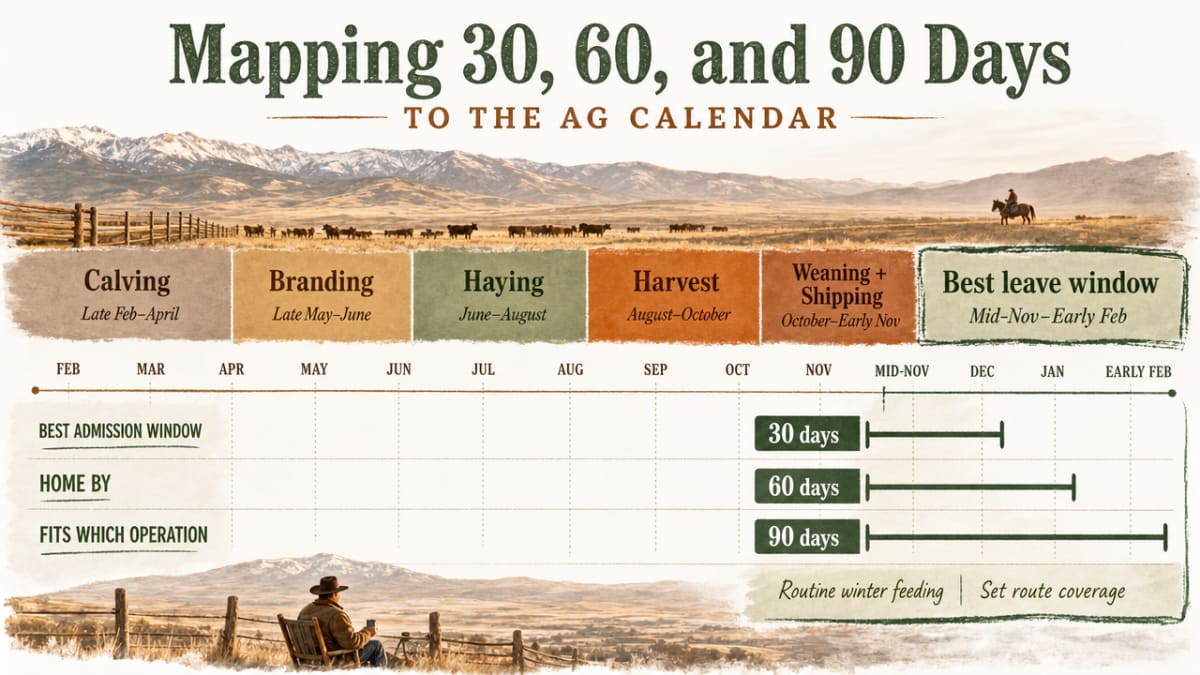
Pull a blank calendar. Mark the weeks you cannot leave under any circumstance. For most cow-calf outfits in this part of the country, that’s late February through April for calving, late May into June for branding, June through August for haying, August through October for harvest if you run any grain, and October into early November for weaning and shipping. Then look at what’s left.
What’s left, for most operations, is a stretch that runs roughly from mid-November through early February. Winter feeding is real work, but it’s routine work. A hired hand, a neighbor, or a family member can run a feed truck on a set route. Nobody has to pull a calf at 2 a.m. yet. That’s your window.
Here’s how the three program lengths at Rocky Mountain Treatment Center map onto that window:
| Program length | Best admission window | Home by | Fits which operation |
|---|---|---|---|
| 30 days | Early to mid-January | Mid-February | Cow-calf outfits with early March calving; grain operations in deep winter slack |
| 60 days | Mid-November to early December | Mid-January to early February | Later-calving herds (April onward); operations with reliable winter feed help |
| 90 days | Early to mid-November, right after shipping | Early to mid-February | Yearling operations; grain-only operations; anyone whose spring work starts in March at the earliest |
None of these lines are rigid. If your first heifers hit the ground the last week of February, a 30-day stay starting January 10 gets you home with a week and a half to spare. If you run a straight yearling operation and don’t turn out until May, a 90-day stay that starts the day after the last load of calves leaves the yard puts you back in the pickup by mid-February with time to work on equipment.
The federal legislation that names financial, geographic, and cultural barriers for farmers and ranchers assumes what most rural people already know: a residential stay has to be planned around the work, or it won’t happen at all 3. That’s not a limitation to apologize for. It’s the starting point.
A few things to think through when you’re picking a window:
- Your calving date, not the calendar’s. Some outfits calve in February. Some go May-June on purpose. Pick the window that ends at least two weeks before your first calf is due, not before some generic calving “season.”
- Weather buffer. A February blizzard can close I-15. Build in a few days on either end of your stay so a storm doesn’t turn a 30-day plan into a 34-day plan you didn’t sign up for.
- Who is actually available. A 60-day stay only works if the person feeding cows can commit to 60 days, not 45. Have that conversation before you call the treatment center, not after.
- Equipment and repair timing. If the swather needs a new sickle guard and the parts are three weeks out, order the parts before you leave. Coming home to a broken machine is worse than leaving with one that’s already fixed.
- Grain operations. If you run wheat or barley and your grain is already in the bin by November, you have a longer window than most cow-calf people. Use it.
The point of the 30/60/90 range isn’t that longer is always better. It’s that the length should match the slack you actually have, not the slack a brochure assumes you have. When you call the intake line at Rocky Mountain, this is the conversation to have first — before insurance, before paperwork. What does your year look like, and what length fits inside it.
What to Line Up Before You Leave
Once you know your window, the work moves to the list. A residential stay only holds together if the place holds together while you’re gone. That’s not a small thing to admit, but it’s also not a reason to stall. Most of what needs doing is stuff you’d handle anyway if you had to go to Billings for surgery or spend three weeks at your daughter’s wedding out of state. Put it on paper. Cross it off.
Here’s the short list worth working through before you call intake:
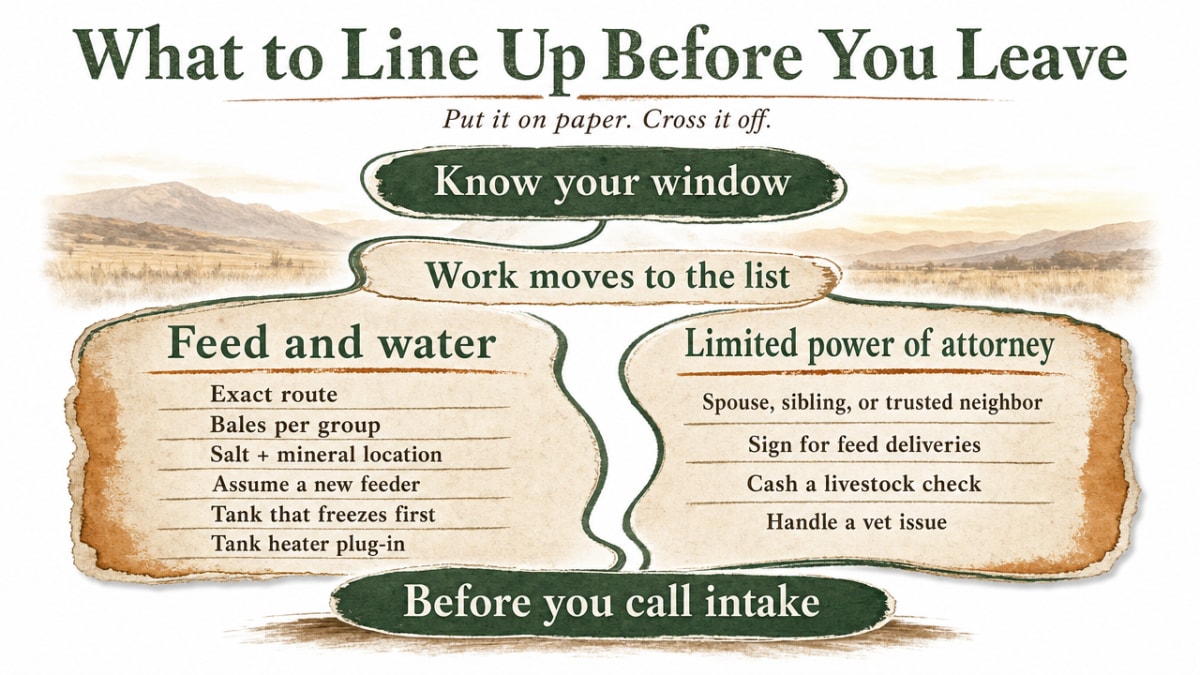
- Feed and water. Write down the exact route, the number of bales per group, and where the salt and mineral sit. Assume the person feeding has never done it your way. Note which tank freezes first and where the tank heater is plugged in.
- Power of attorney. A limited power of attorney lets your spouse, a sibling, or a trusted neighbor sign for feed deliveries, cash a livestock check, or handle a vet bill. Your local attorney can draw one up in an afternoon.
- The vet, the brand inspector, and the feed store. Call each one. Tell them who to talk to while you’re out. You don’t have to say why. “I’ll be out of state for a few weeks” is a full sentence.
- Cash flow. Line up bill pay for the phone, the electric co-op, the insurance premium, and the loan payment. Autopay if you can. A written check left with someone you trust if you can’t.
- Equipment. Fix what’s broken now. Order the parts three weeks out now. Change the oil in the feed truck now. Assume nothing gets touched while you’re gone except what has to run daily.
- The dog, the barn cats, the horses. Someone needs to know the feeding schedule and where the vet records live.
- Your phone. Set an out-of-office on email if you use it. A short voicemail greeting: “I’m away until [date]. For anything urgent, call [name] at [number].” That’s it.
The federal read on rancher care puts financial, geographic, and cultural barriers in the same sentence 3. The list above is how you shrink two of the three before you ever leave the driveway. The third one — the cultural piece, what people say and think — has its own section further down. For now, the goal is a place that runs on autopilot for 30, 60, or 90 days, so you can put the work of getting sober where it needs to be, which is on you.
Getting There: Great Falls, the Pickup Truck, and the Drive
Great Falls sits along I-15, about three and a half hours north of Bozeman, two hours east of Missoula, and a straight shot down US-87 from the Hi-Line. If you’re coming from eastern Montana, the Dakotas, northern Wyoming, or the Idaho panhandle, it’s a drive you’ve probably made for a bull sale or a parts run.
You don’t have to make it alone. Rocky Mountain Treatment Center offers a complimentary Montana pickup. That means somebody from the center drives out and gets you. You give them an address — the ranch, a truck stop off the interstate, a motel parking lot in Havre or Miles City — and they come to you. No airport shuffle. No borrowing your brother-in-law’s day to run you across the state.
That matters more than it sounds. Research on rural care keeps landing on the same handful of obstacles: transportation, distance, and time away from work 7. Taking the drive off your plate handles one of them outright, and it keeps the pickup at home where your spouse or hired hand can use it to feed cows.
Pack light. A duffel with warm clothes, boots you don’t mind getting dirty around the horses, a jacket that handles Montana wind, and whatever medications you take. Leave the phone charger where you can find it. When you call intake, ask what the pickup timing looks like for your part of the country — some drives happen the same day, some the next morning. Either way, you’re not driving yourself in.
Horses on the Property: What Equine Therapy Actually Is and Isn’t
You’ll see horses when you get to Rocky Mountain. That’s not a marketing detail. It’s part of the program, and it’s worth explaining honestly — what it is, what it isn’t, and why it might matter for someone who has been around stock their whole life.
Equine therapy at the center means guided time with horses as part of your treatment week, alongside individual counseling, group work, and 12-step meetings. Sometimes that’s groundwork — leading, brushing, handling. Sometimes it’s noticing what a horse does when you walk up carrying something you haven’t said out loud. A counselor is there. It’s not a trail ride, and it’s not a lesson.
Here’s the honest picture on evidence. One prospective study of young adults in a residential program found that participants who did horse-assisted therapy completed treatment at 56.9% compared to 14% for those getting usual care alone, and they stayed in treatment an average of 141 days versus 70 12. That’s a real difference. It’s also one program, a small sample, and young adults — not middle-aged ranchers. A later randomized study of complementary horse-assisted therapy did not find a statistically significant effect on completion, though the numbers still trended in the same direction 14. A systematic review of equine-assisted services for substance use disorders reached a careful conclusion: promising, but not yet proven 11.
What that means for you: nobody should promise you the horses will get you sober. They won’t. The counseling, the group work, the 12-step foundation, and your own decision to stay through the program — that’s what does the work. But a study of youth in a residential program described equine sessions as more than a welcome break; participants pointed to the patient–horse relationship itself as part of what kept them engaged 13. Another residential study measured meaningful gains in emotional safety after equine-integrated care 1.
If you’ve spent your life around livestock, that might land differently than it would for someone who has never touched a horse. A barn smells like a barn. A halter feels like a halter. Sitting in a group room talking about feelings is unfamiliar territory for most people who make their living outside. Time on the ground with a horse is not. It doesn’t lower your guard because it’s clever. It lowers your guard because it’s familiar.
That’s what the equine piece is at Rocky Mountain. Not a gimmick, not the reason to come, not a cure. A familiar surface in an unfamiliar setting, next to the counseling that actually moves things.
The Coffee Shop, the Sale Barn, and Who Notices the Pickup Is Gone
Small towns keep track. You know this. If your rig isn’t parked at the elevator on a Tuesday morning, somebody notices. If you miss two weeks at the sale barn, somebody asks. That’s not paranoia — it’s just how a place with one grocery store and one coffee pot works.
The USDA has said the quiet part out loud: stigma is one of the biggest reasons rural people don’t get help, and its weight is heavier where relationships are close and privacy is thin 10. Qualitative work with rural clients puts stigma right alongside cost, distance, and availability as a core reason people stay home 2. That’s real. It’s also worth deciding what you’re going to do about it before you leave, not after.
Here’s the thing nobody tells you: you don’t owe anybody an explanation. “I was out of state for a while dealing with some health stuff” is a complete sentence. So is “Family thing. Everything’s fine now.” The people who need to know — your spouse, the person feeding cows, maybe a brother or sister — already know. Everyone else is running on curiosity, not on need.
Some ranchers decide, later on, that they want to be open about it. Some don’t. Both are honest ways to live. The choice isn’t part of the intake paperwork at Rocky Mountain. Nobody in Great Falls is going to post your name in the county paper. You come, you do the work, you go home. What you say about it at the coffee shop is yours to figure out on your own time.
Family Week and What Comes After Discharge
Ranching is a family operation, even when it doesn’t feel like one. Your spouse has been carrying more than her share. Maybe a grown son or daughter has been watching longer than you knew. When you go to Great Falls, they need a place in the process too — not as an afterthought, but as part of what makes the sober version of you stick when you get home.
Rocky Mountain runs a three-day Family Week during your stay. Your people come to the center. They sit in on sessions, ask hard questions, and hear from counselors about what the last few years have actually done to the house. It’s not a lecture and it’s not a courtroom. It’s a chance to say things out loud that have been sitting in the kitchen unsaid for a long time. If driving to Great Falls is a hardship, the center will work with you on timing.
What comes after discharge matters as much as the stay itself. The center follows up at 30, 60, 90, 180, and 365 days, and runs weekly Zoom groups you can join from a laptop at the kitchen table after chores. That’s the piece that fits ranch life — no extra drives to town, no missed feeding. Rural clients sometimes have lower completion and follow-through rates than urban ones, and program fit is part of why 8. Staying connected on your own porch is fit.
Call and Talk Timing
If any of this landed, the next step is a phone call — not a form, not an intake questionnaire. Call Rocky Mountain Treatment Center in Great Falls and tell whoever picks up when your calves are due, when your combine rolls, and what your winter feeding looks like. That’s the conversation. Length of stay, pickup logistics, insurance, Family Week timing — all of it gets built around your year, not the other way around.
You’ve already done the hardest part, which is reading this far. The next part is a phone call from the pickup or the kitchen. That’s it.
Frequently Asked Questions
When is the best time of year for a rancher to go to residential treatment?
For most cow-calf and small-grain operations, the window that actually works runs from mid-November through early February — after shipping and before the first heifers calve. Winter feeding is routine enough that a spouse, hired hand, or neighbor can hold the line. A 30-day stay in January, a 60-day stay starting in late November, or a 90-day stay right after shipping all fit inside that stretch if your work is planned around it, not against it.
Can I really be gone for 30, 60, or 90 days without the operation falling apart?
You can if one person runs point. Not a committee — one neighbor, sibling, or hired hand with a key, a phone number, and a written feed route. Line up a limited power of attorney for checks and vet bills, put utilities on autopay, and fix or order parts for anything critical before you leave. Ranchers handle two-week absences for surgery or weddings. This is the same planning, stretched further.
How does the pickup from Great Falls work, and who drives?
Rocky Mountain Treatment Center offers complimentary Montana pickup. You give the intake line an address — the ranch, a truck stop off I-15, a motel parking lot in Havre or Miles City — and somebody from the center drives out and gets you. Your pickup stays home for feeding cows. When you call, ask about timing for your part of the country. Some drives happen same-day, some the next morning.
Is the equine therapy actually useful, or is it a gimmick for people who’ve never been around horses?
The evidence is promising but not conclusive. One systematic review called equine-assisted services helpful for retention and engagement while noting small samples and mixed results 11. Nobody at Rocky Mountain should tell you horses will get you sober — the counseling, group work, and 12-step foundation do that. But if you’ve spent your life around stock, a barn is familiar ground in an unfamiliar setting. That’s what it’s there for.
What do I tell people at the coffee shop or sale barn about where I’ve been?
Whatever you want to tell them. “I was out of state for a while dealing with some health stuff” is a complete sentence. So is “Family thing.” Rural stigma is real and it lands heavier where relationships are close and privacy is thin 10. But the people who need to know already know. Everyone else is running on curiosity. Decide what you’re comfortable saying, and let the rest sit.
What should I have lined up before I leave the place?
A written feed and water route with bale counts and tank locations. A limited power of attorney. Autopay on the electric, phone, and loan. A call to the vet, brand inspector, and feed store letting them know who’s handling things. Any equipment repairs done or parts ordered. Someone assigned to the dog, barn cats, and horses. And one person — not three — with the authority to make calls while you’re gone.
References
- Equine assisted psychotherapy and learning as an effective complementary form of substance use disorder treatment for college-age young adults in a residential treatment program. https://pmc.ncbi.nlm.nih.gov/articles/PMC9758116/
- Barriers and Facilitators to Substance Use Treatment in the Rural South: A Qualitative Study. https://pubmed.ncbi.nlm.nih.gov/26184098/
- BILLS-119s1074is: Legislation Addressing Farmer and Rancher Mental Health. https://www.govinfo.gov/content/pkg/BILLS-119s1074is/xml/BILLS-119s1074is.xml
- The Impact of Equine-Assisted Therapy on Mental Health and Emotional Regulation in Patients With Addiction. https://clinicaltrials.gov/study/NCT07495839
- Addressing Opioid Use Disorder in Rural Areas: State and Local Strategies. https://www.ncbi.nlm.nih.gov/pmc/articles/PMC7333490/
- Substance Use Disorder Treatment in Rural Areas: Access and Outcomes. https://pubmed.ncbi.nlm.nih.gov/32278741/
- Barriers to and Facilitators of Substance Use Treatment Among Rural Populations: A Systematic Review. https://pubmed.ncbi.nlm.nih.gov/32849100/
- Rural-Urban Differences in Substance Use Treatment Completion. https://pubmed.ncbi.nlm.nih.gov/31362353/
- Animal-Assisted Interventions for Mental Health: A Systematic Review. https://pubmed.ncbi.nlm.nih.gov/29490168/
- Rural Community Action Guide: Building Stronger, Healthier Rural Communities. https://www.usda.gov/sites/default/files/documents/rural-community-action-guide.pdf
- Equine-Assisted Services for Individuals with Substance Use Disorders: A Systematic Review. https://pmc.ncbi.nlm.nih.gov/articles/PMC9749232/
- Substance Use Disorder Treatment Retention and Completion: A Prospective Study of Horse-Assisted Therapy for Young Adults. https://pmc.ncbi.nlm.nih.gov/articles/PMC4672500/
- More Than Just a Break from Treatment: How Substance Use Disorder Patients Experience Horse-Assisted Therapy. https://pmc.ncbi.nlm.nih.gov/articles/PMC5054942/
- Complementary Horse-Assisted Therapy for Substance Use Disorders: A Randomized Controlled Study. https://pubmed.ncbi.nlm.nih.gov/32019584/
- Substance Use in Rural Areas: Unique Needs and Challenges. https://www.ncbi.nlm.nih.gov/pmc/articles/PMC6527141/