
Key Takeaways
- Head-to-head research shows 12-step, CBT, and motivational enhancement produce broadly comparable outcomes, with 12-step approaches holding a modest edge on continuous abstinence.1,10
- Secular options like SMART Recovery, LifeRing, and Women for Sobriety produce equivalent one-year outcomes to 12-step groups when participation levels match, so picking a non-12-step path is not settling.5
- The active ingredient across models is engagement—sponsorship, meeting attendance, reading literature, and naming abstinence as the goal—not the specific therapy hours logged.3
- Spiritual language is a real fit question, not a moral one; skeptics who stay engaged still benefit from AA, and secular alternatives exist for those the language shuts down.8
- Day 31 decides more than the residential program does, which is why continuing care and a chosen community you will keep showing up for matter more than the model’s label.11
What Actually Decides Whether Recovery Sticks
You are probably not here because you want a lecture on willpower. You want to know if the 12 step program vs. other recovery models, the language, the higher-power talk, the workbook exercises—any of it—actually changes whether you stay sober six months from now.
Here is the honest answer, pulled from decades of research on people trying exactly what you are trying: the specific model matters less than whether you stay engaged with something after treatment ends.
Project MATCH, the landmark trial comparing Twelve-Step Facilitation, cognitive behavioral therapy, and motivational enhancement, found comparable outcomes across all three. A large VA study of over 3,000 patients across 15 programs reached a similar conclusion—12-step and CBT programs were roughly equal on most measures. And when researchers followed people in SMART Recovery, LifeRing, and Women for Sobriety alongside 12-step members, the secular groups held their own.2,5,10
So the question shifts. It is not “which model wins?” It is “which one will you actually keep showing up for after day 31?” That is the variable that moves the needle—sponsorship, attendance, an abstinence goal, a phone number you will call at 9 p.m. on a hard Tuesday.3
The rest of this piece walks through what each path really looks like, so you can pick one you will not quietly abandon.
What the Research Really Shows About 12-Step vs. Everything Else
The Head-to-Head Evidence: Project MATCH, Cochrane, and the VA Multisite Study
If you have spent any time online researching this, you have probably seen strong opinions on both sides. Someone swears AA saved their life. Someone else says the God talk drove them out the door. Both people are telling the truth about their own experience. Neither one is telling you what the studies actually found.
So here is what the biggest, most careful comparisons say.
Project MATCH, funded by the National Institute on Alcohol Abuse and Alcoholism, randomly assigned people with alcohol dependence to Twelve-Step Facilitation, cognitive behavioral therapy, or motivational enhancement therapy. The headline result: outcomes were broadly comparable across all three. Where TSF pulled ahead was among people with more severe alcohol dependence and those who actually engaged with AA meetings during and after treatment.10
The Cochrane review on AA and Twelve-Step Facilitation went further. It found that manualized AA/TSF tends to outperform other established treatments on continuous abstinence and remission, matches them on other alcohol-related measures, and reduces healthcare costs along the way. That is not a small finding. Cochrane reviews are the gold standard, and this one landed on the 12-step side of the ledger.1
Then there is the VA multisite study—3,018 patients across 15 programs, followed for a year. The takeaway: 12-step, CBT, and blended programs were roughly equal on reductions in substance use and psychosocial functioning, though 12-step patients were slightly more likely to be fully abstinent.2
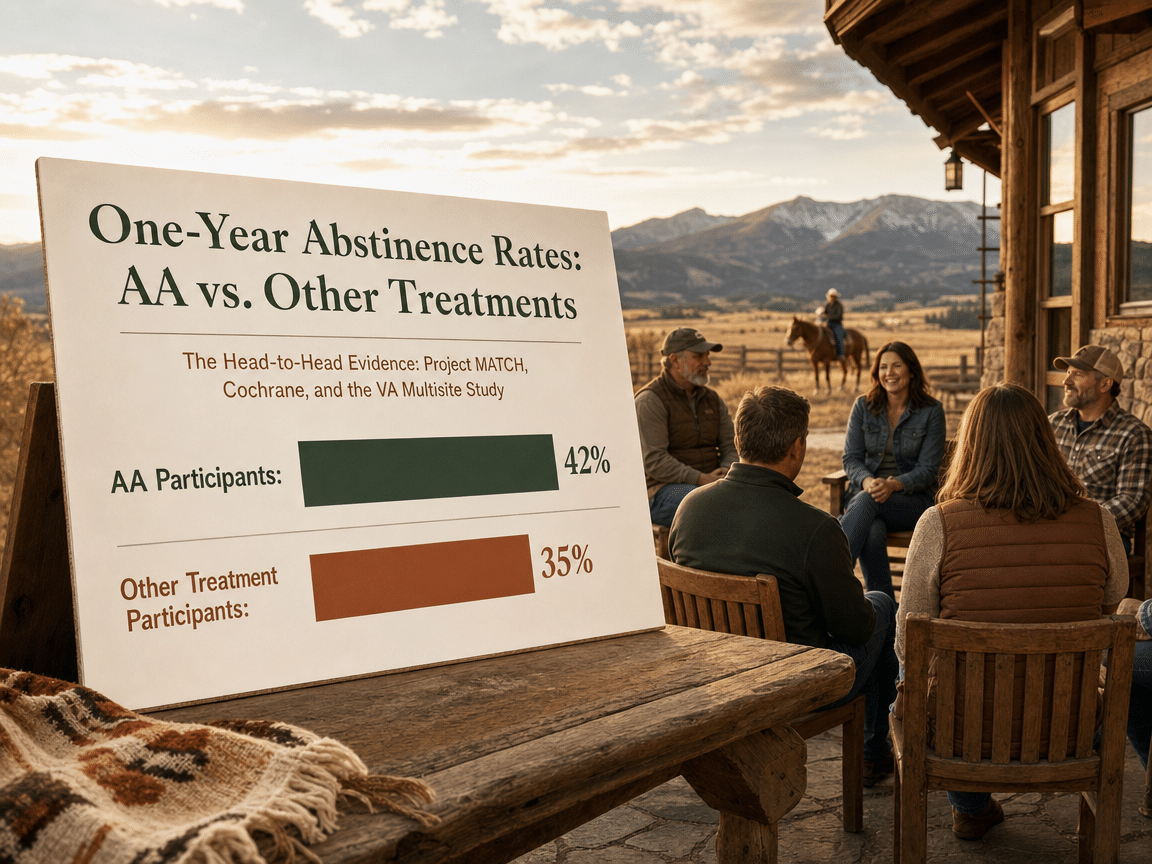
A related end-of-treatment study put a number on that edge: about 42% of AA-involved participants stayed abstinent at one year, compared with roughly 35% of those in other treatments. That is a meaningful but modest gap, drawn from people who were already in structured programs and choosing to engage. It is not a promise. It is a pattern.3
Add it all up and you get something more nuanced than the internet arguments suggest: 12-step approaches hold up well, sometimes with a slight edge, and the other evidence-based paths are not far behind.
Why 12-Step Sometimes Wins: The Mediators Matter More Than the Method
Here is the part that changes how you should read those numbers.
When researchers looked closely at why 12-step programs sometimes edge out CBT on abstinence, the answer was not the steps themselves. It was the stuff that surrounds them:3
- Having a sponsor.
- Reading the literature.
- Showing up to meetings after discharge.
- Naming abstinence as your goal rather than moderation.
Those four ingredients did most of the work.
Project MATCH found the same pattern from a different angle. TSF produced more AA participation, and that participation—not the specific therapy hours—predicted better long-term outcomes, especially for people with heavier dependence.10
Think about what that means for you. The active ingredient is engagement with a recovery community that keeps you accountable when the counselor is no longer three doors down the hall. A 12-step meeting is one durable, free, everywhere-in-America way to get that. It is not the only way.
Rocky Mountain Treatment Center’s staff—more than 80% of whom are in recovery themselves—know this from both sides of the chair. They introduce you to 12-step principles during your stay not because a checklist requires it, but because those principles come with a built-in community that is still there on day 90, day 180, day 365. If you take to it, you have a network. If you do not, you have not lost anything but a few hours.
The method matters less than the muscle memory you build around staying connected.
Non-12-Step Isn’t a Consolation Prize
If the language of AA never sat right with you, this next finding is worth reading twice.
A 12-month longitudinal study followed people with alcohol use disorder across four types of mutual-help groups: Women for Sobriety, LifeRing, SMART Recovery, and traditional 12-step. When participants were similarly engaged—showing up with comparable frequency, doing the work of the group—outcomes on abstinence and alcohol-related problems were essentially equivalent across all four.5
Read that again. Equivalent. Not “almost as good.” Not “a reasonable alternative if you cannot handle AA.” The researchers concluded that WFS, LifeRing, and SMART are as effective as 12-step groups for people with alcohol use disorder.5
That is a genuinely important finding, because it means the choice between paths is not a trade-off between what works and what feels comfortable. If SMART Recovery’s cognitive-behavioral toolkit fits your brain better, use it. If Women for Sobriety’s emphasis on emotional and spiritual growth without the Higher Power language speaks to you, go there. If LifeRing’s secular, self-directed approach lets you actually show up, that is the right room.
What the data does not support is dabbling. Sampling a meeting here and a workbook there without landing somewhere is where recovery slips. Pick a path you can commit to, and give it enough time to become a habit.
Inside the Rooms: What Each Model Actually Looks Like
A 12-Step Meeting, Honestly Described
You walk into a room. Sometimes a church basement, sometimes a community center, sometimes a folding-chair circle in the corner of a coffee shop. Someone reads a preamble. Someone else reads “How It Works.” People take turns sharing, one at a time, no cross-talk. Most meetings last an hour. Nobody makes you speak. Nobody takes attendance unless you asked them to sign a court slip.
You will hear about a Higher Power. You will hear people say they are alcoholics, out loud, in the present tense. You will hear stories that sound like yours in ways that are strange and a little bit of a relief.
The work happens between meetings, mostly. A sponsor helps you move through the twelve steps in order. You read the Big Book. You call people when things get bad. That informal scaffolding, not the ritual of any single meeting, is what the research keeps identifying as the active ingredient.3
At Rocky Mountain Treatment Center, you get introduced to this format during your stay, so the first meeting you attend after discharge does not feel like a cold plunge.
SMART Recovery, LifeRing, and Women for Sobriety
Secular meetings look and sound different from AA, and that difference matters if AA has never fit you.
A SMART Recovery meeting feels more like a workshop than a testimonial. A facilitator opens with a check-in, then the group works through cognitive tools—cost-benefit analyses, urge-surfing techniques, disputing irrational beliefs. There is a whiteboard sometimes. There is homework, if you want it. No Higher Power. No sponsor system. You are the expert on your own recovery, with the group as a sounding board.
LifeRing sits somewhere in between. Meetings are conversational and secular, organized around the simple question “How was your week?” People talk about what they did to strengthen their sober self and quiet their addicted self. No steps, no dogma, no required beliefs.
Women for Sobriety uses thirteen “Acceptance Statements” focused on emotional growth, self-worth, and taking responsibility for your own well-being. Meetings are women-only, which for many members is the whole point.
Here is what makes these worth taking seriously: when researchers followed people across all four options for a year and matched them on how actively they participated, outcomes on abstinence and alcohol-related problems came out equivalent. Women for Sobriety, LifeRing, and SMART Recovery held their own against 12-step groups when engagement levels were similar.5
That means if the SMART toolkit fits your thinking, or LifeRing’s plain-language style feels honest, or WFS’s focus on emotional growth speaks to you, you are not settling for second place. You are picking a room you will actually keep walking back into.
CBT and Motivational Enhancement as Therapy, Not Community
One thing that trips people up: CBT and motivational enhancement therapy are not mutual-help groups. They are structured, time-limited therapies delivered one-on-one or in a small clinical group by a trained counselor.
In CBT, you map the situations, thoughts, and feelings that lead to drinking. You practice specific skills—refusing a drink, managing a craving, planning around a wedding you cannot skip. It is concrete, and it ends. Most protocols run 12 to 16 sessions.
Motivational enhancement is even shorter, often four sessions. The counselor helps you sort out your own reasons for changing, without arguing you into it. It works especially well early on, when you are still ambivalent.
Both approaches held their own against Twelve-Step Facilitation in Project MATCH, producing comparable outcomes across the board. What they do not give you is the ongoing community. Twelve or sixteen sessions end. AA and SMART meetings do not.10
That is why the strongest residential programs, Rocky Mountain included, use CBT-style counseling and introduce you to a mutual-help path. The therapy gives you the skills. The meetings give you the people who will still be there in month six.
The Spiritual Language Problem
Let’s talk about the part nobody wants to bring up first.
You have probably read the Serenity Prayer at some point and felt something tighten in your chest. Higher Power. Turning your will over. Making a searching moral inventory. For some people that language is oxygen. For others it feels like being asked to speak a language they stopped believing in a long time ago—or never spoke at all.
Here is what the research actually says about that discomfort. A study looking at religiosity, spirituality, and AA participation found that increased AA involvement and spiritual practices correlated with higher abstinence rates, even after adjusting for how severe someone’s drinking was to begin with. But—and this is the part that gets left out of most write-ups—the benefit was not confined to highly religious people. Skeptics, agnostics, and outright atheists who stuck with AA still got something out of it.8
That something appears to be the social and behavioral scaffolding more than the theology. The meetings. The sponsor calls. The routine of showing up. You can translate “Higher Power” into whatever gives you honest humility—the group itself, the natural world, the version of yourself you are trying to become. AA’s own literature invites that translation.
If the language still does not land, that is real information about fit—not a moral failing. SMART Recovery and LifeRing exist for exactly this reason.
When Attendance Is Court-Ordered or Family-Pressured
Maybe you are not choosing this freely. A judge signed a piece of paper. A spouse gave you a deadline. Your job is on the line. However you got here, the meeting slip in your pocket has someone else’s expectation written on it.
That matters, and the research is straightforward about why. People mandated to attend AA go to fewer meetings and engage less deeply than people who show up on their own. Weaker involvement tends to mean weaker outcomes. Coercion is a lousy motivator for the kind of honest work recovery asks of you.9
But here is the part worth sitting with: readiness is not a switch. It is something that can grow inside a room you were dragged into. Plenty of people arrive angry at the requirement and, six months later, are calling their sponsor because they want to, not because a probation officer is checking.
If you are in this spot, two things help:
- Try more than one meeting before deciding the whole model is not for you—every room has its own personality.
- If the 12-step language keeps you shut down, ask whether SMART Recovery or another secular option satisfies your requirement. Many courts accept alternatives now.
At Rocky Mountain, counselors who have been through this themselves can help you have that conversation without it becoming a fight.
How a Residential Stay Introduces You to a Path
Detox, Counseling, and Family Work as the Foundation
Before you pick a recovery model, your body and brain need a stable place to land. That is what the first stretch of a residential stay is for.
At Rocky Mountain Treatment Center, that means medically monitored detox—someone watching your vitals, adjusting medications, keeping you comfortable through the days when withdrawal is not something you should be walking through alone. Detox is not treatment. It is what makes treatment possible.
From there, the day fills in. Individual counseling. Group sessions. The kind of conversations where someone asks you what actually happened, not what you told your family happened. More than 80% of the counselors here are in recovery themselves, which changes the tone of those conversations in ways that are hard to describe until you sit in one.
Family work runs alongside all of it. The three-day Family Week pulls in the people who love you—so they understand what they have been watching, and so you understand what your drinking has cost the people around you. Comprehensive treatment that integrates with community-based supports produces better outcomes than any single component on its own. This is the foundation. The path you pick sits on top of it.7
Experiential Additions: Where Equine Therapy Actually Fits
You have probably seen the photos. Someone in a barn coat, hand on a horse’s neck, caption talking about breakthroughs. It is a beautiful image, and it is worth being honest about what it can and cannot do.
A recent scoping review of equine-assisted services for substance use disorders looked at the quantitative research and concluded that the data are currently insufficient to confirm a beneficial effect on the recovery process itself. Early observational studies were encouraging. Newer randomized trials have not consistently reproduced those results.6
So here is how to think about it. Equine therapy at Rocky Mountain is not a cure. It is a complementary experience—time outside, working with an animal that reads your body language faster than any person can, in a setting that quiets the noise long enough for something honest to come up. For some people, that unlocks a session with their counselor that would have taken three more weeks to reach otherwise.
Recreational activities, hiking, arts, music, meditation—these fit the same slot. They are not the mechanism of recovery. They are the conditions that make the real work possible.
What Happens on Day 31: Continuing Care as the Real Test
The morning after discharge is when the recovery model you picked stops being an idea and starts being a schedule.
This is the moment the research keeps pointing to. Post-discharge meeting attendance, having a sponsor, reading the literature, keeping abstinence as your stated goal—these are the ingredients that separate people who hold their gains from people who lose them. Not the intensity of the residential program. Not the specific therapy hours logged inside. What you do in month two, month five, month eleven.3
Which is why continuing care is not an add-on at Rocky Mountain. It is the point. Weekly Zoom groups keep you tethered to the people you sat next to in group therapy. Structured follow-ups happen at 30, 60, 90, 180, and 365 days—not vague check-ins, but real conversations about how the plan is holding up and where it is leaking. If AA is your community, you have a meeting schedule before you leave. If SMART Recovery fits you better, the same is true.
Simple, non-coercive referral and follow-up strategies significantly increase mutual-help involvement and reduce drinking days. That is the boring, unglamorous machinery of staying sober. It is also what works.11
Day 31 is not the end of treatment. It is the day the training wheels come off, and it goes better when someone is still riding next to you.
How to Choose Without Overthinking It
You do not have to solve this in one sitting. You just need to pick a first door.1,5
- If you are drawn to a community that will still be there on a Saturday night in a small town, if you find something honest in hearing other people say the words out loud, if the spiritual language does not stop you cold—start with a 12-step meeting. The evidence for staying engaged is strongest here, and the network is everywhere.
- If you think in frameworks and want a whiteboard, not a testimony, try SMART Recovery first. If secular and self-directed matters to you, LifeRing. If a women-only room feels safer, Women for Sobriety. The 12-month data says you are not settling.
If you are not sure, do this: commit to one path for 90 days. Meetings, phone numbers, whatever the model asks. If it does not fit by then, switch—without calling it failure. That is information.
At Rocky Mountain, your treatment plan gets built around the path you pick, and continuing care keeps you tethered to it long after day 31.
Frequently Asked Questions
Is a 12-step program more effective than non-12-step alternatives like SMART Recovery?
Do I have to be religious or believe in God to benefit from a 12-step program?
What if I’ve tried AA before and it didn’t work for me?
Does court-ordered or family-pressured attendance actually help recovery?
Does equine therapy or other experiential treatment actually work?
What happens after residential treatment ends on day 31?
References
- Alcoholics Anonymous and 12-Step Facilitation Treatments for Alcohol Use Disorder: Efficacy and Cost-Effectiveness. https://pubmed.ncbi.nlm.nih.gov/32628263/
- Twelve-step and cognitive–behavioral treatment for substance abuse: A comparison of treatment effectiveness. https://pubmed.ncbi.nlm.nih.gov/9086686/
- End-of-treatment outcomes in cognitive-behavioral treatment and 12-step substance use treatment programs: do they differ and do they predict 1-year outcomes?. https://pubmed.ncbi.nlm.nih.gov/16814009/
- A Pilot Randomized Clinical Trial Testing Integrated Twelve-Step Facilitation (iTSF) for Adolescent Substance Use Disorder. https://pmc.ncbi.nlm.nih.gov/articles/PMC5673563/
- A Longitudinal Study of the Comparative Efficacy of Women for Sobriety, LifeRing, and SMART Recovery vs. 12-Step Groups. https://pmc.ncbi.nlm.nih.gov/articles/PMC5884451/
- Equine-assisted services for individuals with substance use disorders: A scoping review. https://pmc.ncbi.nlm.nih.gov/articles/PMC9749232/
- Principles of Drug Abuse Treatment for Criminal Justice Populations: A Research-Based Guide. https://nida.nih.gov/sites/default/files/podat_cj_guide_508.pdf
- Religiosity, spirituality, and Alcoholics Anonymous participation in recovery from alcohol dependence. https://pubmed.ncbi.nlm.nih.gov/18642747/
- The impact of mandatory vs. voluntary Alcoholics Anonymous attendance on outcomes. https://pubmed.ncbi.nlm.nih.gov/14700586/
- Project MATCH: Twelve-Step Facilitation vs. Cognitive Behavioral vs. Motivational Enhancement Therapy. https://pubmed.ncbi.nlm.nih.gov/11932134/
- Primary care-based interventions to promote Alcoholics Anonymous involvement. https://pubmed.ncbi.nlm.nih.gov/25068211/