
Key Takeaways
- Systemic family therapy treats the household as an interconnected system, addressing roles, communication patterns, and unspoken rules that inadvertently sustain substance use rather than assigning blame 2.
- Four evidence-based approaches serve different needs: BSFT and MDFT for adolescents, BCT for adult partners, and CRAFT when a loved one refuses to enter treatment 10.
- Family involvement measurably improves engagement, retention, and relapse outcomes, with one trial showing substance use increases of 52% in family-integrated care versus 81% in standard services 7.
- Joint sessions are not appropriate during ongoing violence, abuse, active psychosis, or acute withdrawal; safety screening determines whether individual work or modified formats should come first 3.
The Eggshells You’ve Been Walking On
You know the routines, the excuses, and the different versions of your loved one. You’ve tried every approach, every conversation, hoping for change. It hasn’t happened, and now you’re exploring new avenues like systemic family therapy.
Research shows that when families engage in structured treatment, loved ones are more likely to enter care, remain in treatment, and sustain their progress after leaving 3. This isn’t because you were doing something wrong, but because addiction impacts relationships, and these relationships are crucial for fostering lasting change. You are not to blame, and you are not powerless. Let’s explore what this means for you and your family at Rocky Mountain Treatment Center.
Why One Person’s Use Is Never Just One Person’s Problem
When addiction takes hold, it reshapes family dynamics. Dinners grow quiet, celebrations feel strained, and daily life revolves around the substance use. Family members often adopt specific roles: the fixer, the peacekeeper, the scapegoat, or the invisible one. These aren’t inherent personality traits but survival responses to a constantly shifting problem.
Across randomized trials involving both teenagers and adults, family-based treatment has been shown to improve substance use outcomes and family functioning more effectively than individual treatment alone 1. This highlights that the roles you’ve adopted are not permanent and can be addressed and changed. Systemic family therapy operates on the principle that the individual with substance use disorder is part of a larger network of daily interactions. This network has often organized itself around the substance. Treating the individual without addressing these family dynamics can make sustained recovery challenging. Working with the entire family system provides everyone, including you, a path toward healthier interactions.
What ‘Systemic’ Actually Means (And What It Doesn’t)
The term “systemic” might sound clinical, but it simply means that a therapist views your family as a living system with its own rhythms, rules, and unspoken agreements. Instead of focusing solely on the individual with substance use disorder, systemic therapy considers the entire family environment. The person using is not the sole problem; the environment they return to, and the one they left for treatment, are also integral to the picture.
Systemic therapy does not imply that the family caused the addiction, nor does it suggest you missed warning signs. It doesn’t involve scrutinizing your past to assign blame. Instead, a systemic therapist observes patterns: how family members react, which conversations are avoided, and which unspoken rules inadvertently maintain the substance use. This approach is recognized in clinical research as a well-established treatment for substance use, having met rigorous evidence standards in multiple controlled trials 2. It’s a proven method, not just a philosophy. The focus shifts from “How do I make them stop?” to “What changes can we all make in our interactions to support recovery?”
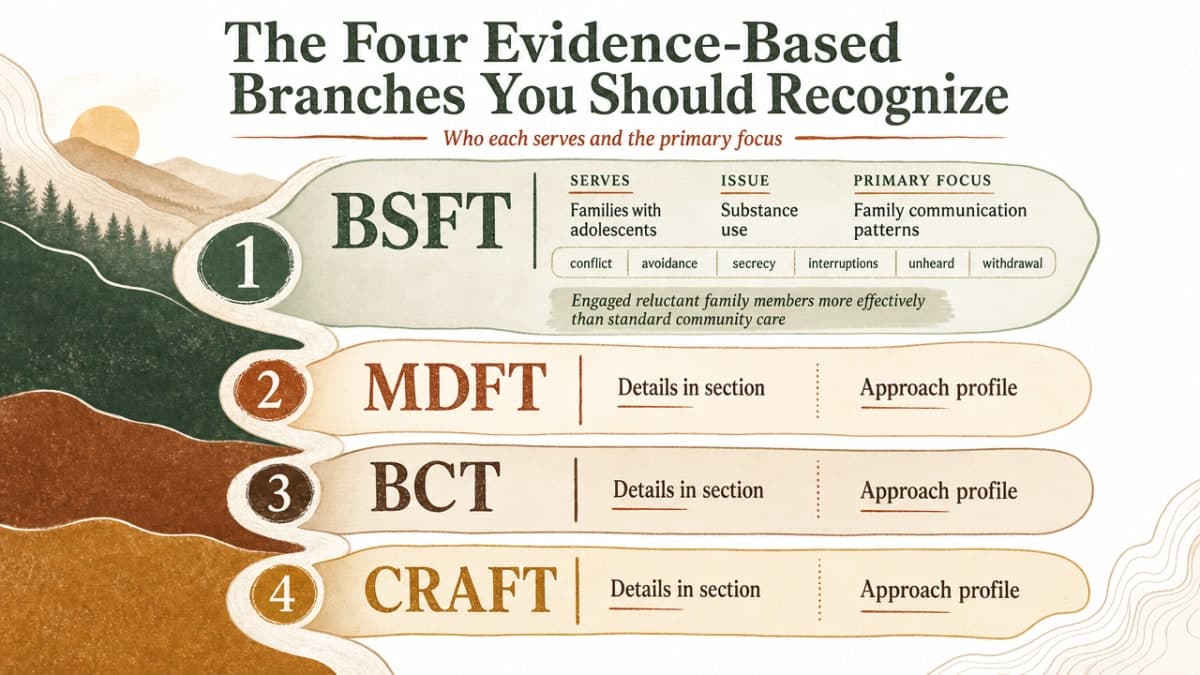
The Four Evidence-Based Branches You Should Recognize
Family therapy isn’t a one-size-fits-all solution. Different approaches are designed to address specific challenges. Understanding these distinctions can help you ask informed questions about the program your loved one is considering at Rocky Mountain Treatment Center.
BSFT: Rewriting How an Adolescent’s Family Talks
Brief Strategic Family Therapy (BSFT) is tailored for families with adolescents struggling with substance use. A BSFT therapist observes family communication patterns and works to modify those that perpetuate conflict, avoidance, or secrecy. The emphasis is less on the substance itself and more on the dynamics of interaction—who interrupts, who is unheard, and who withdraws during difficult conversations.
In a randomized trial, BSFT was more effective than standard community care at engaging reluctant family members in treatment and improving overall family functioning, as reported by parents 6. While self-reported drug use didn’t always decrease faster than with usual care, the significant improvement in household dynamics often served as a crucial entry point for further change.
MDFT: When the Whole Environment Needs Reworking
Multidimensional Family Therapy (MDFT) takes a broader approach, extending beyond the immediate family to involve schools, probation officers, extended family, and even friends. This recognizes that an adolescent’s substance use is influenced by more than just home life, requiring a comprehensive intervention.
A study comparing MDFT to residential treatment for adolescents with substance use and co-occurring mental health issues found that youth in MDFT maintained their reductions in substance use and delinquent behavior more effectively over 18 months 8. This demonstrates that intensive, well-executed family work can be as impactful as removing a child from their environment entirely.
BCT: The Partner in the Room
Behavioral Couples Therapy (BCT) is designed for adults, integrating the spouse or long-term partner directly into the treatment process. Together with a therapist, partners develop a recovery contract and practice new communication strategies to navigate challenges. This includes daily check-ins, clear expectations, and repair strategies for difficult moments.
Research on BCT for alcohol use disorders indicates higher abstinence rates and improved relationship satisfaction compared to treating the individual alone 9. Federal guidelines also note that BCT can reduce legal and family problems, as well as hospitalizations 3. While not suitable for all couples, particularly in cases of ongoing violence, BCT can be highly effective when appropriate, demonstrating that addressing marital dynamics can directly support sobriety.
CRAFT: For When Your Loved One Refuses to Go
Community Reinforcement and Family Training (CRAFT) is invaluable for families whose loved one is unwilling to seek treatment. CRAFT works directly with concerned family members, coaching them on how to modify their own responses to shift family dynamics. This involves learning when to reinforce sober behavior, when to allow natural consequences, and how to discuss treatment without escalating conflict.
In its original randomized trial, family members trained in CRAFT were significantly more successful at encouraging resistant loved ones to enter treatment compared to those receiving other family-focused approaches or Al-Anon-style support 10. This highlights that your actions can directly influence whether your loved one seeks help, rather than waiting for a “rock bottom” that may never come.
What Actually Happens Inside a Three-Day Family Week
A three-day family week at Rocky Mountain Treatment Center is a structured experience designed to facilitate healing and understanding. While the idea of intense emotional work might seem daunting, knowing the process can alleviate some apprehension.
Day one is mostly listening. The morning focuses on educating families about the impact of addiction on the brain, body, and household. This education provides clarity on past experiences. Federal guidance emphasizes that family members who understand the illness are more engaged, which correlates with better retention and outcomes for the individual in treatment 3. During this day, a counselor will also conduct a private session to assess the home environment, including any safety concerns. This screening is crucial for tailoring the rest of the week’s activities safely.
Day two is the hard middle. This is when you and your loved one engage in guided sessions with a therapist. The focus is on identifying family roles, unspoken agreements, and communication patterns. The therapist helps to gently name these dynamics, allowing for their modification. Boundaries are also addressed, framed as clear statements about what you can and cannot manage moving forward, rather than ultimatums.
Day three turns toward home. This day involves practicing real-life conversations and developing strategies for future challenges. You’ll learn how to respond to difficult nights or potential slips without derailing the recovery plan. You will leave with a comprehensive aftercare plan, including details about continuing care groups for your loved one and follow-up rhythms at 30, 60, 90, 180, and 365 days 5. Families involved in this planning report reduced stress and are more likely to sustain their support for recovery 4. While three days cannot erase years of struggle, it can significantly alter the trajectory for everyone involved.
Whether Your Participation Really Changes Anything
After investing time and emotional energy, it’s natural to wonder if your participation truly makes a difference. The answer is a resounding yes, and this impact is measurable, not just anecdotal.
A randomized trial involving adolescents receiving integrated family-based and mental health treatment (OPT-A) versus standard outpatient services tracked both groups for 18 months post-treatment. While substance use increased in both groups over time, the increase was significantly lower in the family-integrated group (52%) compared to the usual-services group (81%) 7. This demonstrates that family involvement helps to preserve early gains and slow the progression of substance use.
While this study focused on adolescents, the principle that family engagement strengthens long-term recovery echoes across the broader evidence base for adults and couples as well 3. At Rocky Mountain Treatment Center, the hours you dedicate to family sessions are not merely symbolic; they are a critical component in helping your loved one achieve lasting recovery, bridging the gap between initial treatment and sustained sobriety.
The Guilt Trap: Systemic Is Not the Same as At-Fault
It’s common for family members to feel a sense of guilt, believing that if they were “better” parents or partners, addiction wouldn’t have occurred. It’s important to understand that “systemic” does not equate to “at-fault.”
When Family Therapy Is Not the Right Call
While family therapy is highly beneficial, it’s not appropriate for every situation. There are instances where joint sessions can be counterproductive or even harmful. Rocky Mountain Treatment Center prioritizes safety and assesses each family’s unique circumstances.
Other reasons to delay or modify family therapy include active untreated psychosis, acute withdrawal, or a family member who cannot participate without becoming abusive. Waiting or pursuing alternative care is not a failure; it’s a responsible approach that ensures everyone’s well-being and preserves the possibility of future engagement when the timing is right.
What Families Can Do at Home, Starting This Week
You don’t have to wait for formal family sessions to begin making positive changes. Research highlights several shifts that can significantly impact family dynamics and support recovery, even before structured therapy begins.
- Educate yourself about the illness, not just the person. Federal guidance for families emphasizes that understanding how addiction affects the brain and behavior allows you to respond with informed clarity rather than fear 4. Even a single evening spent with reputable educational materials can make a difference.
- Stop cushioning consequences that can safely be allowed to occur. Intervening to pay fines, call employers, or replace lost items, while well-intentioned, inadvertently teaches that substance use has fewer repercussions than it truly does 10.
- Practice calm, truthful communication. Instead of lengthy speeches or ultimatums, try a single, clear sentence spoken during a quiet moment, such as, “I love you, and I will not ride in the car when you have been drinking.” Short, calm statements are often more effective than loud, extended arguments 5.
- Finally, prioritize your own well-being. Ensure you are getting enough sleep, engaging in activities you enjoy, and connecting with someone you trust. Your stability and self-care contribute to creating a supportive environment for your loved one’s return home.
How a Family Week Fits Inside Residential Care
At Rocky Mountain Treatment Center, a three-day family program is an integral part of a broader continuum of care, not an isolated event. Understanding its place within this arc helps set appropriate expectations.
During a 30, 60, or 90-day residential stay, your loved one first engages in individual work, which may include detox, group counseling, and one-on-one sessions to explore the underlying causes of their substance use. By the time family week arrives, they have often gained a level of clarity they lacked upon admission. This timing is intentional, as family sessions are more impactful when the individual has already begun to recognize their own patterns 2.
The period following family week is equally crucial. Discharge is not the end of treatment. Continuing care, which includes weekly video groups, scheduled check-ins at 30, 60, 90, 180, and 365 days, and alumni support, is where the skills learned during family week are applied to real-life challenges 5. Rocky Mountain Treatment Center purposefully integrates family programming into this extended structure. The three days provide essential tools, and the subsequent year offers the time and support needed to implement them effectively.
Frequently Asked Questions
How is systemic family therapy different from regular family counseling?
General family counseling often focuses on communication skills or resolving specific conflicts. Systemic family therapy, as practiced at Rocky Mountain Treatment Center, treats your family as a dynamic system with its own patterns, roles, and unspoken rules. It works to shift the interactions that may inadvertently maintain substance use. It is recognized in clinical literature as a well-established treatment for substance use disorders, having met rigorous evidence standards in controlled trials 2.
What if my loved one refuses to enter treatment?
You don’t have to wait for a crisis. Community Reinforcement and Family Training (CRAFT) coaches family members on how to change their own responses to increase the likelihood of a resistant loved one accepting help. In a randomized trial, family members trained in CRAFT were significantly more successful at engaging reluctant loved ones in treatment than those using other family-focused approaches 10. Your actions can make a measurable difference.
Does my participation in family therapy actually change my loved one’s recovery outcomes?
Yes, your participation is a measurable factor in recovery. Federal guidance directly states that involving family members in substance use treatment positively impacts engagement, retention, abstinence, and relapse outcomes for the individual in care 3. The time you invest in family sessions at Rocky Mountain Treatment Center helps early progress endure, especially in the crucial months after discharge when real-life pressures resume.
Will the therapist blame me or say our family caused the addiction?
No. Systemic therapy does not assign blame. Substance use disorders arise from a combination of genetics, brain chemistry, trauma, mental health, and environmental factors. A systemic therapist at Rocky Mountain Treatment Center focuses on current interaction patterns that can be adjusted to support recovery, rather than dwelling on past mistakes 3. You are invited to participate because your presence is vital for healing, not to be indicted.
Are there situations where family therapy is not recommended?
Yes, and ethical programs like Rocky Mountain Treatment Center screen for these situations. Joint family sessions are not the appropriate starting point if there is ongoing physical violence, sexual abuse, serious intimidation, active untreated psychosis, or if someone is in acute withdrawal 3. In such cases, care will be adjusted to prioritize safety, potentially involving individual therapy, safety planning, or working with a smaller group of relatives first. This ensures everyone’s protection and sets the stage for future engagement when conditions are safer.
What should I expect during a three-day family week at a residential program?
At Rocky Mountain Treatment Center, day one of family week focuses on educating families about addiction and includes a private safety assessment. Day two involves guided sessions with your loved one and a therapist to identify and address family roles, patterns, and boundaries. Day three is dedicated to practicing real conversations and developing a comprehensive aftercare plan, including continuing care check-ins after discharge 5. This structured approach helps facilitate meaningful progress.
References
- A Systematic Review on Randomized Controlled Trials of Family-Based Interventions for Substance Use Disorders. https://pmc.ncbi.nlm.nih.gov/articles/PMC13068785/
- Couple and family therapy for substance use disorders. https://pubmed.ncbi.nlm.nih.gov/34435387/
- The Importance of Family Therapy in Substance Use Disorder Treatment (Advisory 39). https://library.samhsa.gov/sites/default/files/pep20-02-02-016.pdf
- Family Therapy Can Help: For People in Recovery From Mental Illness or Addiction. https://library.samhsa.gov/sites/default/files/sma13-4784.pdf
- What Is Substance Abuse Treatment? A Booklet for Families. https://library.samhsa.gov/product/what-substance-abuse-treatment-booklet-families/sma14-4126
- Brief Strategic Family Therapy Versus Treatment as Usual for Adolescent Drug Abuse. https://pubmed.ncbi.nlm.nih.gov/21967492/
- Randomized Controlled Trial of an Integrated Family-Based and Mental Health Treatment for Adolescents. https://pmc.ncbi.nlm.nih.gov/articles/PMC8081741/
- Multidimensional Family Therapy as a Community-Based Alternative to Residential Treatment for Adolescents with Substance Use and Co-Occurring Mental Health Disorders. https://pubmed.ncbi.nlm.nih.gov/29866383/
- Behavioral Couples Therapy for Alcohol Use Disorders: Effects on Substance Use and Relationship Functioning. https://pubmed.ncbi.nlm.nih.gov/16602813/
- Community Reinforcement and Family Training (CRAFT) for Substance-Abusing Individuals: A Randomized Controlled Trial. https://pubmed.ncbi.nlm.nih.gov/11293212/