Key Takeaways
- In Great Falls, substance use often traces back to trauma — combat experience, generational loss, rural isolation — so addressing only the substance without the underlying pain tends to fall short.
- Genuine holistic care layers mindfulness, equine work, yoga, creative therapies, and cultural practice alongside medical detox and clinical counseling, not as replacements for them.1
- Trauma-informed delivery — safety, trustworthiness, collaboration, and empowerment — has to be the foundation, or holistic activities sit on top of a culture that keeps the nervous system on guard.8
- Before choosing a program, compare length of stay, who leads each modality, how detox is medically handled overnight, and whether cultural and spiritual practices are offered specifically rather than vaguely.
Why Trauma and Substance Use Travel Together in Montana
If you’ve ever wondered why drinking or using never quite felt like a choice — why it felt more like reaching for the only thing that could quiet what was already happening inside you — you’re not imagining that connection. For a lot of people in Montana, substance use didn’t show up out of nowhere. It showed up after something, or a long string of somethings, that the body never got to put down.
The Montana Department of Public Health and Human Services tracks what are called adverse childhood experiences — things like growing up around violence, neglect, a parent’s addiction, or a parent’s incarceration. Their 2023 report makes the link plain: adults in Montana with higher ACE scores are significantly more likely to struggle with heavy drinking, illicit drug use, and depression in adulthood. ACEs are described as “potentially traumatic events or circumstances in childhood” that shape physical, mental, emotional, and behavioral health for years afterward. That’s not a moral failing. That’s a nervous system that learned, early, how to survive — and then kept using the same tools long after the original threat was gone.9
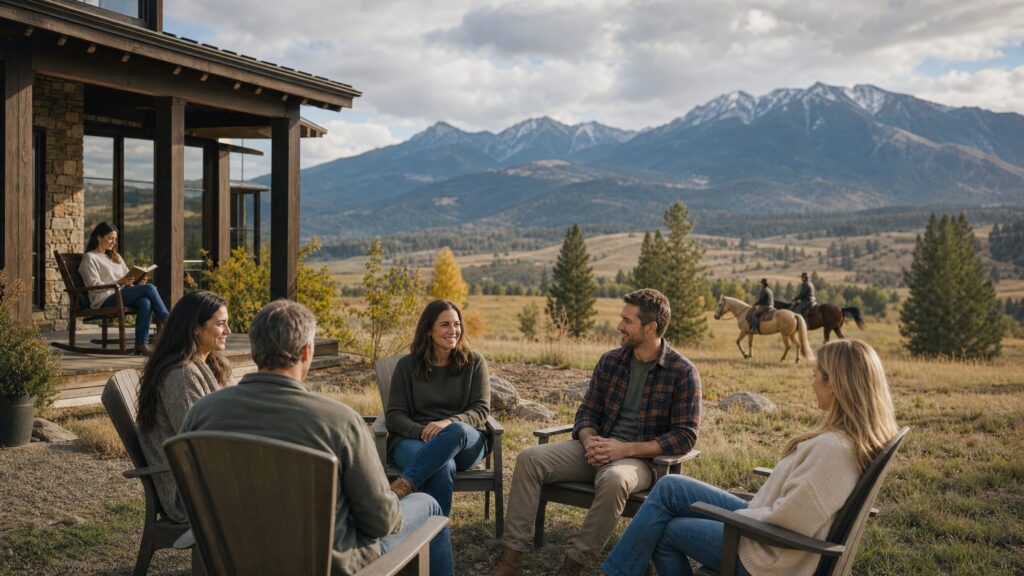
Great Falls carries this story in a particular way. You’ve got veterans coming home with combat trauma. You’ve got Native families navigating generations of historical loss. You’ve got rural distance that turns ordinary struggles into isolated ones, where the nearest support might be a long drive on a cold road. Stigma here can feel louder because the town is smaller.
That’s why a treatment approach that only targets the substance — without ever turning toward the pain underneath — tends to come up short. If clinical-only care didn’t hold last time, that’s not on you. The wound it was treating was bigger than the tool it was using.
What ‘Holistic’ Actually Means Inside a Residential Program
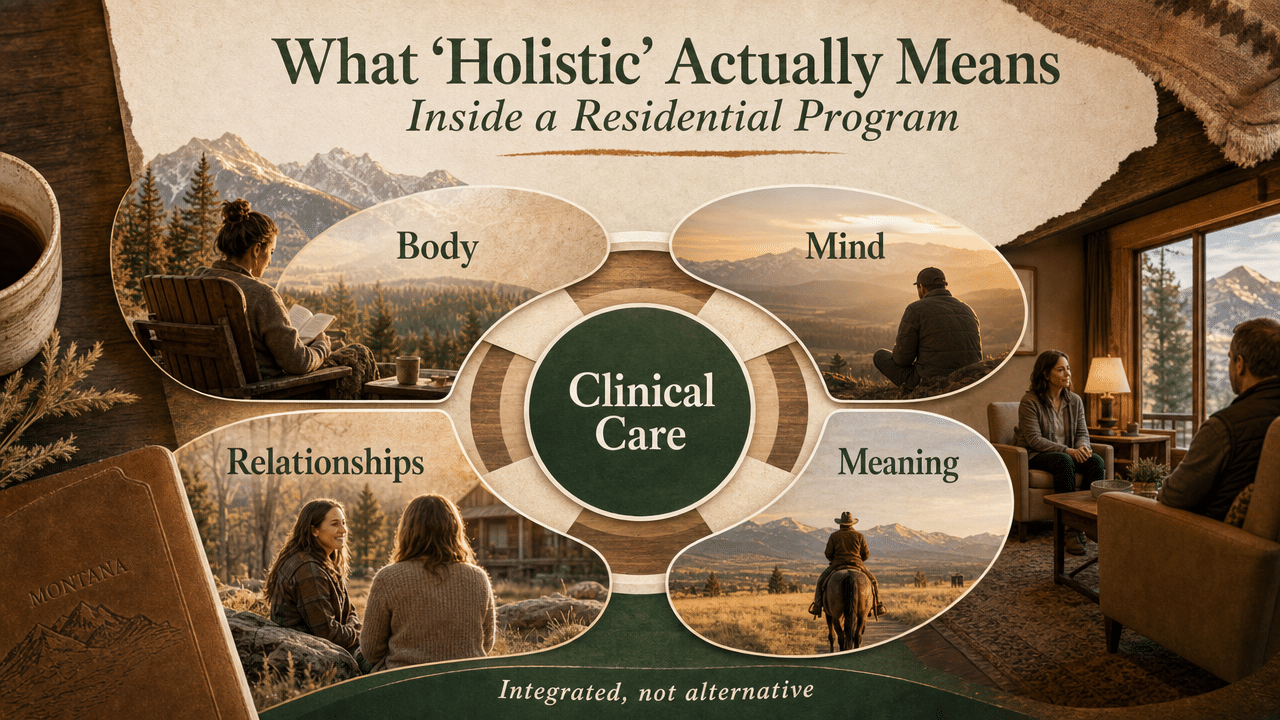
The word “holistic” gets used so loosely that it’s fair to be skeptical. You’ve probably seen it slapped on everything from juice cleanses to weekend retreats. So let’s be plain about what it means when it’s done right inside an addiction treatment program: it means the people caring for you treat your body, your mind, your relationships, and your sense of meaning as parts of the same problem — because they are.
Research on whole-person integrative care has found that models which address physical health, mental health, and social well-being together routinely report substantial benefits across diverse settings. That’s not wellness marketing. That’s a shift in how serious care is delivered. In addiction treatment specifically, the National Center for Complementary and Integrative Health is clear that mind–body approaches — mindfulness, yoga, certain movement and breath practices — are best used alongside standard treatments, not in place of them.1,12
Inside a residential program, that distinction matters. You’re not picking one. You’re getting medically monitored detox when your body needs it, individual and group counseling to work through what’s underneath, and then layered alongside that, the practices that help you actually feel your body again, sit with hard emotions, and find some quiet in your head. Montana’s standards for clinically managed high-intensity residential treatment require 24-hour structured care with planned clinical interventions. The holistic work happens inside that container — not as a substitute for it.10
So if you’ve heard “holistic” and worried it meant skipping the medical part, breathe out. The point is to add tools, not subtract them.
Trauma-Informed Care as the Spine, Not an Add-On
Here’s where a lot of programs get it wrong: they bolt holistic activities onto a clinical schedule and call it whole-person care. The activities might be fine in isolation, but if the underlying culture still treats you like a case file — if staff move fast, ask intrusive questions before you trust them, or react to your reactions as problems to manage — your nervous system stays on guard. And when your nervous system is on guard, none of the deeper work can land.
Trauma-informed care, as SAMHSA defines it, isn’t a single technique. It’s a way of running a program. The guidance describes trauma-informed services as ones that recognize how widely trauma shapes people’s lives, watch for its signs, and build that awareness into every policy and interaction. Four principles do the heavy lifting: safety, trustworthiness, collaboration, and empowerment. You should feel physically and emotionally safe in the space. You should know what’s happening next and why. You should have a say in your own plan. And you should leave each day with a little more agency, not less.8
When this is the spine, the holistic pieces actually work. A mindfulness session is different when you trust the person leading it. Time with a horse is different when you weren’t pushed into the arena before you were ready. A spiritual conversation is different when no one is trying to convert you. The modalities you’ll read about next are not standalone fixes — they’re what becomes possible once the ground underneath them is steady.
The Modalities, One by One
Working With Horses: Equine-Assisted Therapy
Walking into an arena with a thousand-pound animal who is paying very close attention to you is, frankly, not subtle. That’s the point. Horses read posture, breath, and tension the way most of us read facial expressions. They don’t care what you’ve done, what you’re ashamed of, or what story you tell about yourself. They respond to what’s happening in your body right now. For someone whose body has been numbed by years of drinking or using, that immediate, honest feedback can be a doorway back into feeling.
The work itself is usually quiet. You might brush a horse and notice your shoulders drop. You might try to lead one across the arena and discover that when you push too hard, the horse plants its feet — and so does whatever you’ve been pushing away inside yourself. A therapist is there with you, not to interpret the horse, but to help you notice what’s coming up and what it might be telling you about how you handle fear, control, or closeness with people.
The research is encouraging, with honest limits. A randomized controlled study added complementary horse-assisted therapy to standard inpatient substance use treatment and compared it with standard treatment alone. The horse-assisted group showed higher retention and treatment completion than the standard-treatment group. In plain terms: people who worked with horses stuck with the program longer and were more likely to finish it. A broader scoping review of equine-assisted services for substance use disorders points in the same direction, with reported benefits in emotional regulation and self-efficacy, while noting that most studies are still small and uncontrolled.2,3
So this isn’t a magic cure. It’s a powerful adjunct — one that seems to help people stay in the room long enough for everything else to work. If you’ve left programs early before, that finding alone is worth sitting with.
Learning to Sit With Hard Feelings: Mindfulness and Relapse Prevention
Cravings don’t usually announce themselves with a marching band. They show up as a tight chest at 4 p.m., a restless ache after an argument, a dull pull when the house gets too quiet. If you’ve spent years answering that signal with a drink or a pill, your brain has built a very fast highway from discomfort to use. Mindfulness training is, more or less, the work of building a service road next to that highway — somewhere you can pull over.
Mindfulness-based relapse prevention teaches you to notice a craving as a wave: rising, peaking, and falling, without you needing to act on it. You learn to feel where it lives in your body, name it, and breathe through the worst minute of it. A systematic review of these programs in people with substance use disorders found that they reduced cravings, decreased the frequency of substance use, and improved psychological functioning compared with some control conditions. The National Center for Complementary and Integrative Health specifically points to improving distress tolerance as a central piece of mindfulness-based substance abuse treatment.1,5
None of this asks you to empty your mind or feel peaceful on command. If anyone sells it to you that way, walk out. What it actually asks is harder and gentler: can you stay with what you’re feeling for thirty seconds longer than you did yesterday? Then a minute? Then five?
In a residential setting, you practice this in short, structured sessions — sometimes guided, sometimes silent — every day. Repetition is the medicine. By the time you go home, the service road exists. The craving still comes. You just have somewhere else to go.
Moving Your Body Again: Yoga and Gentle Movement
Active addiction is hard on a body. Sleep gets wrecked. Appetite goes sideways. Muscles forget what unclenched feels like. And if there’s trauma underneath, your body may have learned to disappear from itself entirely — a survival skill that stops being useful the moment you’re safe. Getting back into your skin is part of getting better, and it’s rarely as simple as joining a gym.
Yoga inside a treatment program isn’t about pretzel poses or wearing the right clothes. It’s slow, modified, and often done in a chair or on a mat in regular sweats. You learn to breathe deeply again. You feel your feet on the floor. You stretch a hip and a memory surfaces, and a teacher who knows what they’re doing helps you stay with it without flooding.
The evidence here is among the strongest for any holistic modality in addiction care. A naturalistic study added a structured yoga program to usual residential treatment for women with substance use disorders. Both groups improved, but the yoga group had significantly greater reductions in cravings and psychiatric symptoms and significantly greater increases in mindfulness compared with treatment as usual. The same study also noted improvements in self-efficacy and impulsivity. That’s a meaningful stack of changes from something as quiet as moving your body for an hour.4
Beyond the yoga mat, gentle movement can mean a lot of things in a Montana program — a slow morning walk, a hike when you’re up for it, time in a gym with someone who isn’t barking at you. The point isn’t fitness. The point is helping your nervous system relearn that movement can be safe, that effort can feel good, that your body is yours to inhabit again. If you’ve been carrying yourself like furniture for years, this part matters more than it sounds.
Music, Art, and Other Ways Out of Silence
Some things won’t come out in a counseling office. You sit across from someone kind, who asks the right questions, and the words just aren’t there. That’s not resistance. That’s the way trauma sometimes lives — in the body, in images, in sound, in places language doesn’t reach. Creative work gives those parts of you a side door.
Music therapy in addiction care can look like group drumming, songwriting, guided listening, or improvisation with simple instruments. A Cochrane review of music therapy for people with substance use disorders points to potential benefits for depression, motivation, and engagement when it’s added to standard treatment, with one cited trial examining group improvisational music therapy for depression in adolescents and adults with substance abuse. The evidence base is still building, but it’s headed somewhere good.6
Art therapy works on a similar wavelength. You draw what your craving looks like. You paint the version of yourself you’re trying to come back to. A therapist helps you make sense of what shows up on the page.
If this sounds fringe to you, it shouldn’t. A study using a nationally representative sample of U.S. substance abuse treatment programs found that a meaningful share incorporate art and music therapy as adjunctive services. These are established pieces of holistic care, not boutique extras.7
You don’t have to be good at any of it. You won’t be graded. Nobody is going to hang it on a wall. The point is that the parts of you that have been silent for a long time get to make a noise, in a room where someone is listening.Nature, Spiritual Practice, and Cultural Healing
Montana has a way of doing some of the work for you. Open sky, wind off the prairie, the river cutting through town — you don’t have to believe anything in particular for that landscape to lower your shoulders. Time outdoors during a residential stay isn’t recreation tacked onto a schedule. It’s part of the medicine. Walking a trail, sitting by water, noticing weather instead of arguing with it — these are nervous system practices, even if no one calls them that.
Spiritual care is the part of holistic work that gets the most nervous reactions, often for good reason. People have been hurt by religious environments and have a right to be cautious. Done well, spiritual practice in treatment doesn’t require you to believe anything specific. It’s an invitation to ask what gives your life meaning, what you want to be accountable to, and where you draw strength from when the day is hard. For some people that’s God. For others it’s family, sobriety itself, or the land.
For Native clients especially, spiritual and cultural practice can be central to recovery, not optional. A paper describing a Native American treatment program details how traditional practices like talking circles and sweat lodges are integrated alongside Western evidence-based approaches, emphasizing community and spiritual healing. The authors also note that few studies have examined how Native and Western healing practices are being integrated in these settings. A good program in Montana respects that history and makes room for cultural practice rather than treating it as an add-on or a curiosity. You should be able to ask, on a first call, how they handle this — and get a real answer.13
How 30, 60, and 90 Days Let These Practices Compound
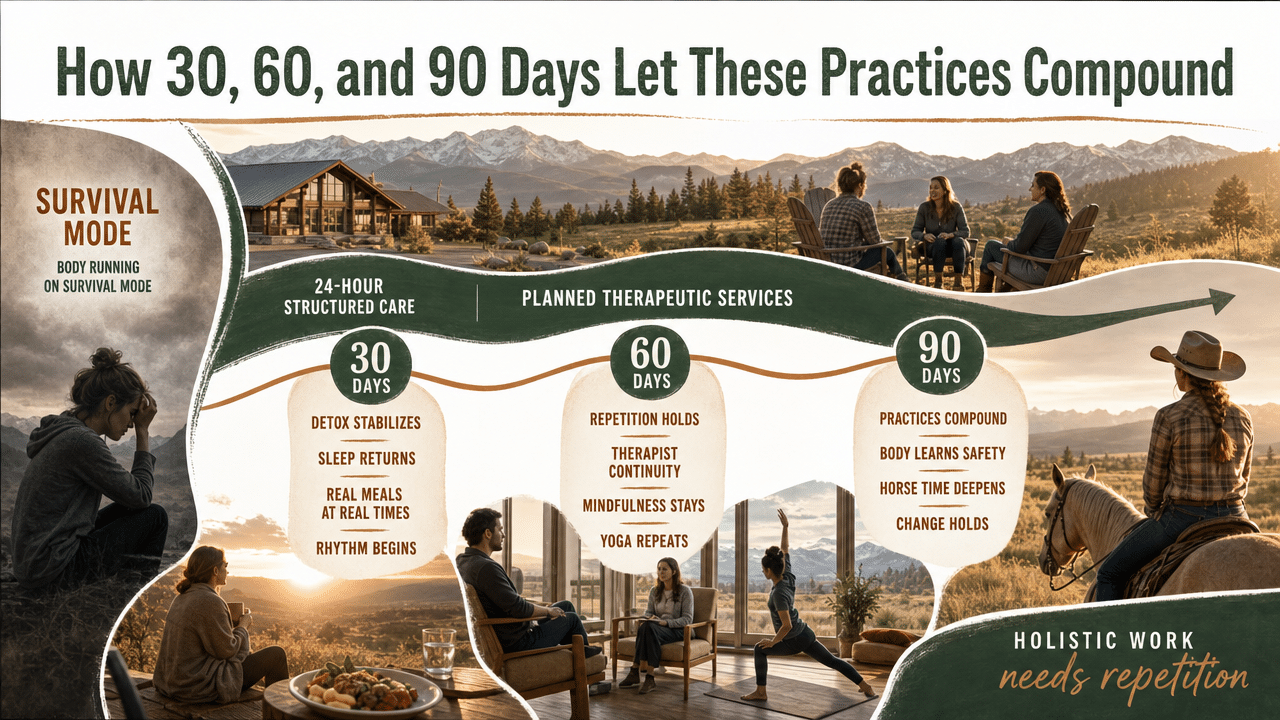
One yoga class won’t rewire a nervous system. One afternoon with a horse won’t undo years of using to cope. That’s not a failure of those practices — it’s a fact about how change actually happens in a body that has been running on survival mode for a long time. The reason residential length-of-stay matters is that the holistic work needs repetition, and repetition needs a structure that holds you while you do it.
Montana’s standards for clinically managed high-intensity residential treatment call for 24-hour structured care with planned therapeutic services. Inside that container, a week starts to look like rhythm: detox stabilizes, sleep returns, you eat real meals at real times, and the same therapist who saw you on a hard Tuesday is there on Friday. That continuity is what lets the mindfulness session you almost walked out of on day five become the one that clicks on day twenty.10
The arc tends to go something like this:
- The first thirty days are mostly about your body settling and your guard coming down — withdrawal eases, you start sleeping again, you let one staff member in.
- Sixty days is where the deeper work usually opens up; you’ve been around horses or breath practice long enough that you stop performing and start noticing.
- By ninety, you’re rehearsing what life looks like when you go home — practicing the tools enough times that they’re actually there when the craving hits in your kitchen at 9 p.m.
If you’ve cycled through shorter programs before and watched the gains evaporate within weeks, the issue often wasn’t your willpower. It was time. Whole-person care needs enough of it to stop being something done to you and start being something you do.
What to Look for in a Great Falls Program — and When to Reach Out
If you’ve read this far, you already know more than most people walking into their first call with a treatment center. Use what you know. When you talk to a program in or near Great Falls, ask specific questions and listen for specific answers.
Ask how detox is handled medically, and who is on-site overnight. Ask how trauma-informed care actually shows up day to day — what does safety, trust, collaboration, and empowerment look like in their building, not just on their website. Ask what holistic modalities they offer, how often, and who leads them. A good answer names real people and a real weekly schedule. A vague answer is itself information.8
Ask about length of stay and what happens after. Whole-person work needs time and a way home — continuing care, family involvement, somewhere to land when the structured days end. If you or a loved one is Native, ask directly how cultural and spiritual practice is honored inside the program. You should get a specific answer, not a flinch.
And then, when you’re ready — or close to ready — pick up the phone. Rocky Mountain Treatment Center has been doing this work in Great Falls since 1983, with counselors who know recovery from the inside. You don’t have to have it figured out before you call. That’s what the first conversation is for.Frequently Asked Questions
Is holistic therapy a replacement for medical detox or clinical addiction treatment?
What actually happens in equine therapy, and does it really work?
I have serious trauma. Will mindfulness or yoga make things worse before they help?
How does a residential program in Great Falls fit holistic work into a daily schedule?
Can spiritual or cultural practices, including Native traditions, be part of treatment?
How do I know if a Great Falls program is genuinely holistic versus just using the word?
References
- Psychological and Physical Approaches for Substance Use Disorders. https://www.nccih.nih.gov/health/providers/digest/mind-and-body-approaches-for-substance-use-disorders
- Complementary horse-assisted therapy for substance use disorders: a randomized controlled study. https://pmc.ncbi.nlm.nih.gov/articles/PMC7001193/
- Equine-assisted services for individuals with substance use disorders: a scoping review. https://pmc.ncbi.nlm.nih.gov/articles/PMC9749232/
- Naturalistic Evaluation of an Adjunctive Yoga Program for Women in Residential Substance Use Disorder Treatment. https://pmc.ncbi.nlm.nih.gov/articles/PMC8246483/
- Effectiveness of Mindfulness-Based Relapse Prevention in the Treatment of Substance Use Disorders: A Systematic Review. https://pmc.ncbi.nlm.nih.gov/articles/PMC8533446/
- Music therapy for people with substance use disorders. https://pmc.ncbi.nlm.nih.gov/articles/PMC6472527/
- The use of art and music therapy in substance abuse treatment programs. https://pubmed.ncbi.nlm.nih.gov/25514689/
- Trauma-Informed Care in Behavioral Health Services (TIP 57). https://www.ncbi.nlm.nih.gov/books/NBK207201/
- Special Emphasis Report: Adverse Childhood Experiences (ACEs) in Montana. https://dphhs.mt.gov/assets/publichealth/EMSTS/Data/ACEs-Montana_2023_final.pdf
- SUD Clinically Managed High-Intensity Residential (ASAM 3.5) Adult – Policy 540. https://dphhs.mt.gov/assets/BHDD/MedicaidManual/540SUDASAM3-5.pdf
- QuickFacts: Great Falls city, Montana. https://www.census.gov/quickfacts/fact/table/greatfallscitymontana/PST045225
- The Case for Whole-Person Integrative Care. https://pmc.ncbi.nlm.nih.gov/articles/PMC8307064/
- Integrating Spiritual and Western Treatment Modalities in a Native American Substance User Treatment Center. https://pmc.ncbi.nlm.nih.gov/articles/PMC4104509/