Key Takeaways
- Horses give honest, non-verbal feedback that reaches people when talk therapy stalls, helping regulate the nervous system and rebuild self-awareness in early sobriety.6
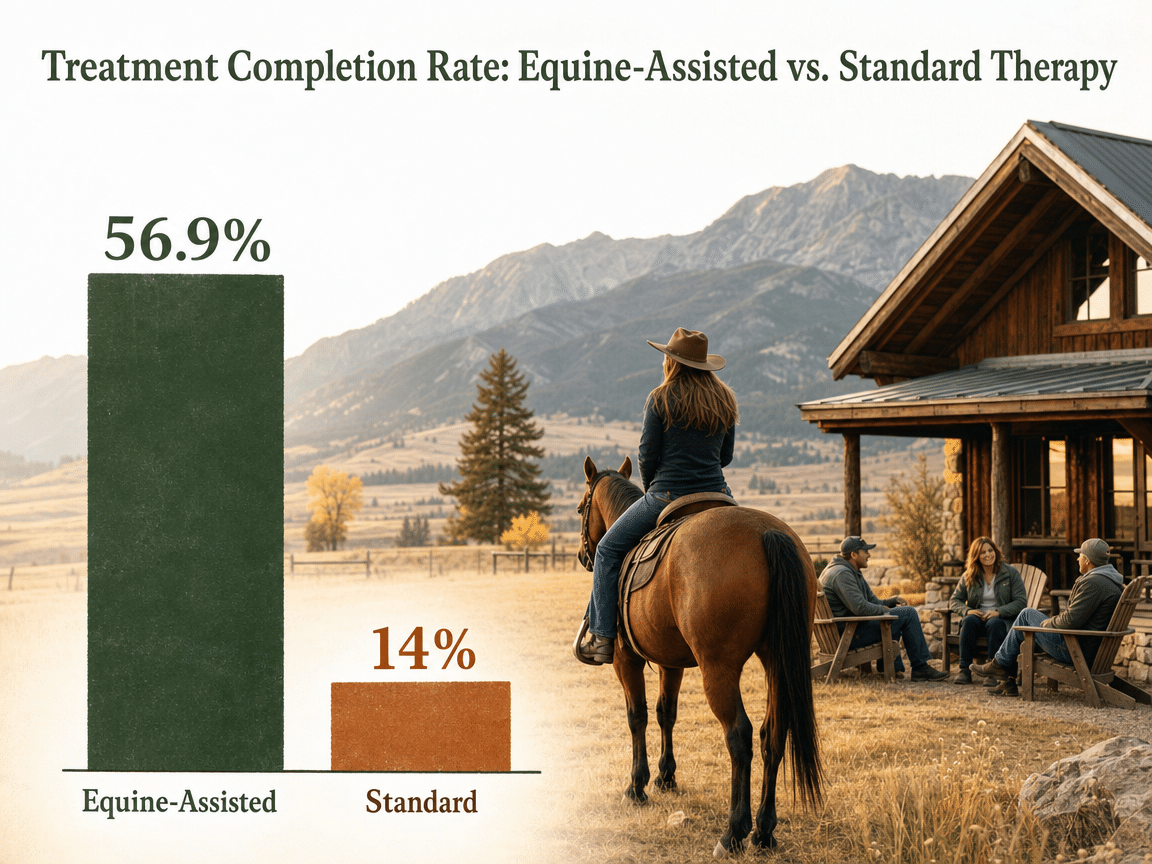
- Adding equine therapy for addiction recovery to residential treatment is linked to longer stays and higher completion rates, with one study showing 56.9% program completion versus 14% in standard care.3
- Time with horses improves emotion regulation, reappraisal, and self-efficacy, and shows meaningful reductions in PTSD symptoms for people whose addiction sits on top of trauma.2,10
- Equine therapy is a complement, not a cure — it works alongside detox, counseling, 12-step work, and continuing care rather than replacing any of them.1
What Happens When You Stand Next to a Horse in Early Sobriety
The first time you walk into a barn sober, something quiet happens. The horse doesn’t ask what you’ve been drinking or how long. It doesn’t scan your face for the guilt you’ve been carrying. It just breathes, shifts its weight, and notices you noticing it.
If you’re reading this, you probably know how tired talk therapy can feel when the words won’t come. Maybe you’ve sat through group. Maybe you’ve tried outpatient, or AA, or a detox that didn’t stick. You are not broken for wanting something that reaches you differently. You’re paying attention.
Here’s what the research keeps finding: when horses are added to residential addiction treatment, people tend to stay longer, feel more engaged, and build skills — emotion regulation, self-efficacy, self-esteem — that early sobriety actually depends on. It’s not magic. It’s not a cure. A 2022 scoping review of equine-assisted services for substance use disorders called the evidence promising but still developing, and honest programs will tell you the same.1,2
At Rocky Mountain Treatment Center in Great Falls, Montana, equine therapy is part of a 30, 60, or 90-day residential program — woven into counseling, 12-step work, family sessions, and medically monitored detox. The horse isn’t a photo opportunity. It’s a working partner in helping you learn what a steady body feels like again.
The rest of this article walks through why that works, what a day with the horses actually looks like, and where the honest limits are. No hype. Just what the research says and what happens on the ground.
The Mechanism: Why Horses Reach People Talk Therapy Sometimes Can’t
Honest Feedback From a 1,200-Pound Animal
A horse doesn’t care what you did last year. It cares what your body is doing right now. If your shoulders are tight, it feels that through the lead rope. If your breath is shallow, it reads that in how you move toward the fence. If you’re pretending to be calm when you’re not, the horse knows before you finish the sentence.
That kind of feedback is hard to argue with. You can talk your way around a counselor. You can perform for a group. You cannot perform for a 1,200-pound animal that responds to what your nervous system is actually saying. When the horse steps back, or turns its head away, or plants its feet, that’s information. It’s not judgment. It’s just what’s true in the room.
For someone in early sobriety, that honesty can feel like a strange kind of relief. You’ve probably spent years hiding — from partners, employers, doctors, yourself. Standing next to an animal that reflects your inside state without shame gives you something rare: a clear mirror and no one to defend against. Therapists working with horses describe this as one of the fastest ways to build self-awareness, especially with people who have struggled to stay engaged in traditional treatment.6
Co-Regulation and the Cortisol Question
Here’s the part that surprises people. When you stand quietly next to a horse for a few minutes, your body starts to borrow from theirs. Heart rate slows. Breathing deepens. Shoulders drop an inch. Researchers call this physiological coupling — two nervous systems finding a shared rhythm.
That matters more than it sounds. Addiction and withdrawal keep your stress system stuck in the on position for a long time, with chronically elevated cortisol and a body that doesn’t remember what settled feels like. A 2025 review of equine-assisted work in substance use recovery found that time with horses may help mediate those stress responses through this kind of coupling, and that it strengthens the therapeutic alliance, emotional stability, and communication skills people need to keep showing up for treatment.5
The review also noted something quieter but important: patients in equine programs often describe feeling like they’re doing something useful, not just being a patient waiting for the day to pass. That shift in identity — from person being treated to person taking care of something — is part of why the work sticks.5
At Rocky Mountain Treatment Center, this fits alongside medically monitored detox and counseling. Your body has been through a lot. Learning what calm feels like, standing beside an animal that already knows, is one way it starts coming back.
The Horse as a Secure Base for Rebuilding Trust
If addiction has cost you relationships — and it usually has — the idea of trusting anything again can feel out of reach. You may have burned through the patience of family, friends, coworkers. You may not fully trust yourself yet either. That’s a hard place to start rebuilding from.
This is where the horse does something specific. In trauma and recovery work, therapists describe the horse as a secure base — a steady, non-verbal presence you can lean toward without fear of being judged or abandoned mid-sentence. The horse doesn’t need your explanation. It doesn’t remember what you said last week. It’s just there, breathing, present, and willing to be near you when you’re near it.6
That kind of connection is unusual for anyone who has spent years bracing for disappointment. A book chapter on horses in trauma treatment describes this alliance-building as one of the most consistent factors linked to positive therapy outcomes — the sense of safety, trust, and attuned connection in a relationship where you don’t have to perform to be accepted.7
What you practice with the horse — showing up, staying present, letting someone matter to you — is what you’ll need to practice with the people in your life again. That’s the point.
Why Staying in Treatment Is the Battle Horses Help You Win
Here’s a truth nobody in recovery says out loud enough: the hardest part isn’t deciding to get sober. It’s staying long enough for the work to change you. Week two hits. The detox fog lifts. You start feeling everything you numbed for years, and every part of you wants to leave.
This is where the horses do something quietly remarkable. In a 2020 naturalistic study of residential substance use treatment, 56.9% of patients who received horse-assisted therapy completed their program, compared with 14% in standard care. Their average length of stay was 141 days versus 70. That’s not a small gap. That’s the difference between finishing what you started and going home before your body has learned how to be sober.3
Read that with clear eyes, though. The study wasn’t randomized. Patients weren’t assigned by coin flip, which means the people who chose equine work may have differed from those who didn’t. The scoping review that pulled this literature together in 2022 called the retention findings promising but not yet proven, and asked for larger, controlled trials before anyone claims the case is closed. Honest programs will tell you the same thing.1
What the numbers point to, even with those caveats, is something people in the barn already sense. When you have a reason to show up on Thursday — a horse that knows you, a groom job you started, a small task waiting — the pull to walk out on Wednesday loses some of its grip. Therapists working with horses describe this as one of the strongest levers they have for people who typically drop out of treatment early.6
At Rocky Mountain Treatment Center, that lever matters. The 30, 60, and 90-day programs are built around the idea that time in treatment is what changes outcomes, and the horses give you one more reason to keep going when the second and third weeks test everything you thought you decided. You’re not staying because someone told you to. You’re staying because something out there is expecting you.
What Horses Teach You About Emotions Without Saying a Word
Reappraisal, Suppression, and Learning to Sit With a Feeling
For a long time, drinking probably did the work your emotions couldn’t. Anger got quiet. Grief got smaller. Fear got manageable enough to get through a day. When you take the alcohol away, all of that comes back, and it comes back louder than you remember.
This is where the horses do something you can feel. A 2023 clinical study of equine-assisted therapy for people with substance use disorders measured two specific skills: reappraisal, which is the ability to look at a hard feeling and reframe it without running from it, and suppression, which is the habit of shoving a feeling down and hoping it goes away. Patients who worked with horses showed real improvements in reappraisal and real reductions in suppression, along with gains in self-esteem. In plain terms, they got better at feeling something and staying in the room.2
Horses teach this the hard way, which is the only way it sticks. If you walk up to a horse angry and pretending you’re not, the horse moves. If you soften your breath and drop your shoulders, the horse comes closer. You learn — not from a workbook, but from a 1,200-pound teacher — that a feeling handled honestly changes something, while a feeling stuffed down changes nothing.
Every counseling session and 12-step meeting at Rocky Mountain Treatment Center asks you to do the same thing with words. The barn just gives you a place to practice with your body first.
Self-Efficacy: Haltering a Horse When You Haven’t Trusted Yourself in Years
Self-efficacy is a clinical word for a simple idea: the belief that you can do something and see it through. Addiction eats that belief slowly. Every broken promise to yourself, every morning that started with a drink instead of a decision, chipped away at the part of you that used to trust your own follow-through.
The same 2023 study found that patients who worked with horses had significant gains in general self-efficacy alongside their emotion regulation improvements. Therapists who use horses in their practice describe watching this shift in real time — clients who arrive convinced they can’t do anything right suddenly discover they can lead a horse across a paddock, pick up a hoof, or get a halter on straight.2,6
That sounds small. It isn’t. When you haltered a horse this morning, you did something that required attention, patience, and a steady hand. You did it sober. The horse cooperated because you showed up in a way that worked. That’s a data point your brain files away, and it stacks on top of the next one, and the next.
By the time you’re a few weeks into a 30, 60, or 90-day program at Rocky Mountain Treatment Center, you’re not just talking about being someone who follows through. You’ve done it, in the barn, in front of an animal that noticed. That’s what starts to rebuild the trust you lost in yourself.
When Addiction Sits on Top of Trauma
For a lot of people who end up in a rehab bed, drinking wasn’t the first problem. It was the answer to something older. A childhood you don’t talk about. A tour of duty. A car accident. A relationship that broke something in the way you sleep. If any of that sounds familiar, you already know how tangled sobriety and trauma can be — you can’t drink through the memories anymore, and now the memories are louder than they’ve been in years.
This is the part of recovery where horses do some of their most careful work. A 2023 systematic review and meta-analysis of equine-assisted therapy for PTSD pooled data across trials and found significant reductions in PTSD symptoms, along with improvements in related struggles like depression and anxiety. The authors were careful — small samples, varied designs — but the pattern held up: for people carrying trauma, time with horses seems to reach something that words alone often can’t.10
The most concrete numbers come from a 2021 clinical study of veterans with PTSD who worked through an equine-assisted therapy program. Only 8% of them dropped out, which is remarkable in a population that often walks away from trauma treatment early. Mean clinician-rated PTSD scores on the CAPS-5 fell from 38.6 before therapy to 26.9 after, and 50.8% of participants showed a clinically significant reduction in symptoms — a drop of at least 30% — that held at three-month follow-up.8
Those numbers matter because trauma treatment usually asks you to talk about the worst things that ever happened to you. That’s a big ask for anyone, and it’s a bigger ask when your nervous system is already raw from getting sober. Standing with a horse gives you a way to do trauma work without having to narrate every piece of it out loud. The horse notices when your breathing changes. You notice that it noticed. Something in you starts practicing safety again, in a body that had forgotten what safe felt like.
One honest note. A 2019 randomized trial of six weeks of equine-assisted psychotherapy in veterans with PTSD found no statistically significant advantage over standard therapy on symptoms, resilience, or cortisol. Read that carefully: it didn’t beat traditional trauma care. It worked about as well. For someone who has struggled to stay in a talk-therapy chair, that equivalence is the point — a format you can actually tolerate is a format that can actually help you.9
At Rocky Mountain Treatment Center, trauma-focused counseling sits inside the same 30, 60, or 90-day program as the barn work and the 12-step meetings. The horses aren’t a substitute for trauma therapy. They’re a place where your body gets to practice what your counselor is helping your mind unpack.
What Equine Therapy Is Not: An Honest Look at the Limits
You’ve probably read enough treatment center websites to spot a promise that’s working too hard. So here’s the plain version: horses don’t cure addiction. Nothing does. What the research actually says, taken as a whole, is that equine work is a promising complement to core addiction care, not a replacement for it.
The 2022 scoping review that pulled together the existing studies on equine-assisted services for substance use disorders said it directly. The findings point to potential benefits for retention, completion, and mental health, but the sample sizes are small and rigorous trials are still scarce. The authors called the evidence insufficient to conclusively prove benefit. That’s not a reason to walk away from the work. It’s a reason to be careful about anyone who tells you the barn alone will fix what alcohol has been doing to your life.1
Equine therapy also won’t detox your body. It won’t replace the medically monitored care your first days sober may require. It won’t do the work of a counselor helping you sit with the memories underneath the drinking, and it won’t stand in for the 12-step community that keeps a lot of people connected long after they leave a residential bed. At Rocky Mountain Treatment Center, the horses sit alongside all of that — not in front of it.
One more honest note. If horses aren’t your thing, or you arrive nervous around large animals, the work still meets you where you are. You’re not failing recovery by preferring the counseling room to the paddock. The point was never the horse. The point is a body learning what steady feels like, in whatever room helps you find it.
A Day With Horses at Rocky Mountain Treatment Center
The Great Falls Setting and How Stall Time Fits the 30/60/90-Day Program
Great Falls sits where the plains meet the front range of the Rockies. The light is big. The air is cold in the morning and warmer by mid-day, and the horses at Rocky Mountain Treatment Center live in that same weather you’ll be walking through. It’s not a manicured backdrop. It’s Montana, and that ordinariness is part of what makes the work land.
Your day here has a shape. Detox care comes first if your body needs it, because you can’t do this work while you’re still coming off alcohol. From there, mornings and afternoons move between individual counseling, group sessions, 12-step meetings, and the barn. Equine time isn’t tacked onto the end of a full day. It’s placed where it can do something — often when your body needs to move, or when a hard session needs a place to land.
The 26-bed size matters more than it sounds. You’re not a face in a crowd of a hundred. Your counselor knows what happened in group yesterday. The staff working with you at the barn know what you talked about in therapy that morning. That thread — from counseling room to paddock to dinner table — is how a lesson with a horse becomes a skill you can actually use when the phone rings and the person calling knows every way to pull you off track.
Staff Who Have Walked This, Family Week, and the Year After You Leave
Something worth knowing before you arrive: over 80% of the staff at Rocky Mountain Treatment Center are in recovery themselves. The people walking you through the barn, the counseling room, and the harder afternoons have sat in the chair you’re sitting in. That doesn’t make them soft on you. It usually makes them harder to fool, in the best possible way.
Family Week is a three-day piece of the program where the people who love you come in and do their own work alongside yours. Addiction is rarely a solo project, and the repair isn’t either. What you’ve been practicing in the barn — showing up, staying present, letting someone matter — you get to practice with your family in a room built for honest conversation.
Then there’s the year after. Continuing care check-ins happen at 30, 60, 90, 180, and 365 days after you leave, plus weekly Zoom groups that keep you connected to the community you built here. This is the part most brochures skip. You’ll leave Great Falls, and the day you leave will not be the hardest day of your recovery. The check-ins exist because sobriety is built in the months when nobody’s watching. You’ll still have somebody watching. That’s the point.
Frequently Asked Questions
Is equine therapy actually effective for addiction recovery, or is it just a nice extra?
Do I need any experience with horses to participate in equine therapy?
What does a session with a horse actually look like during residential treatment?
Can equine therapy help if my addiction is tied to past trauma or PTSD?
How does equine therapy fit with 12-step work, counseling, and detox at Rocky Mountain Treatment Center?
What if I’m afraid of horses or not sure this is right for me?
References
- Equine-assisted services for individuals with substance use disorders: a scoping review. https://pmc.ncbi.nlm.nih.gov/articles/PMC9749232/
- Equine-assisted therapy effectiveness in improving emotion regulation, self-efficacy, and self-esteem among patients with substance use disorders. https://pmc.ncbi.nlm.nih.gov/articles/PMC10576391/
- Complementary horse-assisted therapy for substance use disorders: a naturalistic study. https://pmc.ncbi.nlm.nih.gov/articles/PMC7001193/
- An evaluation of the effect of equine-facilitated psychotherapy on patients with substance use disorders. https://pubmed.ncbi.nlm.nih.gov/37379304/
- Cognitive and physiological impacts of psychotherapy incorporating equine interaction in substance use disorder recovery: a literature review. https://pmc.ncbi.nlm.nih.gov/articles/PMC12497412/
- Therapists’ reasons for including horses into psychotherapy and their perceived changes in therapy sessions: a mixed-methods study. https://pmc.ncbi.nlm.nih.gov/articles/PMC12821812/
- Chapter 8: Horses in the Treatment of Trauma. https://muse.jhu.edu/pub/60/oa_edited_volume/chapter/2503864
- Equine-Assisted Therapy for Posttraumatic Stress Disorder Among Military Veterans. https://pubmed.ncbi.nlm.nih.gov/34464523/
- Efficacy of equine-assisted psychotherapy in veterans with posttraumatic stress disorder. https://pubmed.ncbi.nlm.nih.gov/30497951/
- Equine-Assisted Therapy in Post-Traumatic-Stress Disorder: A Systematic Review and Meta-Analysis. https://pubmed.ncbi.nlm.nih.gov/37355148/