
Key Takeaways
- Montana Code 20-4-110 lists specific grounds for teacher discipline like gross neglect and immoral conduct related to teaching, but entering treatment for alcohol use disorder is not among them 10.
- 42 CFR Part 2 keeps your identity, diagnosis, and treatment plan sealed by default, releasing records only with written consent, a court order plus subpoena, or a medical emergency 1, 2.
- The ADA treats alcoholism as a potential disability and limits what districts can ask, so HR typically needs only dates and a physician’s note rather than a diagnosis 4, 7.
- Facility headcount shapes real-world privacy: a 26-bed program in Great Falls means fewer hands on your chart and less chance of running into someone from your county at intake.
- Vet admissions with direct questions about the written Part 2 policy, subpoena handling, revocable releases, mail return addresses, and breach notification under the 2026 Part 2 update 3, 12.
- Itemized bills and EOBs should list the facility name, dates, and generic service codes without wording that flags a substance use program, keeping disclosures to the minimum necessary 1.
- Relapse risk is front-loaded in year one, which is why structured check-ins at 30, 60, 90, 180, and 365 days produce documented engagement that licensing bodies and HR files recognize 9.
- Aligning a 30-day stay with a school break helps, but a physician-certified medical leave is a legitimate reason to be out and keeps the diagnosis off the paperwork 6, 7.
The fear that keeps teachers drinking
You already know the pattern. The wine bottle after grading. The mouthwash before the staff meeting. The mental math about how many days until spring break so you can finally rest without pretending. And underneath all of it, a quieter calculation: what happens to your certificate, your classroom, your name in a small town, if anyone finds out.
That fear is the reason a lot of teachers keep drinking long past the point where they wanted to stop. Not because they don’t want help. Because the cost of asking for it feels higher than the cost of hiding. You’ve watched a colleague get quietly reassigned. You’ve seen how fast a rumor moves through a district office. You’ve read enough of Montana’s educator discipline statute to know the Board of Public Education can act on grounds like incompetency, gross neglect of duty, or immoral conduct related to teaching 10. So you stay quiet. You white-knuckle another semester.
This guide will separate the fear from the actual law. It will show you which federal privacy rules protect a treatment record, what a school district can and cannot ask, and how to pick a program small enough that discretion isn’t just a promise on a website. Rocky Mountain Treatment Center in Great Falls is one of those small programs, and we’ll be honest about how a 26-bed setting changes what privacy actually feels like.
You didn’t drink your way into this alone. You don’t have to plan your way out of it alone either.
What Montana can actually discipline you for
Here’s what the statute actually says, because vague fear is worse than the specifics. Under Montana Code 20-4-110, the Board of Public Education can reprimand, suspend, revoke, or deny a teaching certificate for a defined list of reasons: making false statements on a certification application, incompetency, gross neglect of duty, a criminal conviction involving moral turpitude, and immoral conduct related to teaching, among similar grounds 10. Read that list again, slowly. Notice what isn’t there.
Entering treatment for alcohol use disorder is not on that list. Asking for help is not on that list. Taking a leave of absence to go to a residential program is not on that list. The statute is aimed at conduct — what you do or fail to do in your role — not at the private medical decision to get well.
The cleanest analogy comes from federal guidance for healthcare workers. The National Practitioner Data Bank tells licensing boards to report adverse actions against a practitioner, but specifically instructs them not to report the fact that someone entered a drug or alcohol treatment program 14. Different profession, same principle: the reportable event is the harm or the misconduct, not the treatment.
This is why a lot of educators call Rocky Mountain Treatment Center before anything has boiled over at work. Getting care while your record is still clean is a very different conversation than getting care after a district investigation has already started. You are, right now, in the better of those two positions. The window is open. Use it.
The privacy shield around your treatment record
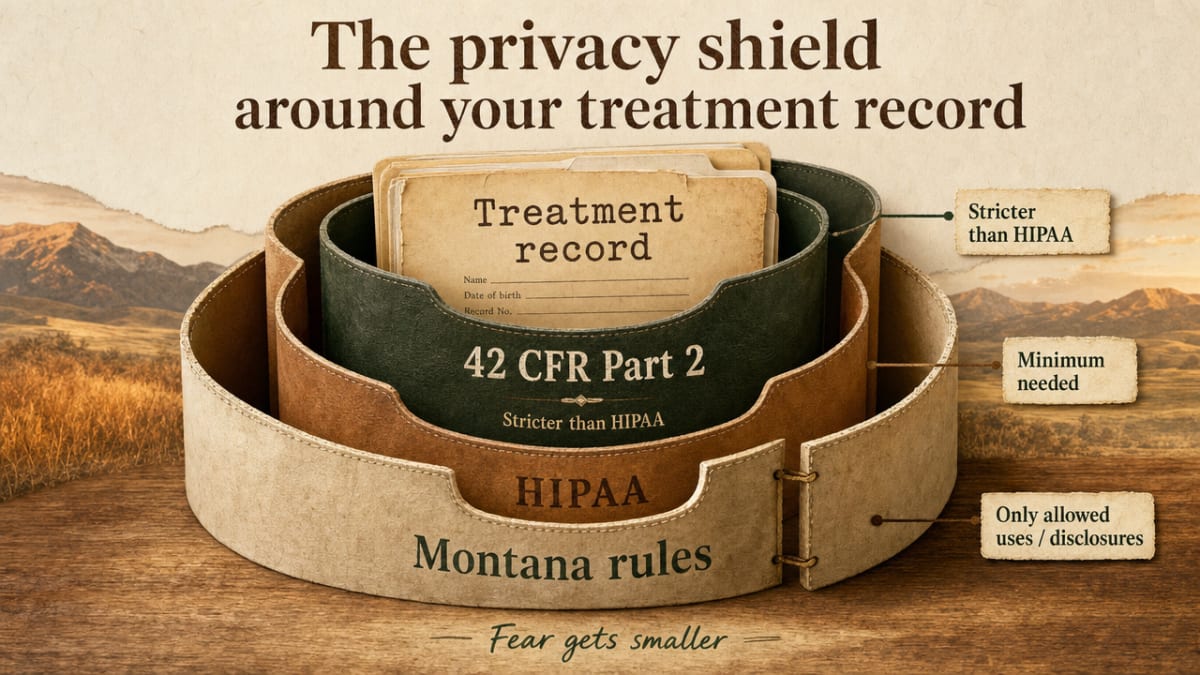
The reason a treatment record is harder to pry loose than almost any other medical file comes down to one specific federal rule, plus a couple of state and federal layers stacked on top of it. Once you understand what sits between your chart and anyone who might come asking, the fear gets smaller. Not gone. Smaller. And smaller is enough to make the phone call.
Who can see your chart under 42 CFR Part 2
The rule you want to know the name of is 42 CFR Part 2. It’s the federal regulation that specifically protects substance use disorder treatment records, and it’s stricter than the HIPAA rules you might already be familiar with from a regular doctor’s visit. Under Part 2, a program can only use or disclose your records the ways the regulation allows, and any disclosure has to be limited to the minimum information needed 1. At admission, the facility is required to tell you, in writing, that federal law protects the confidentiality of your alcohol and drug treatment records 1.
In plain language: your identity as a patient, your diagnosis, your treatment plan, and even the fact that you walked through the door stays inside the program by default. HHS puts it simply — with limited exceptions, records can be shared only if you give written consent, or there’s a court order paired with a subpoena 2. The other narrow exceptions are things like a genuine medical emergency and certain qualified research uses. A district HR office calling to ask if you’re a patient does not qualify.
The 2026 update to Part 2 changed a few practical things without weakening the shield. It allows a single written consent to cover future uses for treatment, payment, and health care operations, and it added HIPAA-style breach notification if something ever does go wrong 3. What hasn’t changed: nobody at your school gets to see anything without your written, specific, revocable permission.
Where HIPAA and Montana rules add another layer
Part 2 is the main lock on the door. HIPAA is the deadbolt. The HIPAA Privacy Rule sets national standards for how medical records and personal health information are handled by covered entities 16, which covers the medical detox side of a residential stay — the physical exam, the vitals, the medications used to keep you safe coming off alcohol. Between the two rules, both the addiction-specific record and the general medical record are protected.
Montana adds its own layer on top. State administrative rules require any substance use disorder facility operating in Montana to have a written client confidentiality policy tied directly to 42 CFR Part 2, and to tell you about it at admission 12. Client rights rules go further and say your clinical and personal information has to be handled in line with state and federal statute 11. Montana’s broader posture on rehabilitation records is the same — confidentiality is the default, disclosure is the exception 15.
When you call Rocky Mountain Treatment Center’s admissions line in Great Falls, that written policy is something you can ask to see before you say yes to anything. A facility that can’t hand you its Part 2 policy on request is not the facility you want.
What your district can and cannot ask
Once you decide treatment is on the table, the next question is usually the one that keeps you up at 2 a.m.: what does your employer get to know? The short answer is less than you think, but the specifics matter. The Americans with Disabilities Act draws a line most teachers have never had explained to them, and how you handle the initial conversation with HR or your principal shapes what ends up in your personnel file for the rest of your career.
The ADA line between alcoholism and current illegal drug use
The ADA treats alcoholism as a condition that can qualify as a disability, which means an employee in recovery from alcohol use disorder may be protected from discrimination and entitled to reasonable accommodation 4. Current illegal drug use sits on the other side of the line — the ADA does not protect it 4. That distinction matters because most teachers reading this are dealing with alcohol, and the legal ground under your feet is steadier than you’ve been telling yourself.
Two more things sit inside that same body of guidance. Employers can hold every worker to the same conduct standards — showing up sober, not endangering students — regardless of whether alcoholism is in the picture 4. And any medical information your district does obtain has to be kept confidential and stored separately from your regular personnel file 4. Your treatment isn’t supposed to end up in the folder a future hiring committee sees.
A disclosure decision framework: HR, principal, doctor, sealed
Think of your information in four buckets. What HR needs to process a leave: dates, a doctor’s note saying you have a medical condition requiring inpatient care, and any work restrictions when you return. Employers may ask for medical information only when the request is job-related and consistent with business necessity 7. “I’m in rehab” is more than they need. “I’m on medical leave with documentation from my physician” is usually enough.
What your principal needs: even less. Under ADA rules, medical information can only be shared internally in narrow situations, like a supervisor who needs to know your work restrictions 5. Your principal doesn’t need a diagnosis to cover your classroom.
What your doctor handles: the clinical detail, routed through your physician’s note rather than your own mouth. What stays sealed: everything protected by 42 CFR Part 2 — the fact that you were in a substance use program at all. Rocky Mountain’s admissions team can help you shape a leave letter that meets district requirements without naming what you’re being treated for.
Why facility size changes what discretion actually means
Every rehab website promises confidentiality. Very few can tell you how many people will actually see your name written down. That’s the number that matters, and it’s almost entirely a function of how big the building is.
Think about what happens in a 200-bed facility. Shift changes involve a lot of nurses. Group therapy rotates through several counselors. The intake team is one department, the clinical team is another, the billing office is somewhere else entirely, and the cafeteria has its own staff. Your file passes through more hands not because anyone is careless, but because that’s how large operations run. Part 2 still applies 1, but the physical footprint of your privacy is bigger. More rooms, more computers, more chances for someone to walk past a screen.
Rocky Mountain Treatment Center runs 26 beds in Great Falls. Over 80% of the staff are in recovery themselves. The intake counselor who takes your call is likely to be someone you’ll still see in the hallway three weeks in. Your primary counselor knows your first name, your story, and the specific reason you asked to keep your phone in a locked drawer during the school day. Nobody is looking up who you are because they already know. That’s not a marketing line — it’s what “small” produces structurally.
There’s also the lobby problem. In a big center, you might sit next to fifteen strangers at admission, any one of whom could be from your county. In a 26-bed program tucked into Great Falls, the odds of running into a parent from your school are lower to start with, and the intake process itself happens in a private office, not a waiting room. Montana’s SUD facility rules require every licensed program to hand you a written Part 2 confidentiality policy at admission 12. In a smaller setting, the person handing it to you is also the person who will honor it.
Discretion, in other words, isn’t a policy statement. It’s a headcount.
Vetting a program without sounding like you’re hiding something
Here’s the awkward part of the search: you want to ask hard questions about privacy without tipping off the person on the other end of the phone that you have a lot to lose. Take a breath. Every good admissions counselor at a substance use facility hears these questions from professionals — nurses, pilots, judges, and yes, teachers — every week. Asking about records handling isn’t a red flag. It’s what a careful person does. Rocky Mountain Treatment Center’s admissions team in Great Falls answers these questions before you ever share a last name, and you’re allowed to stay in that pre-intake space as long as you need to.
The two things worth vetting in detail are how the program handles your written record and what your bill will look like when it lands in your mailbox or your insurance portal. Those are the two places a leak, if one ever happens, is most likely to start.
Seven questions to ask admissions about records and billing
Write these down before you call. You don’t have to ask them in order, and you don’t have to explain why you’re asking.
- Can you send me your written 42 CFR Part 2 confidentiality policy before I admit? Montana facilities are required to have one 12.
- Who inside the program will see my chart, and how many people is that in total?
- What is your process if my employer, a school district, or a licensing body calls asking whether I’m a patient?
- What happens if you receive a subpoena — do you require a court order alongside it before releasing anything 2?
- How do you handle a written release of information, and can I revoke it in writing at any time 1?
- What name and return address appear on mail you send me during and after treatment?
- Under the 2026 Part 2 update, how do you notify me if there’s ever a breach involving my record 3?
A program that answers these plainly, without defensiveness, is a program that has thought about people like you before.
What should appear on your itemized bill (and what shouldn’t)
Your itemized bill and any explanation of benefits from your insurance are the documents most likely to be seen by someone other than you — a spouse, an accountant, a shared household mailbox. Ask admissions to walk you through what a sample statement looks like.
What generally appears: the facility name, dates of service, and generic service codes for room and board, physician evaluation, and counseling. What shouldn’t appear on the outside of an envelope or in a subject line: any wording that identifies the facility as a substance use program. Part 2 requires programs to limit disclosures to the minimum necessary 1, and that principle extends to how they package a bill.
The recovery that licensing bodies respect
Here’s the part nobody tells you when you’re staring at the phone trying to decide whether to call. The kind of recovery that holds up — the kind a school district, a licensing body, or your own conscience will trust six months from now — isn’t the 30 days you spend inside a facility. It’s what happens after. The structure. The follow-up. The paper trail that shows you didn’t just disappear for a month and hope for the best.
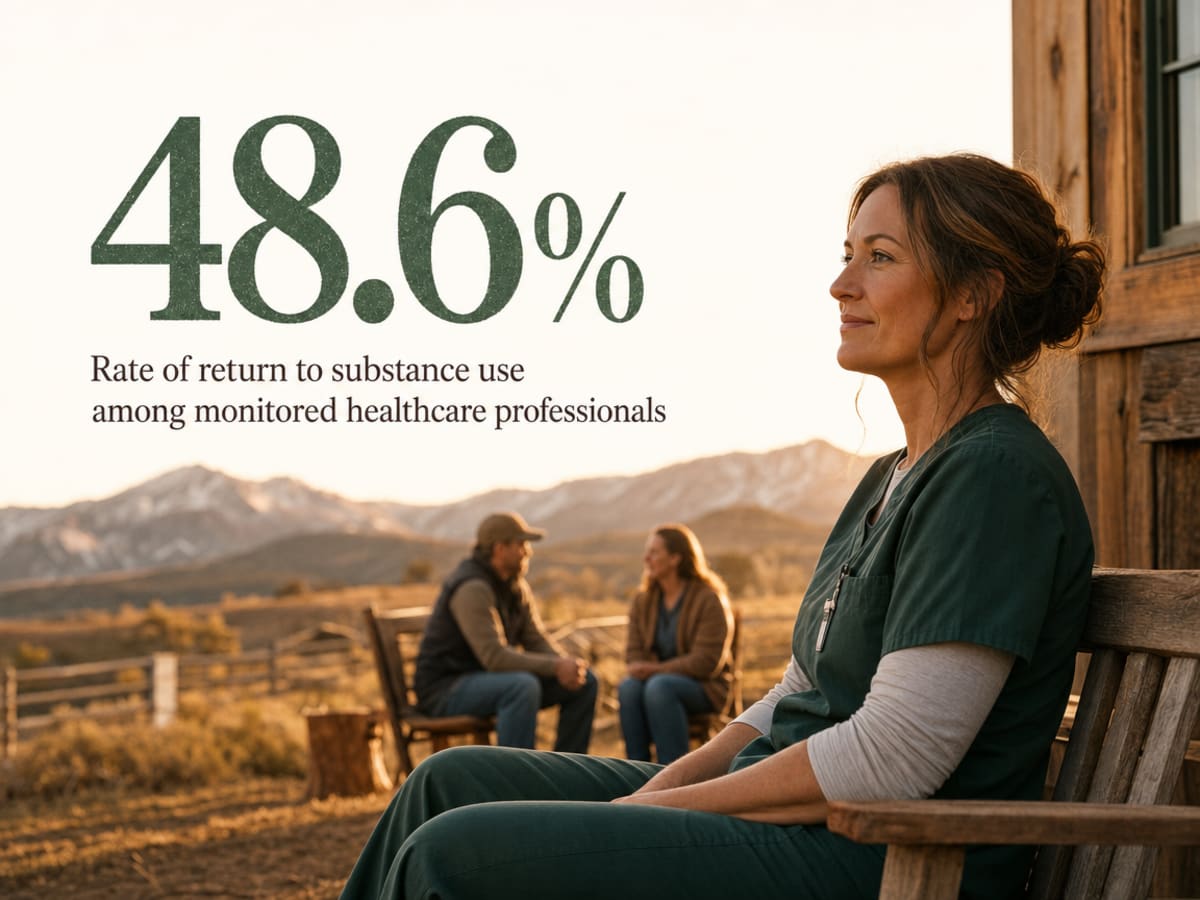
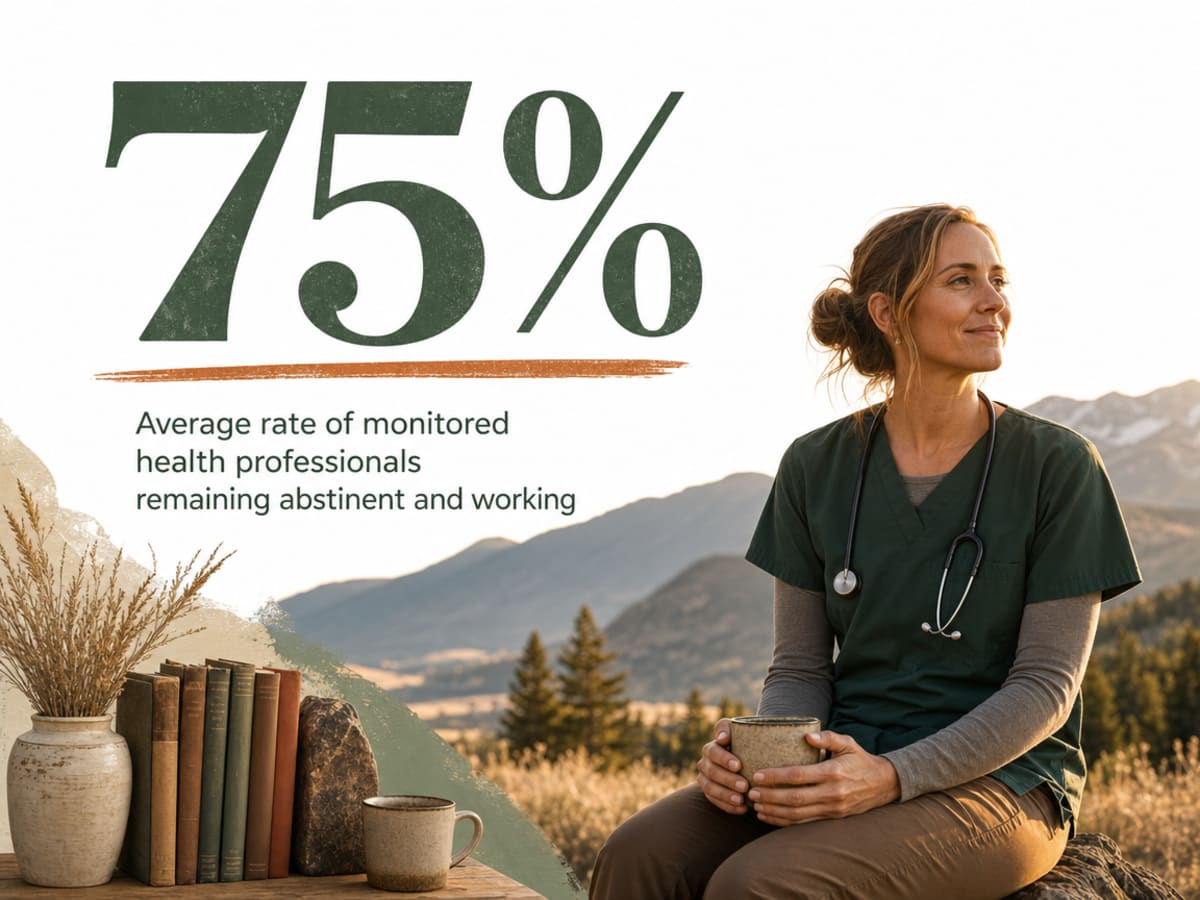
The strongest evidence we have on this comes from monitoring programs for healthcare professionals, which are the closest professional cousin to what educators face. In one recent study tracking healthcare workers through structured monitoring, 48.6% experienced a return to substance use during the monitoring period, and the highest risk sat in the first year 9. By year five, 81.4% had completed their monitoring program and 55.9% were working full-time in healthcare again 9. Two things stand out in those numbers. First, this is data on doctors and nurses, not teachers — the professions are different, and no one has run the same study on educators. Second, the year-one number is the whole argument for structured continuing care. Relapse risk is front-loaded. So follow-up has to be, too.
That’s why Rocky Mountain Treatment Center builds continuing care into the calendar rather than leaving it as a suggestion. After you leave Great Falls, there are weekly Zoom groups and scheduled check-ins at 30, 60, 90, 180, and 365 days. The pattern isn’t arbitrary — it maps onto the window when the risk of slipping is highest, and it produces something a licensing body or an HR file will actually recognize: dated, documented engagement with a program. If you ever do need to show a superintendent or an attorney that you took this seriously, “I completed 30 days of inpatient care and stayed engaged with structured follow-up for a full year” is a very different sentence than “I went to rehab.”
The other reason the follow-up matters is quieter. Coming home is when the fear comes back. The first faculty meeting. The first parent-teacher night. The first Friday where the old routine used to start. Having a group waiting for you on Tuesday evening — people who already know your name, your job, and why you left — is the difference between white-knuckling week two and actually building week three.
Planning the leave: timing, coverage, and the story you tell
The logistics are usually where the fear gets loud again. When do you go? Who covers your classes? What do you actually say in the leave request? A little planning here keeps the paperwork boring, and boring is exactly what you want.
On timing, most teachers who call Rocky Mountain Treatment Center try to line up the start of a 30-day stay with a natural break in the calendar — the week before spring break, the first week of summer, the stretch between semesters. It’s not always possible, and waiting for the perfect window has kept plenty of people drinking through another semester they didn’t need to. If the calendar won’t cooperate, a physician-certified medical leave is a legitimate reason to be out, and the ADA generally allows employers to ask for medical information only when the request is job-related and consistent with business necessity 7. Your doctor’s note handles the certification. Your diagnosis does not have to appear on it.
On coverage, most districts use FMLA or a district-specific medical leave policy. Human resources needs dates and documentation. They do not need the name of the facility, and they do not need to know it’s a substance use program. Whatever medical information they do receive has to be kept confidential and separate from your regular personnel file 6.
On the story you tell colleagues: keep it short and true. “I’m dealing with a health issue and taking medical leave” is a complete sentence. You don’t owe anyone the next paragraph.
Making the call
You’ve read this far, which means part of you has already decided. The rest of you is just looking for permission to pick up the phone. Consider this that permission.
A call to Rocky Mountain Treatment Center’s admissions line in Great Falls doesn’t put anything into a chart. It doesn’t create a record with your district. You can ask every question in this article — about the written Part 2 policy 12, about what shows up on a bill, about how a leave letter gets worded — before you ever say your last name. The person answering has talked to teachers before. They know what the stakes feel like when a certificate and a mortgage and a classroom full of third-graders are all sitting on the same table.
Nothing has to be decided in one conversation. Thirty days can start next week or next month or after the semester ends. The only thing that matters right now is one phone call, made from a quiet room, to people who won’t be surprised by anything you say.
Frequently Asked Questions
Will my school district find out if I go to rehab?
Not from the treatment center. Under 42 CFR Part 2, a substance use program can only share your records with your written consent, a court order paired with a subpoena, or in a genuine medical emergency 1, 2. A district calling to ask if you’re a patient gets nowhere without your signature. What your district sees is what you choose to hand them: usually a physician’s leave note with dates and any work restrictions, and nothing more.
Does entering treatment trigger a Montana Board of Public Education review?
Entering treatment isn’t on the list of grounds the Board acts on. Montana Code 20-4-110 authorizes discipline for things like false statements on a certification application, incompetency, gross neglect of duty, criminal convictions involving moral turpitude, and immoral conduct related to teaching 10. Federal guidance for healthcare licensing follows the same principle — the adverse conduct is reportable, not the fact that someone entered a treatment program 14. Getting help is not the triggering event.
What can my principal or HR legally ask me about my treatment?
Less than most teachers assume. Employers may seek medical information only when the inquiry is job-related and consistent with business necessity 7. HR usually needs dates and a doctor’s note; your principal generally only needs any work restrictions when you return 5. Whatever medical information the district does receive has to be kept confidential and stored separately from your regular personnel file 6. You don’t owe them a diagnosis or the facility’s name.
How does 42 CFR Part 2 protect my treatment records?
Part 2 is the federal rule built specifically for substance use records. Your identity as a patient, your diagnosis, and your treatment plan can only be used or disclosed as the regulation allows, and any disclosure must be limited to the minimum necessary 1. HHS lays out the narrow exceptions in plain language: written consent, a court order plus subpoena, or a medical emergency 2. The 2026 update adds HIPAA-style breach notification if something ever goes wrong 3.
What should and shouldn’t appear on my itemized bill?
Your bill should show the facility name, dates of service, and generic service codes for things like room and board, physician evaluation, and counseling. What shouldn’t appear on the outside of an envelope, in a subject line, or in an explanation of benefits is wording that identifies the facility as a substance use program. Part 2 requires programs to limit disclosures to the minimum necessary 1. Ask admissions for a sample statement before you admit so there are no surprises.
How do I explain a 30-day absence without disclosing rehab?
Keep it short and true. “I’m dealing with a health issue and taking medical leave” is a complete sentence for colleagues. For HR, a physician’s note certifying medical leave with dates and any return restrictions is usually enough — employers may only ask for medical information that’s job-related and consistent with business necessity 7. You don’t have to name the condition or the facility. Rocky Mountain’s admissions team in Great Falls can help shape a leave letter that meets district requirements without naming what you’re being treated for.
References
- 42 CFR Part 2 — Confidentiality of Substance Use Disorder Patient Records. https://www.ecfr.gov/current/title-42/chapter-I/subchapter-A/part-2
- Understanding Confidentiality of Substance Use Disorder (SUD) Patient Records or Part 2. https://www.hhs.gov/hipaa/part-2/index.html
- Fact Sheet 42 CFR Part 2 Final Rule. https://www.hhs.gov/hipaa/for-professionals/regulatory-initiatives/fact-sheet-42-cfr-part-2-final-rule/index.html
- Applying Performance and Conduct Standards to Employees with Disabilities. https://www.eeoc.gov/laws/guidance/applying-performance-and-conduct-standards-employees-disabilities
- Enforcement Guidance on Reasonable Accommodation and Undue Hardship under the ADA. https://www.eeoc.gov/laws/guidance/enforcement-guidance-reasonable-accommodation-and-undue-hardship-under-ada
- The ADA: A Primer for Small Business. https://www.eeoc.gov/laws/guidance/ada-primer-small-business
- Enforcement Guidance on Disability Related Inquiries and Medical Examinations of Employees under the ADA. https://www.eeoc.gov/laws/guidance/questions-and-answers-enforcement-guidance-disability-related-inquiries-and-medical
- Success Rates of Monitoring for Healthcare Professionals with Substance Use Disorders. https://pmc.ncbi.nlm.nih.gov/articles/PMC7828295/
- Monitoring outcomes of substance use disorder among healthcare professionals. https://pubmed.ncbi.nlm.nih.gov/41401912/?fc=None&ff=20251218151410&v=2.18.0.post22+67771e2
- 20-4-110 – Letter of reprimand, suspension, revocation, and denial of certificate. https://archive.legmt.gov/bills/mca/title_0200/chapter_0040/part_0010/section_0100/0200-0040-0010-0100.html
- Mont. Admin. r. 37.106.1450 – CLIENT RIGHTS. https://www.law.cornell.edu/regulations/montana/Mont-Admin-r-37.106.1450
- Rules for Substance use Disorder Facility. https://dphhs.mt.gov/assets/oig/Rules_for_Substance_use_Disorder_Facility.pdf
- Constraints on Sharing Mental Health and Substance-Use Treatment Information Imposed by Federal and State Medical Records Privacy Laws. https://www.ncbi.nlm.nih.gov/sites/books/NBK19829/
- Reporting Impaired Practitioners – National Practitioner Data Bank (NPDB) Policy Guidance. https://www.npdb.hrsa.gov/qa/policy3.jsp
- Montana Vocational Rehabilitation – Policy and Procedure Manual, Chapter 7 (Confidentiality). https://dphhs.mt.gov/assets/detd/PolicyProcedureManual/chapter7.pdf
- Summary of the HIPAA Privacy Rule – U.S. Department of Health and Human Services. https://www.hhs.gov/hipaa/for-professionals/privacy/index.html