
Key Takeaways
- Start by describing what’s actually happening in plain language, which moves the problem out of shame and into the medical territory where it can be treated.3
- Handle safety before anything else: alcohol, benzodiazepines, and heavy opioid withdrawal can be dangerous, and naloxone should be on hand if opioids are involved.1,7
- Make one phone call to a doctor, treatment admissions line, or the SAMHSA helpline; even a brief clinical conversation moves you forward.
- Expect the first assessment to be a conversation covering your use, health, mental health, and home life, so the recommended care actually fits your situation.1,8
- Match the level of care—outpatient, intensive outpatient, or residential—to the severity and your circumstances, not to how serious you want to appear.3
- A 30, 60, or 90-day residential stay provides daily structure, counseling, and community, and staying long enough is one of the strongest predictors of lasting change.1
- Experiential approaches like equine therapy aren’t filler; one trial showed 44% program completion with equine work versus 32% in treatment as usual.5
- Bring family in carefully and on your terms, since family involvement consistently improves outcomes but works best when boundaries and roles are clear.10
When You Already Know Something Has to Change
You probably didn’t open this article on a whim. Something pushed you here. Maybe it was a morning that felt heavier than the last one. A look on someone’s face. A promise to yourself that you broke again. A bill, a job, a missed pickup at school.
You already know. That’s the part most articles skip past, and it’s the part that matters most. You don’t need a checklist to tell you that drug use is taking more from your life than it’s giving back. You’re past that. You’re at the part where you’re trying to figure out how to fix drug abuse, what to actually do about it.
Here’s what’s true, and worth saying plainly: drug problems are treatable. The Surgeon General’s report calls substance use disorders medical illnesses that can be prevented and treated, and notes that people can and do recover. The CDC says the same thing in simpler words. This is not a character flaw you have to outgrow alone.2,6
The rest of this guide walks you through what actually happens next, in the order it happens. Not theory. The phone call, the safety check, the assessment, the choice about what kind of help fits. One step at a time. You’re already on the first one.
Naming What’s Happening Without Making It Bigger Than It Is
There’s a quiet trap a lot of people fall into here. You either tell yourself it’s not that bad, or you decide it’s so bad you’re beyond help. Neither one is accurate. Both keep you stuck.
Try this instead: just describe what’s actually happening. Out loud, or on paper. “I’ve been using every day for six months.” “I told myself I’d stop on Sunday and I didn’t.” “I’ve started hiding it from my partner.” “I used more than I meant to again last night.” You don’t need a label. You need a sentence that’s true.
Clinicians have a name for what you’re noticing — they call it a substance use disorder, and they describe it as a medical condition where drug use starts affecting your health, your relationships, and your ability to stop even when you want to. That definition matters because it pulls the problem out of the moral column and into the medical one. You wouldn’t shame yourself for needing treatment for high blood pressure. This works the same way.3
Naming it doesn’t mean you’ve signed up for anything yet. It just means you’ve stopped pretending. That’s not a small thing — most of the energy you’ve been spending lately has probably gone into not looking at this directly.
You’re looking now. Keep going.
Safety First: What to Handle Before Anything Else
When Stopping on Your Own Is Dangerous
Before you make any other decision, you need to know this: with some drugs, quitting cold turkey at home can hurt you. With a few, it can kill you.
If you’ve been using daily, drinking heavily for weeks or months, or taking prescription sedatives beyond what you were prescribed, do not just stop on a Sunday night and white-knuckle through. Call a doctor, an urgent care, or a treatment center first and ask one question: “Is it safe for me to stop on my own, or do I need medical detox?” They will tell you straight.
Medically monitored detox exists for exactly this moment. It’s the bridge between still using and starting treatment, and effective care attends to your medical needs alongside the drug use itself. You don’t have to figure out the safety part alone.1
Overdose Risk, Naloxone, and the Number to Keep Nearby
If opioids are part of what you’re using — heroin, fentanyl, prescription pain pills, anything you bought that might be cut — get naloxone now. Today, if you can.
Naloxone (you may hear it called Narcan) reverses an opioid overdose. The CDC names expanded naloxone access and quick connection to treatment as core strategies for keeping people alive long enough to recover. Most pharmacies sell it without a prescription. Many health departments give it away. Keep it where someone can find it — not locked in a drawer, not in your car.7
Tell one person you trust where it is and how to use it. That person doesn’t have to know everything about your situation. They just have to know where the box is.
Save 911 in your phone. Save the SAMHSA national helpline too: 1-800-662-HELP (4357). It’s free, confidential, and runs around the clock. You can call it before you’re ready to commit to anything.
The First Phone Call: Who to Reach and What to Say
The phone call is the hardest part. Once it’s made, the next thing happens to you instead of being something you have to drag yourself toward. So the goal here is small: get the call done. Not perfect. Done.
You have a few good options, and you don’t have to pick the right one. Any of them works.8,9
- Your regular doctor counts. Even a short conversation with a clinician — what researchers call a brief intervention — is a real first step, and it’s exactly the kind of structured, non-judgmental talk that’s been shown to help people move toward change. You can call the office and say you need to talk about your drug or alcohol use.
- A treatment center’s admissions line counts too. Most run all day, every day. They are not going to lecture you. The good ones use a collaborative, motivational style — meaning they ask questions and listen, instead of selling you something.
- The SAMHSA helpline (1-800-662-HELP) counts. It’s free and confidential. You can call before you’ve decided anything.
If you’re not sure what to say, try one of these out loud first:
“Hi. I think I have a problem with [alcohol, opioids, meth, pills]. I don’t know what I need yet. Can you help me figure out what comes next?”
“I’ve been using daily and I’m scared to stop on my own. What do I do?”
“I’m calling for my [son, partner, sister]. They’re willing to talk. What’s the first step?”
That’s it. You don’t owe anyone your full story on the first call. You’re not signing anything. You’re gathering information and letting someone trained for this moment take the next part off your shoulders.
Pick up the phone. That counts.
The Assessment: What a Clinician Actually Asks You
The first real meeting with a clinician is usually less intimidating than you’re picturing. It’s a conversation, not a test. They ask. You answer as honestly as you can. They listen.
Expect questions in a few areas:
- What you’ve been using, how much, and how often. When you started, and what’s changed lately.
- Your physical health — sleep, appetite, any conditions, any medications.
- Your mental health — whether you’ve dealt with anxiety, depression, trauma, or thoughts of hurting yourself.
- Your living situation, your work, who’s around you, who isn’t.
- Any past attempts at quitting, and what happened.
None of this is to catch you out. A thorough assessment is what tells the clinician which level of care matches what you’re actually facing, and good treatment is built around your specific medical, psychological, and social needs — not a one-size template. The Surgeon General’s framework treats this conversation as a real stage of care, not paperwork before the real thing starts.1,3
Tell the truth about the amount. Underreporting now leads to a detox plan that doesn’t fit your body later. The clinician has heard it all before. You’re not going to shock them.
You’ll leave the assessment with a recommendation. That’s the next decision.
Choosing a Level of Care That Matches What You’re Facing
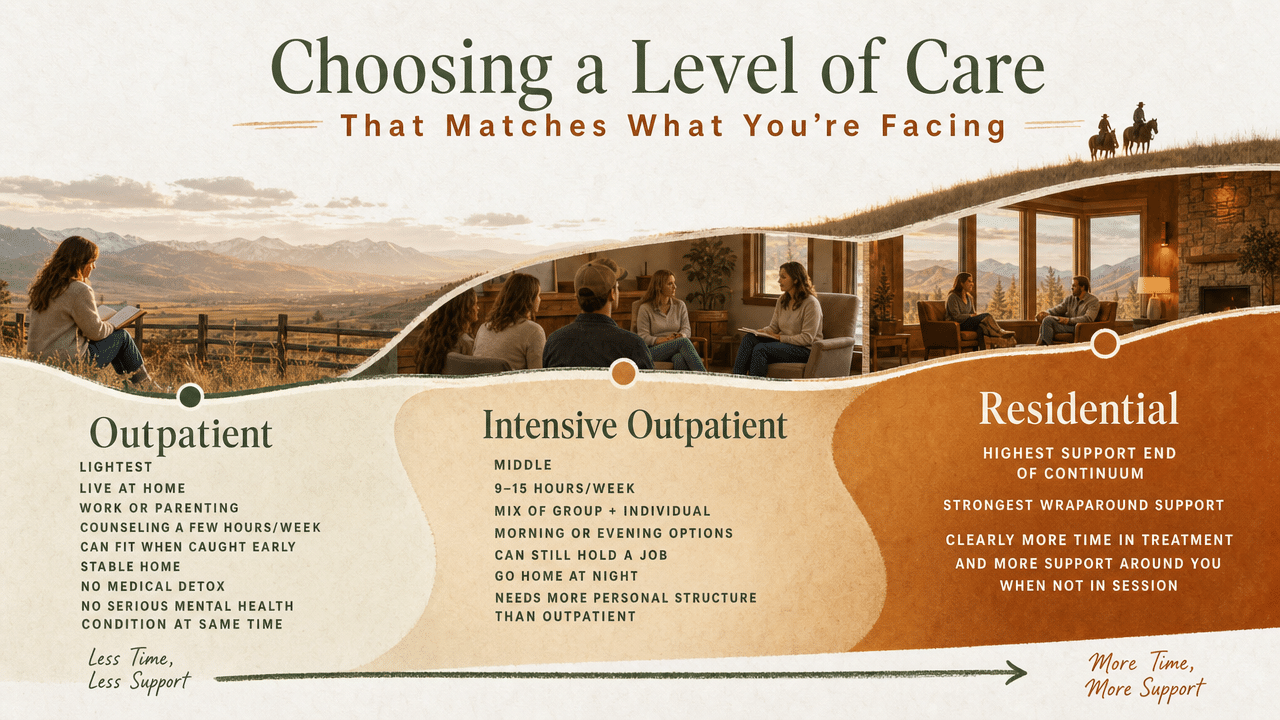
After the assessment, you’ll hear words like outpatient, intensive outpatient, or residential. They sound like industry shorthand, but they really just describe how many hours a week you spend in treatment and how much support is around you when you’re not in a session.3
| Level of Care | Description |
|---|---|
| Outpatient | The lightest. You live at home, keep working or parenting, and go to counseling a few hours a week. It can work if your use is caught early, your home is stable, you don’t need medical detox, and you don’t have a serious mental health condition pulling at you at the same time. |
| Intensive Outpatient | Sits in the middle. Nine to fifteen hours a week, usually a mix of group and individual sessions, sometimes mornings or evenings so you can still hold a job. You still go home at night. It asks more of your own structure than outpatient does. |
| Residential | You live where you’re treated, usually for 30, 60, or 90 days. Counseling, groups, meals, sleep, and the people around you are all part of the program. The Surgeon General’s framework lays this out as a real continuum, where the right setting depends on the severity of the problem and what’s going on in your life, not a default first step. |
A few honest signals that residential is probably the right match:
- You’ve tried to stop on your own and couldn’t.
- You’ve completed outpatient before and relapsed.
- Your home isn’t a place where staying sober is realistic right now.
- You’re using daily, or you’re using something that needs medical detox.
- You have a co-occurring condition — anxiety, depression, trauma — that gets louder when you’re not using.
The point isn’t to pick the most intensive option to prove you’re serious. It’s to match the setting to what you’re actually facing. NIDA’s research on what makes treatment work keeps coming back to two things: the plan has to fit your specific medical, psychological, and social needs, and you have to stay long enough for it to take. A program that’s too light leaves gaps. A program that’s too heavy can feel like punishment and push you out the door.1
Ask the clinician who assessed you to walk through their recommendation and why. Ask what would have to change for a lighter level to work. Ask what residential would give you that outpatient wouldn’t. Their answer will tell you a lot — about the program and about your own situation.
What a 30, 60, or 90-Day Residential Stay Actually Looks Like
A Day Inside: Structure, Counseling, and Who You Live With
The first thing most people notice in residential treatment is how full the day is — and how that, after a while, becomes a relief instead of a burden.
Mornings usually start early. Breakfast with the other residents. A check-in group where everyone says how they slept and what they’re carrying into the day. Then the work begins: individual counseling once or twice a week, group sessions most days, education on how drugs change the brain and body, and time set aside for the practical stuff — meals, exercise, sleep, journaling, downtime that isn’t a screen.
The people around you are not a random group. They’re other adults who landed in the same place you did, through different doors. You’ll live with maybe a dozen or two dozen of them, depending on the facility. You’ll eat together, sit in groups together, and slowly stop performing for each other. That’s part of how it works.
NIDA’s research is clear that treatment has to attend to more than just the drug use — medical, psychological, social, vocational — and that staying long enough matters as much as the program itself. Thirty days steadies you. Sixty starts rebuilding habits. Ninety lets the new ones hold.1
Why Experiential Therapies Like Equine Work Aren’t Filler
When you see equine therapy on a program schedule, it’s easy to assume it’s the soft option — something put there to look good in a brochure. It isn’t.
A randomized controlled trial of complementary horse-assisted therapy alongside standard substance use treatment found that 44% of participants in the equine group completed their program, compared with 32% in the treatment-as-usual group. That’s a real gap in a metric that matters, because finishing the program you started is one of the strongest predictors of what comes after it.5
The reason it works isn’t mystical. A scoping review of equine-assisted services for substance use disorders found qualitative reports of increased self-efficacy and positive emotional engagement among participants — the sense that you can do something hard, and that you’re present in your own body while doing it. Horses don’t argue with you. They don’t read your story. They respond to how you actually are in the moment, which is information most people in early recovery haven’t had access to in a long time.4
In Montana, where some residential programs build equine work into the weekly schedule, it tends to land differently than a fluorescent-lit group room. That’s the point. Different rooms, different parts of you wake up.
Letting Family In Without Handing Them the Steering Wheel
If you’re the one using, family is complicated. Some of them have earned a seat at this table. Some of them haven’t. You get to decide who’s in the room, and when.
But here’s what the research keeps showing: when family is involved in treatment in a real way, outcomes get better. A review of family involvement in substance use treatment found that families are powerful resources for enhancing recovery success — and yet they’re often left out of clinical practice entirely. The same pattern holds in prevention work, where family-based interventions are one of the few approaches with consistent evidence behind them.10,11
Involvement doesn’t mean handing them control. It means letting them learn what’s actually going on, instead of guessing. Most quality residential programs build in family education sessions, family counseling, and structured family days during the stay. That’s not just for them. It’s for you, too. The people you go home to need to understand what they’re walking back into, or the same patterns close around you within a week.
What family involvement looks like in a 30-day stay usually maps to the broader stages of care the Surgeon General’s framework describes — from assessment, through engagement, into structured treatment and the supports that come after. Day one is your call and assessment. The first week is detox if your body needs it, and the start of individual counseling. By weeks two through four, family contact and family education enter the picture — phone calls, scheduled visits, sessions where a counselor sits with all of you and translates what’s been happening on both sides of the wall.3
You don’t have to invite everyone. One sister. A parent. A partner who has stayed. Pick the people who can listen without taking over, and let the program handle the rest.
What ‘Working a Program’ Looks Like After Week One
By the end of the first week, the loudest part is usually quieter. Your body is calmer. You’ve slept through more than one night. The fog starts to lift, and a different kind of work begins.
This is when individual counseling stops being introductions and starts going somewhere. Your counselor begins asking about what was underneath the using — what you were trying to turn down, turn off, or get through. Groups stop feeling like a room of strangers. You start recognizing your own thinking in someone else’s story.
The collaborative, motivational style of good counseling shows up here, not as a technique but as a tone — questions instead of lectures, your reasons for change pulled forward instead of forced. You’ll also start working a 12-step framework if the program uses one: reading, writing, talking honestly with one other person about what you’ve done and what’s been done to you.9
None of this is fast. NIDA’s research keeps pointing to the same thing — staying long enough for the work to take is as important as the work itself. Week two is where staying starts to matter more than starting.1
Honest Expectations: What Recovery Is and Isn’t
Here’s the part most brochures soften, and you deserve the unsoftened version.
Recovery is not a switch. It’s a slow rearrangement of how you spend a Tuesday. Cravings don’t vanish the day you finish a program — they get quieter, more predictable, and easier to sit with. You learn what sets them off, and you stop being surprised by them.
You may stumble. Plenty of people do, and a slip is not the end of the work. The CDC frames substance use disorder as a treatable chronic disease, and people do recover. The Surgeon General’s report says the same — these are medical illnesses, and recovery is real, even when it takes more than one try.2,6
What recovery isn’t: a personality transplant. You’ll still be you. The difference is that more of your day belongs to you again — your mornings, your money, your relationships, the quiet hour after dinner that used to disappear.
That’s the honest promise. Not a guarantee. A direction worth walking in.
If You’re Ready to Make the Call This Week
You don’t have to be sure. You don’t have to have your bag packed or your story straight. You just have to make one call this week.
Try this: pick a day. Tuesday afternoon. Thursday morning. Put it on your phone like a real thing. When the time comes, call the SAMHSA helpline (1-800-662-HELP), your doctor, or a residential program’s admissions line. Say the sentence you practiced earlier. Let them take it from there.
If a residential stay is what fits — daily structure, medically monitored detox, counseling from people who often know recovery from the inside — Rocky Mountain Treatment Center in Great Falls is one of the places that does this work. Whoever you call, the goal this week is the same.
One call Contact Us. You’ve already done harder things this year. Make this one count.
Frequently Asked Questions
Do I have to hit rock bottom before getting help for drug abuse?
No. That idea has cost a lot of people a lot of time. You can get help at any point — earlier is usually easier on your body, your relationships, and your work. Even a short, structured conversation with a clinician counts as a real first step toward change. You don’t have to lose everything first.8
Is it safe to quit drugs cold turkey at home?
Not always. Alcohol, benzodiazepines, and heavy opioid use can produce withdrawal that needs medical supervision — seizures and dangerous blood pressure swings are real risks. Effective treatment attends to your medical needs alongside the drug use itself. Call a doctor or a treatment center and ask one question: do I need medical detox? They’ll tell you straight.1
How long does residential drug treatment usually last?
Most residential programs run 30, 60, or 90 days. The right length depends on the assessment, not a default. NIDA’s research keeps pointing to the same thing: staying in treatment long enough is one of the strongest factors in whether the work holds. Thirty days steadies you. Sixty starts rebuilding habits. Ninety lets the new ones settle in.1
What’s the difference between outpatient and residential treatment?
Outpatient means you live at home and go to counseling a few hours a week. Residential means you live where you’re treated, with structured counseling, groups, and support around the clock. The Surgeon General’s framework treats these as a real continuum — the right setting depends on the severity of your use and what’s happening at home, not on willpower.3
What should I say when I call a treatment center for the first time?
Keep it simple. Try: “I think I have a problem with [substance]. I don’t know what I need yet. Can you help me figure out what comes next?” You don’t owe them your full story. Good admissions staff use a collaborative, non-judgmental style — they ask questions and listen instead of selling. Picking up the phone is the work.9
Can my family be part of treatment, or is it only for me?
Family can be part of it, and often should be. Research finds families are powerful resources for recovery, even though they’re frequently left out of clinical practice. Most quality residential programs build in family education, counseling sessions, and structured family days. You choose who’s in the room — one parent, a partner, a sibling. Not everyone has to be invited.10
References
- Principles of Drug Addiction Treatment: A Research-Based Guide (Third Edition) – NIDA. https://nida.nih.gov/sites/default/files/podat-3rdEd-508.pdf
- Facing Addiction in America: The Surgeon General’s Report on Alcohol, Drugs, and Health. https://www.ncbi.nlm.nih.gov/books/NBK424857/
- Early Intervention, Treatment, and Management of Substance Use Disorders (Chapter 4, Surgeon General’s Report). https://www.ncbi.nlm.nih.gov/books/NBK424859/
- Equine-assisted services for individuals with substance use disorders. https://pmc.ncbi.nlm.nih.gov/articles/PMC9749232/
- Complementary horse-assisted therapy for substance use disorders: A randomized controlled trial. https://pmc.ncbi.nlm.nih.gov/articles/PMC7001193/
- Treatment of Substance Use Disorders | Overdose Prevention – CDC. https://www.cdc.gov/overdose-prevention/treatment/index.html
- Preventing Opioid Overdose – CDC. https://www.cdc.gov/overdose-prevention/prevention/index.html
- Brief intervention in substance use disorders. https://pmc.ncbi.nlm.nih.gov/articles/PMC5844156/
- Motivational interviewing for substance abuse (Cochrane Review). https://pmc.ncbi.nlm.nih.gov/articles/PMC8939890/
- Family Involvement in Treatment and Recovery for Substance Use Disorders among Youth. https://pmc.ncbi.nlm.nih.gov/articles/PMC8380649/
- Starting at Home: Family-based Interventions Prevent Youth Substance Use. https://odphp.health.gov/news/202311/starting-home-family-based-interventions-prevent-youth-substance-use
- Substance Abuse Treatment: For Adults in the Criminal Justice System (SAMHSA TIP 44). https://www.ncbi.nlm.nih.gov/books/NBK572951/