Key Takeaways
- Farmers and ranchers face elevated suicide risk tied to isolation and financial strain, yet routinely underreport depression, so drinking often fills the gap where a diagnosis never happens.1
- Horse work reaches people who won’t sit across a desk because it demands presence and reads body language, giving ranchers a familiar, non-verbal doorway into treatment.2
- Equine-assisted care works as an adjunct to detox, counseling, and 12-step, with studies showing improved retention, reduced craving, and gains in seven of eight quality-of-life dimensions.4,8,10
- Practical barriers like livestock chores, pride, insurance, and getting to Great Falls have workable answers, and starting with an intake conversation is the move worth making next.
When the Whiskey Starts Doing the Work the Land Used To
You know the sound of a tailgate at 5 a.m. better than you know most people. You know which fence needs pulling, which cow is off, which loan is due. And somewhere in the last year or two, you started knowing something else: the drink at the end of the day stopped being a wind-down and started being the whole point, we offer equine therapy for ranchers and farmers.
Maybe it started after a drought year. Maybe after a bad calving season, a price crash, or a funeral you couldn’t quite feel. Maybe it just crept in the way a coyote works a treeline. You’re not weak. You’re not broken. You’re carrying a load that was built for two or three people, and the bottle has been quietly picking up the slack.
Here’s a hard number worth sitting with: U.S. primary farmers and their family members face elevated risk for depression and suicide, driven by financial strain, isolation, and the weather itself. That’s not a scare tactic. That’s the ground you’re standing on.1
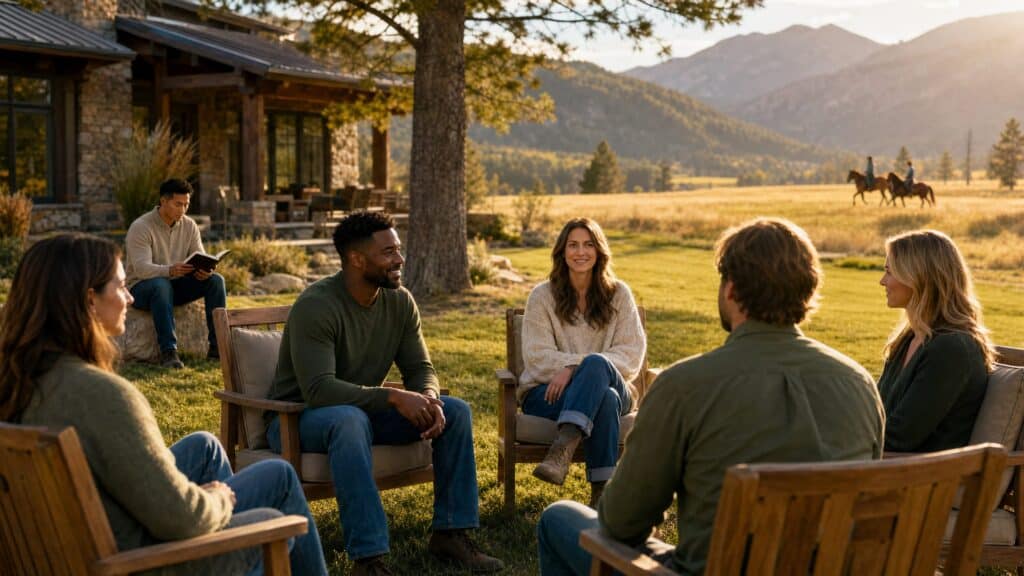
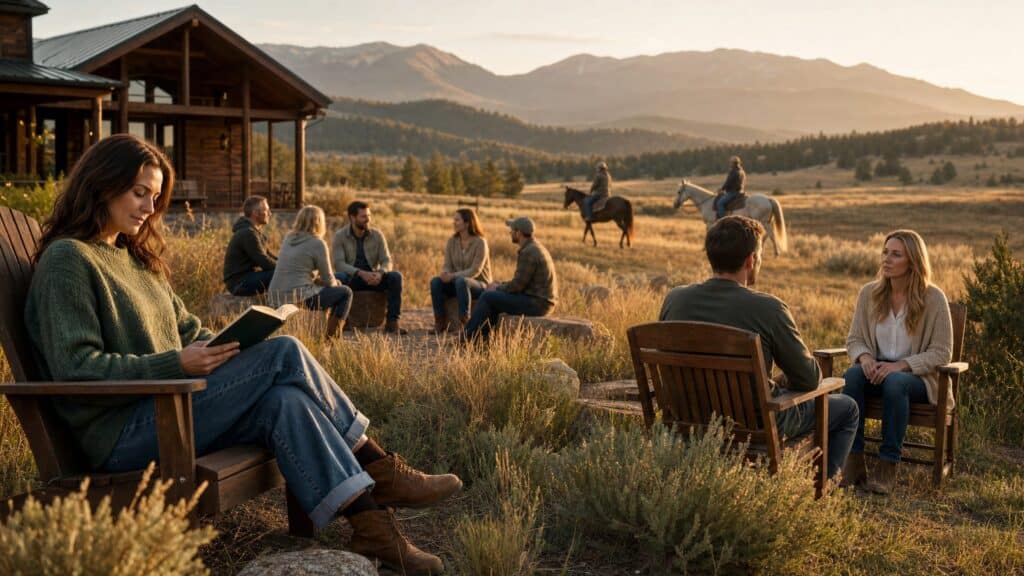
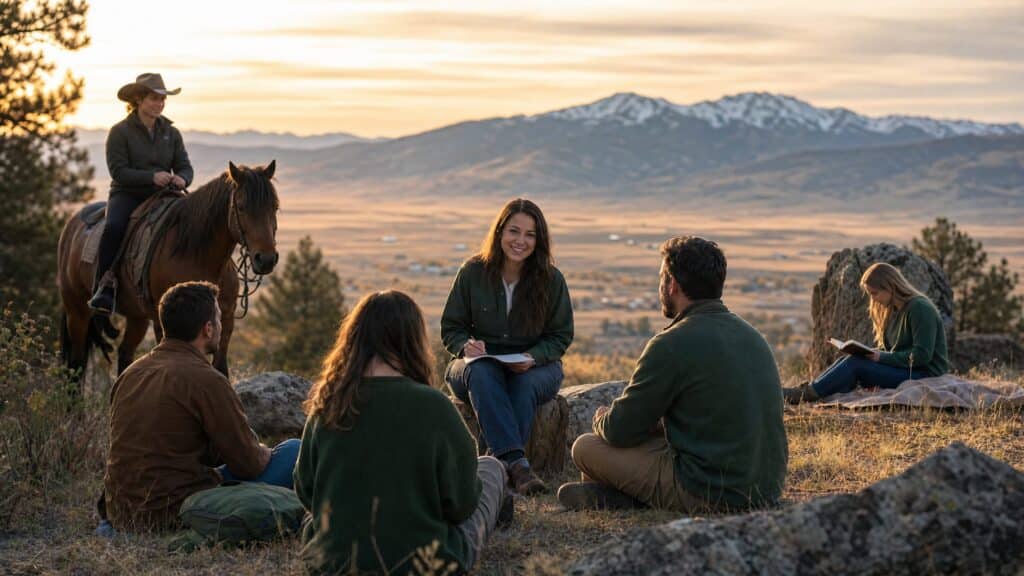
This piece is for you, and for the spouse or son or ranch partner reading over your shoulder. It’s about working with horses, a equine therapy for ranchers and farmers in Great Falls, Montana can make asking for help feel less like giving up your identity and more like tending to it.
The Quiet Math of Ag Country and Alcohol
Higher Suicide Rates, Same Diagnosed Depression: The Underdiagnosis Gap
Here is something strange that shows up when researchers look at the numbers. When you compare people in farming occupations to people in non-farming jobs, the odds of reporting frequent poor mental health days or a depression diagnosis come out about the same. On paper, you’d think ag country is doing fine.7
But farmers die by suicide at higher rates than the general population. That’s the gap that keeps public health researchers up at night. Same reported symptoms on a survey, very different outcomes in the ground.
What that tells you, if you’ve spent any time in a feed store parking lot, is that the surveys aren’t catching what’s actually happening. People in ag don’t tend to check a box that says depressed. They say tired. They say busy. They say fine. They call it a rough stretch, a hard year, a bad run of luck. And they keep working, because the cattle don’t care how you feel.
The systematic review of U.S. primary farmers and their families is blunter about the risk itself: this sector carries elevated risk for depression and suicide, tied to financial strain, isolation, and the environmental stressors that come with the job. Drought. Trade shocks. A calf you couldn’t save. A loan officer who used to know your dad.1
So when the drinking creeps up, it’s rarely because someone got a diagnosis and shrugged. It’s because there was no diagnosis at all, and the bottle was the only thing sitting on the shelf at the end of a long day. That gap between what a survey catches and what a life actually feels like is the ground this piece is standing on.
What Actually Sends a Rancher to the Bottle
It’s rarely one thing. It’s the pile.
It’s the phone call at 2 a.m. about a heifer down in the corner pasture. It’s watching hay prices while your kid’s tuition bill comes in. It’s the neighbor who sold out last spring and now his ground grows houses. It’s a body that hurts in places you didn’t know had names. It’s the quiet after your spouse goes to bed, when the day finally stops moving and there’s nothing left to point yourself at.
The CDC put it in plainer terms in its report on resilience in agricultural communities: the answer isn’t just clinics and hotlines dropped into rural counties. It’s screening tools, outreach, and interventions that actually travel through the networks farmers already trust, delivered by people who can recognize the early signs of stress before it becomes a crisis.6
That matters because pride is real. So is distance. So is the honest worry that if you drive to town for help, someone will see the truck in the parking lot. Alcohol, meanwhile, doesn’t require an appointment. It doesn’t ask questions. It’s already in the house.
None of this makes you weak. It makes you a person carrying more than one person should, in a place where help was built for someone else’s life. That’s the starting point. Not the ending one.
Why Horses Reach People Who Won’t Sit in a Chair and Talk
Here’s the thing about a horse. He doesn’t care what you did last weekend. He doesn’t care about your credit score, your yield, or whether your dad thought you’d amount to anything. He cares whether your shoulders are loose or tight, whether your feet are planted, whether the rope in your hand is honest or nervous.
That’s why horse work reaches people who would walk right back out of a counseling office. If you’ve spent your life reading livestock, you already have the skill. You just haven’t been told it counts as therapy.
Researchers who look at animal-assisted work on farms describe it in plain terms: structured contact with animals and farm routines can support recovery, and the benefits show up in mood, self-efficacy, and coping. In a randomized study with psychiatric patients doing farm-animal work, self-efficacy went up in the treatment group and stayed flat in the control group. Self-efficacy is a clinical word. What it means on the ground is you start believing you can handle the next thing.2,12
Horses also require you to be present. Not thoughtful. Not articulate. Present. A thousand-pound animal will not stand still for a man whose mind is three counties away. So without anyone lecturing you about mindfulness, you end up doing it. You breathe. You slow down. You notice.
And you talk, when you talk, sideways. Not across a desk. Shoulder to shoulder, brushing out a mane, tightening a cinch. For a lot of ranchers and farmers, that’s the only door in.
What the Research Actually Says About Horses and Recovery
Substance Use, Behavior, and Quality of Life
You’re a practical person. You want to know if this works, not whether it feels nice. Fair enough. Let’s look at what the studies actually show, and where they hedge.
The strongest single tie between horse work and addiction outcomes comes from a study of equine-facilitated psychotherapy inside an inpatient program for adults with substance use and other psychiatric issues. Researchers tracked four clinical domains and eight quality-of-life dimensions. The area that improved most in the horse group was behavioral problems, and that category included alcohol and drug misuse. Across quality of life, 7 of 8 dimensions showed significant improvement. Things like emotional well-being, how you feel in your own body, how you get along with people, how you spend your time.4
Sit with that for a second. Not one dimension. Seven. And the one clinical area that moved the most was the drinking and the drug use itself.
Now the honest part. This was a quasi-experimental study, not a randomized trial, and the sample was small. The authors are the first to say bigger studies are needed before anyone calls this settled science. A separate systematic review looking at equine-assisted services across substance use treatment came to the same careful conclusion: promising signals for retention, completion, and mental health, but small samples and inconclusive overall.4,8
So here’s the read. Horse work is not a magic bullet. But when it’s stacked onto real addiction treatment, the people in it tend to feel better in most of the ways a life gets measured, and their drinking and using tend to move in the right direction. For a rancher who has spent years being told to just tough it out, that’s not nothing.
Staying in Treatment Long Enough for It to Work
You already know this in your bones: nothing works if you quit halfway. A round bale doesn’t feed the herd if you leave it on the trailer. Treatment is the same. The people who get better are, more often than not, the people who stayed.
That’s why the retention question matters more than almost any other. A randomized controlled trial looked at exactly this. Adults in residential substance use treatment were assigned either to standard care or to standard care plus complementary horse-assisted therapy. When the researchers counted who finished the program, 44% of the horse group completed treatment compared to 32% of the standard care group.13
That’s a 12-point spread. In a room of a hundred people, twelve more walk out with the full course of care under their belt.
Here’s the honest catch. When the statisticians ran the numbers formally, the difference didn’t cross the threshold for statistical significance. Which means, in plain English, we can’t rule out that the gap was chance. What we can say is the direction is encouraging, and it lines up with what other reviewers see in the field: horse work seems to help people stay engaged, even if the trials so far are too small to prove it hard.
If you’re a person who has walked out of things before, that directional finding matters. Something about grooming, leading, and reading a horse gives people a reason to come back tomorrow.8,13
Trauma, Anxiety, and the Drinking That Follows
Ranch and farm life carries its own catalog of hard days. The rollover on the two-track. The bull that got someone. The barn fire. The friend who didn’t make it through a hard winter. Nobody hands you a debrief afterward. You feed in the morning and you keep
going.That kind of thing doesn’t just disappear. It settles in. And for a lot of people, the drink at night is what dulls it enough to sleep.
A clinical study of an equine-assisted program for people with anxiety and post-traumatic stress symptoms tracked what happened after the final session. Participants had significantly reduced PTSD symptoms. Less generalized anxiety. Fewer symptoms of depression. And, notably for anyone reading this, decreased alcohol use. They also reported more of the small mental habits, like paying attention on purpose, that help a person get through a rough moment without reaching for a bottle.14
The same study didn’t find changes in every measure. Physical health and self-efficacy didn’t move much in that group. Which lines up with what a broader review of animal-assisted farm work has found too: the emotional and coping benefits show up more consistently than the whole-life measures do.2,14
The point isn’t that a horse fixes trauma. It’s that time with a horse seems to give the nervous system somewhere to go besides the bottle. For a rancher who has been carrying too much for too long, that’s a door worth trying.
A Week Inside Rocky Mountain: Where Horse Work Fits
Detox First, Then the Round Pen
Nobody starts with the horses. That part matters, and it’s worth saying up front.
If you’ve been drinking hard for years, your body has to come off it safely before anything else can happen. At Rocky Mountain Treatment Center in Great Falls, the first few days are medically monitored detox. Nurses check on you. A doctor is in the loop. The shaking, the sweating, the sleep that won’t come, the fog that sits behind your eyes for a week or so, all of that gets handled with people watching. You don’t have to white-knuckle it in a bunkhouse hoping for the best.
Once your body settles, the week starts to take shape. Mornings tend to be individual counseling and group work. Afternoons might hold a 12-step meeting, a walk, a session with the horses. Equine work is one thread woven through the week, not the whole rope. That framing lines up with what the research says too: the systematic review on equine therapy for ranchers and farmers for substance use disorders treats horse work as an adjunct to real treatment, not a replacement for it. The signal is promising for retention and mood, but the horses do their part inside a bigger structure of care.8
So the round pen comes after the shaking stops. It comes after you’ve slept a full night. It comes when your feet can carry you out to the barn, and when a thousand-pound animal standing next to you feels like a companion, not a hazard.
Group Counseling, 12-Step, and the Family Back Home
Group is where a lot of the actual work gets done. You’ll sit in a room with people who are not from your county, which turns out to be a mercy. Nobody there sold you hay last fall. Nobody’s cousin married your ex. You can say the thing you’ve been carrying and it doesn’t ricochet through three feed stores by Sunday.
Most of the counselors at Rocky Mountain are in recovery themselves. Over 80% of the staff have lived what you’re living. That changes the temperature of a room. You are not being studied. You are being met.
The 12-step piece runs alongside. Meetings on-site, meetings off-site, sponsors, the whole framework. It’s optional to lean hard into it, and it’s optional to pair it with the Bible study offering if that’s your background. Nobody makes you.
Then there’s the family. The Family Week program brings your spouse, your kids, your ranch partner into the room for three days of education and honest talk. Because if you go home to the same silences that helped grow this, the horses in Great Falls won’t be able to hold you up alone.
Answering the Questions You Haven’t Said Out Loud
Who Feeds Stock During a 30-Day Stay
This is the question that stops most ranchers before they even pick up the phone. Not the drinking. Not the shame. The cattle.
Here’s the truth: nobody at Rocky Mountain expects you to leave your place unattended. What people usually do is get honest with one or two humans they already trust. A brother-in-law. A neighbor who owes you a favor from three winters ago. The kid down the road who’s been leasing pasture. You don’t have to tell them the whole story. You can tell them you have a health thing that needs 30 days and you’d be square with them if they’d handle chores.
Most people say yes. That surprises folks. Ranch country runs on returned favors, and the debt you’re worried about creating is smaller than the one your neighbors would carry if something worse happened to you.
If it helps, start with the shortest program that gets the job done and build from there. Thirty days is the floor. Sixty or ninety are options when the situation calls for it. The intake conversation in Great Falls is a good place to sort through what your operation can absorb.
What About the Neighbors, the Pride, and the Cost
The neighbors are going to talk no matter what you do. That’s ag country. What you get to decide is which story they end up telling. The one where you disappeared for a season and came back steadier, or the one that ends the way you’re afraid it will.
Pride is the harder one. You’ve spent a life not asking. The CDC’s own guidance on building resilience in ag communities says the interventions that actually reach farmers are the ones delivered through trusted networks, by people who recognize the signs early instead of waiting for a crisis. Translation: getting help early is the tough move, not the soft one. It’s what someone does when they still have something worth protecting.6
On cost, here’s the plain version. Rocky Mountain Treatment Center works with most major insurance plans. It does not currently accept Medicaid or Medicare, so if that’s your coverage, this particular door isn’t the one. If you carry private insurance through a spouse’s job, a co-op plan, or a policy you kept from a past employer, the admissions office can run your benefits before you commit to anything. And if you’re coming in from a far corner of Montana, complimentary pickup is part of the deal. You don’t have to figure out how to get to Great Falls alone.
For Veterans Who Ranched Before and After the Service
Plenty of the men and women running ground in Montana wore a uniform before they ever ran a tractor. Some came home to a family place. Some bought in later, drawn to the quiet after too much noise. Either way, the drinking often started somewhere in the overlap, and it followed them out to the hay meadow.
Horse work has a small but useful track record with veterans in residential addiction treatment. A VA program studied equine-assisted sessions for veterans in inpatient substance abuse care and found statistically significant pre- to post-session improvements, with medium-to-large effect sizes, in negative affect, positive affect, anxiety, and craving. Craving. The thing that wakes you up at 3 a.m. and points you at the shop fridge.10
That’s short-term data, not a promise of long-term sobriety. The authors are clear about that. But if you’ve been white-knuckling cravings alone in a bunkhouse, a therapy that measurably takes some of that edge off in a single session is worth knowing about. At Rocky Mountain, you’d be in a room with counselors who have carried their own version of what you’re carrying.10
What a First Session in the Round Pen Actually Looks Like
Nobody hands you a rope and asks you to talk about your childhood. That’s not how it goes.
A first session usually starts outside the pen, watching. You’ll meet the horse from the fence line. The counselor might ask you what you notice. Which ear he’s flicking. Where his weight is set. Whether he’s paying attention to you or to something over your shoulder. You already read livestock for a living, so this part is not new. It just counts now.
When you step in, the work is small. Approach. Halter. Lead a few steps. Stop. Groom. That’s often the whole first hour. No cross-legged circle. No feelings inventory. Just you, a horse, and a person who’s watched a lot of both.
What surprises people is how much comes up in that quiet. A horse mirrors what you bring in with you, and a good counselor names it gently. That non-verbal doorway is part of why animal-assisted work reaches people who won’t sit for a talk-therapy intake cold. You don’t have to find the words first. You find the feet.2
Frequently Asked Questions
Do I need horse experience to benefit from equine therapy at Rocky Mountain Treatment Center?
Who takes care of my livestock and land while I’m in a 30-day residential program?
Does equine therapy actually help with alcohol dependence, or is it just a feel-good add-on?
How does horse work fit with detox, counseling, and 12-step meetings?
I’m a veteran who went back to ranching. Will this program understand both sides?
How do I get to Great Falls if I’m coming from a remote part of Montana?
References
- Risk for Depressive Symptoms and Suicide Among U.S. Primary Farmers and Family Members: A Systematic Literature Review. https://pubmed.ncbi.nlm.nih.gov/31957602/
- Green Care: A Review of the Benefits and Potential of Animal-Assisted Interventions on Farms. https://pmc.ncbi.nlm.nih.gov/articles/PMC5406676/
- Farm-based interventions for people with mental disorders: a systematic review of literature. https://pubmed.ncbi.nlm.nih.gov/24963943/
- An evaluation of the effect of equine-facilitated psychotherapy on patients in addiction treatment. https://pmc.ncbi.nlm.nih.gov/articles/PMC10306210/
- The impact of care farms on quality of life, depression and anxiety among different population groups: A systematic review. https://pubmed.ncbi.nlm.nih.gov/37131853/
- Building Resilient Agricultural Communities. https://stacks.cdc.gov/view/cdc/248768/cdc_248768_DS1.pdf
- Poor Mental Health Days and Depression by Farming Occupation in the United States. https://pmc.ncbi.nlm.nih.gov/articles/PMC12626400/
- Equine-assisted services for individuals with substance use disorders: A systematic review. https://pmc.ncbi.nlm.nih.gov/articles/PMC9749232/
- Animal-assisted therapy with farm animals for persons with psychiatric disorders. https://pubmed.ncbi.nlm.nih.gov/22194073/
- The Benefits of Equine Assisted Therapy for Veterans in the VA Residential Substance Abuse Treatment Program. https://extension.usu.edu/tribal-rural-wellness/files/2023-benefits-of-equine-assisted-therapy-for-veterans-presentation.pdf
- Attitudes to animal-assisted therapy with farm animals among health staff and farmers. https://pubmed.ncbi.nlm.nih.gov/18768010/
- Effects on self-efficacy, coping ability and quality of life: a randomized study of animal-assisted therapy with farm animals in psychiatric patients. https://pmc.ncbi.nlm.nih.gov/articles/PMC2323374/
- Complementary horse-assisted therapy for substance use disorders: A randomized controlled trial. https://pmc.ncbi.nlm.nih.gov/articles/PMC7001193/
- Equine-assisted therapy for anxiety and posttraumatic stress symptoms. https://pubmed.ncbi.nlm.nih.gov/25782709/